Skip to content · ⁨Bỏ qua nội dung⁩
Subjects · ⁨Môn học⁩

English Grammar · A1 · ⁨Ngữ pháp Tiếng Anh · A1⁩

  • 1 The verb to be · ⁨Động từ to be⁩
    1.1

    am / is / are

    English

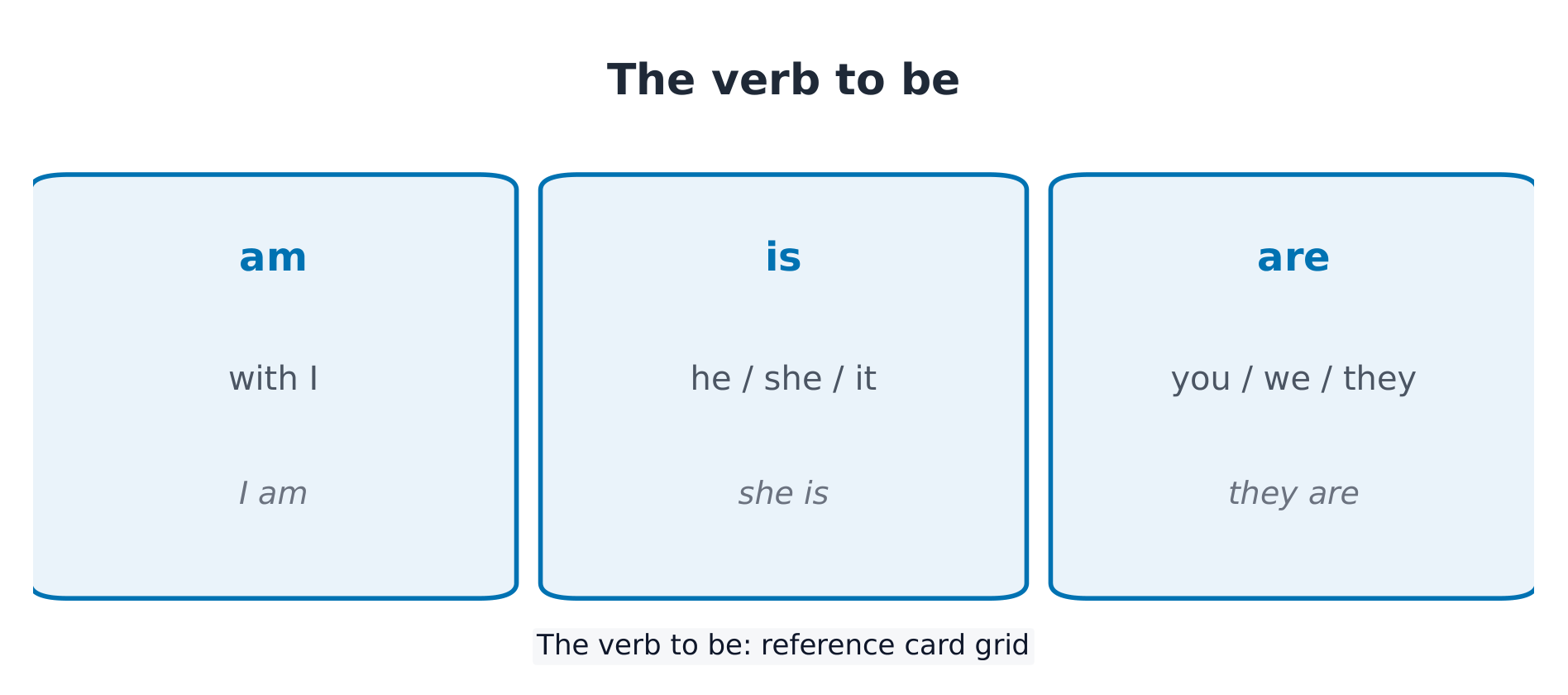
    The verb "to be" means "is / am / are." It changes according to the subject and has three forms:

    • I → am
    • he / she / it → is
    • you / we / they → are

    我I 是am 一名a 学生student.

    I am a student.

    她She 是is 开心happy.

    She is happy.

    他们They (是)are 来自from 中国China.

    They are from China.

    Note: Common spoken contractions: I'm, you're, he's, she's, it's, we're, they're.

    Tiếng Việt
    be 动词:am / is / are 随主语变化

    be 动词 (the verb to be) 表示"是 / 在"。它随主语变化,有三种形式:

    • I → am
    • he / she / it → is
    • you / we / they → are

    我I 是am 一名a 学生student.

    Tôi là một học sinh.

    她She 是is 开心happy.

    Cô ấy rất vui vẻ.

    他们They (是)are 来自from 中国China.

    Họ đến từ Trung Quốc.

    注意 口语常用缩写:I'm、you're、he's、she's、it's、we're、they're。
    1.2

    Phủ định và Nghi vấn

    English

    Negation: Add not after the be verb (often contracted).

    他He 不是is not 一名a 老师teacher.

    He is not a teacher. (= He isn't a teacher.)

    Interrogative: Place the be verb before the subject.

    (是吗)Are 你you 准备好ready?

    Are you ready?

    Short answers: Yes, I am. / No, I'm not.

    Note: Negative contractions: is not → isn't, are not → aren't; but am not is only contracted to I'm not (there is no ~~amn't~~).

    Common Errors

    • ❌ ~~He busy.~~ → ✓ He is busy. — In Chinese, "He is very busy" can exist without a verb, but an English sentence must have a verb. Use be to link when the predicative is an adjective or noun and there are no other verbs in the sentence (He is busy); do not add be if the sentence already contains an ordinary verb (I go to school).
    • ❌ ~~I am go to school.~~ → ✓ I go to school. — Do not use be and ordinary verbs together; "go" alone suffices for "to go."
    • ❌ ~~They is my friends.~~ → ✓ They are my friends. — Plural subjects (you / we / they) take are.
    • ❌ ~~I am agree.~~ → ✓ I agree. — agree is itself a verb; do not add am before it.
    • ❌ ~~Are you ready? — Yes, I'm.~~ → ✓ Yes, I am. — Contractions cannot be used at the end of affirmative short answers (say Yes, I am); however, negative short answers typically end with a negative contraction (No, he isn't / No, I can't; first person is No, I'm not, as there is no amn't).
    Tiếng Việt

    否定: 在 be 动词后加 not(常缩写)。

    他He 不是is not 一名a 老师teacher.

    他不是老师。(= He isn't a teacher.)

    疑问: 把 be 动词放到主语前面。

    (是吗)Are 你you 准备好ready?

    Bạn đã sẵn sàng chưa?

    简短回答:Yes, I am. / No, I'm not.

    注意 否定缩写:is not → isn't,are not → aren't;但 am not 只缩写成 I'm not(没有 ~~amn't~~)

    Lỗi thường gặp

    • ❌ ~~He busy.~~ → ✓ He is busy. — Câu tiếng Trung "他很忙" có thể không cần động từ, nhưng câu tiếng Anh bắt buộc phải có động từ. Khi tân ngữ là tính từ hoặc danh từ, mà trong câu không có động từ khác thì dùng be để nối (He is busy); nếu câu đã có động từ thông thường thì không thêm be (I go to school).
    • ❌ ~~I am go to school.~~ → ✓ I go to school. — Be và động từ thông thường không được sử dụng cùng nhau; "đi" chỉ cần dùng go.
    • ❌ ~~They is my friends.~~ → ✓ They are my friends. — Chủ ngữ số nhiều (you / we / they) đi với are.
    • ❌ ~~I am agree.~~ → ✓ I agree. — Agree (đồng ý) bản thân đã là động từ, không thêm am ở trước.
    • ❌ ~~Are you ready? — Yes, I'm.~~ → ✓ Yes, I am. — Cuối câu trả lời ngắn khẳng định không được dùng dạng rút gọn (nói Yes, I am); nhưng câu trả lời ngắn phủ định thường kết thúc bằng dạng rút gọn phủ định (No, he isn't / No, I can't; người ngôi thứ nhất là No, I'm not, vì không có amn't).
  • 2 Subject pronouns · ⁨Đại từ chủ ngữ⁩
    2.1

    I, you, he, she, it, we, they

    English

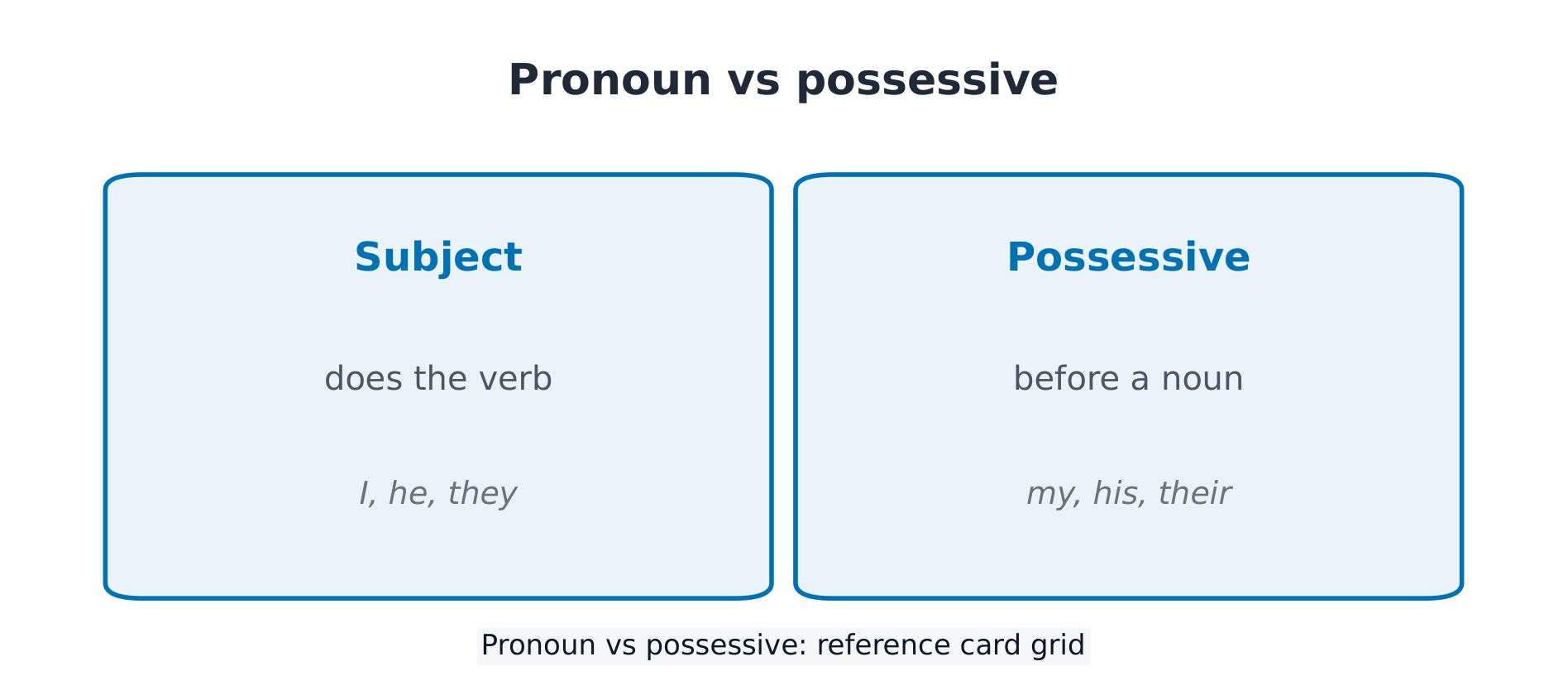
    Subject pronouns replace the subject and are placed before the verb:

    • I(I), you(you), he(he), she(she)
    • it(it), we(we), they(they)

    他He 是is 我的my 哥哥brother.

    He is my brother.

    我们We 喜欢like 音乐music.

    We like music.

    Key Usage Points:

    • I is always capitalized, regardless of its position in the sentence.
    • Things and animals commonly use it: This is my bag. It is new.(This is my bag. It is new.)*
    • Plural people or things both use they: The books are here. They are mine.(The books are here. They are mine.)*

    Note: Subject pronouns are followed by verbs; do not confuse them with object pronouns (me, him, her...) which will be learned later.

    Common Errors

    • ❌ ~~My mother is a doctor. He is very kind.~~ → ✓ She is very kind. — In colloquial Chinese, "he/she" sounds identical, but in English, he and she must be clearly distinguished.
    • ❌ ~~Me am a student.~~ → ✓ I am a student. — Use I for the subject, not me.
    • ❌ ~~My friend he is tall.~~ → ✓ My friend is tall. — The subject needs to be mentioned only once; avoid repeating "noun + pronoun" (the Chinese habit of saying "my friend he..." does not apply in English).
    • ❌ ~~Is raining.~~ → ✓ It is raining. — English sentences must have a subject; weather, time, and dates begin with it.
    Tiếng Việt
    Đại từ chủ ngữ và Đại từ sở hữu

    Đại từ nhân xưng chủ ngữ (subject pronouns) dùng thay thế cho chủ ngữ, đặt trước động từ:

    • I(tôi), you(bạn / các bạn), he(anh ấy), she(cô ấy)
    • it(nó/đó), we(chúng tôi/chúng ta), they(họ/ chúng)

    他He 是is 我的my 哥哥brother.

    Anh ấy là anh trai của tôi.

    我们We 喜欢like 音乐music.

    Chúng tôi thích âm nhạc.

    Điểm chú ý về cách dùng:

    • I luôn được viết viết hoa, bất kể ở đâu trong câu.
    • Đồ vật, động vật thường dùng it: This is my bag. It is new. (Đây là cái túi của tôi. Nó mới.)
    • Số nhiều của người hay vật đều dùng they: The books are here. They are mine. (Sách ở đây rồi. Chúng là của tôi.)

    Lưu ý đại từ chủ ngữ đi kèm động từ; đừng nhầm lẫn với đại từ tân ngữ (me, him, her…) sẽ học sau.

    Lỗi thường gặp

    • ❌ ~~My mother is a doctor. He is very kind.~~ → ✓ She is very kind. — Trong văn nói tiếng Trung "他 / 她" phát âm giống nhau, nhưng tiếng Anh he / she phân biệt rất rõ ràng.
    • ❌ ~~Me am a student.~~ → ✓ I am a student. — Làm chủ ngữ dùng I, không dùng me.
    • ❌ ~~My friend he is tall.~~ → ✓ My friend is tall. — Chỉ nhắc đến chủ ngữ một lần là đủ, không lặp lại theo cấu trúc "danh từ + đại từ" (thói quen "我朋友他……" của tiếng Trung không áp dụng được vào tiếng Anh).
    • ❌ ~~Is raining.~~ → ✓ It is raining. — Câu tiếng Anh bắt buộc phải có chủ ngữ; thời tiết, thời gian, ngày tháng dùng it làm chủ ngữ.
  • 3 Possessive adjectives · ⁨Tính từ sở hữu⁩
    3.1

    my, your, his, her, our, their

    English

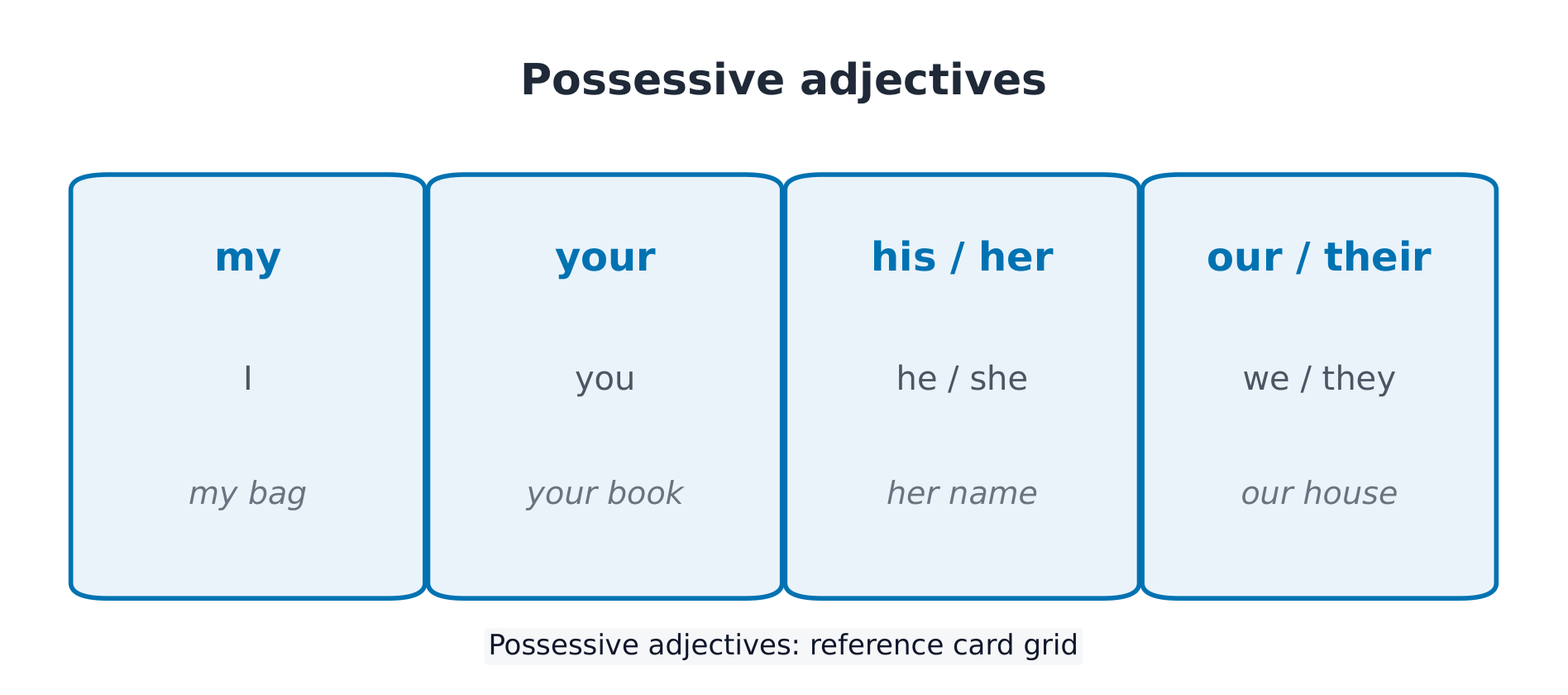
    Possessive adjectives indicate "whose" and are placed before the noun:

    • I → my(my), you → your(your), he → his(his)
    • she → her(her), it → its(its), we → our(our), they → their(their)

    这This 是is 我的my 包bag.

    This is my bag.

    她的Her 名字name 是is 露西Lucy.

    Her name is Lucy.

    Key Usage Points:

    • Possessive adjectives are always followed by a noun: my book, their house.
    • They do not change with noun number: my book, my books(my remains unchanged).

    Note: Be careful to distinguish its (its, no apostrophe) and it's (= it is). For example: The dog wags its tail.(The dog wags its tail.)*

    Common Errors

    • ❌ ~~This is she book.~~ → ✓ This is her book. — A possessive form must precede a noun: he → his, she → her.
    • ❌ ~~He is me friend.~~ → ✓ He is my friend. — The possessive form of I is my.
    • ❌ ~~The dog wags it's tail.~~ → ✓ …wags its tail. — it's = it is; "its" (possessive) has no apostrophe.
    • ❌ ~~Their is a park near here.~~ → ✓ There is a park near here. — their (their) and there (there/here) sound identical; do not mix them up in writing.
    Tiếng Việt
    物主限定词:my / your / his / her

    Tính từ sở hữu (possessive adjectives) biểu thị "của ai", đặt trước danh từ:

    • I → my(của tôi), you → your(của bạn), he → his(của anh ấy)
    • she → her(của cô ấy), it → its(của nó), we → our(của chúng tôi), they → their(của họ)

    这This 是is 我的my 包bag.

    Đây là chiếc túi của tôi.

    她的Her 名字name 是is 露西Lucy.

    Tên cô ấy là Lucy.

    Điểm chú ý về cách dùng:

    • Tính từ sở hữu bắt buộc đi kèm danh từ: my book, their house.
    • Nó không biến đổi theo số ít/số nhiều của danh từ: my book, my books (my không đổi).

    Lưu ý phân biệt kỹ its (của nó, không có dấu nháy) và it's (= it is). Ví dụ: The dog wags its tail. (Con chó vẫy đuôi của nó.)

    Lỗi thường gặp

    • ❌ ~~This is she book.~~ → ✓ This is her book. — Trước danh từ phải dùng dạng sở hữu: he → his, she → her.
    • ❌ ~~He is me friend.~~ → ✓ He is my friend. — Dạng sở hữu của I là my.
    • ❌ ~~The dog wags it's tail.~~ → ✓ …wags its tail. — it's = it is; "của nó" là its, không có dấu nháy.
    • ❌ ~~Their is a park near here.~~ → ✓ There is a park near here. — Their (của họ) và there (có / ở đó) phát âm giống nhau, khi viết đừng nhầm lẫn.
  • 4 this, that, these, those
    4.1

    this với that

    English

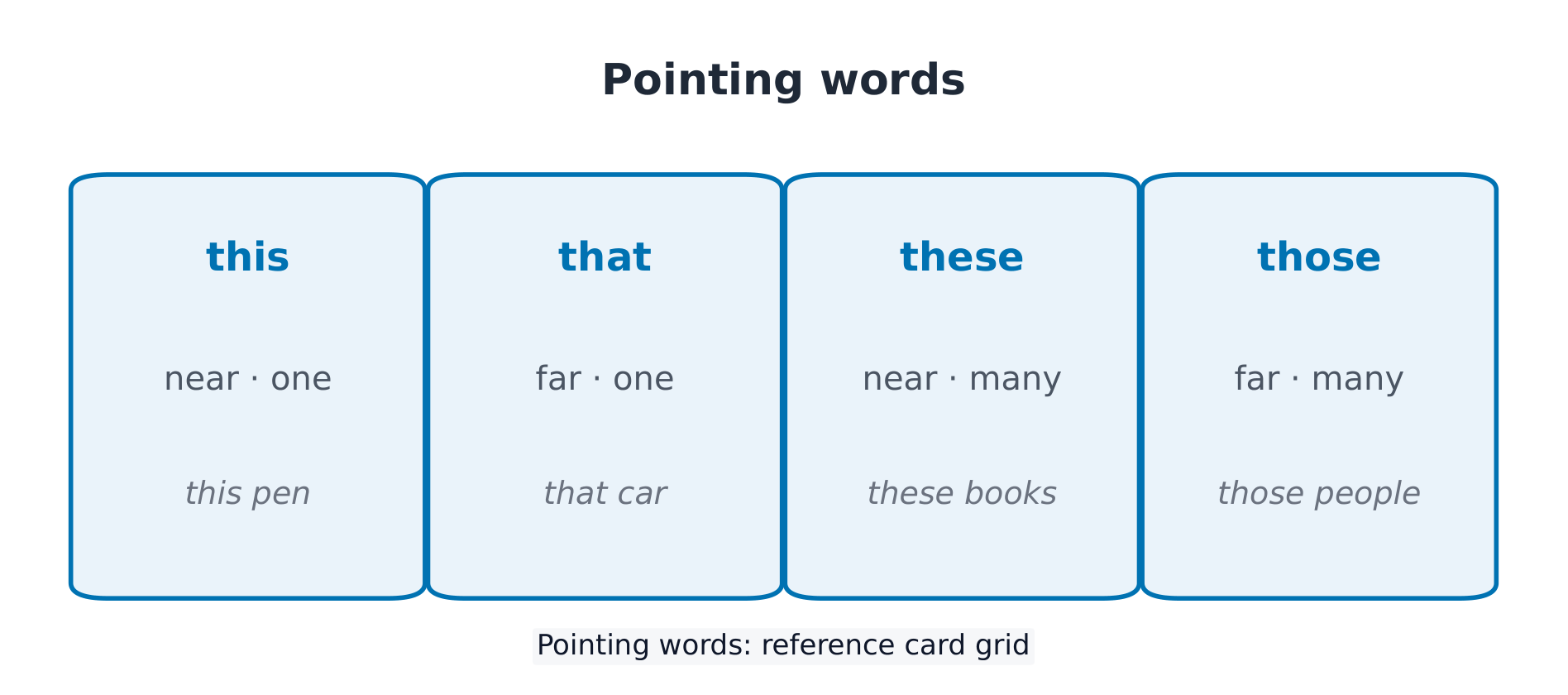
    Demonstratives point out "which one." Use this and that for singular:

    • this(this): Close to the speaker.
    • that(that): Far from the speaker.

    这This 是is 我的my 手机phone.

    This is my phone. (Close)

    那That 是is 你的your 车car.

    That is your car. (Far)

    Tiếng Việt
    近/远 × 单数/复数:this / that / these / those

    Từ chỉ định (demonstratives) chỉ ra "cái nào". Số ít dùng this và that:

    • this(này): nằm gần người nói.
    • that(kia): nằm xa người nói.

    这This 是is 我的my 手机phone.

    Đây là điện thoại của tôi. (Gần)

    那That 是is 你的your 车car.

    Kia là chiếc xe của bạn. (Xa)

    4.2

    these với those

    English

    Use these and those for plural:

    • these(these): Close. those(those): Far.

    这些These 是are 我的my 书books.

    These are my books.

    那些Those 是are 她的her 朋友friends.

    Those are her friends.

    Contrastive Memory:

    • Near → this (singular) / these (plural).
    • Far → that (singular) / those (plural).

    Note: These / those are followed by plural nouns: these books, not ~~these book~~.

    Common Errors

    • ❌ ~~these book~~ → ✓ these books — Plural nouns must follow these / those.
    • ❌ ~~This books are mine.~~ → ✓ These books are mine. — If the noun is plural, the demonstrative must also be plural.
    • ❌ When introducing yourself on the phone, say ~~I am Tom.~~ → ✓ This is Tom. — In English, introduce yourself on the phone using this is.
    • Remember pairs: Near this / these are often used with here; far that / those are often used with there.
    Tiếng Việt

    Số nhiều dùng these và those:

    • these(này): gần. those(kia): xa.

    这些These 是are 我的my 书books.

    Những cuốn sách này là của tôi.

    那些Those 是are 她的her 朋友friends.

    Những người bạn kia là của cô ấy.

    So sánh để nhớ:

    • Gần → this (số ít) / these (số nhiều).
    • Xa → that (số ít) / those (số nhiều).

    Lưu ý these / those đi kèm danh từ số nhiều: these books, không phải ~~these book~~.

    Lỗi thường gặp

    • ❌ ~~these book~~ → ✓ these books — Sau these / những bắt buộc đi kèm danh từ số nhiều.
    • ❌ ~~This books are mine.~~ → ✓ These books are mine. — Danh từ là số nhiều, từ chỉ định cũng phải dùng dạng số nhiều.
    • ❌ Khi gọi điện nói ~~I am Tom.~~ → ✓ This is Tom. — Tiếng Anh tự giới thiệu tên tuổi qua điện thoại dùng this is.
    • Nhớ cặp ghép: this / these (gần) thường đi kèm here, that / those (xa) thường đi kèm there.
  • 5 a, an and plurals · ⁨a, an và danh từ số nhiều⁩
    5.1

    a với an

    English

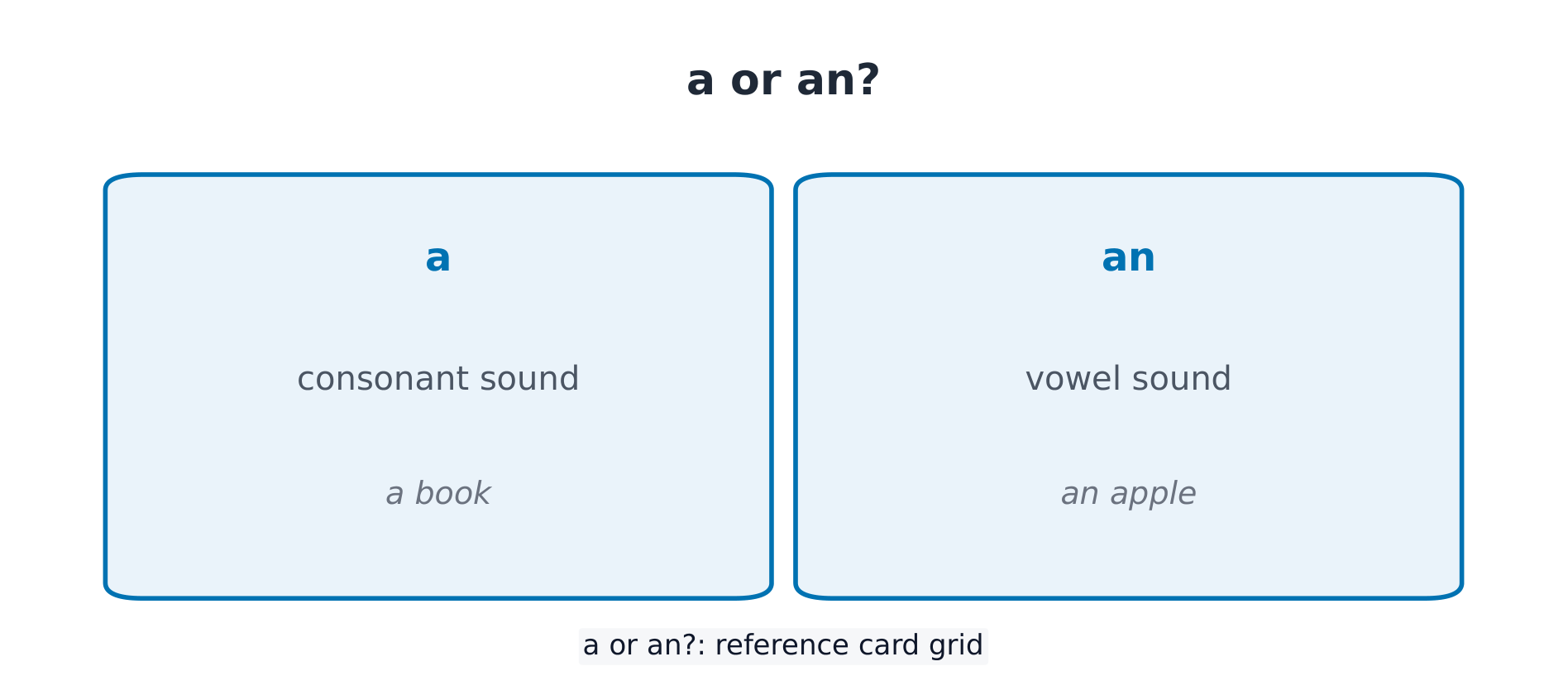
    a and an mean "one" and are used before singular countable nouns. How to choose depends on pronunciation:

    • a + consonant sound: a book, a dog, a cat.
    • an + vowel sound: an apple, an egg, an orange.

    我I 有have 一个a 笔pen.

    I have a pen.

    她She 吃eats 一个an 苹果apple.

    She eats an apple.

    Note: Look at the sound, not the letter: an hour (h is silent), a university (pronounced "yu-").

    Tiếng Việt
    a / an:看读音(辅音 vs 元音)

    a và an biểu thị "một", dùng trước danh từ đếm được số ít. Cách chọn xem phiên âm:

    • a + âm phụ âm: a book, a dog, a cat.
    • an + âm nguyên âm: an apple, an egg, an orange.

    我I 有have 一个a 笔pen.

    Tôi có một cây bút.

    她She 吃eats 一个an 苹果apple.

    Cô ấy ăn một quả táo.

    Lưu ý xem âm thanh chứ không xem chữ cái: an hour (h không đọc), a university (đọc là "yu-").

    5.2

    Danh từ số nhiều

    English

    To indicate "more than one," use the plural form of the noun, usually adding -s:

    • Generally add -s: book → books, car → cars.
    • Words ending in -s / -sh / -ch / -x add -es: bus → buses, box → boxes.
    • Consonant + y ending: change y to i and add -es: baby → babies, city → cities.

    我I 有have 两two 猫cats.

    I have two cats.

    Irregular plurals (must memorize):

    • man → men, woman → women, child → children.
    • foot → feet, tooth → teeth, person → people.

    Note: Do not use a / an before plural nouns: ~~a books~~ ✗ → books / two books ✓.

    Common Errors

    • ❌ ~~I have dog.~~ → ✓ I have a dog. — In Chinese you can say "I have dogs," but singular countable nouns in English must have a / an (or my, the, etc.) before them.
    • ❌ ~~an university~~ → ✓ a university; ❌ ~~a hour~~ → ✓ an hour — Look at pronunciation, not spelling: university starts with a consonant sound /j/, and h is silent in hour.
    • ❌ ~~two book~~ → ✓ two books — Chinese nouns do not change for plurality, but nouns after numbers in English require -s; this is easily forgotten.
    • ❌ ~~three childs~~ → ✓ three children — Irregular plurals must be memorized separately: men, women, children, feet, teeth, people.
    • ❌ ~~a people~~ → ✓ a person (one person) / people (many people) — people is inherently plural.
    Tiếng Việt

    Khi biểu thị "không chỉ một", danh từ dùng số nhiều, thường thêm -s:

    • Thông thường thêm -s: book → books, car → cars.
    • Kết thúc bằng -s / -sh / -ch / -x, thêm -es: bus → buses, box → boxes.
    • Phụ âm + y kết thúc, y chuyển thành i, thêm -es: baby → babies, city → cities.

    我I 有have 两two 猫cats.

    Tôi có hai con mèo.

    Số nhiều không quy tắc (cần học thuộc):

    • man → men, woman → women, child → children.
    • foot → feet, tooth → teeth, person → people.

    Lưu ý trước danh từ số nhiều không dùng a / an: ~~a books~~ ✗ → books / two books ✓.

    Lỗi thường gặp

    • ❌ ~~I have dog.~~ → ✓ I have a dog. — Tiếng Trung có thể nói "我有狗", nhưng tiếng Anh trước danh từ đếm được số ít bắt buộc phải có a / an (hoặc my, the, v.v.).
    • ❌ ~~an university~~ → ✓ a university; ❌ ~~a hour~~ → ✓ an hour — Xem phiên âm chứ không xem chữ cái: university bắt đầu bằng phụ âm /j/, h của hour không đọc.
    • ❌ ~~two book~~ → ✓ two books — Danh từ tiếng Trung không biến đổi số nhiều, nhưng danh từ sau số từ tiếng Anh phải thêm -s, dễ bị quên nhất.
    • ❌ ~~three childs~~ → ✓ three children — Danh từ số nhiều bất quy tắc phải học thuộc riêng: men, women, children, feet, teeth, people.
    • ❌ ~~a people~~ → ✓ a person(một người) / people(积极推动 số nhiều) — People bản thân đã mang nghĩa số nhiều.
  • 6 there is and there are · ⁨there is và there are⁩
    6.1

    Số ít và Số nhiều

    English

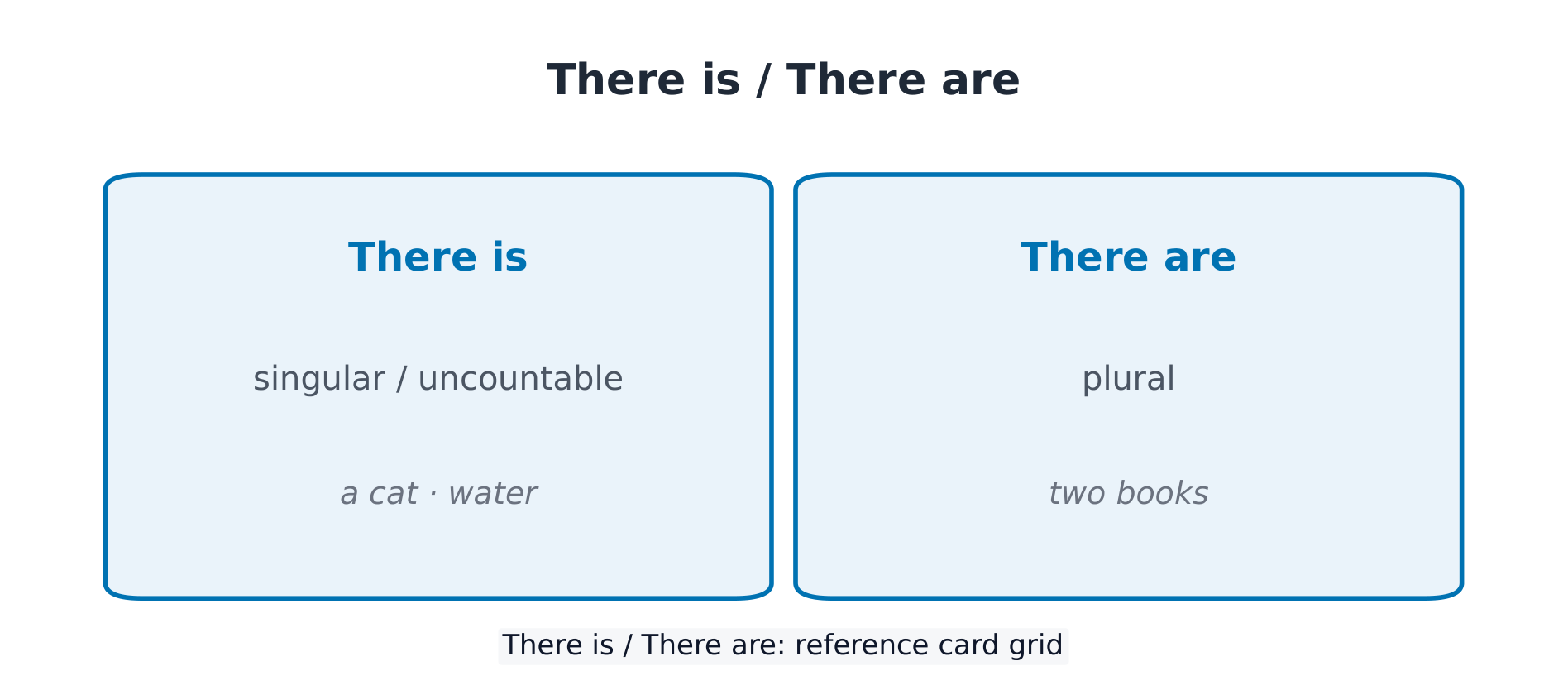
    there is / there are means "there exists" (something exists somewhere).

    • There is + singular / uncountable noun: There is a book.
    • There are + plural noun: There are two books.

    (有)There 有is 一只a 猫cat 在on (冠词)the 沙发上sofa.

    There is a cat on the sofa.

    (有)There 有are 三three 书books 在on (冠词)the 桌上desk.

    There are three books on the table.

    Note: In spoken English, there is is often contracted to there's: There's a problem.

    Tiếng Việt
    There is(单数)/ There are(复数)

    there is / there are 表示“有”(某处存在某物)。

    • There is + 单数 / 不可数名词: There is a book.
    • There are + 复数名词: There are two books.

    (有)There 有is 一只a 猫cat 在on (冠词)the 沙发上sofa.

    Có một con mèo trên sofa.

    (有)There 有are 三three 书books 在on (冠词)the 桌上desk.

    Trên bàn có ba cuốn sách.

    注意 口语里 there is 常缩写成 there's: There's a problem.

    6.2

    Phủ định và Nghi vấn

    English

    Negative: there is not / there are not (contracted as there isn't / there aren't).

    (有)There 没有isn't 任何any 牛奶milk.

    There is no milk left.

    Question: Move is / are to the front of there.

    (有吗)Is (有)there 一家a 银行bank 附近near 这里here?

    Is there a bank nearby?

    Short answer: Yes, there is. / No, there isn't.

    Note: Use any frequently in negative / question sentences: Is there any water? (Is there any water?)

    Common Errors

    • ❌ ~~Here has many people.~~ → ✓ There are many people here. — The "have" in the Chinese "There are many people here" indicates existence; use there is / there are in English, do not translate literally as have.
    • ❌ ~~There have a book on the desk.~~ → ✓ There is a book on the desk. — Use is / are after there; there have does not exist.
    • ❌ ~~There is two cats.~~ → ✓ There are two cats. — If the following noun is plural, use are.
    • ❌ ~~There are a milk.~~ → ✓ There is some milk. — milk is uncountable: use there is + some, do not use a.
    Tiếng Việt

    否定: there is not / there are not (缩写 there isn't / there aren't)。

    (有)There 没有isn't 任何any 牛奶milk.

    Không còn sữa nữa rồi.

    疑问: 把 is / are 放到 there 前面。

    (有吗)Is (有)there 一家a 银行bank 附近near 这里here?

    Xung quanh đây có ngân hàng không?

    简短回答: Yes, there is. / No, there isn't.

    注意 否定 / 疑问句里常用 any: Is there any water? (有水吗?)

    Lỗi thường gặp

    • ❌ ~~Here has many people.~~ → ✓ There are many people here. — 中文“这里有很多人”的“有”表示存在,英语用 there is / there are,不能直译成 have。
    • ❌ ~~There have a book on the desk.~~ → ✓ There is a book on the desk. — there 后面用 is / are,没有 there have 这种说法。
    • ❌ ~~There is two cats.~~ → ✓ There are two cats. — 后面的名词是复数,就用 are。
    • ❌ ~~There are a milk.~~ → ✓ There is some milk. — milk 不可数:用 there is + some,不能用 a。
  • 7 have got
    7.1

    have got / has got

    English

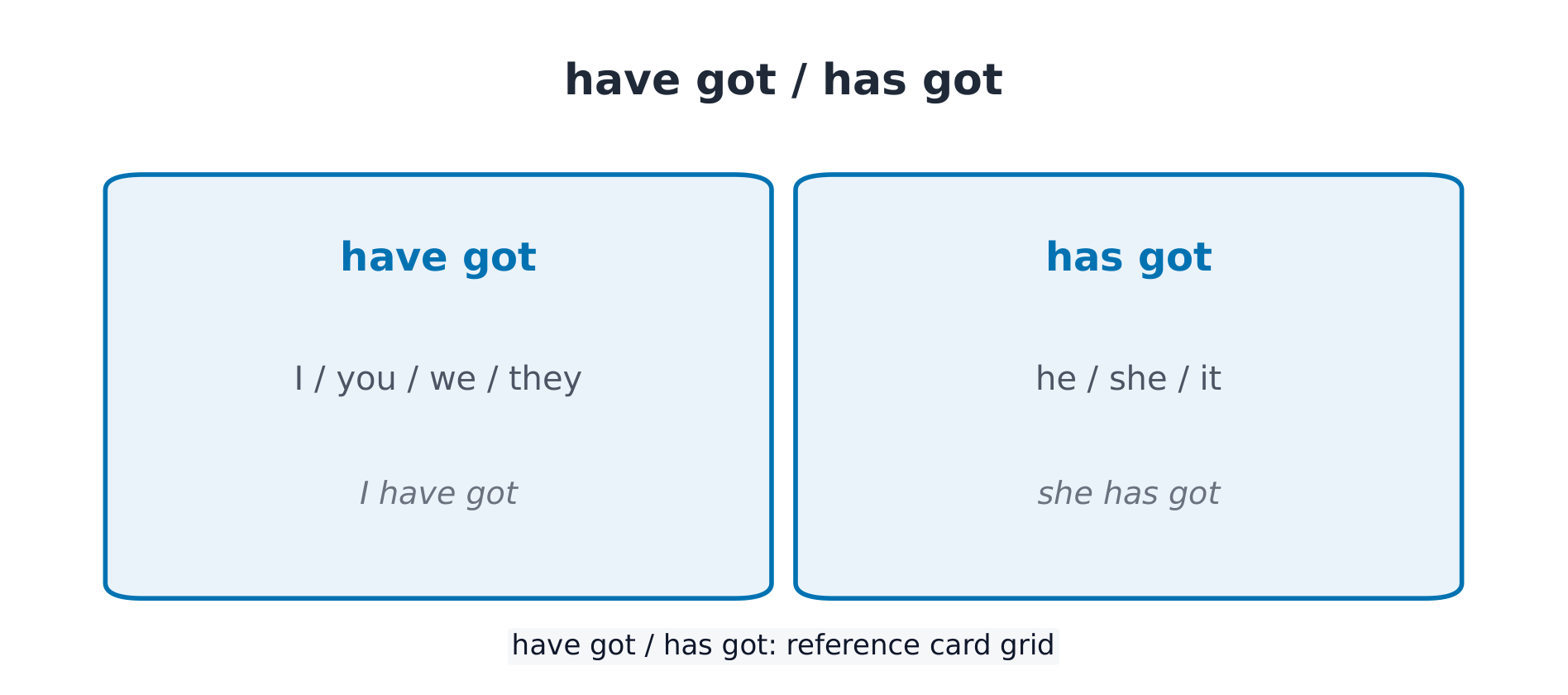
    have got means "to possess" (= have), common in British English.

    • I / you / we / they → have got
    • he / she / it → has got

    我I 有have got 一个a 兄弟brother.

    I have a brother. (= I have a brother.)

    她She 有has got 蓝色blue 眼睛eyes.

    She has blue eyes.

    Note: Often contracted in spoken language: I've got, she's got, they've got. Same meaning as have / has.

    Tiếng Việt
    have got / has got

    have got 表示“拥有” (= have),在英式英语里很常见。

    • I / you / we / they → have got
    • he / she / it → has got

    我I 有have got 一个a 兄弟brother.

    我有一个兄弟。(= I have a brother.)

    她She 有has got 蓝色blue 眼睛eyes.

    Cô ấy có đôi mắt màu xanh.

    注意 口语常缩写: I've got、she's got、they've got。意思和 have / has 一样。

    7.2

    Phủ định và Nghi vấn

    English

    Negative: haven't got / hasn't got.

    他He 没有hasn't got 一辆a 车car.

    He doesn't have a car.

    Question: Move Have / Has to the front of the subject.

    (有吗)Have 你you 有got 一支a 笔pen?

    Do you have a pen?

    Short answer: Yes, I have. / No, I haven't.

    Note: have got is mostly used for current possession; for past or habits, use regular have / had.

    Common Errors

    • ❌ ~~She have got long hair.~~ → ✓ She has got long hair. — Use has got for he / she / it.
    • ❌ ~~I have got not a car.~~ → ✓ I haven't got a car. — Place not after have / has, then contract.
    • ❌ ~~Do you have got a pen?~~ → ✓ Have you got a pen? / Do you have a pen? — Both question forms are correct, but never mix them.
    • ❌ ~~Yes, I have got.~~ → ✓ Yes, I have. — Short answers end at have / has, without got.
    Tiếng Việt

    否定: haven't got / hasn't got。

    他He 没有hasn't got 一辆a 车car.

    Anh ấy không có xe cộ.

    疑问: 把 Have / Has 放到主语前面。

    (有吗)Have 你you 有got 一支a 笔pen?

    Bạn có bút không?

    简短回答: Yes, I have. / No, I haven't.

    注意 have got 多用于“拥有”这一刻的状态;讲过去或习惯时,还是用普通的 have / had。

    Lỗi thường gặp

    • ❌ ~~She have got long hair.~~ → ✓ She has got long hair. — he / she / it 用 has got。
    • ❌ ~~I have got not a car.~~ → ✓ I haven't got a car. — not 加在 have / has 后面,再缩写。
    • ❌ ~~Do you have got a pen?~~ → ✓ Have you got a pen? / Do you have a pen? — 两种问法都对,但不能混成一句。
    • ❌ ~~Yes, I have got.~~ → ✓ Yes, I have. — 简短回答只到 have / has,不再带 got。
  • 8 Present simple · ⁨Hiện tại đơn⁩
    8.1

    Thói quen và ngôi thứ ba -s

    English

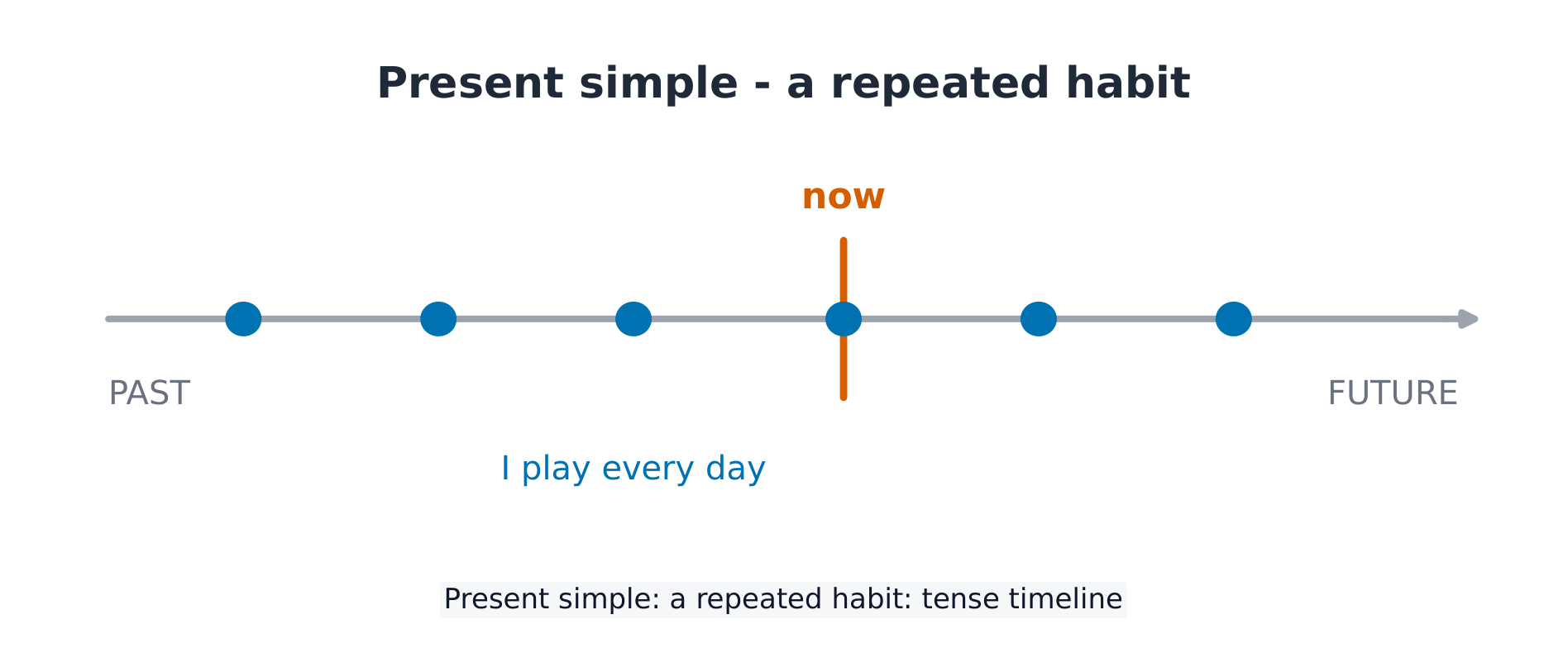
    Present simple (present simple) describes habits and facts. The base form is the infinitive (base verb).

    我I 喜欢like 茶tea.

    I like tea.

    When the subject is he / she / it, add -s to the verb:

    他He 踢plays 足球football.

    He plays football.

    Spelling rules:

    • Generally add -s: like → likes.
    • Words ending in -s / -sh / -ch / -x / -o add -es: go → goes, watch → watches.
    • Consonant + y ending: change y to i and add -es: study → studies.

    Note: Only he / she / it take -s; I / you / we / they use the base form: They like tea.

    Tiếng Việt
    Thì hiện tại đơn: thói quen lặp lại

    一般现在时 (present simple) 讲习惯和事实。基本形式就是动词原形。

    我I 喜欢like 茶tea.

    Tôi thích trà.

    主语是 he / she / it 时,动词加 -s:

    他He 踢plays 足球football.

    Anh ấy đá bóng.

    Chữ viết:

    • 一般加 -s: like → likes。
    • 以 -s / -sh / -ch / -x / -o 结尾,加 -es: go → goes, watch → watches。
    • 辅音 + y,y 变 i 加 -es: study → studies。

    注意 只有 he / she / it 加 -s; I / you / we / they 用原形: They like tea.

    8.2

    Phủ định và Nghi vấn

    English

    For negatives and questions, use auxiliary verbs do / does (does for he / she / it).

    Negative: Subject + don't / doesn't + base verb.

    我I 不don't 喜欢like 咖啡coffee.

    I don't like coffee.

    Question: Do / Does + Subject + base verb ?

    (助动词)Does 她she 住live 这里here?

    Does she live here?

    Note: When using do / does, the verb returns to its base form (no -s): ~~Does she lives~~ ✗ → Does she live ✓.

    Common Errors

    • ❌ ~~He go to school by bus.~~ → ✓ He goes to school by bus. — Forgetting to add -s in third person singular is the most frequent error; check your work afterwards.
    • ❌ ~~She doesn't likes coffee.~~ → ✓ She doesn't like coffee. — When using does / doesn't, the verb returns to its base form.
    • ❌ ~~I very like English.~~ → ✓ I like English very much. — "Very much" in Chinese cannot be translated literally; very cannot directly modify a verb.
    • ❌ ~~You like tea?~~ → ✓ Do you like tea? — Questions must start with do / does; rising intonation alone is insufficient.
    Tiếng Việt
    日常习惯: I have breakfast every morning.

    否定和疑问用助动词 do / does (he / she / it 用 does)。

    否定: 主语 + don't / doesn't + 动词原形。

    我I 不don't 喜欢like 咖啡coffee.

    Tôi không thích cà phê.

    疑问: Do / Does + 主语 + 动词原形 ?

    (助动词)Does 她she 住live 这里here?

    Cô ấy sống ở đây không?

    注意 用了 do / does,动词回到原形 (不加 -s): ~~Does she lives~~ ✗ → Does she live ✓。

    Lỗi thường gặp

    • ❌ ~~He go to school by bus.~~ → ✓ He goes to school by bus. — 第三人称单数忘加 -s 是最常见的错误,写完回头检查一遍。
    • ❌ ~~She doesn't likes coffee.~~ → ✓ She doesn't like coffee. — 用了 does / doesn't,动词就回到原形。
    • ❌ ~~I very like English.~~ → ✓ I like English very much. — 中文“很喜欢”不能直译;very 不能直接修饰动词。
    • ❌ ~~You like tea?~~ → ✓ Do you like tea? — 疑问句要用 do / does 开头,不能只靠语调上扬。
  • 9 can
    9.1

    Năng lực và Yêu cầu

    English

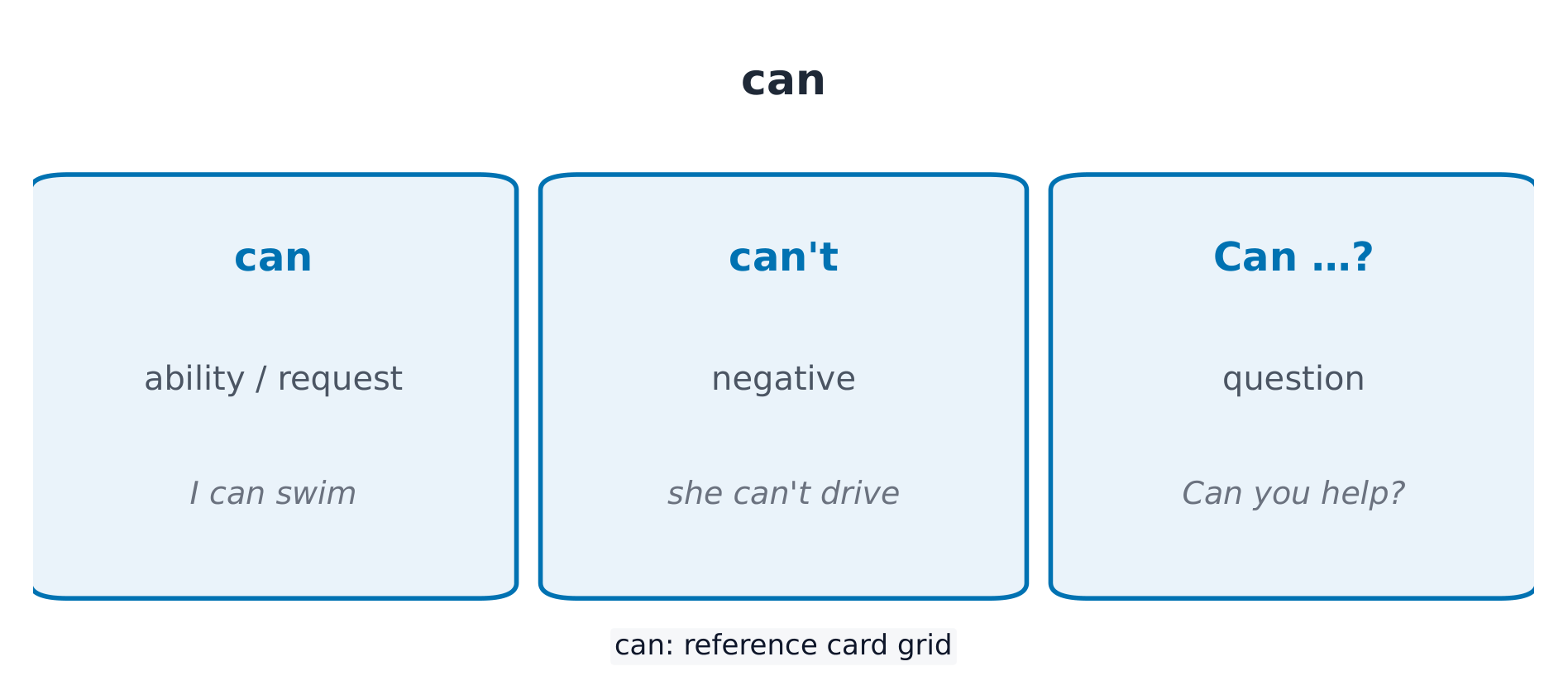
    can expresses ability ("know how to / be able to") or is used for requests. It is followed by the base form of the verb, and remains the same for all persons.

    我I 会can 游泳swim.

    I can swim.

    能Can 你you 帮help 我me?

    Can you help me?

    Note: Use the base form after can: ~~can to swim~~ ✗, ~~can swims~~ ✗ → can swim ✓.

    Tiếng Việt
    can: 能力、否定、疑问

    can 表示能力 (“会 / 能”) 或用来请求。它后面跟动词原形,所有人称都一样。

    我I 会can 游泳swim.

    Tôi biết bơi.

    能Can 你you 帮help 我me?

    Bạn có thể giúp tôi một chút không?

    注意 can 后面用原形: ~~can to swim~~ ✗、~~can swims~~ ✗ → can swim ✓。

    9.2

    Phủ định và Nghi vấn

    English

    Negative: cannot (abbreviation can't) + base form of the verb.

    她She 不会can't 开车drive.

    She cannot drive.

    Question: Place Can before the subject.

    能Can 他he 做饭cook?

    Can he cook?

    Short answer: Yes, I can. / No, I can't.

    Note: can has no -s and does not use do/does: ask directly with Can he…?, not ~~Does he can…?~~

    Common Errors

    • ❌ ~~She cans drive.~~ → ✓ She can drive. — can has no third-person singular -s; it is the same for all persons.
    • ❌ ~~I don't can swim.~~ → ✓ I can't swim. — The negative of can is formed directly with not (can't), without using don't.
    • ❌ ~~He can sings very good.~~ → ✓ He can sing very well. — Use the base form of the verb after can; use the adverb well to modify a verb, not good.
    • ❌ ~~You can help me?~~ → ✓ Can you help me? — When making a request, place can before the subject.
    Tiếng Việt

    否定: cannot (缩写 can't) + 动词原形。

    她She 不会can't 开车drive.

    Cô ấy không biết lái xe.

    疑问: 把 Can 放到主语前面。

    能Can 他he 做饭cook?

    Anh ấy có biết nấu ăn không?

    简短回答: Yes, I can. / No, I can't.

    注意 can 没有 -s、没有 do / does: 疑问直接用 Can he…?,不是 ~~Does he can…?~~

    Lỗi thường gặp

    • ❌ ~~She cans drive.~~ → ✓ She can drive. — can 没有第三人称 -s,所有人称同形。
    • ❌ ~~I don't can swim.~~ → ✓ I can't swim. — can 的否定直接加 not (can't),不用 don't。
    • ❌ ~~He can sings very good.~~ → ✓ He can sing very well. — can 后用动词原形;修饰动词用副词 well,不用 good。
    • ❌ ~~You can help me?~~ → ✓ Can you help me? — 请求别人时,把 can 提到主语前面。
  • 10 Imperatives · ⁨Câu mệnh lệnh⁩
    10.1

    Lệnh và Chỉ thị

    English

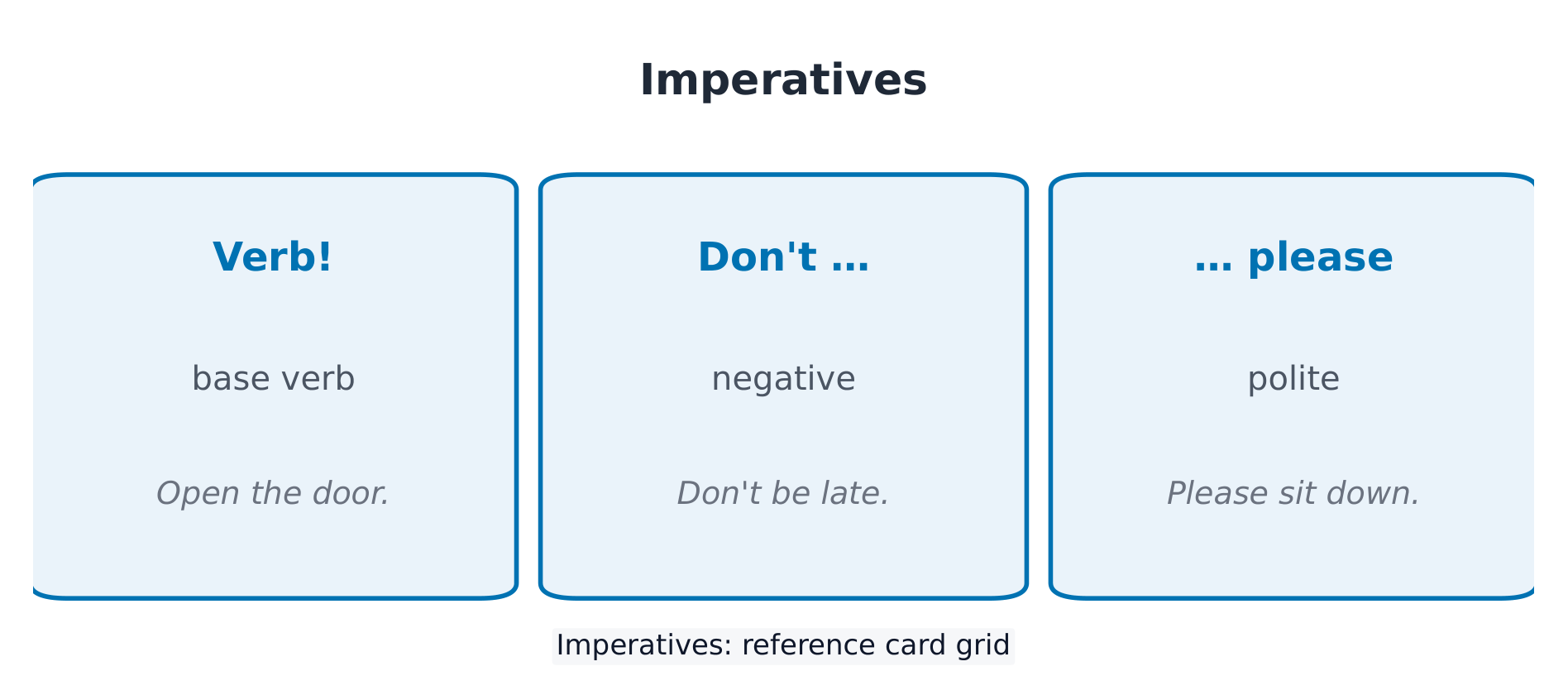
    Imperatives are used to give commands, provide instructions, or make requests. Start directly with the base form of the verb, without a subject.

    打开Open (冠词)the 门door 请, please.

    Please open the door.

    坐Sit 下down.

    Sit down.

    Negative: Add Don't at the beginning.

    不要Don't (是)be 迟到late.

    Don't be late.

    Key Usage Points:

    • Add please to be more polite: Please come in.
    • Also used for directions and instructions: Turn left. Mix the eggs.

    Note: Do not write a subject in imperatives: ~~You open the door~~ (for a command) → Open the door.

    Common Errors

    • ❌ ~~Please open door.~~ → ✓ Please open the door. — Articles must still be included in imperatives.
    • ❌ ~~Don't to touch it.~~ → ✓ Don't touch it. — Follow don't directly with the base form of the verb; do not add to.
    • ❌ ~~No talk in class!~~ → ✓ Don't talk in class! / No talking! — To prohibit an action, use don't + base form; after no, use -ing or a noun.
    • ❌ ~~You sit down!~~ → ✓ Sit down, please. — Adding you to a command sounds angry; add please for politeness, or change to Can you…?
    Tiếng Việt
    Câu mệnh lệnh: Lệnh, Phủ định, Yêu cầu

    祈使句 (imperatives) 用来下命令、给指示或提请求。直接用动词原形开头,不要主语。

    打开Open (冠词)the 门door 请, please.

    Vui lòng mở cửa ra.

    坐Sit 下down.

    Ngồi xuống.

    否定: 前面加 Don't。

    不要Don't (是)be 迟到late.

    Đừng đến muộn.

    Điểm chú ý về cách dùng:

    • 加 please 更礼貌: Please come in. (请进。)
    • 也用于路线、说明: Turn left. (向左转。) Mix the eggs. (把鸡蛋打匀。)

    注意 祈使句不写主语: ~~You open the door~~ (命令时) → Open the door.

    Lỗi thường gặp

    • ❌ ~~Please open door.~~ → ✓ Please open the door. — 祈使句里冠词照样不能丢。
    • ❌ ~~Don't to touch it.~~ → ✓ Don't touch it. — don't 后面直接跟动词原形,不加 to。
    • ❌ ~~No talk in class!~~ → ✓ Don't talk in class! / No talking! — 禁止做某事用 don't + 原形;no 后面要用 -ing 或名词。
    • ❌ ~~You sit down!~~ → ✓ Sit down, please. — 加了 you 的命令听起来很生气;想礼貌就加 please,或改问 Can you…?
  • 11 Question words · ⁨Từ hỏi⁩
    11.1

    what, where, who

    English

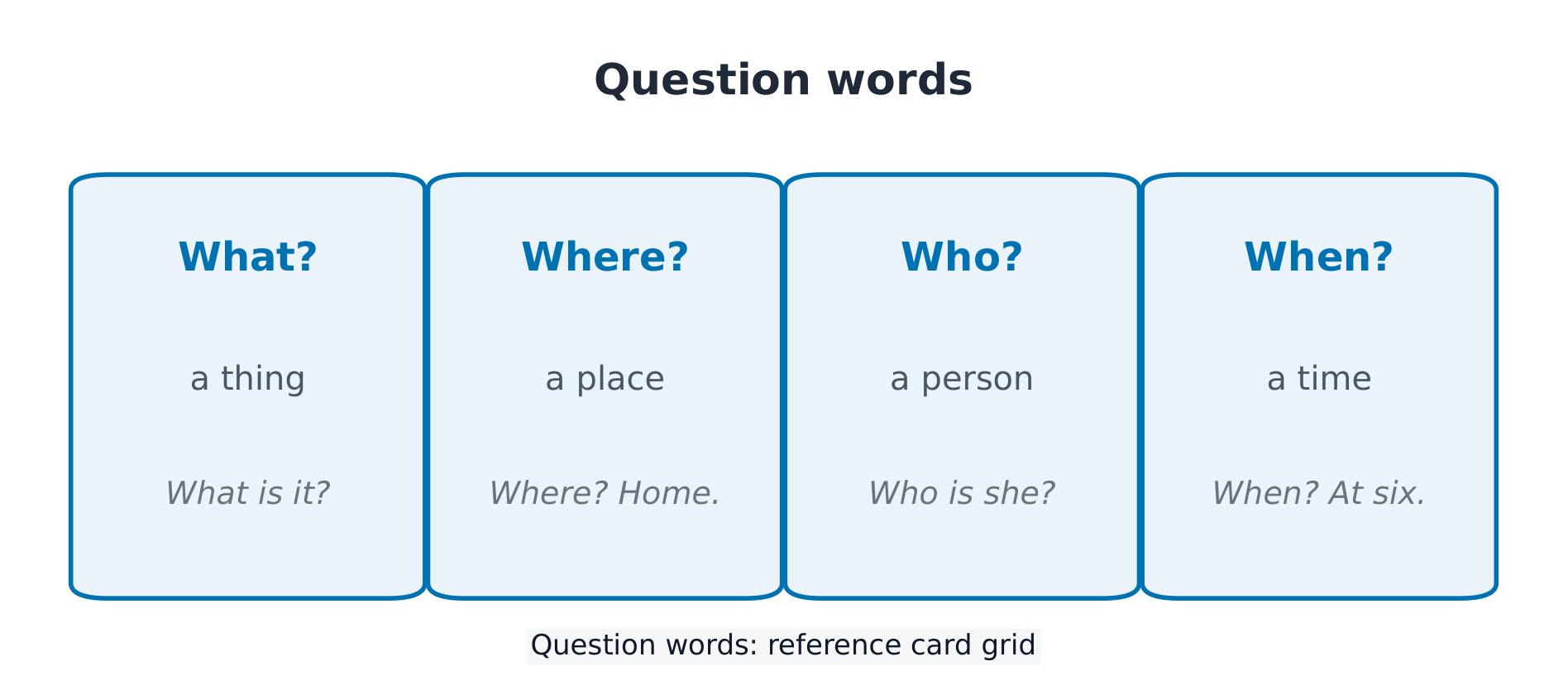
    Question words are placed at the beginning of a question to ask for specific information.

    • what (what), where (where), who (who)

    什么What 是is 你的your 名字name?

    What's your name?

    哪里Where (助动词)do 你you 住live?

    Where do you live?

    谁Who 是is 那个that 男人man?

    Who is that man?

    Note: A be verb or auxiliary do/does often follows the question word: Where do you work?

    Tiếng Việt
    Từ hỏi: Hỏi vật/thành phần/nơi chốn/người/thời gian

    疑问词 (question words) 放在问句开头,用来问具体信息。

    • what (什么)、where (哪里)、who (谁)

    什么What 是is 你的your 名字name?

    Bạn tên là gì?

    哪里Where (助动词)do 你you 住live?

    Bạn sống ở đâu?

    谁Who 是is 那个that 男人man?

    Người đàn ông kia là ai?

    Lưu ý: Sau từ hỏi thường đi kèm động từ to be hoặc trợ động từ do / does: Where do you work?

    11.2

    when, why, how

    English
    • when (when), why (why), how (how / in what way)

    什么时候When 是is (冠词)the 派对party?

    When is the party?

    为什么Why (是)are 你you 难过sad?

    Why are you sad?

    怎么How (助动词)do 你you 拼写spell 它it?

    How do you spell this?

    Note: how can also combine with adjectives to ask about degree: How old are you? How much is it?

    Common Errors

    • ❌ ~~Where you live?~~ → ✓ Where do you live? — After the question word, you still need do/does or be; you cannot follow directly with the subject.
    • ❌ ~~What means this word?~~ → ✓ What does this word mean? — mean is an ordinary verb: question word + does + subject + base form.
    • ❌ ~~Why you are late?~~ → ✓ Why are you late? — When there is a be verb in the sentence, move be before the subject.
    • ❌ ~~How to spell it?~~ → ✓ How do you spell it? — A literal translation of "How to spell?" loses the subject and auxiliary verb; these must be added.
    Tiếng Việt
    • when(khi nào), why(tại sao), how(như thế nào)

    什么时候When 是is (冠词)the 派对party?

    Tiệc diễn ra lúc nào?

    为什么Why (是)are 你you 难过sad?

    Tại sao bạn buồn?

    怎么How (助动词)do 你you 拼写spell 它it?

    Từ này viết thế nào?

    Lưu ý: how còn có thể kết hợp với tính từ để hỏi mức độ: How old are you? (Bạn bao nhiêu tuổi?) How much is it? (Bao nhiêu tiền?)

    Lỗi thường gặp

    • ❌ ~~Where you live?~~ → ✓ Where do you live? — Sau từ hỏi cần có do / does hoặc be, không được đặt chủ ngữ ngay sau đó.
    • ❌ ~~What means this word?~~ → ✓ What does this word mean? — mean là động từ thông thường: từ hỏi + does + chủ ngữ + nguyên mẫu.
    • ❌ ~~Why you are late?~~ → ✓ Why are you late? — Khi câu có động từ to be, đưa to be lên trước chủ ngữ.
    • ❌ ~~How to spell it?~~ → ✓ How do you spell it? — Dịch sát nghĩa "làm thế nào để viết" sẽ làm mất chủ ngữ và trợ động từ, cần bổ sung đầy đủ.
  • 12 Prepositions of place · ⁨Giới từ chỉ vị trí⁩
    12.1

    in, on, under

    English

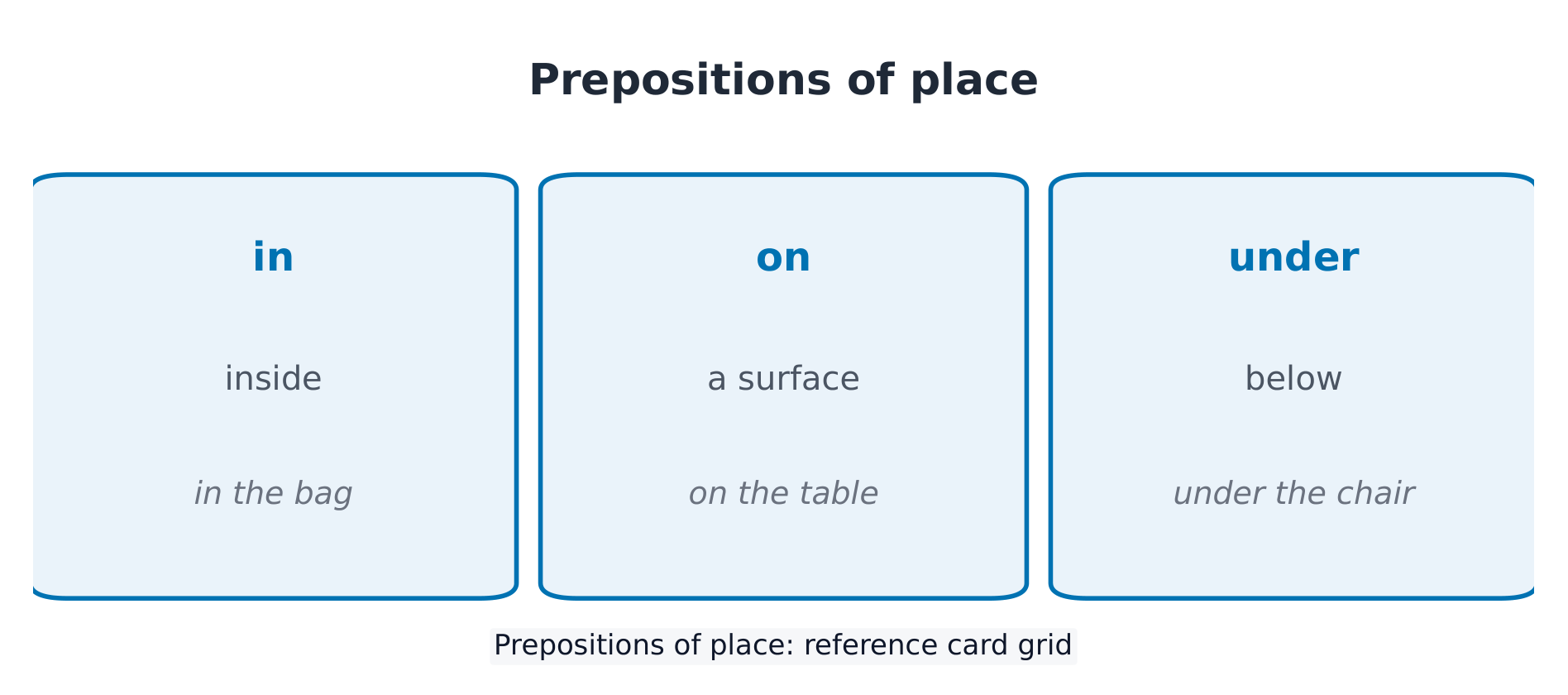
    Prepositions of place indicate where something is located.

    • in (inside...), on (on top of... / surface), under (below...)

    (冠词)The 钥匙keys 在are 在...里in (冠词)the 包里bag.

    The key is in the bag.

    (冠词)The 书book 在is 在...上on (冠词)the 桌上table.

    The book is on the table.

    (冠词)The 猫cat 在is 在...下under (冠词)the 椅子下chair.

    The cat is under the chair.

    Tiếng Việt
    Giới từ chỉ vị trí: in / on / under

    Giới từ chỉ vị trí (prepositions of place) giải thích vật ở đâu.

    • in(ở bên trong...), on(ở trên... / bề mặt), under(ở dưới...)

    (冠词)The 钥匙keys 在are 在...里in (冠词)the 包里bag.

    Chìa khóa nằm trong túi.

    (冠词)The 书book 在is 在...上on (冠词)the 桌上table.

    Sách nằm trên bàn.

    (冠词)The 猫cat 在is 在...下under (冠词)the 椅子下chair.

    Con mèo nằm dưới ghế.

    12.2

    next to, between, behind

    English
    • next to (beside...), between (between...), behind (behind...), in front of (in front of...)

    (冠词)The 商店shop 在is 旁边next to (冠词)the 银行bank.

    The shop is next to the bank.

    她She 坐sits 之间between 汤姆Tom 和and 萨姆Sam.

    She sits between Tom and Sam.

    Note: between means "between two," and is usually followed by A and B: between the door and the window.

    Common Errors

    • ❌ ~~The picture is in the wall.~~ → ✓ The picture is on the wall. — Hanging "on" the wall involves surface contact, so use on.
    • ❌ ~~I read it on the book.~~ → ✓ ...in the book. — Content "inside" a book uses in; people in photos also use in the photo.
    • ❌ ~~The shop is next the bank.~~ → ✓ next to the bank — next to is two words; to cannot be omitted.
    • ❌ ~~between the door with the window~~ → ✓ between the door and the window — between takes the fixed collocation A and B.
    Tiếng Việt
    • next to(bên cạnh...), between(ở giữa...), behind(ở phía sau...), in front of(ở phía trước...)

    (冠词)The 商店shop 在is 旁边next to (冠词)the 银行bank.

    Cửa hàng nằm bên cạnh ngân hàng.

    她She 坐sits 之间between 汤姆Tom 和and 萨姆Sam.

    Cô ấy ngồi giữa Tom và Sam.

    Lưu ý: between mang nghĩa "giữa hai đối tượng", thường dùng cấu trúc A and B: between the door and the window.

    Lỗi thường gặp

    • ❌ ~~The picture is in the wall.~~ → ✓ The picture is on the wall. — Treo tranh "trên" tường là tiếp xúc bề mặt, dùng on.
    • ❌ ~~I read it on the book.~~ → ✓ ...in the book. — Nội dung nằm "trong" sách dùng in; người trong ảnh cũng dùng in the photo.
    • ❌ ~~The shop is next the bank.~~ → ✓ next to the bank — next to gồm hai từ, to không được bỏ.
    • ❌ ~~between the door with the window~~ → ✓ between the door and the window — between cố định đi kèm A and B.

Log in or create account · ⁨Đăng nhập hoặc tạo tài khoản⁩

IGCSE, A-Level & AP