Source: Cambridge International syllabus · แหล่งที่มา: หลักสูตร Cambridge International
English
A free market often gives a good result, but not always. market failure 市场失灵 is when the market does not allocate 配置 (share out) resources efficiently — too much or too little of a good is made. Then the government may step in.
There are several reasons for market failure.
Externalities
An externality 外部性 is a cost or a benefit that falls on a third party 第三方 — someone who is not the buyer or the seller.
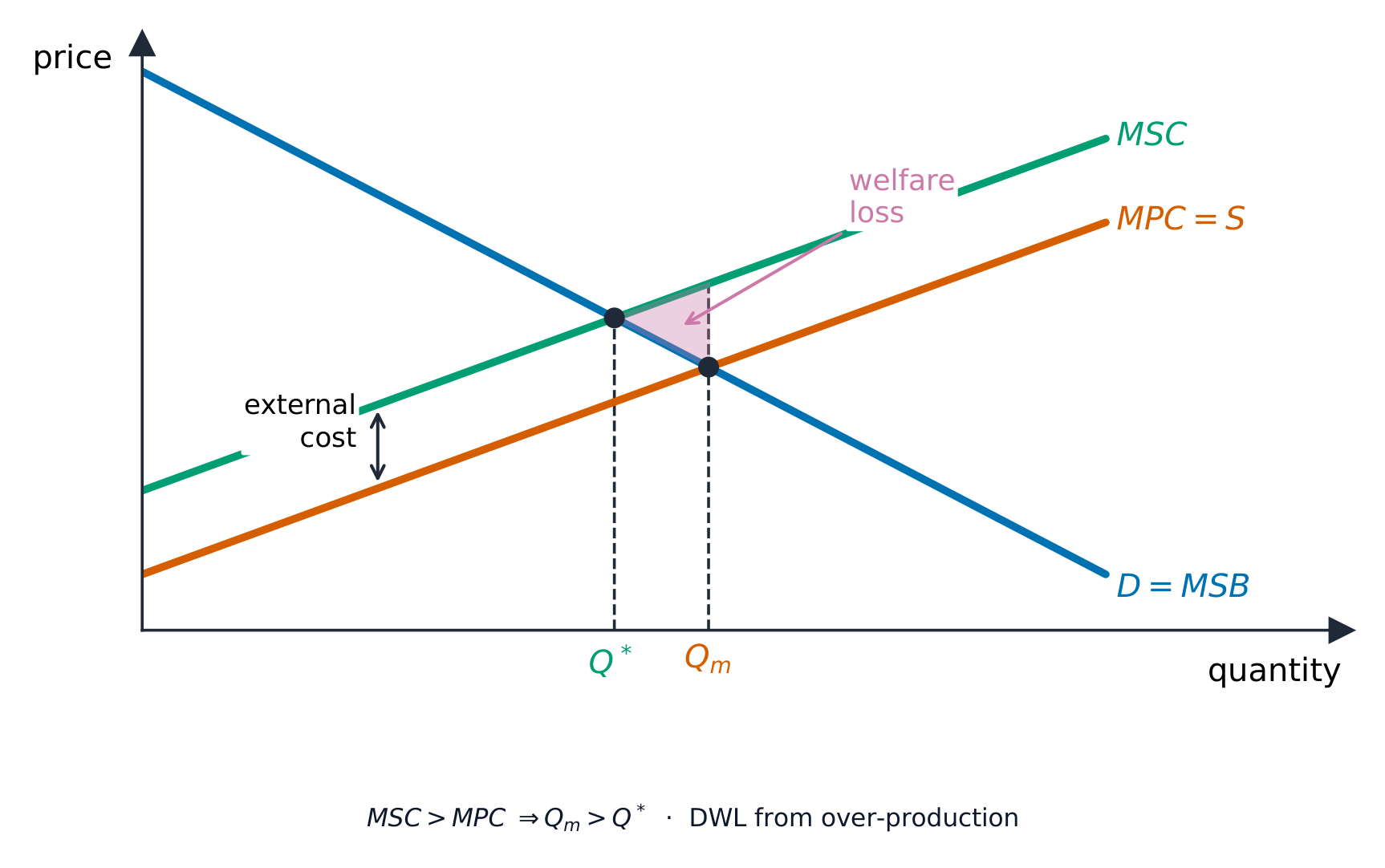
a negative externality 负外部性 is an external cost 外部成本 paid by others, like the pollution from a factory. The social cost 社会成本 (the cost to all of society) is bigger than the private cost 私人成本 (the cost to the producer). When people ignore the external cost, the market makes too much of the good.
a positive externality 正外部性 is an external benefit 外部收益 enjoyed by others, like the protection that vaccination gives to everyone. Here the market makes too little, because buyers ignore the benefit to others.
Public goods
A public good 公共物品 (like street lighting or national defence) has non-rivalry 非竞争性 and non-excludability 非排他性. Because non-payers cannot be shut out, there is a free-rider problem 搭便车问题, so private firms make no profit and supply none. The market fails completely.
Merit and demerit goods
A merit good 优值品 (like education) is under-consumed; a demerit good 劣值品 (like cigarettes) is over-consumed. People misjudge them because of information failure 信息失灵 — they do not know, or do not use, the true benefit or harm.
Monopoly power
monopoly 垄断 means one firm dominates a market. A firm with monopoly power 垄断势力 can cut output and raise the price above the competitive level. This wastes resources and harms consumers.
Inequality and asymmetric information
the market rewards people who own resources, so it can produce great inequality 不平等 — some people are left with too little to live on.
asymmetric information 信息不对称 is when one side of a deal knows more than the other (a used-car seller knows the faults; the buyer does not). This leads to poor decisions and unfair deals.
The market and where it fails · ตลาดและจุดที่มันล้มเหลว
Supply and demand set the market price and quantity at their intersection. Market failure is when this free-market outcome is not the best one for society. · อุปทานและอุปสงค์กำหนดราคาและปริมาณในตลาดที่จุดตัด ความล้มเหลวของตลาดคือเมื่อผลลัพธ์ของตลาดเสรีนี้ไม่ใช่สิ่งที่ดีที่สุดสำหรับสังคม
Source: Cambridge International syllabus · แหล่งที่มา: หลักสูตร Cambridge International
English
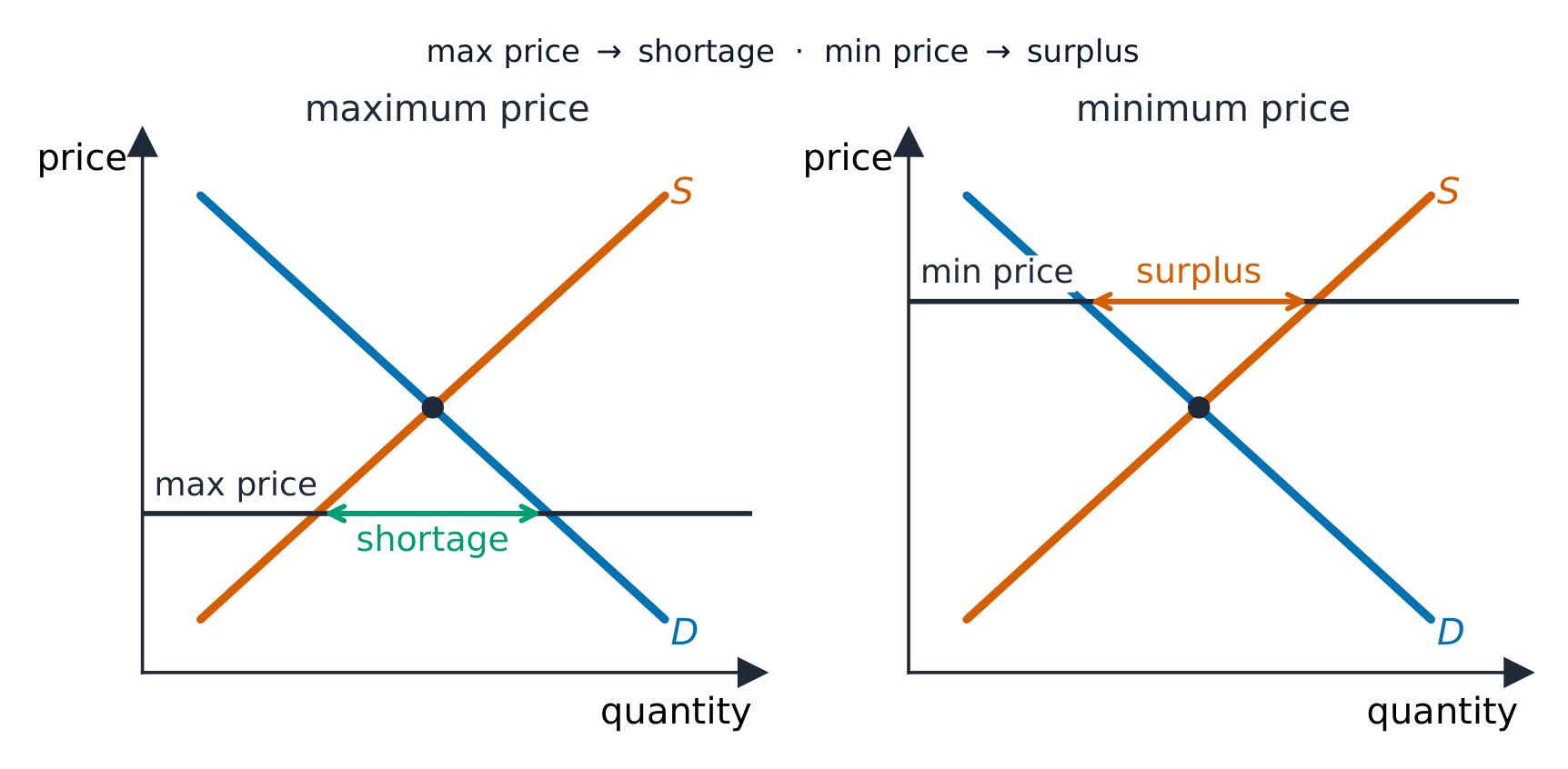
A maximum price creates a shortage
Indirect taxes
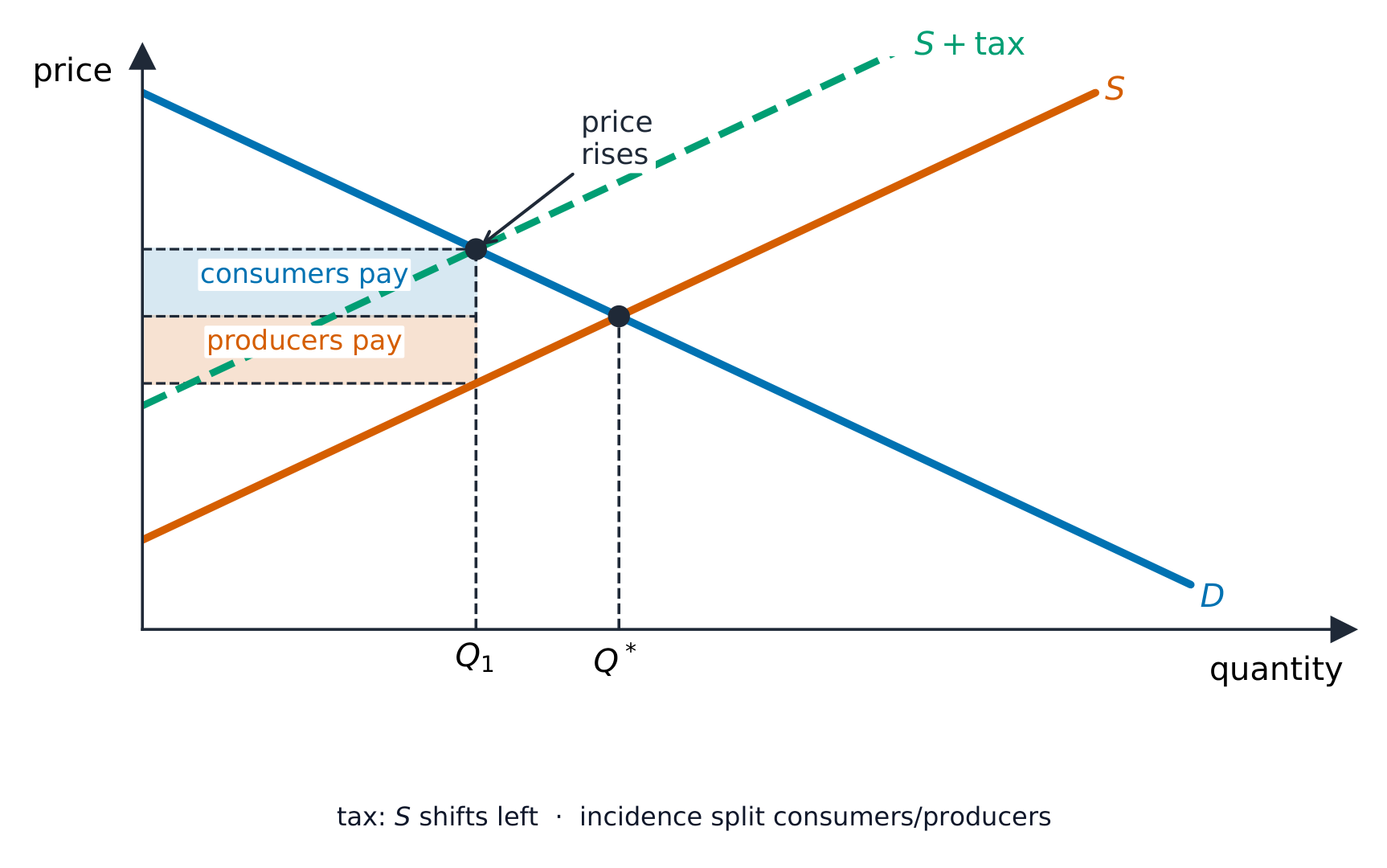
An indirect tax 间接税 is a tax on spending. It raises a firm's costs, shifts the supply curve to the left, and so raises the price and cuts the quantity. Governments tax demerit goods (like tobacco) and goods with negative externalities to make people use less.
The incidence of a tax 税收归宿 is who really pays it. This depends on elasticity:
if demand is inelastic 缺乏弹性, consumers pay most of the tax (the price rises by nearly the full tax).
if demand is elastic 富有弹性, producers pay most of the tax (they cannot pass it on).
Subsidies
A subsidy 补贴 is a government payment to producers. It lowers their costs, shifts the supply curve to the right, and so lowers the price and raises the quantity. Subsidies are used for merit goods and goods with positive externalities.
Maximum and minimum prices
a maximum price 最高限价 is a legal top price, set below equilibrium (for example, rent control). Because the price is held down, quantity demanded is greater than quantity supplied, so there is a shortage 短缺.
a minimum price 最低限价 is a legal bottom price, set above equilibrium (for example, a minimum wage, or a floor for farm prices). Because the price is held up, quantity supplied is greater than quantity demanded, so there is excess supply 超额供给.
Buffer stocks
A buffer stock 缓冲库存 is used to steady the price of farm goods. The government buys and stores the good when the price is low, and sells from the store when the price is high. This keeps the price inside a target band.
Regulation, provision and permits
regulation 管制 means rules and laws — bans, age limits, safety standards, or pollution limits.
state provision 政府提供 means the government 政府 supplies a good directly, often free at the point of use (public goods and merit goods like schools and hospitals).
tradable permits 可交易许可证 set a total cap on pollution and give firms permits to pollute. Firms that pollute less can sell spare permits to firms that pollute more. This caps total pollution at the lowest cost.
Government failure
Intervention does not always help. government failure 政府失灵 is when the government's action makes the use of resources worse, not better. Common causes:
poor information, so the government sets the wrong tax or subsidy.
high cost of running the policy.
unintended results — for example, a maximum price can create an illegal black market 黑市.
decisions made for political reasons rather than for efficiency.
Worked example. A government puts a £2 per-packet tax on cigarettes, whose demand is very price-inelastic. Who really pays it, and what does that mean for the policy's two aims? The incidence falls mainly on whichever side is less able to respond - the more inelastic one. Because smokers keep buying almost the same quantity as the price rises, producers can pass most of the tax on, so consumers bear most of the incidence: the price might rise by about £1.80, with producers absorbing only about £0.20. That creates the tension the question is really testing. As a revenue raiser the tax succeeds: quantity barely falls, so revenue is large and steady. As a way of cutting consumption it largely fails - for exactly the same reason. And because poorer smokers spend a larger share of their income on it, the tax is regressive. Argue from elasticity to incidence, then judge each aim separately.
Governments step into markets when the free-market equilibrium isn't the best outcome for society. · รัฐบาลเข้าไปแทรกแซงตลาดเมื่อจุดดุลยภาพของตลาดเสรีไม่ใช่ผลลัพธ์ที่ดีที่สุดสำหรับสังคม
Source: Cambridge International syllabus · แหล่งที่มา: หลักสูตร Cambridge International
English
It helps to separate two ideas:
income 收入 is a flow 流量 — money received over a period, such as wages, rent and interest.
wealth 财富 is a stock 存量 — the value of assets owned at a point in time, such as houses, shares and savings.
Wealth produces income (savings earn interest), and income can be saved to build wealth, so the two are linked. Inequality has many causes: differences in skills and wages, the ownership of wealth, inheritance, and unemployment.
Policies to reduce inequality
a progressive tax 累进税 takes a larger percentage 百分比 from higher incomes than from lower incomes. This narrows the gap after tax.
benefits 福利金 (also called transfer payments 转移支付) are money paid by the government to the poor, the old, and the unemployed.
state provision of free services, like education and health care, raises the real living standards of poorer people.
Together these policies bring about redistribution 再分配 — moving income and wealth from richer to poorer people. But there is a trade-off 取舍: very high taxes and large benefits may weaken the incentive 激励 to work and to invest.
Pick one and the site follows you — notes, papers, videos and practice all open on it. · เลือกหนึ่งตัว และเว็บจะติดตามคุณ — หมายเหตุ, ใบงาน, วิดีโอ และการฝึกฝนจะเปิดอยู่ที่นั้น
Type to search notes, lessons, code, vocabulary and past-paper questions across every subject. · พิมพ์เพื่อค้นหาบันทึก, บทเรียน, โค้ด, คำศัพท์ และคำถามข้อสอบเก่าในทุกวิชา




 ภาษีทางอ้อมทำให้_supply เลื่อนขึ้นที่