Price controls, regulation and government failure
Introduced| English | Meaning |
|---|---|
| shortage/ˈʃɔːtɪdʒ/ | A situation in which quantity demanded exceeds quantity supplied at the prevailing price. |
| surplus/ˈsɜːpləs/ | An amount exceeding what is required; in a market, quantity supplied above quantity demanded at a given price. |
| price ceiling/praɪs ˈsiːlɪŋ/ | A legally imposed maximum price at which a good or service may be sold. |
| price floor/praɪs flɔː/ | A legally imposed minimum price at which a good, service or factor may be traded. |
| government failure/ˈɡʌvənmənt ˈfeɪlɪə/ | A situation in which government intervention creates inefficiency or worsens the outcome it was intended to improve. |
| unintended consequences/ˌʌnɪnˈtendɪd ˈkɒnsɪkwənsɪz/ | Effects of an action or policy that were not its intended objectives. |
When the government sets the price
- Rent caps to help tenants, minimum wages to help workers — governments sometimes override the market price directly.
- But forcing price away from equilibrium always creates a shortage 短缺 or a surplus 过剩.
A maximum price (price ceiling) set below equilibrium causes a:
Difficulty 1/5 · 100 coins + a small bonus on first completion today
Below equilibrium, demand exceeds supply → a persistent shortage.
A price ceiling is a legal ______ price (it binds when set below equilibrium).
Difficulty 1/5 · 100 coins + a small bonus on first completion today
A ceiling is a maximum; a floor is a minimum.
Maximum price (price ceiling 价格上限)
- A price ceiling set below equilibrium (e.g. rent control) makes the good cheaper — but demand now exceeds supply.
- The result is a persistent shortage (and often queues or black markets).

A ceiling below equilibrium: quantity demanded exceeds quantity supplied — a shortage.
Price controls
A price set away from equilibrium causes a shortage or a surplus.
A minimum wage (a price floor in the labour market) set above equilibrium can cause:
Difficulty 1/5 · 100 coins + a small bonus on first completion today
Above equilibrium, supply exceeds demand → a surplus, i.e. unemployment.
Match each control to its result.
Difficulty 2/5 · 140 coins + a small bonus on first completion today
A binding ceiling creates excess demand; a binding floor creates excess supply.
Minimum price (price floor 价格下限)
- A price floor set above equilibrium (e.g. a minimum wage, or farm price support) raises the price — but supply now exceeds demand.
- The result is a surplus (e.g. unemployment in a labour market, or unsold food).
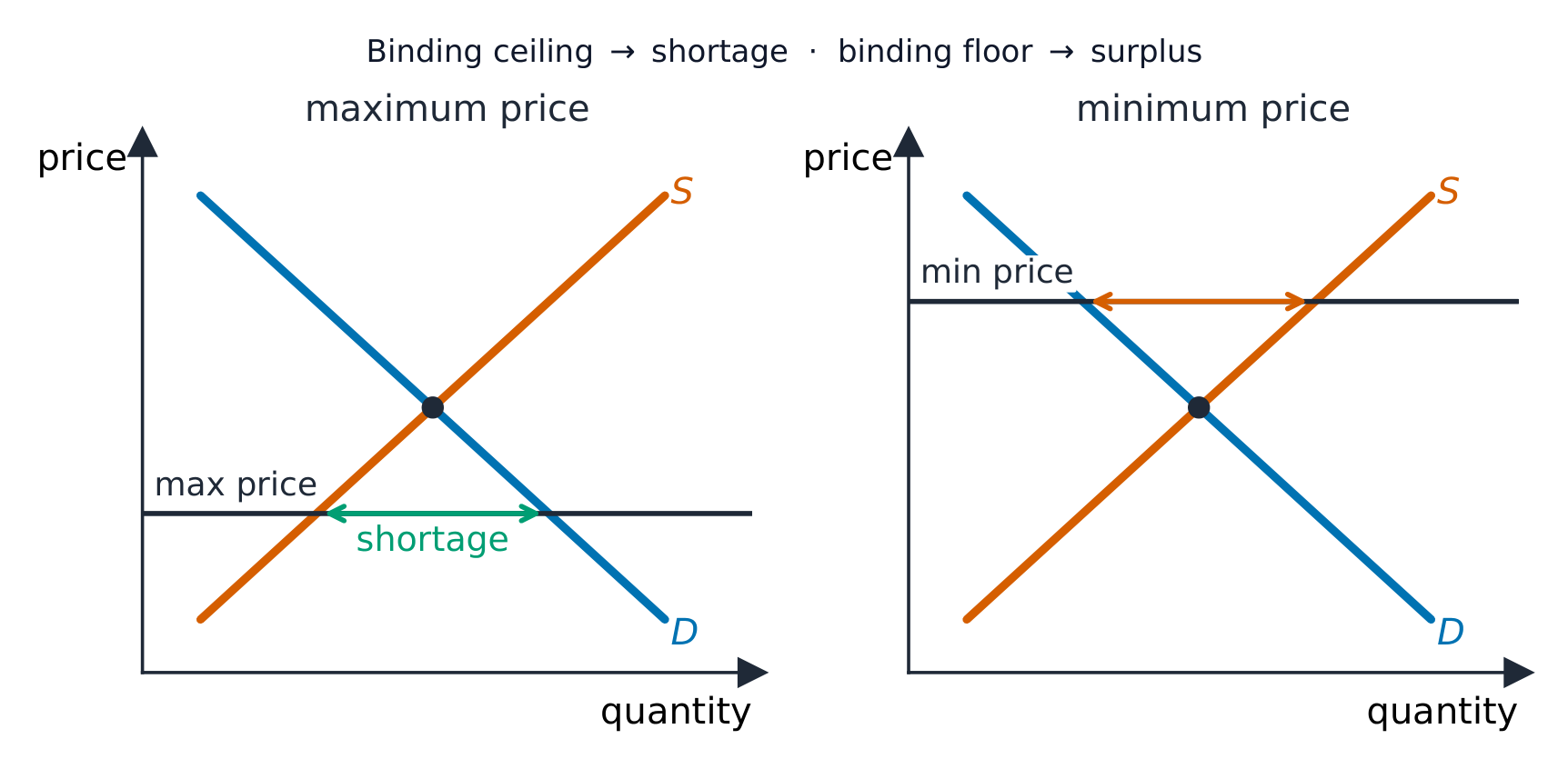
A maximum price causes a shortage; a minimum price causes a surplus
Government failure occurs when intervention creates unintended consequences that worsen welfare.
Difficulty 1/5 · 100 coins + a small bonus on first completion today
E.g. rent caps can reduce the supply of housing over time.
Government failure 政府失灵
- Intervention can make things worse — government failure — through:
- unintended consequences 意外后果 (rent caps → fewer flats built), information gaps, and administrative costs.
Ceiling = shortage, floor = surplus. A ceiling is a maximum (binds below equilibrium → shortage); a floor is a minimum (binds above → surplus). Don't swap them.
You've got it
- price ceiling (max, below equilibrium) → shortage; price floor (min, above) → surplus
- both move the market away from equilibrium, creating excess demand or supply
- government failure: intervention with unintended consequences can worsen welfare