Taxes and subsidies
Introduced| English | Meaning |
|---|---|
| indirect tax/ɪndaɪˈrekt tæks/ | A tax on spending or transactions, usually collected by a seller and included in the price paid by a buyer. |
| Pigouvian tax/pɪˈɡuːvɪən tæks/ | A corrective tax intended to make decision-makers face the external costs their activity imposes on others. |
| social optimum/ˈsəʊʃl ˈɒptɪməm/ | An allocation that maximises overall social welfare, commonly where marginal social benefit equals marginal social cost. |
| subsidy/ˈsʌbsɪdi/ | Financial assistance, usually from government, that reduces costs or supports a particular activity. |
| incidence/ˈɪnsɪdəns/ | incidence |
| elasticity/ɪlæˈstɪsɪti/ | The responsiveness of one variable to a change in another, often measured as a ratio of percentage changes. |
Making the polluter pay
- If a factory's smoke harms others, why not add a tax equal to that harm? Suddenly the firm faces the full cost.
- Indirect taxes 间接税 and subsidies are the government's main tools for correcting externalities.
An indirect tax on a good shifts the supply curve:
Difficulty 1/5 · 100 coins + a small bonus on first completion today
A tax raises firms' costs, reducing supply at every price — a leftward shift.
A Pigouvian tax is set equal to the external cost to reach the social optimum.
Difficulty 1/5 · 100 coins + a small bonus on first completion today
Setting the tax to the external cost internalises it, cutting output to the optimum.
Indirect taxes
- An indirect tax (on a good, like fuel duty or VAT) raises firms' costs, shifting supply left and raising the price.
- A Pigouvian tax 庇古税 is set equal to the external cost, pushing output down to the social optimum 社会最优.
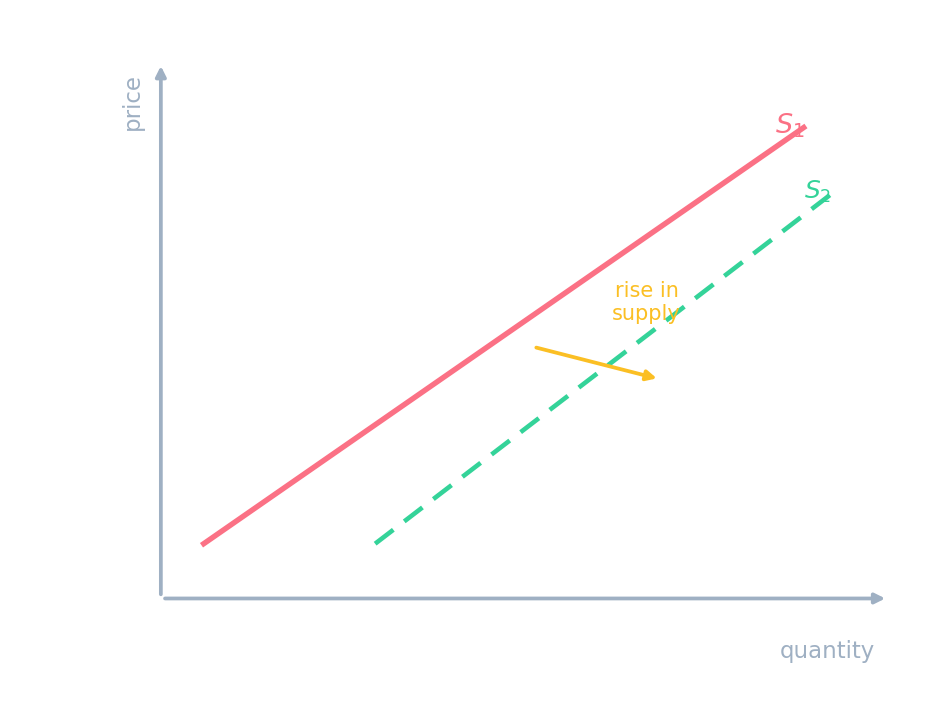
An indirect tax shifts supply left (here drawn as the shift between the two curves); a subsidy 补贴 shifts it right.
Taxes & subsidies
A tax lifts the supply curve; the new crossing sets a higher price.
A subsidy to producers shifts supply right because it:
Difficulty 1/5 · 100 coins + a small bonus on first completion today
A subsidy lowers effective cost, so firms supply more at each price.
Governments often pay a ______ to encourage merit goods like renewable energy.
Difficulty 1/5 · 100 coins + a small bonus on first completion today
A subsidy lowers cost and raises output of the merit good.
Subsidies
- A subsidy is a government payment to producers, lowering their costs and shifting supply right — encouraging output of merit goods (e.g. renewable energy).

A subsidy shifts supply down: lower price and higher quantity
When demand is inelastic, the burden of an indirect tax falls mainly on:
Difficulty 1/5 · 100 coins + a small bonus on first completion today
Inelastic demand means buyers keep buying, so the firm passes most of the tax on as a higher price.
Who really pays? (incidence 税负归宿)
- The incidence of a tax — who bears it — depends on elasticity 弹性:
- Demand inelastic → consumers bear most of the tax (price rises a lot).
- Demand elastic → producers bear most (they can't pass it on).
Tax revenue ≠ correcting the externality. A tax can raise revenue and cut output, but setting it exactly equal to the external cost (hard to measure) is what achieves the social optimum.
You've got it
- an indirect tax shifts supply left (raises price, cuts output); a subsidy shifts it right
- a Pigouvian tax set to the external cost reaches the social optimum
- tax incidence depends on elasticity: inelastic demand → consumers pay more