这个主题以 A Level 深度研究更广的经济:支出如何倍增、增长如何与环境联系、就业–价格的联系,以及货币。
宏观经济(A Level)
A-Level 经济学 · 第 9 主题
 8:33
8:33
The macroeconomy (A Level)
Look at one building going up. Someone is paying for steel, for concrete, for wages. But the story does not stop there. The builders take those wages home and…
英文讲解 · 内嵌中英文字幕
9.1
收入循环流转

大纲
- explain the circular flow of income, injections and leakages, and the multiplier (including the marginal propensities)
- explain the accelerator and the determinants of consumption, saving and investment
来源:剑桥国际大纲
收入循环流(circular flow of income)显示钱在家庭和企业之间传递。注入(injections)把钱加到流中(投资、政府支出、出口);漏出(leakages)把它取出(储蓄、税收、进口)。
The multiplier
一次注入把收入提高多于第一笔数额。这是乘数(multiplier)。当一个企业建造一个工厂时,建造者挣得收入,而他们花掉它的一部分,它变成别人的收入,如此等等。
再次花掉多少取决于边际消费倾向(marginal propensity to consume,MPC)——人们花在本国物品上的额外收入的比例。其余的漏出去。在一个简单的模型中:
$$\text{multiplier} = \frac{1}{1 - MPC}$$
一个更大的 MPC(更小的漏出)给出一个更大的乘数。主要的漏出由边际储蓄倾向(marginal propensity to save,MPS)和边际进口倾向(marginal propensity to import,MPM)测量。
例题。 在一个经济中 MPC 是 $0.8$。求乘数,然后求投资 $\text{\pounds} 10$ 十亿上升的效果。
$$\text{multiplier} = \frac{1}{1 - 0.8} = \frac{1}{0.2} = 5.$$
所以国民收入上升 $5 \times \text{\pounds} 10\text{ billion} = \text{\pounds} 50\text{ billion}$——原始注入的五倍。(因为所有收入要么被花掉要么被储蓄,$\text{MPC} + \text{MPS} = 1$,所以这里 $\text{MPS} = 0.2$ 而乘数也是 $1/\text{MPS}$。)

The accelerator
加速数(accelerator)说投资(investment)取决于产出的变化率。当需求快速上升时,企业需要大量新资本,所以投资跳升。当需求只是保持高时,投资回落。
What drives consumption, saving and investment
- 消费(consumption)和储蓄(saving)取决于可支配收入(disposable income,税后的收入)、财富、利率和信心。
- 投资取决于利率、预期利润、技术和商业信心。
探索
The circular flow and the multiplier
Income circles between households and firms. An injection (e.g. investment) is re-spent again and again — the multiplier effect.
探索
The multiplier, round by round
Drag the injection and the MPC, then press Play — each spending round is MPC times the last, and the total settles at k × the injection.
词汇表
训练
| 英文 | 中文 | 拼音 |
|---|---|---|
| circular flow of income | 收入循环流 | shōu rù xún huán liú |
| injections | 注入 | zhù rù |
| leakages | 漏出 | lòu chū |
| multiplier | 乘数 | chéng shù |
| marginal propensity to consume | 边际消费倾向 | biān jì xiāo fèi qīng xiàng |
| marginal propensity to save | 边际储蓄倾向 | biān jì chǔ xù qīng xiàng |
| marginal propensity to import | 边际进口倾向 | biān jì jìn kǒu qīng xiàng |
| accelerator | 加速数 | jiā sù shù |
| investment | 投资 | tóu zī |
| consumption | 消费 | xiāo fèi |
| saving | 储蓄 | chǔ xù |
| disposable income | 可支配收入 | kě zhī pèi shōu rù |
9.2
经济增长与可持续性

大纲
- distinguish actual and potential growth, output gaps and sustainable growth
- explain the costs and benefits of growth and the relationship between growth and sustainability
来源:剑桥国际大纲
经济增长(economic growth)是实际产出的一个上升。
- 实际增长(actual growth)是发生的真实产出上升。
- 潜在增长(potential growth)是经济能力的上升。
产出缺口(output gap)是实际产出和潜在产出之间的差。一个正缺口(实际在潜在之上)倾向于引起通货膨胀;一个负缺口(实际在潜在之下)意味着闲置产能和失业。

Sustainability
可持续增长(sustainable growth)是满足今天需要而不伤害后代满足他们需要的能力的增长。快速增长能用尽不可再生资源并引起污染,它威胁可持续性(sustainability)。所以一个国家必须把今天的增长与明天的环境和资源权衡。

探索
Economics case lab
Classify real examples by the economic idea they show.
词汇表
训练
| 英文 | 中文 | 拼音 |
|---|---|---|
| economic growth | 经济增长 | jīng jì zēng zhǎng |
| actual growth | 实际增长 | shí jì zēng zhǎng |
| potential growth | 潜在增长 | qián zài zēng zhǎng |
| output gap | 产出缺口 | chǎn chū quē kǒu |
| sustainable growth | 可持续增长 | kě chí xù zēng zhǎng |
| sustainability | 可持续性 | kě chí xù xìng |
9.3
就业/失业

大纲
- explain the measurement, types and causes of unemployment and the natural rate of unemployment
- explain the relationship between unemployment and inflation (the Phillips curve, short run and long run)
来源:剑桥国际大纲
失业(unemployment)以两种方式测量:申领救济人数(claimant count,申领福利的人)和更广的劳动力调查(labour force survey,一个被问及工作的样本)。
Types
- 摩擦性失业(frictional unemployment)——工作之间的短暂时期。
- 结构性失业(structural unemployment)——随着行业衰落,技能不再匹配工作。
- 周期性失业(cyclical unemployment)——由一个衰退中低的需求引起。
- 季节性失业(seasonal unemployment)——只在一年的某些时候工作。
The natural rate and the Phillips curve
自然失业率(natural rate of unemployment)是当劳动力市场处于平衡时剩下的失业(主要是摩擦性和结构性)。它不能只通过提高需求来消除。
菲利普斯曲线(Phillips curve)显示失业和通货膨胀之间的联系:
- 在短期,有一个取舍:更低的失业伴随着更高的通货膨胀,因为强的需求把工资和价格推高。
- 在长期,曲线在自然率处是竖直的。一旦人们预期通货膨胀,就没有持久的取舍——把失业推到自然率之下只加快通货膨胀。

探索
Development chain lab
Follow how policy and resources can change living standards.
词汇表
训练
| 英文 | 中文 | 拼音 |
|---|---|---|
| unemployment | 失业 | shī yè |
| claimant count | 申领救济人数 | shēn lǐng jiù jì rén shù |
| labour force survey | 劳动力调查 | láo dòng lì diào chá |
| frictional unemployment | 摩擦性失业 | mó cā xìng shī yè |
| structural unemployment | 结构性失业 | jié gòu xìng shī yè |
| cyclical unemployment | 周期性失业 | zhōu qī xìng shī yè |
| seasonal unemployment | 季节性失业 | jì jié xìng shī yè |
| natural rate of unemployment | 自然失业率 | zì rán shī yè lǜ |
| Phillips curve | 菲利普斯曲线 | fēi lì pǔ sī qū xiàn |
9.4
货币与银行

大纲
- explain the functions and characteristics of money and the role of the central bank and commercial banks
- explain the demand for money (liquidity preference), the money supply, and the determination of interest rates, including moral hazard
来源:剑桥国际大纲
What money does
货币(money)是任何在支付中被广泛接受的东西。它有四件工作:
- 一个交换媒介(medium of exchange)——用来买卖,避免物物交换。
- 一个价值储藏(store of value)——它随时间保持它的价值,所以你能储蓄它。
- 一个记账单位(unit of account)——一种测量和比较价格的共同方式。
- 一个延期支付标准(standard of deferred payment)——它让人们借款并以后偿还。
好的货币耐用、容易携带、容易分割、难以伪造,而且供应有限。
Banks
- 中央银行(central bank)发行纸币、运行货币政策、持有国家的储备,并对陷入困境的银行充当最后贷款人(lender of last resort)。
- 商业银行(commercial banks)接受存款并发放贷款。通过把存入的大部分借出去,银行系统创造货币。

The demand for money and interest rates
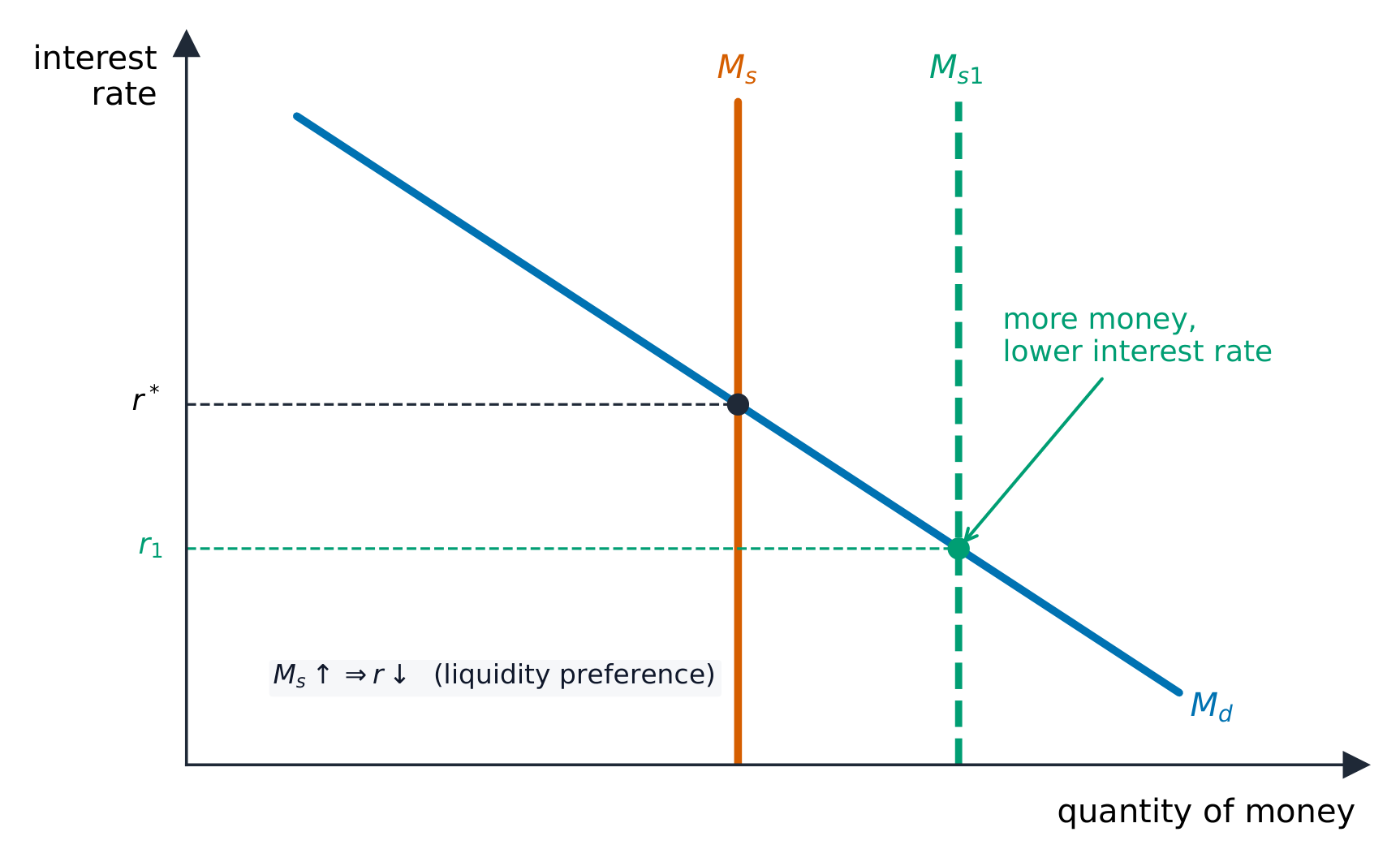
人们持有货币而不是其他资产是为了它的流动性(liquidity,它能立即被花掉)。货币需求(demand for money)——也叫流动性偏好(liquidity preference)——来自做日常支付、保持一个安全缓冲,以及准备好买资产的需要。
利率(interest rate)是借钱的价格。它在货币需求遇到货币供给(money supply)的地方被设定。一个更大的货币供给倾向于降低利率。
Moral hazard
道德风险(moral hazard)是这样的危险:银行承担更大的风险,因为它们预期若事情出错会被救援。若一个银行相信政府会救助它,它可能鲁莽地放贷——知道它保留收益但把损失转给别人。
探索
Economics case lab
Classify real examples by the economic idea they show.
词汇表
训练
| 英文 | 中文 | 拼音 |
|---|---|---|
| money | 货币 | huò bì |
| medium of exchange | 交换媒介 | jiāo huàn méi jiè |
| store of value | 价值储藏 | jià zhí chǔ cáng |
| unit of account | 记账单位 | jì zhàng dān wèi |
| standard of deferred payment | 延期支付标准 | yán qī zhī fù biāo zhǔn |
| central bank | 中央银行 | zhōng yāng yín háng |
| lender of last resort | 最后贷款人 | zuì hòu dài kuǎn rén |
| commercial bank | 商业银行 | shāng yè yín háng |
| liquidity | 流动性 | liú dòng xìng |
| demand for money | 货币需求 | huò bì xū qiú |
| liquidity preference | 流动性偏好 | liú dòng xìng piān hǎo |
| interest rate | 利率 | lì lǜ |
| money supply | 货币供给 | huò bì gōng jǐ |
| moral hazard | 道德风险 | dào dé fēng xiǎn |
9.4
考试技巧
- 计算乘数 $= 1 \div (1 - MPC) = 1 \div MPS$ 并把它应用于一次注入。
- 区分实际与潜在增长并把可持续性与长期能力联系起来。
- 解释货币的功能以及银行和中央银行的作用。
- 解释菲利普斯曲线取舍(失业对通货膨胀)以及为什么它在长期可能不成立。
本主题的互动课程
逐步学习,并即时检测练习。