The circular flow and the multiplier
Introduced| English | Meaning |
|---|---|
| injection/ɪnˈdʒekʃn/ | Spending entering the circular flow from investment, government purchases and exports. |
| multiplier/ˌmʌltɪˈplaɪə/ | A number by which another quantity is multiplied. |
| national income/ˈnæʃənl ˈɪŋkʌm/ | The aggregate income earned from an economy's production over a specified period. |
| withdrawals/wɪθˈdrɔːlz/ | Saving, taxes and import spending that remove expenditure from the domestic circular flow of income. |
| marginal propensity to consume/ˈmɑːdʒɪnl prəˈpensɪti tə kənˈsjuːm/ | The proportion of an additional unit of disposable income that is spent on consumption. |
How one dollar becomes many
- Spend a dollar at a shop; the shopkeeper spends part of it; the next person spends part of that. One injection 注入 ripples through the economy.
- This multiplier 乘数 effect means a change in spending raises national income 国民收入 by more than the original amount.
The circular flow, revisited
- Income circulates between households and firms, with injections (I, G, X) adding in and withdrawals 漏出 (S, T, M) leaking out.

Injections (investment, government spending, exports) feed the loop; withdrawals (saving, taxes, imports) drain it.

Income circulates between households and firms, with injections and leakages
The circular flow and the multiplier
Income circles between households and firms. An injection (e.g. investment) is re-spent again and again — the multiplier effect.
Which is an injection into the circular flow?
Difficulty 1/5 · 100 coins + a small bonus on first completion today
Injections are I, G, X; saving, taxes and imports are withdrawals.
The multiplier
- Each round of re-spending depends on the marginal propensity to consume 边际消费倾向 (MPC):
Worked example. If MPC = 0.75, the multiplier $= \dfrac{1}{1 - 0.75} = \dfrac{1}{0.25} = 4$ — so £1bn of extra spending raises national income by £4bn.
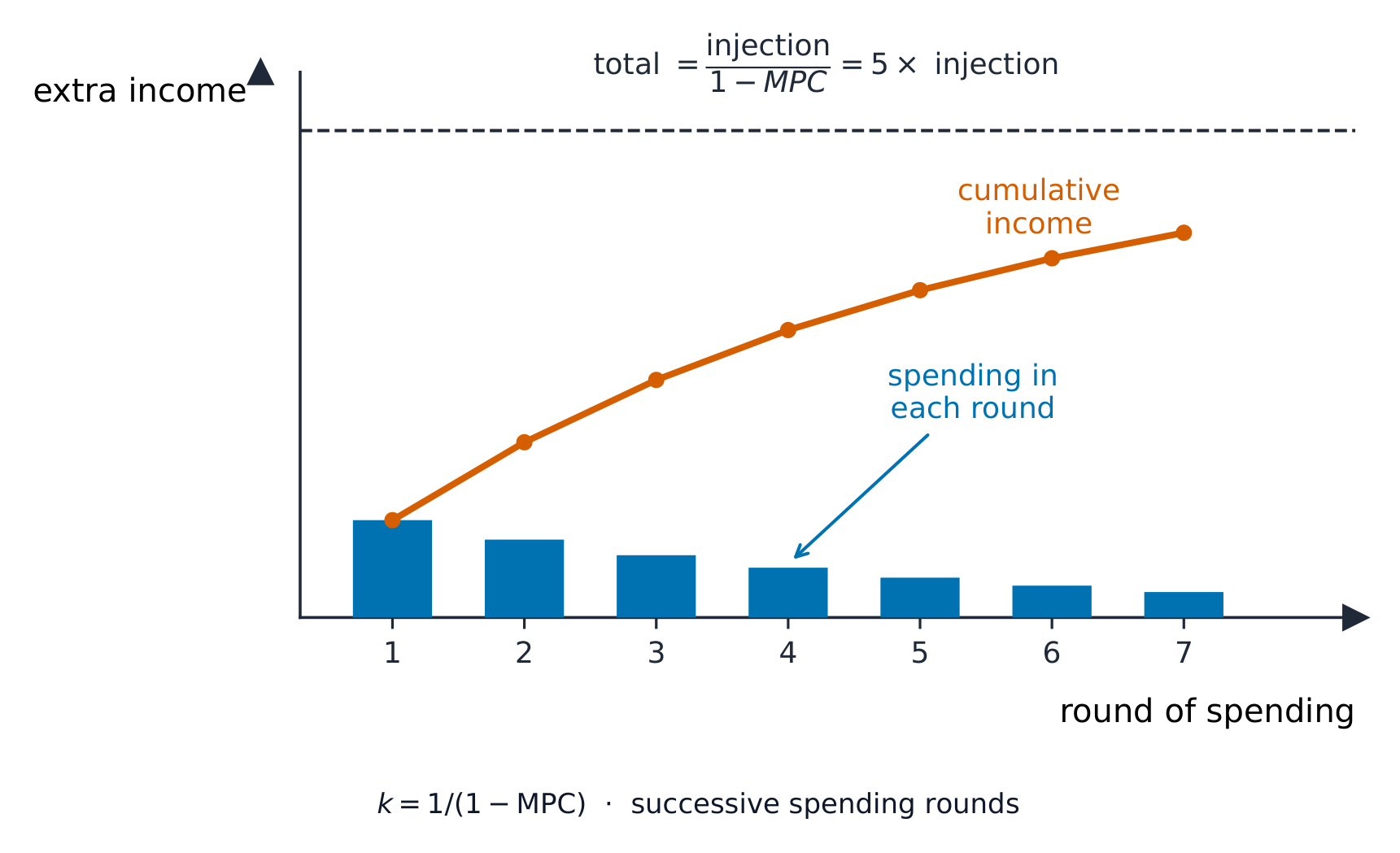
One injection multiplies into a larger rise in income
The multiplier, round by round
Drag the injection and the MPC, then press Play — each spending round is MPC times the last, and the total settles at k × the injection. Bigger leaks, smaller ripple.
If the marginal propensity to consume is 0.75, what is the multiplier = 1/(1 − MPC)?
Difficulty 2/5 · 140 coins + a small bonus on first completion today
1 / (1 − 0.75) = 1 / 0.25 = 4.
With a multiplier of 4, by how much does national income rise if spending increases by 2 billion?
Difficulty 2/5 · 140 coins + a small bonus on first completion today
4 × 2 billion = 8 billion.
The multiplier equals 1 / (1 − ______).
Difficulty 1/5 · 100 coins + a small bonus on first completion today
Multiplier = 1/(1 − MPC).
What weakens the multiplier
- The bigger the withdrawals (high saving, taxes, or import spending), the smaller the multiplier — more leaks out each round.

Actual output around its potential, showing output gaps
A higher rate of saving or imports increases the size of the multiplier.
Difficulty 1/5 · 100 coins + a small bonus on first completion today
False. More income leaks out of the circular flow in each round, so less is re-spent and the multiplier is smaller: k = 1 / (MPS + MPT + MPM).
You've got it
- an injection ripples through re-spending — the multiplier effect
- multiplier $= \dfrac{1}{1 - MPC}$ (MPC 0.75 → multiplier 4)
- bigger withdrawals (saving, tax, imports) → smaller multiplier
Write from a multiplier of 5
- The marginal propensity to consume is 0.8 in a simple economy.
- An injection of 12 enters the circular flow.
What is the multiplier, and by how much does income rise?
One fifth of extra income is withdrawn, so the multiplier is 5.
What is the multiplier when the propensity to consume is 0.8?
Difficulty 1/5 · 100 coins + a small bonus on first completion today
1 divided by 0.2 is 5.