Money and banking
Introduced| English | Meaning |
|---|---|
| barter/ˈbɑːtə/ | The direct exchange of goods or services without using money. |
| medium of exchange/ˈmiːdɪəm ɒv eksˈtʃeɪndʒ/ | Something generally accepted as payment for goods and services. |
| unit of account/ˈjuːnɪt ɒv əˈkaʊnt/ | A common measure used to state prices, debts and the value of goods or services. |
| store of value/stɔː ɒv ˈvæljuː/ | Something that allows purchasing power to be held for future use. |
| commercial banks/kəˈmɜːʃl bæŋks/ | Financial institutions that accept deposits, provide payment services and lend to customers. |
| central bank/ˈsentrəl bæŋk/ | The institution responsible for a country's monetary policy and the management of its currency and banking reserves. |
| interest rate/ˈɪntrest reɪt/ | The interest charged or paid over a period, expressed as a percentage of the relevant principal. |
| lender of last resort/ˈlendə ɒv læst rɪˈzɔːt/ | An institution, usually a central bank, providing emergency liquidity when other sources are unavailable. |
| money supply/ˈmʌni səˈplaɪ/ | The stock of money available in an economy at a particular time, measured using a specified definition. |
What money actually does
- We take money for granted — but a working economy needs something everyone trusts to swap for goods. Strip money away and you're back to barter 物物交换.
- Money, and the banks that create and move it, are the plumbing of the whole economy.
Economics case lab
Classify real examples by the economic idea they show.
Match each function of money to its meaning.
Difficulty 2/5 · 140 coins + a small bonus on first completion today
The four classic functions of money.
The functions of money

Commercial banks 商业银行 take deposits and make loans, creating most of the money in the economy
Using money to compare the value of different goods is its role as a:
Difficulty 1/5 · 100 coins + a small bonus on first completion today
A unit of account lets us measure and compare values.
Commercial banks create money when they make loans.
Difficulty 1/5 · 100 coins + a small bonus on first completion today
Lending creates new deposits — most money is bank-created credit, not cash.
Which is a role of the central bank?
Difficulty 1/5 · 100 coins + a small bonus on first completion today
The central bank sets rates, regulates banks and acts as lender of last resort.
Banks and the central bank 中央银行
- Commercial banks take deposits and make loans — and in lending, they create money (credit).
- The central bank sets interest rates 利率, is the lender of last resort 最后贷款人, and regulates the banking system.
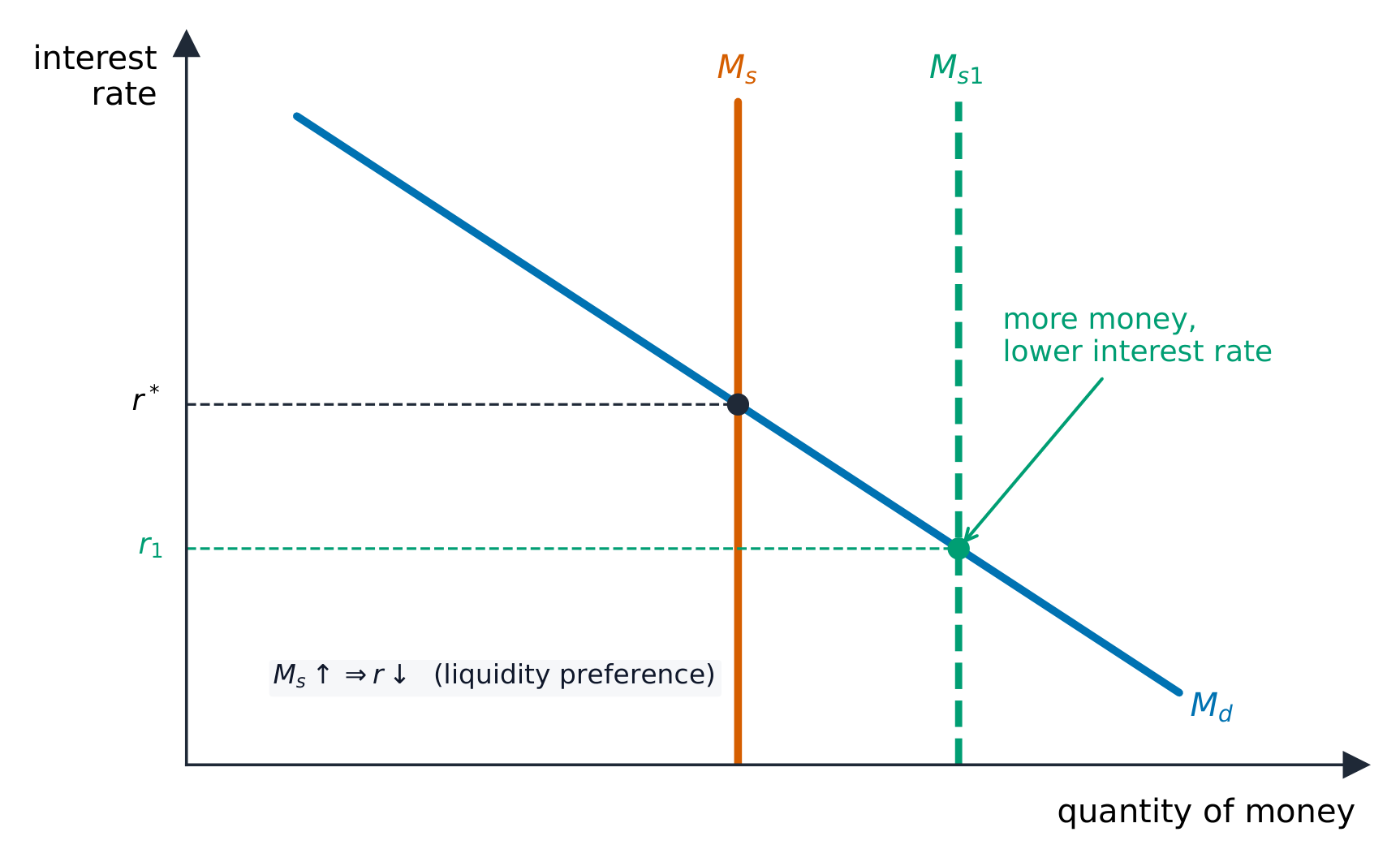
The interest rate set by the demand for and supply of money
The interest rate is the price of ______ money.
Difficulty 1/5 · 100 coins + a small bonus on first completion today
It is what borrowers pay (and savers receive).
Interest rates and the money supply 货币供给
- The interest rate is the price of borrowing money; the money supply is the total money in the economy.
- The central bank adjusts these to control inflation and support the economy (monetary policy).
Banks create most money. Most money isn't cash printed by the state — it's bank deposits created when commercial banks lend. That's why regulating lending matters.
You've got it
- money's four functions: medium of exchange, unit of account, store of value, standard of deferred payment
- commercial banks create money by lending; the central bank sets rates + is lender of last resort
- the interest rate is the price of borrowing; the money supply is total money