English
Big Idea 4 — Systems Interactions: Biological systems interact, and these systems and their interactions exhibit complex properties.
Learning Objective 1.1.A: Explain how the properties of water that result from its polarity and hydrogen bonding affect its biological function.
- 1.1.A.1 Living systems depend on the properties of water to sustain life.
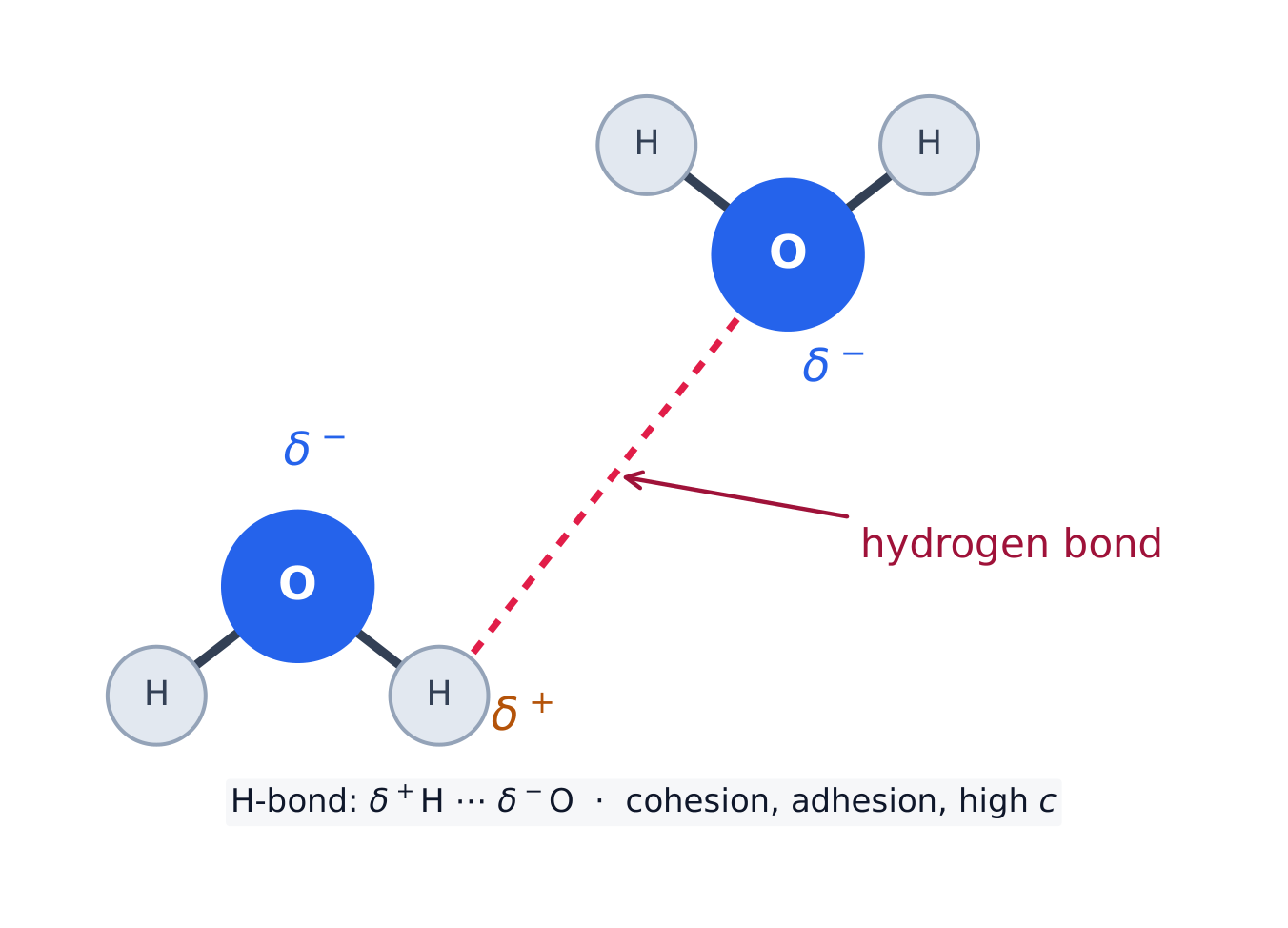
- 1.1.A.1.i Water has polarity, because of the formation of polar covalent bonds between hydrogen and oxygen within water molecules. This polarity contributes to hydrogen bonding between and within biological molecules.
- 1.1.A.1.ii Water has a high specific heat capacity, which allows for the maintenance of homeostatic body temperature within living organisms.
- 1.1.A.1.iii Water has a high heat of vaporization, which allows for the evaporative cooling of the surrounding environment. In living organisms, this property allows for body temperature to be maintained.
- 1.1.A.2 The hydrogen bonds between adjacent polar water molecules result in cohesion, adhesion, and surface tension.
한국어
핵심 개념 4 — 시스템 상호작용: 생물학적 시스템은 상호작용하며, 이러한 시스템과 그 상호작용은 복잡한 성질을 나타냅니다.
학습 목표 1.1.A: 물의 극성과 수소 결합으로 인해 발생하는 성질이 생물학적 기능에 미치는 영향을 설명하십시오.
- 1.1.A.1 생명 시스템은 생명을 유지하기 위해 물의 성질에 의존합니다.
- 1.1.A.1.i 물은 분자 내 수소와 산소 사이의 극성 공유 결합 형성으로 인해 극성을 띱니다. 이 극성은 생물학적 분자 사이 및 내부의 수소 결합에 기여합니다.
- 1.1.A.1.ii 물은 높은 비열을 가지고 있어, 생물체 내에서 항상 체온을 유지할 수 있게 합니다.
- 1.1.A.1.iii 물은 높은 증발열을 가지고 있어 주변 환경의 증발 냉각을 가능하게 합니다. 생물체에서는 이 성질로 인해 체온을 유지할 수 있습니다.
- 1.1.A.2 인접한 극성 물 분자 사이의 수소 결합은 응집력, 흡착력, 표면 장력을 유발합니다.