Nucleic Acids
Introduced| English |
|---|
| nucleic acid/njuːˈklɪɪk ˈæsɪd/ |
| nucleotides/ˈnjuːklɪɒtaɪdz/ |
| nitrogen base/ˈnaɪtrədʒn beɪs/ |
| double helix/ˈdʌbl ˈhiːlɪks/ |
| complementary base pairing/ˌkɒmplɪˈmentəri beɪs ˈpeərɪŋ/ |
The molecule of information
- One family of molecules stores the instructions for building a whole organism.
- These are the nucleic acids: DNA and RNA.
- They do not do chemistry like enzymes — they store and carry a code.
- That code is written in a four-letter alphabet.
Nucleotides: the building blocks
- A nucleic acid 核酸 is a polymer of small units called nucleotides 核苷酸.
- Each nucleotide has three parts: a phosphate, a sugar, and a nitrogen base 碱基.
- There are four bases in DNA: A, T, C, and G.
- The order of these bases is the genetic message.
A nucleotide is made of a phosphate, a sugar, and a…
Each nucleotide = phosphate + sugar + a nitrogen base (A, T, C, G, or U).
DNA: the double helix
- DNA is two strands twisted into a double helix 双螺旋.
- The strands are held together by pairs of bases across the middle.
- Complementary base pairing 互补碱基配对: A always pairs with T, and C with G.
- So one strand is a template that exactly predicts the other.
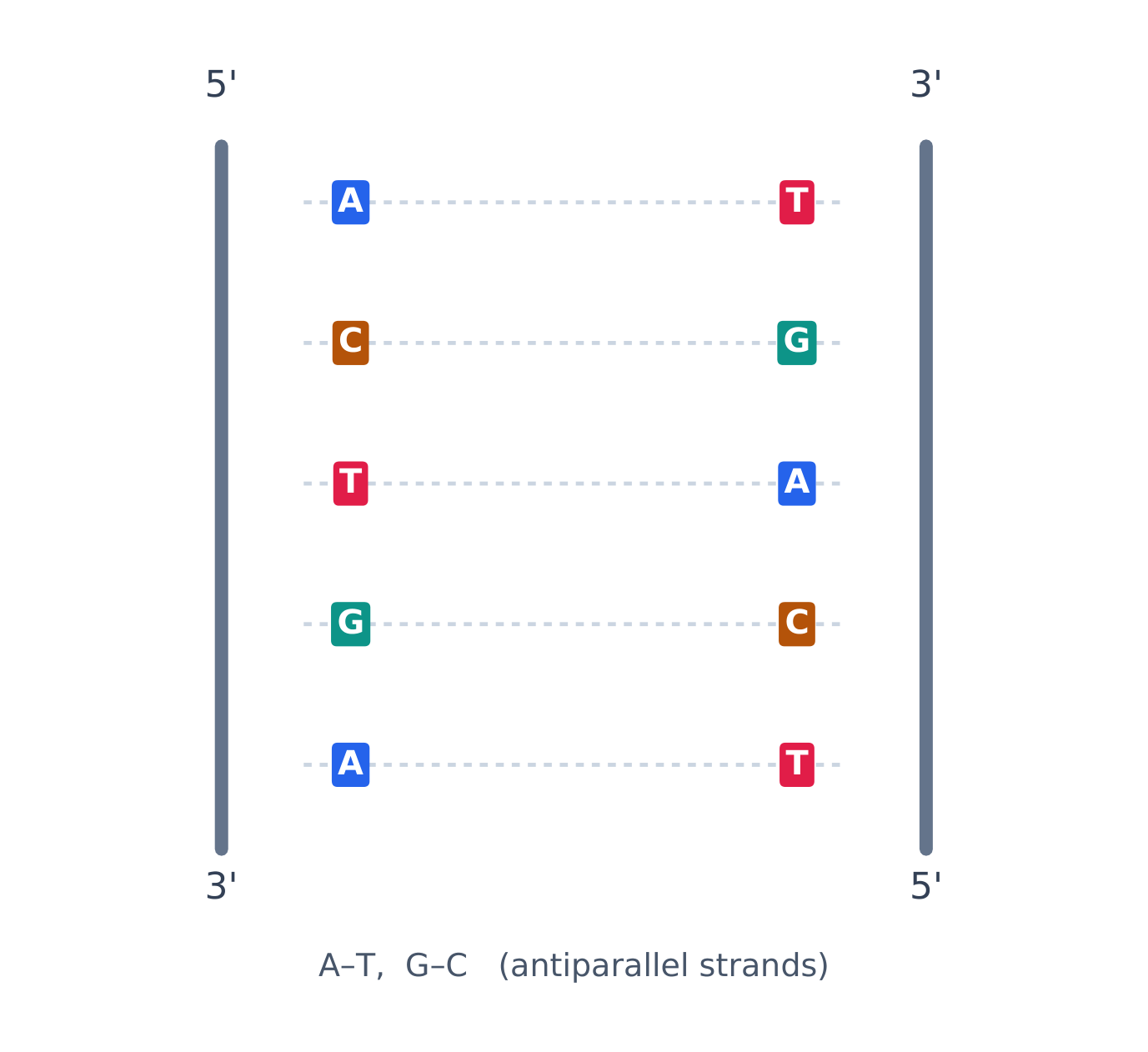
In DNA, which base always pairs with adenine (A)?
A pairs with T, and C pairs with G — this is complementary base pairing.
The twisted-ladder shape of DNA is called a double ____.
DNA is a double helix — two strands wound around each other like a spiral staircase.
RNA: the working copy
- RNA is usually a single strand, not a double helix.
- It uses the base uracil (U) in place of thymine (T).
- RNA carries copies of the DNA message out to where proteins are built.
- DNA is the master library; RNA is the photocopy you carry around.
DNA or RNA?
Sort each feature by whether it belongs to DNA, RNA, or both nucleic acids.
RNA uses the base uracil (U) where DNA uses thymine (T).
RNA replaces thymine with uracil and is usually a single strand.
Select all true statements about nucleic acids.
Nucleic acids are nucleotide chains, not lipids. The other three are correct.
Do not confuse a nucleotide with a nucleic acid. A nucleotide is one building block (phosphate + sugar + base); a nucleic acid is the whole chain of thousands of them, like DNA.
Reading a template strand:
- If one DNA strand reads $\text{A–T–G–C}$…
- …its partner must read $\text{T–A–C–G}$ — each base pairs with its complement.
- This pairing is how DNA is copied exactly before a cell divides.
Nucleic acids are chains of nucleotides (phosphate + sugar + base). DNA is a double helix whose bases follow complementary base pairing (A–T, C–G), storing the genetic code. RNA is a single strand that uses uracil and carries copies of that code.