Introduction to Macromolecules
Introduced| English |
|---|
| monomer/ˈmɒnəʊmə/ |
| polymer/ˈpɒlɪmə/ |
| condensation reaction/kɒndenˈseɪʃn rɪˈækʃn/ |
| hydrolysis/haɪˈdrɒləsɪs/ |
Big molecules from small parts
- The largest molecules in a cell are built like a train — many identical carriages linked in a row.
- Cells make these giants from small, repeating building blocks.
- The same trick — join small parts into a chain — builds most of what a cell is made of.
- Four families of these giant molecules run all of life.
Monomers and polymers
- A monomer 单体 is a single small building-block molecule.
- A polymer 聚合物 is a long chain of many monomers linked together.
- Think beads (monomers) threaded into a necklace (polymer).
- Different monomers give polymers with completely different jobs.
A polymer is best described as…
A polymer is a large molecule made by linking many small monomer subunits into a chain.
Condensation joins them
- To link two monomers, the cell runs a condensation reaction 缩合反应.
- Each new bond releases one molecule of water.
- Do this many times and a short monomer becomes a long polymer.
- This is how the cell builds starch, proteins, and DNA.
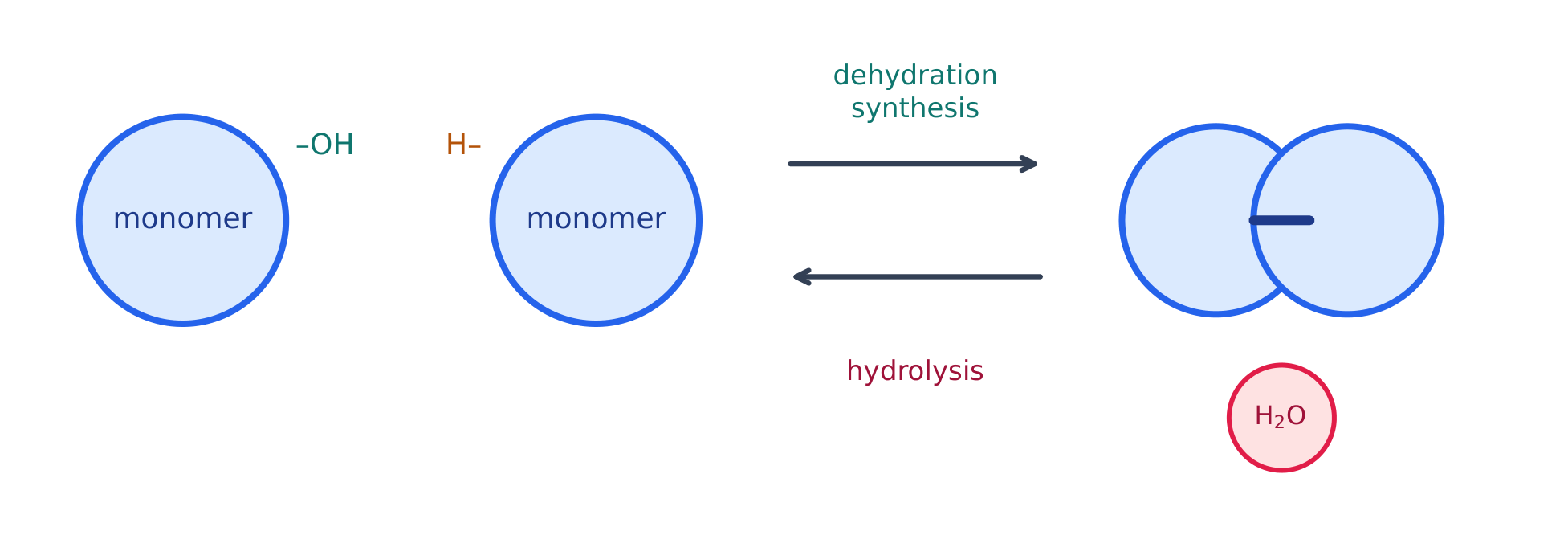
A condensation reaction releases a molecule of water each time it joins two monomers.
Condensation joins monomers and removes one water molecule per bond formed.
Hydrolysis breaks them
- The reverse reaction is hydrolysis 水解 — "splitting with water".
- Adding a water molecule breaks the bond between two monomers.
- This is how digestion breaks big food molecules into small ones.
- Condensation builds up; hydrolysis breaks down.
Breaking a polymer by adding water is called ____.
Hydrolysis ("water-splitting") adds water to break the bond — the reverse of condensation.
The four families
- Carbohydrates: sugar monomers, for quick energy and structure.
- Proteins: amino-acid monomers, doing thousands of different jobs.
- Nucleic acids: nucleotide monomers, storing genetic information.
- Lipids: fats and oils — the odd one out, not built as a true polymer.
Which macromolecule?
Sort each example into its macromolecule family by its building block and job.
Which of these is not one of the four biological macromolecule families?
The four families are carbohydrates, lipids, proteins, and nucleic acids — metals are not macromolecules.
Select all true statements about macromolecules.
Macromolecules are carbon-based, not metallic. The other three statements are correct.
Lipids are usually grouped with the macromolecules, but they are not true polymers — they are not long chains of one repeating monomer. Do not describe a fat as a "polymer of fatty acids" the way starch is a polymer of glucose.
Starch, step by step:
- One glucose monomer joins another by condensation, releasing water.
- Repeat hundreds of times to build a long starch polymer.
- To use it, the cell runs hydrolysis, adding water to release glucose again.
Big biological molecules are polymers — chains of small monomers. A condensation reaction joins monomers and releases water; hydrolysis adds water to break them apart. The four families are carbohydrates, proteins, nucleic acids, and lipids (the odd one, not a true polymer).