Structure of Water and Hydrogen Bonding
Introduced| English |
|---|
| polar molecule/ˈpəʊlə ˈmɒlɪkjuːl/ |
| electronegativity/ɪˌlektrəʊŋɡəˈtɪvɪti/ |
| partial charge/ˈpɑːʃl tʃɑːdʒ/ |
| hydrogen bond/ˈhaɪdrədʒn bɒnd/ |
| cohesion/kəʊˈhiːʒn/ |
| surface tension/ˈsɜːfɪs ˈtenʃn/ |
| adhesion/ədˈhiːʒn/ |
| specific heat/spəˈsɪfɪk hiːt/ |
| solvent/ˈsɒlvənt/ |
The strangest ordinary liquid
- Life started in water, and your cells are about 70% water.
- Water does things most small molecules cannot: it climbs up trees, beads on a leaf, and resists sudden temperature change.
- All of these "superpowers" come from one feature of the water molecule.
- That feature is its shape and the way it shares electrons.
Roughly what percentage of a typical cell is water?
Cells are about 70% water — water is the medium in which the chemistry of life happens.
Water is a polar molecule
- Water is $\text{H}_2\text{O}$: one oxygen joined to two hydrogens in a bent shape.
- Oxygen has a stronger pull on electrons — a higher electronegativity 电负性 — than hydrogen.
- So the shared electrons sit closer to the oxygen.
- This gives oxygen a small negative partial charge 部分电荷 and each hydrogen a small positive one.
- A molecule with separated charge like this is a polar molecule 极性分子.
Why is a water molecule polar?
Oxygen has a higher electronegativity, so the electrons sit closer to it — giving oxygen a partial negative and the hydrogens a partial positive charge.
Opposite charges pull: hydrogen bonds
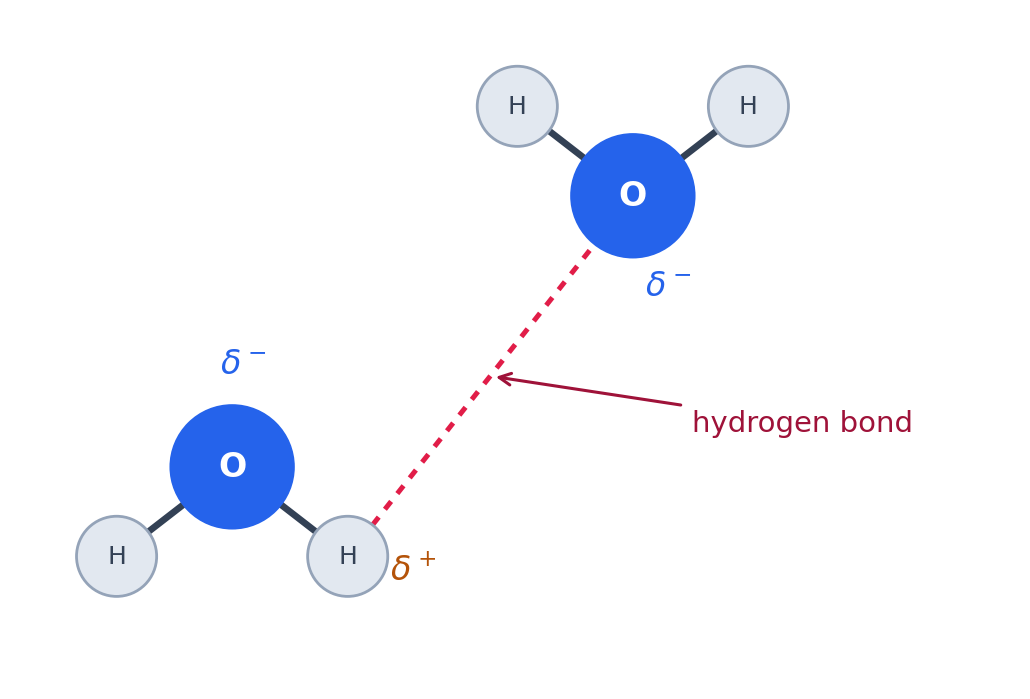
- The positive H of one water molecule is attracted to the negative O of another.
- This weak attraction is a hydrogen bond 氢键.
- Each water molecule can hydrogen-bond to several neighbours at once.
Sticking together and to other things
- Cohesion 内聚力 is water sticking to itself — hydrogen bonds hold the molecules together.
- Cohesion creates surface tension 表面张力, letting insects walk on a pond.
- Adhesion 附着力 is water sticking to other surfaces.
- Together, cohesion and adhesion pull water up narrow tubes (capillary action), helping water rise in a plant.
Water sticking to itself is called ____.
Cohesion is water molecules holding onto each other through hydrogen bonds; sticking to other surfaces is adhesion.
A single hydrogen bond is weak — far weaker than the bonds inside the molecule. Water's power comes from having a huge number of them, constantly breaking and re-forming.
A single hydrogen bond is stronger than the bond holding an O and H together inside a water molecule.
A single hydrogen bond is weak. Water is powerful because it has an enormous number of them.
Select all the properties of water that come from hydrogen bonding.
Cohesion, high specific heat, and solvent behaviour all come from hydrogen bonding. Being made of H and O is just its composition.
Water resists temperature change
- Water has a high specific heat 比热容: it takes a lot of energy to warm it up.
- The energy first goes into breaking hydrogen bonds, not into raising the temperature.
- This buffers cells and whole oceans against sudden temperature swings.
- Water is also an excellent solvent 溶剂 — its polar molecules surround and dissolve other polar and charged substances.
Will it dissolve in water?
Sort substances by whether water — a polar solvent — can dissolve them.
Why does sweating cool you down?
- To evaporate, water molecules must break their hydrogen bonds — which takes energy.
- They take that energy (as heat) from your skin.
- So as sweat evaporates, it carries heat away and your body cools.
Sweating cools you because evaporating water...
Evaporation must break hydrogen bonds, which needs energy. That energy is taken as heat from your skin, cooling you.
Water is a polar molecule, so its molecules form hydrogen bonds. Those bonds explain cohesion, adhesion, surface tension, a high specific heat, and water's power as a solvent — the properties that make life possible.