English
This handout covers Topic 2, Algebra and graphs. Parts marked (Extended) are only tested on the Extended papers; everything else is for both levels.
IGCSE 数学 · 知识点 2
 19:38
代数与图表
看看这座桥的主缆。那个曲线不是偶然的。每一根这样的缆绳都挂成相同的形状,一条简短的规则描述了……上每一点
英语旁白 · 英中内嵌字幕
This handout covers Topic 2, Algebra and graphs. Parts marked (Extended) are only tested on the Extended papers; everything else is for both levels.
| 学科内容 | 注释与示例 |
|---|---|
| 1 了解字母可以用来表示一般的数。 | |
| 2 将数字代入表达式和公式中。 |
| 学科内容 | 注释与示例 |
|---|---|
| 1 了解字母可以用来表示一般化的数。 | |
| 2 将数字代入表达式和公式中。 |
来源:Cambridge International 教学大纲
In algebra 代数 we use letters to stand for numbers. A letter whose value can change is a variable 变量. To substitute 代入 means to put a number in place of a letter.
Worked example. Find the value of $3x^{2} - 2y$ when $x = 4$ and $y = 5$.
跟随表达式运算流程,从合并同类项到求解。
| English | 中文 | 拼音 |
|---|---|---|
| algebra/ˈældʒɪbrə/ | 代数 | dài shù |
| variable/ˈveərɪəbl/ | 变量 | biàn liàng |
| substitute/ˈsʌbstɪtjuːt/ | 代入 | dài rù |

| 学科内容 | 注释与示例 |
|---|---|
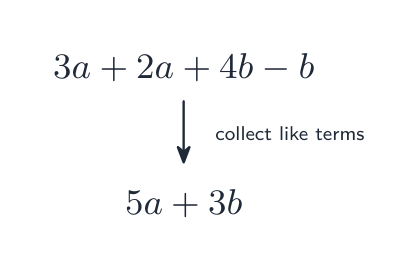
| 1 通过合并同类项简化表达式。 | 简化是指将答案化为最简形式,例如 $2a + 3b + 5a - 9b = 7a - 6b$。 |
| 2 展开代数表达式的乘积。 | 例如展开 $3x(2x - 4y)$。包括涉及一个变量的两个括号相乘的展开,例如展开 $(2x + 1)(x - 4)$。 |
| 3 提取公因式进行因式分解。 | 因式分解意味着要完全分解,例如 $9x^2 + 15xy = 3x(3x + 5y)$。 |
| 学科内容 | 注释与示例 |
|---|---|
| 1 通过合并同类项简化表达式。 | “简化”是指将答案化为最简形式,例如:$2a^2 + 3ab - 1 + 5a^2 - 9ab + 4 = 7a^2 - 6ab + 3$。 |
| 2 展开代数表达式的乘积。 | 例如:展开 $3x(2x - 4y)$,$(3x + y)(x - 4y)$。包括超过两个括号的乘积,例如:展开 $(x - 2)(x + 3)(2x + 1)$。 |
| 3 提取公因式进行因式分解。 | “因式分解”意味着要完全分解,例如:$9x^2 + 15xy = 3x(3x + 5y)$。 |
| 4 对以下形式的表达式进行因式分解: • $ax + bx + kay + kby$ • $a^2x^2 - b^2y^2$ • $a^2 + 2ab + b^2$ • $ax^2 + bx + c$ • $ax^3 + bx^2 + cx$ |
|
| 5 对形如 $ax^2 + bx + c$ 的表达式进行配方法(完成平方)。 |
来源:Cambridge International 教学大纲
A term 项 is a single part of an expression 表达式, such as $5a$ or $-9b$. Like terms 同类项 have the same letters raised to the same powers; you may add or subtract them. The number in front of the letter is the coefficient 系数.
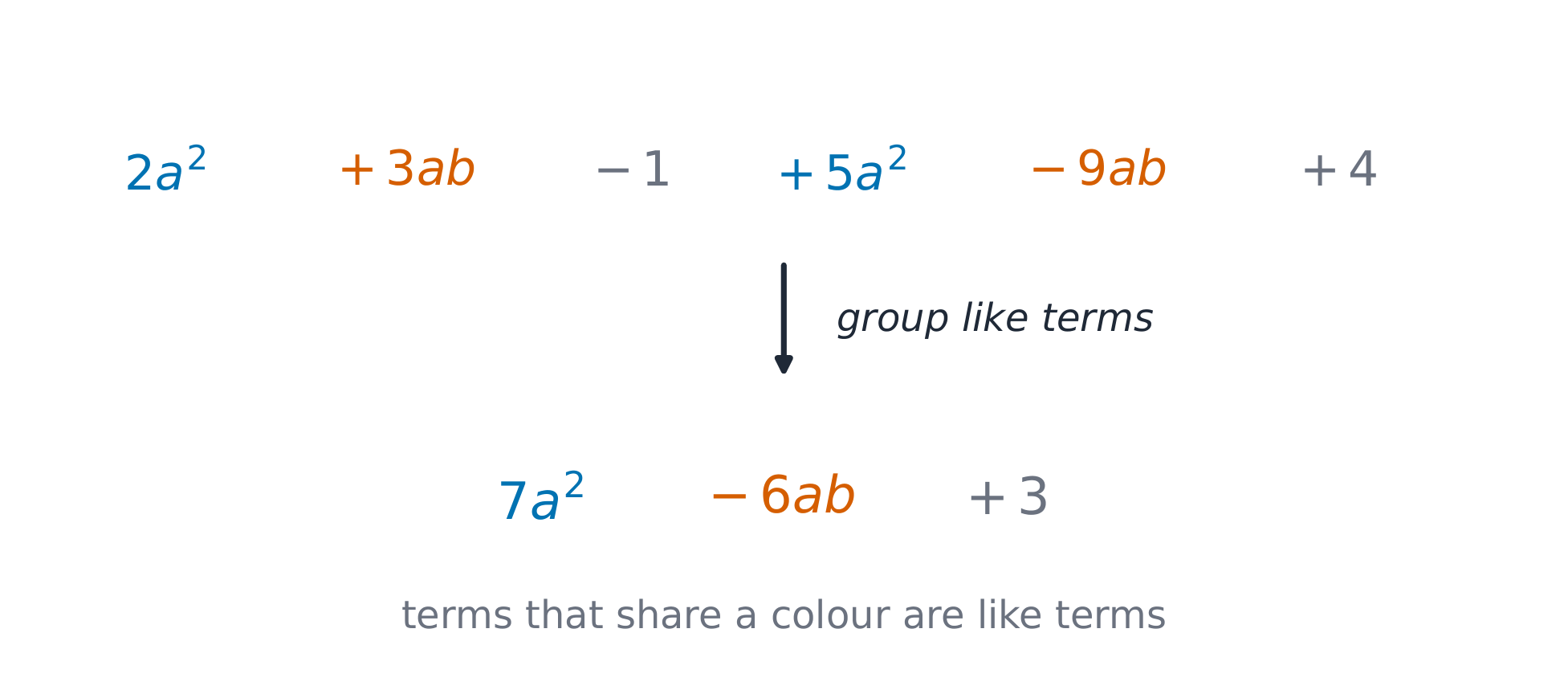
Worked example. Simplify $2a^{2} + 3ab - 1 + 5a^{2} - 9ab + 4$.
Collect like terms: $2a^{2} + 5a^{2} = 7a^{2}$, $3ab - 9ab = -6ab$, $-1 + 4 = 3$. So the answer is
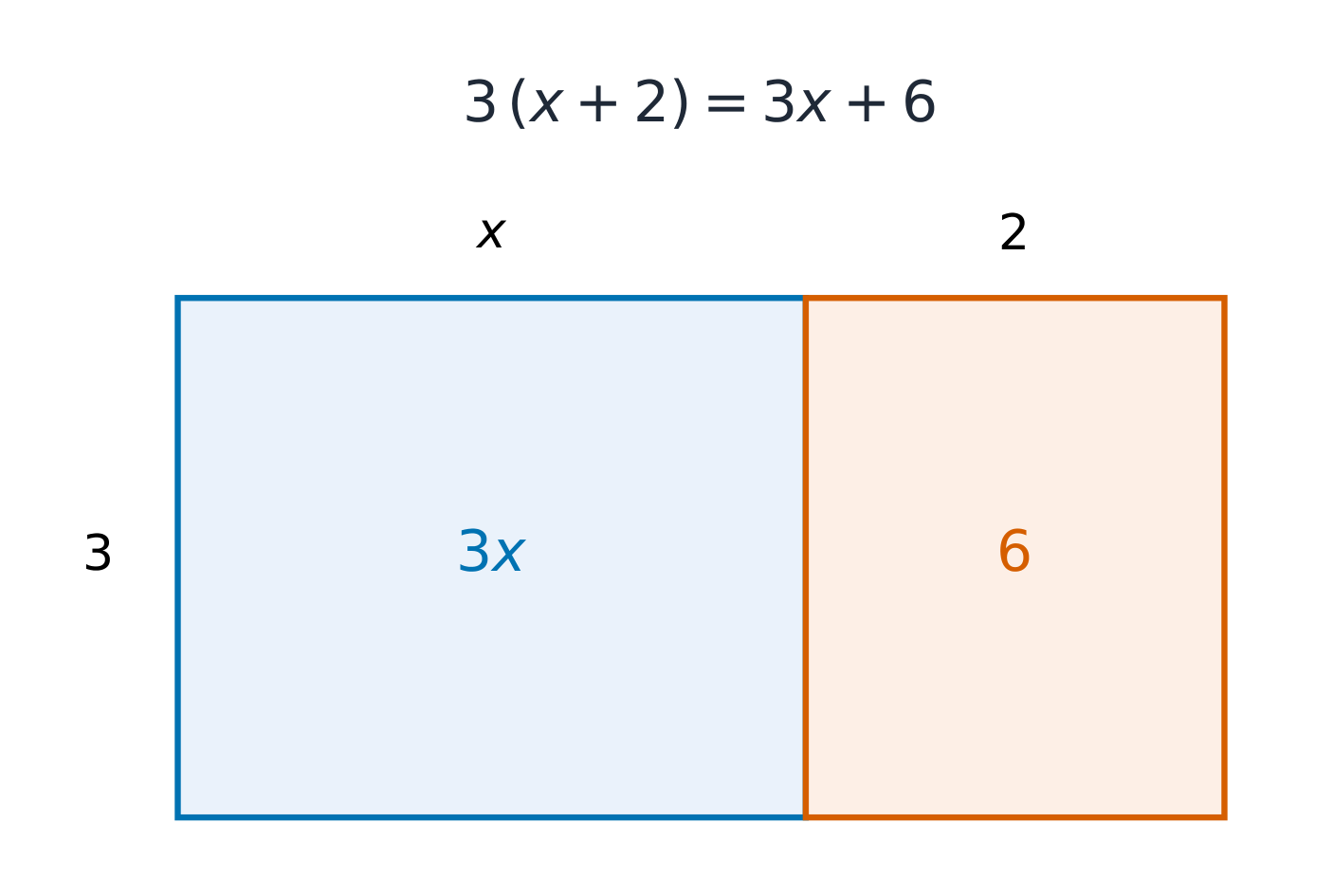
To expand 展开 means to multiply out brackets 括号. Multiply every term inside by the term outside; for two brackets, multiply every term in the first by every term in the second.
Worked examples.
Common mistakes. Multiplying only the first term inside a bracket ($3(x + 4) = 3x + 12$, not $3x + 4$), losing a minus sign ($-2(x - 5) = -2x + 10$), and writing $(x + 3)^{2} = x^{2} + 9$. Squaring a bracket gives three terms: $(x + 3)^{2} = x^{2} + 6x + 9$.
For three brackets (Extended), expand two first, then multiply by the third:
| English | 中文 | 拼音 |
|---|---|---|
| term/tɜːm/ | 项 | xiàng |
| expression/ekˈspreʃn/ | 表达式 | biǎo dá shì |
| like terms/laɪk tɜːmz/ | 同类项 | tóng lèi xiàng |
| coefficient/ˌkəʊɪˈfɪʃənt/ | 系数 | xì shù |
| expand/ekˈspænd/ | 展开 | zhǎn kāi |
| brackets/ˈbrækɪts/ | 括号 | kuò hào |
| 学科内容 | 注释与示例 |
|---|---|
| 1 通过合并同类项简化表达式。 | 简化是指将答案化为最简形式,例如 $2a + 3b + 5a - 9b = 7a - 6b$。 |
| 2 展开代数表达式的乘积。 | 例如展开 $3x(2x - 4y)$。包括涉及一个变量的两个括号相乘的展开,例如展开 $(2x + 1)(x - 4)$。 |
| 3 提取公因式进行因式分解。 | 因式分解意味着要完全分解,例如 $9x^2 + 15xy = 3x(3x + 5y)$。 |
| 学科内容 | 注释与示例 |
|---|---|
| 1 通过合并同类项简化表达式。 | “简化”是指将答案化为最简形式,例如:$2a^2 + 3ab - 1 + 5a^2 - 9ab + 4 = 7a^2 - 6ab + 3$。 |
| 2 展开代数表达式的乘积。 | 例如:展开 $3x(2x - 4y)$,$(3x + y)(x - 4y)$。包括超过两个括号的乘积,例如:展开 $(x - 2)(x + 3)(2x + 1)$。 |
| 3 提取公因式进行因式分解。 | “因式分解”意味着要完全分解,例如:$9x^2 + 15xy = 3x(3x + 5y)$。 |
| 4 对以下形式的表达式进行因式分解: • $ax + bx + kay + kby$ • $a^2x^2 - b^2y^2$ • $a^2 + 2ab + b^2$ • $ax^2 + bx + c$ • $ax^3 + bx^2 + cx$ |
|
| 5 对形如 $ax^2 + bx + c$ 的表达式进行配方法(完成平方)。 |
来源:Cambridge International 教学大纲
To factorise 因式分解 is the opposite of expanding: write the expression as a product of brackets. Always take out the common factor 公因式 first.
Worked example. $9x^{2} + 15xy = 3x(3x + 5y)$, because $3x$ divides both terms.
The following patterns are Extended.
Grouping (four terms): take a common factor from each pair.
Difference of two squares 平方差: $a^{2} - b^{2} = (a + b)(a - b)$.
Perfect square 完全平方: $a^{2} + 2ab + b^{2} = (a + b)^{2}$.
Quadratic 二次 expressions $ax^{2} + bx + c$: find two numbers that multiply to $a \times c$ and add to $b$, then split the middle term.
Worked example. Factorise $2x^{2} + 7x + 3$.
Here $a \times c = 6$ and $b = 7$. The numbers $1$ and $6$ work. Split and group:
For $ax^{3} + bx^{2} + cx$, take out the common $x$ first: $2x^{3} + 7x^{2} + 3x = x(2x^{2} + 7x + 3) = x(x + 3)(2x + 1)$.
| English | 中文 | 拼音 |
|---|---|---|
| factorise/ˈfæktəraɪz/ | 因式分解 | yīn shì fēn jiě |
| common factor/ˈkɒmən ˈfæktə/ | 公因式 | gōng yīn shì |
| difference of two squares/ˈdɪfrəns ɒv tuː skweəz/ | 平方差 | píng fāng chà |
| perfect square/ˈpɜːfekt skweə/ | 完全平方 | wán quán píng fāng |
| quadratic/kwɒˈdrætɪk/ | 二次 | èr cì |

| 学科内容 | 注释与示例 |
|---|---|
| 1 通过合并同类项简化表达式。 | “简化”是指将答案化为最简形式,例如:$2a^2 + 3ab - 1 + 5a^2 - 9ab + 4 = 7a^2 - 6ab + 3$。 |
| 2 展开代数表达式的乘积。 | 例如:展开 $3x(2x - 4y)$,$(3x + y)(x - 4y)$。包括超过两个括号的乘积,例如:展开 $(x - 2)(x + 3)(2x + 1)$。 |
| 3 提取公因式进行因式分解。 | “因式分解”意味着要完全分解,例如:$9x^2 + 15xy = 3x(3x + 5y)$。 |
| 4 对以下形式的表达式进行因式分解: • $ax + bx + kay + kby$ • $a^2x^2 - b^2y^2$ • $a^2 + 2ab + b^2$ • $ax^2 + bx + c$ • $ax^3 + bx^2 + cx$ |
|
| 5 对形如 $ax^2 + bx + c$ 的表达式进行配方法(完成平方)。 |
来源:Cambridge International 教学大纲
Completing the square 配方法 rewrites $x^{2} + bx + c$ as $(x + p)^{2} + q$. Take half of the $x$-coefficient, square it, then balance.
Worked example. Write $x^{2} + 6x + 1$ in completed-square form.
Half of $6$ is $3$, and $3^{2} = 9$:
When the $x^{2}$ has a coefficient, take it out of the first two terms first:
| English | 中文 | 拼音 |
|---|---|---|
| completing the square/kəmˈpliːtɪŋ ðə skweə/ | 配方法 | pèi fāng fǎ |
| 学科内容 | 注释与示例 |
|---|---|
| 1 运算代数分式。 | 示例包括: • $\frac{x}{3} + \frac{x - 4}{2}$ • $\frac{2x}{3} - \frac{3(x - 5)}{2}$ • $\frac{3a}{4} \times \frac{9a}{10}$ • $\frac{3a}{4} \div \frac{9a}{10}$ • $\frac{1}{x - 2} + \frac{x + 1}{x - 3}$。 |
| 2 因式分解并化简有理表达式。 | 例如 $\frac{x^2 - 2x}{x^2 - 5x + 6}$。 |
来源:Cambridge International 教学大纲
An algebraic fraction 分式 has algebra on the top or bottom. Add and subtract using a common denominator; multiply and divide as with ordinary fractions.
Worked examples.
To simplify a rational expression 有理式, factorise the top and bottom, then cancel common brackets.
通过先因式分解再约分来化简代数分式。
| English | 中文 | 拼音 |
|---|---|---|
| algebraic fraction/ˌældʒɪˈbreɪɪk ˈfrækʃn/ | 分式 | fēn shì |
| rational expression/ˈræʃənl ekˈspreʃn/ | 有理式 | yǒu lǐ shì |
| 学科内容 | 注释与示例 |
|---|---|
| 1 理解并使用指数(正指数、零指数和负指数)。 | 例如:$2^x = 32$。求 $x$ 的值。 |
| 2 理解并使用指数法则。 | 例如:化简: • $(5x^3)^2$ • $12a^5 \div 3a^{-2}$ • $6x^7y^4 \times 5x^{-5}y$。 不要求掌握对数知识。 |
| 学科内容 | 注释与示例 |
|---|---|
| 1 理解并使用指数(正整数指数、零指数、负指数和分数指数)。 | 例如:求解: • $32^x = 2$ • $5^{x+1} = 25^x$。 |
| 2 理解并使用指数法则。 | 例如:化简: • $3x^{-4} \times \frac{2}{3}x^{\frac{1}{2}}$ • $\frac{2}{5}x^{\frac{1}{2}} \div 2x^{-2}$ • $\left(\frac{2x^5}{3}\right)^3$。 无需掌握对数知识。 |
来源:Cambridge International 教学大纲
The laws of indices 指数 work with letters too: $a^{m} \times a^{n} = a^{m+n}$, $a^{m} \div a^{n} = a^{m-n}$, and $(a^{m})^{n} = a^{mn}$.
Worked examples.
You can also solve simple index equations by writing both sides with the same base 底数.
Worked example. Solve $2^{x} = 32$. Since $32 = 2^{5}$, you get $x = 5$.
根据所使用的规则对指数法则示例进行分类。
| English | 中文 | 拼音 |
|---|---|---|
| indices/ˈɪndɪsiːz/ | 指数 | zhǐ shù |
| base/beɪs/ | 底数 | dǐ shù |

| 学科内容 | 注释与示例 |
|---|---|
| 1 构建简单的表达式、方程和公式。 | 例如:写出一个比 $n$ 大 2 的数的表达式。包括构建线性联立方程。 |
| 2 解含一个未知数的一元一次方程。 | 示例包括:• $3x + 4 = 10$ • $5 - 2x = 3(x + 7)$。 |
| 3 解含两个未知数的二元一次联立方程组。 | |
| 4 变换简单公式的主项(主语)。 | 例如:变换主项仅出现一次且不含主项的幂或根式的公式。 |
| 学科内容 | 说明与示例 |
|---|---|
| 1 构造表达式、方程和公式。 | 例如:写出两个连续偶数之积的表达式。包括构造联立方程。 |
| 2 求解单未知数线性方程。 | 示例包括: • $3x + 4 = 10$ • $5 - 2x = 3(x + 7)$。 |
| 3 求解分母为数值和线性代数式的分式方程。 | 示例包括: • $\frac{x}{2x + 1} = 4$ • $\frac{2}{x + 2} + \frac{3}{2x - 1} = 1$ • $\frac{x}{x + 2} = \frac{3}{x - 6}$。 |
| 4 求解双未知数联立线性方程组。 | |
| 5 求解包含一个线性方程和一个非线性方程的联立方程组。 | 其中幂次不超过二次。 |
| 6 通过因式分解、配方法和使用求根公式求解一元二次方程。 | 包括将一元二次表达式写成完全平方形式。考生可能需要以根式形式给出解。求根公式列于《公式表》中。 |
| 7 变换公式的主语(即换元/变形公式)。 | 例如:变换主语出现在两次或涉及主语的幂次或根号的公式。 |
来源:Cambridge International 教学大纲
An equation 方程 says two expressions are equal. To solve a linear 一次 equation, do the same operation to both sides until the unknown 未知数 is alone.
Worked example. Solve $5 - 2x = 3(x + 7)$.
Common mistake. Moving a term across the equals sign without changing its sign. Do the same thing to both sides instead: "subtract $21$ from both sides" makes the sign change automatic.
A fractional equation 分式方程 has the unknown in a denominator. Multiply both sides by the denominator to clear it.
Worked example. Solve $\dfrac{x}{2x + 1} = 4$.
Simultaneous equations 联立方程 are two equations solved together. For two linear equations, add or subtract to remove one letter.
Worked example. Solve $2x + y = 7$ and $3x - y = 8$.
Adding removes $y$: $5x = 15$, so $x = 3$. Then $y = 7 - 2(3) = 1$.

For one linear and one quadratic equation (Extended), substitute the linear into the curve.
Worked example. Solve $y = x + 2$ and $y = x^{2}$.
so $x = 2$ (giving $y = 4$) or $x = -1$ (giving $y = 1$).
There are three methods.
Worked example (formula). Solve $2x^{2} + 3x - 1 = 0$. Here $a = 2$, $b = 3$, $c = -1$:
To change the subject 公式变形 of a formula means to rearrange it so a chosen letter is alone on one side.
Worked example. Make $r$ the subject of $A = \pi r^{2}$ (Extended, because of the power).
When the letter appears twice (Extended), collect those terms and factorise. To make $x$ the subject of $y = \dfrac{x + 1}{x - 1}$:
y = ax² + bx + c
解意味着求根——曲线穿过 x 轴的地方。
| English | 中文 | 拼音 |
|---|---|---|
| equation/ɪˈkweɪʒn/ | 方程 | fāng chéng |
| linear/ˈlɪnɪə/ | 一次 | yī cì |
| unknown/ʌnˈnəʊn/ | 未知数 | wèi zhī shù |
| fractional equation/ˈfrækʃənl ɪˈkweɪʒn/ | 分式方程 | fēn shì fāng chéng |
| simultaneous equations/ˌsɪməlˈteɪnɪəs ɪˈkweɪʒnz/ | 联立方程 | lián lì fāng chéng |
| quadratic formula/kwɒˈdrætɪk ˈfɔːmjʊlə/ | 求根公式 | qiú gēn gōng shì |
| change the subject/tʃeɪndʒ ðə ˈsʌbdʒekt/ | 公式变形 | gōng shì biàn xíng |

| 学科内容 | 注释与示例 |
|---|---|
| 表示和解释不等式,包括在数轴上表示。 | 当在数轴上表示和解释不等式时:• 开圆圈应用于表示严格不等式(<, >)• 闭圆圈应用于表示包含端点的不等式($\leqslant$, $\geqslant$)例如 $-3 \leqslant x < 1$ |
| 学科内容 | 注释与示例 |
|---|---|
| 1 在数轴上表示和解释不等式。 | 在数轴上表示和解释不等式时: • 空心圆点应用于表示严格不等式(<, >) • 实心圆点应用于表示非严格不等式($\leqslant$, $\geqslant$)。例如:$-3 \leqslant x < 1$ |
| 2 构建、求解并解释线性不等式。 | 示例包括: • $3x < 2x + 4$ • $-3 \leqslant 3x - 2 < 7$。 |
| 3 在图形上表示和解释二元变量的线性不等式。 | 应遵循以下惯例: • 虚线应用于表示严格不等式(<, >) • 实线应用于表示非严格不等式($\leqslant$, $\geqslant$) • 阴影区域应用于表示不需要的区域(除非题目另有说明)。例如:$x < 1$ 和 $y \geqslant 1$ 的图像 |
| 4 列出定义给定区域的不等式。 | 不包括线性规划问题。 |
来源:Cambridge International 教学大纲
An inequality 不等式 uses $<$, $>$, $\leqslant$ or $\geqslant$. Solve it like an equation, but reverse the sign if you multiply or divide by a negative number.
Worked example. Solve $-3 \leqslant 3x - 2 < 7$.
Add $2$ to all parts, then divide by $3$:
Worked example. Solve $5 - 2x > 11$.
Dividing by $-2$ reverses the sign. Check with $x = -4$: $5 + 8 = 13 > 11$, which is correct.
Common mistake. Forgetting to reverse the sign when dividing by a negative number, which here would give the wrong answer $x > -3$.
On a number line 数轴, use an open circle for $<$ or $>$ (value not included) and a closed circle for $\leqslant$ or $\geqslant$ (value included).
An inequality in two letters describes a region 区域 of the graph. Draw the boundary line (broken for $<$ or $>$, solid for $\leqslant$ or $\geqslant$) and shade the unwanted side. You may also be asked to list the inequalities that define a given region.
y = ax + b
一个不等式询问直线在哪里高于或低于一个值。
| English | 中文 | 拼音 |
|---|---|---|
| inequality/ɪniːˈkwɒlɪti/ | 不等式 | bù děng shì |
| number line/ˈnʌmbə laɪn/ | 数轴 | shù zhóu |
| region/ˈriːdʒn/ | 区域 | qū yù |

| 学科内容 | 说明与示例 |
|---|---|
| 1 延续给定的数字序列或模式。 | 例如:写出该数列的接下来两项:1, 3, 6, 10, 15, ... , ... |
| 2 识别数列中的模式,包括项与项之间的规则,以及不同数列之间的关系。 | |
| 3 找出并使用以下数列的第 $n$ 项:(a) 线性 (b) 简单二次 (c) 简单三次。 | 例如:求 2, 5, 10, 17 的第 $n$ 项 |
| 教学内容 | 说明与示例 |
|---|---|
| 1 延续给定的数字序列或模式。 | 可使用下标表示法,例如 $T_n$ 是序列 $T$ 的第 $n$ 项。 |
| 2 识别数列中的模式,包括逐项规则以及不同数列之间的关系。 | 包括线性、二次、三次和指数数列,以及这些数列的简单组合。 |
| 3 找出并使用数列的 $n$ 项。 |
来源:Cambridge International 教学大纲
A sequence 数列 is a list of numbers that follow a rule. The term-to-term rule 递推规则 tells you how to get the next term from the one before.
To find the rule for the term in position $n$ (the $n$th term), look at how the terms change.
Linear sequence (the terms go up by the same amount each time). The difference is the multiple of $n$.
Worked example. Find the $n$th term of $2, 5, 8, 11, \dots$
The terms go up by $3$, so start with $3n$. Since $3 \times 1 = 3$ but the first term is $2$, subtract $1$: the $n$th term is $3n - 1$.
Quadratic sequence (the differences themselves change by the same amount). The second difference equals $2 \times$ the coefficient of $n^{2}$.
Worked example. Find the $n$th term of $2, 5, 10, 17, \dots$
First differences are $3, 5, 7$; the second difference is $2$, so the $n^{2}$ part is $1n^{2}$. Subtracting $n^{2}$ ($1, 4, 9, 16$) from the sequence leaves $1, 1, 1, 1$. So the $n$th term is $n^{2} + 1$.
A cubic 三次 sequence such as $1, 8, 27, 64, \dots$ has $n$th term $n^{3}$. An exponential sequence 指数数列 such as $2, 6, 18, 54, \dots$ multiplies by a fixed number each time; here the $n$th term is $2 \times 3^{\,n-1}$.
逐项构建等差数列(加d)或等比数列(乘r)。
| English | 中文 | 拼音 |
|---|---|---|
| sequence/ˈsiːkwəns/ | 数列 | shù liè |
| term-to-term rule/tɜːm tə tɜːm ruːl/ | 递推规则 | dì tuī guī zé |
| cubic/ˈkjuːbɪk/ | 三次 | sān cì |
| exponential sequence/ˌekspəˈnenʃl ˈsiːkwəns/ | 指数数列 | zhǐ shù shù liè |
| 学科内容 | 注释与示例 |
|---|---|
| 用代数形式表达正比和反比关系,并利用这种表达式求解未知量。 | 包括线性、平方、平方根、立方及立方根比例。需掌握比例符号($\propto$)的知识。 |
来源:Cambridge International 教学大纲
Two quantities are in direct proportion 正比例 if one is always a fixed multiple of the other: $y \propto x$ means $y = kx$, where $k$ is a constant 常数. They are in inverse proportion 反比例 if their product is constant: $y \propto \dfrac{1}{x}$ means $y = \dfrac{k}{x}$. The symbol $\propto$ is read "is proportional to". You can also have proportion to a square, square root, cube or cube root.
Worked example. $y$ is in direct proportion to $x$, and $y = 12$ when $x = 3$. Find $y$ when $x = 7$.
First find $k$: $12 = k \times 3$, so $k = 4$ and $y = 4x$. Then $y = 4 \times 7 = 28$.
y = a/x
反比例:x 翻倍,y 减半——一条带两条渐近线的倒数曲线。
| English | 中文 | 拼音 |
|---|---|---|
| direct proportion/daɪˈrekt prəˈpɔːʃn/ | 正比例 | zhèng bǐ lì |
| constant/ˈkɒnstənt/ | 常数 | cháng shù |
| inverse proportion/ɪnˈvɜːs prəˈpɔːʃn/ | 反比例 | fǎn bǐ lì |
| 学科内容 | 注释与示例 |
|---|---|
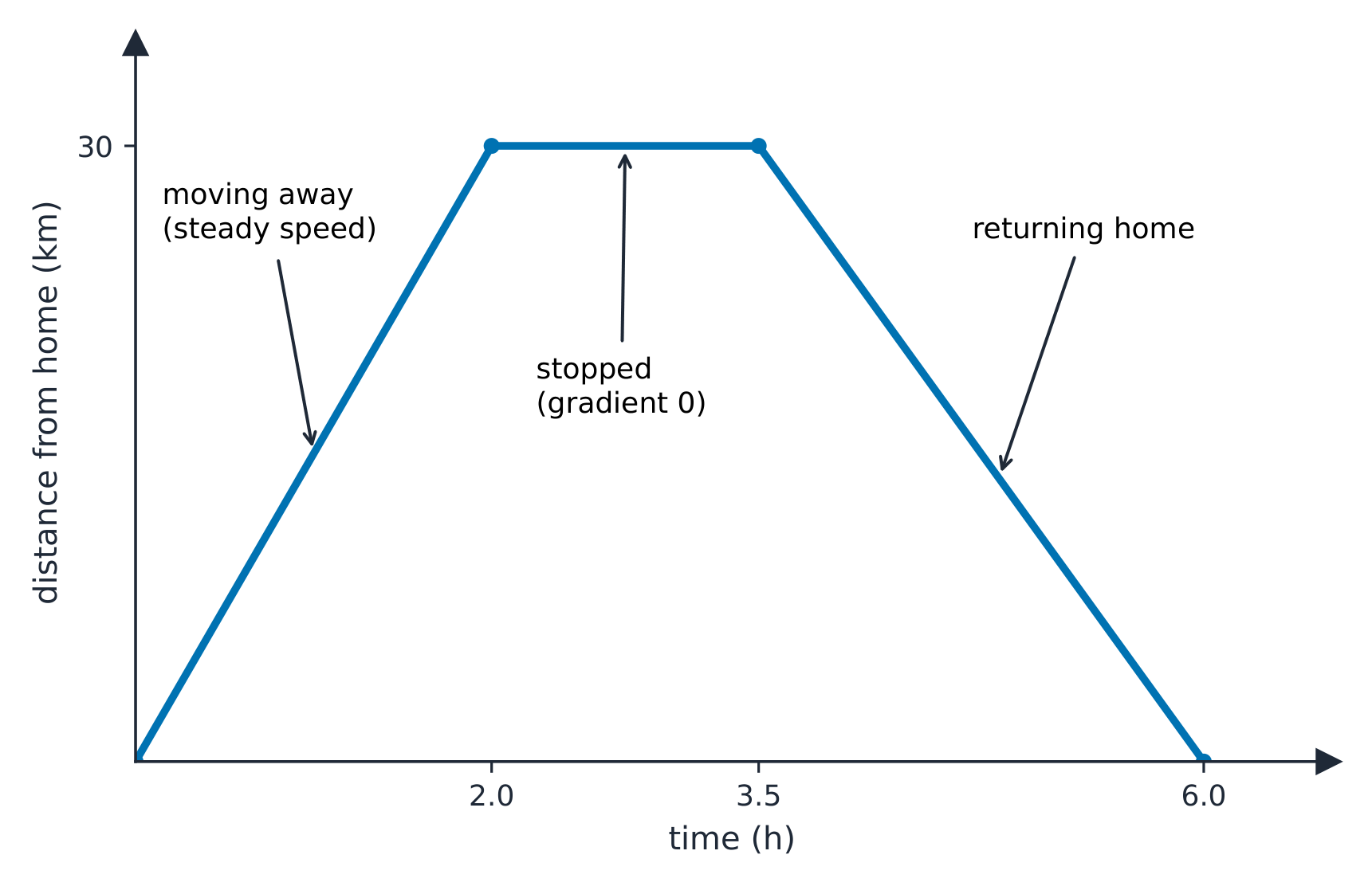
| 1 在实际情境中(包括行程图和换算图)使用并解读图表。 | 例如:将直线图的斜率解释为变化率。 |
| 2 根据给定数据绘制图表。 | 例如:绘制距离-时间图来表示一次旅程。 |
| 学科内容 | 备注与示例 |
|---|---|
| 1 在实际情境中使用和解读图表,包括行程图和换算图。 | 包括估算和解读某点处切线的斜率。 |
| 2 根据给定数据绘制图表。 | |
| 3 将变化率的概念应用于简单的运动学问题,涉及距离-时间图和速度-时间图、加速度与减速度。 | |
| 4 计算速度-时间图下方区域所表示的行驶距离。 | 区域仅涉及图表的线性部分。 |
来源:Cambridge International 教学大纲
The gradient 斜率 (steepness) of a graph shows a rate of change 变化率.
On a speed–time graph the gradient is the acceleration 加速度 (or deceleration 减速度 if the speed falls), and the area 面积 under the graph is the distance 距离 travelled.
Worked example. A car speeds up from rest to $20\text{ m/s}$ in $8\text{ s}$, then stays at $20\text{ m/s}$ for $12\text{ s}$. Find the acceleration and the total distance.
Acceleration $= \dfrac{20}{8} = 2.5\text{ m/s}^{2}$. The distance is the area: a triangle plus a rectangle,

y = ax + b
一个距离-时间或成本图从它的斜率和它的截距读取。
| English | 中文 | 拼音 |
|---|---|---|
| gradient/ˈɡreɪdɪənt/ | 斜率 | xié lǜ |
| rate of change/reɪt ɒv tʃeɪndʒ/ | 变化率 | biàn huà lǜ |
| travel graph/ˈtrævl ɡræf/ | 行程图 | xíng chéng tú |
| conversion graph/kənˈvɜːʃn ɡræf/ | 换算图 | huàn suàn tú |
| acceleration/əkˌseləˈreɪʃn/ | 加速度 | jiā sù dù |
| deceleration/dɪˌseləˈreɪʃn/ | 减速度 | jiǎn sù dù |
| area/ˈeərɪə/ | 面积 | miàn jī |
| distance/ˈdɪstəns/ | 距离 | jù lí |
| 学科内容 | 注释与示例 |
|---|---|
| 1 构造数值表,并绘制、识别和解释以下形式函数的图像: • $ax + b$ • $\pm x^2 + ax + b$ • $\frac{a}{x} \ (x \neq 0)$ 其中 $a$ 和 $b$ 为整数常数。 | |
| 2 通过图形方法求解相关方程,包括利用图形方法寻找和解释根。 | 例如:求直线与曲线的交点。 |
| 学科内容 | 备注与示例 |
|---|---|
| 1 构建数值表,并绘制、识别及解读以下形式函数的图像: • $a x^n$(包括至多三个此类项的和) • $a b^x + c$,其中 $n = -2, -1, -\frac{1}{2}, 0, \frac{1}{2}, 1, 2, 3$;$a$ 和 $c$ 为有理数;且 $b$ 为正整数。 | 示例包括: • $y = x^3 + x - 4$ • $y = 2x + \frac{3}{x^2}$ • $y = \frac{1}{4} \times 2^x$。 |
| 2 通过图形法解相关方程,包括利用图形法求根并解释根的含义。 | 例如:求直线与曲线的交点。 |
| 3 绘制并解读代表指数增长和衰减问题的图像。 |
来源:Cambridge International 教学大纲
To draw a graph, make a table of values 数值表: choose values of $x$, work out $y$, then plot the coordinates 坐标 and join them with a smooth curve.
The points where a graph crosses the $x$-axis (the horizontal axis 坐标轴) are the roots 根 — the solutions of $y = 0$.
You can solve an equation by reading a graph. The intersection point 交点 of a line and a curve gives the solution of the two equations together.
For exponential growth 指数增长 and exponential decay 指数衰减, consider $y = a\,b^{x} + c$ with $a>0$ and $b>0$, $b\ne1$. If $b>1$, the graph grows as $x$ increases and approaches $y=c$ as $x$ decreases. If $0<b<1$, it decays towards $y=c$ as $x$ increases.
y = ax² + bx + c
拖动a、b和c,观察抛物线的移动——其顶点和与坐标轴的交点。
| English | 中文 | 拼音 |
|---|---|---|
| table of values/ˈteɪbl ɒv ˈvæljuːz/ | 数值表 | shù zhí biǎo |
| coordinates/kəʊˈɔːdɪnəts/ | 坐标 | zuò biāo |
| axis/ˈæksɪs/ | 坐标轴 | zuò biāo zhóu |
| roots/ruːts/ | 根 | gēn |
| intersection point/ˌɪntəˈsekʃn pɔɪnt/ | 交点 | jiāo diǎn |
| exponential growth/ˌekspəˈnenʃl ɡrəʊθ/ | 指数增长 | zhǐ shù zēng zhǎng |
| exponential decay/ˌekspəˈnenʃl dɪˈkeɪ/ | 指数衰减 | zhǐ shù shuāi jiǎn |
| 内容要点 | 注释与示例 |
|---|---|
| 识别、绘制并解读以下函数的图像:(a) 一次函数 (b) 二次函数。 | 需要掌握对称性和根的知识。不要求掌握极值点(拐点)的知识。 |
| 学科内容 | 注释与示例 |
|---|---|
| 识别、绘制并解读以下函数的图像:(a) 一次函数 (b) 二次函数 (c) 三次函数 (d) 倒数函数 (e) 指数函数。 | 这些函数等价于: • $ax + by = c$ • $y = ax^2 + bx + c$ • $y = ax^3 + b$ • $y = ax^3 + bx^2 + cx$ • $y = \frac{a}{x} + b$ • $y = ar^x + b$ 其中 $a$,$b$ 和 $c$ 为有理数,$r$ 为正有理数。需要掌握极值点(转折点)、根及对称性的知识。需要掌握垂直渐近线和水平渐近线的知识。需要通过配方法求二次函数的极值点。 |
来源:Cambridge International 教学大纲
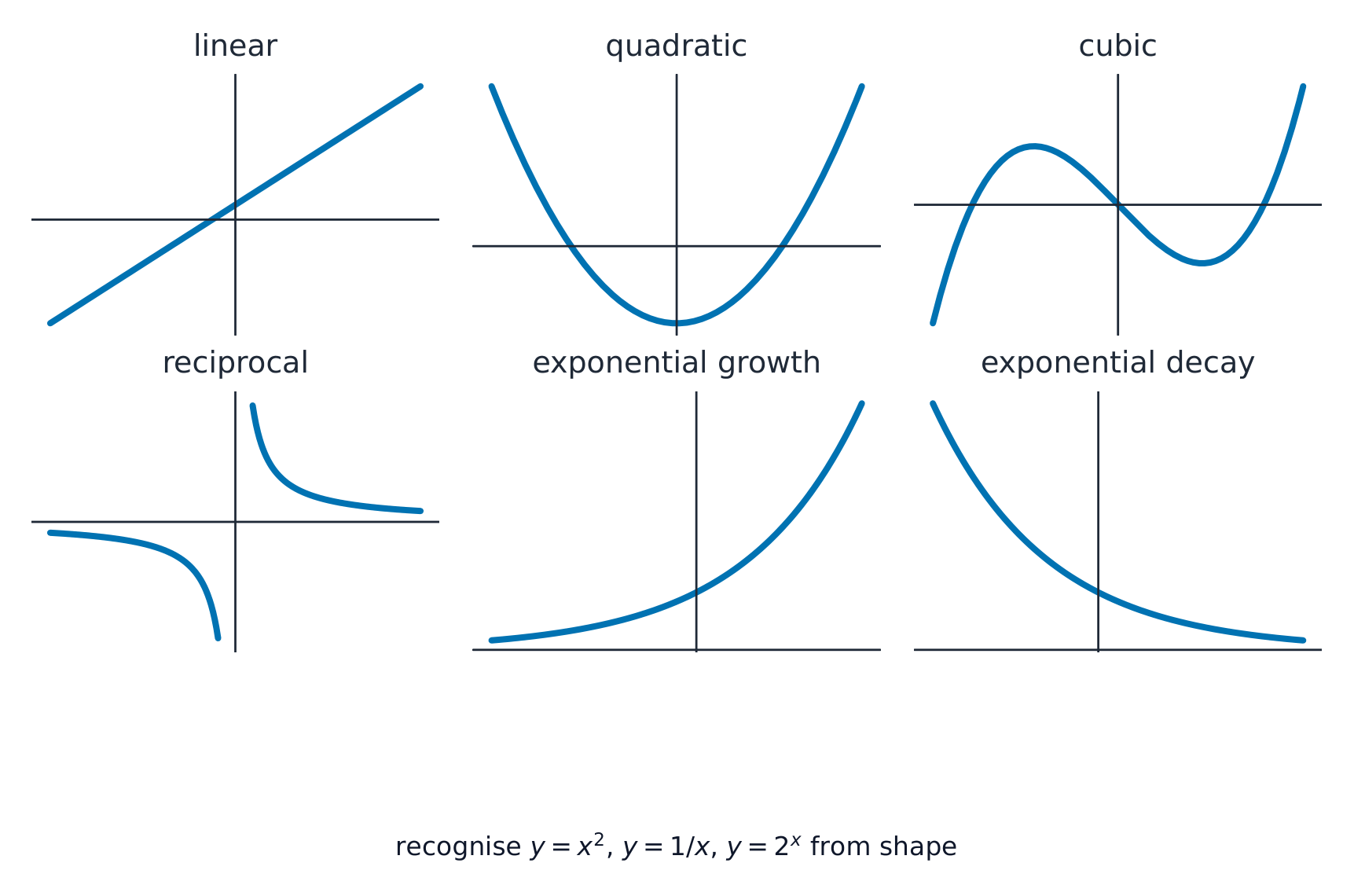
A quick sketch should show the right shape and the key features: where it crosses the axes, any symmetry 对称, and any line the curve gets close to.
| Function | Shape |
|---|---|
| linear, $y = mx + c$ | straight line; gradient $m$, $y$-intercept 截距 $c$ |
| quadratic, $y = ax^{2} + bx + c$ | a parabola 抛物线 (U-shape if $a>0$, $\cap$-shape if $a<0$) |
| cubic, $y = ax^{3} + bx + c$ | an S-shaped curve |
| reciprocal, $y = \dfrac{a}{x} + b$ | two separate curves |
| exponential, $y = a\,r^{x} + b$ | fast growth or decay |
For a parabola, completing the square gives the turning point 转折点 (the lowest or highest point). For example $y = (x + 3)^{2} - 8$ has its turning point at $(-3, -8)$.
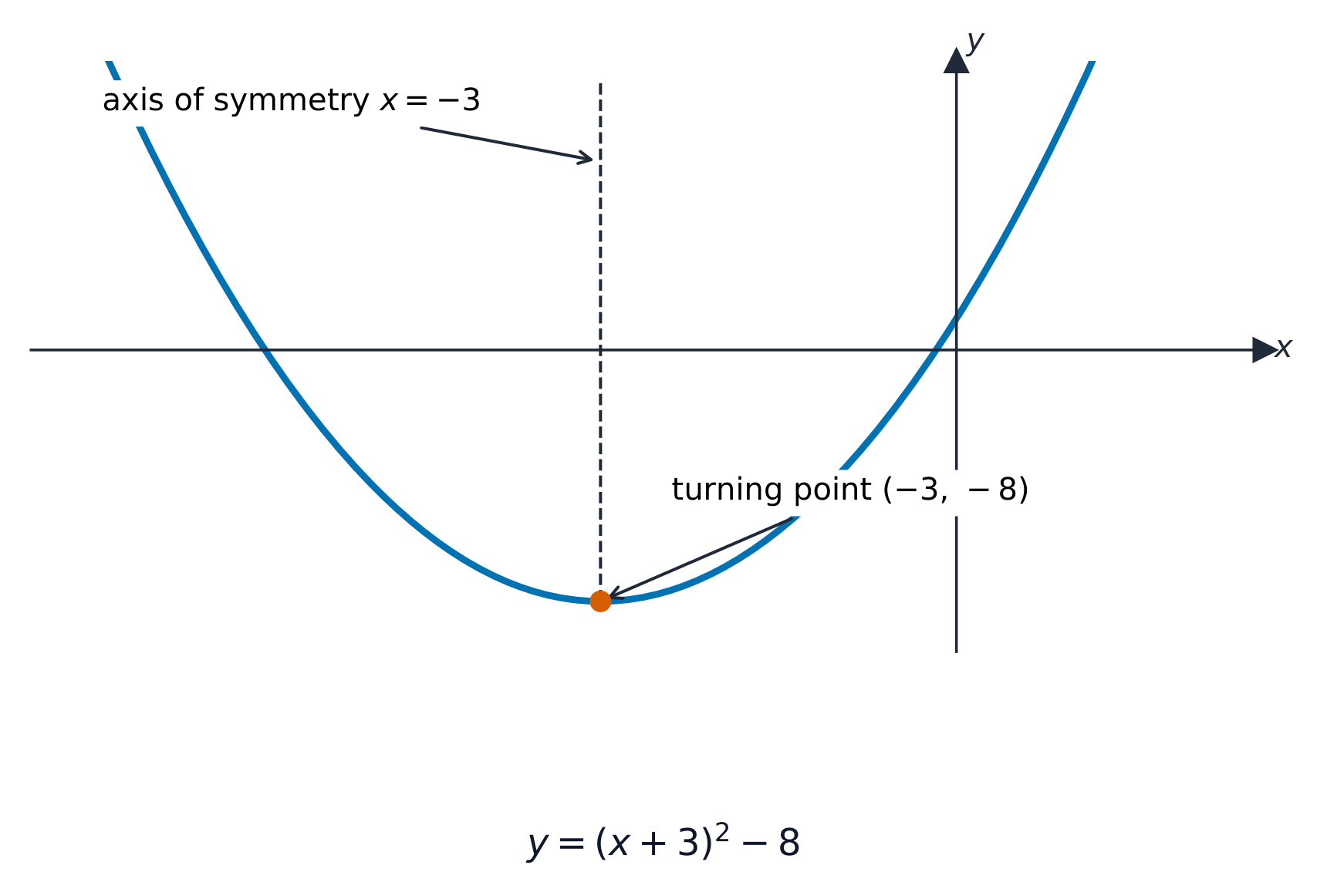
An asymptote 渐近线 is a line that the curve approaches in a stated limit. A curve may cross a horizontal asymptote elsewhere. In these examples the curve does not meet the stated line — for example, the $x$-axis for $y = \dfrac{a}{x}$, or the line $y = b$ for $y = a\,r^{x} + b$.
| English | 中文 | 拼音 |
|---|---|---|
| symmetry/ˈsɪmətri/ | 对称 | duì chèn |
| intercept/ˌɪntəˈsept/ | 截距 | jié jù |
| parabola/pəˈræbələ/ | 抛物线 | pāo wù xiàn |
| turning point/ˈtɜːnɪŋ pɔɪnt/ | 转折点 | zhuǎn zhé diǎn |
| asymptote/ˈæsɪmptəʊt/ | 渐近线 | jiàn jìn xiàn |
| 学科内容 | 备注与示例 |
|---|---|
| 1 通过绘制切线来估计曲线的斜率。 | |
| 2 对形如 $ax^n$ 的函数进行求导,其中 $a$ 为有理常数,$n$ 为正整数或零,以及对不超过三个此类函数的简单和式进行求导。 | 预期使用 $\frac{\mathrm{d}y}{\mathrm{d}x}$ 记号。 |
| 3 将微分应用于斜率和驻点(拐点/极值点)。 | |
| 4 通过任意方法区分极大值和极小值。 | 极大值和极小值点可通过以下方式识别:• 精确的草图 • 使用二阶微分 • 检查极值点两侧的斜率。考生无需识别拐点。 |
来源:Cambridge International 教学大纲
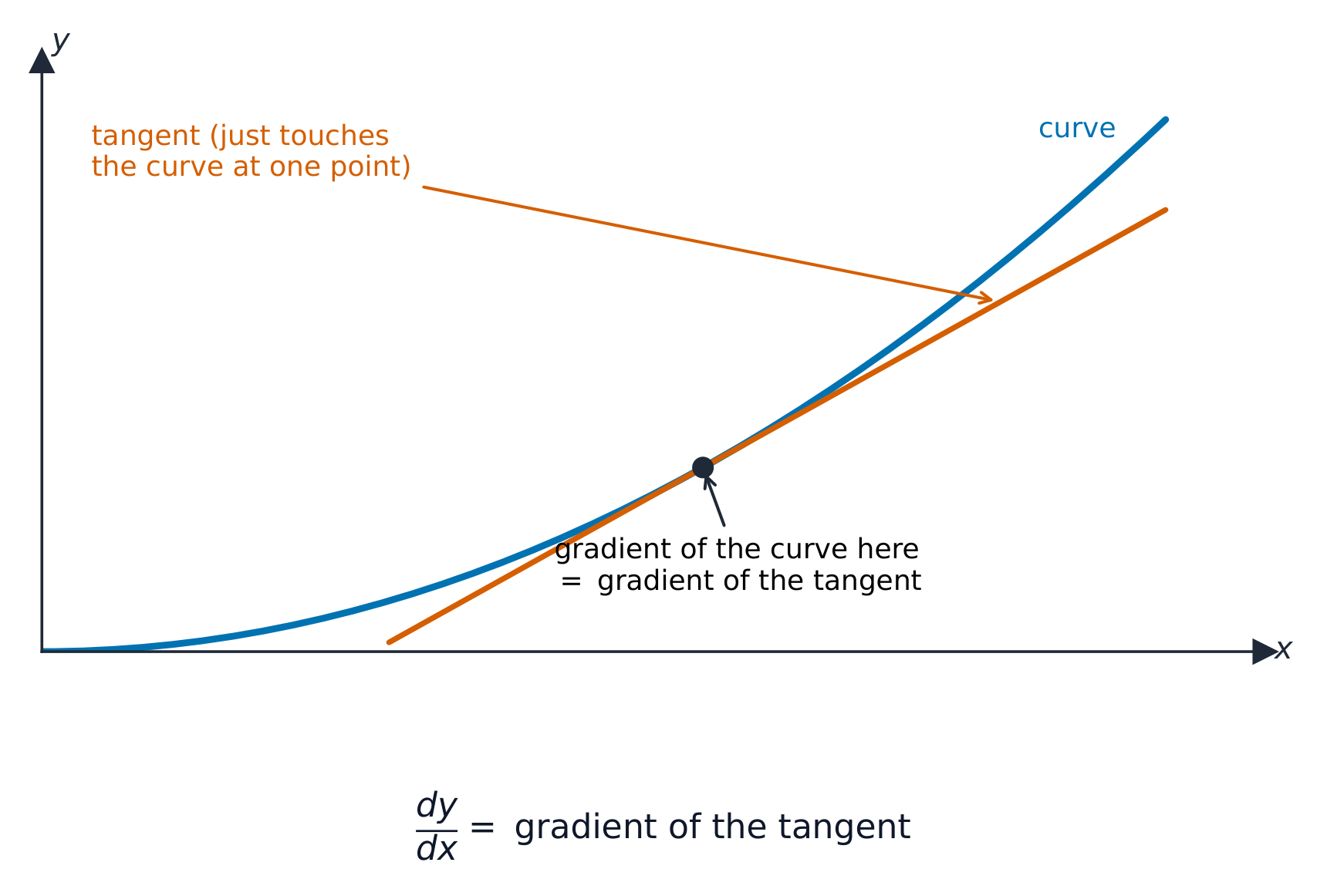
Differentiation 微分 finds the gradient of a curve where that gradient exists. You can estimate it by drawing a tangent 切线 (a line that just touches the curve) and measuring its gradient.
The exact rule: if $y = ax^{n}$, then the derivative 导数 is
Differentiate a sum term by term.
Worked example. If $y = x^{3} + 2x^{2} - 5x$, then $\dfrac{\mathrm{d}y}{\mathrm{d}x} = 3x^{2} + 4x - 5$.
A stationary point 驻点 is where the gradient is zero. It need not be a turning point: $y=x^3$ keeps increasing through its stationary point at the origin. To find stationary points, set $\dfrac{\mathrm{d}y}{\mathrm{d}x} = 0$.
Worked example. Find the turning point of $y = x^{2} - 6x + 5$.
The turning point is $(3, -4)$. To decide whether a turning point is a maximum 最大值 or a minimum 最小值, check the sign of the gradient on each side, or use the second derivative (positive means a minimum).
y = ax³ + bx² + cx + d
移动该点:切线显示该处的斜率,这正是微分所求的内容。
| English | 中文 | 拼音 |
|---|---|---|
| differentiation/ˌdɪfəˌrenʃɪˈeɪʃn/ | 微分 | wēi fēn |
| tangent/ˈtændʒənt/ | 切线 | qiē xiàn |
| derivative/dɪˈrɪvətɪv/ | 导数 | dǎo shù |
| stationary point/ˈsteɪʃənəri pɔɪnt/ | 驻点 | zhù diǎn |
| maximum/ˈmæksɪməm/ | 最大值 | zuì dà zhí |
| minimum/ˈmɪnɪməm/ | 最小值 | zuì xiǎo zhí |
| 学科内容 | 注释和示例 |
|---|---|
| 1 理解函数、定义域和值域,并使用函数记号。 | 示例包括:• $f(x) = 3x - 5$ • $g(x) = \frac{3(x + 4)}{5}$ • $h(x) = 2x^2 + 3$。 |
| 2 理解并求反函数 $f^{-1}(x)$。 | |
| 3 根据定义 $gf(x) = g(f(x))$ 构成复合函数。 | 例如:$f(x) = \frac{3}{x + 2}$ 且 $g(x) = (3x + 5)^2$。求 $fg(x)$。请将答案以最简分式形式给出。不要求考生求出复合函数的定义域和值域。本主题可能包含映射图。 |
来源:Cambridge International 教学大纲
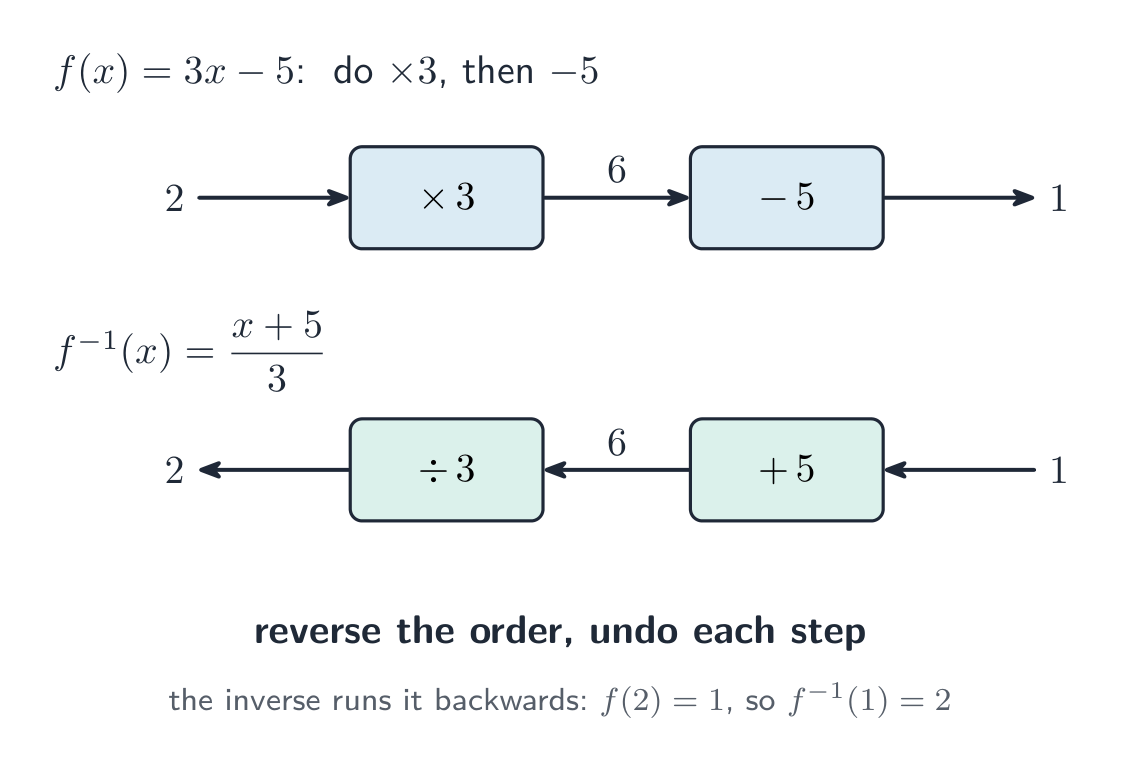
A function 函数 turns each input into one output. We write $f(x)$, for example $f(x) = 3x - 5$, so $f(2) = 1$. The set of allowed inputs is the domain 定义域; the set of possible outputs is the range 值域.
The inverse function 反函数 $f^{-1}(x)$ undoes the function. Each output must come from only one allowed input; restrict the original domain if necessary. To find it, write $y = f(x)$, swap the roles, and make $x$ the subject.
Worked example. Find the inverse of $f(x) = 3x - 5$.
A composite function 复合函数 applies one function after another: $gf(x)$ means "do $f$ first, then $g$".
Worked example. If $f(x) = 2x$ and $g(x) = x + 3$, then
Common mistakes. Doing the outside function first ($gf(x)$ starts with $f$, the one nearest to $x$), and confusing $f^{-1}(x)$ with $\dfrac{1}{f(x)}$. For $f(x) = 3x - 5$, $f^{-1}(1) = 2$ but $\dfrac{1}{f(1)} = -\dfrac{1}{2}$.
y = f(x)
一个函数把每个输入变成恰好一个输出——观察它的形状。
| English | 中文 | 拼音 |
|---|---|---|
| function/ˈfʌŋkʃn/ | 函数 | hán shù |
| domain/dəˈmeɪn/ | 定义域 | dìng yì yù |
| range/reɪndʒ/ | 值域 | zhí yù |
| inverse function/ɪnˈvɜːs ˈfʌŋkʃn/ | 反函数 | fǎn hán shù |
| composite function/ˈkɒmpəzɪt ˈfʌŋkʃn/ | 复合函数 | fù hé hán shù |
逐步完成,配合即时检查练习。
正在加载学科…