This handout covers Topic 1, Number. Cambridge Maths has two levels: Core and Extended. Parts marked (Extended) are only tested on the Extended papers; everything else is for both levels.
Number
IGCSE Mathematics · Topic 1
 30:48
30:48
Number
Two buses leave the same stop at nine o'clock. One runs every twelve minutes, the other every eighteen. When do they next leave together? Not at thirty…
English narration · English + 中文 subtitles burned in
1.1
Types of number

Syllabus
| Subject content | Notes and examples |
|---|---|
| Identify and use: • natural numbers • integers (positive, zero and negative) • prime numbers • square numbers • cube numbers • common factors • common multiples • rational and irrational numbers • reciprocals. | Example tasks include: • convert between numbers and words, e.g. six billion is 6000000000 10007 is ten thousand and seven • express 72 as a product of its prime factors • find the highest common factor (HCF) of two numbers • find the lowest common multiple (LCM) of two numbers. |
Source: Cambridge International syllabus
You must know the words for the different kinds of number. Examiners give marks for using them correctly.
Counting numbers and integers
- natural numbers 自然数 — the counting numbers $1, 2, 3, 4, \dots$
- integers 整数 — whole numbers, positive, negative or zero: $\dots, -2, -1, 0, 1, 2, \dots$
Factors and multiples
- A factor 因数 of a number divides into it exactly, leaving no remainder 余数. The factors of $18$ are $1, 2, 3, 6, 9, 18$.
- A multiple 倍数 of a number is that number times an integer. Multiples of $6$ are $6, 12, 18, 24, \dots$
- A common factor 公因数 of two numbers is a factor of both.
- A common multiple 公倍数 of two numbers is a multiple of both.
Prime, square and cube numbers
- A prime number 质数 has exactly two factors: $1$ and itself. The first primes are $2, 3, 5, 7, 11, 13, \dots$ Note that $1$ is not prime.
- A square number 平方数 is a whole number times itself: $1, 4, 9, 16, 25, \dots$
- A cube number 立方数 uses a whole number three times: $1, 8, 27, 64, \dots$
Rational, irrational and reciprocal
- A rational number 有理数 can be written as a fraction 分数 $\frac{a}{b}$ of two integers. Examples: $\frac{3}{4}$, $5$, $0.7$.
- An irrational number 无理数 cannot be written this way. Examples: $\pi$ and $\sqrt{2}$.
- The reciprocal 倒数 of a number is $1$ divided by that number. The reciprocal of $4$ is $\frac{1}{4}$; the reciprocal of $0.25$ is $4$; the reciprocal of $\frac{2}{3}$ is $\frac{3}{2}$.
Prime factors, HCF and LCM
Every integer above $1$ is prime, or can be written as a product 乘积 of prime numbers. To write a number as a product of its prime factors 质因数, keep dividing by the smallest prime that fits.
Worked example. Write $72$ as a product of its prime factors.
$$72 = 2 \times 36 = 2 \times 2 \times 18 = 2 \times 2 \times 2 \times 9 = 2 \times 2 \times 2 \times 3 \times 3 = 2^{3} \times 3^{2}.$$

The highest common factor (HCF) 最大公因数 of two numbers is the largest factor they share. The lowest common multiple (LCM) 最小公倍数 is the smallest multiple they share. Prime factors give a quick method.
Worked example. Find the HCF and LCM of $72$ and $120$.
First write each as a product of primes:
$$72 = 2^{3} \times 3^{2}, \qquad 120 = 2^{3} \times 3 \times 5.$$
- HCF: take the lowest power of each prime that appears in both: $2^{3} \times 3 = 24$.
- LCM: take the highest power of every prime that appears: $2^{3} \times 3^{2} \times 5 = 360$.
Explore
Sets of numbers
Every counting number is also an integer, every integer a rational — see how the number sets nest, and how union and intersection combine them.
Vocabulary
Train
| English |
|---|
| natural number/ˈnætʃərəl ˈnʌmbə/ |
| integer/ˈɪntɪdʒə/ |
| factor/ˈfæktə/ |
| remainder/rɪˈmeɪndə/ |
| multiple/ˈmʌltɪpl/ |
| common factor/ˈkɒmən ˈfæktə/ |
| common multiple/ˈkɒmən ˈmʌltɪpl/ |
| prime number/praɪm ˈnʌmbə/ |
| square number/skweə ˈnʌmbə/ |
| cube number/kjuːb ˈnʌmbə/ |
| rational number/ˈræʃənl ˈnʌmbə/ |
| fraction/ˈfrækʃn/ |
| irrational number/ɪˈræʃənl ˈnʌmbə/ |
| reciprocal/rɪˈsɪprəkl/ |
| product/ˈprɒdʌkt/ |
| prime factor/praɪm ˈfæktə/ |
| highest common factor/ˈhaɪɪst ˈkɒmən ˈfæktə/ |
| lowest common multiple/ˈləʊɪst ˈkɒmən ˈmʌltɪpl/ |
1.2
Sets and Venn diagrams

Syllabus
| Subject content | Notes and examples |
|---|---|
| Understand and use set language, notation and Venn diagrams to describe sets. | Venn diagrams are limited to two sets. The following set notation will be used: • $n(A)$ Number of elements in set $A$ • $A'$ Complement of set $A$ • $\mathscr{E}$ Universal set • $A \cup B$ Union of $A$ and $B$ • $A \cap B$ Intersection of $A$ and $B$. Example definition of sets: $A = \{x : x \text{ is a natural number}\}$ $B = \{a, b, c, \dots\}$ $C = \{x : a \leqslant x \leqslant b\}$. |
| Subject content | Notes and examples |
|---|---|
| Understand and use set language, notation and Venn diagrams to describe sets and represent relationships between sets. | Venn diagrams are limited to two or three sets. The following set notation will be used: • $n(A)$ Number of elements in set $A$ • $\in$ "... is an element of ..." • $\notin$ "... is not an element of ..." • $A'$ Complement of set $A$ • $\varnothing$ The empty set • $\mathscr{E}$ Universal set • $A \subseteq B$ $A$ is a subset of $B$ • $A \nsubseteq B$ $A$ is not a subset of $B$ • $A \cup B$ Union of $A$ and $B$ • $A \cap B$ Intersection of $A$ and $B$. Example definition of sets: $A = \{x : x \text{ is a natural number}\}$ $B = \{(x, y) : y = mx + c\}$ $C = \{x : a \leqslant x \leqslant b\}$ $D = \{a, b, c, \dots\}$. |
Source: Cambridge International syllabus
A set 集合 is a collection of objects. Each object in the set is an element 元素 of the set. You should know this notation:
| Symbol | Meaning |
|---|---|
| $n(A)$ | the number of elements in set $A$ |
| $x \in A$ | $x$ is an element of $A$ |
| $x \notin A$ | $x$ is not an element of $A$ |
| $\mathscr{E}$ | the universal set 全集 — everything being talked about |
| $A'$ | the complement 补集 of $A$ — everything not in $A$ |
| $\varnothing$ | the empty set 空集 — a set with no elements |
| $A \subseteq B$ | $A$ is a subset 子集 of $B$ — every element of $A$ is also in $B$ |
| $A \cup B$ | the union 并集 — elements in $A$ or $B$ or both |
| $A \cap B$ | the intersection 交集 — elements in both $A$ and $B$ |
A Venn diagram 维恩图 draws each set as a circle inside a rectangle (the universal set). Core uses two sets; Extended may use three.
Worked example. $\mathscr{E} = \{1,2,3,4,5,6,7,8,9,10\}$, $A = \{\text{even numbers}\}$, $B = \{\text{multiples of } 3\}$.
- $A = \{2,4,6,8,10\}$ and $B = \{3,6,9\}$.
- $A \cap B = \{6\}$ — the only number in both.
- $A \cup B = \{2,3,4,6,8,9,10\}$ — the numbers in either set.
- $n(A \cup B) = 7$.
You may also see a set written as a rule, e.g. $C = \{x : 1 \leqslant x \leqslant 5\}$ means "all values $x$ such that $1 \leqslant x \leqslant 5$".
Explore
Venn diagrams
Tap the regions to see union, intersection and complement — the language of sets.
Vocabulary
Train
| English |
|---|
| set/set/ |
| element/ˈelɪmənt/ |
| universal set/ˌjuːnɪˈvɜːsl set/ |
| complement/ˈkɒmplɪmənt/ |
| empty set/ˈempti set/ |
| subset/ˈsʌbset/ |
| union/ˈjuːnɪən/ |
| intersection/ˌɪntəˈsekʃn/ |
| Venn diagram/ven ˈdaɪəɡræm/ |
1.3
Powers and roots
Syllabus
| Subject content | Notes and examples |
|---|---|
| Calculate with the following: • squares • square roots • cubes • cube roots • other powers and roots of numbers. | Includes recall of squares and their corresponding roots from 1 to 15, and recall of cubes and their corresponding roots of 1, 2, 3, 4, 5 and 10, e.g.: • Write down the value of $\sqrt{169}$ . • Work out $5^2 \times \sqrt[3]{8}$ . |
| Subject content | Notes and examples |
|---|---|
| Calculate with the following: • squares • square roots • cubes • cube roots • other powers and roots of numbers. | Includes recall of squares and their corresponding roots from 1 to 15, and recall of cubes and their corresponding roots of 1, 2, 3, 4, 5 and 10, e.g.: • Write down the value of $\sqrt{169}$. • Work out $5^2 \times \sqrt[3]{8}$. |
Source: Cambridge International syllabus
- A power 幂 (also called an index 指数, plural indices) shows how many times to multiply a number by itself: $2^{5} = 2 \times 2 \times 2 \times 2 \times 2 = 32$.
- A square root 平方根 of a number gives that number when squared: $\sqrt{169} = 13$ because $13^{2} = 169$.
- A cube root 立方根 works the same way for cubes: $\sqrt[3]{8} = 2$ because $2^{3} = 8$.
You should be able to recall the squares from $1^2$ to $15^2$ (and their roots), and the cubes of $1, 2, 3, 4, 5$ and $10$.
Worked example. Work out $5^{2} \times \sqrt[3]{8}$.
$$5^{2} \times \sqrt[3]{8} = 25 \times 2 = 50.$$
Explore
Powers and roots lab
square = x^2
Change the base and see powers grow while roots undo powers.
Vocabulary
Train
| English |
|---|
| power/ˈpaʊə/ |
| index/ˈɪndeks/ |
| square root/skweə ruːt/ |
| cube root/kjuːb ruːt/ |
1.7
The laws of indices

Syllabus
| Subject content | Notes and examples |
|---|---|
| 1 Understand and use indices (positive, zero and negative integers). | e.g. find the value of $7^{-2}$. |
| 2 Understand and use the rules of indices. | e.g. find the value of $2^{-3} \times 2^4$, $(2^3)^2$, $2^3 \div 2^4$. |
| Subject content | Notes and examples |
|---|---|
| 1 Understand and use indices (positive, zero, negative, and fractional). | Examples include: • $6^{\frac{1}{2}} = \sqrt{6}$ • $16^{\frac{1}{4}} = \sqrt[4]{16}$ • find the value of $7^{-2}$, $81^{\frac{1}{2}}$, $8^{-\frac{2}{3}}$. |
| 2 Understand and use the rules of indices. | e.g. find the value of $2^{-3} \times 2^4$, $(2^3)^2$, $2^3 \div 2^4$. |
Source: Cambridge International syllabus
When you multiply or divide powers of the same base 底数, use these rules:
$$a^{m} \times a^{n} = a^{m+n}, \qquad a^{m} \div a^{n} = a^{m-n}, \qquad (a^{m})^{n} = a^{mn}.$$
Some special powers:
$$a^{0} = 1, \qquad a^{-n} = \frac{1}{a^{n}}, \qquad a^{\frac{1}{n}} = \sqrt[n]{a}, \qquad a^{\frac{m}{n}} = \left(\sqrt[n]{a}\right)^{m}.$$
(Fractional powers like $a^{\frac{m}{n}}$ are Extended.)
Worked examples.
- $2^{-3} \times 2^{4} = 2^{-3+4} = 2^{1} = 2.$
- $(2^{3})^{2} = 2^{6} = 64.$
- $2^{3} \div 2^{4} = 2^{3-4} = 2^{-1} = \dfrac{1}{2}.$
- $7^{-2} = \dfrac{1}{7^{2}} = \dfrac{1}{49}.$
- $81^{\frac{1}{2}} = \sqrt{81} = 9.$
- $8^{-\frac{2}{3}} = \dfrac{1}{8^{\frac{2}{3}}} = \dfrac{1}{\left(\sqrt[3]{8}\right)^{2}} = \dfrac{1}{2^{2}} = \dfrac{1}{4}.$
Vocabulary
Train
| English |
|---|
| base/beɪs/ |
1.8
Standard form

Syllabus
| Subject content | Notes and examples |
|---|---|
| 1 Use the standard form $A \times 10^n$ where $n$ is a positive or negative integer and $1 \leqslant A < 10$. | |
| 2 Convert numbers into and out of standard form. | |
| 3 Calculate with values in standard form. | Core candidates are expected to calculate with standard form only on Paper 3. |
| Subject content | Notes and examples |
|---|---|
| 1 Use the standard form $A \times 10^n$ where $n$ is a positive or negative integer and $1 \leqslant A < 10$. | |
| 2 Convert numbers into and out of standard form. | |
| 3 Calculate with values in standard form. |
Source: Cambridge International syllabus
Standard form 科学记数法 writes a number as $A \times 10^{n}$, where $1 \leqslant A < 10$ and $n$ is an integer. It is used for very large or very small numbers.
To convert, count how many places the decimal point moves:
- $4\,500\,000 = 4.5 \times 10^{6}$ — the point moves $6$ places left, so the power is positive.
- $0.00072 = 7.2 \times 10^{-4}$ — the point moves $4$ places right, so the power is negative.
Worked example. Work out $(3 \times 10^{5}) \times (2 \times 10^{-2})$.
Multiply the front numbers and add the powers:
$$3 \times 2 = 6, \qquad 10^{5} \times 10^{-2} = 10^{3}, \qquad \text{so the answer is } 6 \times 10^{3}.$$

Explore
Standard form route
Follow a large or small number into a x 10^n form.
Vocabulary
Train
| English |
|---|
| standard form/ˈstændəd fɔːm/ |
1.18
Surds (Extended)

Syllabus
| Subject content | Notes and examples |
|---|---|
| 1 Understand and use surds, including simplifying expressions. | Examples include: • $\sqrt{20} = 2\sqrt{5}$ • $\sqrt{200} - \sqrt{32} = 6\sqrt{2}$. |
| 2 Rationalise the denominator. | Examples include: • $\frac{10}{\sqrt{5}} = 2\sqrt{5}$ • $\frac{1}{-1 + \sqrt{3}} = \frac{1 + \sqrt{3}}{2}$. |
Source: Cambridge International syllabus
A surd 根式 is a root that is irrational, such as $\sqrt{5}$. Leave it in exact form instead of rounding. Two useful rules:
$$\sqrt{a} \times \sqrt{b} = \sqrt{ab}, \qquad \sqrt{\frac{a}{b}} = \frac{\sqrt{a}}{\sqrt{b}}.$$
Simplify a surd by taking out the largest square factor.
Worked example. Simplify $\sqrt{20}$ and $\sqrt{200} - \sqrt{32}$.
$$\sqrt{20} = \sqrt{4 \times 5} = \sqrt{4}\,\sqrt{5} = 2\sqrt{5}.$$
$$\sqrt{200} - \sqrt{32} = \sqrt{100 \times 2} - \sqrt{16 \times 2} = 10\sqrt{2} - 4\sqrt{2} = 6\sqrt{2}.$$
To rationalise the denominator 分母有理化 means to remove a surd from the bottom of a fraction (the denominator 分母). Multiply the top and bottom by a value that clears the surd.
Worked example. Rationalise $\dfrac{10}{\sqrt{5}}$ and $\dfrac{1}{-1+\sqrt{3}}$.
$$\frac{10}{\sqrt{5}} = \frac{10}{\sqrt{5}} \times \frac{\sqrt{5}}{\sqrt{5}} = \frac{10\sqrt{5}}{5} = 2\sqrt{5}.$$
$$\frac{1}{-1+\sqrt{3}} = \frac{1}{\sqrt{3}-1} \times \frac{\sqrt{3}+1}{\sqrt{3}+1} = \frac{\sqrt{3}+1}{3-1} = \frac{1+\sqrt{3}}{2}.$$
Explore
Surd simplification route
Break a surd into square factors and simplify it.
Vocabulary
Train
| English |
|---|
| surd/sɜːd/ |
| rationalise the denominator/ˈræʃənəlaɪz ðə dɪˈnɒmɪneɪtə/ |
| denominator/dɪˈnɒmɪneɪtə/ |
1.4
Fractions, decimals and percentages

Syllabus
| Subject content | Notes and examples |
|---|---|
| 1 Use the language and notation of the following in appropriate contexts: • proper fractions • improper fractions • mixed numbers • decimals • percentages. | Candidates are expected to be able to write fractions in their simplest form. Candidates are not expected to use recurring decimal notation. |
| 2 Recognise equivalence and convert between these forms. | Candidates are not expected to demonstrate the conversion of a recurring decimal to a fraction and vice versa. |
| Subject content | Notes and examples |
|---|---|
| 1 Use the language and notation of the following in appropriate contexts: • proper fractions • improper fractions • mixed numbers • decimals • percentages. | Candidates are expected to be able to write fractions in their simplest form. Recurring decimal notation is required, e.g. • $0.1\dot{7} = 0.1777...$ • $0.1\dot{2}\dot{3} = 0.1232323...$ • $0.\dot{1}2\dot{3} = 0.123123...$ |
| 2 Recognise equivalence and convert between these forms. | Includes converting between recurring decimals and fractions and vice versa, e.g. write $0.1\dot{7}$ as a fraction. |
Source: Cambridge International syllabus
A fraction has a numerator 分子 (the top) and a denominator (the bottom).
- proper fraction 真分数: numerator smaller than denominator, e.g. $\frac{3}{4}$.
- improper fraction 假分数: numerator the same or larger, e.g. $\frac{7}{4}$.
- mixed number 带分数: a whole number plus a fraction, e.g. $1\frac{3}{4}$.
Change between improper and mixed: $\frac{7}{4} = 1\frac{3}{4}$ because $7 \div 4 = 1$ remainder $3$.
A decimal 小数 uses place value after a point. A percentage 百分比 means "out of $100$", so $37\% = \frac{37}{100} = 0.37$.
Converting between forms
| To change | Method | Example |
|---|---|---|
| fraction → decimal | divide top by bottom | $\frac{3}{8} = 3 \div 8 = 0.375$ |
| decimal → percentage | multiply by $100$ | $0.07 = 7\%$ |
| percentage → fraction | put over $100$, then simplify | $7\% = \frac{7}{100}$ |
| percentage → decimal | divide by $100$ | $34\% = 0.34$ |
Write a fraction in its simplest form 最简形式 by dividing the top and bottom by their HCF: $\frac{18}{24} = \frac{3}{4}$ (both divided by $6$).
Recurring decimals (Extended)
A recurring decimal 循环小数 repeats the same digits forever. Dots mark the repeating part: $0.1\dot{7} = 0.1777\ldots$ and $0.\dot{1}2\dot{3} = 0.123123\ldots$
To turn a recurring decimal into a fraction, multiply so the repeating parts line up, then subtract.
Worked example. Write $0.1\dot{7}$ as a fraction.
Let $x = 0.1777\ldots$ Only the $7$ repeats, so use $10x$ and $100x$:
$$100x = 17.777\ldots, \qquad 10x = 1.777\ldots$$
$$100x - 10x = 16, \qquad 90x = 16, \qquad x = \frac{16}{90} = \frac{8}{45}.$$

Explore
Number form lab
Classify equivalent number forms and operations.
Vocabulary
Train
| English |
|---|
| numerator/ˈnjuːməreɪtə/ |
| proper fraction/ˈprɒpə ˈfrækʃn/ |
| improper fraction/ɪmˈprɒpə ˈfrækʃn/ |
| mixed number/mɪkst ˈnʌmbə/ |
| decimal/ˈdesɪml/ |
| percentage/pəˈsentɪdʒ/ |
| simplest form/ˈsɪmpəlɪst fɔːm/ |
| recurring decimal/rɪˈkɜːrɪŋ ˈdesɪml/ |
1.6
The four operations

Syllabus
| Subject content | Notes and examples |
|---|---|
| Use the four operations for calculations with integers, fractions and decimals, including correct ordering of operations and use of brackets. | Includes: • negative numbers • improper fractions • mixed numbers • practical situations, e.g. temperature changes. |
Source: Cambridge International syllabus
Order of operations
Work in this order — the order of operations 运算顺序: brackets first, then indices (powers and roots), then multiply and divide (left to right), then add and subtract (left to right).
Worked example. Work out $-6 \times -3 + 7 \times 2$.
Do the multiplications first: $-6 \times -3 = 18$ and $7 \times 2 = 14$. Then add: $18 + 14 = 32$.
Negative numbers
- Adding a negative: $5 + (-3) = 5 - 3 = 2$.
- Subtracting a negative: $5 - (-3) = 5 + 3 = 8$.
- Multiplying or dividing: same signs give a positive; different signs give a negative. So $-6 \times -3 = 18$ but $-12 \div 4 = -3$.
A change in temperature from $-5\,{}^{\circ}\text{C}$ to $3\,{}^{\circ}\text{C}$ is a rise of $8\,{}^{\circ}\text{C}$.
Calculating with fractions
- Multiply: multiply the tops, multiply the bottoms: $\frac{2}{3} \times \frac{4}{5} = \frac{8}{15}$.
- Divide: multiply by the reciprocal of the second fraction: $\frac{2}{3} \div \frac{4}{5} = \frac{2}{3} \times \frac{5}{4} = \frac{10}{12} = \frac{5}{6}$.
- Add or subtract: use a common denominator (the LCM of the bottoms).
Worked example. Work out $1\frac{7}{15} - \frac{4}{5}$, giving the answer in its simplest form.
Change the mixed number to an improper fraction, then use denominator $15$:
$$1\frac{7}{15} = \frac{22}{15}, \qquad \frac{4}{5} = \frac{12}{15}, \qquad \frac{22}{15} - \frac{12}{15} = \frac{10}{15} = \frac{2}{3}.$$
Vocabulary
Train
| English |
|---|
| order of operations/ˈɔːdə ɒv ˌɒpəˈreɪʃnz/ |
1.5
Ordering
Syllabus
| Subject content | Notes and examples |
|---|---|
| Order quantities by magnitude and demonstrate familiarity with the symbols $=, \ne, >, <, \geqslant$ and $\leqslant$. |
| Subject content | Notes and examples |
|---|---|
| Order quantities by magnitude and demonstrate familiarity with the symbols $=, \neq, >, <, \geqslant$ and $\leqslant$. |
Source: Cambridge International syllabus
Use these symbols to compare numbers by magnitude 大小 (size):
| Symbol | Meaning |
|---|---|
| $=$ | is equal to |
| $\neq$ | is not equal to |
| $>$ | is greater than |
| $<$ | is less than |
| $\geqslant$ | is greater than or equal to |
| $\leqslant$ | is less than or equal to |
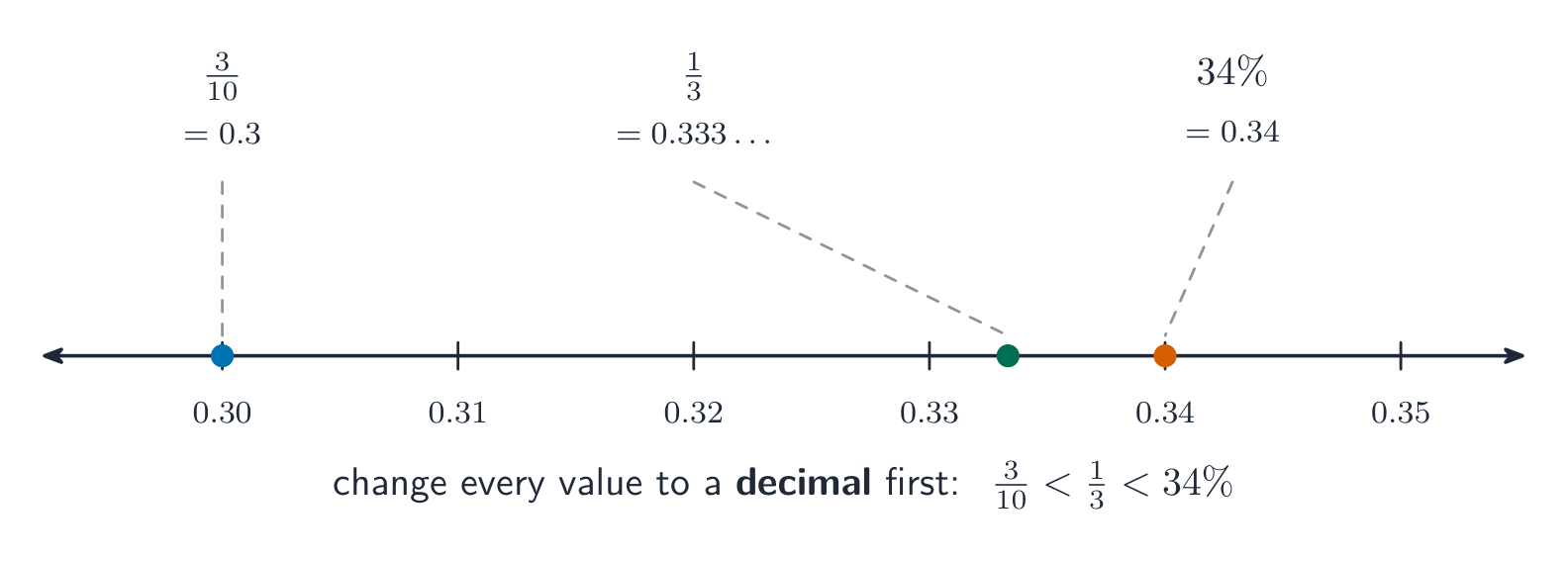
To put a mixed list in order, change every value to a decimal first.
Worked example. Put $34\%$, $\frac{1}{3}$ and $\frac{3}{10}$ in order, smallest first.
As decimals: $34\% = 0.34$, $\frac{1}{3} = 0.333\ldots$, $\frac{3}{10} = 0.3$. So the order is
$$\frac{3}{10} < \frac{1}{3} < 34\%.$$
Vocabulary
Train
| English |
|---|
| magnitude/ˈmæɡnɪtjuːd/ |
1.13
Percentages

Syllabus
| Subject content | Notes and examples |
|---|---|
| 1 Calculate a given percentage of a quantity. | |
| 2 Express one quantity as a percentage of another. | |
| 3 Calculate percentage increase or decrease. | |
| 4 Calculate with simple and compound interest. | Formulas are not given. Percentage calculations may include: • deposit • discount • profit and loss (as an amount or a percentage) • earnings • percentages over 100%. |
| Subject content | Notes and examples |
|---|---|
| 1 Calculate a given percentage of a quantity. | |
| 2 Express one quantity as a percentage of another. | |
| 3 Calculate percentage increase or decrease. | |
| 4 Calculate with simple and compound interest. | Problems may include repeated percentage change. Formulas are not given. |
| 5 Calculate using reverse percentages. | e.g. find the cost price given the selling price and the percentage profit. Percentage calculations may include: • deposit • discount • profit and loss (as an amount or a percentage) • earnings • percentages over 100%. |
Source: Cambridge International syllabus
Find a percentage of an amount. $15\%$ of $\$80 = 0.15 \times 80 = \$12$.
Write one amount as a percentage of another. A score of $18$ out of $25$ is $\frac{18}{25} \times 100\% = 72\%$.
Percentage increase or decrease uses
$$\text{percentage change} = \frac{\text{change}}{\text{original amount}} \times 100\%.$$
Worked example. A price rises from $\$40$ to $\$50$. Find the percentage increase.
The change is $\$10$, so $\frac{10}{40} \times 100\% = 25\%$ increase.
A quick way is a multiplier 乘数. To increase by $15\%$, multiply by $1.15$; to decrease by $15\%$, multiply by $0.85$.
Simple and compound interest
Interest 利息 is money paid for borrowing or for saving. The principal 本金 is the starting amount.
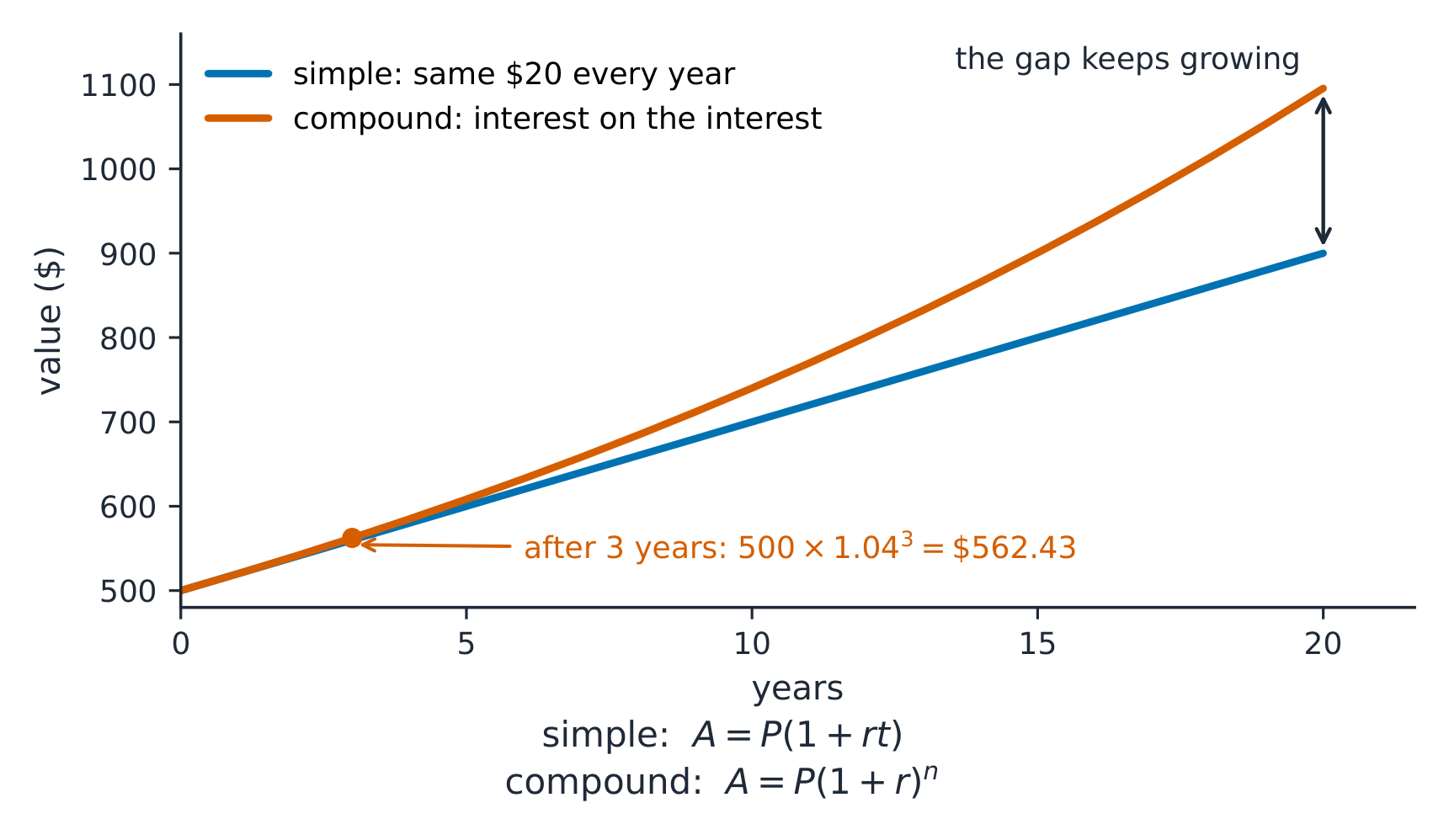
- Simple interest 单利 pays the same amount each year, worked out on the principal only:
$$I = \frac{P \times r \times t}{100},$$where $P$ is the principal, $r$ is the rate per year (as a percentage) and $t$ is the number of years.
- Compound interest 复利 adds the interest on each year, so the next year earns interest on a larger total:
$$\text{final value} = P\left(1 + \frac{r}{100}\right)^{t}.$$
Worked example. Find the value of $\$500$ saved at $4\%$ compound interest for $3$ years.
$$500 \times 1.04^{3} = 500 \times 1.124864 = \$562.43 \ (\text{to the nearest cent}).$$
Reverse percentages (Extended)
A reverse percentage 逆百分比 problem gives the amount after a change and asks for the original. To solve it, divide by the multiplier — do not just take the percentage off.
Worked example. A coat costs $\$60$ after a $20\%$ increase. Find the original price.
$\$60$ is $120\%$ of the original, so the original price is $60 \div 1.2 = \$50$.
Explore
Percentage change lab
new value = old value x multiplier
Change the multiplier and see the final value change.
Vocabulary
Train
| English |
|---|
| multiplier/ˌmʌltɪˈplaɪə/ |
| interest/ˈɪntrest/ |
| principal/ˈprɪnsɪpl/ |
| simple interest/ˈsɪmpl ˈɪntrest/ |
| compound interest/ˈkɒmpaʊnd ˈɪntrest/ |
| reverse percentage/rɪˈvɜːs pəˈsentɪdʒ/ |
1.17
Exponential growth and decay (Extended)
Syllabus
| Subject content | Notes and examples |
|---|---|
| Use exponential growth and decay. | e.g. depreciation, population change. Knowledge of e is not required. |
Source: Cambridge International syllabus
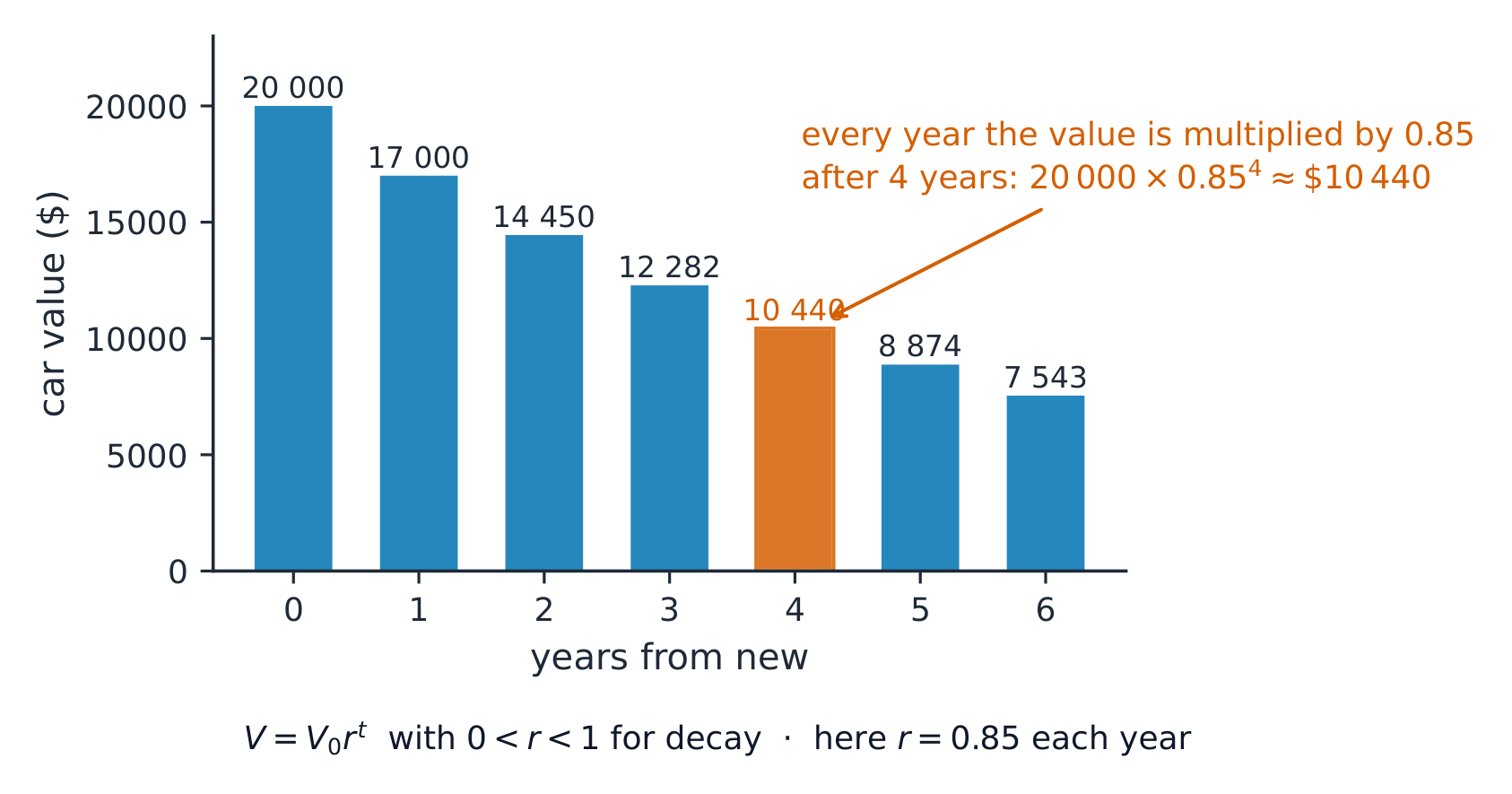
When a quantity changes by the same percentage in each time period, it shows exponential growth 指数增长 (it gets bigger) or exponential decay 指数衰减 (it gets smaller). Use the compound formula. Depreciation 折旧, where something like a car loses value each year, is decay.
Worked example. A car worth $\$20\,000$ loses $15\%$ of its value each year. Find its value after $4$ years.
The multiplier is $0.85$, so
$$20\,000 \times 0.85^{4} = 20\,000 \times 0.522\ldots = \$10\,440 \ (\text{to the nearest dollar}).$$
Explore
Compound interest
Money grows by (1 + r) every year, so compound interest curves above simple interest. Drag the rate and the number of years.
Explore
Exponential growth & decay
y = a·bˣ
Change the base b: b > 1 grows, 0 < b < 1 decays — useful for interest and populations.
Vocabulary
Train
| English |
|---|
| exponential growth/ˌekspəˈnenʃl ɡrəʊθ/ |
| exponential decay/ˌekspəˈnenʃl dɪˈkeɪ/ |
| depreciation/dɪˌpriːʃɪˈeɪʃn/ |
1.11
Ratio and proportion

Syllabus
| Subject content | Notes and examples |
|---|---|
| Understand and use ratio and proportion to: | |
| • give ratios in their simplest form | e.g. 20:30:40 in its simplest form is 2:3:4. |
| • divide a quantity in a given ratio | |
| • use proportional reasoning and ratios in context. | e.g. adapt recipes; use map scales; determine best value. |
Source: Cambridge International syllabus
A ratio 比 compares quantities, written like $a:b$. Simplify it like a fraction by dividing by the HCF: $20:30:40 = 2:3:4$.
Dividing in a ratio. Share $\$48$ in the ratio $3:5$.
The total number of parts is $3 + 5 = 8$. One part is $48 \div 8 = \$6$. So the shares are $3 \times 6 = \$18$ and $5 \times 6 = \$30$.
Proportion 比例 means two ratios are equal. Use it for recipes, map scales 比例尺 and finding best value.
Worked example. $3$ pens cost $\$1.80$. Find the cost of $7$ pens.
One pen costs $1.80 \div 3 = \$0.60$. So $7$ pens cost $7 \times 0.60 = \$4.20$.
Explore
Direct proportion
y = ax
Direct proportion is a straight line through the origin — double x and you double y.
Vocabulary
Train
| English |
|---|
| ratio/ˈreɪʃɪəʊ/ |
| proportion/prəˈpɔːʃn/ |
| scale/skeɪl/ |
1.12
Rates and average speed

Syllabus
| Subject content | Notes and examples |
|---|---|
| 1 Use common measures of rate. | e.g. calculate with: • hourly rates of pay • exchange rates between currencies • flow rates • fuel consumption. |
| 2 Apply other measures of rate. | e.g. calculate with: • pressure • density • population density. Required formulas will be given in the question. |
| 3 Solve problems involving average speed. | Knowledge of speed/distance/time formula is required. e.g. A cyclist travels 45 km in 3 hours 45 minutes. What is their average speed? Notation used will be, e.g. m/s (metres per second), $\text{g/cm}^3$ (grams per cubic centimetre). |
| Subject content | Notes and examples |
|---|---|
| 1 Use common measures of rate. | e.g. calculate with: • hourly rates of pay • exchange rates between currencies • flow rates • fuel consumption. |
| 2 Apply other measures of rate. | e.g. calculate with: • pressure • density • population density. Required formulas will be given in the question. |
| 3 Solve problems involving average speed. | Knowledge of speed/distance/time formula is required. e.g. A cyclist travels 45 km in 3 hours 45 minutes. What is their average speed? Notation used will be, e.g. m/s (metres per second), g/cm$^{3}$ (grams per cubic centimetre). |
Source: Cambridge International syllabus
A rate 比率 compares two quantities measured in different units, such as price per kilogram, or distance per hour.
Average speed 平均速度 uses
$$\text{average speed} = \frac{\text{total distance}}{\text{total time}}.$$
Worked example. A cyclist travels $45\text{ km}$ in $3$ hours $45$ minutes. Find the average speed.
First change the time to hours: $3$ h $45$ min $= 3.75$ h. Then
$$\text{average speed} = \frac{45}{3.75} = 12\text{ km/h}.$$
Other rates work the same way. Density 密度 is found from mass 质量 and volume 体积:
$$\text{density} = \frac{\text{mass}}{\text{volume}}.$$
Other examples are flow rate, fuel consumption and population density 人口密度. If a rate needs a special formula (such as pressure 压强), the question will give it to you.
Vocabulary
Train
| English |
|---|
| rate/reɪt/ |
| average speed/ˈævrɪdʒ spiːd/ |
| density/ˈdensɪti/ |
| mass/mæs/ |
| volume/ˈvɒljuːm/ |
| population density/ˌpɒpjʊˈleɪʃn ˈdensɪti/ |
| pressure/ˈpreʃə/ |
1.9
Rounding and estimation
Syllabus
| Subject content | Notes and examples |
|---|---|
| 1 Round values to a specified degree of accuracy. | Includes decimal places and significant figures. |
| 2 Make estimates for calculations involving numbers, quantities and measurements. | e.g. write 5764 correct to the nearest thousand. e.g. by writing each number correct to 1 significant figure, estimate the value of $$\frac{41.3}{9.79 \times 0.765}$$ . |
| 3 Round answers to a reasonable degree of accuracy in the context of a given problem. |
| Subject content | Notes and examples |
|---|---|
| 1 Round values to a specified degree of accuracy. | Includes decimal places and significant figures. e.g. write 5764 correct to the nearest thousand. |
| 2 Make estimates for calculations involving numbers, quantities and measurements. | e.g. by writing each number correct to 1 significant figure, estimate the value of $$\frac{41.3}{9.79 \times 0.765}$$ . |
| 3 Round answers to a reasonable degree of accuracy in the context of a given problem. |
Source: Cambridge International syllabus
Rounding
- decimal places (d.p.) 小数位: digits counted after the point. $3.14159$ to $2$ d.p. is $3.14$.
- significant figures (s.f.) 有效数字: digits counted from the first non-zero digit. $5764$ to $1$ s.f. is $6000$; $0.004067$ to $2$ s.f. is $0.0041$.
Rule: look at the next digit. If it is $5$ or more, round up; if it is less, round down.
Estimation
To estimate 估算 an answer, round every number to $1$ s.f., then calculate.
Worked example. Estimate $\dfrac{41.3}{9.79 \times 0.765}$.
$$\frac{41.3}{9.79 \times 0.765} \approx \frac{40}{10 \times 0.8} = \frac{40}{8} = 5.$$
Explore
Rounding and bounds lab
Classify numbers by the decision needed for accuracy.
Vocabulary
Train
| English |
|---|
| decimal place/ˈdesɪml pleɪs/ |
| significant figure/sɪɡˈnɪfɪkənt ˈfɪɡə/ |
| estimate/ˈestɪmət/ |
1.10
Limits of accuracy

Syllabus
| Subject content | Notes and examples |
|---|---|
| Give upper and lower bounds for data rounded to a specified accuracy. | e.g. write down the upper bound of a length measured correct to the nearest metre. Candidates are not expected to find the bounds of the results of calculations which have used data rounded to a specified accuracy. |
| Subject content | Notes and examples |
|---|---|
| 1 Give upper and lower bounds for data rounded to a specified accuracy. | e.g. write down the upper bound of a length measured correct to the nearest metre. |
| 2 Find upper and lower bounds of the results of calculations which have used data rounded to a specified accuracy. | Example calculations include: • calculate the upper bound of the perimeter or the area of a rectangle given dimensions measured to the nearest centimetre • find the lower bound of the speed given rounded values of distance and time. |
Source: Cambridge International syllabus
A rounded value could really be anything that rounds to it. The smallest possible value is the lower bound 下界; the largest is the upper bound 上界. For a value rounded to the nearest unit, the bounds lie half a unit on each side.
Worked example. A height $h$ is $635\text{ m}$, correct to the nearest metre. Give the bounds.
$$634.5 \leqslant h < 635.5.$$
So the lower bound is $634.5\text{ m}$ and the upper bound is $635.5\text{ m}$.
Bounds in calculations (Extended)
Combine the bounds to get the bound you want.
Worked example. A rectangle is $8\text{ cm}$ by $5\text{ cm}$, each side to the nearest cm. Find the largest possible area 面积.
Use the upper bounds of both sides: $8.5 \times 5.5 = 46.75\text{ cm}^{2}$. (The smallest area uses the lower bounds: $7.5 \times 4.5 = 33.75\text{ cm}^{2}$.)
For a divided quantity such as $\text{speed} = \dfrac{\text{distance}}{\text{time}}$, the largest speed comes from the largest distance divided by the smallest time.
Vocabulary
Train
| English |
|---|
| lower bound/ˈləʊə baʊnd/ |
| upper bound/ˈʌpə baʊnd/ |
| area/ˈeərɪə/ |
1.15
Time
Syllabus
| Subject content | Notes and examples |
|---|---|
| 1 Calculate with time: seconds (s), minutes (min), hours (h), days, weeks, months, years, including the relationship between units. | 1 year = 365 days. |
| 2 Calculate times in terms of the 24-hour and 12-hour clock. | In the 24-hour clock, for example, 3.15 a.m. will be denoted by 03 15 and 3.15 p.m. by 15 15. |
| 3 Read clocks and timetables. | Includes problems involving time zones, local times and time differences. |
| Subject content | Notes and examples |
|---|---|
| 1 Calculate with time: seconds (s), minutes (min), hours (h), days, weeks, months, years, including the relationship between units. | 1 year = 365 days. |
| 2 Calculate times in terms of the 24-hour and 12-hour clock. | In the 24-hour clock, for example, 3.15 a.m. will be denoted by 0315 and 3.15 p.m. by 1515. |
| 3 Read clocks and timetables. | Includes problems involving time zones, local times and time differences. |
Source: Cambridge International syllabus
- $60$ seconds $= 1$ minute, $60$ minutes $= 1$ hour, $24$ hours $= 1$ day, and $1$ year $= 365$ days.
- The 24-hour clock writes a time as four digits: $3.15$ p.m. is $15\,15$.
Worked example. A film starts at $19\,35$ and lasts $70$ minutes. Find the time it finishes.
$70$ min $= 1$ h $10$ min. Adding $1$ hour gives $20\,35$; adding $10$ minutes gives $20\,45$.
For timetables and time zone 时区 problems, add or subtract the time difference between the places.
Explore
Time, money and calculator lab
Choose the operation that matches a real measurement problem.
Vocabulary
Train
| English |
|---|
| time zone/taɪm zəʊn/ |
1.16
Money
Syllabus
| Subject content | Notes and examples |
|---|---|
| 1 Calculate with money. | |
| 2 Convert from one currency to another. |
Source: Cambridge International syllabus
Work with money as ordinary decimals, but give answers to $2$ d.p. (so $\$4.8$ is written $\$4.80$).
Currency conversion. Use the exchange rate 汇率 as a multiplier.
Worked example. The exchange rate is $\$1 = €0.92$. Convert $\$150$ to euros, and convert $€138$ back to dollars.
$$150 \times 0.92 = €138, \qquad 138 \div 0.92 = \$150.$$
Vocabulary
Train
| English |
|---|
| exchange rate/eksˈtʃeɪndʒ reɪt/ |
1.14
Using a calculator
Syllabus
| Subject content | Notes and examples |
|---|---|
| 1 Use a calculator efficiently. | e.g. know not to round values within a calculation and to only round the final answer. |
| 2 Enter values appropriately on a calculator. | e.g. enter 2 hours 30 minutes as 2.5 hours or 2° 30’ 0’’. |
| 3 Interpret the calculator display appropriately. | e.g. in money 4.8 means $4.80; in time 3.25 means 3 hours 15 minutes. |
| Subject content | Notes and examples |
|---|---|
| 1 Use a calculator efficiently. | e.g. know not to round values within a calculation and to only round the final answer. |
| 2 Enter values appropriately on a calculator. | e.g. enter 2 hours 30 minutes as 2.5 hours or 2° 30' 0''. |
| 3 Interpret the calculator display appropriately. | e.g. in money 4.8 means $4.80; in time 3.25 means 3 hours 15 minutes. |
Source: Cambridge International syllabus
- Do not round part-way through a calculation. Keep the full value and round only the final answer.
- Enter time as a decimal of an hour: $2$ hours $30$ minutes is $2.5$ hours, not $2.30$.
- Read the display in context: in money, $4.8$ means $\$4.80$; in time, $3.25$ hours means $3$ hours $15$ minutes.
1.14
Exam tips
- Follow BIDMAS (brackets, indices, division/multiplication, addition/subtraction) in order, and remember a negative times a negative is positive.
- In standard form the number in front is between 1 and 10; a small number (like $0.0004$) has a negative power of 10.
- A percentage change is worked out on the original amount. For a reverse percentage, divide by the multiplier (e.g. $\div 1.2$ undoes a $20\%$ rise).
- Do not round part-way through — keep the full value and round only at the end, to the accuracy the question asks for (decimal places or significant figures).
- For limits of accuracy, a value rounded to the nearest whole number can be up to $0.5$ either side (so $8$ means $7.5 \le x < 8.5$).
Interactive lessons on this topic
Work through it step by step, with instant-check exercises.