This handout covers Topic 1, Number. Cambridge Maths has two levels: Core and Extended. Parts marked (Extended) are only tested on the Extended papers; everything else is for both levels.
Tips
IGCSE Mathematics (0580) covers number, algebra and graphs, coordinate geometry, geometry, mensuration, trigonometry, transformations and vectors, probability and statistics.
Entry splits between Core and Extended, and Extended reaches noticeably further in algebra and trigonometry — confirm your tier before choosing what to practise.
Method marks are given for written work. A numerically wrong answer can still score most of the marks if the working is visible, and a correct answer with no working can score fewer. Writing every line is not neatness — it is points.
-
1
Number
Watch lesson1.1
Types of number

Syllabus
Subject content Notes and examples Identify and use: • natural numbers • integers (positive, zero and negative) • prime numbers • square numbers • cube numbers • common factors • common multiples • rational and irrational numbers • reciprocals. Example tasks include: • convert between numbers and words, e.g. six billion is 6000000000 10007 is ten thousand and seven • express 72 as a product of its prime factors • find the highest common factor (HCF) of two numbers • find the lowest common multiple (LCM) of two numbers. Source: Cambridge International syllabus
You must know the words for the different kinds of number. Examiners give marks for using them correctly.
Each set sits inside the next: every natural number is an integer, every integer is rational, every rational is real. Irrational numbers are real but not rational. Counting numbers and integers
- natural numbers 自然数 — the counting numbers $1, 2, 3, 4, \dots$
- integers 整数 — whole numbers, positive, negative or zero: $\dots, -2, -1, 0, 1, 2, \dots$
Factors and multiples
- A factor 因数 of a number divides into it exactly, leaving no remainder 余数. The factors of $18$ are $1, 2, 3, 6, 9, 18$.
- A multiple 倍数 of a number is that number times an integer. Multiples of $6$ are $6, 12, 18, 24, \dots$
- A common factor 公因数 of two numbers is a factor of both.
- A common multiple 公倍数 of two numbers is a multiple of both.
Prime, square and cube numbers
- A prime number 质数 has exactly two factors: $1$ and itself. The first primes are $2, 3, 5, 7, 11, 13, \dots$ Note that $1$ is not prime.
- A square number 平方数 is a whole number times itself: $1, 4, 9, 16, 25, \dots$
- A cube number 立方数 uses a whole number three times: $1, 8, 27, 64, \dots$
Rational, irrational and reciprocal
- A rational number 有理数 can be written as a fraction 分数 $\frac{a}{b}$ of two integers. Examples: $\frac{3}{4}$, $5$, $0.7$.
- An irrational number 无理数 cannot be written this way. Examples: $\pi$ and $\sqrt{2}$.
- The reciprocal 倒数 of a number is $1$ divided by that number. The reciprocal of $4$ is $\frac{1}{4}$; the reciprocal of $0.25$ is $4$; the reciprocal of $\frac{2}{3}$ is $\frac{3}{2}$.
Prime factors, HCF and LCM
Every integer above $1$ is prime, or can be written as a product 乘积 of prime numbers. To write a number as a product of its prime factors 质因数, keep dividing by the smallest prime that fits.
Worked example. Write $72$ as a product of its prime factors.
$$72 = 2 \times 36 = 2 \times 2 \times 18 = 2 \times 2 \times 2 \times 9 = 2 \times 2 \times 2 \times 3 \times 3 = 2^{3} \times 3^{2}.$$
Keep splitting until every branch ends on a prime (circled); collecting them gives $72 = 2^{3} \times 3^{2}$. The highest common factor (HCF) 最大公因数 of two numbers is the largest factor they share. The lowest common multiple (LCM) 最小公倍数 is the smallest multiple they share. Prime factors give a quick method.
Worked example. Find the HCF and LCM of $72$ and $120$.
First write each as a product of primes:
$$72 = 2^{3} \times 3^{2}, \qquad 120 = 2^{3} \times 3 \times 5.$$- HCF: take the lowest power of each prime that appears in both: $2^{3} \times 3 = 24$.
- LCM: take the highest power of every prime that appears: $2^{3} \times 3^{2} \times 5 = 360$.
ExploreSets of numbers
Every counting number is also an integer, every integer a rational — see how the number sets nest, and how union and intersection combine them.
Vocabulary TrainEnglish natural number/ˈnætʃərəl ˈnʌmbə/ integer/ˈɪntɪdʒə/ factor/ˈfæktə/ remainder/rɪˈmeɪndə/ multiple/ˈmʌltɪpl/ common factor/ˈkɒmən ˈfæktə/ common multiple/ˈkɒmən ˈmʌltɪpl/ prime number/praɪm ˈnʌmbə/ square number/skweə ˈnʌmbə/ cube number/kjuːb ˈnʌmbə/ rational number/ˈræʃənl ˈnʌmbə/ fraction/ˈfrækʃn/ irrational number/ɪˈræʃənl ˈnʌmbə/ reciprocal/rɪˈsɪprəkl/ product/ˈprɒdʌkt/ prime factor/praɪm ˈfæktə/ highest common factor/ˈhaɪɪst ˈkɒmən ˈfæktə/ lowest common multiple/ˈləʊɪst ˈkɒmən ˈmʌltɪpl/ 1.2
Sets and Venn diagrams

Syllabus
Subject content Notes and examples Understand and use set language, notation and Venn diagrams to describe sets. Venn diagrams are limited to two sets. The following set notation will be used: • $n(A)$ Number of elements in set $A$ • $A'$ Complement of set $A$ • $\mathscr{E}$ Universal set • $A \cup B$ Union of $A$ and $B$ • $A \cap B$ Intersection of $A$ and $B$. Example definition of sets: $A = \{x : x \text{ is a natural number}\}$ $B = \{a, b, c, \dots\}$ $C = \{x : a \leqslant x \leqslant b\}$. Subject content Notes and examples Understand and use set language, notation and Venn diagrams to describe sets and represent relationships between sets. Venn diagrams are limited to two or three sets. The following set notation will be used: • $n(A)$ Number of elements in set $A$ • $\in$ "... is an element of ..." • $\notin$ "... is not an element of ..." • $A'$ Complement of set $A$ • $\varnothing$ The empty set • $\mathscr{E}$ Universal set • $A \subseteq B$ $A$ is a subset of $B$ • $A \nsubseteq B$ $A$ is not a subset of $B$ • $A \cup B$ Union of $A$ and $B$ • $A \cap B$ Intersection of $A$ and $B$. Example definition of sets: $A = \{x : x \text{ is a natural number}\}$ $B = \{(x, y) : y = mx + c\}$ $C = \{x : a \leqslant x \leqslant b\}$ $D = \{a, b, c, \dots\}$. Source: Cambridge International syllabus
A set 集合 is a collection of objects. Each object in the set is an element 元素 of the set. You should know this notation:
Symbol Meaning $n(A)$ the number of elements in set $A$ $x \in A$ $x$ is an element of $A$ $x \notin A$ $x$ is not an element of $A$ $\mathscr{E}$ the universal set 全集 — everything being talked about $A'$ the complement 补集 of $A$ — everything not in $A$ $\varnothing$ the empty set 空集 — a set with no elements $A \subseteq B$ $A$ is a subset 子集 of $B$ — every element of $A$ is also in $B$ $A \cup B$ the union 并集 — elements in $A$ or $B$ or both $A \cap B$ the intersection 交集 — elements in both $A$ and $B$ A Venn diagram 维恩图 draws each set as a circle inside a rectangle (the universal set). Core uses two sets; Extended may use three.
Worked example. $\mathscr{E} = \{1,2,3,4,5,6,7,8,9,10\}$, $A = \{\text{even numbers}\}$, $B = \{\text{multiples of } 3\}$.
- $A = \{2,4,6,8,10\}$ and $B = \{3,6,9\}$.
- $A \cap B = \{6\}$ — the only number in both.
- $A \cup B = \{2,3,4,6,8,9,10\}$ — the numbers in either set.
- $n(A \cup B) = 7$.
$A \cap B = \{6\}$ is the only number in both circles; $A \cup B$ is everything inside either circle. You may also see a set written as a rule, e.g. $C = \{x : 1 \leqslant x \leqslant 5\}$ means "all values $x$ such that $1 \leqslant x \leqslant 5$".
ExploreVenn diagrams
Tap the regions to see union, intersection and complement — the language of sets.
Vocabulary TrainEnglish set/set/ element/ˈelɪmənt/ universal set/ˌjuːnɪˈvɜːsl set/ complement/ˈkɒmplɪmənt/ empty set/ˈempti set/ subset/ˈsʌbset/ union/ˈjuːnɪən/ intersection/ˌɪntəˈsekʃn/ Venn diagram/ven ˈdaɪəɡræm/ 1.3
Powers and roots
Syllabus
Subject content Notes and examples Calculate with the following: • squares • square roots • cubes • cube roots • other powers and roots of numbers. Includes recall of squares and their corresponding roots from 1 to 15, and recall of cubes and their corresponding roots of 1, 2, 3, 4, 5 and 10, e.g.: • Write down the value of $\sqrt{169}$ . • Work out $5^2 \times \sqrt[3]{8}$ . Subject content Notes and examples Calculate with the following: • squares • square roots • cubes • cube roots • other powers and roots of numbers. Includes recall of squares and their corresponding roots from 1 to 15, and recall of cubes and their corresponding roots of 1, 2, 3, 4, 5 and 10, e.g.: • Write down the value of $\sqrt{169}$. • Work out $5^2 \times \sqrt[3]{8}$. Source: Cambridge International syllabus
- A power 幂 (also called an index 指数, plural indices) shows how many times to multiply a number by itself: $2^{5} = 2 \times 2 \times 2 \times 2 \times 2 = 32$.
- A square root 平方根 of a number gives that number when squared: $\sqrt{169} = 13$ because $13^{2} = 169$.
- A cube root 立方根 works the same way for cubes: $\sqrt[3]{8} = 2$ because $2^{3} = 8$.
You should be able to recall the squares from $1^2$ to $15^2$ (and their roots), and the cubes of $1, 2, 3, 4, 5$ and $10$.
Worked example. Work out $5^{2} \times \sqrt[3]{8}$.
$$5^{2} \times \sqrt[3]{8} = 25 \times 2 = 50.$$ExplorePowers and roots lab
square = x^2
Change the base and see powers grow while roots undo powers.
Vocabulary TrainEnglish power/ˈpaʊə/ index/ˈɪndeks/ square root/skweə ruːt/ cube root/kjuːb ruːt/ 1.7
The laws of indices

Syllabus
Subject content Notes and examples 1 Understand and use indices (positive, zero and negative integers). e.g. find the value of $7^{-2}$. 2 Understand and use the rules of indices. e.g. find the value of $2^{-3} \times 2^4$, $(2^3)^2$, $2^3 \div 2^4$. Subject content Notes and examples 1 Understand and use indices (positive, zero, negative, and fractional). Examples include: • $6^{\frac{1}{2}} = \sqrt{6}$ • $16^{\frac{1}{4}} = \sqrt[4]{16}$ • find the value of $7^{-2}$, $81^{\frac{1}{2}}$, $8^{-\frac{2}{3}}$. 2 Understand and use the rules of indices. e.g. find the value of $2^{-3} \times 2^4$, $(2^3)^2$, $2^3 \div 2^4$. Source: Cambridge International syllabus
When you multiply or divide powers of the same base 底数, use these rules:
$$a^{m} \times a^{n} = a^{m+n}, \qquad a^{m} \div a^{n} = a^{m-n}, \qquad (a^{m})^{n} = a^{mn}.$$Some special powers:
$$a^{0} = 1, \qquad a^{-n} = \frac{1}{a^{n}}, \qquad a^{\frac{1}{n}} = \sqrt[n]{a}, \qquad a^{\frac{m}{n}} = \left(\sqrt[n]{a}\right)^{m}.$$(Fractional powers like $a^{\frac{m}{n}}$ are Extended.)
Worked examples.
- $2^{-3} \times 2^{4} = 2^{-3+4} = 2^{1} = 2.$
- $(2^{3})^{2} = 2^{6} = 64.$
- $2^{3} \div 2^{4} = 2^{3-4} = 2^{-1} = \dfrac{1}{2}.$
- $7^{-2} = \dfrac{1}{7^{2}} = \dfrac{1}{49}.$
- $81^{\frac{1}{2}} = \sqrt{81} = 9.$
- $8^{-\frac{2}{3}} = \dfrac{1}{8^{\frac{2}{3}}} = \dfrac{1}{\left(\sqrt[3]{8}\right)^{2}} = \dfrac{1}{2^{2}} = \dfrac{1}{4}.$
The three index laws: multiply adds the powers, divide subtracts them, a power of a power multiplies them Vocabulary TrainEnglish base/beɪs/ 1.8
Standard form

Syllabus
Subject content Notes and examples 1 Use the standard form $A \times 10^n$ where $n$ is a positive or negative integer and $1 \leqslant A < 10$. 2 Convert numbers into and out of standard form. 3 Calculate with values in standard form. Core candidates are expected to calculate with standard form only on Paper 3. Subject content Notes and examples 1 Use the standard form $A \times 10^n$ where $n$ is a positive or negative integer and $1 \leqslant A < 10$. 2 Convert numbers into and out of standard form. 3 Calculate with values in standard form. Source: Cambridge International syllabus
A galaxy: huge distances are written compactly in standard form. Standard form 科学记数法 writes a number as $A \times 10^{n}$, where $1 \leqslant A < 10$ and $n$ is an integer. It is used for very large or very small numbers.
To convert, count how many places the decimal point moves:
- $4\,500\,000 = 4.5 \times 10^{6}$ — the point moves $6$ places left, so the power is positive.
- $0.00072 = 7.2 \times 10^{-4}$ — the point moves $4$ places right, so the power is negative.
Worked example. Work out $(3 \times 10^{5}) \times (2 \times 10^{-2})$.
Multiply the front numbers and add the powers:
$$3 \times 2 = 6, \qquad 10^{5} \times 10^{-2} = 10^{3}, \qquad \text{so the answer is } 6 \times 10^{3}.$$
Standard form: a number written as a × 10^n with 1 ≤ a < 10 ExploreStandard form route
Follow a large or small number into a x 10^n form.
Vocabulary TrainEnglish standard form/ˈstændəd fɔːm/ 1.18
Surds (Extended)

Syllabus
Subject content Notes and examples 1 Understand and use surds, including simplifying expressions. Examples include: • $\sqrt{20} = 2\sqrt{5}$ • $\sqrt{200} - \sqrt{32} = 6\sqrt{2}$. 2 Rationalise the denominator. Examples include: • $\frac{10}{\sqrt{5}} = 2\sqrt{5}$ • $\frac{1}{-1 + \sqrt{3}} = \frac{1 + \sqrt{3}}{2}$. Source: Cambridge International syllabus
A surd 根式 is a root that is irrational, such as $\sqrt{5}$. Leave it in exact form instead of rounding. Two useful rules:
$$\sqrt{a} \times \sqrt{b} = \sqrt{ab}, \qquad \sqrt{\frac{a}{b}} = \frac{\sqrt{a}}{\sqrt{b}}.$$Simplify a surd by taking out the largest square factor.
Worked example. Simplify $\sqrt{20}$ and $\sqrt{200} - \sqrt{32}$.
$$\sqrt{20} = \sqrt{4 \times 5} = \sqrt{4}\,\sqrt{5} = 2\sqrt{5}.$$$$\sqrt{200} - \sqrt{32} = \sqrt{100 \times 2} - \sqrt{16 \times 2} = 10\sqrt{2} - 4\sqrt{2} = 6\sqrt{2}.$$Simplifying a surd: take out the largest square factor To rationalise the denominator 分母有理化 means to remove a surd from the bottom of a fraction (the denominator 分母). Multiply the top and bottom by a value that clears the surd.
Worked example. Rationalise $\dfrac{10}{\sqrt{5}}$ and $\dfrac{1}{-1+\sqrt{3}}$.
$$\frac{10}{\sqrt{5}} = \frac{10}{\sqrt{5}} \times \frac{\sqrt{5}}{\sqrt{5}} = \frac{10\sqrt{5}}{5} = 2\sqrt{5}.$$$$\frac{1}{-1+\sqrt{3}} = \frac{1}{\sqrt{3}-1} \times \frac{\sqrt{3}+1}{\sqrt{3}+1} = \frac{\sqrt{3}+1}{3-1} = \frac{1+\sqrt{3}}{2}.$$ExploreSurd simplification route
Break a surd into square factors and simplify it.
Vocabulary TrainEnglish surd/sɜːd/ rationalise the denominator/ˈræʃənəlaɪz ðə dɪˈnɒmɪneɪtə/ denominator/dɪˈnɒmɪneɪtə/ 1.4
Fractions, decimals and percentages

Syllabus
Subject content Notes and examples 1 Use the language and notation of the following in appropriate contexts: • proper fractions • improper fractions • mixed numbers • decimals • percentages. Candidates are expected to be able to write fractions in their simplest form. Candidates are not expected to use recurring decimal notation. 2 Recognise equivalence and convert between these forms. Candidates are not expected to demonstrate the conversion of a recurring decimal to a fraction and vice versa. Subject content Notes and examples 1 Use the language and notation of the following in appropriate contexts: • proper fractions • improper fractions • mixed numbers • decimals • percentages. Candidates are expected to be able to write fractions in their simplest form. Recurring decimal notation is required, e.g. • $0.1\dot{7} = 0.1777...$ • $0.1\dot{2}\dot{3} = 0.1232323...$ • $0.\dot{1}2\dot{3} = 0.123123...$ 2 Recognise equivalence and convert between these forms. Includes converting between recurring decimals and fractions and vice versa, e.g. write $0.1\dot{7}$ as a fraction. Source: Cambridge International syllabus
A fraction has a numerator 分子 (the top) and a denominator (the bottom).
One value three ways: a fraction, a decimal and a percentage - proper fraction 真分数: numerator smaller than denominator, e.g. $\frac{3}{4}$.
- improper fraction 假分数: numerator the same or larger, e.g. $\frac{7}{4}$.
- mixed number 带分数: a whole number plus a fraction, e.g. $1\frac{3}{4}$.
Change between improper and mixed: $\frac{7}{4} = 1\frac{3}{4}$ because $7 \div 4 = 1$ remainder $3$.
A decimal 小数 uses place value after a point. A percentage 百分比 means "out of $100$", so $37\% = \frac{37}{100} = 0.37$.
Converting between forms
To change Method Example fraction → decimal divide top by bottom $\frac{3}{8} = 3 \div 8 = 0.375$ decimal → percentage multiply by $100$ $0.07 = 7\%$ percentage → fraction put over $100$, then simplify $7\% = \frac{7}{100}$ percentage → decimal divide by $100$ $34\% = 0.34$ Write a fraction in its simplest form 最简形式 by dividing the top and bottom by their HCF: $\frac{18}{24} = \frac{3}{4}$ (both divided by $6$).
Recurring decimals (Extended)
A recurring decimal 循环小数 repeats the same digits forever. Dots mark the repeating part: $0.1\dot{7} = 0.1777\ldots$ and $0.\dot{1}2\dot{3} = 0.123123\ldots$
To turn a recurring decimal into a fraction, multiply so the repeating parts line up, then subtract.
Worked example. Write $0.1\dot{7}$ as a fraction.
Let $x = 0.1777\ldots$ Only the $7$ repeats, so use $10x$ and $100x$:
$$100x = 17.777\ldots, \qquad 10x = 1.777\ldots$$$$100x - 10x = 16, \qquad 90x = 16, \qquad x = \frac{16}{90} = \frac{8}{45}.$$
Line up the repeating tails, subtract, and the tails cancel ExploreNumber form lab
Classify equivalent number forms and operations.
Vocabulary TrainEnglish numerator/ˈnjuːməreɪtə/ proper fraction/ˈprɒpə ˈfrækʃn/ improper fraction/ɪmˈprɒpə ˈfrækʃn/ mixed number/mɪkst ˈnʌmbə/ decimal/ˈdesɪml/ percentage/pəˈsentɪdʒ/ simplest form/ˈsɪmpəlɪst fɔːm/ recurring decimal/rɪˈkɜːrɪŋ ˈdesɪml/ 1.6
The four operations

Syllabus
Subject content Notes and examples Use the four operations for calculations with integers, fractions and decimals, including correct ordering of operations and use of brackets. Includes: • negative numbers • improper fractions • mixed numbers • practical situations, e.g. temperature changes. Source: Cambridge International syllabus
Order of operations
Work in this order — the order of operations 运算顺序: brackets first, then indices (powers and roots), then multiply and divide (left to right), then add and subtract (left to right).
Worked example. Work out $-6 \times -3 + 7 \times 2$.
Do the multiplications first: $-6 \times -3 = 18$ and $7 \times 2 = 14$. Then add: $18 + 14 = 32$.
The order of operations, applied to the worked example Negative numbers
- Adding a negative: $5 + (-3) = 5 - 3 = 2$.
- Subtracting a negative: $5 - (-3) = 5 + 3 = 8$.
- Multiplying or dividing: same signs give a positive; different signs give a negative. So $-6 \times -3 = 18$ but $-12 \div 4 = -3$.
A change in temperature from $-5\,{}^{\circ}\text{C}$ to $3\,{}^{\circ}\text{C}$ is a rise of $8\,{}^{\circ}\text{C}$.
Calculating with fractions
- Multiply: multiply the tops, multiply the bottoms: $\frac{2}{3} \times \frac{4}{5} = \frac{8}{15}$.
- Divide: multiply by the reciprocal of the second fraction: $\frac{2}{3} \div \frac{4}{5} = \frac{2}{3} \times \frac{5}{4} = \frac{10}{12} = \frac{5}{6}$.
- Add or subtract: use a common denominator (the LCM of the bottoms).
Worked example. Work out $1\frac{7}{15} - \frac{4}{5}$, giving the answer in its simplest form.
Change the mixed number to an improper fraction, then use denominator $15$:
$$1\frac{7}{15} = \frac{22}{15}, \qquad \frac{4}{5} = \frac{12}{15}, \qquad \frac{22}{15} - \frac{12}{15} = \frac{10}{15} = \frac{2}{3}.$$Vocabulary TrainEnglish order of operations/ˈɔːdə ɒv ˌɒpəˈreɪʃnz/ 1.5
Ordering
Syllabus
Subject content Notes and examples Order quantities by magnitude and demonstrate familiarity with the symbols $=, \ne, >, <, \geqslant$ and $\leqslant$. Subject content Notes and examples Order quantities by magnitude and demonstrate familiarity with the symbols $=, \neq, >, <, \geqslant$ and $\leqslant$. Source: Cambridge International syllabus
Use these symbols to compare numbers by magnitude 大小 (size):
Symbol Meaning $=$ is equal to $\neq$ is not equal to $>$ is greater than $<$ is less than $\geqslant$ is greater than or equal to $\leqslant$ is less than or equal to To put a mixed list in order, change every value to a decimal first.
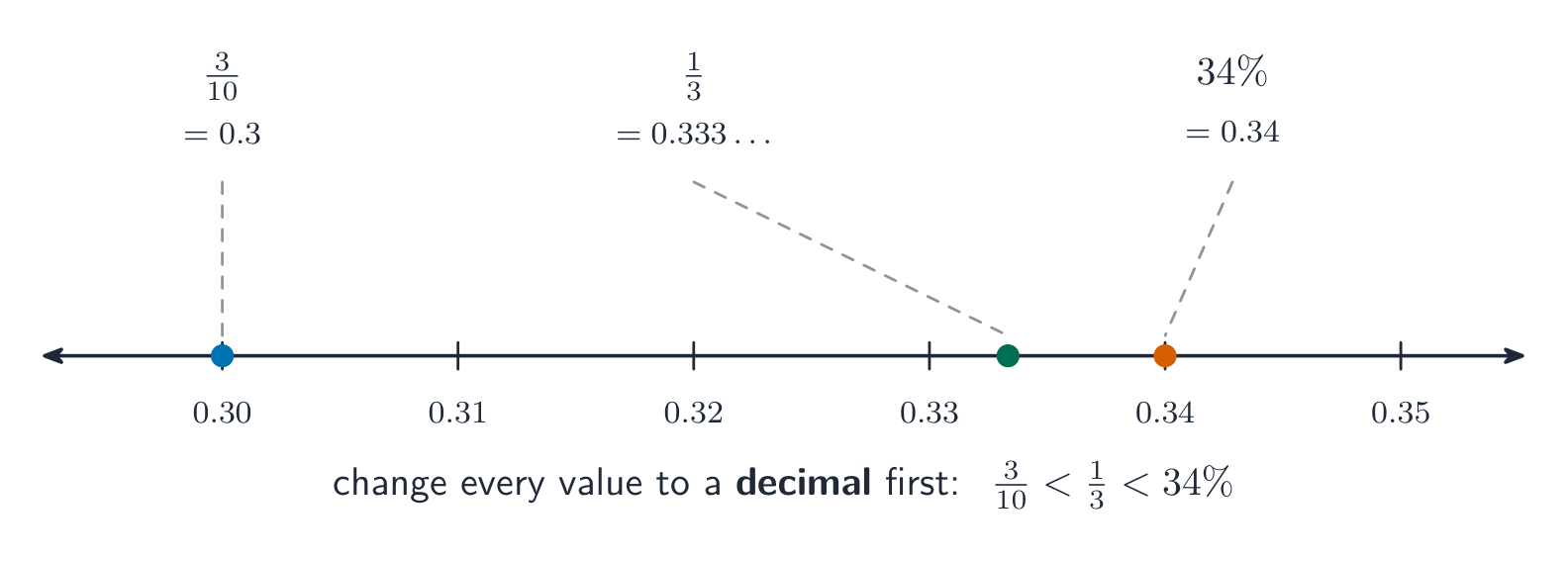
Worked example. Put $34\%$, $\frac{1}{3}$ and $\frac{3}{10}$ in order, smallest first.
As decimals: $34\% = 0.34$, $\frac{1}{3} = 0.333\ldots$, $\frac{3}{10} = 0.3$. So the order is
$$\frac{3}{10} < \frac{1}{3} < 34\%.$$Convert every value to a decimal, then place them on a number line Vocabulary TrainEnglish magnitude/ˈmæɡnɪtjuːd/ 1.13
Percentages

Syllabus
Subject content Notes and examples 1 Calculate a given percentage of a quantity. 2 Express one quantity as a percentage of another. 3 Calculate percentage increase or decrease. 4 Calculate with simple and compound interest. Formulas are not given. Percentage calculations may include: • deposit • discount • profit and loss (as an amount or a percentage) • earnings • percentages over 100%. Subject content Notes and examples 1 Calculate a given percentage of a quantity. 2 Express one quantity as a percentage of another. 3 Calculate percentage increase or decrease. 4 Calculate with simple and compound interest. Problems may include repeated percentage change. Formulas are not given. 5 Calculate using reverse percentages. e.g. find the cost price given the selling price and the percentage profit. Percentage calculations may include: • deposit • discount • profit and loss (as an amount or a percentage) • earnings • percentages over 100%. Source: Cambridge International syllabus
Shops use percentages for discounts, sales tax and profit margins. Find a percentage of an amount. $15\%$ of $\$80 = 0.15 \times 80 = \$12$.
Write one amount as a percentage of another. A score of $18$ out of $25$ is $\frac{18}{25} \times 100\% = 72\%$.
Percentage increase or decrease uses
$$\text{percentage change} = \frac{\text{change}}{\text{original amount}} \times 100\%.$$Worked example. A price rises from $\$40$ to $\$50$. Find the percentage increase.
The change is $\$10$, so $\frac{10}{40} \times 100\% = 25\%$ increase.
A quick way is a multiplier 乘数. To increase by $15\%$, multiply by $1.15$; to decrease by $15\%$, multiply by $0.85$.
Simple and compound interest
Interest 利息 is money paid for borrowing or for saving. The principal 本金 is the starting amount.
- Simple interest 单利 pays the same amount each year, worked out on the principal only:
$$I = \frac{P \times r \times t}{100},$$where $P$ is the principal, $r$ is the rate per year (as a percentage) and $t$ is the number of years.
- Compound interest 复利 adds the interest on each year, so the next year earns interest on a larger total:
$$\text{final value} = P\left(1 + \frac{r}{100}\right)^{t}.$$
Worked example. Find the value of $\$500$ saved at $4\%$ compound interest for $3$ years.
$$500 \times 1.04^{3} = 500 \times 1.124864 = \$562.43 \ (\text{to the nearest cent}).$$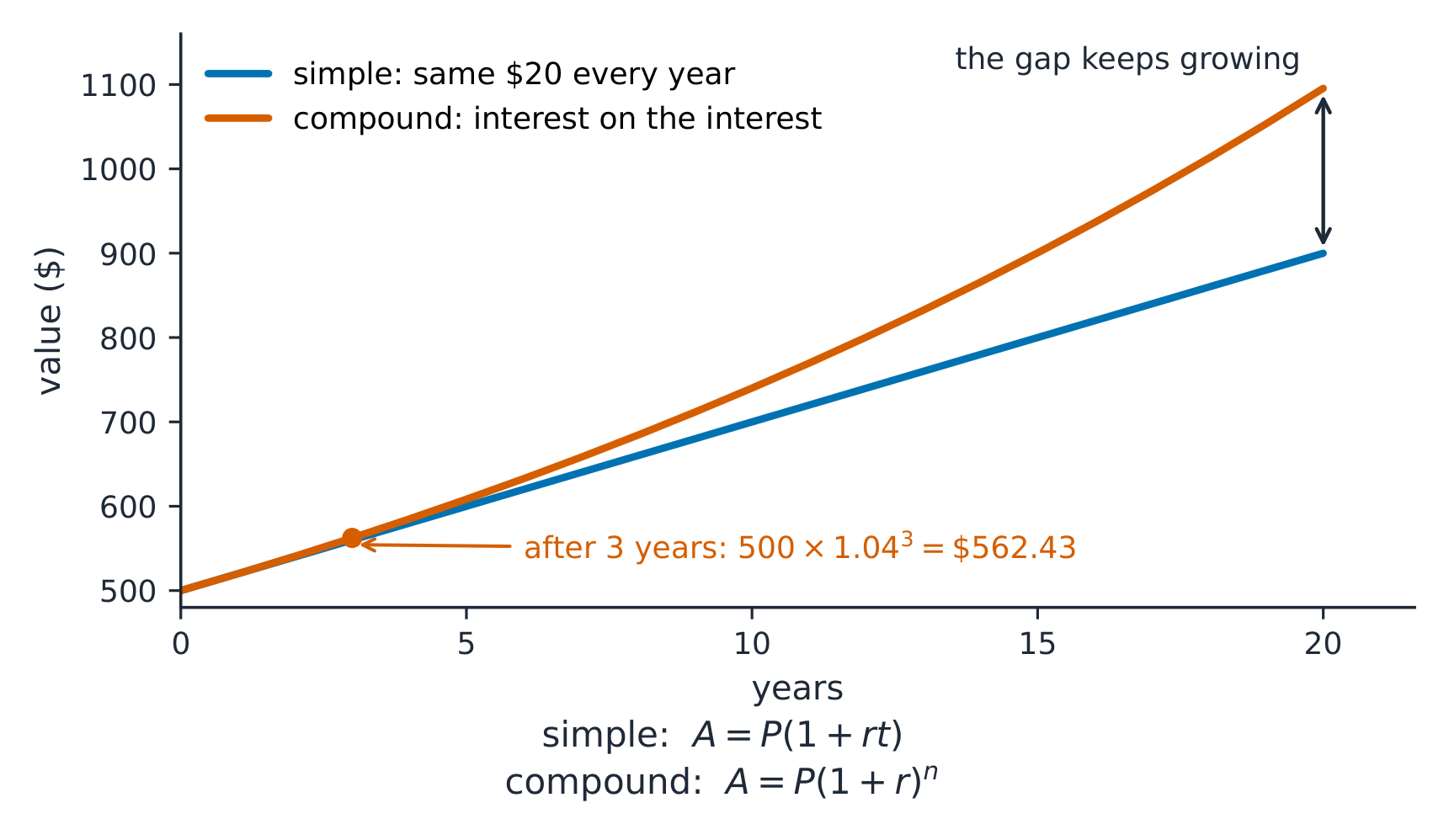
Simple interest grows in a straight line; compound interest grows faster every year Reverse percentages (Extended)
A reverse percentage 逆百分比 problem gives the amount after a change and asks for the original. To solve it, divide by the multiplier — do not just take the percentage off.
Worked example. A coat costs $\$60$ after a $20\%$ increase. Find the original price.
$\$60$ is $120\%$ of the original, so the original price is $60 \div 1.2 = \$50$.
ExplorePercentage change lab
new value = old value x multiplier
Change the multiplier and see the final value change.
Vocabulary TrainEnglish multiplier/ˌmʌltɪˈplaɪə/ interest/ˈɪntrest/ principal/ˈprɪnsɪpl/ simple interest/ˈsɪmpl ˈɪntrest/ compound interest/ˈkɒmpaʊnd ˈɪntrest/ reverse percentage/rɪˈvɜːs pəˈsentɪdʒ/ 1.17
Exponential growth and decay (Extended)
Syllabus
Subject content Notes and examples Use exponential growth and decay. e.g. depreciation, population change. Knowledge of e is not required. Source: Cambridge International syllabus
When a quantity changes by the same percentage in each time period, it shows exponential growth 指数增长 (it gets bigger) or exponential decay 指数衰减 (it gets smaller). Use the compound formula. Depreciation 折旧, where something like a car loses value each year, is decay.
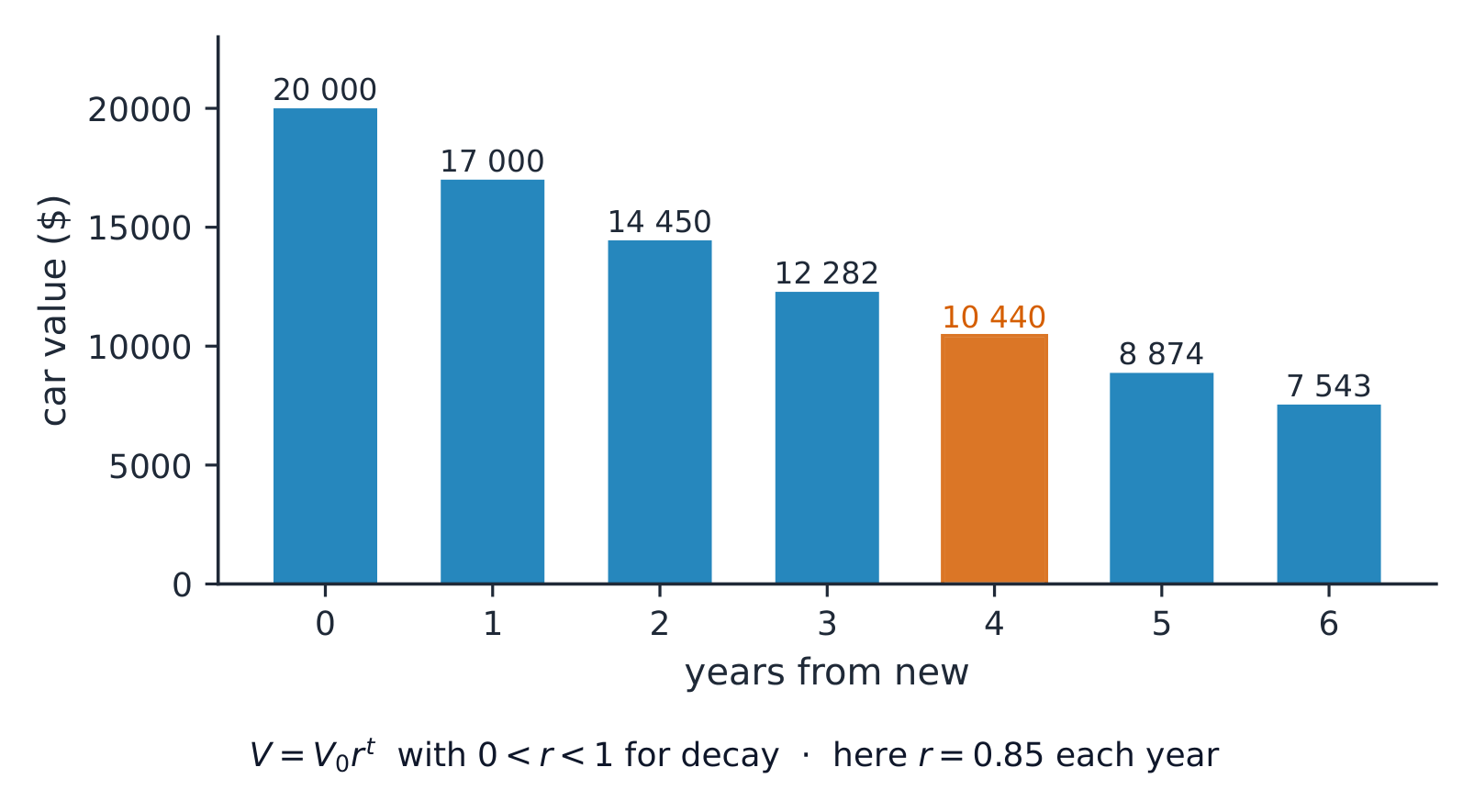
Worked example. A car worth $\$20\,000$ loses $15\%$ of its value each year. Find its value after $4$ years.
The multiplier is $0.85$, so
$$20\,000 \times 0.85^{4} = 20\,000 \times 0.522\ldots = \$10\,440 \ (\text{to the nearest dollar}).$$Exponential decay: the car loses 15 percent of its current value every year ExploreCompound interest
Money grows by (1 + r) every year, so compound interest curves above simple interest. Drag the rate and the number of years.
ExploreExponential growth & decay
y = a·bˣ
Change the base b: b > 1 grows, 0 < b < 1 decays — useful for interest and populations.
Vocabulary TrainEnglish exponential growth/ˌekspəˈnenʃl ɡrəʊθ/ exponential decay/ˌekspəˈnenʃl dɪˈkeɪ/ depreciation/dɪˌpriːʃɪˈeɪʃn/ 1.11
Ratio and proportion

Syllabus
Subject content Notes and examples Understand and use ratio and proportion to: • give ratios in their simplest form e.g. 20:30:40 in its simplest form is 2:3:4. • divide a quantity in a given ratio • use proportional reasoning and ratios in context. e.g. adapt recipes; use map scales; determine best value. Source: Cambridge International syllabus
A ratio 比 compares quantities, written like $a:b$. Simplify it like a fraction by dividing by the HCF: $20:30:40 = 2:3:4$.
Dividing in a ratio. Share $\$48$ in the ratio $3:5$.
The total number of parts is $3 + 5 = 8$. One part is $48 \div 8 = \$6$. So the shares are $3 \times 6 = \$18$ and $5 \times 6 = \$30$.
A bar model for sharing 48 dollars in the ratio 3 to 5 Proportion 比例 means two ratios are equal. Use it for recipes, map scales 比例尺 and finding best value.
Worked example. $3$ pens cost $\$1.80$. Find the cost of $7$ pens.
One pen costs $1.80 \div 3 = \$0.60$. So $7$ pens cost $7 \times 0.60 = \$4.20$.
ExploreDirect proportion
y = ax
Direct proportion is a straight line through the origin — double x and you double y.
Vocabulary TrainEnglish ratio/ˈreɪʃɪəʊ/ proportion/prəˈpɔːʃn/ scale/skeɪl/ 1.12
Rates and average speed

Syllabus
Subject content Notes and examples 1 Use common measures of rate. e.g. calculate with: • hourly rates of pay • exchange rates between currencies • flow rates • fuel consumption. 2 Apply other measures of rate. e.g. calculate with: • pressure • density • population density. Required formulas will be given in the question. 3 Solve problems involving average speed. Knowledge of speed/distance/time formula is required. e.g. A cyclist travels 45 km in 3 hours 45 minutes. What is their average speed? Notation used will be, e.g. m/s (metres per second), $\text{g/cm}^3$ (grams per cubic centimetre). Subject content Notes and examples 1 Use common measures of rate. e.g. calculate with: • hourly rates of pay • exchange rates between currencies • flow rates • fuel consumption. 2 Apply other measures of rate. e.g. calculate with: • pressure • density • population density. Required formulas will be given in the question. 3 Solve problems involving average speed. Knowledge of speed/distance/time formula is required. e.g. A cyclist travels 45 km in 3 hours 45 minutes. What is their average speed? Notation used will be, e.g. m/s (metres per second), g/cm$^{3}$ (grams per cubic centimetre). Source: Cambridge International syllabus
A rate 比率 compares two quantities measured in different units, such as price per kilogram, or distance per hour.
Average speed 平均速度 uses
$$\text{average speed} = \frac{\text{total distance}}{\text{total time}}.$$Worked example. A cyclist travels $45\text{ km}$ in $3$ hours $45$ minutes. Find the average speed.
First change the time to hours: $3$ h $45$ min $= 3.75$ h. Then
$$\text{average speed} = \frac{45}{3.75} = 12\text{ km/h}.$$The distance-speed-time triangle: cover the one you want Other rates work the same way. Density 密度 is found from mass 质量 and volume 体积:
$$\text{density} = \frac{\text{mass}}{\text{volume}}.$$Other examples are flow rate, fuel consumption and population density 人口密度. If a rate needs a special formula (such as pressure 压强), the question will give it to you.
Vocabulary TrainEnglish rate/reɪt/ average speed/ˈævrɪdʒ spiːd/ density/ˈdensɪti/ mass/mæs/ volume/ˈvɒljuːm/ population density/ˌpɒpjʊˈleɪʃn ˈdensɪti/ pressure/ˈpreʃə/ 1.9
Rounding and estimation
Syllabus
Subject content Notes and examples 1 Round values to a specified degree of accuracy. Includes decimal places and significant figures. 2 Make estimates for calculations involving numbers, quantities and measurements. e.g. write 5764 correct to the nearest thousand. e.g. by writing each number correct to 1 significant figure, estimate the value of $$\frac{41.3}{9.79 \times 0.765}$$.3 Round answers to a reasonable degree of accuracy in the context of a given problem. Subject content Notes and examples 1 Round values to a specified degree of accuracy. Includes decimal places and significant figures. e.g. write 5764 correct to the nearest thousand. 2 Make estimates for calculations involving numbers, quantities and measurements. e.g. by writing each number correct to 1 significant figure, estimate the value of $$\frac{41.3}{9.79 \times 0.765}$$.3 Round answers to a reasonable degree of accuracy in the context of a given problem. Source: Cambridge International syllabus
Rounding
- decimal places (d.p.) 小数位: digits counted after the point. $3.14159$ to $2$ d.p. is $3.14$.
- significant figures (s.f.) 有效数字: digits counted from the first non-zero digit. $5764$ to $1$ s.f. is $6000$; $0.004067$ to $2$ s.f. is $0.0041$.
Rule: look at the next digit. If it is $5$ or more, round up; if it is less, round down.
Estimation
To estimate 估算 an answer, round every number to $1$ s.f., then calculate.
Worked example. Estimate $\dfrac{41.3}{9.79 \times 0.765}$.
$$\frac{41.3}{9.79 \times 0.765} \approx \frac{40}{10 \times 0.8} = \frac{40}{8} = 5.$$ExploreRounding and bounds lab
Classify numbers by the decision needed for accuracy.
Vocabulary TrainEnglish decimal place/ˈdesɪml pleɪs/ significant figure/sɪɡˈnɪfɪkənt ˈfɪɡə/ estimate/ˈestɪmət/ 1.10
Limits of accuracy

Syllabus
Subject content Notes and examples Give upper and lower bounds for data rounded to a specified accuracy. e.g. write down the upper bound of a length measured correct to the nearest metre. Candidates are not expected to find the bounds of the results of calculations which have used data rounded to a specified accuracy. Subject content Notes and examples 1 Give upper and lower bounds for data rounded to a specified accuracy. e.g. write down the upper bound of a length measured correct to the nearest metre. 2 Find upper and lower bounds of the results of calculations which have used data rounded to a specified accuracy. Example calculations include: • calculate the upper bound of the perimeter or the area of a rectangle given dimensions measured to the nearest centimetre • find the lower bound of the speed given rounded values of distance and time. Source: Cambridge International syllabus
A rounded value could really be anything that rounds to it. The smallest possible value is the lower bound 下界; the largest is the upper bound 上界. For a value rounded to the nearest unit, the bounds lie half a unit on each side.
Worked example. A height $h$ is $635\text{ m}$, correct to the nearest metre. Give the bounds.
$$634.5 \leqslant h < 635.5.$$Everything in the band rounds to 635: the lower bound is included, the upper bound is not So the lower bound is $634.5\text{ m}$ and the upper bound is $635.5\text{ m}$.
Bounds in calculations (Extended)
Combine the bounds to get the bound you want.
Worked example. A rectangle is $8\text{ cm}$ by $5\text{ cm}$, each side to the nearest cm. Find the largest possible area 面积.
Use the upper bounds of both sides: $8.5 \times 5.5 = 46.75\text{ cm}^{2}$. (The smallest area uses the lower bounds: $7.5 \times 4.5 = 33.75\text{ cm}^{2}$.)
For a divided quantity such as $\text{speed} = \dfrac{\text{distance}}{\text{time}}$, the largest speed comes from the largest distance divided by the smallest time.
Vocabulary TrainEnglish lower bound/ˈləʊə baʊnd/ upper bound/ˈʌpə baʊnd/ area/ˈeərɪə/ 1.15
Time
Syllabus
Subject content Notes and examples 1 Calculate with time: seconds (s), minutes (min), hours (h), days, weeks, months, years, including the relationship between units. 1 year = 365 days. 2 Calculate times in terms of the 24-hour and 12-hour clock. In the 24-hour clock, for example, 3.15 a.m. will be denoted by 03 15 and 3.15 p.m. by 15 15. 3 Read clocks and timetables. Includes problems involving time zones, local times and time differences. Subject content Notes and examples 1 Calculate with time: seconds (s), minutes (min), hours (h), days, weeks, months, years, including the relationship between units. 1 year = 365 days. 2 Calculate times in terms of the 24-hour and 12-hour clock. In the 24-hour clock, for example, 3.15 a.m. will be denoted by 0315 and 3.15 p.m. by 1515. 3 Read clocks and timetables. Includes problems involving time zones, local times and time differences. Source: Cambridge International syllabus
- $60$ seconds $= 1$ minute, $60$ minutes $= 1$ hour, $24$ hours $= 1$ day, and $1$ year $= 365$ days.
- The 24-hour clock writes a time as four digits: $3.15$ p.m. is $15\,15$.
Worked example. A film starts at $19\,35$ and lasts $70$ minutes. Find the time it finishes.
$70$ min $= 1$ h $10$ min. Adding $1$ hour gives $20\,35$; adding $10$ minutes gives $20\,45$.
For timetables and time zone 时区 problems, add or subtract the time difference between the places.
ExploreTime, money and calculator lab
Choose the operation that matches a real measurement problem.
Vocabulary TrainEnglish time zone/taɪm zəʊn/ 1.16
Money
Syllabus
Subject content Notes and examples 1 Calculate with money. 2 Convert from one currency to another. Source: Cambridge International syllabus
Work with money as ordinary decimals, but give answers to $2$ d.p. (so $\$4.8$ is written $\$4.80$).
Currency conversion. Use the exchange rate 汇率 as a multiplier.
Worked example. The exchange rate is $\$1 = €0.92$. Convert $\$150$ to euros, and convert $€138$ back to dollars.
$$150 \times 0.92 = €138, \qquad 138 \div 0.92 = \$150.$$Vocabulary TrainEnglish exchange rate/eksˈtʃeɪndʒ reɪt/ 1.14
Using a calculator
Syllabus
Subject content Notes and examples 1 Use a calculator efficiently. e.g. know not to round values within a calculation and to only round the final answer. 2 Enter values appropriately on a calculator. e.g. enter 2 hours 30 minutes as 2.5 hours or 2° 30’ 0’’. 3 Interpret the calculator display appropriately. e.g. in money 4.8 means $4.80; in time 3.25 means 3 hours 15 minutes. Subject content Notes and examples 1 Use a calculator efficiently. e.g. know not to round values within a calculation and to only round the final answer. 2 Enter values appropriately on a calculator. e.g. enter 2 hours 30 minutes as 2.5 hours or 2° 30' 0''. 3 Interpret the calculator display appropriately. e.g. in money 4.8 means $4.80; in time 3.25 means 3 hours 15 minutes. Source: Cambridge International syllabus
- Do not round part-way through a calculation. Keep the full value and round only the final answer.
- Enter time as a decimal of an hour: $2$ hours $30$ minutes is $2.5$ hours, not $2.30$.
- Read the display in context: in money, $4.8$ means $\$4.80$; in time, $3.25$ hours means $3$ hours $15$ minutes.
1.14
Exam tips
- Follow BIDMAS (brackets, indices, division/multiplication, addition/subtraction) in order, and remember a negative times a negative is positive.
- In standard form the number in front is between 1 and 10; a small number (like $0.0004$) has a negative power of 10.
- A percentage change is worked out on the original amount. For a reverse percentage, divide by the multiplier (e.g. $\div 1.2$ undoes a $20\%$ rise).
- Do not round part-way through — keep the full value and round only at the end, to the accuracy the question asks for (decimal places or significant figures).
- For limits of accuracy, a value rounded to the nearest whole number can be up to $0.5$ either side (so $8$ means $7.5 \le x < 8.5$).
-
2
Algebra and graphs
Watch lessonThis handout covers Topic 2, Algebra and graphs. Parts marked (Extended) are only tested on the Extended papers; everything else is for both levels.
2.1
Working with algebra
Syllabus
Subject content Notes and examples 1 Know that letters can be used to represent generalised numbers. 2 Substitute numbers into expressions and formulas. Source: Cambridge International syllabus
In algebra 代数 we use letters to stand for numbers. A letter whose value can change is a variable 变量. To substitute 代入 means to put a number in place of a letter.
Worked example. Find the value of $3x^{2} - 2y$ when $x = 4$ and $y = 5$.
$$3 \times 4^{2} - 2 \times 5 = 3 \times 16 - 10 = 48 - 10 = 38.$$ExploreAlgebra manipulation route
Follow expression work from collecting terms to solving.
Vocabulary TrainEnglish algebra/ˈældʒɪbrə/ variable/ˈveərɪəbl/ substitute/ˈsʌbstɪtjuːt/ 2.2
Simplifying and expanding

Syllabus
Subject content Notes and examples 1 Simplify expressions by collecting like terms. Simplify means give the answer in its simplest form, e.g. $2a + 3b + 5a - 9b = 7a - 6b$. 2 Expand products of algebraic expressions. e.g. expand $3x(2x - 4y)$. Includes products of two brackets involving one variable, e.g. expand $(2x + 1)(x - 4)$. 3 Factorise by extracting common factors. Factorise means factorise fully, e.g. $9x^2 + 15xy = 3x(3x + 5y)$. Subject content Notes and examples 1 Simplify expressions by collecting like terms. Simplify means give the answer in its simplest form, e.g. $2a^2 + 3ab - 1 + 5a^2 - 9ab + 4 = 7a^2 - 6ab + 3$. 2 Expand products of algebraic expressions. e.g. expand $3x(2x - 4y)$, $(3x + y)(x - 4y)$. Includes products of more than two brackets, e.g. expand $(x - 2)(x + 3)(2x + 1)$. 3 Factorise by extracting common factors. Factorise means factorise fully, e.g. $9x^2 + 15xy = 3x(3x + 5y)$. 4 Factorise expressions of the form: • $ax + bx + kay + kby$ • $a^2x^2 - b^2y^2$ • $a^2 + 2ab + b^2$ • $ax^2 + bx + c$ • $ax^3 + bx^2 + cx$. 5 Complete the square for expressions in the form $ax^2 + bx + c$. Source: Cambridge International syllabus
A term 项 is a single part of an expression 表达式, such as $5a$ or $-9b$. Like terms 同类项 have exactly the same letters; you may add or subtract them. The number in front of the letter is the coefficient 系数.
Expanding a bracket with an area model 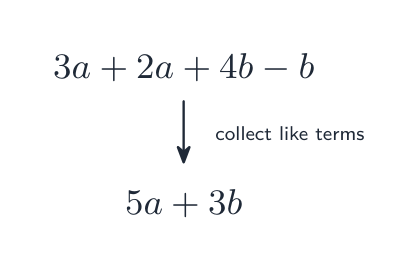
Collecting like terms: add terms with the same letter Worked example. Simplify $2a^{2} + 3ab - 1 + 5a^{2} - 9ab + 4$.
Collect like terms: $2a^{2} + 5a^{2} = 7a^{2}$, $3ab - 9ab = -6ab$, $-1 + 4 = 3$. So the answer is
$$7a^{2} - 6ab + 3.$$To expand 展开 means to multiply out brackets 括号. Multiply every term inside by the term outside; for two brackets, multiply every term in the first by every term in the second.
Worked examples.
$$3x(2x - 4y) = 6x^{2} - 12xy.$$$$(2x + 1)(x - 4) = 2x^{2} - 8x + x - 4 = 2x^{2} - 7x - 4.$$For three brackets (Extended), expand two first, then multiply by the third:
$$(x - 2)(x + 3)(2x + 1) = (x^{2} + x - 6)(2x + 1) = 2x^{3} + 3x^{2} - 11x - 6.$$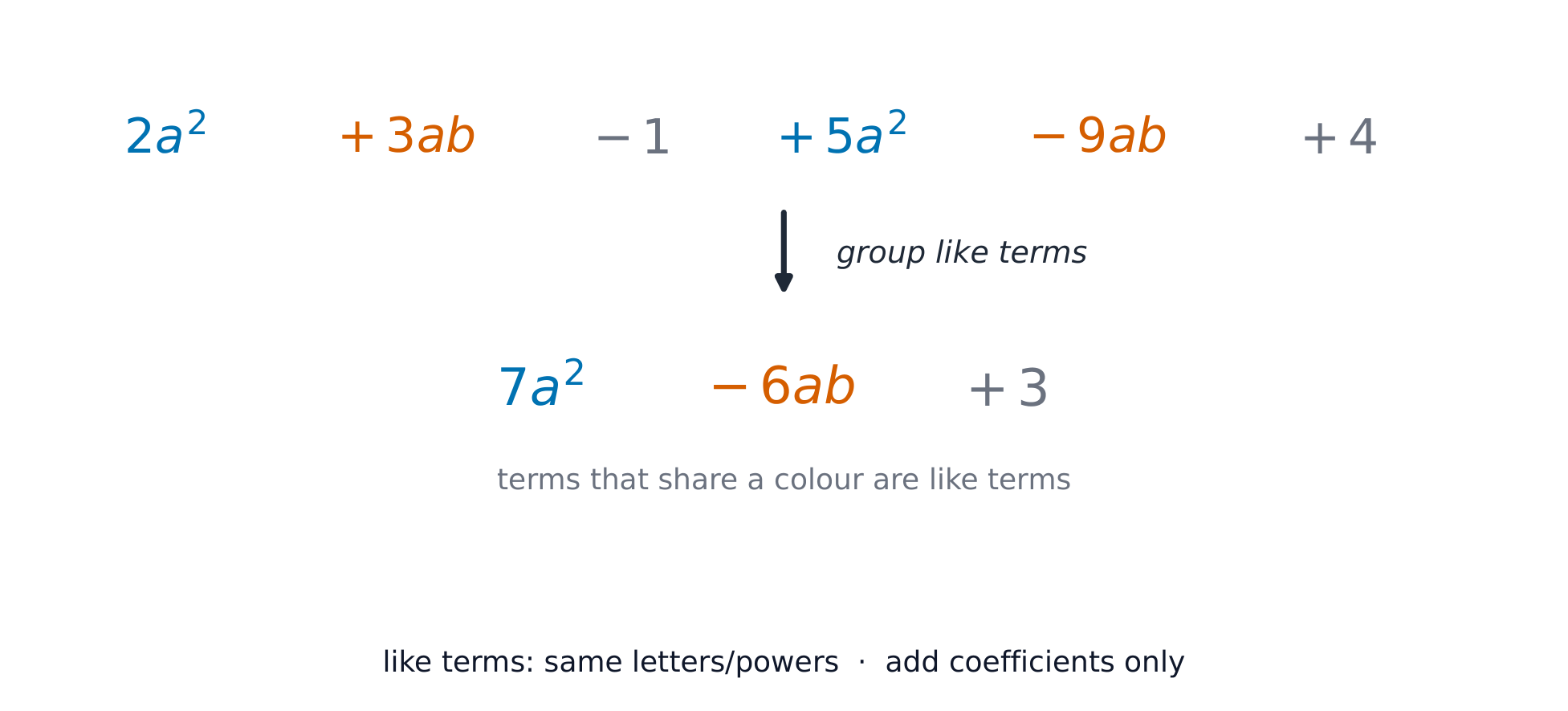
Like terms share the same letters and powers — add coefficients only 
Expand by distributing: a(b+c)=ab+ac (area model) Vocabulary TrainEnglish term/tɜːm/ expression/ekˈspreʃn/ like terms/laɪk tɜːmz/ coefficient/ˌkəʊɪˈfɪʃənt/ expand/ekˈspænd/ brackets/ˈbrækɪts/ 2.2
Factorising
Syllabus
Subject content Notes and examples 1 Simplify expressions by collecting like terms. Simplify means give the answer in its simplest form, e.g. $2a + 3b + 5a - 9b = 7a - 6b$. 2 Expand products of algebraic expressions. e.g. expand $3x(2x - 4y)$. Includes products of two brackets involving one variable, e.g. expand $(2x + 1)(x - 4)$. 3 Factorise by extracting common factors. Factorise means factorise fully, e.g. $9x^2 + 15xy = 3x(3x + 5y)$. Subject content Notes and examples 1 Simplify expressions by collecting like terms. Simplify means give the answer in its simplest form, e.g. $2a^2 + 3ab - 1 + 5a^2 - 9ab + 4 = 7a^2 - 6ab + 3$. 2 Expand products of algebraic expressions. e.g. expand $3x(2x - 4y)$, $(3x + y)(x - 4y)$. Includes products of more than two brackets, e.g. expand $(x - 2)(x + 3)(2x + 1)$. 3 Factorise by extracting common factors. Factorise means factorise fully, e.g. $9x^2 + 15xy = 3x(3x + 5y)$. 4 Factorise expressions of the form: • $ax + bx + kay + kby$ • $a^2x^2 - b^2y^2$ • $a^2 + 2ab + b^2$ • $ax^2 + bx + c$ • $ax^3 + bx^2 + cx$. 5 Complete the square for expressions in the form $ax^2 + bx + c$. Source: Cambridge International syllabus
To factorise 因式分解 is the opposite of expanding: write the expression as a product of brackets. Always take out the common factor 公因式 first.
Worked example. $9x^{2} + 15xy = 3x(3x + 5y)$, because $3x$ divides both terms.
The following patterns are Extended.
Grouping (four terms): take a common factor from each pair.
$$xy + 2x + 3y + 6 = x(y + 2) + 3(y + 2) = (x + 3)(y + 2).$$Difference of two squares 平方差: $a^{2} - b^{2} = (a + b)(a - b)$.
$$9x^{2} - 16 = (3x + 4)(3x - 4).$$Perfect square 完全平方: $a^{2} + 2ab + b^{2} = (a + b)^{2}$.
$$x^{2} + 6x + 9 = (x + 3)^{2}.$$Quadratic 二次 expressions $ax^{2} + bx + c$: find two numbers that multiply to $a \times c$ and add to $b$, then split the middle term.
Worked example. Factorise $2x^{2} + 7x + 3$.
Here $a \times c = 6$ and $b = 7$. The numbers $1$ and $6$ work. Split and group:
$$2x^{2} + x + 6x + 3 = x(2x + 1) + 3(2x + 1) = (x + 3)(2x + 1).$$For $ax^{3} + bx^{2} + cx$, take out the common $x$ first: $2x^{3} + 7x^{2} + 3x = x(2x^{2} + 7x + 3) = x(x + 3)(2x + 1)$.
Vocabulary TrainEnglish factorise/ˈfæktəraɪz/ common factor/ˈkɒmən ˈfæktə/ difference of two squares/ˈdɪfrəns ɒv tuː skweəz/ perfect square/ˈpɜːfekt skweə/ quadratic/kwɒˈdrætɪk/ 2.2
Completing the square (Extended)

Syllabus
Subject content Notes and examples 1 Simplify expressions by collecting like terms. Simplify means give the answer in its simplest form, e.g. $2a^2 + 3ab - 1 + 5a^2 - 9ab + 4 = 7a^2 - 6ab + 3$. 2 Expand products of algebraic expressions. e.g. expand $3x(2x - 4y)$, $(3x + y)(x - 4y)$. Includes products of more than two brackets, e.g. expand $(x - 2)(x + 3)(2x + 1)$. 3 Factorise by extracting common factors. Factorise means factorise fully, e.g. $9x^2 + 15xy = 3x(3x + 5y)$. 4 Factorise expressions of the form: • $ax + bx + kay + kby$ • $a^2x^2 - b^2y^2$ • $a^2 + 2ab + b^2$ • $ax^2 + bx + c$ • $ax^3 + bx^2 + cx$. 5 Complete the square for expressions in the form $ax^2 + bx + c$. Source: Cambridge International syllabus
A suspension bridge cable hangs in a parabola — the graph of a quadratic. Completing the square 配方法 rewrites $x^{2} + bx + c$ as $(x + p)^{2} + q$. Take half of the $x$-coefficient, square it, then balance.
Worked example. Write $x^{2} + 6x + 1$ in completed-square form.
Half of $6$ is $3$, and $3^{2} = 9$:
$$x^{2} + 6x + 1 = (x + 3)^{2} - 9 + 1 = (x + 3)^{2} - 8.$$When the $x^{2}$ has a coefficient, take it out of the first two terms first:
$$2x^{2} + 8x + 3 = 2(x^{2} + 4x) + 3 = 2\big((x + 2)^{2} - 4\big) + 3 = 2(x + 2)^{2} - 5.$$Vocabulary TrainEnglish completing the square/kəmˈpliːtɪŋ ðə skweə/ 2.3
Algebraic fractions (Extended)
Syllabus
Subject content Notes and examples 1 Manipulate algebraic fractions. Examples include: • $\frac{x}{3} + \frac{x - 4}{2}$ • $\frac{2x}{3} - \frac{3(x - 5)}{2}$ • $\frac{3a}{4} \times \frac{9a}{10}$ • $\frac{3a}{4} \div \frac{9a}{10}$ • $\frac{1}{x - 2} + \frac{x + 1}{x - 3}$. 2 Factorise and simplify rational expressions. e.g. $\frac{x^2 - 2x}{x^2 - 5x + 6}$. Source: Cambridge International syllabus
An algebraic fraction 分式 has algebra on the top or bottom. Add and subtract using a common denominator; multiply and divide as with ordinary fractions.
Worked examples.
$$\frac{x}{3} + \frac{x - 4}{2} = \frac{2x}{6} + \frac{3(x - 4)}{6} = \frac{2x + 3x - 12}{6} = \frac{5x - 12}{6}.$$$$\frac{3a}{4} \div \frac{9a}{10} = \frac{3a}{4} \times \frac{10}{9a} = \frac{30a}{36a} = \frac{5}{6}.$$To simplify a rational expression 有理式, factorise the top and bottom, then cancel common brackets.
$$\frac{x^{2} - 2x}{x^{2} - 5x + 6} = \frac{x(x - 2)}{(x - 2)(x - 3)} = \frac{x}{x - 3}.$$ExploreAlgebraic fraction route
Simplify algebraic fractions by factorising before cancelling.
Vocabulary TrainEnglish algebraic fraction/ˌældʒɪˈbreɪɪk ˈfrækʃn/ rational expression/ˈræʃənl ekˈspreʃn/ 2.4
Indices in algebra
Syllabus
Subject content Notes and examples 1 Understand and use indices (positive, zero and negative). e.g. $2^x = 32$. Find the value of $x$. 2 Understand and use the rules of indices. e.g. simplify: • $(5x^3)^2$ • $12a^5 \div 3a^{-2}$ • $6x^7y^4 \times 5x^{-5}y$. Knowledge of logarithms is not required. Subject content Notes and examples 1 Understand and use indices (positive, zero, negative and fractional). e.g. solve: • $32^x = 2$ • $5^{x+1} = 25^x$. 2 Understand and use the rules of indices. e.g. simplify: • $3x^{-4} \times \frac{2}{3}x^{\frac{1}{2}}$ • $\frac{2}{5}x^{\frac{1}{2}} \div 2x^{-2}$ • $\left(\frac{2x^5}{3}\right)^3$. Knowledge of logarithms is not required. Source: Cambridge International syllabus
The laws of indices 指数 work with letters too: $a^{m} \times a^{n} = a^{m+n}$, $a^{m} \div a^{n} = a^{m-n}$, and $(a^{m})^{n} = a^{mn}$.
Worked examples.
$$(5x^{3})^{2} = 25x^{6}, \qquad 12a^{5} \div 3a^{-2} = 4a^{7}, \qquad 6x^{7}y^{4} \times 5x^{-5}y = 30x^{2}y^{5}.$$You can also solve simple index equations by writing both sides with the same base 底数.
Worked example. Solve $2^{x} = 32$. Since $32 = 2^{5}$, you get $x = 5$.
ExploreAlgebraic index law lab
Classify index-law examples by the rule being used.
Vocabulary TrainEnglish indices/ˈɪndɪsiːz/ base/beɪs/ 2.5
Equations

Syllabus
Subject content Notes and examples 1 Construct simple expressions, equations and formulas. e.g. write an expression for a number that is 2 more than $n$. Includes constructing linear simultaneous equations. 2 Solve linear equations in one unknown. Examples include: • $3x + 4 = 10$ • $5 - 2x = 3(x + 7)$. 3 Solve simultaneous linear equations in two unknowns. 4 Change the subject of simple formulas. e.g. change the subject of formulas where: • the subject only appears once • there is not a power or root of the subject. Subject content Notes and examples 1 Construct expressions, equations and formulas. e.g. write an expression for the product of two consecutive even numbers. Includes constructing simultaneous equations. 2 Solve linear equations in one unknown. Examples include: • $3x + 4 = 10$ • $5 - 2x = 3(x + 7)$. 3 Solve fractional equations with numerical and linear algebraic denominators. Examples include: • $\frac{x}{2x + 1} = 4$ • $\frac{2}{x + 2} + \frac{3}{2x - 1} = 1$ • $\frac{x}{x + 2} = \frac{3}{x - 6}$. 4 Solve simultaneous linear equations in two unknowns. 5 Solve simultaneous equations, involving one linear and one non-linear. With powers no higher than two. 6 Solve quadratic equations by factorisation, completing the square and by use of the quadratic formula. Includes writing a quadratic expression in completed square form. Candidates may be expected to give solutions in surd form. The quadratic formula is given in the List of formulas. 7 Change the subject of formulas. e.g. change the subject of a formula where: • the subject appears twice • there is a power or root of the subject. Source: Cambridge International syllabus
Simultaneous equations: where the lines cross An equation 方程 says two expressions are equal. To solve a linear 一次 equation, do the same operation to both sides until the unknown 未知数 is alone.
Solve by doing the same to both sides Worked example. Solve $5 - 2x = 3(x + 7)$.
$$5 - 2x = 3x + 21 \;\Rightarrow\; 5 - 21 = 3x + 2x \;\Rightarrow\; -16 = 5x \;\Rightarrow\; x = -\tfrac{16}{5}.$$Fractional equations (Extended)
A fractional equation 分式方程 has the unknown in a denominator. Multiply both sides by the denominator to clear it.
Worked example. Solve $\dfrac{x}{2x + 1} = 4$.
$$x = 4(2x + 1) = 8x + 4 \;\Rightarrow\; -7x = 4 \;\Rightarrow\; x = -\tfrac{4}{7}.$$Simultaneous equations
Simultaneous equations 联立方程 are two equations solved together. For two linear equations, add or subtract to remove one letter.
Worked example. Solve $2x + y = 7$ and $3x - y = 8$.
Adding removes $y$: $5x = 15$, so $x = 3$. Then $y = 7 - 2(3) = 1$.

The solution of simultaneous equations is where their graphs cross For one linear and one quadratic equation (Extended), substitute the linear into the curve.
Worked example. Solve $y = x + 2$ and $y = x^{2}$.
$$x^{2} = x + 2 \;\Rightarrow\; x^{2} - x - 2 = 0 \;\Rightarrow\; (x - 2)(x + 1) = 0,$$so $x = 2$ (giving $y = 4$) or $x = -1$ (giving $y = 1$).
Solving quadratic equations (Extended)
There are three methods.
- By factorising: $x^{2} + 5x + 6 = 0 \Rightarrow (x + 2)(x + 3) = 0 \Rightarrow x = -2$ or $x = -3$.
- By completing the square: $x^{2} + 6x + 1 = 0 \Rightarrow (x + 3)^{2} = 8 \Rightarrow x + 3 = \pm 2\sqrt{2} \Rightarrow x = -3 \pm 2\sqrt{2}$.
- By the quadratic formula 求根公式, which is given in the exam:
$$x = \frac{-b \pm \sqrt{b^{2} - 4ac}}{2a}.$$
Worked example (formula). Solve $2x^{2} + 3x - 1 = 0$. Here $a = 2$, $b = 3$, $c = -1$:
$$x = \frac{-3 \pm \sqrt{9 + 8}}{4} = \frac{-3 \pm \sqrt{17}}{4}.$$Changing the subject
To change the subject 公式变形 of a formula means to rearrange it so a chosen letter is alone on one side.
Worked example. Make $r$ the subject of $A = \pi r^{2}$ (Extended, because of the power).
$$r^{2} = \frac{A}{\pi} \;\Rightarrow\; r = \sqrt{\frac{A}{\pi}}.$$When the letter appears twice (Extended), collect those terms and factorise. To make $x$ the subject of $y = \dfrac{x + 1}{x - 1}$:
$$y(x - 1) = x + 1 \;\Rightarrow\; yx - x = 1 + y \;\Rightarrow\; x(y - 1) = 1 + y \;\Rightarrow\; x = \frac{1 + y}{y - 1}.$$ExploreSolving an equation
y = ax² + bx + c
Solving means finding the roots — where the curve crosses the x-axis.
Vocabulary TrainEnglish equation/ɪˈkweɪʒn/ linear/ˈlɪnɪə/ unknown/ʌnˈnəʊn/ fractional equation/ˈfrækʃənl ɪˈkweɪʒn/ simultaneous equations/ˌsɪməlˈteɪnɪəs ɪˈkweɪʒnz/ quadratic formula/kwɒˈdrætɪk ˈfɔːmjʊlə/ change the subject/tʃeɪndʒ ðə ˈsʌbdʒekt/ 2.6
Inequalities

Syllabus
Subject content Notes and examples Represent and interpret inequalities, including on a number line. When representing and interpreting inequalities on a number line: • open circles should be used to represent strict inequalities (<, >) • closed circles should be used to represent inclusive inequalities ($\leqslant$, $\geqslant$) e.g. $-3 \leqslant x < 1$ Subject content Notes and examples 1 Represent and interpret inequalities, including on a number line. When representing and interpreting inequalities on a number line: • open circles should be used to represent strict inequalities (<, >) • closed circles should be used to represent inclusive inequalities ($\leqslant$, $\geqslant$). e.g. $-3 \leqslant x < 1$ 2 Construct, solve and interpret linear inequalities. Examples include: • $3x < 2x + 4$ • $-3 \leqslant 3x - 2 < 7$. 3 Represent and interpret linear inequalities in two variables graphically. The following conventions should be used: • broken lines should be used to represent strict inequalities (<, >) • solid lines should be used to represent inclusive inequalities ($\leqslant$, $\geqslant$) • shading should be used to represent unwanted regions (unless otherwise directed in the question). e.g. graphs of $x < 1$ and $y \geqslant 1$ 4 List inequalities that define a given region. Linear programming problems are not included. Source: Cambridge International syllabus
An inequality 不等式 uses $<$, $>$, $\leqslant$ or $\geqslant$. Solve it like an equation, but reverse the sign if you multiply or divide by a negative number.
Worked example. Solve $-3 \leqslant 3x - 2 < 7$.
Add $2$ to all parts, then divide by $3$:
$$-1 \leqslant 3x < 9 \;\Rightarrow\; -\tfrac{1}{3} \leqslant x < 3.$$On a number line 数轴, use an open circle for $<$ or $>$ (value not included) and a closed circle for $\leqslant$ or $\geqslant$ (value included).
$-\tfrac{1}{3} \leqslant x < 3$: a closed circle includes the end value, an open circle excludes it. Regions (Extended)
An inequality in two letters describes a region 区域 of the graph. Draw the boundary line (broken for $<$ or $>$, solid for $\leqslant$ or $\geqslant$) and shade the unwanted side. You may also be asked to list the inequalities that define a given region.
ExploreInequalities
y = ax + b
An inequality asks where the line is above or below a value.
Vocabulary TrainEnglish inequality/ɪniːˈkwɒlɪti/ number line/ˈnʌmbə laɪn/ region/ˈriːdʒn/ 2.7
Sequences

Syllabus
Subject content Notes and examples 1 Continue a given number sequence or pattern. e.g. write the next two terms in this sequence: 1, 3, 6, 10, 15, ... , ... 2 Recognise patterns in sequences, including the term-to-term rule, and relationships between different sequences. 3 Find and use the $n$th term of the following sequences: (a) linear (b) simple quadratic (c) simple cubic. e.g. find the $n$th term of 2, 5, 10, 17 Subject content Notes and examples 1 Continue a given number sequence or pattern. Subscript notation may be used, e.g. $T_n$ is the $n$th term of sequence $T$. 2 Recognise patterns in sequences, including the term-to-term rule, and relationships between different sequences. Includes linear, quadratic, cubic and exponential sequences and simple combinations of these. 3 Find and use the $n$th term of sequences. Source: Cambridge International syllabus
Romanesco broccoli: self-similar spirals form a natural number pattern. A sequence 数列 is a list of numbers that follow a rule. The term-to-term rule 递推规则 tells you how to get the next term from the one before.
To find the rule for the term in position $n$ (the $n$th term), look at how the terms change.
Linear sequence (the terms go up by the same amount each time). The difference is the multiple of $n$.
Worked example. Find the $n$th term of $2, 5, 8, 11, \dots$
The terms go up by $3$, so start with $3n$. Since $3 \times 1 = 3$ but the first term is $2$, subtract $1$: the $n$th term is $3n - 1$.
Quadratic sequence (the differences themselves change by the same amount). The second difference equals $2 \times$ the coefficient of $n^{2}$.
Worked example. Find the $n$th term of $2, 5, 10, 17, \dots$
First differences are $3, 5, 7$; the second difference is $2$, so the $n^{2}$ part is $1n^{2}$. Subtracting $n^{2}$ ($1, 4, 9, 16$) from the sequence leaves $1, 1, 1, 1$. So the $n$th term is $n^{2} + 1$.
A cubic 三次 sequence such as $1, 8, 27, 64, \dots$ has $n$th term $n^{3}$. An exponential sequence 指数数列 such as $2, 6, 18, 54, \dots$ multiplies by a fixed number each time; here the $n$th term is $2 \times 3^{\,n-1}$.
ExploreNumber sequences
Build an arithmetic (add d) or geometric (times r) sequence term by term.
Vocabulary TrainEnglish sequence/ˈsiːkwəns/ term-to-term rule/tɜːm tə tɜːm ruːl/ cubic/ˈkjuːbɪk/ exponential sequence/ˌekspəˈnenʃl ˈsiːkwəns/ 2.8
Direct and inverse proportion (Extended)
Syllabus
Subject content Notes and examples Express direct and inverse proportion in algebraic terms and use this form of expression to find unknown quantities. Includes linear, square, square root, cube and cube root proportion. Knowledge of proportional symbol ($\propto$) is required. Source: Cambridge International syllabus
Two quantities are in direct proportion 正比例 if one is always a fixed multiple of the other: $y \propto x$ means $y = kx$, where $k$ is a constant 常数. They are in inverse proportion 反比例 if one rises as the other falls: $y \propto \dfrac{1}{x}$ means $y = \dfrac{k}{x}$. The symbol $\propto$ is read "is proportional to". You can also have proportion to a square, square root, cube or cube root.
Worked example. $y$ is in direct proportion to $x$, and $y = 12$ when $x = 3$. Find $y$ when $x = 7$.
First find $k$: $12 = k \times 3$, so $k = 4$ and $y = 4x$. Then $y = 4 \times 7 = 28$.
ExploreInverse proportion
y = a/x
Inverse proportion: as x doubles, y halves — a reciprocal curve with two asymptotes.
Vocabulary TrainEnglish direct proportion/daɪˈrekt prəˈpɔːʃn/ constant/ˈkɒnstənt/ inverse proportion/ɪnˈvɜːs prəˈpɔːʃn/ 2.9
Graphs in practical situations
Syllabus
Subject content Notes and examples 1 Use and interpret graphs in practical situations including travel graphs and conversion graphs. e.g. interpret the gradient of a straight-line graph as a rate of change. 2 Draw graphs from given data. e.g. draw a distance–time graph to represent a journey. Subject content Notes and examples 1 Use and interpret graphs in practical situations including travel graphs and conversion graphs. Includes estimation and interpretation of the gradient of a tangent at a point. 2 Draw graphs from given data. 3 Apply the idea of rate of change to simple kinematics involving distance–time and speed–time graphs, acceleration and deceleration. 4 Calculate distance travelled as area under a speed–time graph. Areas will involve linear sections of the graph only. Source: Cambridge International syllabus
Speed-time graphs: gradient and area The gradient 斜率 (steepness) of a graph shows a rate of change 变化率.
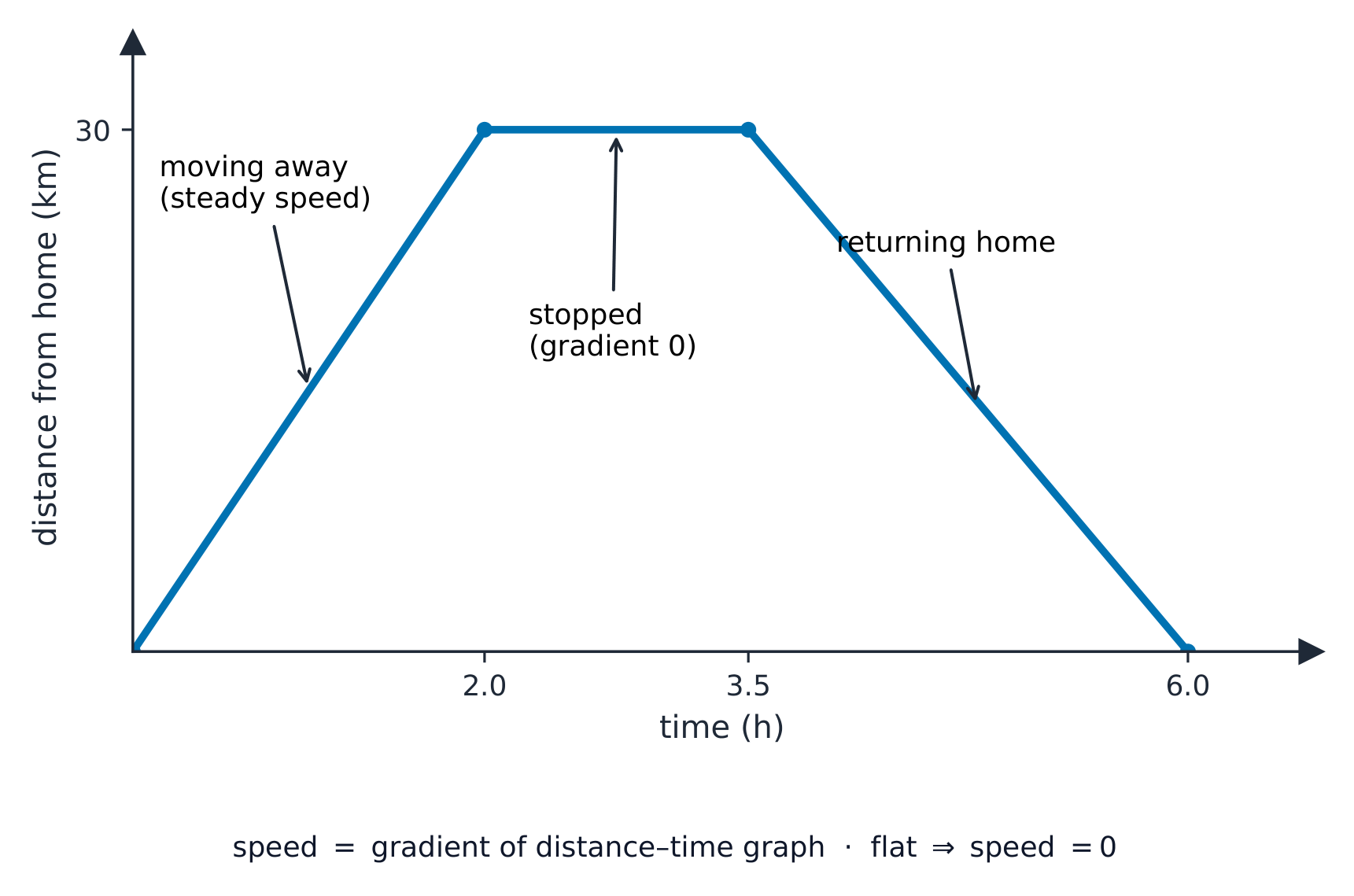
- A travel graph 行程图 (distance–time graph) has gradient equal to speed; a flat part means the object is not moving.
- A conversion graph 换算图 is a straight line used to change between two units (for example, miles and kilometres).
On a distance–time graph the gradient is the speed; a flat section means the object has stopped. Speed–time graphs (Extended)
On a speed–time graph the gradient is the acceleration 加速度 (or deceleration 减速度 if the speed falls), and the area 面积 under the graph is the distance 距离 travelled.
Worked example. A car speeds up from rest to $20\text{ m/s}$ in $8\text{ s}$, then stays at $20\text{ m/s}$ for $12\text{ s}$. Find the acceleration and the total distance.
Acceleration $= \dfrac{20}{8} = 2.5\text{ m/s}^{2}$. The distance is the area: a triangle plus a rectangle,
$$\tfrac{1}{2} \times 8 \times 20 + 12 \times 20 = 80 + 240 = 320\text{ m}.$$
On a speed–time graph the gradient is the acceleration and the area underneath is the distance travelled. ExploreReal-life graphs
y = ax + b
A distance–time or cost graph is read from its gradient and its intercept.
Vocabulary TrainEnglish gradient/ˈɡreɪdɪənt/ rate of change/reɪt ɒv tʃeɪndʒ/ travel graph/ˈtrævl ɡræf/ conversion graph/kənˈvɜːʃn ɡræf/ acceleration/əkˌseləˈreɪʃn/ deceleration/dɪˌseləˈreɪʃn/ area/ˈeərɪə/ distance/ˈdɪstəns/ 2.10
Graphs of functions
Syllabus
Subject content Notes and examples 1 Construct tables of values, and draw, recognise and interpret graphs for functions of the following forms: • $ax + b$ • $\pm x^2 + ax + b$ • $\frac{a}{x} \ (x \neq 0)$ where $a$ and $b$ are integer constants. 2 Solve associated equations graphically, including finding and interpreting roots by graphical methods. e.g. find the intersection of a line and a curve. Subject content Notes and examples 1 Construct tables of values, and draw, recognise and interpret graphs for functions of the following forms: • $a x^n$ (includes sums of no more than three of these) • $a b^x + c$ where $n = -2, -1, -\frac{1}{2}, 0, \frac{1}{2}, 1, 2, 3$; $a$ and $c$ are rational numbers; and $b$ is a positive integer. Examples include: • $y = x^3 + x - 4$ • $y = 2x + \frac{3}{x^2}$ • $y = \frac{1}{4} \times 2^x$. 2 Solve associated equations graphically, including finding and interpreting roots by graphical methods. e.g. finding the intersection of a line and a curve. 3 Draw and interpret graphs representing exponential growth and decay problems. Source: Cambridge International syllabus
To draw a graph, make a table of values 数值表: choose values of $x$, work out $y$, then plot the coordinates 坐标 and join them with a smooth curve.
The points where a graph crosses the $x$-axis (the horizontal axis 坐标轴) are the roots 根 — the solutions of $y = 0$.
You can solve an equation by reading a graph. The intersection point 交点 of a line and a curve gives the solution of the two equations together.
For exponential growth 指数增长 and exponential decay 指数衰减, the graph of $y = a\,b^{x} + c$ rises (or falls) faster and faster and flattens towards a horizontal line.
ExploreGraphing a quadratic
y = ax² + bx + c
Drag a, b and c and watch the parabola move — its turning point and where it crosses the axes.
Vocabulary TrainEnglish table of values/ˈteɪbl ɒv ˈvæljuːz/ coordinates/kəʊˈɔːdɪnəts/ axis/ˈæksɪs/ roots/ruːts/ intersection point/ˌɪntəˈsekʃn pɔɪnt/ exponential growth/ˌekspəˈnenʃl ɡrəʊθ/ exponential decay/ˌekspəˈnenʃl dɪˈkeɪ/ 2.11
Sketching curves
Syllabus
Subject content Notes and examples Recognise, sketch and interpret graphs of the following functions: (a) linear (b) quadratic. Knowledge of symmetry and roots is required. Knowledge of turning points is not required. Subject content Notes and examples Recognise, sketch and interpret graphs of the following functions: (a) linear (b) quadratic (c) cubic (d) reciprocal (e) exponential. Functions will be equivalent to: • $ax + by = c$ • $y = ax^2 + bx + c$ • $y = ax^3 + b$ • $y = ax^3 + bx^2 + cx$ • $y = \frac{a}{x} + b$ • $y = ar^x + b$ where $a$, $b$ and $c$ are rational numbers and $r$ is a rational, positive number. Knowledge of turning points, roots and symmetry is required. Knowledge of vertical and horizontal asymptotes is required. Finding turning points of quadratics by completing the square is required. Source: Cambridge International syllabus
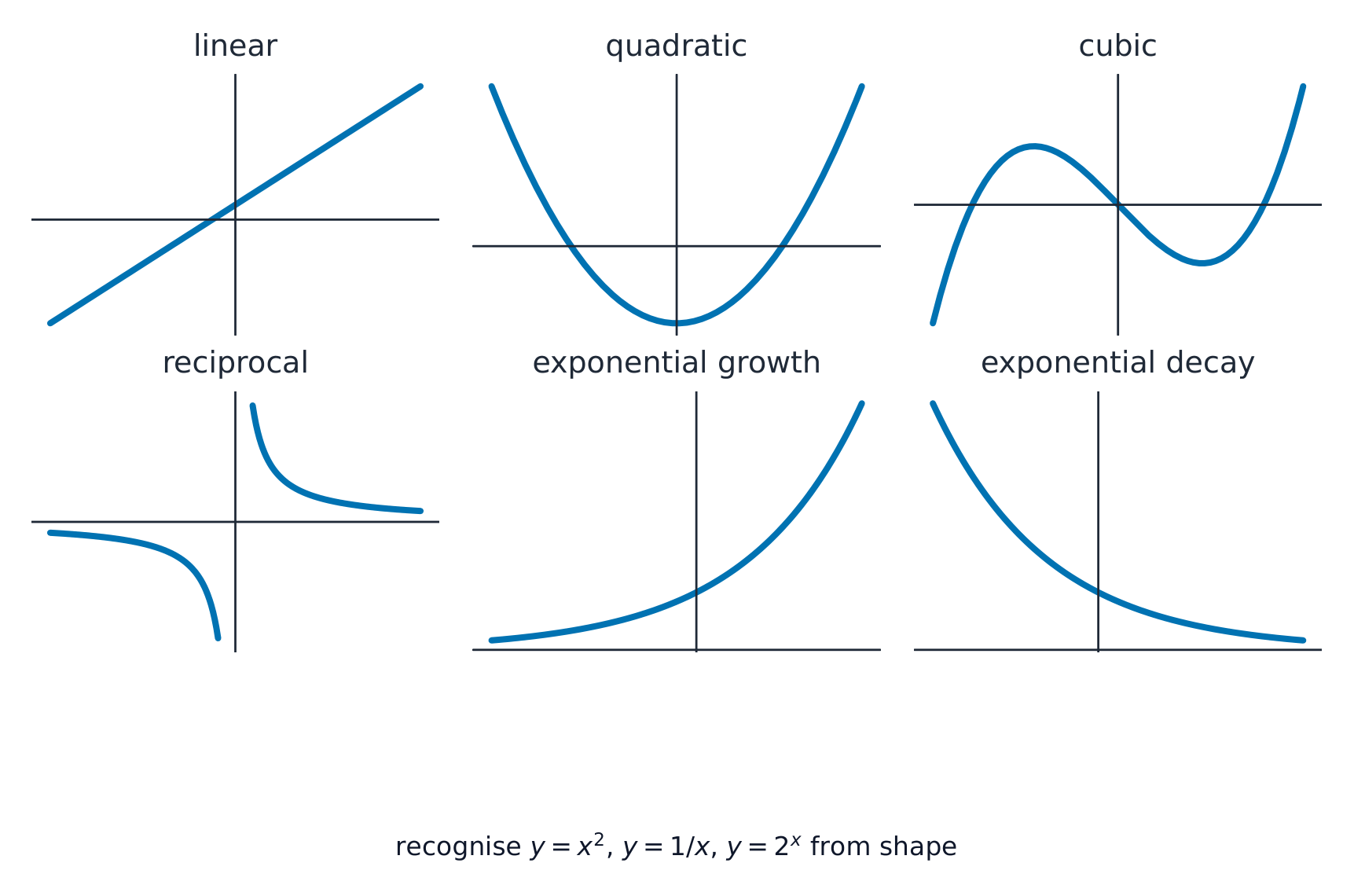
A quick sketch should show the right shape and the key features: where it crosses the axes, any symmetry 对称, and any line the curve gets close to.
Function Shape linear, $y = mx + c$ straight line; gradient $m$, $y$-intercept 截距 $c$ quadratic, $y = ax^{2} + bx + c$ a parabola 抛物线 (U-shape if $a>0$, $\cap$-shape if $a<0$) cubic, $y = ax^{3} + bx + c$ an S-shaped curve reciprocal, $y = \dfrac{a}{x} + b$ two separate curves exponential, $y = a\,r^{x} + b$ fast growth or decay The basic graph shapes; knowing each shape lets you sketch quickly from the equation. For a parabola, completing the square gives the turning point 转折点 (the lowest or highest point). For example $y = (x + 3)^{2} - 8$ has its turning point at $(-3, -8)$.
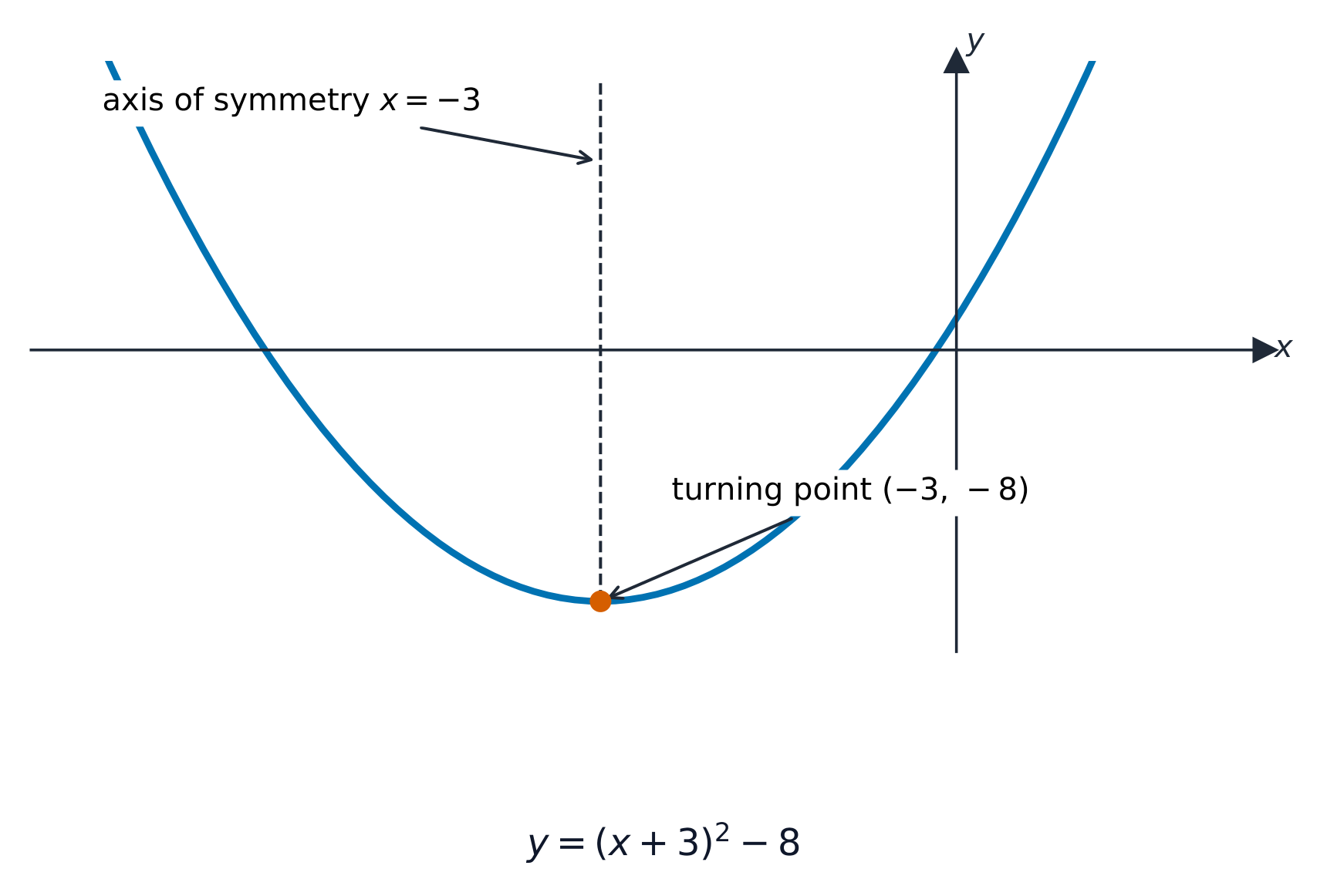
Completing the square, $y=(x+3)^2-8$, shows the turning point $(-3,-8)$ and the line of symmetry $x=-3$. An asymptote 渐近线 is a line that the curve gets closer and closer to but never touches — for example, the $x$-axis for $y = \dfrac{a}{x}$, or the line $y = b$ for $y = a\,r^{x} + b$.
Vocabulary TrainEnglish symmetry/ˈsɪmətri/ intercept/ˌɪntəˈsept/ parabola/pəˈræbələ/ turning point/ˈtɜːnɪŋ pɔɪnt/ asymptote/ˈæsɪmptəʊt/ 2.12
Differentiation (Extended)
Syllabus
Subject content Notes and examples 1 Estimate gradients of curves by drawing tangents. 2 Use the derivatives of functions of the form $ax^n$, where $a$ is a rational constant and $n$ is a positive integer or zero, and simple sums of not more than three of these. $\frac{\mathrm{d}y}{\mathrm{d}x}$ notation will be expected. 3 Apply differentiation to gradients and stationary points (turning points). 4 Discriminate between maxima and minima by any method. Maximum and minimum points may be identified by: • an accurate sketch • use of the second differential • inspecting the gradient either side of a turning point. Candidates are not expected to identify points of inflection. Source: Cambridge International syllabus
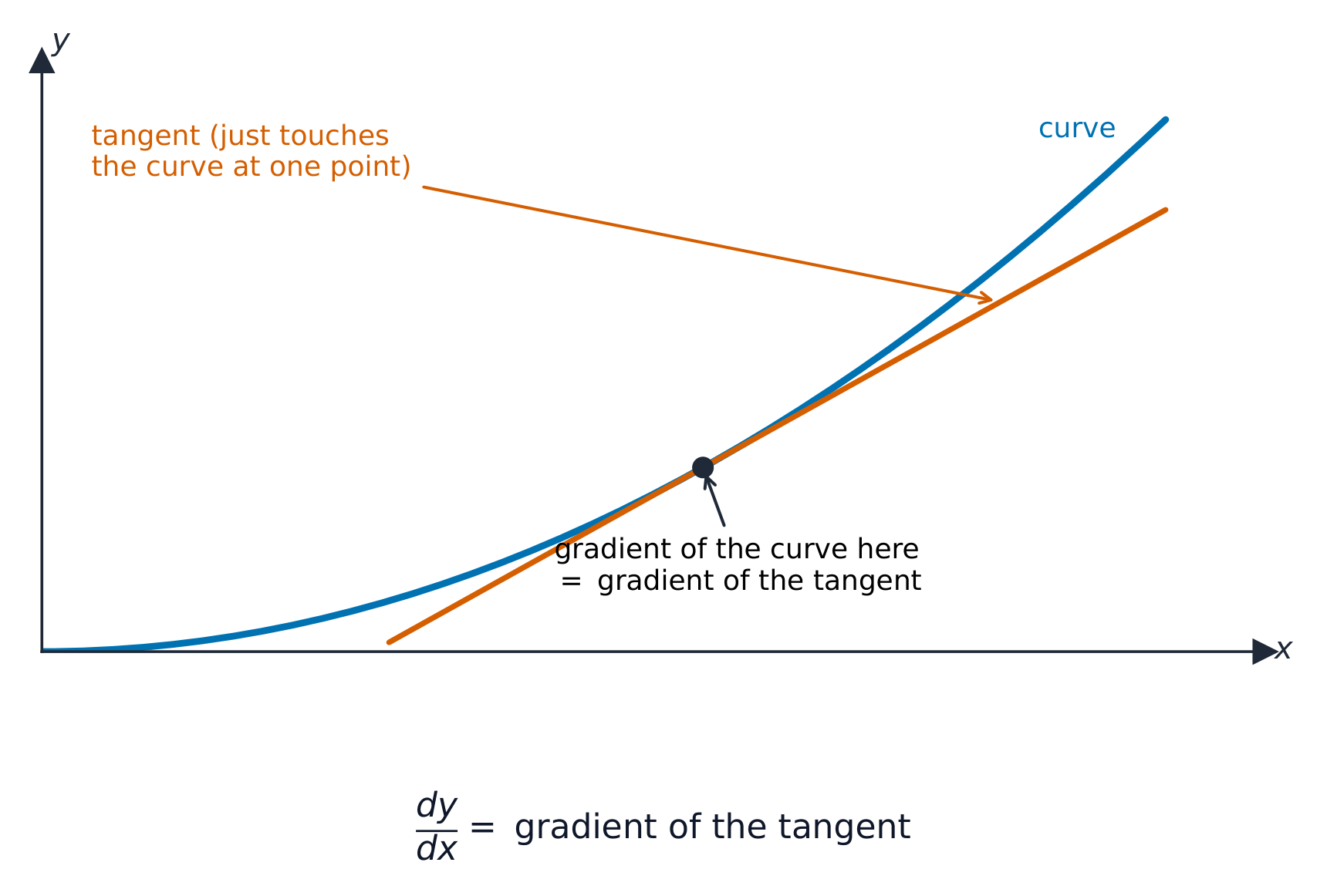
Differentiation 微分 finds the gradient of a curve at any point. You can estimate it by drawing a tangent 切线 (a line that just touches the curve) and measuring its gradient.
The gradient of a curve at a point equals the gradient of the tangent there — what differentiation finds. The exact rule: if $y = ax^{n}$, then the derivative 导数 is
$$\frac{\mathrm{d}y}{\mathrm{d}x} = a\,n\,x^{\,n-1}.$$Differentiate a sum term by term.
Worked example. If $y = x^{3} + 2x^{2} - 5x$, then $\dfrac{\mathrm{d}y}{\mathrm{d}x} = 3x^{2} + 4x - 5$.
A stationary point 驻点 (turning point) is where the gradient is zero, so set $\dfrac{\mathrm{d}y}{\mathrm{d}x} = 0$.
Worked example. Find the turning point of $y = x^{2} - 6x + 5$.
$$\frac{\mathrm{d}y}{\mathrm{d}x} = 2x - 6 = 0 \;\Rightarrow\; x = 3, \quad y = 3^{2} - 6(3) + 5 = -4.$$The turning point is $(3, -4)$. To decide whether a turning point is a maximum 最大值 or a minimum 最小值, check the sign of the gradient on each side, or use the second derivative (positive means a minimum).
ExploreGradient of a curve
y = ax³ + bx² + cx + d
Move the point: the tangent shows the gradient there, which is what differentiation finds.
Vocabulary TrainEnglish differentiation/ˌdɪfəˌrenʃɪˈeɪʃn/ tangent/ˈtændʒənt/ derivative/dɪˈrɪvətɪv/ stationary point/ˈsteɪʃənəri pɔɪnt/ maximum/ˈmæksɪməm/ minimum/ˈmɪnɪməm/ 2.13
Functions (Extended)
Syllabus
Subject content Notes and examples 1 Understand functions, domain and range and use function notation. Examples include: • $f(x) = 3x - 5$ • $g(x) = \frac{3(x + 4)}{5}$ • $h(x) = 2x^2 + 3$. 2 Understand and find inverse functions $f^{-1}(x)$. 3 Form composite functions as defined by $gf(x) = g(f(x))$. e.g. $f(x) = \frac{3}{x + 2}$ and $g(x) = (3x + 5)^2$. Find $fg(x)$. Give your answer as a fraction in its simplest form. Candidates are not expected to find the domains and ranges of composite functions. This topic may include mapping diagrams. Source: Cambridge International syllabus
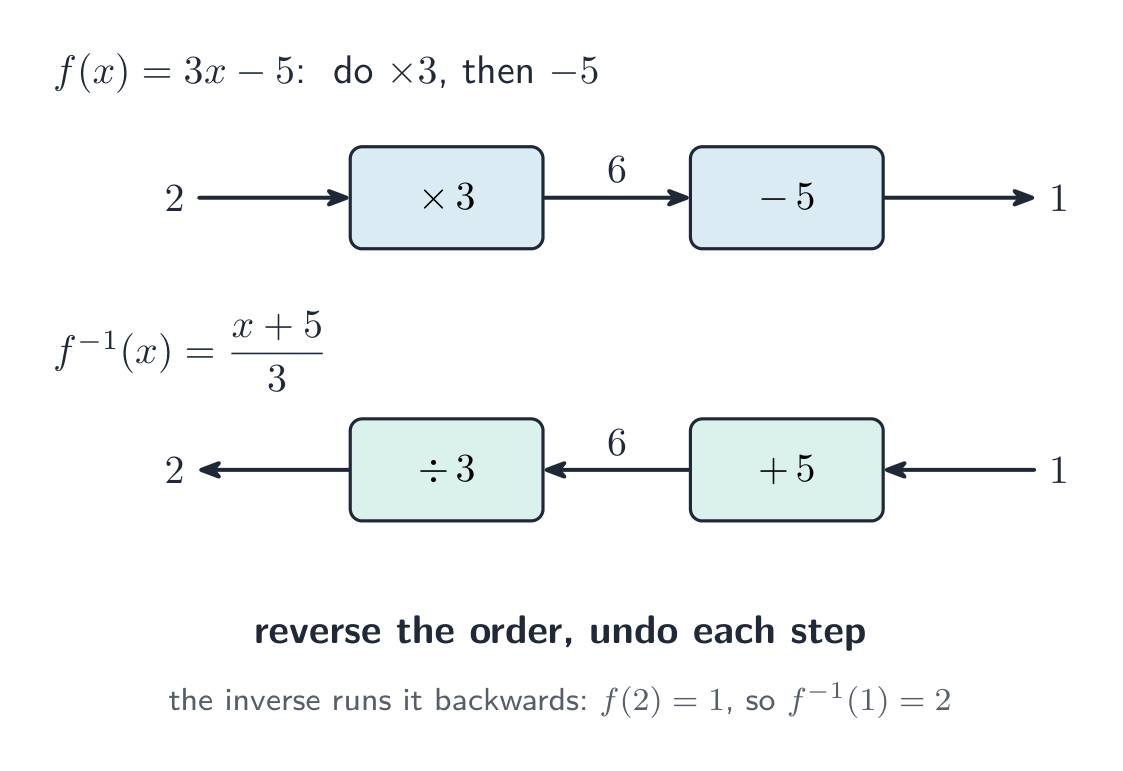
A function 函数 turns each input into one output. We write $f(x)$, for example $f(x) = 3x - 5$, so $f(2) = 1$. The set of allowed inputs is the domain 定义域; the set of possible outputs is the range 值域.
The inverse function 反函数 $f^{-1}(x)$ undoes the function. To find it, write $y = f(x)$, swap the roles, and make $x$ the subject.
Worked example. Find the inverse of $f(x) = 3x - 5$.
$$y = 3x - 5 \;\Rightarrow\; x = \frac{y + 5}{3}, \quad \text{so} \quad f^{-1}(x) = \frac{x + 5}{3}.$$A function as a machine; the inverse runs it backwards - reverse the order, undo each step A composite function 复合函数 applies one function after another: $gf(x)$ means "do $f$ first, then $g$".
Worked example. If $f(x) = 2x$ and $g(x) = x + 3$, then
$$gf(x) = g(2x) = 2x + 3, \qquad fg(x) = f(x + 3) = 2(x + 3) = 2x + 6.$$ExploreFunctions
y = f(x)
A function turns each input into exactly one output — watch its shape.
Vocabulary TrainEnglish function/ˈfʌŋkʃn/ domain/dəˈmeɪn/ range/reɪndʒ/ inverse function/ɪnˈvɜːs ˈfʌŋkʃn/ composite function/ˈkɒmpəzɪt ˈfʌŋkʃn/ 2.13
Exam tips
- When you expand brackets, multiply every term and watch the signs, especially with a minus in front: $-(x - 3) = -x + 3$.
- To solve an equation, do the same thing to both sides. When you multiply or divide an inequality by a negative number, flip the sign.
- Factorise fully: take out the highest common factor first, then look for a difference of two squares or a quadratic pattern.
- A quadratic usually has two solutions — give both. Check whether the question wants factorising, the formula, or completing the square.
- When substituting into a formula, put each value in brackets first, so signs and powers come out right.
-
3
Coordinate geometry
Watch lessonThis handout covers Topic 3, Coordinate geometry. Parts marked (Extended) are only tested on the Extended papers; everything else is for both levels.
3.1
Coordinates

Syllabus
Subject content Notes and examples Use and interpret Cartesian coordinates in two dimensions. Source: Cambridge International syllabus
A city street grid: every place is fixed by its coordinates. A point on a graph is described by its coordinates 坐标, sometimes called Cartesian coordinates, written $(x, y)$. The first number is the across value and the second is the up value.
- The two number lines are the axes 坐标轴: the horizontal 水平 $x$-axis and the vertical 竖直 $y$-axis.
- They cross at the origin 原点, the point $(0, 0)$.
- The axes split the grid into four quadrants 象限.
So the point $(3, -2)$ is found by going $3$ to the right and $2$ down.

The axes meet at the origin $O$ and split the plane into four quadrants; $(3,-2)$ means 3 right then 2 down. ExploreThe coordinate plane
y = mx + c
Every point has an (x, y) coordinate. A straight line is the set of points where y depends on x in a fixed way.
Vocabulary TrainEnglish coordinates/kəʊˈɔːdɪnəts/ axes/ˈæksɪz/ horizontal/ˌhɒrɪˈzɒntl/ vertical/ˈvɜːtɪkl/ origin/ˈɒrɪdʒɪn/ quadrants/ˈkwɒdrənts/ 3.5
The equation of a straight line
Syllabus
Subject content Notes and examples Interpret and obtain the equation of a straight-line graph in the form $y = mx + c$. Questions may: • use and request lines in the forms $y = mx + c$, $x = k$ • involve finding the equation when the graph is given • ask for the gradient or $y$-intercept of a graph from an equation, e.g. find the gradient and $y$-intercept of the graph with the equation $y = 6x + 3$. Candidates are expected to give equations of a line in a fully simplified form. Subject content Notes and examples Interpret and obtain the equation of a straight-line graph. Questions may: • use and request lines in different forms, e.g. $ax + by = c$, $y = mx + c$, $x = k$ • involve finding the equation when the graph is given • ask for the gradient or $y$-intercept of a graph from an equation, e.g. find the gradient and $y$-intercept of the graph with equation $5x + 4y = 8$. Candidates are expected to give equations of a line in a fully simplified form. Source: Cambridge International syllabus
Most straight lines can be written as
$$y = mx + c,$$where $m$ is the gradient 斜率 (steepness) and $c$ is the intercept 截距 — the $y$-value where the line crosses the $y$-axis.
- A line like $x = k$ (for example $x = 3$) is vertical.
- A line like $y = k$ (for example $y = 3$) is horizontal.
A line may also be given as $ax + by = c$. Rearrange it into $y = mx + c$ to read off the gradient and intercept.
Worked example. Find the gradient and $y$-intercept of $5x + 4y = 8$.
$$4y = -5x + 8 \;\Rightarrow\; y = -\tfrac{5}{4}x + 2.$$So the gradient is $-\tfrac{5}{4}$ and the $y$-intercept is $2$.
Explorey = mx + c
y = ax + b
Drag the gradient and the intercept. a is the gradient (steepness) and b is where the line crosses the y-axis.
Vocabulary TrainEnglish gradient/ˈɡreɪdɪənt/ intercept/ˌɪntəˈsept/ 3.3
Gradient

Syllabus
Subject content Notes and examples Find the gradient of a straight line. From a grid only. Subject content Notes and examples 1 Find the gradient of a straight line. 2 Calculate the gradient of a straight line from the coordinates of two points on it. Source: Cambridge International syllabus
y = mx + c: gradient and intercept, live A steep mountain road: gradient measures steepness as rise over run. The gradient measures how steep a line is:
$$m = \frac{\text{change in } y}{\text{change in } x} = \frac{\text{rise}}{\text{run}}.$$A positive gradient goes up to the right; a negative gradient goes down to the right.
Worked example. Find the gradient of the line through $(1, 2)$ and $(4, 11)$.
$$m = \frac{11 - 2}{4 - 1} = \frac{9}{3} = 3.$$
For $y=mx+c$, the line crosses the $y$-axis at $c$ and the gradient $m$ is the rise divided by the run. ExploreGradient
y = ax + b
The gradient a measures steepness — rise over run.
3.2
Drawing a straight-line graph

Syllabus
Subject content Notes and examples Draw straight-line graphs for linear equations. Equations will be given in the form $y = mx + c$ (e.g. $y = -2x + 5$), unless a table of values is given. Subject content Notes and examples Draw straight-line graphs for linear equations. Examples include: • $y = -2x + 5$ • $y = 7 - 4x$ • $3x + 2y = 5$. Source: Cambridge International syllabus
To draw $y = mx + c$, the quickest way is:
- Mark the intercept $c$ on the $y$-axis.
- Use the gradient to step to more points (for $m = 3$, go $1$ right and $3$ up).
- Join the points with a straight line.
You can also make a small table of values 数值表: choose two or three $x$-values, work out $y$, and plot the points.
Drawing a line fast: mark the intercept, then use the gradient to step to new points Vocabulary TrainEnglish table of values/ˈteɪbl ɒv ˈvæljuːz/ 3.5
Finding the equation of a line
Syllabus
Subject content Notes and examples Interpret and obtain the equation of a straight-line graph in the form $y = mx + c$. Questions may: • use and request lines in the forms $y = mx + c$, $x = k$ • involve finding the equation when the graph is given • ask for the gradient or $y$-intercept of a graph from an equation, e.g. find the gradient and $y$-intercept of the graph with the equation $y = 6x + 3$. Candidates are expected to give equations of a line in a fully simplified form. Subject content Notes and examples Interpret and obtain the equation of a straight-line graph. Questions may: • use and request lines in different forms, e.g. $ax + by = c$, $y = mx + c$, $x = k$ • involve finding the equation when the graph is given • ask for the gradient or $y$-intercept of a graph from an equation, e.g. find the gradient and $y$-intercept of the graph with equation $5x + 4y = 8$. Candidates are expected to give equations of a line in a fully simplified form. Source: Cambridge International syllabus
If you know the gradient $m$ and one point on the line, put the point into $y = mx + c$ to find $c$.
Worked example. A line has gradient $3$ and passes through $(1, 2)$. Find its equation.
$$y = 3x + c, \qquad 2 = 3(1) + c, \qquad c = -1.$$So the equation is $y = 3x - 1$. (If you are given two points, first find the gradient, then do this.)
3.4
Length and midpoint (Extended)

Syllabus
Subject content Notes and examples 1 Calculate the length of a line segment. 2 Find the coordinates of the midpoint of a line segment. Source: Cambridge International syllabus
A line segment 线段 is the straight piece between two points.
To find the length 长度 of the segment between $(x_1, y_1)$ and $(x_2, y_2)$, use Pythagoras' theorem 勾股定理 on the horizontal and vertical gaps:
$$\text{length} = \sqrt{(x_2 - x_1)^2 + (y_2 - y_1)^2}.$$To find the midpoint 中点 (the point exactly in the middle), average the coordinates:
$$\text{midpoint} = \left( \frac{x_1 + x_2}{2}, \; \frac{y_1 + y_2}{2} \right).$$Worked example. Find the length and midpoint of the segment from $(1, 2)$ to $(4, 6)$.
$$\text{length} = \sqrt{(4 - 1)^2 + (6 - 2)^2} = \sqrt{9 + 16} = \sqrt{25} = 5.$$$$\text{midpoint} = \left( \frac{1 + 4}{2}, \; \frac{2 + 6}{2} \right) = (2.5, \, 4).$$The horizontal gap (3) and vertical gap (4) make a right triangle, so the length is $\sqrt{3^2+4^2}=5$; the midpoint is the average of the coordinates. ExploreLength and midpoint lab
midpoint is halfway between endpoints
Move along a line segment and see midpoint as halfway.
Vocabulary TrainEnglish line segment/laɪn ˈseɡmənt/ length/leŋθ/ Pythagoras' theorem/paɪˈθæɡərəs ˈθɪərəm/ midpoint/ˈmɪdpɔɪnt/ 3.6
Parallel lines
Syllabus
Subject content Notes and examples Find the gradient and equation of a straight line parallel to a given line. e.g. find the equation of the line parallel to $y = 4x - 1$ that passes through $(1, -3)$. Source: Cambridge International syllabus
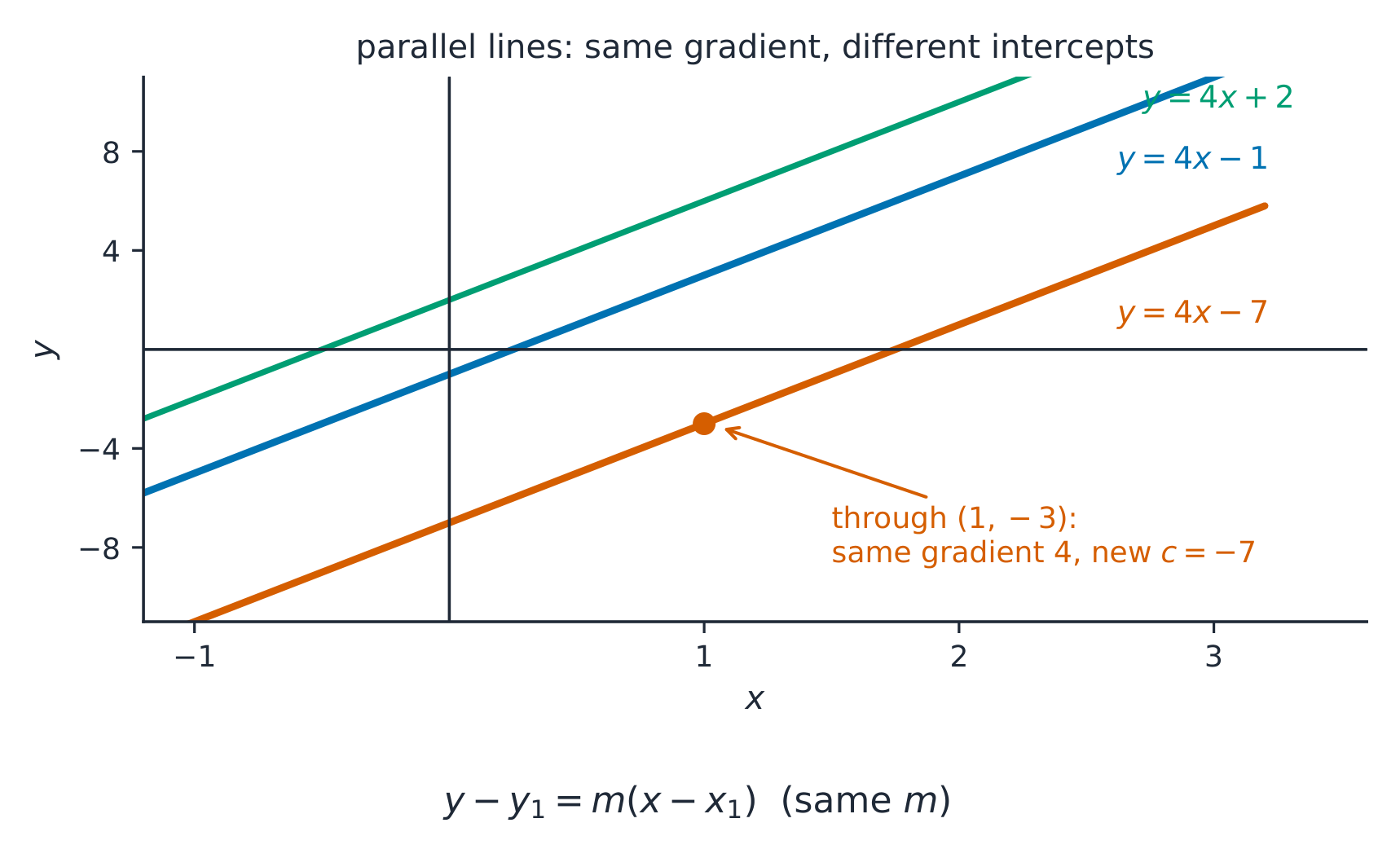
Parallel 平行 lines never meet, so they have the same gradient.
Worked example. Find the equation of the line parallel to $y = 4x - 1$ that passes through $(1, -3)$.
The gradient is also $4$. Put the point in:
$$-3 = 4(1) + c \;\Rightarrow\; c = -7,$$so the line is $y = 4x - 7$.
Parallel lines: same gradient, different intercepts ExploreParallel & perpendicular
y = ax + b
Parallel lines share a gradient; perpendicular gradients multiply to −1.
Vocabulary TrainEnglish parallel/ˈpærəlel/ 3.7
Perpendicular lines (Extended)

Syllabus
Subject content Notes and examples Find the gradient and equation of a straight line perpendicular to a given line. Examples include: • find the gradient of a line perpendicular to $2y = 3x + 1$ • find the equation of the perpendicular bisector of the line joining the points $(-3, 8)$ and $(9, -2)$. Source: Cambridge International syllabus
Two lines are perpendicular 垂直 if they meet at a right angle 直角. Their gradients multiply to $-1$:
$$m_1 \times m_2 = -1, \qquad \text{so} \qquad m_2 = -\frac{1}{m_1}.$$In words: flip the fraction and change the sign.
Worked example. Find the gradient of a line perpendicular to $2y = 3x + 1$.
Rearrange: $y = \tfrac{3}{2}x + \tfrac{1}{2}$, so the gradient is $\tfrac{3}{2}$. The perpendicular gradient is $-\tfrac{2}{3}$.
Parallel lines share the same gradient; perpendicular gradients multiply to $-1$. Perpendicular bisector
The perpendicular bisector 垂直平分线 of a segment cuts it in half at a right angle. To find its equation: get the midpoint, then use the perpendicular gradient through that midpoint.
Worked example. Find the perpendicular bisector of the segment joining $(-3, 8)$ and $(9, -2)$.
- Midpoint: $\left( \frac{-3 + 9}{2}, \frac{8 + (-2)}{2} \right) = (3, 3)$.
- Gradient of the segment: $\frac{-2 - 8}{9 - (-3)} = \frac{-10}{12} = -\tfrac{5}{6}$.
- Perpendicular gradient: $\frac{6}{5}$.
Through $(3, 3)$: $\; 3 = \tfrac{6}{5}(3) + c \Rightarrow c = 3 - \tfrac{18}{5} = -\tfrac{3}{5}$. So the bisector is
$$y = \tfrac{6}{5}x - \tfrac{3}{5}.$$Vocabulary TrainEnglish perpendicular/ˌpɜːpənˈdɪkjʊlə/ right angle/raɪt ˈæŋɡl/ perpendicular bisector/ˌpɜːpənˈdɪkjʊlə baɪˈsektə/ 3.7
Exam tips
- The straight line is $y = mx + c$: $m$ is the gradient and $c$ is where the line crosses the $y$-axis.
- Gradient = (change in $y$) ÷ (change in $x$). Keep the two coordinates in the same order on the top and the bottom.
- Parallel lines have the same gradient; perpendicular lines have gradients that multiply to $-1$ (the negative reciprocal).
- The midpoint is the average of the coordinates; the distance between two points comes from Pythagoras on the differences.
-
4
Geometry
Watch lessonThis handout covers Topic 4, Geometry. Parts marked (Extended) are only tested on the Extended papers; everything else is for both levels. In the exam you must give reasons using the correct names below, not just the numbers.
4.1
Lines and angles

Syllabus
Subject content Notes and examples 1 Use and interpret the following geometrical terms: • point • vertex • line • parallel • perpendicular • bearing • right angle • acute, obtuse and reflex angles • interior and exterior angles • similar • congruent • scale factor. Candidates are not expected to show that two shapes are congruent. 2 Use and interpret the vocabulary of: • triangles • special quadrilaterals • polygons • nets • simple solids. Includes the following terms: Triangles: • equilateral • isosceles • scalene • right-angled. Quadrilaterals: • square • rectangle • kite • rhombus • parallelogram • trapezium. Polygons: • regular and irregular polygons • pentagon • hexagon • octagon • decagon. Simple solids: • cube • cuboid • prism • cylinder • pyramid • cone • sphere (term ‘hemisphere’ not required) • face • surface • edge. 3 Use and interpret the vocabulary of a circle. Includes the following terms: • centre • radius (plural radii) • diameter • circumference • semicircle • chord • tangent • arc • sector • segment. Subject content Notes and examples 1 Use and interpret the following geometrical terms: • point • vertex • line • plane • parallel • perpendicular • perpendicular bisector • bearing • right angle • acute, obtuse and reflex angles • interior and exterior angles • similar • congruent • scale factor. Candidates are not expected to show that two shapes are congruent. 2 Use and interpret the vocabulary of: • triangles • special quadrilaterals • polygons • nets • solids. Includes the following terms. Triangles: • equilateral • isosceles • scalene • right-angled. Quadrilaterals: • square • rectangle • kite • rhombus • parallelogram • trapezium. Polygons: • regular and irregular polygons • pentagon • hexagon • octagon • decagon. Solids: • cube • cuboid • prism • cylinder • pyramid • cone • sphere • hemisphere • frustum • face • surface • edge. 3 Use and interpret the vocabulary of a circle. Includes the following terms: • centre • radius (plural radii) • diameter • circumference • semicircle • chord • tangent • major and minor arc • sector • segment. Source: Cambridge International syllabus
A corner where two lines meet is a vertex 顶点. Two lines are parallel 平行 if they never meet, and perpendicular 垂直 if they meet at a right angle. Angles are named by their size:
Name Size acute angle 锐角 less than $90^{\circ}$ right angle 直角 exactly $90^{\circ}$ obtuse angle 钝角 between $90^{\circ}$ and $180^{\circ}$ reflex angle 优角 between $180^{\circ}$ and $360^{\circ}$ Angles by size: acute (under $90^\circ$), right ($90^\circ$, shown by a square), obtuse ($90^\circ$–$180^\circ$) and reflex ($180^\circ$–$360^\circ$). We name an angle with three letters, e.g. angle $ABC$ is the angle at $B$.
ExploreShape and angle lab
Classify angle facts by the diagram feature that creates them.
Vocabulary TrainEnglish vertex/ˈvɜːteks/ parallel/ˈpærəlel/ perpendicular/ˌpɜːpənˈdɪkjʊlə/ acute angle/əˈkjuːt ˈæŋɡl/ right angle/raɪt ˈæŋɡl/ obtuse angle/ɒbˈtjuːs ˈæŋɡl/ reflex angle/ˈriːfleks ˈæŋɡl/ 4.6
Angle facts

Syllabus
Subject content Notes and examples 1 Calculate unknown angles and give simple explanations using the following geometrical properties: • sum of angles at a point = 360° • sum of angles at a point on a straight line = 180° • vertically opposite angles are equal • angle sum of a triangle = 180° and angle sum of a quadrilateral = 360°. Knowledge of three-letter notation for angles is required, e.g. angle $ABC$. Candidates are expected to use the correct geometrical terminology when giving reasons for answers. 2 Calculate unknown angles and give geometric explanations for angles formed within parallel lines: • corresponding angles are equal • alternate angles are equal • co-interior angles sum to 180° (supplementary). 3 Know and use angle properties of regular polygons. Includes exterior and interior angles, and angle sum. Subject content Notes and examples 1 Calculate unknown angles and give simple explanations using the following geometrical properties: • sum of angles at a point = 360° • sum of angles at a point on a straight line = 180° • vertically opposite angles are equal • angle sum of a triangle = 180° and angle sum of a quadrilateral = 360°. Knowledge of 3-letter notation for angles is required, e.g. angle $ABC$. Candidates are expected to use the correct geometrical terminology when giving reasons for answers. 2 Calculate unknown angles and give geometric explanations for angles formed within parallel lines: • corresponding angles are equal • alternate angles are equal • co-interior angles sum to 180° (supplementary). 3 Know and use angle properties of regular and irregular polygons. Includes exterior and interior angles, and angle sum. Source: Cambridge International syllabus
Learn these basic facts. Each one is a valid reason in the exam.
Angles around a point add up to 360 degrees 
Angles on a straight line add up to 180 degrees - Angles at a point add up to $360^{\circ}$.
- Angles on a straight line add up to $180^{\circ}$.
- Vertically opposite angles 对顶角 (made by two crossing lines) are equal.
Worked example. Three angles on a straight line are $x$, $50^{\circ}$ and $70^{\circ}$. Find $x$.
$$x + 50 + 70 = 180 \;\Rightarrow\; x = 60^{\circ}.$$ExploreParallel line and polygon lab
Pick the angle rule that unlocks each diagram.
Vocabulary TrainEnglish vertically opposite angles/ˈvɜːtɪkli ˈɒpəzɪt ˈæŋɡlz/ 4.6
Angles in parallel lines

Syllabus
Subject content Notes and examples 1 Calculate unknown angles and give simple explanations using the following geometrical properties: • sum of angles at a point = 360° • sum of angles at a point on a straight line = 180° • vertically opposite angles are equal • angle sum of a triangle = 180° and angle sum of a quadrilateral = 360°. Knowledge of three-letter notation for angles is required, e.g. angle $ABC$. Candidates are expected to use the correct geometrical terminology when giving reasons for answers. 2 Calculate unknown angles and give geometric explanations for angles formed within parallel lines: • corresponding angles are equal • alternate angles are equal • co-interior angles sum to 180° (supplementary). 3 Know and use angle properties of regular polygons. Includes exterior and interior angles, and angle sum. Subject content Notes and examples 1 Calculate unknown angles and give simple explanations using the following geometrical properties: • sum of angles at a point = 360° • sum of angles at a point on a straight line = 180° • vertically opposite angles are equal • angle sum of a triangle = 180° and angle sum of a quadrilateral = 360°. Knowledge of 3-letter notation for angles is required, e.g. angle $ABC$. Candidates are expected to use the correct geometrical terminology when giving reasons for answers. 2 Calculate unknown angles and give geometric explanations for angles formed within parallel lines: • corresponding angles are equal • alternate angles are equal • co-interior angles sum to 180° (supplementary). 3 Know and use angle properties of regular and irregular polygons. Includes exterior and interior angles, and angle sum. Source: Cambridge International syllabus
When a line crosses two parallel lines:
- Corresponding angles 同位角 (in matching positions, an "F" shape) are equal.
- Alternate angles 内错角 (opposite sides of the crossing line, a "Z" shape) are equal.
- Co-interior angles 同旁内角 (a "C" shape) add up to $180^{\circ}$; we say they are supplementary 互补.
Worked example. A straight line crosses two parallel lines. One angle is $110^{\circ}$. The co-interior angle $y$ satisfies $110 + y = 180$, so $y = 70^{\circ}$.
Corresponding (F) and alternate (Z) angles are equal; co-interior (C) angles add to $180^\circ$. Vocabulary TrainEnglish corresponding angles/ˌkɒrɪˈspɒndɪŋ ˈæŋɡlz/ alternate angles/ɔːlˈtɜːnət ˈæŋɡlz/ co-interior angles/kəʊ ɪnˈtɪərɪə ˈæŋɡlz/ supplementary/ˌsʌplɪˈmentəri/ 4.1
Triangles

Syllabus
Subject content Notes and examples 1 Use and interpret the following geometrical terms: • point • vertex • line • parallel • perpendicular • bearing • right angle • acute, obtuse and reflex angles • interior and exterior angles • similar • congruent • scale factor. Candidates are not expected to show that two shapes are congruent. 2 Use and interpret the vocabulary of: • triangles • special quadrilaterals • polygons • nets • simple solids. Includes the following terms: Triangles: • equilateral • isosceles • scalene • right-angled. Quadrilaterals: • square • rectangle • kite • rhombus • parallelogram • trapezium. Polygons: • regular and irregular polygons • pentagon • hexagon • octagon • decagon. Simple solids: • cube • cuboid • prism • cylinder • pyramid • cone • sphere (term ‘hemisphere’ not required) • face • surface • edge. 3 Use and interpret the vocabulary of a circle. Includes the following terms: • centre • radius (plural radii) • diameter • circumference • semicircle • chord • tangent • arc • sector • segment. Subject content Notes and examples 1 Use and interpret the following geometrical terms: • point • vertex • line • plane • parallel • perpendicular • perpendicular bisector • bearing • right angle • acute, obtuse and reflex angles • interior and exterior angles • similar • congruent • scale factor. Candidates are not expected to show that two shapes are congruent. 2 Use and interpret the vocabulary of: • triangles • special quadrilaterals • polygons • nets • solids. Includes the following terms. Triangles: • equilateral • isosceles • scalene • right-angled. Quadrilaterals: • square • rectangle • kite • rhombus • parallelogram • trapezium. Polygons: • regular and irregular polygons • pentagon • hexagon • octagon • decagon. Solids: • cube • cuboid • prism • cylinder • pyramid • cone • sphere • hemisphere • frustum • face • surface • edge. 3 Use and interpret the vocabulary of a circle. Includes the following terms: • centre • radius (plural radii) • diameter • circumference • semicircle • chord • tangent • major and minor arc • sector • segment. Source: Cambridge International syllabus
A triangle 三角形 has three sides and angles that add up to $180^{\circ}$.
The three angles of a triangle add up to 180 degrees Type Property equilateral 等边 all sides equal, all angles $60^{\circ}$ isosceles 等腰 two sides equal, two angles equal scalene 不等边 all sides and angles different right-angled has one right angle Worked example. A triangle has angles $x$, $2x$ and $90^{\circ}$. Find $x$.
$$x + 2x + 90 = 180 \;\Rightarrow\; 3x = 90 \;\Rightarrow\; x = 30^{\circ}.$$Vocabulary TrainEnglish triangle/ˈtraɪæŋɡl/ equilateral/ˌiːkwɪˈlætərəl/ isosceles/aɪˈsɒsəliːz/ scalene/ˈskeɪliːn/ 4.1
Quadrilaterals
Syllabus
Subject content Notes and examples 1 Use and interpret the following geometrical terms: • point • vertex • line • parallel • perpendicular • bearing • right angle • acute, obtuse and reflex angles • interior and exterior angles • similar • congruent • scale factor. Candidates are not expected to show that two shapes are congruent. 2 Use and interpret the vocabulary of: • triangles • special quadrilaterals • polygons • nets • simple solids. Includes the following terms: Triangles: • equilateral • isosceles • scalene • right-angled. Quadrilaterals: • square • rectangle • kite • rhombus • parallelogram • trapezium. Polygons: • regular and irregular polygons • pentagon • hexagon • octagon • decagon. Simple solids: • cube • cuboid • prism • cylinder • pyramid • cone • sphere (term ‘hemisphere’ not required) • face • surface • edge. 3 Use and interpret the vocabulary of a circle. Includes the following terms: • centre • radius (plural radii) • diameter • circumference • semicircle • chord • tangent • arc • sector • segment. Subject content Notes and examples 1 Use and interpret the following geometrical terms: • point • vertex • line • plane • parallel • perpendicular • perpendicular bisector • bearing • right angle • acute, obtuse and reflex angles • interior and exterior angles • similar • congruent • scale factor. Candidates are not expected to show that two shapes are congruent. 2 Use and interpret the vocabulary of: • triangles • special quadrilaterals • polygons • nets • solids. Includes the following terms. Triangles: • equilateral • isosceles • scalene • right-angled. Quadrilaterals: • square • rectangle • kite • rhombus • parallelogram • trapezium. Polygons: • regular and irregular polygons • pentagon • hexagon • octagon • decagon. Solids: • cube • cuboid • prism • cylinder • pyramid • cone • sphere • hemisphere • frustum • face • surface • edge. 3 Use and interpret the vocabulary of a circle. Includes the following terms: • centre • radius (plural radii) • diameter • circumference • semicircle • chord • tangent • major and minor arc • sector • segment. Source: Cambridge International syllabus
A quadrilateral 四边形 has four sides and angles that add up to $360^{\circ}$.
Shape Property square 正方形 four equal sides, four right angles rectangle 矩形 opposite sides equal, four right angles parallelogram 平行四边形 opposite sides parallel and equal rhombus 菱形 four equal sides, opposite sides parallel kite 鸢形 two pairs of equal sides next to each other trapezium 梯形 one pair of parallel sides Vocabulary TrainEnglish quadrilateral/ˌkwɒdrɪˈlætərəl/ square/skweə/ rectangle/ˈrektæŋɡl/ parallelogram/ˌpærəˈleləɡræm/ rhombus/ˈrɒmbəs/ kite/kaɪt/ trapezium/trəˈpiːzɪəm/ 4.6
Polygons

Syllabus
Subject content Notes and examples 1 Calculate unknown angles and give simple explanations using the following geometrical properties: • sum of angles at a point = 360° • sum of angles at a point on a straight line = 180° • vertically opposite angles are equal • angle sum of a triangle = 180° and angle sum of a quadrilateral = 360°. Knowledge of three-letter notation for angles is required, e.g. angle $ABC$. Candidates are expected to use the correct geometrical terminology when giving reasons for answers. 2 Calculate unknown angles and give geometric explanations for angles formed within parallel lines: • corresponding angles are equal • alternate angles are equal • co-interior angles sum to 180° (supplementary). 3 Know and use angle properties of regular polygons. Includes exterior and interior angles, and angle sum. Subject content Notes and examples 1 Calculate unknown angles and give simple explanations using the following geometrical properties: • sum of angles at a point = 360° • sum of angles at a point on a straight line = 180° • vertically opposite angles are equal • angle sum of a triangle = 180° and angle sum of a quadrilateral = 360°. Knowledge of 3-letter notation for angles is required, e.g. angle $ABC$. Candidates are expected to use the correct geometrical terminology when giving reasons for answers. 2 Calculate unknown angles and give geometric explanations for angles formed within parallel lines: • corresponding angles are equal • alternate angles are equal • co-interior angles sum to 180° (supplementary). 3 Know and use angle properties of regular and irregular polygons. Includes exterior and interior angles, and angle sum. Source: Cambridge International syllabus
A honeycomb tessellates the plane with regular hexagons. A polygon 多边形 is a shape with straight sides. A regular polygon 正多边形 has all sides and all angles equal.
Sides Name 5 pentagon 五边形 6 hexagon 六边形 8 octagon 八边形 10 decagon 十边形 For a polygon with $n$ sides:
$$\text{sum of interior angles} = (n - 2) \times 180^{\circ}, \qquad \text{sum of exterior angles} = 360^{\circ}.$$The interior angle 内角 and the exterior angle 外角 at each corner add up to $180^{\circ}$.
Worked example. Find each interior angle of a regular hexagon.
The exterior angle is $\dfrac{360^{\circ}}{6} = 60^{\circ}$, so each interior angle is $180^{\circ} - 60^{\circ} = 120^{\circ}$.

At each corner the interior and exterior angles add to $180^\circ$; a regular hexagon has $60^\circ$ exterior and $120^\circ$ interior angles. Vocabulary TrainEnglish polygon/ˈpɒlɪɡən/ regular polygon/ˈreɡjʊlə ˈpɒlɪɡən/ pentagon/ˈpentæɡən/ hexagon/ˈheksæɡən/ octagon/ˈɒktæɡən/ decagon/dɪˈkæɡən/ interior angle/ɪnˈtɪərɪə ˈæŋɡl/ exterior angle/ekˈstɪərɪə ˈæŋɡl/ 4.5
Symmetry

Syllabus
Subject content Notes and examples Recognise line symmetry and order of rotational symmetry in two dimensions. Includes properties of triangles, quadrilaterals and polygons directly related to their symmetries. Subject content Notes and examples 1 Recognise line symmetry and order of rotational symmetry in two dimensions. Includes properties of triangles, quadrilaterals and polygons directly related to their symmetries. 2 Recognise symmetry properties of prisms, cylinders, pyramids and cones. e.g. identify planes and axes of symmetry. Source: Cambridge International syllabus
The Taj Mahal has a clear line of symmetry down its centre. - A shape has line symmetry 轴对称 if a mirror line splits it into two matching halves.
- A shape has rotational symmetry 旋转对称 if it fits onto itself as you turn it. The order is how many times it fits in one full turn.
For solids (Extended), a flat slice that splits the solid into mirror halves is a plane of symmetry 对称面, and a line you can spin it around is an axis of symmetry 对称轴.
ExploreSymmetry as a reflection
A shape has line symmetry if reflecting it leaves it unchanged. Reflect the shape and watch what is preserved.
Vocabulary TrainEnglish line symmetry/laɪn ˈsɪmətri/ rotational symmetry/rəʊˈteɪʃənl ˈsɪmətri/ plane of symmetry/pleɪn ɒv ˈsɪmətri/ axis of symmetry/ˈæksɪs ɒv ˈsɪmətri/ 4.1
Circles: the parts

Syllabus
Subject content Notes and examples 1 Use and interpret the following geometrical terms: • point • vertex • line • parallel • perpendicular • bearing • right angle • acute, obtuse and reflex angles • interior and exterior angles • similar • congruent • scale factor. Candidates are not expected to show that two shapes are congruent. 2 Use and interpret the vocabulary of: • triangles • special quadrilaterals • polygons • nets • simple solids. Includes the following terms: Triangles: • equilateral • isosceles • scalene • right-angled. Quadrilaterals: • square • rectangle • kite • rhombus • parallelogram • trapezium. Polygons: • regular and irregular polygons • pentagon • hexagon • octagon • decagon. Simple solids: • cube • cuboid • prism • cylinder • pyramid • cone • sphere (term ‘hemisphere’ not required) • face • surface • edge. 3 Use and interpret the vocabulary of a circle. Includes the following terms: • centre • radius (plural radii) • diameter • circumference • semicircle • chord • tangent • arc • sector • segment. Subject content Notes and examples 1 Use and interpret the following geometrical terms: • point • vertex • line • plane • parallel • perpendicular • perpendicular bisector • bearing • right angle • acute, obtuse and reflex angles • interior and exterior angles • similar • congruent • scale factor. Candidates are not expected to show that two shapes are congruent. 2 Use and interpret the vocabulary of: • triangles • special quadrilaterals • polygons • nets • solids. Includes the following terms. Triangles: • equilateral • isosceles • scalene • right-angled. Quadrilaterals: • square • rectangle • kite • rhombus • parallelogram • trapezium. Polygons: • regular and irregular polygons • pentagon • hexagon • octagon • decagon. Solids: • cube • cuboid • prism • cylinder • pyramid • cone • sphere • hemisphere • frustum • face • surface • edge. 3 Use and interpret the vocabulary of a circle. Includes the following terms: • centre • radius (plural radii) • diameter • circumference • semicircle • chord • tangent • major and minor arc • sector • segment. Source: Cambridge International syllabus
Term Meaning circle 圆 all points the same distance from a centre centre 圆心 the middle point radius 半径 centre to edge (plural radii) diameter 直径 right across through the centre ($= 2 \times$ radius) circumference 圆周 the distance all the way round chord 弦 a straight line joining two points on the circle arc 弧 part of the circumference sector 扇形 a "pizza slice" between two radii segment 弓形 the region cut off by a chord semicircle 半圆 half a circle tangent 切线 a line that touches the circle at one point The main parts of a circle: a chord joins two points, while a tangent touches at just one. 
A sector is a slice between two radii, a segment is cut off by a chord, an arc is part of the circumference, and a semicircle is half the circle. ExploreArc and sector
Drag the angle and radius to see the arc (part of the circumference) and the sector (pie slice) it cuts off.
Vocabulary TrainEnglish circle/ˈsɜːkl/ centre/ˈsentə/ radius/ˈreɪdɪəs/ diameter/daɪˈæmɪtə/ circumference/sɜːˈkʌmfrəns/ chord/kɔːd/ arc/ɑːk/ sector/ˈsektə/ segment/ˈseɡmənt/ semicircle/ˈsemɪsɜːkl/ tangent/ˈtændʒənt/ 4.7 4.8
Circle theorems

Syllabus
Subject content Notes and examples Calculate unknown angles and give explanations using the following geometrical properties of circles: • angle in a semicircle = 90° • angle between tangent and radius = 90°. Candidates will be expected to use the geometrical properties listed in the syllabus when giving reasons for answers. Subject content Notes and examples Calculate unknown angles and give explanations using the following geometrical properties of circles: • angle in a semicircle = 90° • angle between tangent and radius = 90° • angle at the centre is twice the angle at the circumference • angles in the same segment are equal • opposite angles of a cyclic quadrilateral sum to 180° (supplementary) • alternate segment theorem. Candidates are expected to use the geometrical properties listed in the syllabus when giving reasons for answers. Subject content Notes and examples Use the following symmetry properties of circles: • equal chords are equidistant from the centre • the perpendicular bisector of a chord passes through the centre • tangents from an external point are equal in length. Candidates are expected to use the geometrical properties listed in the syllabus when giving reasons for answers. Source: Cambridge International syllabus
Angle in a semicircle: always 90 degrees Angle at the centre: always double Use these to find unknown angles, always giving the reason.
For both levels:
- The angle in a semicircle is $90^{\circ}$.
- The angle between a tangent and a radius is $90^{\circ}$.
Two theorems for both levels: the angle in a semicircle is $90^\circ$, and a tangent meets a radius at $90^\circ$. Extended (theorems I):
- The angle at the centre is twice the angle at the circumference (standing on the same arc).
- Angles in the same segment are equal.
- Opposite angles of a cyclic quadrilateral 圆内接四边形 add up to $180^{\circ}$.
- The alternate segment theorem 弦切角定理: the angle between a tangent and a chord equals the angle in the other segment.
Extended (theorems II): equal chords are the same distance from the centre; the perpendicular bisector of a chord passes through the centre; two tangents from the same outside point are equal in length.
Worked example. A, B, C are on a circle. The angle at the circumference $ABC$ is $40^{\circ}$. Find the angle $AOC$ at the centre $O$.
The angle at the centre is twice the angle at the circumference: $2 \times 40^{\circ} = 80^{\circ}$.

The angle at the centre ($80^\circ$) is twice the angle at the circumference ($40^\circ$) standing on the same arc. Vocabulary TrainEnglish cyclic quadrilateral/ˈsaɪklɪk ˌkwɒdrɪˈlætərəl/ alternate segment theorem/ɔːlˈtɜːnət ˈseɡmənt ˈθɪərəm/ 4.4
Similar shapes

Syllabus
Subject content Notes and examples Calculate lengths of similar shapes. Subject content Notes and examples 1 Calculate lengths of similar shapes. 2 Use the relationships between lengths and areas of similar shapes and lengths, surface areas and volumes of similar solids. Includes use of scale factor, e.g. $$\frac{\text{Volume of } A}{\text{Volume of } B} = \frac{(\text{Length of } A)^3}{(\text{Length of } B)^3}$$3 Solve problems and give simple explanations involving similarity. Includes showing that two triangles are similar using geometric reasons. Source: Cambridge International syllabus
Two shapes are similar 相似 if one is an enlargement of the other: same angles, and all sides multiplied by the same scale factor 比例因子 $k$. (Shapes that are exactly the same size and shape are congruent 全等.)
Nesting dolls are similar shapes: each one is the same shape as the others, just multiplied by a scale factor For similar shapes and solids:
$$\frac{\text{area of } A}{\text{area of } B} = k^{2}, \qquad \frac{\text{volume of } A}{\text{volume of } B} = k^{3}.$$Worked example. Two similar solids have lengths in the ratio $2 : 3$. The smaller has volume $40\text{ cm}^{3}$. Find the volume of the larger.
The volume ratio is $2^{3} : 3^{3} = 8 : 27$. So the larger volume is $40 \times \dfrac{27}{8} = 135\text{ cm}^{3}$.
ExploreSimilar shapes — enlargement
Similar shapes are the same shape but a different size. An enlargement scales every length by the same factor; angles stay the same.
Vocabulary TrainEnglish similar/ˈsɪmɪlə/ scale factor/skeɪl ˈfæktə/ congruent/ˈkɒŋɡruːənt/ 4.6
Bearings

Syllabus
Subject content Notes and examples 1 Calculate unknown angles and give simple explanations using the following geometrical properties: • sum of angles at a point = 360° • sum of angles at a point on a straight line = 180° • vertically opposite angles are equal • angle sum of a triangle = 180° and angle sum of a quadrilateral = 360°. Knowledge of three-letter notation for angles is required, e.g. angle $ABC$. Candidates are expected to use the correct geometrical terminology when giving reasons for answers. 2 Calculate unknown angles and give geometric explanations for angles formed within parallel lines: • corresponding angles are equal • alternate angles are equal • co-interior angles sum to 180° (supplementary). 3 Know and use angle properties of regular polygons. Includes exterior and interior angles, and angle sum. Subject content Notes and examples 1 Calculate unknown angles and give simple explanations using the following geometrical properties: • sum of angles at a point = 360° • sum of angles at a point on a straight line = 180° • vertically opposite angles are equal • angle sum of a triangle = 180° and angle sum of a quadrilateral = 360°. Knowledge of 3-letter notation for angles is required, e.g. angle $ABC$. Candidates are expected to use the correct geometrical terminology when giving reasons for answers. 2 Calculate unknown angles and give geometric explanations for angles formed within parallel lines: • corresponding angles are equal • alternate angles are equal • co-interior angles sum to 180° (supplementary). 3 Know and use angle properties of regular and irregular polygons. Includes exterior and interior angles, and angle sum. Source: Cambridge International syllabus
A bearing 方位角 gives a direction as a three-figure angle, measured clockwise 顺时针 from north, from $000^{\circ}$ to $360^{\circ}$. So due east is $090^{\circ}$ and due south is $180^{\circ}$.
Worked example. The bearing of $B$ from $A$ is $025^{\circ}$. Find the bearing of $A$ from $B$.
The return (back) bearing differs by $180^{\circ}$: $025^{\circ} + 180^{\circ} = 205^{\circ}$.
A bearing is measured clockwise from north as three figures; the back bearing differs by $180^\circ$. ExploreBearings route
Follow how to measure a bearing correctly from north.
Vocabulary TrainEnglish bearing/ˈbeərɪŋ/ clockwise/ˈklɒkwaɪz/ 4.2 4.3
Constructions, nets and solids

Syllabus
Subject content Notes and examples 1 Measure and draw lines and angles. A ruler should be used for all straight edges. Constructions of perpendicular bisectors and angle bisectors are not required. 2 Construct a triangle, given the lengths of all sides, using a ruler and pair of compasses only. e.g. construct a rhombus by drawing two triangles. Construction arcs must be shown. 3 Draw, use and interpret nets. Examples include: • draw nets of cubes, cuboids, prisms and pyramids • use measurements from nets to calculate volumes and surface areas. Subject content Notes and examples 1 Draw and interpret scale drawings. A ruler must be used for all straight edges. 2 Use and interpret three-figure bearings. Bearings are measured clockwise from north (000° to 360°). e.g. find the bearing of A from B if the bearing of B from A is 025°. Includes an understanding of the terms north, east, south and west. e.g. point D is due east of point C. Subject content Notes and examples 1 Draw and interpret scale drawings. A ruler must be used for all straight edges. 2 Use and interpret three-figure bearings. Bearings are measured clockwise from north ($000^{\circ}$ to $360^{\circ}$). e.g. find the bearing of $A$ from $B$ if the bearing of $B$ from $A$ is $025^{\circ}$. Includes an understanding of the terms north, east, south and west. e.g. point $D$ is due east of point $C$. Source: Cambridge International syllabus
- To construct 作图 a triangle from three given sides, draw the base with a ruler, then use a pair of compasses 圆规 to mark each other side as an arc. Leave the construction arcs showing.
- A net 展开图 is a flat shape that folds up into a solid. You can use a net to work out surface areas.
- A scale drawing 比例图 shows a real object smaller (or larger) by a fixed scale, such as $1\text{ cm}$ to $5\text{ m}$.
Unfolding a solid gives its net. Add the areas of the pieces to get the surface area: a cylinder is $2\pi r^{2} + 2\pi r h$. Common solids 几何体 and their parts:
Solid Note cube 立方体 / cuboid 长方体 box shapes prism 棱柱 the same shape all along its length cylinder 圆柱 a circular prism pyramid 棱锥 / cone 圆锥 come to a point sphere 球 / hemisphere 半球 a ball / half a ball frustum 平截头体 a cone or pyramid with the top cut off A flat side of a solid is a face 面, two faces meet at an edge 棱, and the whole outside is its surface 表面.
ExploreConstruction and solid lab
Classify geometry tasks by the tool or representation needed.
Vocabulary TrainEnglish construct/ˈkɒnstrʌkt/ compasses/ˈkʌmpəsɪz/ net/net/ scale drawing/skeɪl ˈdrɔːɪŋ/ solids/ˈsɒlɪdz/ cube/kjuːb/ cuboid/ˈkjuːbɔɪd/ prism/ˈprɪzəm/ cylinder/ˈsɪlɪndə/ pyramid/ˈpɪrəmɪd/ cone/kəʊn/ sphere/sfɪə/ hemisphere/ˈhemɪsfɪə/ frustum/ˈfrʌstəm/ face/feɪs/ edge/edʒ/ surface/ˈsɜːfɪs/ 4.2 4.3
Exam tips
- Angles on a straight line add to $180°$, around a point to $360°$, and in a triangle to $180°$. Give a reason for every step of an angle question.
- Learn the circle theorems: the angle at the centre is twice the angle at the circumference; the angle in a semicircle is $90°$; angles in the same segment are equal; opposite angles of a cyclic quadrilateral add to $180°$.
- The exterior angles of any polygon add to $360°$, and each interior angle + its exterior angle = $180°$.
- Bearings are measured clockwise from north and always written with three figures (e.g. $072°$).
-
5
Mensuration
Watch lessonThis handout covers Topic 5, Mensuration (measuring length, area and volume). The Core and Extended content here is almost the same. In the exam, some formulas are given in the List of formulas, but you should still learn them all.
5.1
Units of measure

Syllabus
Subject content Notes and examples Use metric units of mass, length, area, volume and capacity in practical situations and convert quantities into larger or smaller units. Units include: • mm, cm, m, km • $\text{mm}^2$, $\text{cm}^2$, $\text{m}^2$, $\text{km}^2$ • $\text{mm}^3$, $\text{cm}^3$, $\text{m}^3$ • ml, l • g, kg. Conversion between units includes: • between different units of area, e.g. $\text{cm}^2 \leftrightarrow \text{m}^2$ • between units of volume and capacity, e.g. $\text{m}^3 \leftrightarrow \text{litres}$. Source: Cambridge International syllabus
We use metric 公制 units for mass 质量 (g, kg), length 长度 (mm, cm, m, km), area 面积, volume 体积 and capacity 容量 (ml, litres — the space inside a container).
Changing length units: multiply going down, divide going up To change units, be careful with squares and cubes:
- Length: $1\text{ m} = 100\text{ cm}$.
- Area: $1\text{ m}^{2} = 100^{2} = 10\,000\text{ cm}^{2}$.
- Volume: $1\text{ m}^{3} = 100^{3} = 1\,000\,000\text{ cm}^{3}$.
- Capacity: $1\text{ litre} = 1000\text{ cm}^{3}$, so $1\text{ m}^{3} = 1000$ litres.
Worked example. Convert $3\text{ m}^{2}$ to $\text{cm}^{2}$.
$$3 \times 10\,000 = 30\,000\text{ cm}^{2}.$$ExploreUnit choice lab
Choose the unit that matches the measurement scale.
Vocabulary TrainEnglish metric/ˈmetrɪk/ mass/mæs/ length/leŋθ/ area/ˈeərɪə/ volume/ˈvɒljuːm/ capacity/kəˈpæsɪti/ 5.2
Perimeter and area of basic shapes

Syllabus
Subject content Notes and examples Carry out calculations involving the perimeter and area of a rectangle, triangle, parallelogram and trapezium. Except for area of a triangle, formulas are not given. Subject content Notes and examples Carry out calculations involving the perimeter and area of a rectangle, triangle, parallelogram and trapezium. Except for the area of a triangle, formulas are not given. Source: Cambridge International syllabus
The perimeter 周长 is the distance all the way round a shape. The area is the amount of flat space inside it. Here $b$ is the base 底 and $h$ is the perpendicular height 高.
Shape Area rectangle 矩形 $\text{length} \times \text{width}$ triangle 三角形 $\tfrac{1}{2} \times b \times h$ parallelogram 平行四边形 $b \times h$ trapezium 梯形 $\tfrac{1}{2}(a + b)h$, where $a$ and $b$ are the two parallel sides Area of the basic shapes; $b$ is the base, $h$ the perpendicular height, and $a$, $b$ the two parallel sides of a trapezium. Worked example. A trapezium has parallel sides $6\text{ cm}$ and $10\text{ cm}$, and height $4\text{ cm}$. Find its area.
$$\tfrac{1}{2}(6 + 10) \times 4 = \tfrac{1}{2} \times 16 \times 4 = 32\text{ cm}^{2}.$$ExploreArea scaling lab
area = side^2
Change side length and see why area grows quadratically.
Vocabulary TrainEnglish perimeter/pəˈrɪmɪtə/ base/beɪs/ height/haɪt/ rectangle/ˈrektæŋɡl/ triangle/ˈtraɪæŋɡl/ parallelogram/ˌpærəˈleləɡræm/ trapezium/trəˈpiːzɪəm/ 5.3
Circles

Syllabus
Subject content Notes and examples 1 Carry out calculations involving the circumference and area of a circle. Answers may be asked for in terms of $\pi$. 2 Carry out calculations involving arc length and sector area as fractions of the circumference and area of a circle, where the sector angle is a factor of $360^\circ$. Formulas are given in the List of formulas. Subject content Notes and examples 1 Carry out calculations involving the circumference and area of a circle. Answers may be asked for in terms of $\pi$. Formulas are given in the List of formulas. 2 Carry out calculations involving arc length and sector area as fractions of the circumference and area of a circle. Includes minor and major sectors. Source: Cambridge International syllabus
For a circle 圆 with radius 半径 $r$ (and diameter 直径 $d = 2r$):
A circle: circumference = pi d and area = pi r squared $$\text{circumference} = 2\pi r = \pi d, \qquad \text{area} = \pi r^{2}.$$The circumference 圆周 is the distance round the circle.
Worked example. A circle has radius $7\text{ cm}$. Find its circumference and area (leave $\pi$ in the answer).
$$\text{circumference} = 2\pi \times 7 = 14\pi\text{ cm}, \qquad \text{area} = \pi \times 7^{2} = 49\pi\text{ cm}^{2}.$$Vocabulary TrainEnglish circle/ˈsɜːkl/ radius/ˈreɪdɪəs/ diameter/daɪˈæmɪtə/ circumference/sɜːˈkʌmfrəns/ 5.3
Arcs and sectors

Syllabus
Subject content Notes and examples 1 Carry out calculations involving the circumference and area of a circle. Answers may be asked for in terms of $\pi$. 2 Carry out calculations involving arc length and sector area as fractions of the circumference and area of a circle, where the sector angle is a factor of $360^\circ$. Formulas are given in the List of formulas. Subject content Notes and examples 1 Carry out calculations involving the circumference and area of a circle. Answers may be asked for in terms of $\pi$. Formulas are given in the List of formulas. 2 Carry out calculations involving arc length and sector area as fractions of the circumference and area of a circle. Includes minor and major sectors. Source: Cambridge International syllabus
An arc 弧 is part of the circumference. A sector 扇形 is a "pizza slice" between two radii. If the sector angle is $\theta$, the arc and sector are that fraction $\dfrac{\theta}{360}$ of the whole circle:
$$\text{arc length} = \frac{\theta}{360} \times 2\pi r, \qquad \text{sector area} = \frac{\theta}{360} \times \pi r^{2}.$$A sector is the fraction $\tfrac{\theta}{360}$ of the whole circle, so its arc and area are that fraction of the circumference and the area. A small slice is a minor sector 小扇形; the large rest is a major sector 大扇形.
Worked example. Find the arc length 弧长 and area of a sector with angle $90^{\circ}$ and radius $8\text{ cm}$.
The fraction is $\dfrac{90}{360} = \dfrac{1}{4}$, so
$$\text{arc} = \tfrac{1}{4} \times 2\pi \times 8 = 4\pi\text{ cm}, \qquad \text{area} = \tfrac{1}{4} \times \pi \times 8^{2} = 16\pi\text{ cm}^{2}.$$ExploreArcs & sectors
s = rθ · A = ½r²θ
A bigger angle or radius means a longer arc and larger sector area.
ExploreArc length and sector area
Change the angle and radius and read off the arc length and sector area — a fraction of the whole circle.
Vocabulary TrainEnglish arc/ɑːk/ sector/ˈsektə/ minor sector/ˈmaɪnə ˈsektə/ major sector/ˈmeɪdʒə ˈsektə/ arc length/ɑːk leŋθ/ 5.4
Surface area and volume of solids

Syllabus
Subject content Notes and examples Carry out calculations and solve problems involving the surface area and volume of a: • cuboid • prism • cylinder • sphere • pyramid • cone. Answers may be asked for in terms of $\pi$. The following formulas are given in the List of formulas: • curved surface area of a cylinder • curved surface area of a cone • surface area of a sphere • volume of a prism • volume of a pyramid • volume of a cylinder • volume of a cone • volume of a sphere. The term prism refers to any solid with a uniform cross-section, e.g. a cylindrical sector. Source: Cambridge International syllabus
The pyramids of Giza are square-based pyramids — a 3-D solid. The surface area 表面积 is the total area of all the outside faces. The volume is the space inside. For these solids ($r$ = radius, $h$ = height):
Solid Volume Surface area cuboid 长方体 $\text{length} \times \text{width} \times \text{height}$ add the six faces prism 棱柱 (cross-section 横截面 area) $\times$ length — cylinder 圆柱 $\pi r^{2} h$ $2\pi r h$ (curved surface area 侧面积) $+\, 2\pi r^{2}$ pyramid 棱锥 $\tfrac{1}{3} \times \text{base area} \times h$ — cone 圆锥 $\tfrac{1}{3}\pi r^{2} h$ $\pi r l$ (curved) $+\, \pi r^{2}$, where $l$ is the slant height 斜高 sphere 球 $\tfrac{4}{3}\pi r^{3}$ $4\pi r^{2}$ 
Common solids and the dimensions ($r$, $h$, $\ell$, slant $l$) used in their volume and surface-area formulas. Worked example. A cylinder has radius $5\text{ cm}$ and height $10\text{ cm}$. Find its volume and total surface area (in terms of $\pi$).
$$\text{volume} = \pi \times 5^{2} \times 10 = 250\pi\text{ cm}^{3}.$$$$\text{surface area} = 2\pi(5)(10) + 2\pi(5)^{2} = 100\pi + 50\pi = 150\pi\text{ cm}^{2}.$$ExploreVolume scaling lab
surface area grows with scale^2
Change length scale and see volume grow faster than surface area.
Vocabulary TrainEnglish surface area/ˈsɜːfɪs ˈeərɪə/ cuboid/ˈkjuːbɔɪd/ prism/ˈprɪzəm/ cross-section/krɒs ˈsekʃn/ cylinder/ˈsɪlɪndə/ curved surface area/kɜːvd ˈsɜːfɪs ˈeərɪə/ pyramid/ˈpɪrəmɪd/ cone/kəʊn/ slant height/slænt haɪt/ sphere/sfɪə/ 5.5
Compound shapes and parts of shapes

Syllabus
Subject content Notes and examples 1 Carry out calculations and solve problems involving perimeters and areas of: • compound shapes • parts of shapes. Answers may be asked for in terms of $\pi$. 2 Carry out calculations and solve problems involving surface areas and volumes of: • compound solids • parts of solids. e.g. find the volume of half of a sphere. Subject content Notes and examples 1 Carry out calculations and solve problems involving perimeters and areas of: • compound shapes • parts of shapes. Answers may be asked for in terms of $\pi$. 2 Carry out calculations and solve problems involving surface areas and volumes of: • compound solids • parts of solids. e.g. find the surface area and volume of a frustum. Source: Cambridge International syllabus
Stacked containers are cuboids; volume is length times width times height. A compound shape 组合图形 is made by joining or cutting simple shapes. Split it into parts you know, then add or subtract.
For "parts" of a circle or solid, take the right fraction. For example, a hemisphere 半球 (half a sphere) has volume
$$\tfrac{1}{2} \times \tfrac{4}{3}\pi r^{3} = \tfrac{2}{3}\pi r^{3}.$$A frustum 平截头体 is a cone or pyramid with its top cut off; find its volume by subtracting the small top cone from the whole cone.
Worked example. Find the area of a shape made of a rectangle $8\text{ cm} \times 5\text{ cm}$ with a semicircle of diameter $5\text{ cm}$ on one end.

Split a compound shape into parts you know — here a rectangle plus a semicircle — then add the areas. The semicircle has radius $2.5\text{ cm}$:
$$\text{area} = 8 \times 5 + \tfrac{1}{2}\pi (2.5)^{2} = 40 + 3.125\pi \approx 49.8\text{ cm}^{2}.$$ExploreCompound shape route
Break a compound shape into simple parts, then recombine.
Vocabulary TrainEnglish compound shape/ˈkɒmpaʊnd ʃeɪp/ hemisphere/ˈhemɪsfɪə/ frustum/ˈfrʌstəm/ 5.5
Exam tips
- Match the formula to the shape: the area of a circle is $\pi r^2$, the circumference is $\pi d$ (or $2\pi r$) — do not mix them up.
- Keep units consistent, and remember area units are squared and volume units cubed (e.g. $1\text{ m}^2 = 10\,000\text{ cm}^2$).
- For an arc or sector, take the fraction $\frac{\theta}{360}$ of the whole circumference or area.
- Surface area is the total of all the faces — draw the net if you are unsure. Leave an answer in terms of $\pi$ only if the question allows it.
-
6
Trigonometry
Watch lessonThis handout covers Topic 6, Trigonometry. Parts marked (Extended) are only tested on the Extended papers; everything else is for both levels. Give angle answers to one decimal place.
6.1
Pythagoras' theorem

Syllabus
Subject content Notes and examples Know and use Pythagoras’ theorem. Source: Cambridge International syllabus
Pythagoras: the rearrangement proof Pythagoras' theorem 勾股定理 links the three sides of a right-angled triangle 直角三角形 (a triangle 三角形 with one $90^{\circ}$ angle). If the longest side (the hypotenuse 斜边, opposite the right angle) is $c$, then
$$a^{2} + b^{2} = c^{2}.$$Use it to find a missing side.
Pythagoras as areas: the squares on the two shorter sides ($9+16$) add up to the square on the hypotenuse ($25$). Worked example. A right-angled triangle has a hypotenuse of $13\text{ cm}$ and one short side of $5\text{ cm}$. Find the other short side.
$$b^{2} = 13^{2} - 5^{2} = 169 - 25 = 144, \qquad b = \sqrt{144} = 12\text{ cm}.$$ExplorePythagoras' theorem
Change the two short sides and see $a^2 + b^2 = c^2$ — the squares on the sides really do add up.
Vocabulary TrainEnglish Pythagoras' theorem/paɪˈθæɡərəs ˈθɪərəm/ right-angled triangle/raɪt ˈæŋɡld ˈtraɪæŋɡl/ triangle/ˈtraɪæŋɡl/ hypotenuse/haɪˈpɒtənjuːs/ 6.2
Trigonometry in right-angled triangles

Syllabus
Subject content Notes and examples 1 Know and use the sine, cosine and tangent ratios for acute angles in calculations involving sides and angles of a right-angled triangle. Angles will be given in degrees and answers should be written in degrees, with decimals correct to one decimal place. 2 Solve problems in two dimensions using Pythagoras’ theorem and trigonometry. Knowledge of bearings may be required. Subject content Notes and examples 1 Know and use the sine, cosine and tangent ratios for acute angles in calculations involving sides and angles of a right-angled triangle. Angles will be given in degrees and answers should be written in degrees, with decimals correct to one decimal place. 2 Solve problems in two dimensions using Pythagoras’ theorem and trigonometry. Knowledge of bearings may be required. 3 Know that the perpendicular distance from a point to a line is the shortest distance to the line. 4 Carry out calculations involving angles of elevation and depression. Source: Cambridge International syllabus
SOH CAH TOA: the ratio belongs to the angle Label the sides from the angle you are using: the opposite 对边 (across from the angle), the adjacent 邻边 (next to the angle), and the hypotenuse. The three ratios are the sine 正弦, cosine 余弦 and tangent ratio 正切 (sin, cos, tan):
$$\sin\theta = \frac{\text{opp}}{\text{hyp}}, \qquad \cos\theta = \frac{\text{adj}}{\text{hyp}}, \qquad \tan\theta = \frac{\text{opp}}{\text{adj}}.$$Remember them as SOH-CAH-TOA. To find an angle, use the inverse ($\sin^{-1}$, $\cos^{-1}$, $\tan^{-1}$).
Name the sides from the angle $\theta$: the opposite is across from it, the adjacent next to it, and the hypotenuse opposite the right angle (SOH-CAH-TOA). Worked example (find a side). In a right-angled triangle the hypotenuse is $10\text{ cm}$ and the angle is $30^{\circ}$. Find the opposite side.
$$\text{opp} = 10 \times \sin 30^{\circ} = 10 \times 0.5 = 5\text{ cm}.$$Worked example (find an angle). The opposite side is $4\text{ cm}$ and the adjacent side is $3\text{ cm}$.
$$\tan\theta = \frac{4}{3}, \qquad \theta = \tan^{-1}\!\left(\frac{4}{3}\right) = 53.1^{\circ}.$$ExploreSine, cosine and tangent
Drag the angle on the unit circle to see where sin, cos and tan come from.
Vocabulary TrainEnglish opposite/ˈɒpəzɪt/ adjacent/əˈdʒeɪsənt/ sine/saɪn/ cosine/ˈkəʊsaɪn/ tangent ratio/ˈtændʒənt ˈreɪʃɪəʊ/ 6.2
Angles of elevation and depression (Extended)

Syllabus
Subject content Notes and examples 1 Know and use the sine, cosine and tangent ratios for acute angles in calculations involving sides and angles of a right-angled triangle. Angles will be given in degrees and answers should be written in degrees, with decimals correct to one decimal place. 2 Solve problems in two dimensions using Pythagoras’ theorem and trigonometry. Knowledge of bearings may be required. 3 Know that the perpendicular distance from a point to a line is the shortest distance to the line. 4 Carry out calculations involving angles of elevation and depression. Source: Cambridge International syllabus
Looking up at a tower involves an angle of elevation. The angle of elevation 仰角 is the angle up from the horizontal to an object above you. The angle of depression 俯角 is the angle down from the horizontal to an object below you. The shortest distance from a point to a line is the perpendicular 垂直 distance.

The angle of elevation looks up from the horizontal; the angle of depression looks down. Worked example. From a point $50\text{ m}$ from the foot of a tower, the angle of elevation to the top is $40^{\circ}$. Find the height of the tower.
$$\text{height} = 50 \times \tan 40^{\circ} = 50 \times 0.839 = 42.0\text{ m}.$$Vocabulary TrainEnglish angle of elevation/ˈæŋɡl ɒv ˌelɪˈveɪʃn/ angle of depression/ˈæŋɡl ɒv dɪˈpreʃn/ perpendicular/ˌpɜːpənˈdɪkjʊlə/ 6.3
Exact trigonometric values (Extended)

Syllabus
Subject content Notes and examples Know the exact values of: 1 $\sin x$ and $\cos x$ for $x = 0^\circ, 30^\circ, 45^\circ, 60^\circ$ and $90^\circ$. 2 $\tan x$ for $x = 0^\circ, 30^\circ, 45^\circ$ and $60^\circ$. Source: Cambridge International syllabus
You must know these exact values without a calculator.
$x$ $0^{\circ}$ $30^{\circ}$ $45^{\circ}$ $60^{\circ}$ $90^{\circ}$ $\sin x$ $0$ $\tfrac{1}{2}$ $\tfrac{\sqrt{2}}{2}$ $\tfrac{\sqrt{3}}{2}$ $1$ $\cos x$ $1$ $\tfrac{\sqrt{3}}{2}$ $\tfrac{\sqrt{2}}{2}$ $\tfrac{1}{2}$ $0$ $\tan x$ $0$ $\tfrac{1}{\sqrt{3}}$ $1$ $\sqrt{3}$ — These two special triangles are where the exact values come from — worth memorising. 6.4
Graphs and trigonometric equations (Extended)

Syllabus
Subject content Notes and examples 1 Recognise, sketch and interpret the following graphs for $0^\circ \leqslant x \leqslant 360^\circ$: • $y = \sin x$ • $y = \cos x$ • $y = \tan x$. 2 Solve trigonometric equations involving $\sin x$, $\cos x$ or $\tan x$, for $0^\circ \leqslant x \leqslant 360^\circ$. e.g. solve: • $\sin x = \frac{\sqrt{3}}{2}$ for $0^\circ \leqslant x \leqslant 360^\circ$ • $2 \cos x + 1 = 0$ for $0^\circ \leqslant x \leqslant 360^\circ$. Source: Cambridge International syllabus
A Ferris wheel: a point on the rim traces a sine curve as it turns. For $0^{\circ} \leqslant x \leqslant 360^{\circ}$:
- $y = \sin x$ is a wave starting at $0$, peaking at $90^{\circ}$, back to $0$ at $180^{\circ}$, down to $-1$ at $270^{\circ}$.
- $y = \cos x$ is the same wave but starting at $1$.
- $y = \tan x$ rises steeply and repeats every $180^{\circ}$.

$y=\sin x$ and $y=\cos x$ are smooth waves between $-1$ and $1$; cosine is sine shifted left by $90^\circ$. A trigonometric equation 三角方程 often has more than one answer in this range. Use the graph (or the symmetry of the wave) to find them all.
Worked example. Solve $\sin x = \tfrac{\sqrt{3}}{2}$ for $0^{\circ} \leqslant x \leqslant 360^{\circ}$.
One answer is $x = 60^{\circ}$. The sine wave is also $\tfrac{\sqrt{3}}{2}$ at $180^{\circ} - 60^{\circ} = 120^{\circ}$. So $x = 60^{\circ}$ or $120^{\circ}$.
Worked example. Solve $2\cos x + 1 = 0$ for $0^{\circ} \leqslant x \leqslant 360^{\circ}$.
$$\cos x = -\tfrac{1}{2} \;\Rightarrow\; x = 120^{\circ} \text{ or } 240^{\circ}.$$ExploreTrig graphs & equations
(cos θ, sin θ)
As θ turns, sin and cos trace their waves — and repeat every 360°.
Vocabulary TrainEnglish trigonometric equation/ˌtrɪɡənəʊˈmetrɪk ɪˈkweɪʒn/ 6.5
The sine and cosine rules (Extended)

Syllabus
Subject content Notes and examples 1 Use the sine and cosine rules in calculations involving lengths and angles for any triangle. Includes problems involving obtuse angles and the ambiguous case. 2 Use the formula $\text{area of triangle} = \frac{1}{2} ab \sin C$. The sine and cosine rules and the formula for area of a triangle are given in the List of formulas. Source: Cambridge International syllabus
For any triangle (not just right-angled), with sides $a, b, c$ opposite angles $A, B, C$:
$$\text{sine rule:}\quad \frac{a}{\sin A} = \frac{b}{\sin B} = \frac{c}{\sin C},$$$$\text{cosine rule:}\quad a^{2} = b^{2} + c^{2} - 2bc\cos A.$$In any triangle, sides $a$, $b$, $c$ lie opposite the angles $A$, $B$, $C$ of the same letter. Use the sine rule 正弦定理 when you have a side and its opposite angle. Use the cosine rule 余弦定理 when you have two sides and the angle between them, or all three sides. With the sine rule, watch for the ambiguous case 两解情况, where an angle could be acute or obtuse.
The area of any triangle is
$$\text{area} = \tfrac{1}{2}ab\sin C.$$Worked example. A triangle has $b = 7\text{ cm}$, $c = 8\text{ cm}$ and the angle between them $A = 40^{\circ}$. Find side $a$.
$$a^{2} = 7^{2} + 8^{2} - 2(7)(8)\cos 40^{\circ} = 113 - 112 \times 0.766 = 27.2,$$$$a = \sqrt{27.2} = 5.2\text{ cm}.$$ExploreSine & cosine rule
Two sides and the angle between them fix the triangle: the cosine rule finds the third side, the sine rule the other angles.
ExploreWhat sin and cos mean
Spin the angle on the unit circle: the horizontal leg is cos θ and the vertical leg is sin θ — the same ratios the sine and cosine rules use.
Vocabulary TrainEnglish sine rule/saɪn ruːl/ cosine rule/ˈkəʊsaɪn ruːl/ ambiguous case/æmˈbɪɡjuːəs keɪs/ 6.6
Pythagoras and trigonometry in 3D (Extended)
Syllabus
Subject content Notes and examples Carry out calculations and solve problems in three dimensions using Pythagoras' theorem and trigonometry, including calculating the angle between a line and a plane. Source: Cambridge International syllabus
In three dimensions, find a right-angled triangle inside the solid, then use Pythagoras or trigonometry on it. A common task is the angle between a line and a flat surface (a plane 平面).
Worked example. A box has a base $6\text{ cm}$ by $8\text{ cm}$ and height $5\text{ cm}$. Find the angle between a space diagonal and the base.
First the base diagonal: $\sqrt{6^{2} + 8^{2}} = \sqrt{100} = 10\text{ cm}$. This diagonal and the height form a right-angled triangle, so the angle $\theta$ with the base is
$$\tan\theta = \frac{5}{10} = 0.5, \qquad \theta = \tan^{-1}(0.5) = 26.6^{\circ}.$$ExplorePythagoras' theorem
In a right-angled triangle a² + b² = c². The same idea, applied twice, gives lengths inside 3-D solids.
Vocabulary TrainEnglish plane/pleɪn/ 6.6
Exam tips
- Use Pythagoras ($a^2 + b^2 = c^2$) when there is no angle; use SOH-CAH-TOA when an angle is involved.
- The hypotenuse is always opposite the right angle. Label the sides (opposite, adjacent, hypotenuse) relative to the angle you are using.
- To find an angle, use the inverse ($\sin^{-1}$, $\cos^{-1}$, $\tan^{-1}$), and check your calculator is set to degrees.
- For a triangle with no right angle, use the sine rule or the cosine rule — the cosine rule when you know two sides and the angle between them.
-
7
Transformations and vectors
Watch lessonThis handout covers Topic 7, Transformations and vectors. Parts marked (Extended) are only tested on the Extended papers; everything else is for both levels. Vectors as a whole topic are Extended.
7.1
Transformations

Syllabus
Subject content Notes and examples Recognise, describe and draw the following transformations: Questions will not involve combinations of transformations. A ruler must be used for all straight edges. 1 Reflection of a shape in a vertical or horizontal line. 2 Rotation of a shape about the origin, vertices or midpoints of edges of the shape, through multiples of 90°. 3 Enlargement of a shape from a centre by a scale factor. Positive and fractional scale factors only. 4 Translation of a shape by a vector $\begin{pmatrix} x \\ y \end{pmatrix}$. Transformations Notes and examples Recognise, describe and draw the following transformations: Questions may involve combinations of transformations. A ruler must be used for all straight edges. 1 Reflection of a shape in a straight line. 2 Rotation of a shape about a centre through multiples of 90°. 3 Enlargement of a shape from a centre by a scale factor. Positive, fractional and negative scale factors may be used. 4 Translation of a shape by a vector $\begin{pmatrix} x \\ y \end{pmatrix}$. Source: Cambridge International syllabus
Translate, reflect, rotate, enlarge Geometric tiles are built by reflecting, rotating and translating shapes. A transformation 变换 changes the position or size of a shape. The original is the object and the result is the image. There are four types. When asked to describe one, you must name the type and give all the details below.
Reflection
A reflection 反射 flips the shape over a mirror line 对称轴. Each image point is the same distance from the line as the object point, on the other side.
- To describe it, give the equation of the mirror line (for Core, a horizontal or vertical line; Extended allows any line such as $y = x$).
Worked example. Reflect the point $(3, 2)$ in the $y$-axis. Only the sign of $x$ changes: the image is $(-3, 2)$. (In the $x$-axis it would be $(3, -2)$.)

A reflection flips the shape over a mirror line (here the $y$-axis); each point and its image are the same distance from the line. Rotation
A rotation 旋转 turns the shape about a fixed point, the centre 中心 of rotation, through multiples of $90^{\circ}$.
- To describe it, give the centre, the angle, and the direction (clockwise or anticlockwise).
Worked example. Rotate $(3, 1)$ by $90^{\circ}$ anticlockwise about the origin. The rule is $(x, y) \to (-y, x)$, so the image is $(-1, 3)$.

A rotation turns the shape about a fixed centre — here $90^\circ$ anticlockwise about the origin. Enlargement
An enlargement 放大 changes the size by a scale factor 比例因子 $k$, measured from a fixed centre. Each distance from the centre is multiplied by $k$.
- To describe it, give the centre and the scale factor. A fractional scale factor (between 0 and 1) makes the shape smaller. For Extended, $k$ may also be negative (the image appears on the other side of the centre).
Worked example. Enlarge $(1, 2)$ from the origin by scale factor $2$. Multiply both coordinates: the image is $(2, 4)$.

An enlargement multiplies every distance from the centre by the scale factor (here $2$). Translation
A translation 平移 slides the shape with no turning, by a vector 向量 written as a column vector 列向量 $\begin{pmatrix} x \\ y \end{pmatrix}$ ($x$ across, $y$ up).
Worked example. Translate $(5, 3)$ by $\begin{pmatrix} -2 \\ 4 \end{pmatrix}$: move $2$ left and $4$ up to get $(3, 7)$.

A translation slides every point by the same column vector, with no turning. (Extended: a question may ask you to combine two transformations and describe the single transformation that has the same effect.)
ExploreTransforming a shape
Translate, reflect, rotate or enlarge the shape and watch where it lands.
Vocabulary TrainEnglish transformation/trænsfɔːˈmeɪʃn/ reflection/rɪˈflekʃn/ mirror line/ˈmɪrə laɪn/ rotation/rəʊˈteɪʃn/ centre/ˈsentə/ enlargement/enˈlɑːdʒmənt/ scale factor/skeɪl ˈfæktə/ translation/trænˈsleɪʃn/ vector/ˈvektə/ column vector/ˈkɒlʌm ˈvektə/ 7.2
Vectors in two dimensions (Extended)

Syllabus
Vectors in two dimensions Notes and examples 1 Describe a translation using a vector represented by $\begin{pmatrix} x \\ y \end{pmatrix}$, $\overrightarrow{AB}$ or $\mathbf{a}$. Vectors will be printed as $\overrightarrow{AB}$ or $\mathbf{a}$. 2 Add and subtract vectors. 3 Multiply a vector by a scalar. Source: Cambridge International syllabus
Forces like wind are vectors, with both size and direction. A vector has both size and direction. It can be written as a column vector, as $\overrightarrow{AB}$ (from $A$ to $B$), or in bold as $\mathbf{a}$.
- Add or subtract by working on the top and bottom numbers separately.
- Multiply by a scalar 标量 (an ordinary number) by multiplying both numbers.
Worked example. If $\mathbf{a} = \begin{pmatrix} 3 \\ 1 \end{pmatrix}$ and $\mathbf{b} = \begin{pmatrix} 2 \\ -4 \end{pmatrix}$, then
$$\mathbf{a} + \mathbf{b} = \begin{pmatrix} 5 \\ -3 \end{pmatrix}, \qquad 3\mathbf{a} = \begin{pmatrix} 9 \\ 3 \end{pmatrix}.$$
Adding by the triangle law: draw $\mathbf{b}$ from the tip of $\mathbf{a}$, and $\mathbf{a}+\mathbf{b}$ runs from start to finish. ExploreAdding vectors
Drag two vectors and add them tip to tail to get the resultant.
Vocabulary TrainEnglish scalar/ˈskeɪlə/ 7.3
Magnitude of a vector (Extended)

Syllabus
Magnitude of a vector Notes and examples Calculate the magnitude of a vector $\begin{pmatrix} x \\ y \end{pmatrix}$ as $\sqrt{x^2 + y^2}$. The magnitudes of vectors will be denoted by modulus signs, e.g. • $|\mathbf{a}|$ is the magnitude of $\mathbf{a}$ • $|\overrightarrow{AB}|$ is the magnitude of $\overrightarrow{AB}$. Source: Cambridge International syllabus
The magnitude 模 (length) of a vector is found with Pythagoras. For $\begin{pmatrix} x \\ y \end{pmatrix}$,
$$\left| \begin{pmatrix} x \\ y \end{pmatrix} \right| = \sqrt{x^{2} + y^{2}}.$$Worked example. The magnitude of $\begin{pmatrix} 3 \\ 4 \end{pmatrix}$ is $\sqrt{3^{2} + 4^{2}} = \sqrt{25} = 5$.
The magnitude of $\begin{pmatrix}3\\4\end{pmatrix}$ comes from Pythagoras on its horizontal and vertical parts. Vocabulary TrainEnglish magnitude/ˈmæɡnɪtjuːd/ 7.4
Vector geometry (Extended)

Syllabus
Vector geometry Notes and examples 1 Represent vectors by directed line segments. 2 Use position vectors. 3 Use the sum and difference of two or more vectors to express given vectors in terms of two coplanar vectors. 4 Use vectors to reason and to solve geometric problems. Examples include: • show that vectors are parallel • show that 3 points are collinear • solve vector problems involving ratio and similarity. Source: Cambridge International syllabus
A vector can be drawn as a directed line segment 有向线段 (an arrow). The position vector 位置向量 of a point is the vector from the origin $O$ to that point.
A key idea: the vector from $A$ to $B$ is
$$\overrightarrow{AB} = \mathbf{b} - \mathbf{a},$$where $\mathbf{a}$ and $\mathbf{b}$ are the position vectors of $A$ and $B$.
To go from $A$ to $B$, travel back along $\mathbf{a}$ to $O$ then forward along $\mathbf{b}$: so $\overrightarrow{AB} = \mathbf{b} - \mathbf{a}$. Two vectors are parallel 平行 if one is a scalar multiple of the other (for example $\overrightarrow{AB} = 2\,\overrightarrow{CD}$). Three points are collinear 共线 (in a straight line) if the vectors between them are parallel and share a point. You can express any vector in terms of two coplanar 共面 vectors.
Worked example. $O$ is the origin, with $\overrightarrow{OA} = \mathbf{a}$ and $\overrightarrow{OB} = \mathbf{b}$. $M$ is the midpoint of $AB$. Find $\overrightarrow{OM}$ in terms of $\mathbf{a}$ and $\mathbf{b}$.
$$\overrightarrow{OM} = \mathbf{a} + \tfrac{1}{2}\overrightarrow{AB} = \mathbf{a} + \tfrac{1}{2}(\mathbf{b} - \mathbf{a}) = \tfrac{1}{2}(\mathbf{a} + \mathbf{b}).$$ExploreVector geometry
resultant = a + b
Combine vectors to reach a point — the resultant is the direct route.
Vocabulary TrainEnglish directed line segment/daɪˈrektɪd laɪn ˈseɡmənt/ position vector/pəˈzɪʃn ˈvektə/ parallel/ˈpærəlel/ collinear/ˈkɒlɪnɪə/ coplanar/ˌkəʊˈpleɪnə/ 7.4
Exam tips
- Fully describe each transformation: a translation (a vector), a reflection (the mirror line), a rotation (centre, angle and direction), an enlargement (centre and scale factor).
- A negative scale factor turns the image upside down through the centre; a fractional one (between 0 and 1) makes it smaller.
- Add vectors tip-to-tail — add the top numbers, then the bottom numbers. The magnitude of a vector comes from Pythagoras on its components.
- $\overrightarrow{AB} = \mathbf{b} - \mathbf{a}$ (end minus start). Two vectors are parallel if one is a scalar multiple of the other.
-
8
Probability
Watch lessonThis handout covers Topic 8, Probability. Parts marked (Extended) are only tested on the Extended papers; everything else is for both levels.
8.1
The probability scale

Syllabus
Subject content Notes and examples 1 Understand and use the probability scale from 0 to 1. Probability notation is not required. Probabilities should be given as a fraction, decimal or percentage. Problems may require using information from tables, graphs or Venn diagrams (limited to two sets). 2 Calculate the probability of a single event. 3 Understand that the probability of an event not occurring = 1 – the probability of the event occurring. e.g. The probability that a counter is blue is 0.8. What is the probability that it is not blue? Subject content Notes and examples 1 Understand and use the probability scale from 0 to 1. $\text{P}(A)$ is the probability of $A$ 2 Understand and use probability notation. $\text{P}(A')$ is the probability of not $A$ 3 Calculate the probability of a single event. Probabilities should be given as a fraction, decimal or percentage. Problems may require using information from tables, graphs or Venn diagrams. 4 Understand that the probability of an event not occurring = 1 – the probability of the event occurring. e.g. $\text{P}(B) = 0.8$, find $\text{P}(B')$ Source: Cambridge International syllabus
Dice: the probability scale runs from impossible (0) to certain (1). Probability 概率 measures how likely an event 事件 is. It runs on a scale from $0$ (impossible) to $1$ (certain), and can be written as a fraction, decimal or percentage. We write $\text{P}(A)$ for the probability of event $A$.

Probability runs from $0$ (impossible) to $1$ (certain), with $\tfrac12$ an even chance. For equally likely outcomes 结果,
$$\text{P}(\text{event}) = \frac{\text{number of favourable outcomes}}{\text{total number of outcomes}}.$$
A roulette wheel: because every pocket is the same size, the outcomes are equally likely and the probability is just a count The probability that an event does not happen is
$$\text{P}(A') = 1 - \text{P}(A).$$Worked example. A bag has $3$ red and $5$ blue counters. Find the probability of not drawing red.
$$\text{P}(\text{red}) = \frac{3}{8}, \qquad \text{P}(\text{not red}) = 1 - \frac{3}{8} = \frac{5}{8}.$$ExploreThe probability scale
Slide the marker from 0 (impossible) to 1 (certain) to place an event on the probability scale.
Vocabulary TrainEnglish probability/ˌprɒbəˈbɪlɪti/ event/ɪˈvent/ outcome/ˈaʊtkʌm/ 8.2
Relative frequency and expected frequency
Syllabus
Subject content Notes and examples 1 Understand relative frequency as an estimate of probability. e.g. use results of experiments with a spinner to estimate the probability of a given outcome. 2 Calculate expected frequencies. e.g. use probability to estimate an expected value from a population. Includes understanding what is meant by fair, bias and random. Subject content Notes and examples 1 Understand relative frequency as an estimate of probability. e.g. use results of experiments with a spinner to estimate the probability of a given outcome. 2 Calculate expected frequencies. e.g. use probability to estimate an expected value from a population. Includes understanding what is meant by fair, bias and random. Source: Cambridge International syllabus
When outcomes are not equally likely, do an experiment. The relative frequency 相对频率 estimates the probability:
$$\text{relative frequency} = \frac{\text{number of times it happened}}{\text{total number of trials}}.$$The more trials you do, the better the estimate. A fair 公平 object gives equal chances; one with bias 偏倚 does not; random 随机 means each outcome happens by chance.
The expected frequency 期望频数 is how many times you expect an event in $n$ trials:
$$\text{expected frequency} = \text{P}(\text{event}) \times n.$$Worked example. The probability of rolling a six is $\tfrac{1}{6}$. How many sixes are expected in $300$ rolls?
$$\frac{1}{6} \times 300 = 50.$$ExploreTwo-dice probability
Roll the two dice many times: the bars start jumpy but settle into the theoretical triangle peaking at 7 — experimental probability closing in on theory.
Vocabulary TrainEnglish relative frequency/ˈrelətɪv ˈfriːkwənsi/ fair/feə/ bias/ˈbaɪəs/ random/ˈrændəm/ expected frequency/ekˈspektɪd ˈfriːkwənsi/ 8.3
Combined events

Syllabus
Subject content Notes and examples Calculate the probability of combined events using, where appropriate: • sample space diagrams • Venn diagrams • tree diagrams. Combined events will only be with replacement. Venn diagrams will be limited to two sets. In tree diagrams, outcomes will be written at the end of the branches and probabilities by the side of the branches. Subject content Notes and examples Calculate the probability of combined events using, where appropriate: • sample space diagrams • Venn diagrams Combined events could be with or without replacement. The notation $\text{P}(A \cap B)$ and $\text{P}(A \cup B)$ may be used in the context of Venn diagrams. • tree diagrams. On tree diagrams outcomes will be written at the end of branches and probabilities by the side of the branches. Source: Cambridge International syllabus
A fair spinner: eight identical sectors, so each number is an equally likely outcome. For two or more events together (combined events 组合事件), two rules help:
- AND (both happen): multiply the probabilities — when the events are independent 独立事件 (one does not affect the other).
- OR (either happens): add the probabilities — when the events are mutually exclusive 互斥 (they cannot both happen).
Three pictures help you organise the work.
Sample space diagrams
A sample space diagram 样本空间图 is a table or grid listing every possible outcome — useful for two dice or two spinners. Count the outcomes you want out of the total.
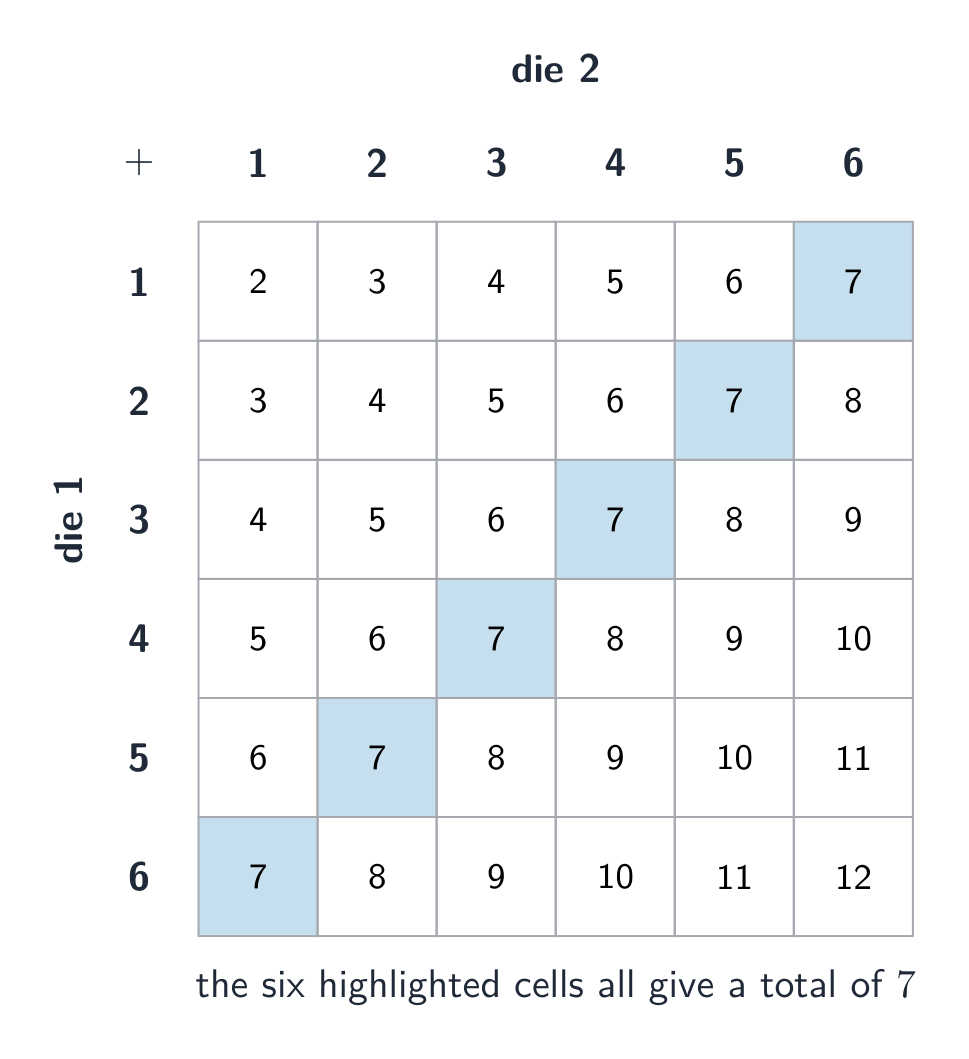
A sample space diagram lists every outcome; for the total of two dice there are $36$ equally likely cells. Venn diagrams
A Venn diagram 维恩图 sorts outcomes into overlapping sets. From it you can read $\text{P}(A \cap B)$ (in both) and $\text{P}(A \cup B)$ (in either).
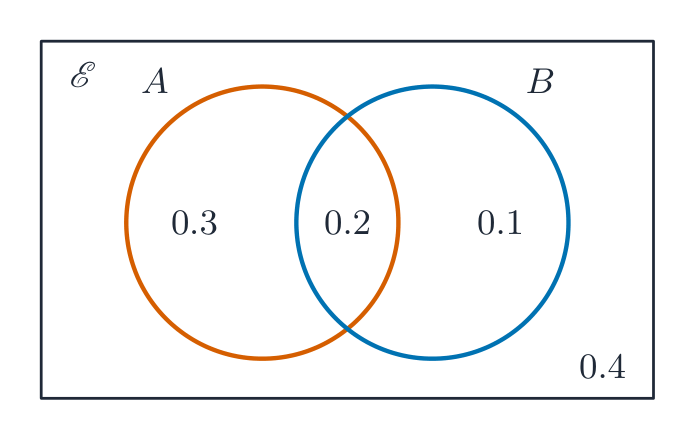
The overlap is $\text{P}(A\cap B)=0.2$; everything inside either circle is $\text{P}(A\cup B)=0.6$; outside both is $0.4$. Tree diagrams
A tree diagram 树状图 shows each stage as a set of branches. Write the probability on each branch and the outcome at the end. Multiply along the branches, then add the paths you want.
Worked example (with replacement). From the bag ($3$ red, $5$ blue), a counter is drawn, replaced, then a second is drawn. This is with replacement 有放回, so the chances do not change. Find the probability of two reds.
$$\text{P}(\text{red, red}) = \frac{3}{8} \times \frac{3}{8} = \frac{9}{64}.$$
On a tree diagram, multiply the probabilities along the branches; the four outcomes' probabilities add to $1$. Worked example (without replacement, Extended). Now the first counter is not replaced — drawing without replacement 无放回. After one red is taken, $2$ reds remain out of $7$:
$$\text{P}(\text{red, red}) = \frac{3}{8} \times \frac{2}{7} = \frac{6}{56} = \frac{3}{28}.$$ExploreProbability tree
Multiply the probabilities along each branch; the four outcomes always add up to 1.
ExploreCombined events
P(A ∩ B) = P(A)·P(B|A)
Combine two events: the area model shows AND (overlap) versus OR (union).
Vocabulary TrainEnglish combined events/kəmˈbaɪnd ɪˈvents/ independent events/ˌɪndɪˈpendənt ɪˈvents/ mutually exclusive/ˈmjuːtʃuːəli eksˈkluːsɪv/ sample space diagram/ˈsæmpl speɪs ˈdaɪəɡræm/ Venn diagram/ven ˈdaɪəɡræm/ tree diagram/triː ˈdaɪəɡræm/ with replacement/wɪð rɪˈpleɪsmənt/ without replacement/wɪˈðaʊt rɪˈpleɪsmənt/ 8.4
Conditional probability (Extended)
Syllabus
Subject content Notes and examples Calculate conditional probability using Venn diagrams, tree diagrams and tables. Knowledge of notation, $\text{P}(A|B)$, and formulas relating to conditional probability is not required. Source: Cambridge International syllabus
Conditional probability 条件概率 is the probability of one event given that another has already happened. Read it from a Venn diagram, two-way table or tree diagram by looking only at the part that matches the condition.
Worked example. In a class of $30$, $18$ study French and, of those, $7$ also study German. A French student is picked. Find the probability they also study German.
Look only at the $18$ French students:
$$\text{P}(\text{German} \mid \text{French}) = \frac{7}{18}.$$ExploreProbability trees
Change the branch probabilities and read combined and conditional probabilities off the tree.
Vocabulary TrainEnglish conditional probability/kənˈdɪʃənl ˌprɒbəˈbɪlɪti/ 8.4
Exam tips
- Every probability lies between $0$ and $1$, and the probabilities of all the outcomes add to $1$.
- For "and" (both events) multiply the probabilities; for "or" (either event) add them. On a tree diagram, multiply along the branches.
- Watch for without replacement: the second probability changes because one item has already been removed.
- Expected frequency = probability × number of trials.
-
9
Statistics
Watch lessonThis handout covers Topic 9, Statistics. Parts marked (Extended) are only tested on the Extended papers; everything else is for both levels.
9.1 9.2
Collecting and showing data

Syllabus
Subject content Notes and examples Classify and tabulate statistical data. e.g. tally tables, two-way tables. Subject content Notes and examples 1 Read, interpret and draw inferences from tables and statistical diagrams. 2 Compare sets of data using tables, graphs and statistical measures. e.g. compare averages and ranges between two data sets. 3 Appreciate restrictions on drawing conclusions from given data. Subject content Notes and examples 1 Read, interpret and draw inferences from tables and statistical diagrams. 2 Compare sets of data using tables, graphs and statistical measures. e.g. compare averages and measures of spread between two data sets. 3 Appreciate restrictions on drawing conclusions from given data. Source: Cambridge International syllabus
Data is collected from people — a sample drawn from a population. To organise statistical 统计 data 数据, use:
- a tally table 计数表 — make a mark for each value, then count.
- a two-way table 双向表 — sorts data by two features at once (for example, boys/girls against walk/bus).
When you read a diagram, only draw conclusions the data really supports.
ExploreData handling cycle
Follow a statistical question from collection to display.
Vocabulary TrainEnglish statistical/stəˈtɪstɪkl/ data/ˈdeɪtə/ tally table/ˈtælɪ ˈteɪbl/ two-way table/tuː weɪ ˈteɪbl/ 9.3
Averages and range

Syllabus
Subject content Notes and examples Calculate the mean, median, mode and range for individual data and distinguish between the purposes for which these are used. Data may be in a list or frequency table, but will not be grouped. Subject content Notes and examples 1 Calculate the mean, median, mode, quartiles, range and interquartile range for individual data and distinguish between the purposes for which these are used. 2 Calculate an estimate of the mean for grouped discrete or grouped continuous data. 3 Identify the modal class from a grouped frequency distribution. Source: Cambridge International syllabus
Three averages describe a typical value of the data, and the range shows how spread out it is. Each is used for a different purpose:
Mean, median, mode and range of a small data set - mean 平均数 $= \dfrac{\text{sum of all values}}{\text{how many values}}$.
- median 中位数 $=$ the middle value when the data is put in order.
- mode 众数 $=$ the value that appears most often.
- range 极差 $=$ largest value $-$ smallest value (it shows how spread out the data is).
Worked example. Find the mean, median, mode and range of $4, 7, 7, 2, 5$.
Order the data: $2, 4, 5, 7, 7$.
$$\text{mean} = \frac{4 + 7 + 7 + 2 + 5}{5} = \frac{25}{5} = 5, \quad \text{median} = 5, \quad \text{mode} = 7, \quad \text{range} = 7 - 2 = 5.$$ExploreAverage choice lab
Choose the average that fits the data situation.
Vocabulary TrainEnglish mean/miːn/ median/ˈmiːdiːən/ mode/məʊd/ range/reɪndʒ/ 9.3
Averages from a frequency table
Syllabus
Subject content Notes and examples Calculate the mean, median, mode and range for individual data and distinguish between the purposes for which these are used. Data may be in a list or frequency table, but will not be grouped. Subject content Notes and examples 1 Calculate the mean, median, mode, quartiles, range and interquartile range for individual data and distinguish between the purposes for which these are used. 2 Calculate an estimate of the mean for grouped discrete or grouped continuous data. 3 Identify the modal class from a grouped frequency distribution. Source: Cambridge International syllabus
When data is listed with its frequency 频数 (how many times each value occurs), the mean is
$$\text{mean} = \frac{\sum (\text{value} \times \text{frequency})}{\sum \text{frequency}}.$$Worked example. Values $1, 2, 3$ occur with frequencies $4, 5, 1$. Find the mean.
$$\text{mean} = \frac{1(4) + 2(5) + 3(1)}{4 + 5 + 1} = \frac{17}{10} = 1.7.$$Grouped data (Extended)
For grouped data 分组数据, you cannot find the exact mean, so estimate it using the midpoint of each group as the value. The modal class 众数组 is simply the group with the highest frequency.
Vocabulary TrainEnglish frequency/ˈfriːkwənsi/ grouped data/ɡruːpt ˈdeɪtə/ modal class/ˈməʊdl klæs/ 9.3
Measures of spread (Extended)
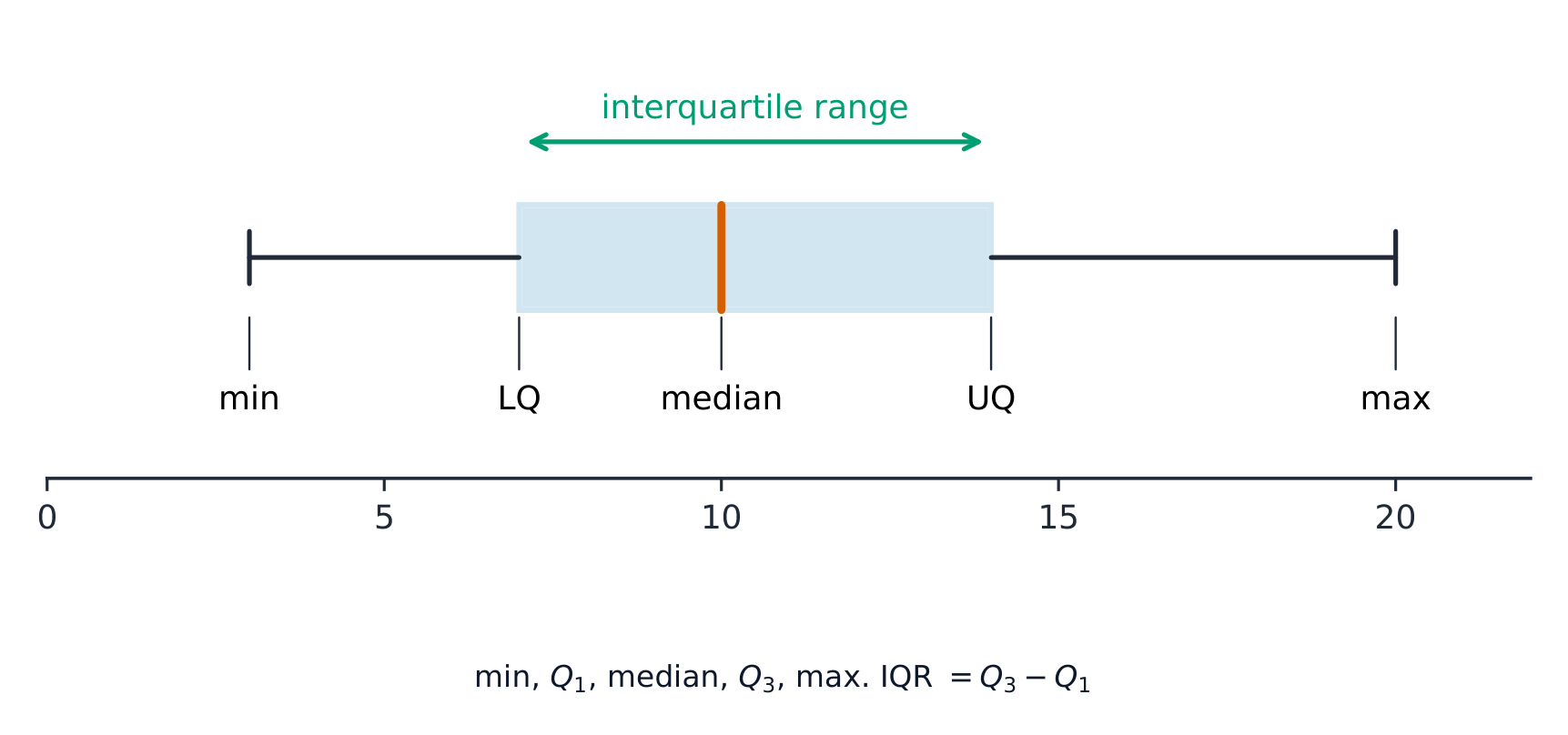
Syllabus
Subject content Notes and examples 1 Calculate the mean, median, mode, quartiles, range and interquartile range for individual data and distinguish between the purposes for which these are used. 2 Calculate an estimate of the mean for grouped discrete or grouped continuous data. 3 Identify the modal class from a grouped frequency distribution. Source: Cambridge International syllabus
When data is in order, the quartiles 四分位数 cut it into four equal parts. The lower quartile (LQ) is one quarter of the way up; the upper quartile (UQ) is three quarters of the way up. The interquartile range 四分位距 measures the spread of the middle half:
$$\text{interquartile range} = \text{UQ} - \text{LQ}.$$The interquartile range is useful because, unlike the range, it ignores extreme values.
A box-and-whisker plot shows the five-number summary; the box length is the interquartile range. ExploreBox-and-whisker plot
Build a box plot from the five-number summary: the box is the middle 50% (the interquartile range) and the median's position shows the skew.
Vocabulary TrainEnglish quartile/ˈkwɔːtaɪl/ interquartile range/ˌɪntəˈkwɔːtaɪl reɪndʒ/ 9.4
Charts and diagrams

Syllabus
Subject content Notes and examples Draw and interpret: (a) bar charts (b) pie charts (c) pictograms (d) stem-and-leaf diagrams (e) simple frequency distributions. Includes composite (stacked) and dual (side-by-side) bar charts. Stem-and-leaf diagrams should have ordered data with a key. Source: Cambridge International syllabus
A Galton board shows how data piles up into a distribution. 
A pictogram uses a symbol to stand for a number of items 
A bar chart shows the frequency of each group Chart What it shows bar chart 条形图 a bar for each category; height is the frequency pie chart 饼图 a circle split into slices, each a fraction of $360^{\circ}$ pictogram 象形图 uses a symbol to stand for a number of items stem-and-leaf diagram 茎叶图 keeps the digits of ordered data, with a key frequency distribution 频数分布 a table of values and their frequencies Worked example (pie chart). Out of $120$ people, $30$ chose tea. Find the angle of the tea slice.
$$\frac{30}{120} \times 360^{\circ} = 90^{\circ}.$$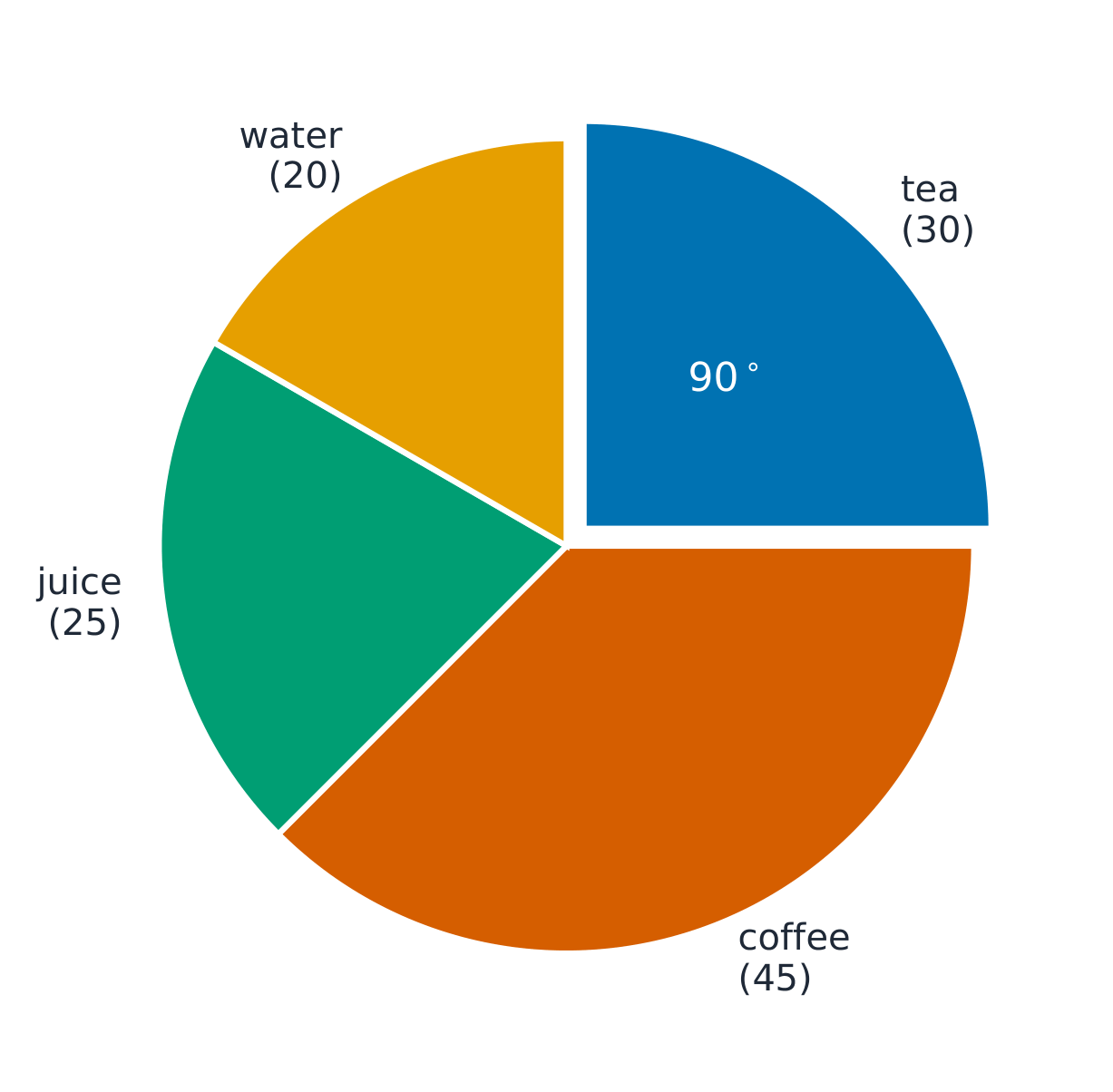
Each slice is its fraction of $360^\circ$; tea is $\tfrac{30}{120}\times360^\circ=90^\circ$. ExplorePie-chart angles
Each slice's angle is its share of the whole turned into degrees — frequency ÷ total × 360 — and the slices always add to 360°.
ExploreChart choice lab
Choose the chart that fits the kind of data.
Vocabulary TrainEnglish bar chart/bɑː tʃɑːt/ pie chart/paɪ tʃɑːt/ pictogram/ˈpɪktəɡræm/ stem-and-leaf diagram/stem ænd liːf ˈdaɪəɡræm/ frequency distribution/ˈfriːkwənsi ˌdɪstrɪˈbjuːʃn/ 9.5
Scatter diagrams and correlation

Syllabus
Subject content Notes and examples 1 Draw and interpret scatter diagrams. Plotted points should be clearly marked, for example as small crosses (×). 2 Understand what is meant by positive, negative and zero correlation. 3 Draw by eye, interpret and use a straight line of best fit. A line of best fit: • should be a single ruled line drawn by inspection • should extend across the full data set • does not need to coincide exactly with any of the points but there should be a roughly even distribution of points either side of the line over its entire length. Subject content Notes and examples 1 Draw and interpret scatter diagrams. Plotted points should be clearly marked, for example as small crosses (x). 2 Understand what is meant by positive, negative and zero correlation. 3 Draw by eye, interpret and use a straight line of best fit. A line of best fit: • should be a single ruled line drawn by inspection • should extend across the full data set • does not need to coincide exactly with any of the points but there should be a roughly even distribution of points either side of the line over its entire length. Source: Cambridge International syllabus
A scatter diagram 散点图 plots pairs of values as points to show whether two things are linked. The link is the correlation 相关性:
- positive correlation 正相关 — as one goes up, the other goes up.
- negative correlation 负相关 — as one goes up, the other goes down.
- zero correlation 零相关 — no clear link.
Positive correlation rises together; negative falls as the other rises; zero shows no clear link. If there is correlation, draw a line of best fit 最佳拟合线: one straight ruled line through the middle of the points, with about the same number of points on each side. Use it to predict values.

A line of best fit is one straight ruled line through the middle of the points; use it to predict. ExploreScatter and correlation
Change the strength of the relationship and add a line of best fit to spot the trend.
Vocabulary TrainEnglish scatter diagram/ˈskætə ˈdaɪəɡræm/ correlation/ˌkɒrɪˈleɪʃn/ positive correlation/ˈpɒzɪtɪv ˌkɒrɪˈleɪʃn/ negative correlation/ˈneɡətɪv ˌkɒrɪˈleɪʃn/ zero correlation/ˈzɪərəʊ ˌkɒrɪˈleɪʃn/ line of best fit/laɪn ɒv best fɪt/ 9.6
Cumulative frequency diagrams (Extended)
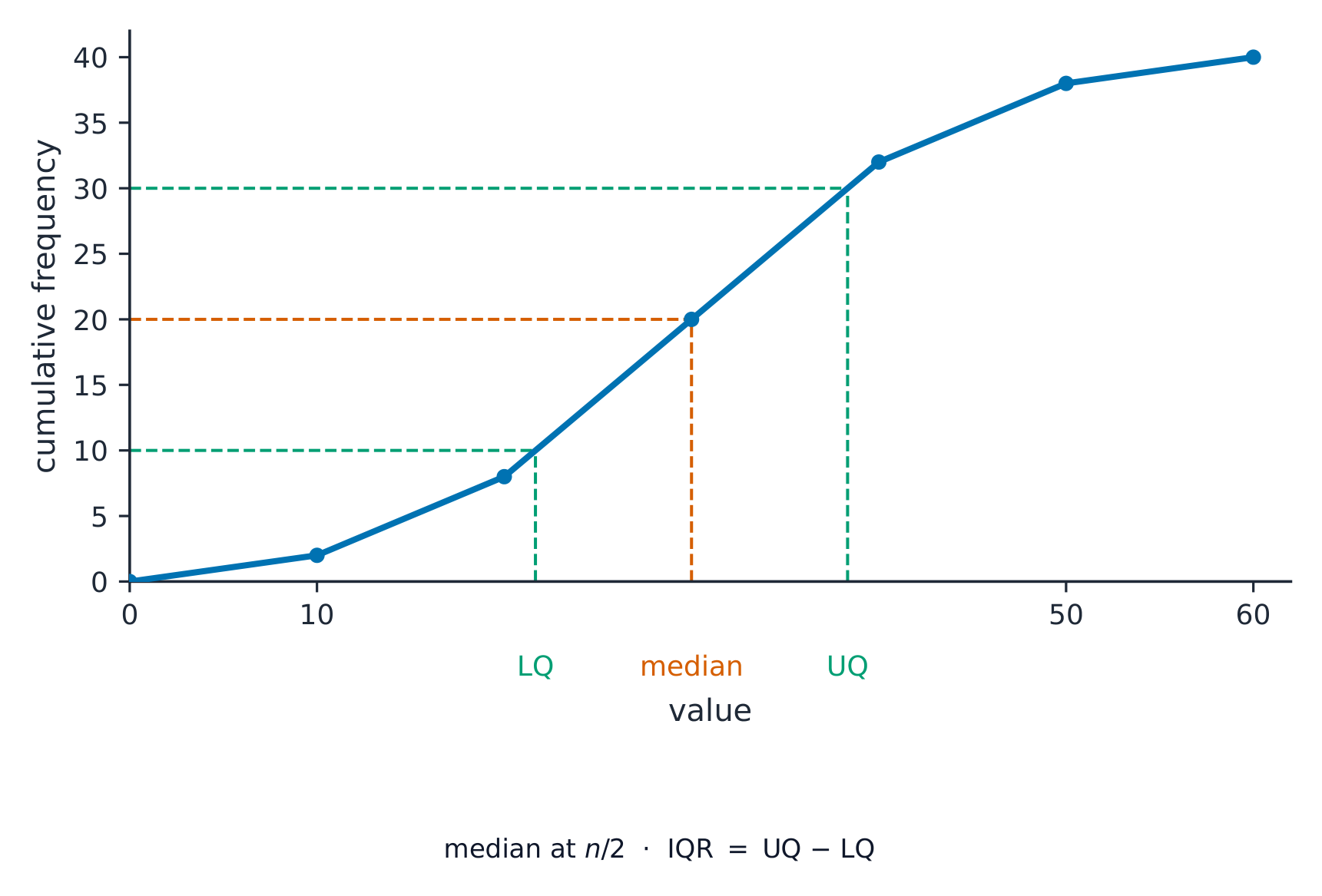
Syllabus
Subject content Notes and examples 1 Draw and interpret cumulative frequency tables and diagrams. Plotted points on a cumulative frequency diagram should be clearly marked, for example as small crosses (x), and be joined with a smooth curve. 2 Estimate and interpret the median, percentiles, quartiles and interquartile range from cumulative frequency diagrams. Source: Cambridge International syllabus
The cumulative frequency 累积频数 is a running total of the frequencies. Plot it against the upper end of each class and join the points with a smooth curve.
From the curve you can read the median (at half the total), the quartiles (at one quarter and three quarters), and any percentile 百分位数 (for example, the $90$th percentile is at $90\%$ of the total).
Read the median at half the total, and the quartiles at one quarter and three quarters: across to the curve, then down. ExploreCumulative frequency route
Follow raw data into a cumulative frequency curve and percentile reading.
Vocabulary TrainEnglish cumulative frequency/ˈkjuːmjʊlətɪv ˈfriːkwənsi/ percentile/pəˈsentaɪl/ 9.7
Histograms (Extended)
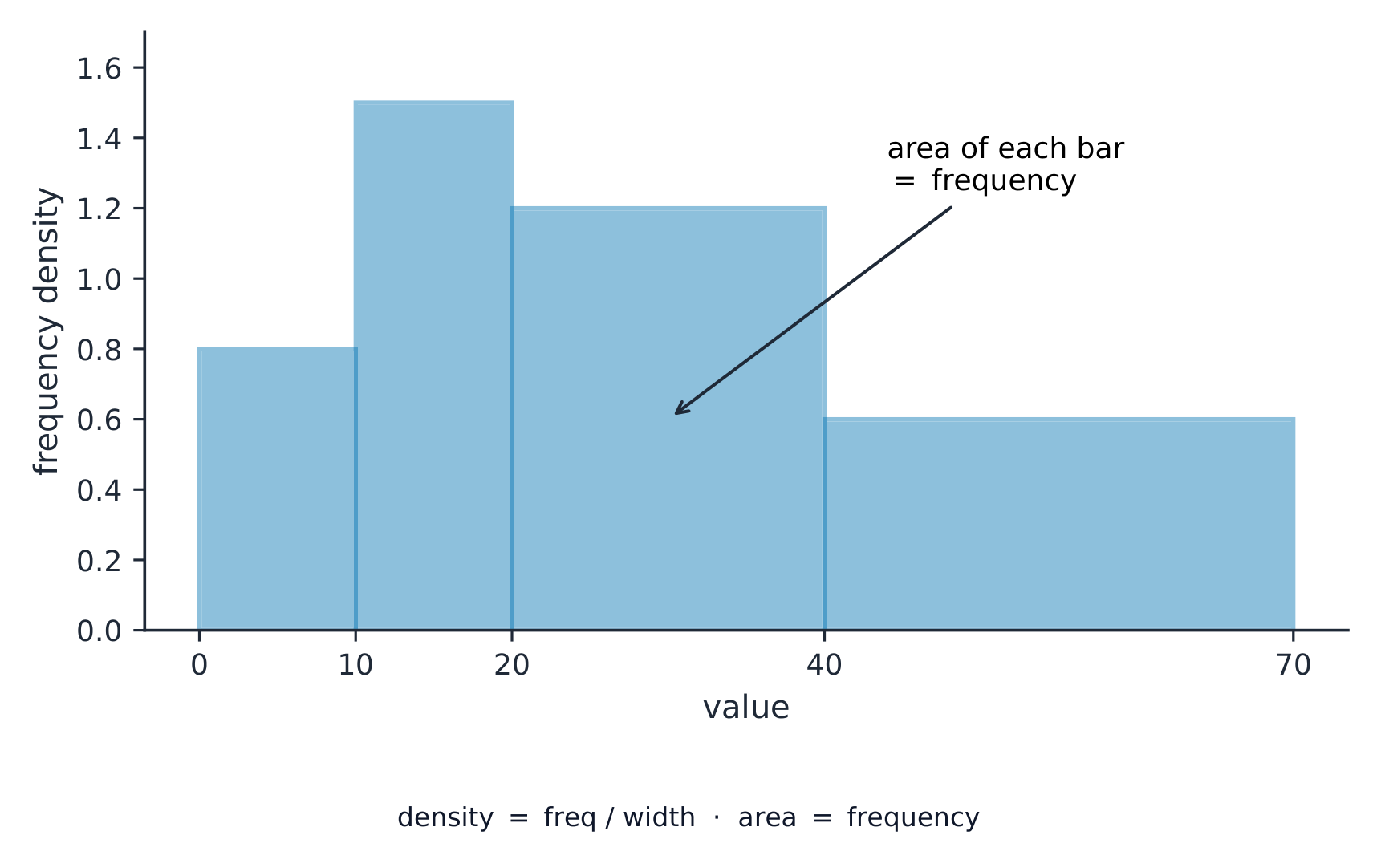
Syllabus
Subject content Notes and examples 1 Draw and interpret histograms. On histograms, the vertical axis is labelled 'Frequency density'. 2 Calculate with frequency density. Frequency density is defined as $\text{frequency density} = \text{frequency} \div \text{class width}$. Source: Cambridge International syllabus
A histogram 直方图 looks like a bar chart, but the bars can have different widths and the area of each bar (not its height) shows the frequency. The vertical axis is the frequency density 频数密度:
$$\text{frequency density} = \frac{\text{frequency}}{\text{class width}}.$$With unequal class widths the bar AREA (not its height) is the frequency, so the axis is frequency density. Worked example. A class has class width 组距 $10$ and frequency $25$. Find the frequency density.
$$\text{frequency density} = \frac{25}{10} = 2.5.$$ExploreFrequency-density histogram
With unequal class widths the bar height is frequency density, so the area (not the height) represents the frequency.
Vocabulary TrainEnglish histogram/ˈhɪstəɡræm/ frequency density/ˈfriːkwənsi ˈdensɪti/ class width/klæs wɪtθ/ 9.7
Exam tips
- Know the three averages: mean (add up ÷ how many), median (the middle value when in order), mode (the most common). The range is highest − lowest.
- From a frequency table the mean is $\frac{\sum fx}{\sum f}$ — divide by the total frequency, not the number of rows.
- On a scatter diagram, describe the correlation as positive, negative or none, and draw the line of best fit through the mean point.
- For a histogram with unequal class widths, the height is the frequency density (frequency ÷ class width), not the frequency.