This handout covers Topic 2, Algebra and graphs. Parts marked (Extended) are only tested on the Extended papers; everything else is for both levels.
Algebra and graphs
IGCSE Mathematics · Topic 2
 19:38
19:38
Algebra and graphs
Look at the main cable of this bridge. That curve is not an accident. Every cable like it hangs in the same shape, and one short rule describes every point on…
English narration · English + 中文 subtitles burned in
2.1
Working with algebra
Syllabus
| Subject content | Notes and examples |
|---|---|
| 1 Know that letters can be used to represent generalised numbers. | |
| 2 Substitute numbers into expressions and formulas. |
Source: Cambridge International syllabus
In algebra 代数 we use letters to stand for numbers. A letter whose value can change is a variable 变量. To substitute 代入 means to put a number in place of a letter.
Worked example. Find the value of $3x^{2} - 2y$ when $x = 4$ and $y = 5$.
$$3 \times 4^{2} - 2 \times 5 = 3 \times 16 - 10 = 48 - 10 = 38.$$
Explore
Algebra manipulation route
Follow expression work from collecting terms to solving.
Vocabulary
Train
| English |
|---|
| algebra/ˈældʒɪbrə/ |
| variable/ˈveərɪəbl/ |
| substitute/ˈsʌbstɪtjuːt/ |
2.2
Simplifying and expanding

Syllabus
| Subject content | Notes and examples |
|---|---|
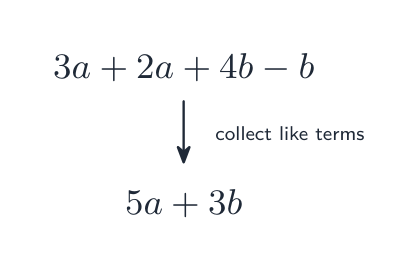
| 1 Simplify expressions by collecting like terms. | Simplify means give the answer in its simplest form, e.g. $2a + 3b + 5a - 9b = 7a - 6b$. |
| 2 Expand products of algebraic expressions. | e.g. expand $3x(2x - 4y)$. Includes products of two brackets involving one variable, e.g. expand $(2x + 1)(x - 4)$. |
| 3 Factorise by extracting common factors. | Factorise means factorise fully, e.g. $9x^2 + 15xy = 3x(3x + 5y)$. |
| Subject content | Notes and examples |
|---|---|
| 1 Simplify expressions by collecting like terms. | Simplify means give the answer in its simplest form, e.g. $2a^2 + 3ab - 1 + 5a^2 - 9ab + 4 = 7a^2 - 6ab + 3$. |
| 2 Expand products of algebraic expressions. | e.g. expand $3x(2x - 4y)$, $(3x + y)(x - 4y)$. Includes products of more than two brackets, e.g. expand $(x - 2)(x + 3)(2x + 1)$. |
| 3 Factorise by extracting common factors. | Factorise means factorise fully, e.g. $9x^2 + 15xy = 3x(3x + 5y)$. |
| 4 Factorise expressions of the form: • $ax + bx + kay + kby$ • $a^2x^2 - b^2y^2$ • $a^2 + 2ab + b^2$ • $ax^2 + bx + c$ • $ax^3 + bx^2 + cx$. | |
| 5 Complete the square for expressions in the form $ax^2 + bx + c$. |
Source: Cambridge International syllabus
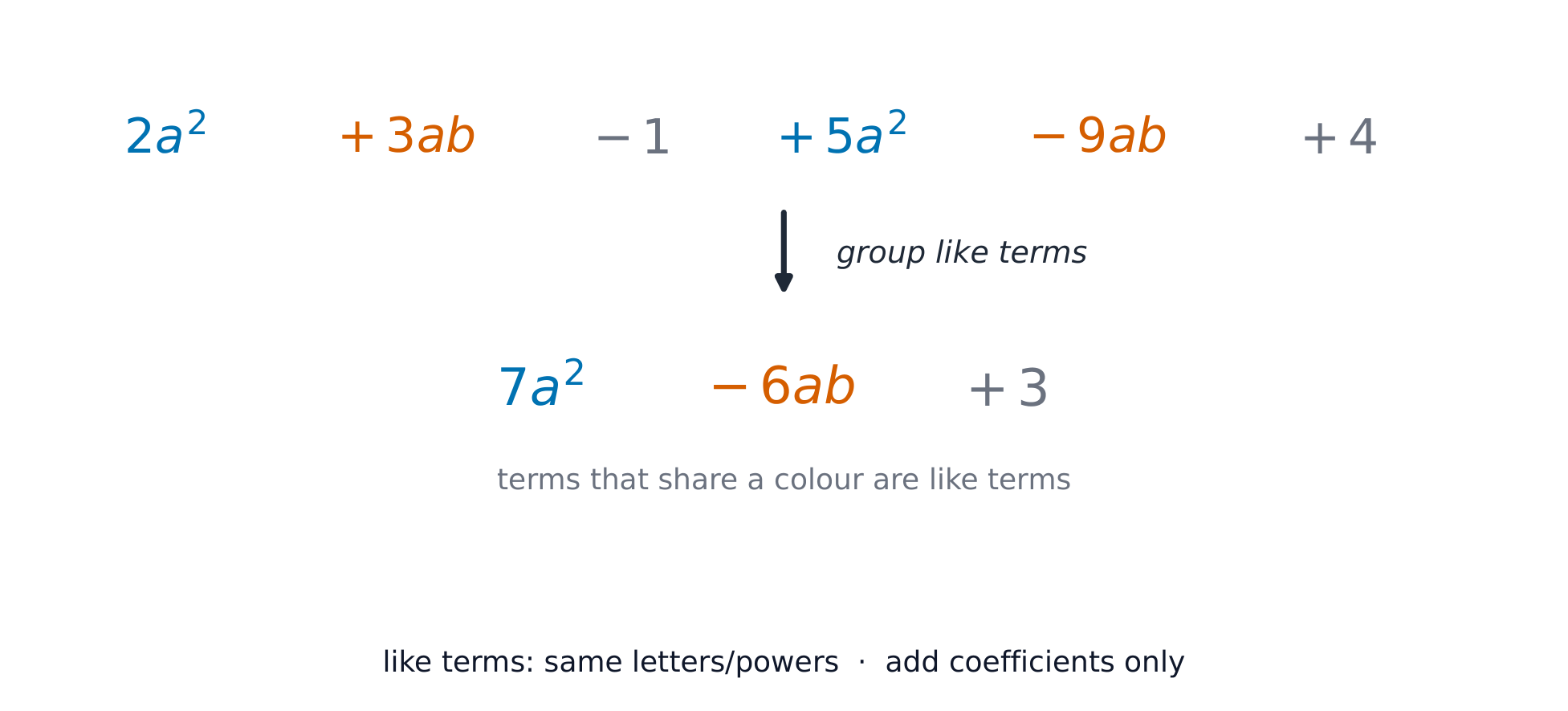
A term 项 is a single part of an expression 表达式, such as $5a$ or $-9b$. Like terms 同类项 have exactly the same letters; you may add or subtract them. The number in front of the letter is the coefficient 系数.
Worked example. Simplify $2a^{2} + 3ab - 1 + 5a^{2} - 9ab + 4$.
Collect like terms: $2a^{2} + 5a^{2} = 7a^{2}$, $3ab - 9ab = -6ab$, $-1 + 4 = 3$. So the answer is
$$7a^{2} - 6ab + 3.$$
To expand 展开 means to multiply out brackets 括号. Multiply every term inside by the term outside; for two brackets, multiply every term in the first by every term in the second.
Worked examples.
$$3x(2x - 4y) = 6x^{2} - 12xy.$$
$$(2x + 1)(x - 4) = 2x^{2} - 8x + x - 4 = 2x^{2} - 7x - 4.$$
For three brackets (Extended), expand two first, then multiply by the third:
$$(x - 2)(x + 3)(2x + 1) = (x^{2} + x - 6)(2x + 1) = 2x^{3} + 3x^{2} - 11x - 6.$$

Vocabulary
Train
| English |
|---|
| term/tɜːm/ |
| expression/ekˈspreʃn/ |
| like terms/laɪk tɜːmz/ |
| coefficient/ˌkəʊɪˈfɪʃənt/ |
| expand/ekˈspænd/ |
| brackets/ˈbrækɪts/ |
2.2
Factorising
Syllabus
| Subject content | Notes and examples |
|---|---|
| 1 Simplify expressions by collecting like terms. | Simplify means give the answer in its simplest form, e.g. $2a + 3b + 5a - 9b = 7a - 6b$. |
| 2 Expand products of algebraic expressions. | e.g. expand $3x(2x - 4y)$. Includes products of two brackets involving one variable, e.g. expand $(2x + 1)(x - 4)$. |
| 3 Factorise by extracting common factors. | Factorise means factorise fully, e.g. $9x^2 + 15xy = 3x(3x + 5y)$. |
| Subject content | Notes and examples |
|---|---|
| 1 Simplify expressions by collecting like terms. | Simplify means give the answer in its simplest form, e.g. $2a^2 + 3ab - 1 + 5a^2 - 9ab + 4 = 7a^2 - 6ab + 3$. |
| 2 Expand products of algebraic expressions. | e.g. expand $3x(2x - 4y)$, $(3x + y)(x - 4y)$. Includes products of more than two brackets, e.g. expand $(x - 2)(x + 3)(2x + 1)$. |
| 3 Factorise by extracting common factors. | Factorise means factorise fully, e.g. $9x^2 + 15xy = 3x(3x + 5y)$. |
| 4 Factorise expressions of the form: • $ax + bx + kay + kby$ • $a^2x^2 - b^2y^2$ • $a^2 + 2ab + b^2$ • $ax^2 + bx + c$ • $ax^3 + bx^2 + cx$. | |
| 5 Complete the square for expressions in the form $ax^2 + bx + c$. |
Source: Cambridge International syllabus
To factorise 因式分解 is the opposite of expanding: write the expression as a product of brackets. Always take out the common factor 公因式 first.
Worked example. $9x^{2} + 15xy = 3x(3x + 5y)$, because $3x$ divides both terms.
The following patterns are Extended.
Grouping (four terms): take a common factor from each pair.
$$xy + 2x + 3y + 6 = x(y + 2) + 3(y + 2) = (x + 3)(y + 2).$$
Difference of two squares 平方差: $a^{2} - b^{2} = (a + b)(a - b)$.
$$9x^{2} - 16 = (3x + 4)(3x - 4).$$
Perfect square 完全平方: $a^{2} + 2ab + b^{2} = (a + b)^{2}$.
$$x^{2} + 6x + 9 = (x + 3)^{2}.$$
Quadratic 二次 expressions $ax^{2} + bx + c$: find two numbers that multiply to $a \times c$ and add to $b$, then split the middle term.
Worked example. Factorise $2x^{2} + 7x + 3$.
Here $a \times c = 6$ and $b = 7$. The numbers $1$ and $6$ work. Split and group:
$$2x^{2} + x + 6x + 3 = x(2x + 1) + 3(2x + 1) = (x + 3)(2x + 1).$$
For $ax^{3} + bx^{2} + cx$, take out the common $x$ first: $2x^{3} + 7x^{2} + 3x = x(2x^{2} + 7x + 3) = x(x + 3)(2x + 1)$.
Vocabulary
Train
| English |
|---|
| factorise/ˈfæktəraɪz/ |
| common factor/ˈkɒmən ˈfæktə/ |
| difference of two squares/ˈdɪfrəns ɒv tuː skweəz/ |
| perfect square/ˈpɜːfekt skweə/ |
| quadratic/kwɒˈdrætɪk/ |
2.2
Completing the square (Extended)

Syllabus
| Subject content | Notes and examples |
|---|---|
| 1 Simplify expressions by collecting like terms. | Simplify means give the answer in its simplest form, e.g. $2a^2 + 3ab - 1 + 5a^2 - 9ab + 4 = 7a^2 - 6ab + 3$. |
| 2 Expand products of algebraic expressions. | e.g. expand $3x(2x - 4y)$, $(3x + y)(x - 4y)$. Includes products of more than two brackets, e.g. expand $(x - 2)(x + 3)(2x + 1)$. |
| 3 Factorise by extracting common factors. | Factorise means factorise fully, e.g. $9x^2 + 15xy = 3x(3x + 5y)$. |
| 4 Factorise expressions of the form: • $ax + bx + kay + kby$ • $a^2x^2 - b^2y^2$ • $a^2 + 2ab + b^2$ • $ax^2 + bx + c$ • $ax^3 + bx^2 + cx$. | |
| 5 Complete the square for expressions in the form $ax^2 + bx + c$. |
Source: Cambridge International syllabus
Completing the square 配方法 rewrites $x^{2} + bx + c$ as $(x + p)^{2} + q$. Take half of the $x$-coefficient, square it, then balance.
Worked example. Write $x^{2} + 6x + 1$ in completed-square form.
Half of $6$ is $3$, and $3^{2} = 9$:
$$x^{2} + 6x + 1 = (x + 3)^{2} - 9 + 1 = (x + 3)^{2} - 8.$$
When the $x^{2}$ has a coefficient, take it out of the first two terms first:
$$2x^{2} + 8x + 3 = 2(x^{2} + 4x) + 3 = 2\big((x + 2)^{2} - 4\big) + 3 = 2(x + 2)^{2} - 5.$$
Vocabulary
Train
| English |
|---|
| completing the square/kəmˈpliːtɪŋ ðə skweə/ |
2.3
Algebraic fractions (Extended)
Syllabus
| Subject content | Notes and examples |
|---|---|
| 1 Manipulate algebraic fractions. | Examples include: • $\frac{x}{3} + \frac{x - 4}{2}$ • $\frac{2x}{3} - \frac{3(x - 5)}{2}$ • $\frac{3a}{4} \times \frac{9a}{10}$ • $\frac{3a}{4} \div \frac{9a}{10}$ • $\frac{1}{x - 2} + \frac{x + 1}{x - 3}$. |
| 2 Factorise and simplify rational expressions. | e.g. $\frac{x^2 - 2x}{x^2 - 5x + 6}$. |
Source: Cambridge International syllabus
An algebraic fraction 分式 has algebra on the top or bottom. Add and subtract using a common denominator; multiply and divide as with ordinary fractions.
Worked examples.
$$\frac{x}{3} + \frac{x - 4}{2} = \frac{2x}{6} + \frac{3(x - 4)}{6} = \frac{2x + 3x - 12}{6} = \frac{5x - 12}{6}.$$
$$\frac{3a}{4} \div \frac{9a}{10} = \frac{3a}{4} \times \frac{10}{9a} = \frac{30a}{36a} = \frac{5}{6}.$$
To simplify a rational expression 有理式, factorise the top and bottom, then cancel common brackets.
$$\frac{x^{2} - 2x}{x^{2} - 5x + 6} = \frac{x(x - 2)}{(x - 2)(x - 3)} = \frac{x}{x - 3}.$$
Explore
Algebraic fraction route
Simplify algebraic fractions by factorising before cancelling.
Vocabulary
Train
| English |
|---|
| algebraic fraction/ˌældʒɪˈbreɪɪk ˈfrækʃn/ |
| rational expression/ˈræʃənl ekˈspreʃn/ |
2.4
Indices in algebra
Syllabus
| Subject content | Notes and examples |
|---|---|
| 1 Understand and use indices (positive, zero and negative). | e.g. $2^x = 32$. Find the value of $x$. |
| 2 Understand and use the rules of indices. | e.g. simplify: • $(5x^3)^2$ • $12a^5 \div 3a^{-2}$ • $6x^7y^4 \times 5x^{-5}y$. Knowledge of logarithms is not required. |
| Subject content | Notes and examples |
|---|---|
| 1 Understand and use indices (positive, zero, negative and fractional). | e.g. solve: • $32^x = 2$ • $5^{x+1} = 25^x$. |
| 2 Understand and use the rules of indices. | e.g. simplify: • $3x^{-4} \times \frac{2}{3}x^{\frac{1}{2}}$ • $\frac{2}{5}x^{\frac{1}{2}} \div 2x^{-2}$ • $\left(\frac{2x^5}{3}\right)^3$. Knowledge of logarithms is not required. |
Source: Cambridge International syllabus
The laws of indices 指数 work with letters too: $a^{m} \times a^{n} = a^{m+n}$, $a^{m} \div a^{n} = a^{m-n}$, and $(a^{m})^{n} = a^{mn}$.
Worked examples.
$$(5x^{3})^{2} = 25x^{6}, \qquad 12a^{5} \div 3a^{-2} = 4a^{7}, \qquad 6x^{7}y^{4} \times 5x^{-5}y = 30x^{2}y^{5}.$$
You can also solve simple index equations by writing both sides with the same base 底数.
Worked example. Solve $2^{x} = 32$. Since $32 = 2^{5}$, you get $x = 5$.
Explore
Algebraic index law lab
Classify index-law examples by the rule being used.
Vocabulary
Train
| English |
|---|
| indices/ˈɪndɪsiːz/ |
| base/beɪs/ |
2.5
Equations

Syllabus
| Subject content | Notes and examples |
|---|---|
| 1 Construct simple expressions, equations and formulas. | e.g. write an expression for a number that is 2 more than $n$. Includes constructing linear simultaneous equations. |
| 2 Solve linear equations in one unknown. | Examples include: • $3x + 4 = 10$ • $5 - 2x = 3(x + 7)$. |
| 3 Solve simultaneous linear equations in two unknowns. | |
| 4 Change the subject of simple formulas. | e.g. change the subject of formulas where: • the subject only appears once • there is not a power or root of the subject. |
| Subject content | Notes and examples |
|---|---|
| 1 Construct expressions, equations and formulas. | e.g. write an expression for the product of two consecutive even numbers. Includes constructing simultaneous equations. |
| 2 Solve linear equations in one unknown. | Examples include: • $3x + 4 = 10$ • $5 - 2x = 3(x + 7)$. |
| 3 Solve fractional equations with numerical and linear algebraic denominators. | Examples include: • $\frac{x}{2x + 1} = 4$ • $\frac{2}{x + 2} + \frac{3}{2x - 1} = 1$ • $\frac{x}{x + 2} = \frac{3}{x - 6}$. |
| 4 Solve simultaneous linear equations in two unknowns. | |
| 5 Solve simultaneous equations, involving one linear and one non-linear. | With powers no higher than two. |
| 6 Solve quadratic equations by factorisation, completing the square and by use of the quadratic formula. | Includes writing a quadratic expression in completed square form. Candidates may be expected to give solutions in surd form. The quadratic formula is given in the List of formulas. |
| 7 Change the subject of formulas. | e.g. change the subject of a formula where: • the subject appears twice • there is a power or root of the subject. |
Source: Cambridge International syllabus
An equation 方程 says two expressions are equal. To solve a linear 一次 equation, do the same operation to both sides until the unknown 未知数 is alone.
Worked example. Solve $5 - 2x = 3(x + 7)$.
$$5 - 2x = 3x + 21 \;\Rightarrow\; 5 - 21 = 3x + 2x \;\Rightarrow\; -16 = 5x \;\Rightarrow\; x = -\tfrac{16}{5}.$$
Fractional equations (Extended)
A fractional equation 分式方程 has the unknown in a denominator. Multiply both sides by the denominator to clear it.
Worked example. Solve $\dfrac{x}{2x + 1} = 4$.
$$x = 4(2x + 1) = 8x + 4 \;\Rightarrow\; -7x = 4 \;\Rightarrow\; x = -\tfrac{4}{7}.$$
Simultaneous equations
Simultaneous equations 联立方程 are two equations solved together. For two linear equations, add or subtract to remove one letter.
Worked example. Solve $2x + y = 7$ and $3x - y = 8$.
Adding removes $y$: $5x = 15$, so $x = 3$. Then $y = 7 - 2(3) = 1$.

For one linear and one quadratic equation (Extended), substitute the linear into the curve.
Worked example. Solve $y = x + 2$ and $y = x^{2}$.
$$x^{2} = x + 2 \;\Rightarrow\; x^{2} - x - 2 = 0 \;\Rightarrow\; (x - 2)(x + 1) = 0,$$
so $x = 2$ (giving $y = 4$) or $x = -1$ (giving $y = 1$).
Solving quadratic equations (Extended)
There are three methods.
- By factorising: $x^{2} + 5x + 6 = 0 \Rightarrow (x + 2)(x + 3) = 0 \Rightarrow x = -2$ or $x = -3$.
- By completing the square: $x^{2} + 6x + 1 = 0 \Rightarrow (x + 3)^{2} = 8 \Rightarrow x + 3 = \pm 2\sqrt{2} \Rightarrow x = -3 \pm 2\sqrt{2}$.
- By the quadratic formula 求根公式, which is given in the exam:
$$x = \frac{-b \pm \sqrt{b^{2} - 4ac}}{2a}.$$
Worked example (formula). Solve $2x^{2} + 3x - 1 = 0$. Here $a = 2$, $b = 3$, $c = -1$:
$$x = \frac{-3 \pm \sqrt{9 + 8}}{4} = \frac{-3 \pm \sqrt{17}}{4}.$$
Changing the subject
To change the subject 公式变形 of a formula means to rearrange it so a chosen letter is alone on one side.
Worked example. Make $r$ the subject of $A = \pi r^{2}$ (Extended, because of the power).
$$r^{2} = \frac{A}{\pi} \;\Rightarrow\; r = \sqrt{\frac{A}{\pi}}.$$
When the letter appears twice (Extended), collect those terms and factorise. To make $x$ the subject of $y = \dfrac{x + 1}{x - 1}$:
$$y(x - 1) = x + 1 \;\Rightarrow\; yx - x = 1 + y \;\Rightarrow\; x(y - 1) = 1 + y \;\Rightarrow\; x = \frac{1 + y}{y - 1}.$$
Explore
Solving an equation
y = ax² + bx + c
Solving means finding the roots — where the curve crosses the x-axis.
Vocabulary
Train
| English |
|---|
| equation/ɪˈkweɪʒn/ |
| linear/ˈlɪnɪə/ |
| unknown/ʌnˈnəʊn/ |
| fractional equation/ˈfrækʃənl ɪˈkweɪʒn/ |
| simultaneous equations/ˌsɪməlˈteɪnɪəs ɪˈkweɪʒnz/ |
| quadratic formula/kwɒˈdrætɪk ˈfɔːmjʊlə/ |
| change the subject/tʃeɪndʒ ðə ˈsʌbdʒekt/ |
2.6
Inequalities

Syllabus
| Subject content | Notes and examples |
|---|---|
| Represent and interpret inequalities, including on a number line. | When representing and interpreting inequalities on a number line: • open circles should be used to represent strict inequalities (<, >) • closed circles should be used to represent inclusive inequalities ($\leqslant$, $\geqslant$) e.g. $-3 \leqslant x < 1$ |
| Subject content | Notes and examples |
|---|---|
| 1 Represent and interpret inequalities, including on a number line. | When representing and interpreting inequalities on a number line: • open circles should be used to represent strict inequalities (<, >) • closed circles should be used to represent inclusive inequalities ($\leqslant$, $\geqslant$). e.g. $-3 \leqslant x < 1$ |
| 2 Construct, solve and interpret linear inequalities. | Examples include: • $3x < 2x + 4$ • $-3 \leqslant 3x - 2 < 7$. |
| 3 Represent and interpret linear inequalities in two variables graphically. | The following conventions should be used: • broken lines should be used to represent strict inequalities (<, >) • solid lines should be used to represent inclusive inequalities ($\leqslant$, $\geqslant$) • shading should be used to represent unwanted regions (unless otherwise directed in the question). e.g. graphs of $x < 1$ and $y \geqslant 1$ |
| 4 List inequalities that define a given region. | Linear programming problems are not included. |
Source: Cambridge International syllabus
An inequality 不等式 uses $<$, $>$, $\leqslant$ or $\geqslant$. Solve it like an equation, but reverse the sign if you multiply or divide by a negative number.
Worked example. Solve $-3 \leqslant 3x - 2 < 7$.
Add $2$ to all parts, then divide by $3$:
$$-1 \leqslant 3x < 9 \;\Rightarrow\; -\tfrac{1}{3} \leqslant x < 3.$$
On a number line 数轴, use an open circle for $<$ or $>$ (value not included) and a closed circle for $\leqslant$ or $\geqslant$ (value included).
Regions (Extended)
An inequality in two letters describes a region 区域 of the graph. Draw the boundary line (broken for $<$ or $>$, solid for $\leqslant$ or $\geqslant$) and shade the unwanted side. You may also be asked to list the inequalities that define a given region.
Explore
Inequalities
y = ax + b
An inequality asks where the line is above or below a value.
Vocabulary
Train
| English |
|---|
| inequality/ɪniːˈkwɒlɪti/ |
| number line/ˈnʌmbə laɪn/ |
| region/ˈriːdʒn/ |
2.7
Sequences

Syllabus
| Subject content | Notes and examples |
|---|---|
| 1 Continue a given number sequence or pattern. | e.g. write the next two terms in this sequence: 1, 3, 6, 10, 15, ... , ... |
| 2 Recognise patterns in sequences, including the term-to-term rule, and relationships between different sequences. | |
| 3 Find and use the $n$th term of the following sequences: (a) linear (b) simple quadratic (c) simple cubic. | e.g. find the $n$th term of 2, 5, 10, 17 |
| Subject content | Notes and examples |
|---|---|
| 1 Continue a given number sequence or pattern. | Subscript notation may be used, e.g. $T_n$ is the $n$th term of sequence $T$. |
| 2 Recognise patterns in sequences, including the term-to-term rule, and relationships between different sequences. | Includes linear, quadratic, cubic and exponential sequences and simple combinations of these. |
| 3 Find and use the $n$th term of sequences. |
Source: Cambridge International syllabus
A sequence 数列 is a list of numbers that follow a rule. The term-to-term rule 递推规则 tells you how to get the next term from the one before.
To find the rule for the term in position $n$ (the $n$th term), look at how the terms change.
Linear sequence (the terms go up by the same amount each time). The difference is the multiple of $n$.
Worked example. Find the $n$th term of $2, 5, 8, 11, \dots$
The terms go up by $3$, so start with $3n$. Since $3 \times 1 = 3$ but the first term is $2$, subtract $1$: the $n$th term is $3n - 1$.
Quadratic sequence (the differences themselves change by the same amount). The second difference equals $2 \times$ the coefficient of $n^{2}$.
Worked example. Find the $n$th term of $2, 5, 10, 17, \dots$
First differences are $3, 5, 7$; the second difference is $2$, so the $n^{2}$ part is $1n^{2}$. Subtracting $n^{2}$ ($1, 4, 9, 16$) from the sequence leaves $1, 1, 1, 1$. So the $n$th term is $n^{2} + 1$.
A cubic 三次 sequence such as $1, 8, 27, 64, \dots$ has $n$th term $n^{3}$. An exponential sequence 指数数列 such as $2, 6, 18, 54, \dots$ multiplies by a fixed number each time; here the $n$th term is $2 \times 3^{\,n-1}$.
Explore
Number sequences
Build an arithmetic (add d) or geometric (times r) sequence term by term.
Vocabulary
Train
| English |
|---|
| sequence/ˈsiːkwəns/ |
| term-to-term rule/tɜːm tə tɜːm ruːl/ |
| cubic/ˈkjuːbɪk/ |
| exponential sequence/ˌekspəˈnenʃl ˈsiːkwəns/ |
2.8
Direct and inverse proportion (Extended)
Syllabus
| Subject content | Notes and examples |
|---|---|
| Express direct and inverse proportion in algebraic terms and use this form of expression to find unknown quantities. | Includes linear, square, square root, cube and cube root proportion. Knowledge of proportional symbol ($\propto$) is required. |
Source: Cambridge International syllabus
Two quantities are in direct proportion 正比例 if one is always a fixed multiple of the other: $y \propto x$ means $y = kx$, where $k$ is a constant 常数. They are in inverse proportion 反比例 if one rises as the other falls: $y \propto \dfrac{1}{x}$ means $y = \dfrac{k}{x}$. The symbol $\propto$ is read "is proportional to". You can also have proportion to a square, square root, cube or cube root.
Worked example. $y$ is in direct proportion to $x$, and $y = 12$ when $x = 3$. Find $y$ when $x = 7$.
First find $k$: $12 = k \times 3$, so $k = 4$ and $y = 4x$. Then $y = 4 \times 7 = 28$.
Explore
Inverse proportion
y = a/x
Inverse proportion: as x doubles, y halves — a reciprocal curve with two asymptotes.
Vocabulary
Train
| English |
|---|
| direct proportion/daɪˈrekt prəˈpɔːʃn/ |
| constant/ˈkɒnstənt/ |
| inverse proportion/ɪnˈvɜːs prəˈpɔːʃn/ |
2.9
Graphs in practical situations
Syllabus
| Subject content | Notes and examples |
|---|---|
| 1 Use and interpret graphs in practical situations including travel graphs and conversion graphs. | e.g. interpret the gradient of a straight-line graph as a rate of change. |
| 2 Draw graphs from given data. | e.g. draw a distance–time graph to represent a journey. |
| Subject content | Notes and examples |
|---|---|
| 1 Use and interpret graphs in practical situations including travel graphs and conversion graphs. | Includes estimation and interpretation of the gradient of a tangent at a point. |
| 2 Draw graphs from given data. | |
| 3 Apply the idea of rate of change to simple kinematics involving distance–time and speed–time graphs, acceleration and deceleration. | |
| 4 Calculate distance travelled as area under a speed–time graph. | Areas will involve linear sections of the graph only. |
Source: Cambridge International syllabus
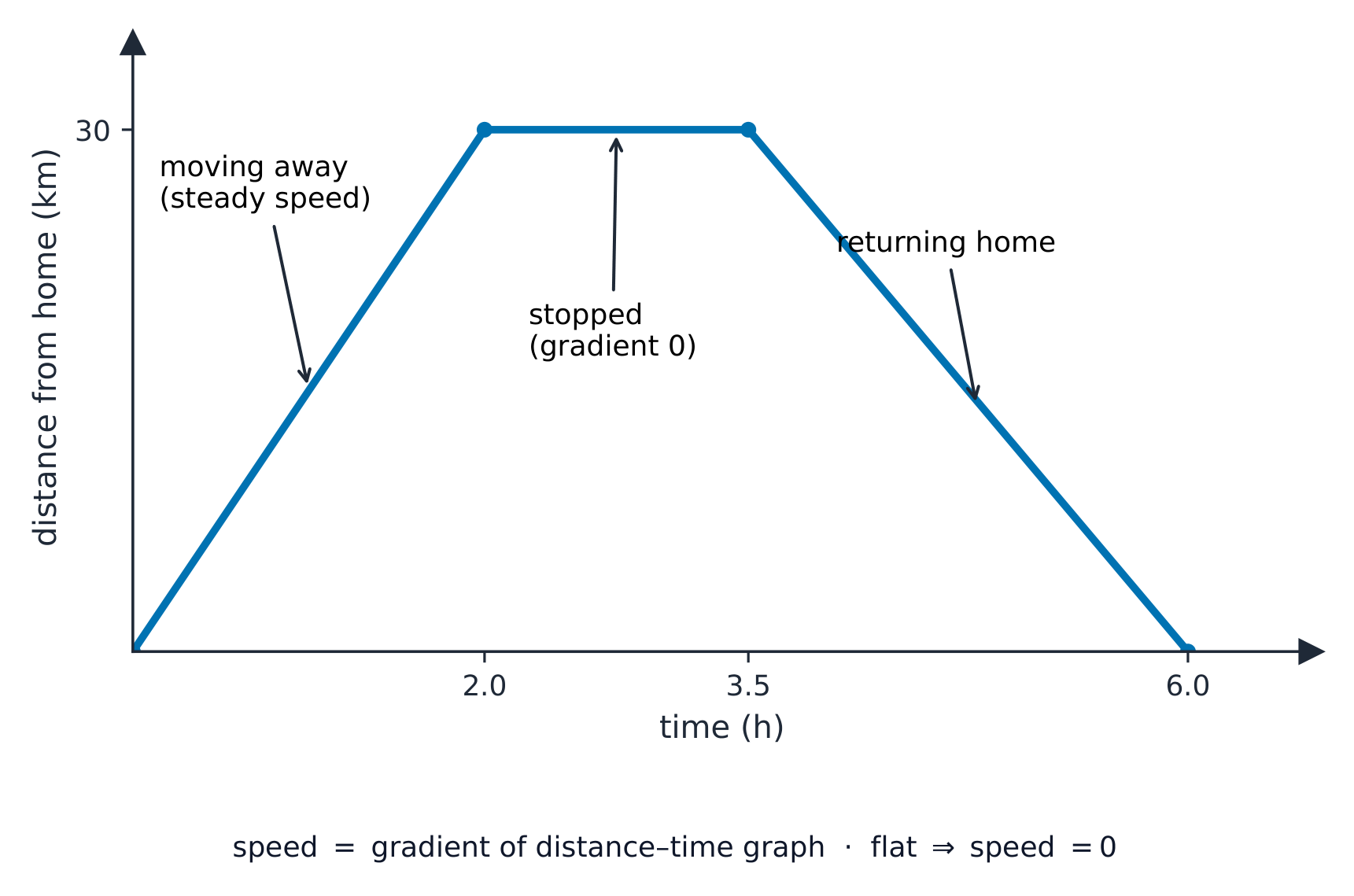
The gradient 斜率 (steepness) of a graph shows a rate of change 变化率.
- A travel graph 行程图 (distance–time graph) has gradient equal to speed; a flat part means the object is not moving.
- A conversion graph 换算图 is a straight line used to change between two units (for example, miles and kilometres).
Speed–time graphs (Extended)
On a speed–time graph the gradient is the acceleration 加速度 (or deceleration 减速度 if the speed falls), and the area 面积 under the graph is the distance 距离 travelled.
Worked example. A car speeds up from rest to $20\text{ m/s}$ in $8\text{ s}$, then stays at $20\text{ m/s}$ for $12\text{ s}$. Find the acceleration and the total distance.
Acceleration $= \dfrac{20}{8} = 2.5\text{ m/s}^{2}$. The distance is the area: a triangle plus a rectangle,
$$\tfrac{1}{2} \times 8 \times 20 + 12 \times 20 = 80 + 240 = 320\text{ m}.$$

Explore
Real-life graphs
y = ax + b
A distance–time or cost graph is read from its gradient and its intercept.
Vocabulary
Train
| English |
|---|
| gradient/ˈɡreɪdɪənt/ |
| rate of change/reɪt ɒv tʃeɪndʒ/ |
| travel graph/ˈtrævl ɡræf/ |
| conversion graph/kənˈvɜːʃn ɡræf/ |
| acceleration/əkˌseləˈreɪʃn/ |
| deceleration/dɪˌseləˈreɪʃn/ |
| area/ˈeərɪə/ |
| distance/ˈdɪstəns/ |
2.10
Graphs of functions
Syllabus
| Subject content | Notes and examples |
|---|---|
| 1 Construct tables of values, and draw, recognise and interpret graphs for functions of the following forms: • $ax + b$ • $\pm x^2 + ax + b$ • $\frac{a}{x} \ (x \neq 0)$ where $a$ and $b$ are integer constants. | |
| 2 Solve associated equations graphically, including finding and interpreting roots by graphical methods. | e.g. find the intersection of a line and a curve. |
| Subject content | Notes and examples |
|---|---|
| 1 Construct tables of values, and draw, recognise and interpret graphs for functions of the following forms: • $a x^n$ (includes sums of no more than three of these) • $a b^x + c$ where $n = -2, -1, -\frac{1}{2}, 0, \frac{1}{2}, 1, 2, 3$; $a$ and $c$ are rational numbers; and $b$ is a positive integer. | Examples include: • $y = x^3 + x - 4$ • $y = 2x + \frac{3}{x^2}$ • $y = \frac{1}{4} \times 2^x$. |
| 2 Solve associated equations graphically, including finding and interpreting roots by graphical methods. | e.g. finding the intersection of a line and a curve. |
| 3 Draw and interpret graphs representing exponential growth and decay problems. |
Source: Cambridge International syllabus
To draw a graph, make a table of values 数值表: choose values of $x$, work out $y$, then plot the coordinates 坐标 and join them with a smooth curve.
The points where a graph crosses the $x$-axis (the horizontal axis 坐标轴) are the roots 根 — the solutions of $y = 0$.
You can solve an equation by reading a graph. The intersection point 交点 of a line and a curve gives the solution of the two equations together.
For exponential growth 指数增长 and exponential decay 指数衰减, the graph of $y = a\,b^{x} + c$ rises (or falls) faster and faster and flattens towards a horizontal line.
Explore
Graphing a quadratic
y = ax² + bx + c
Drag a, b and c and watch the parabola move — its turning point and where it crosses the axes.
Vocabulary
Train
| English |
|---|
| table of values/ˈteɪbl ɒv ˈvæljuːz/ |
| coordinates/kəʊˈɔːdɪnəts/ |
| axis/ˈæksɪs/ |
| roots/ruːts/ |
| intersection point/ˌɪntəˈsekʃn pɔɪnt/ |
| exponential growth/ˌekspəˈnenʃl ɡrəʊθ/ |
| exponential decay/ˌekspəˈnenʃl dɪˈkeɪ/ |
2.11
Sketching curves
Syllabus
| Subject content | Notes and examples |
|---|---|
| Recognise, sketch and interpret graphs of the following functions: (a) linear (b) quadratic. | Knowledge of symmetry and roots is required. Knowledge of turning points is not required. |
| Subject content | Notes and examples |
|---|---|
| Recognise, sketch and interpret graphs of the following functions: (a) linear (b) quadratic (c) cubic (d) reciprocal (e) exponential. | Functions will be equivalent to: • $ax + by = c$ • $y = ax^2 + bx + c$ • $y = ax^3 + b$ • $y = ax^3 + bx^2 + cx$ • $y = \frac{a}{x} + b$ • $y = ar^x + b$ where $a$, $b$ and $c$ are rational numbers and $r$ is a rational, positive number. Knowledge of turning points, roots and symmetry is required. Knowledge of vertical and horizontal asymptotes is required. Finding turning points of quadratics by completing the square is required. |
Source: Cambridge International syllabus
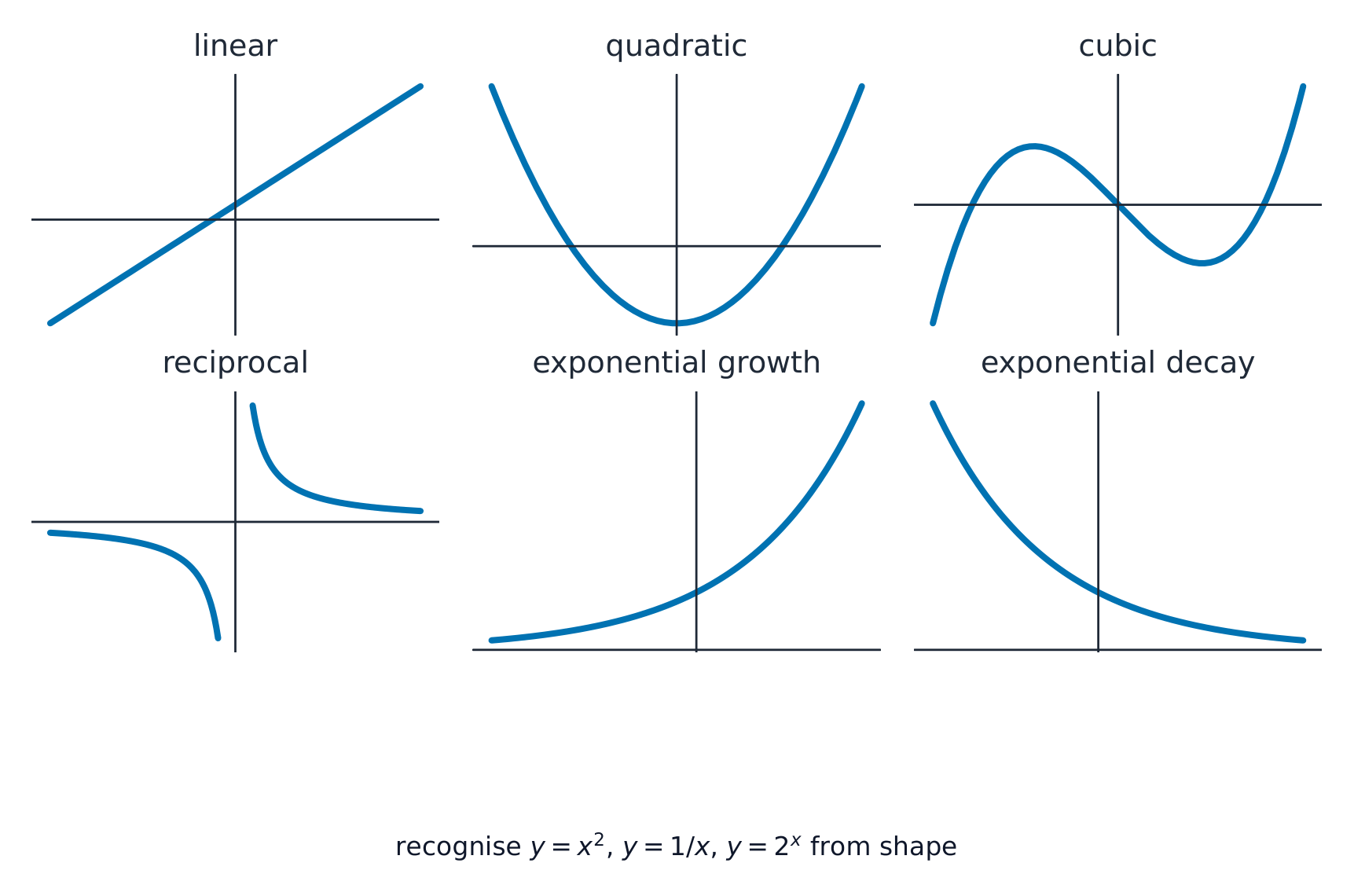
A quick sketch should show the right shape and the key features: where it crosses the axes, any symmetry 对称, and any line the curve gets close to.
| Function | Shape |
|---|---|
| linear, $y = mx + c$ | straight line; gradient $m$, $y$-intercept 截距 $c$ |
| quadratic, $y = ax^{2} + bx + c$ | a parabola 抛物线 (U-shape if $a>0$, $\cap$-shape if $a<0$) |
| cubic, $y = ax^{3} + bx + c$ | an S-shaped curve |
| reciprocal, $y = \dfrac{a}{x} + b$ | two separate curves |
| exponential, $y = a\,r^{x} + b$ | fast growth or decay |
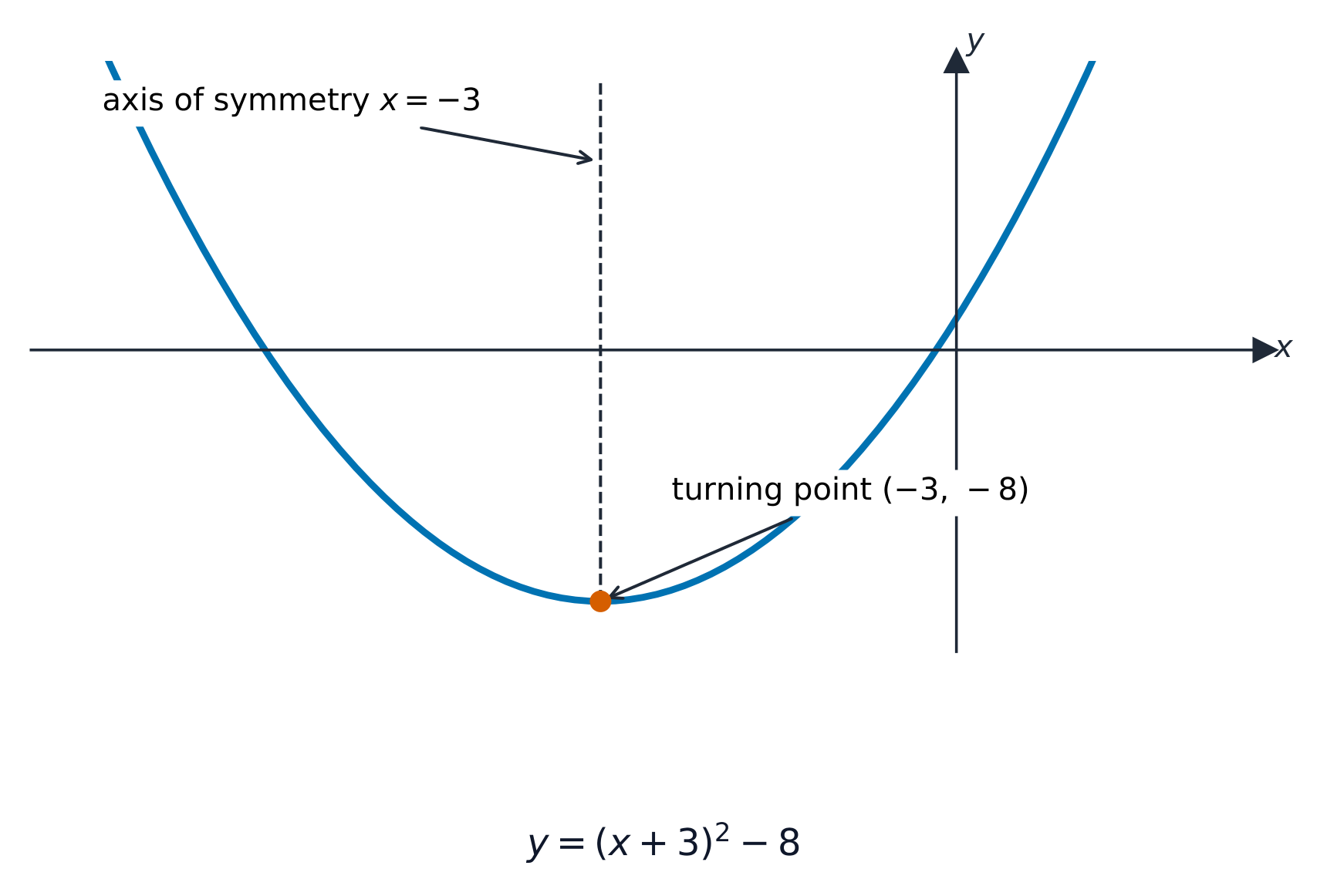
For a parabola, completing the square gives the turning point 转折点 (the lowest or highest point). For example $y = (x + 3)^{2} - 8$ has its turning point at $(-3, -8)$.
An asymptote 渐近线 is a line that the curve gets closer and closer to but never touches — for example, the $x$-axis for $y = \dfrac{a}{x}$, or the line $y = b$ for $y = a\,r^{x} + b$.
Vocabulary
Train
| English |
|---|
| symmetry/ˈsɪmətri/ |
| intercept/ˌɪntəˈsept/ |
| parabola/pəˈræbələ/ |
| turning point/ˈtɜːnɪŋ pɔɪnt/ |
| asymptote/ˈæsɪmptəʊt/ |
2.12
Differentiation (Extended)
Syllabus
| Subject content | Notes and examples |
|---|---|
| 1 Estimate gradients of curves by drawing tangents. | |
| 2 Use the derivatives of functions of the form $ax^n$, where $a$ is a rational constant and $n$ is a positive integer or zero, and simple sums of not more than three of these. | $\frac{\mathrm{d}y}{\mathrm{d}x}$ notation will be expected. |
| 3 Apply differentiation to gradients and stationary points (turning points). | |
| 4 Discriminate between maxima and minima by any method. | Maximum and minimum points may be identified by: • an accurate sketch • use of the second differential • inspecting the gradient either side of a turning point. Candidates are not expected to identify points of inflection. |
Source: Cambridge International syllabus
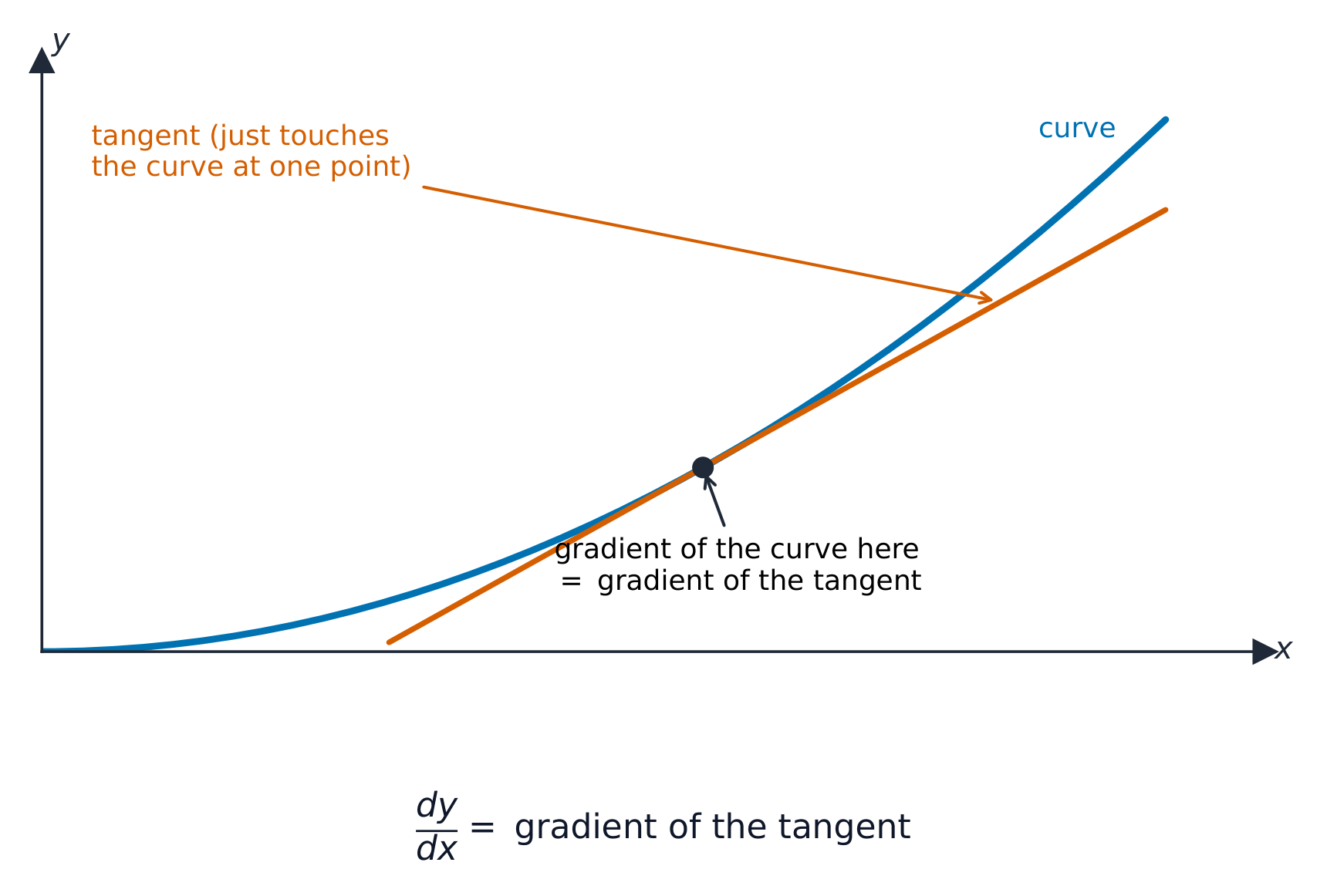
Differentiation 微分 finds the gradient of a curve at any point. You can estimate it by drawing a tangent 切线 (a line that just touches the curve) and measuring its gradient.
The exact rule: if $y = ax^{n}$, then the derivative 导数 is
$$\frac{\mathrm{d}y}{\mathrm{d}x} = a\,n\,x^{\,n-1}.$$
Differentiate a sum term by term.
Worked example. If $y = x^{3} + 2x^{2} - 5x$, then $\dfrac{\mathrm{d}y}{\mathrm{d}x} = 3x^{2} + 4x - 5$.
A stationary point 驻点 (turning point) is where the gradient is zero, so set $\dfrac{\mathrm{d}y}{\mathrm{d}x} = 0$.
Worked example. Find the turning point of $y = x^{2} - 6x + 5$.
$$\frac{\mathrm{d}y}{\mathrm{d}x} = 2x - 6 = 0 \;\Rightarrow\; x = 3, \quad y = 3^{2} - 6(3) + 5 = -4.$$
The turning point is $(3, -4)$. To decide whether a turning point is a maximum 最大值 or a minimum 最小值, check the sign of the gradient on each side, or use the second derivative (positive means a minimum).
Explore
Gradient of a curve
y = ax³ + bx² + cx + d
Move the point: the tangent shows the gradient there, which is what differentiation finds.
Vocabulary
Train
| English |
|---|
| differentiation/ˌdɪfəˌrenʃɪˈeɪʃn/ |
| tangent/ˈtændʒənt/ |
| derivative/dɪˈrɪvətɪv/ |
| stationary point/ˈsteɪʃənəri pɔɪnt/ |
| maximum/ˈmæksɪməm/ |
| minimum/ˈmɪnɪməm/ |
2.13
Functions (Extended)

Syllabus
| Subject content | Notes and examples |
|---|---|
| 1 Understand functions, domain and range and use function notation. | Examples include: • $f(x) = 3x - 5$ • $g(x) = \frac{3(x + 4)}{5}$ • $h(x) = 2x^2 + 3$. |
| 2 Understand and find inverse functions $f^{-1}(x)$. | |
| 3 Form composite functions as defined by $gf(x) = g(f(x))$. | e.g. $f(x) = \frac{3}{x + 2}$ and $g(x) = (3x + 5)^2$. Find $fg(x)$. Give your answer as a fraction in its simplest form. Candidates are not expected to find the domains and ranges of composite functions. This topic may include mapping diagrams. |
Source: Cambridge International syllabus
A function 函数 turns each input into one output. We write $f(x)$, for example $f(x) = 3x - 5$, so $f(2) = 1$. The set of allowed inputs is the domain 定义域; the set of possible outputs is the range 值域.
The inverse function 反函数 $f^{-1}(x)$ undoes the function. To find it, write $y = f(x)$, swap the roles, and make $x$ the subject.
Worked example. Find the inverse of $f(x) = 3x - 5$.
$$y = 3x - 5 \;\Rightarrow\; x = \frac{y + 5}{3}, \quad \text{so} \quad f^{-1}(x) = \frac{x + 5}{3}.$$
A composite function 复合函数 applies one function after another: $gf(x)$ means "do $f$ first, then $g$".
Worked example. If $f(x) = 2x$ and $g(x) = x + 3$, then
$$gf(x) = g(2x) = 2x + 3, \qquad fg(x) = f(x + 3) = 2(x + 3) = 2x + 6.$$
Explore
Functions
y = f(x)
A function turns each input into exactly one output — watch its shape.
Vocabulary
Train
| English |
|---|
| function/ˈfʌŋkʃn/ |
| domain/dəˈmeɪn/ |
| range/reɪndʒ/ |
| inverse function/ɪnˈvɜːs ˈfʌŋkʃn/ |
| composite function/ˈkɒmpəzɪt ˈfʌŋkʃn/ |
2.13
Exam tips
- When you expand brackets, multiply every term and watch the signs, especially with a minus in front: $-(x - 3) = -x + 3$.
- To solve an equation, do the same thing to both sides. When you multiply or divide an inequality by a negative number, flip the sign.
- Factorise fully: take out the highest common factor first, then look for a difference of two squares or a quadratic pattern.
- A quadratic usually has two solutions — give both. Check whether the question wants factorising, the formula, or completing the square.
- When substituting into a formula, put each value in brackets first, so signs and powers come out right.
Interactive lessons on this topic
Work through it step by step, with instant-check exercises.