This handout covers Topic 3, Coordinate geometry. Parts marked (Extended) are only tested on the Extended papers; everything else is for both levels.
Coordinate geometry
IGCSE Mathematics · Topic 3
 7:35
7:35
Coordinate geometry
Look down on a city like this and every street corner has an address: so many blocks across, so many blocks up. Two numbers, and you know exactly where you…
English narration · English + 中文 subtitles burned in
3.1
Coordinates

Syllabus
| Subject content | Notes and examples |
|---|---|
| Use and interpret Cartesian coordinates in two dimensions. |
Source: Cambridge International syllabus
A point on a graph is described by its coordinates 坐标, sometimes called Cartesian coordinates, written $(x, y)$. The first number is the across value and the second is the up value.
- The two number lines are the axes 坐标轴: the horizontal 水平 $x$-axis and the vertical 竖直 $y$-axis.
- They cross at the origin 原点, the point $(0, 0)$.
- The axes split the grid into four quadrants 象限.
So the point $(3, -2)$ is found by going $3$ to the right and $2$ down.

Explore
The coordinate plane
y = mx + c
Every point has an (x, y) coordinate. A straight line is the set of points where y depends on x in a fixed way.
Vocabulary
Train
| English |
|---|
| coordinates/kəʊˈɔːdɪnəts/ |
| axes/ˈæksɪz/ |
| horizontal/ˌhɒrɪˈzɒntl/ |
| vertical/ˈvɜːtɪkl/ |
| origin/ˈɒrɪdʒɪn/ |
| quadrants/ˈkwɒdrənts/ |
3.5
The equation of a straight line
Syllabus
| Subject content | Notes and examples |
|---|---|
| Interpret and obtain the equation of a straight-line graph in the form $y = mx + c$. | Questions may: • use and request lines in the forms $y = mx + c$, $x = k$ • involve finding the equation when the graph is given • ask for the gradient or $y$-intercept of a graph from an equation, e.g. find the gradient and $y$-intercept of the graph with the equation $y = 6x + 3$. Candidates are expected to give equations of a line in a fully simplified form. |
| Subject content | Notes and examples |
|---|---|
| Interpret and obtain the equation of a straight-line graph. | Questions may: • use and request lines in different forms, e.g. $ax + by = c$, $y = mx + c$, $x = k$ • involve finding the equation when the graph is given • ask for the gradient or $y$-intercept of a graph from an equation, e.g. find the gradient and $y$-intercept of the graph with equation $5x + 4y = 8$. Candidates are expected to give equations of a line in a fully simplified form. |
Source: Cambridge International syllabus
Most straight lines can be written as
$$y = mx + c,$$
where $m$ is the gradient 斜率 (steepness) and $c$ is the intercept 截距 — the $y$-value where the line crosses the $y$-axis.
- A line like $x = k$ (for example $x = 3$) is vertical.
- A line like $y = k$ (for example $y = 3$) is horizontal.
A line may also be given as $ax + by = c$. Rearrange it into $y = mx + c$ to read off the gradient and intercept.
Worked example. Find the gradient and $y$-intercept of $5x + 4y = 8$.
$$4y = -5x + 8 \;\Rightarrow\; y = -\tfrac{5}{4}x + 2.$$
So the gradient is $-\tfrac{5}{4}$ and the $y$-intercept is $2$.
Explore
y = mx + c
y = ax + b
Drag the gradient and the intercept. a is the gradient (steepness) and b is where the line crosses the y-axis.
Vocabulary
Train
| English |
|---|
| gradient/ˈɡreɪdɪənt/ |
| intercept/ˌɪntəˈsept/ |
3.3
Gradient

Syllabus
| Subject content | Notes and examples |
|---|---|
| Find the gradient of a straight line. | From a grid only. |
| Subject content | Notes and examples |
|---|---|
| 1 Find the gradient of a straight line. | |
| 2 Calculate the gradient of a straight line from the coordinates of two points on it. |
Source: Cambridge International syllabus
The gradient measures how steep a line is:
$$m = \frac{\text{change in } y}{\text{change in } x} = \frac{\text{rise}}{\text{run}}.$$
A positive gradient goes up to the right; a negative gradient goes down to the right.
Worked example. Find the gradient of the line through $(1, 2)$ and $(4, 11)$.
$$m = \frac{11 - 2}{4 - 1} = \frac{9}{3} = 3.$$

Explore
Gradient
y = ax + b
The gradient a measures steepness — rise over run.
3.2
Drawing a straight-line graph

Syllabus
| Subject content | Notes and examples |
|---|---|
| Draw straight-line graphs for linear equations. | Equations will be given in the form $y = mx + c$ (e.g. $y = -2x + 5$), unless a table of values is given. |
| Subject content | Notes and examples |
|---|---|
| Draw straight-line graphs for linear equations. | Examples include: • $y = -2x + 5$ • $y = 7 - 4x$ • $3x + 2y = 5$. |
Source: Cambridge International syllabus
To draw $y = mx + c$, the quickest way is:
- Mark the intercept $c$ on the $y$-axis.
- Use the gradient to step to more points (for $m = 3$, go $1$ right and $3$ up).
- Join the points with a straight line.
You can also make a small table of values 数值表: choose two or three $x$-values, work out $y$, and plot the points.
Vocabulary
Train
| English |
|---|
| table of values/ˈteɪbl ɒv ˈvæljuːz/ |
3.5
Finding the equation of a line
Syllabus
| Subject content | Notes and examples |
|---|---|
| Interpret and obtain the equation of a straight-line graph in the form $y = mx + c$. | Questions may: • use and request lines in the forms $y = mx + c$, $x = k$ • involve finding the equation when the graph is given • ask for the gradient or $y$-intercept of a graph from an equation, e.g. find the gradient and $y$-intercept of the graph with the equation $y = 6x + 3$. Candidates are expected to give equations of a line in a fully simplified form. |
| Subject content | Notes and examples |
|---|---|
| Interpret and obtain the equation of a straight-line graph. | Questions may: • use and request lines in different forms, e.g. $ax + by = c$, $y = mx + c$, $x = k$ • involve finding the equation when the graph is given • ask for the gradient or $y$-intercept of a graph from an equation, e.g. find the gradient and $y$-intercept of the graph with equation $5x + 4y = 8$. Candidates are expected to give equations of a line in a fully simplified form. |
Source: Cambridge International syllabus
If you know the gradient $m$ and one point on the line, put the point into $y = mx + c$ to find $c$.
Worked example. A line has gradient $3$ and passes through $(1, 2)$. Find its equation.
$$y = 3x + c, \qquad 2 = 3(1) + c, \qquad c = -1.$$
So the equation is $y = 3x - 1$. (If you are given two points, first find the gradient, then do this.)
3.4
Length and midpoint (Extended)

Syllabus
| Subject content | Notes and examples |
|---|---|
| 1 Calculate the length of a line segment. | |
| 2 Find the coordinates of the midpoint of a line segment. |
Source: Cambridge International syllabus
A line segment 线段 is the straight piece between two points.
To find the length 长度 of the segment between $(x_1, y_1)$ and $(x_2, y_2)$, use Pythagoras' theorem 勾股定理 on the horizontal and vertical gaps:
$$\text{length} = \sqrt{(x_2 - x_1)^2 + (y_2 - y_1)^2}.$$
To find the midpoint 中点 (the point exactly in the middle), average the coordinates:
$$\text{midpoint} = \left( \frac{x_1 + x_2}{2}, \; \frac{y_1 + y_2}{2} \right).$$
Worked example. Find the length and midpoint of the segment from $(1, 2)$ to $(4, 6)$.
$$\text{length} = \sqrt{(4 - 1)^2 + (6 - 2)^2} = \sqrt{9 + 16} = \sqrt{25} = 5.$$
$$\text{midpoint} = \left( \frac{1 + 4}{2}, \; \frac{2 + 6}{2} \right) = (2.5, \, 4).$$
Explore
Length and midpoint lab
midpoint is halfway between endpoints
Move along a line segment and see midpoint as halfway.
Vocabulary
Train
| English |
|---|
| line segment/laɪn ˈseɡmənt/ |
| length/leŋθ/ |
| Pythagoras' theorem/paɪˈθæɡərəs ˈθɪərəm/ |
| midpoint/ˈmɪdpɔɪnt/ |
3.6
Parallel lines
Syllabus
| Subject content | Notes and examples |
|---|---|
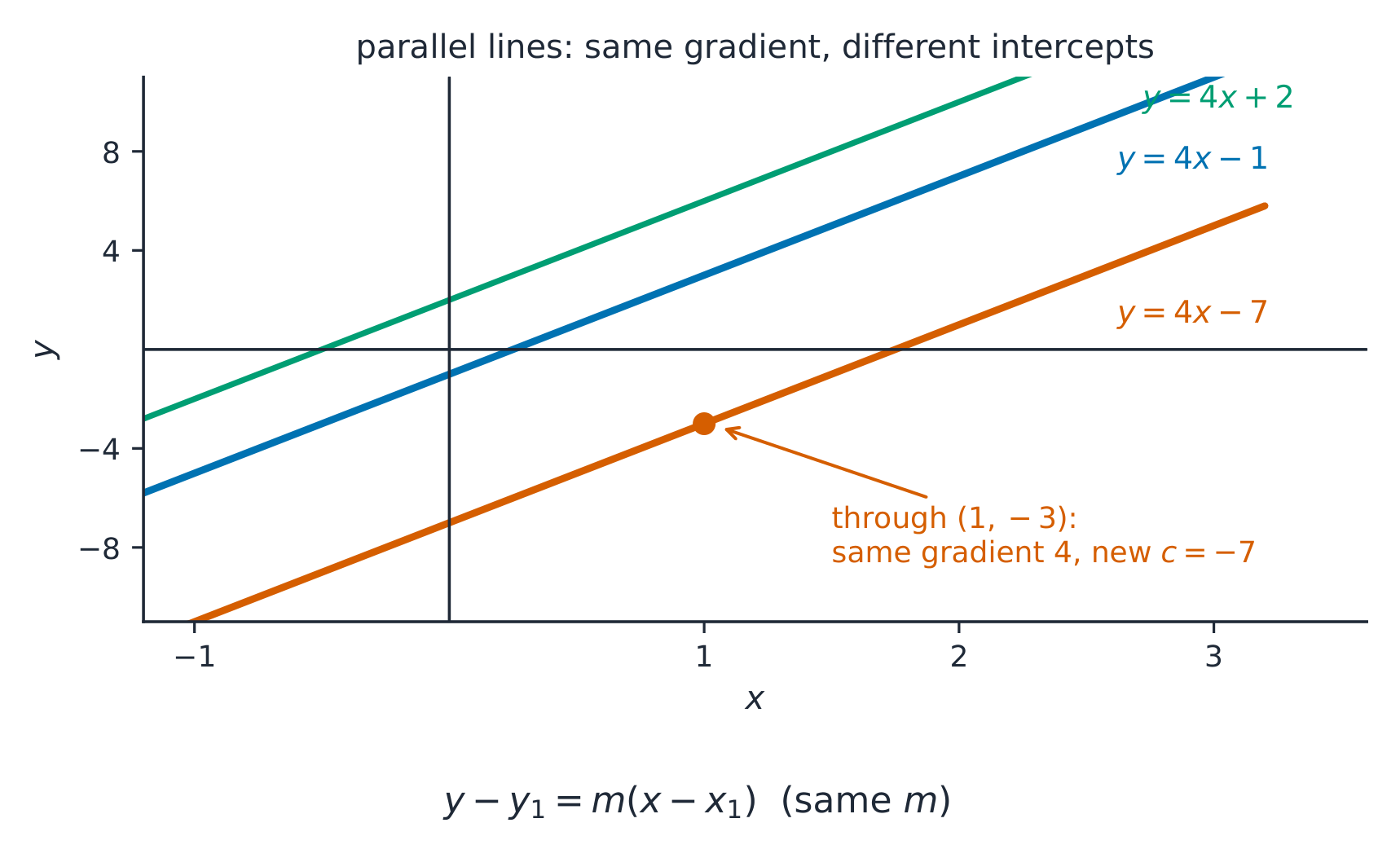
| Find the gradient and equation of a straight line parallel to a given line. | e.g. find the equation of the line parallel to $y = 4x - 1$ that passes through $(1, -3)$. |
Source: Cambridge International syllabus
Parallel 平行 lines never meet, so they have the same gradient.
Worked example. Find the equation of the line parallel to $y = 4x - 1$ that passes through $(1, -3)$.
The gradient is also $4$. Put the point in:
$$-3 = 4(1) + c \;\Rightarrow\; c = -7,$$
so the line is $y = 4x - 7$.
Explore
Parallel & perpendicular
y = ax + b
Parallel lines share a gradient; perpendicular gradients multiply to −1.
Vocabulary
Train
| English |
|---|
| parallel/ˈpærəlel/ |
3.7
Perpendicular lines (Extended)

Syllabus
| Subject content | Notes and examples |
|---|---|
| Find the gradient and equation of a straight line perpendicular to a given line. | Examples include: • find the gradient of a line perpendicular to $2y = 3x + 1$ • find the equation of the perpendicular bisector of the line joining the points $(-3, 8)$ and $(9, -2)$. |
Source: Cambridge International syllabus
Two lines are perpendicular 垂直 if they meet at a right angle 直角. Their gradients multiply to $-1$:
$$m_1 \times m_2 = -1, \qquad \text{so} \qquad m_2 = -\frac{1}{m_1}.$$
In words: flip the fraction and change the sign.
Worked example. Find the gradient of a line perpendicular to $2y = 3x + 1$.
Rearrange: $y = \tfrac{3}{2}x + \tfrac{1}{2}$, so the gradient is $\tfrac{3}{2}$. The perpendicular gradient is $-\tfrac{2}{3}$.
Perpendicular bisector
The perpendicular bisector 垂直平分线 of a segment cuts it in half at a right angle. To find its equation: get the midpoint, then use the perpendicular gradient through that midpoint.
Worked example. Find the perpendicular bisector of the segment joining $(-3, 8)$ and $(9, -2)$.
- Midpoint: $\left( \frac{-3 + 9}{2}, \frac{8 + (-2)}{2} \right) = (3, 3)$.
- Gradient of the segment: $\frac{-2 - 8}{9 - (-3)} = \frac{-10}{12} = -\tfrac{5}{6}$.
- Perpendicular gradient: $\frac{6}{5}$.
Through $(3, 3)$: $\; 3 = \tfrac{6}{5}(3) + c \Rightarrow c = 3 - \tfrac{18}{5} = -\tfrac{3}{5}$. So the bisector is
$$y = \tfrac{6}{5}x - \tfrac{3}{5}.$$
Vocabulary
Train
| English |
|---|
| perpendicular/ˌpɜːpənˈdɪkjʊlə/ |
| right angle/raɪt ˈæŋɡl/ |
| perpendicular bisector/ˌpɜːpənˈdɪkjʊlə baɪˈsektə/ |
3.7
Exam tips
- The straight line is $y = mx + c$: $m$ is the gradient and $c$ is where the line crosses the $y$-axis.
- Gradient = (change in $y$) ÷ (change in $x$). Keep the two coordinates in the same order on the top and the bottom.
- Parallel lines have the same gradient; perpendicular lines have gradients that multiply to $-1$ (the negative reciprocal).
- The midpoint is the average of the coordinates; the distance between two points comes from Pythagoras on the differences.
Interactive lessons on this topic
Work through it step by step, with instant-check exercises.