Graphs of functions and sketching curves
Introduced| English | Meaning |
|---|---|
| function/ˈfʌŋkʃn/ | A mapping that assigns exactly one output to each allowed input. |
| parabola/pəˈræbələ/ | The curve formed by points equally distant from a fixed point and a fixed straight line. |
| reciprocal/rɪˈsɪprəkl/ | The value obtained by dividing one by a non-zero number. |
| roots/ruːts/ | Values of a variable that make an equation or polynomial expression equal to zero. |
| intersection/ˌɪntəˈsekʃn/ | The set of elements that belong to all of the sets being compared. |
| asymptotes/ˈæsɪmptəʊts/ | Lines or curves that a graph approaches arbitrarily closely in a specified limiting direction. |
| turning point/ˈtɜːnɪŋ pɔɪnt/ | A point where a graph changes from increasing to decreasing, or from decreasing to increasing. |
The shape of a function 函数
- Every function has a signature shape, like a fingerprint. A linear function is a straight line; a quadratic is a parabola 抛物线; a reciprocal 倒数 has two branches that never touch the axes.
- Recognising the shape lets you sketch a graph in seconds — without plotting dozens of points.
Plotting and reading graphs
- Make a table of values: pick $x$-values, calculate $y$-values, plot the coordinates, join with a smooth curve.
- Roots 根 are where the graph crosses the $x$-axis (the solutions of $y = 0$).
- The intersection 交集 of two graphs solves the two equations simultaneously.

A suspension bridge cable hangs in a parabola, a quadratic curve
Sketching curves
y = ax³ + bx² + cx + d
Sketch a curve from its turning points and where it crosses the axes.
The roots of a graph are where it:
Difficulty 1/5 · 100 coins + a small bonus on first completion today
Roots are the x-values where y = 0 — where the curve meets the x-axis.
Three families of curves
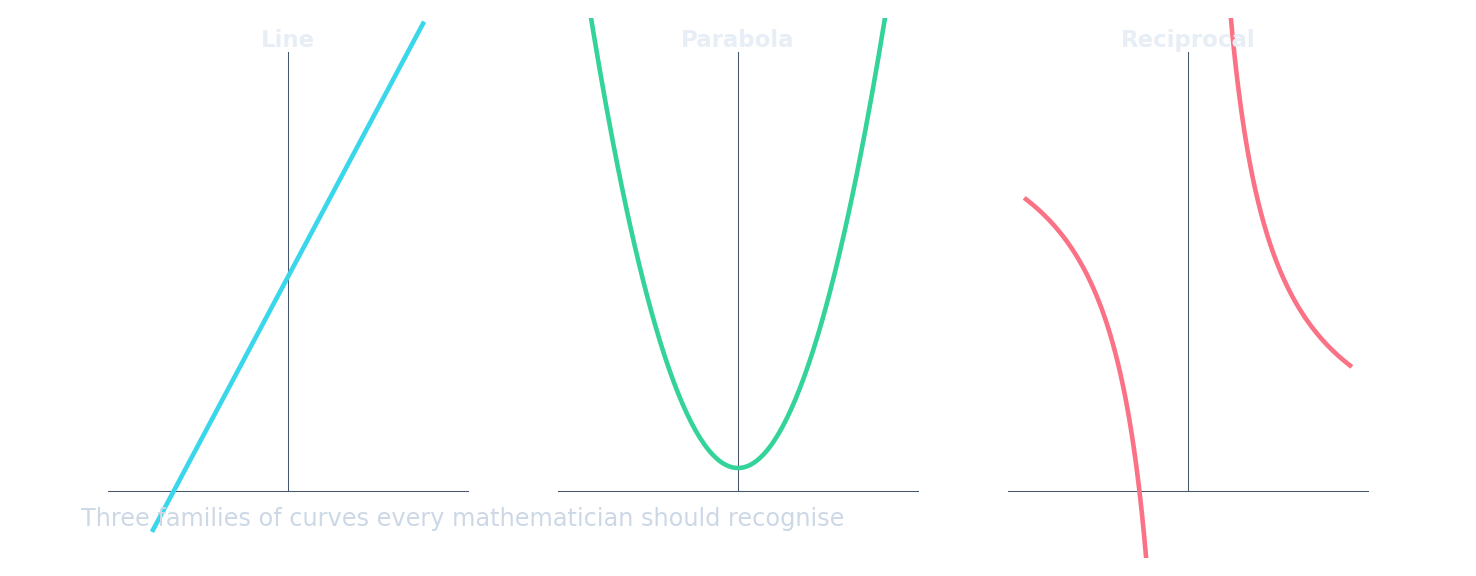
Three families every mathematician should recognise: line, parabola, reciprocal.
| Function | Shape | Key features |
|---|---|---|
| $y = mx + c$ | straight line | gradient $m$, intercept $c$ |
| $y = ax^2 + bx + c$ | parabola | U if $a > 0$, ∩ if $a < 0$ |
| $y = \dfrac{a}{x}$ | reciprocal | two branches, asymptotes 渐近线 at axes |
Parabola direction. $y = x^2 - 4$ opens upward (U-shape) because the coefficient of $x^2$ is positive. $y = -x^2 + 4$ opens downward (∩-shape).
The graph of y = ax² + bx + c (with a > 0) is a:
Difficulty 1/5 · 100 coins + a small bonus on first completion today
A positive a gives a U-shaped parabola; a negative a gives an ∩ shape.
The graph of y = −x² + 4 opens upward.
Difficulty 1/5 · 100 coins + a small bonus on first completion today
The coefficient of x² is negative (−1), so the parabola opens downward (∩-shape).
The graph of y = a/x has two branches that never touch the axes. These lines are called ______.
Difficulty 1/5 · 100 coins + a small bonus on first completion today
Asymptotes are lines the curve approaches but never touches. For y = a/x, the axes are asymptotes.
Turning points 转折点 (Extended)
- A parabola has one turning point (vertex) — its minimum or maximum.
- Completing the square reveals it directly:
- $y = (x + p)^2 + q$ has its turning point at $(-p,\; q)$.
- Example: $y = (x + 3)^2 - 8$ → turning point $(-3, -8)$.
Signs flip. In $(x + 3)^2 - 8$, the turning point is $(-3, -8)$ — the $x$-coordinate has the opposite sign to what's inside the bracket.
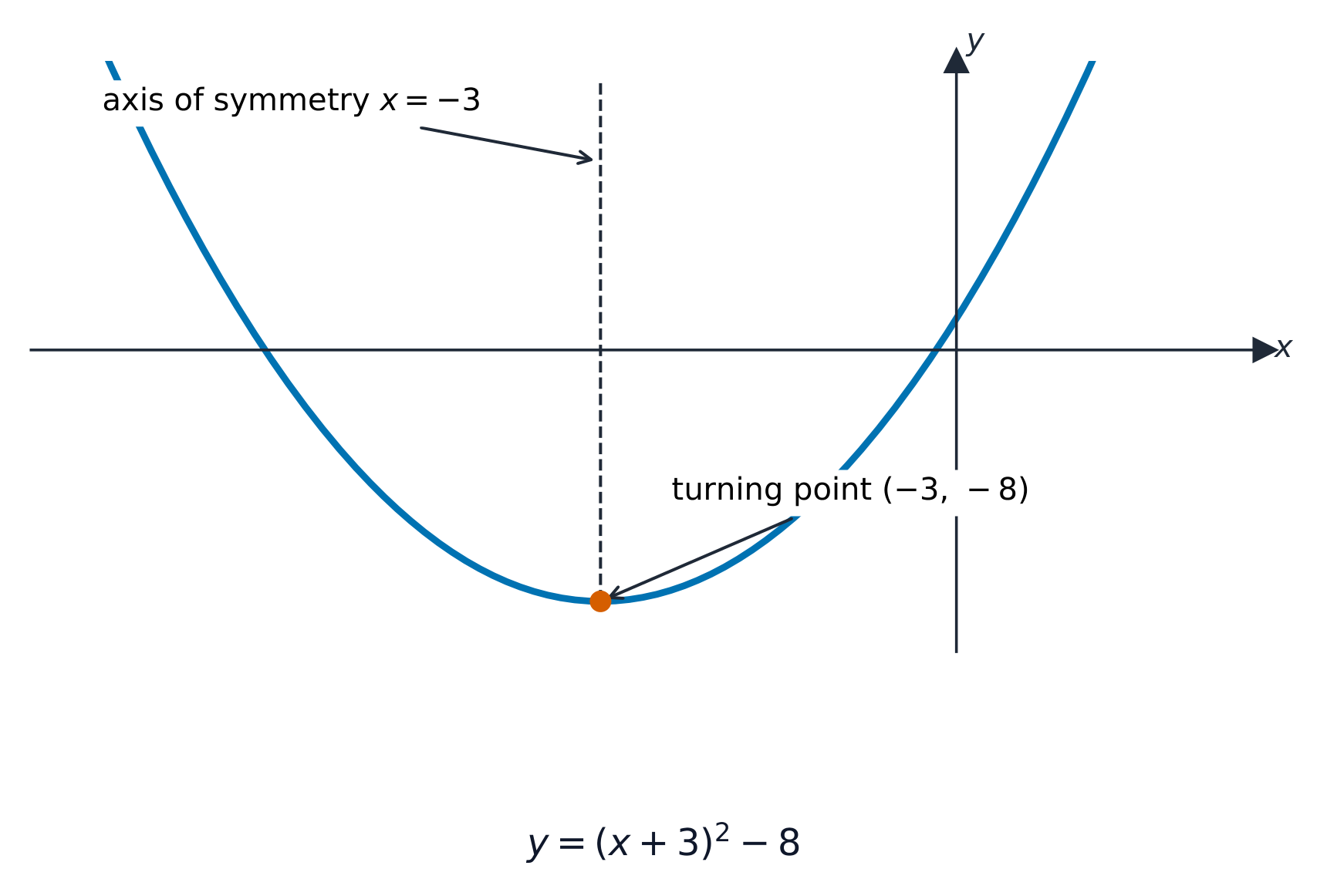
Completing the square, $y=(x+3)^2-8$, shows the turning point $(-3,-8)$ and the line of symmetry $x=-3$
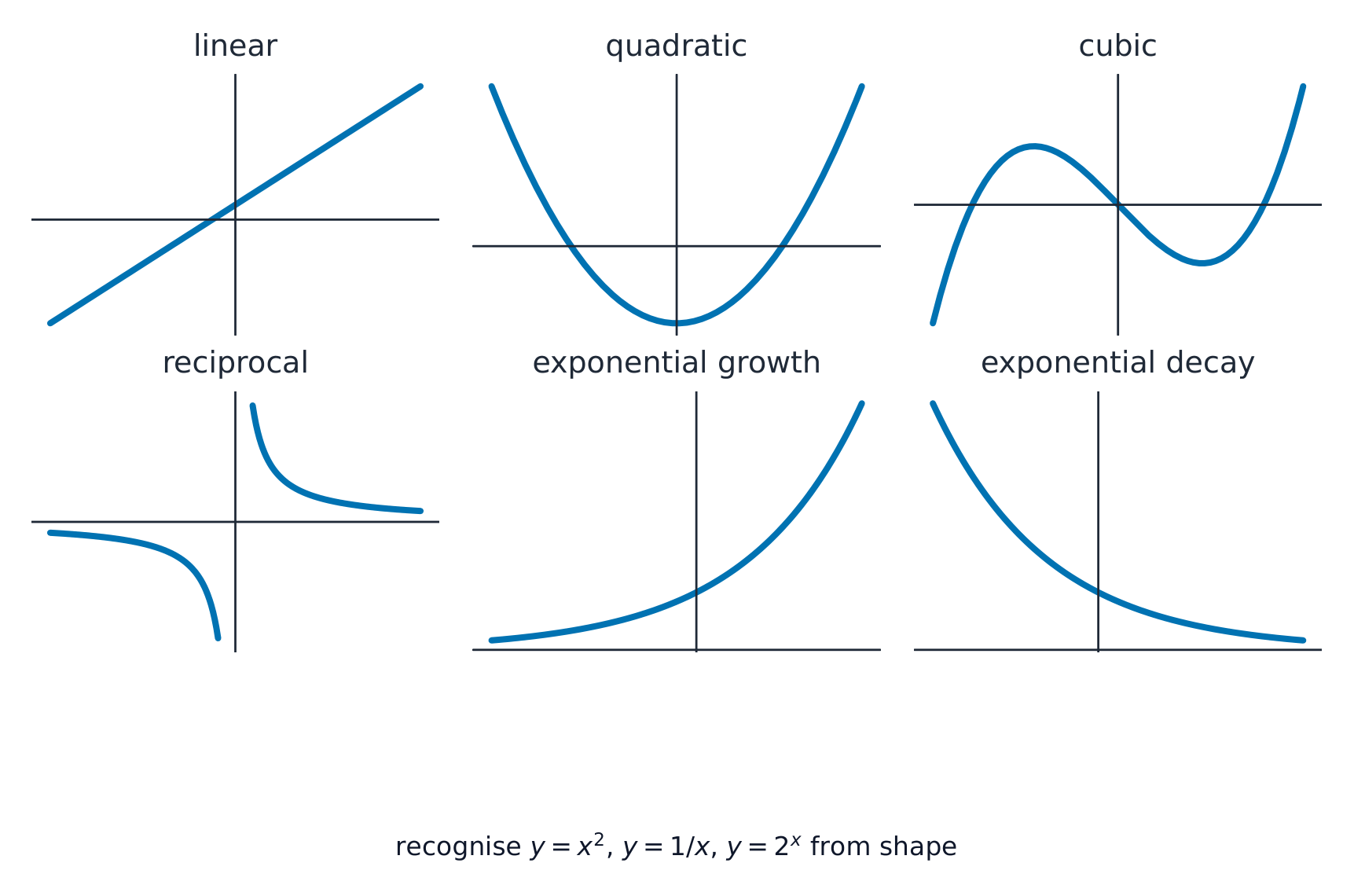
The five basic graph shapes; knowing each shape lets you sketch quickly from the equation
The curve y = (x + 3)² − 8 has its turning point at (−3, q). What is q?
Difficulty 2/5 · 140 coins + a small bonus on first completion today
Completed-square form (x+p)² + q has turning point (−p, q), so q = −8.
Using graphs to solve equations
- Where a line and a curve intersect, both equations are satisfied.
- Solving $x^2 - 4 = 2x + 1$ graphically: plot $y = x^2 - 4$ and $y = 2x + 1$, read off the intersection $x$-values.
The line y = x + 2 intersects the curve y = x² at two points. One has x = 2. What is the other x-value?
Difficulty 2/5 · 140 coins + a small bonus on first completion today
x² = x + 2 → x² − x − 2 = 0 → (x−2)(x+1) = 0 → x = 2 or x = −1.
Solve a graph question completely
- For $y=x^2-2$, calculate $y=2,-1,-2,-1,2$ at $x=-2,-1,0,1,2$ and plot a smooth symmetric curve. Draw $y=2$ with a ruler; crossings give solutions $x=-2,2$ to $x^2-2=2$.
- For $y=6/x$, use positive and negative inputs, but never $x=0$. Points $(2,3),(3,2),(-2,-3),(-3,-2)$ lie on separate branches. Core quadratic sketches require roots and symmetry, not turning-point coordinates.

What is the positive solution read where y = x² − 2 meets y = 2?
Difficulty 2/5 · 140 coins + a small bonus on first completion today
The crossing on the right is (2,2), so x = 2.
Extended cubic and exponential graphs
- For $y=x^3-1$, the integer table at $x=-2,-1,0,1,2$ is $-9,-2,-1,0,7$. Draw a smooth increasing S-shape; the root is 1 and the $y$-intercept is $-1$.
- For $y=2^x+1$, the table at $x=-1,0,1,2,3$ is $1.5,2,3,5,9$. The curve approaches horizontal asymptote $y=1$ to the left and rises to the right; it does not touch the asymptote.
For y = 2ˣ + 1, find y at x = 3.
Difficulty 2/5 · 140 coins + a small bonus on first completion today
2³ + 1 = 9.
Shifted reciprocals and fractional powers (Extended)
- $y=2/x+3$ has vertical asymptote $x=0$ and horizontal asymptote $y=3$. Shift both branches of $2/x$ up 3; do not join them across zero.
- For $y=\sqrt{x}$ use $x\ge0$ and points $(0,0),(1,1),(4,2),(9,3)$. For $y=1/\sqrt{x}$ use $x>0$ and points $(1,1),(4,1/2),(9,1/3)$. For $y=1/x^2$, positive and negative inputs give positive outputs, with symmetry about the $y$-axis.
For y = 2/x + 3, give the value of y at the horizontal asymptote.
Difficulty 2/5 · 140 coins + a small bonus on first completion today
The 2/x term tends to 0 as |x| grows, so the horizontal asymptote is y = 3.
You've got it
- roots $=$ where the curve crosses the $x$-axis; intersection solves two equations
- a quadratic is a parabola (U if $a > 0$, ∩ if $a < 0$)
- the turning point of $(x+p)^2 + q$ is $(-p,\; q)$
- reciprocal curves have asymptotes they never touch