Differentiation
Introduced| English | Meaning |
|---|---|
| calculus/ˈkælkjʊləs/ | calculus |
| derivative/dɪˈrɪvətɪv/ | The instantaneous rate of change of a function with respect to its input. |
| differentiate/ˌdɪfəˈrenʃɪeɪt/ | differentiate |
| stationary point/ˈsteɪʃənəri pɔɪnt/ | A point on a differentiable curve where its derivative is zero. |
The gradient that changes
- A straight line has one gradient everywhere. A curve has a different gradient at every point.
- Newton and Leibniz invented calculus 微积分 to answer: "What is the gradient of a curve right here?" The answer is the derivative 导数.
The power rule
- If $y = ax^n$, then $\dfrac{dy}{dx} = an\,x^{n-1}$.
- In words: bring the power down in front, then reduce it by one.
$y = x^3 + 2x^2 - 5x \Rightarrow \dfrac{dy}{dx} = 3x^2 + 4x - 5$. Differentiate 求导 term by term — each term is treated independently.
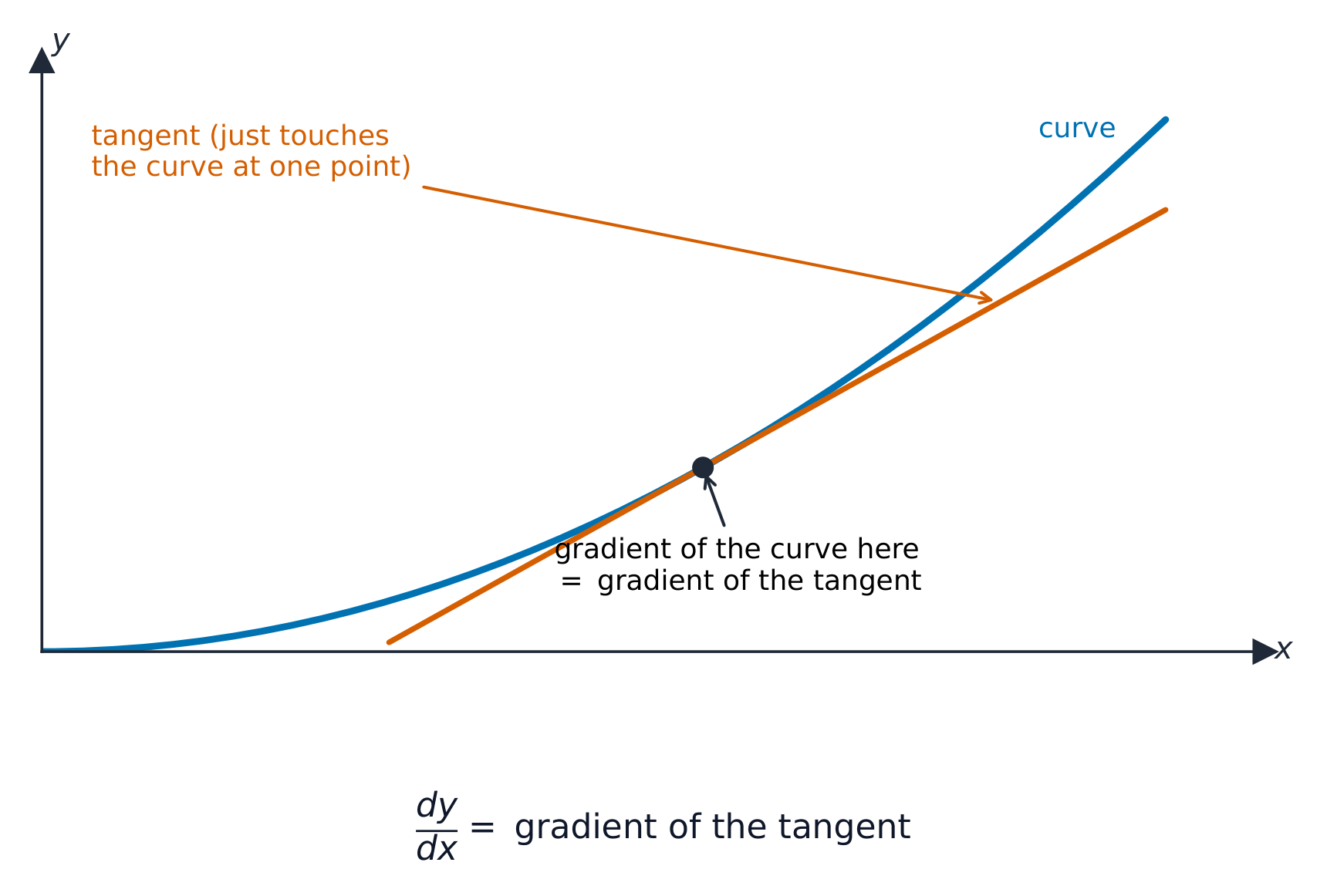
The gradient of a curve at a point is the gradient of the tangent there, which is what differentiation finds
The gradient at a point
gradient = dy/dx
Slide the point — the tangent's slope is the gradient there.
If y = x³ + 2x² − 5x, then dy/dx = 3x² + 4x − 5. What is its value at x = 1?
Difficulty 2/5 · 140 coins + a small bonus on first completion today
3(1)² + 4(1) − 5 = 3 + 4 − 5 = 2.
For y = axⁿ, where n is a positive integer, differentiating gives:
Difficulty 1/5 · 100 coins + a small bonus on first completion today
Bring the power down and reduce it by 1: a·n·xⁿ⁻¹.
If y = 4x³, what is dy/dx at x = 2?
Difficulty 2/5 · 140 coins + a small bonus on first completion today
dy/dx = 12x². At x = 2: 12(4) = 48.
The derivative of y = x⁵ is dy/dx = ______.
Difficulty 1/5 · 100 coins + a small bonus on first completion today
Power rule: bring down the 5, reduce the power: 5x⁴.
Special cases
- $y = c$ (a constant) → $\dfrac{dy}{dx} = 0$ (a horizontal line has zero gradient).
- $y = cx$ → $\dfrac{dy}{dx} = c$ (a straight line has constant gradient).
- The IGCSE power rule here uses nonnegative integer powers and sums of at most three terms; differentiating reciprocal functions is outside this syllabus.
Don't forget the constant term. The derivative of $x^2 + 7$ is $2x$, not $2x + 7$. The derivative of a constant is always zero.
The derivative of y = x² + 7 is 2x + 7.
Difficulty 1/5 · 100 coins + a small bonus on first completion today
The derivative of a constant is 0. So dy/dx = 2x, not 2x + 7.
Stationary points 驻点
- A stationary point is where $\dfrac{dy}{dx} = 0$ — the curve is momentarily flat.
- $y = x^2 - 6x + 5 \Rightarrow \dfrac{dy}{dx} = 2x - 6 = 0 \Rightarrow x = 3$.
- At $x = 3$: $y = 9 - 18 + 5 = -4$. Turning point: $(3, -4)$.
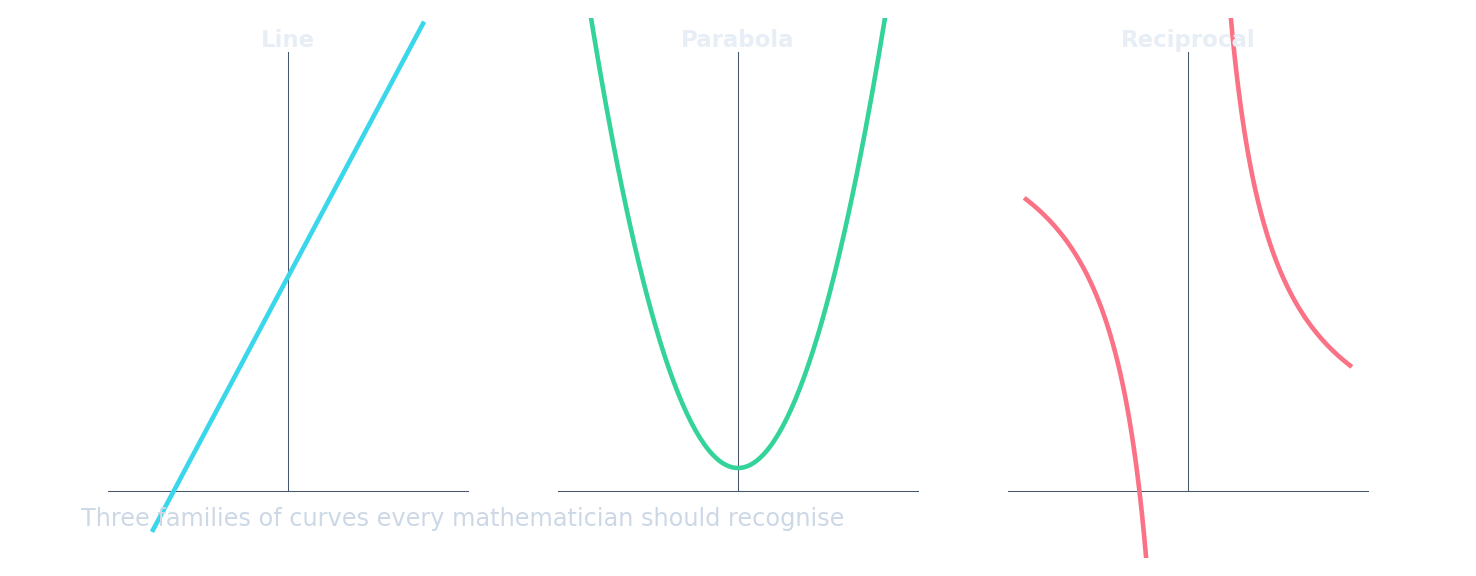
A stationary point is where the curve is momentarily flat — the gradient (derivative) equals zero.
The curve y = x² − 6x + 5 has a turning point. At what x value (dy/dx = 0)?
Difficulty 2/5 · 140 coins + a small bonus on first completion today
dy/dx = 2x − 6 = 0 gives x = 3.
Why differentiation matters
- Physics: velocity is the derivative of position; acceleration is the derivative of velocity.
- Economics: marginal cost is the derivative of total cost — the cost of one more unit.
- Optimisation: to maximise profit or minimise cost, set the derivative to zero.
A tangent estimates a curve gradient
- Draw a tangent touching the curve at the required point, then choose two clear points on the tangent, not two arbitrary points on the curve. Calculate its rise divided by run.
- For $y=x^2$ at $(2,4)$, a tangent through $(1,0)$ and $(3,8)$ has $m=(8-0)/(3-1)=4$. Differentiation confirms $dy/dx=2x=4$ at $x=2$.
A tangent passes through (1,0) and (3,8). Find its gradient.
Difficulty 2/5 · 140 coins + a small bonus on first completion today
Rise 8 divided by run 2 gives 4.
Minimum or maximum?
- For $y=x^2-6x+5$, the derivative is $2x-6$. It is negative at $x=2$, zero at 3 and positive at 4: falling then rising means a minimum at $(3,-4)$.
- For $y=-x^2+4x+1$, $dy/dx=-2x+4$. Positive at 1 and negative at 3 means a maximum at $x=2$, where $y=5$.
For y = −x² + 4x + 1, find the y-coordinate of its maximum.
Difficulty 2/5 · 140 coins + a small bonus on first completion today
dy/dx = −2x + 4 is zero at x = 2; y = −4 + 8 + 1 = 5.
You've got it
- power rule: $y = ax^n \Rightarrow \dfrac{dy}{dx} = an\,x^{n-1}$
- differentiate a sum term by term; the derivative of a constant is zero
- a stationary point is where $\dfrac{dy}{dx} = 0$
- $y = x^3 + 2x^2 - 5x \Rightarrow \dfrac{dy}{dx} = 3x^2 + 4x - 5$