Algebraic fractions
Introduced| English | Meaning |
|---|---|
| algebraic fractions/ˌældʒɪˈbreɪɪk ˈfrækʃnz/ | algebraic fractions |
| factorise/ˈfæktəraɪz/ | To express a number or algebraic expression as a product of factors. |
| cancel/ˈkænsl/ | cancel |
| common denominator/ˈkɒmən dɪˈnɒmɪneɪtə/ | common denominator |
| reciprocal/rɪˈsɪprəkl/ | The value obtained by dividing one by a non-zero number. |
When fractions have letters
- A baker halves a recipe, then thirds it again — that's $\dfrac{1}{2} \times \dfrac{1}{3} = \dfrac{1}{6}$ of the original.
- Algebraic fractions 代数分式 work exactly the same way, but the numbers are replaced by expressions. The rules don't change.
Algebraic fraction route
Simplify algebraic fractions by factorising before cancelling.
Simplifying algebraic fractions
- Factorise 因式分解 the numerator and denominator, then cancel 约分 any common factors.
- $\dfrac{x^2 - 2x}{x^2 - 5x + 6} = \dfrac{x(x-2)}{(x-2)(x-3)} = \dfrac{x}{x-3}$.
Factorise first, then cancel. You cannot cancel individual terms: $\dfrac{x+2}{x+3} \neq \dfrac{2}{3}$. The $+2$ and $+3$ are not factors — they are terms inside a sum.

Expanding a bracket with an area model
Simplify (x² − 2x)/(x² − 5x + 6).
Difficulty 1/5 · 100 coins + a small bonus on first completion today
Factorise: x(x−2) / [(x−2)(x−3)], cancel (x−2) → x/(x−3).
(x + 2)/(x + 3) simplifies to 2/3.
Difficulty 1/5 · 100 coins + a small bonus on first completion today
You can only cancel common FACTORS, not terms in a sum. x+2 and x+3 share no common factor.
Adding and subtracting
- Find a common denominator 公分母, just as with ordinary fractions.
- $\dfrac{x}{3} + \dfrac{x-4}{2} = \dfrac{2x}{6} + \dfrac{3(x-4)}{6} = \dfrac{2x + 3x - 12}{6} = \dfrac{5x - 12}{6}$.
Expand carefully. $3(x-4) = 3x - 12$ (not $3x - 4$). Every term inside the bracket must be multiplied.
Add x/3 + (x−4)/2 over a common denominator of 6.
Difficulty 1/5 · 100 coins + a small bonus on first completion today
2x/6 + 3(x−4)/6 = (2x + 3x − 12)/6 = (5x − 12)/6.
To add algebraic fractions, you must first find a common ______.
Difficulty 1/5 · 100 coins + a small bonus on first completion today
Just like with numeric fractions, you need a common denominator before adding or subtracting.
Multiplying and dividing
- Multiply: tops × tops, bottoms × bottoms — same as ordinary fractions.
- Divide: multiply by the reciprocal 倒数 of the second fraction.
- $\dfrac{x+1}{x-2} \div \dfrac{x+3}{x} = \dfrac{x+1}{x-2} \times \dfrac{x}{x+3} = \dfrac{x(x+1)}{(x-2)(x+3)}$.
To divide algebraic fractions, multiply by the reciprocal of the second one.
Difficulty 1/5 · 100 coins + a small bonus on first completion today
Division by a fraction is multiplication by its reciprocal, just as with numbers.
Worked example
- Simplify $\dfrac{x^2 - 9}{x^2 + 5x + 6}$.
- Factorise: numerator $= (x+3)(x-3)$, denominator $= (x+2)(x+3)$.
- Cancel $(x+3)$: result $= \dfrac{x-3}{x+2}$.
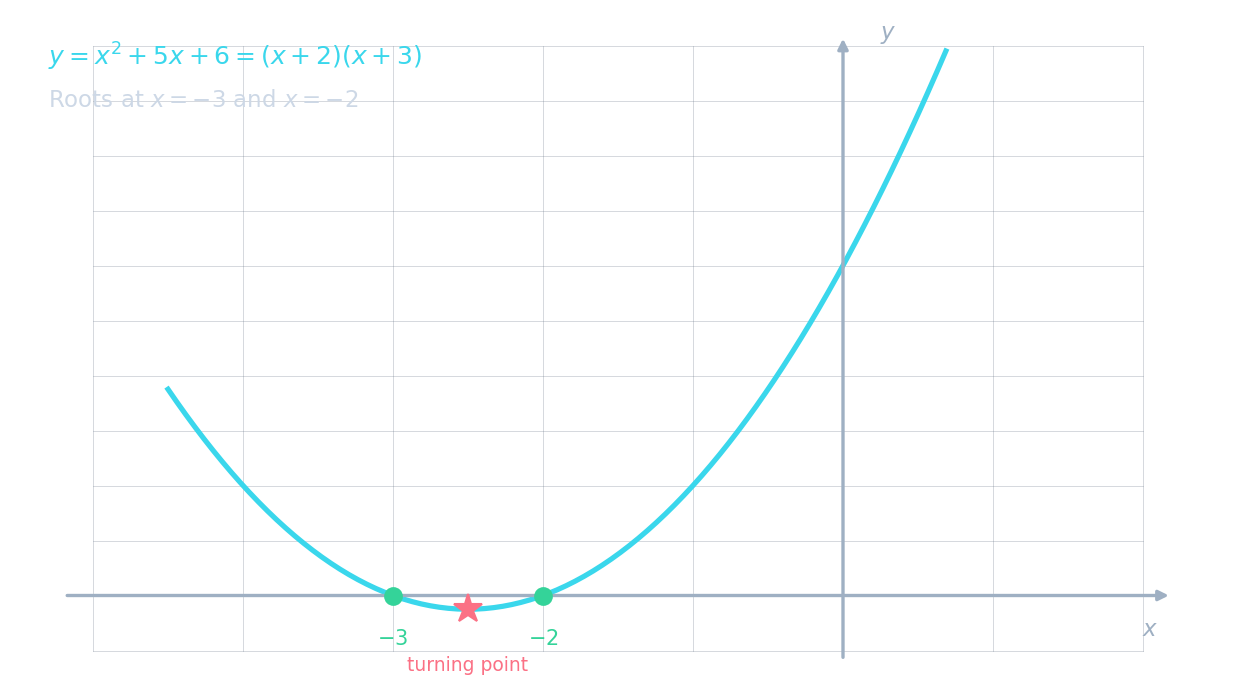
Factorising is the key to both solving quadratics and simplifying algebraic fractions.
Simplify (x² − 9)/(x² + 5x + 6).
Difficulty 1/5 · 100 coins + a small bonus on first completion today
(x+3)(x−3) / [(x+2)(x+3)], cancel (x+3) → (x−3)/(x+2).
Keep the excluded values
- Cancelling a factor does not restore a forbidden input. $x(x-2)/((x-2)(x-3))=x/(x-3)$, but the original still excludes $x=2$ and $x=3$.
- For $(x+1)/(x-2)\div((x+3)/x)$, exclude $x=2,0$ because of denominators, and $x=-3$ because the divisor is zero. Write these restrictions before cancelling.
For (x² − 9)/(x² + 5x + 6), which excluded input besides −2 must remain after cancelling?
Difficulty 2/5 · 140 coins + a small bonus on first completion today
The original denominator is (x+2)(x+3), so x = −3 stays excluded.
You've got it
- simplify: factorise top and bottom, cancel common brackets
- add/subtract: find a common denominator, combine numerators
- multiply/divide: as with ordinary fractions (divide = × the reciprocal)
- never cancel terms inside a sum — only cancel factors