Indices in algebra
Introduced| English | Meaning |
|---|---|
| indices/ˈɪndɪsiːz/ | Numbers or symbols showing the powers to which bases are raised. |
| coefficient/ˌkəʊɪˈfɪʃənt/ | A numerical or constant factor multiplying a term in an expression. |
| index equations/ˈɪndeks ɪˈkweɪʒnz/ | index equations |
The tower of powers
- How many times can you double a grain of rice before it fills a room? About 40 doublings — that's $2^{40} \approx 10^{12}$ grains.
- Index laws let you tame these enormous numbers, working with the powers instead of computing the values.
Algebraic index law lab
Classify index-law examples by the rule being used.
The three core rules
- Multiply same-base powers → add indices 指数: $\;a^m \times a^n = a^{m+n}$.
- Divide same-base powers → subtract indices: $\;a^m \div a^n = a^{m-n}$.
- Power of a power → multiply indices: $\;(a^m)^n = a^{mn}$.
$(5x^3)^2 = 5^2 \times (x^3)^2 = 25x^6$. Apply the power to every factor — the coefficient 系数 and the letter.
(5x³)² = k·x⁶. What is the coefficient k?
Difficulty 2/5 · 140 coins + a small bonus on first completion today
(5x³)² = 5² × (x³)² = 25x⁶, so k = 25.
a³ × a⁴ = a⁷.
Difficulty 1/5 · 100 coins + a small bonus on first completion today
Same base: add indices. a³ × a⁴ = a^(3+4) = a⁷.
Complete the rule: (a^m)^n = a^(____).
Difficulty 1/5 · 100 coins + a small bonus on first completion today
Power of a power: multiply the indices. (a^m)^n = a^(mn).
Working with coefficients
- Separate the number part from the letter part, simplify each, then recombine.
- $12a^5 \div 3a^{-2}$: numbers $12 \div 3 = 4$; letters $a^5 \div a^{-2} = a^{5-(-2)} = a^7$. Answer: $4a^7$.
- $6x^7y^4 \times 5x^{-5}y = 30x^{7+(-5)}y^{4+1} = 30x^2y^5$.
Subtracting a negative. $a^5 \div a^{-2} = a^{5 - (-2)} = a^{5+2} = a^7$. Subtracting a negative is adding.
Simplify 12a⁵ ÷ 3a⁻².
Difficulty 1/5 · 100 coins + a small bonus on first completion today
12/3 = 4 and a⁵ ÷ a⁻² = a^(5−(−2)) = a⁷, so 4a⁷.
Index equations 指数方程
- Write both sides with the same base, then equate the powers.
- Solve $2^x = 32$: since $32 = 2^5$, we get $x = 5$.
- Solve $3^{2x} = 81$: since $81 = 3^4$, $2x = 4$, so $x = 2$.
Solve 2^x = 32.
Difficulty 2/5 · 140 coins + a small bonus on first completion today
32 = 2⁵, so x = 5.
Solve 3^(2x) = 81.
Difficulty 2/5 · 140 coins + a small bonus on first completion today
81 = 3⁴, so 2x = 4, giving x = 2.
Where index laws appear
- Scientific notation relies on $10^a \times 10^b = 10^{a+b}$.
- Compound interest uses $(1+r)^n$ — a power of a real-world multiplier.
- Computer science: memory sizes are powers of 2 (KB $= 2^{10}$, MB $= 2^{20}$, GB $= 2^{30}$).
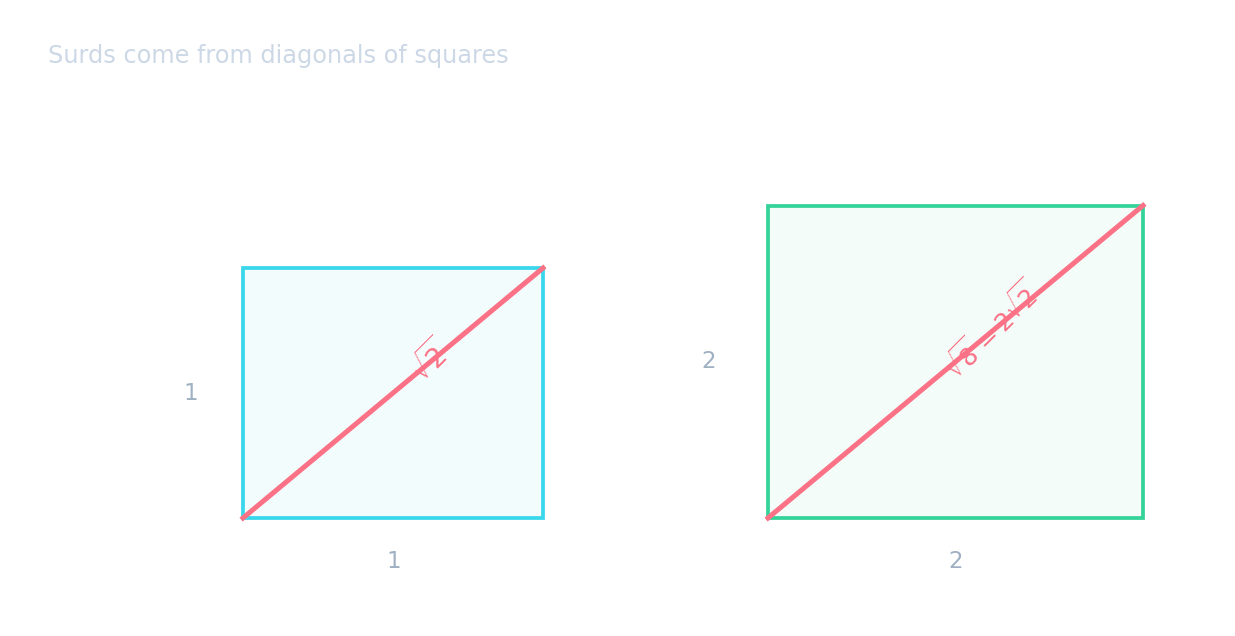
Powers and roots are inverses: the area of a square is $s^2$, and its side is $\sqrt{\text{area}}$.
You've got it
- multiply → add indices; divide → subtract; power of a power → multiply
- handle coefficients and letters separately, then recombine
- solve index equations by writing both sides with the same base
- $(5x^3)^2 = 25x^6$; $\;12a^5 \div 3a^{-2} = 4a^7$; $\;2^x = 32 \Rightarrow x = 5$