| Core | Supplement |
|---|---|
| 1 Describe the differences between elements, compounds and mixtures |
原子、元素与化合物
IGCSE 化学 · 第 2 主题
 16:46
16:46
Atoms & Bonding
Look at these two things. A diamond — the hardest material you can buy. And the soft, grey lead in a pencil. They could not seem more different. Yet both are…
英文讲解 · 内嵌中英文字幕
2.1
元素、化合物与混合物

大纲
来源:剑桥国际大纲
所有物质都由约 100 个简单的构件构成。知道它们如何连接让你把每个物质分入三个组之一。
- 一个元素(element)是只由一种原子(atom)构成的物质。你不能用一个化学反应把它分解成任何更简单的东西。例子:铜、氧、碳。
- 一个化合物(compound)是两个或更多元素化学地连接(键合)在一起。原子以一个固定的比例连接。例子:水、二氧化碳。一个化合物有与它里面的元素不同的性质。
- 一个混合物(mixture)是两个或更多只是混在一起、没有化学连接的物质。各部分保持它们自己的性质,并能通过物理方法分离。例子:空气。
关键的区别:在一个化合物中元素被键合并只能通过化学反应分离;在一个混合物中它们不被键合并容易分离。

探索
Elements, compounds and mixtures lab
Classify everyday particle examples by composition.
词汇表
训练
| 英文 | 中文 | 拼音 |
|---|---|---|
| element/ˈelɪmənt/ | 元素 | yuán sù |
| mixture/ˈmɪkstʃə/ | 混合物 | hùn hé wù |
2.2
原子结构与元素周期表

大纲
| Core | Supplement |
|---|---|
| 1 Describe the structure of the atom as a central nucleus containing neutrons and protons surrounded by electrons in shells | |
| 2 State the relative charges and relative masses of a proton, a neutron and an electron | |
| 3 Define proton number/atomic number as the number of protons in the nucleus of an atom | |
| 4 Define mass number/nucleon number as the total number of protons and neutrons in the nucleus of an atom | |
| 5 Determine the electronic configuration of elements and their ions with proton number 1 to 20, e.g. 2,8,3 | |
| 6 State that: (a) Group VIII noble gases have a full outer electron shell (b) the number of outer shell electrons is equal to the group number in Groups I to VII (c) the number of occupied electron shells is equal to the period number |
来源:剑桥国际大纲
Inside the atom
每个原子有一个小的、致密的中心,叫原子核(nucleus)。围绕它,电子(electrons)在电子层(shells,能级)中运动。原子核含有两种粒子:质子(protons)和中子(neutrons)。
每个粒子有一个相对质量和一个相对电荷(charge)。你必须学习这些值:
| 粒子 | 相对质量 | 相对电荷 |
|---|---|---|
| 质子 | 1 | $+1$ |
| 中子 | 1 | $0$ |
| 电子 | $\frac{1}{1840}$(几乎 0) | $-1$ |
一个原子没有整体电荷,因为它有相等数目的质子(各 $+1$)和电子(各 $-1$)。
Proton number and mass number
两个数描述一个原子:
- 质子数(proton number,也叫原子序数(atomic number))是原子核中质子的数目。它告诉你原子是哪个元素。
- 质量数(mass number,也叫核子数(nucleon number))是原子核中质子和中子的总数。
所以中子的数目 $=$ 质量数 $-$ 质子数。
Electronic configuration
电子从里到外填充电子层。第一个电子层容纳多达 2 个电子;接下来的电子层各容纳多达 8 个(对前 20 个元素)。电子排布(electronic configuration)列出每个电子层中有多少电子,从里面开始。
例如,一个有 13 个电子的原子有排布 $2,8,3$。钠(质子数 11)是 $2,8,1$。钙(质子数 20)是 $2,8,8,2$。
排布与周期表(Periodic Table)联系:
- 一个族(Group)号(族 I 到 VII)等于外层电子的数目。所以 $2,8,1$ 在族 I。
- 一个周期(Period)号等于容纳电子的电子层的数目。所以 $2,8,1$ 有三个电子层,所以它在周期 3。
- 族 VIII(或 0)中的稀有气体(noble gases)有一个满的外层,这使它们非常不活泼。

探索
Electron shells
Change the atomic number and watch the shells fill (2, 8, 8) — the electron arrangement of the first 20 elements.
词汇表
训练
| 英文 | 中文 | 拼音 |
|---|---|---|
| atom/ˈætəm/ | 原子 | yuán zi |
| nucleus/ˈnjuːklɪəs/ | 原子核 | yuán zǐ hé |
| electrons/ɪˈlektrɒnz/ | 电子 | diàn zi |
| shells/ʃelz/ | 电子层 | diàn zi céng |
| protons/ˈprəʊtɒnz/ | 质子 | zhì zi |
| neutrons/ˈnjuːtrɒnz/ | 中子 | zhōng zǐ |
| charge/tʃɑːdʒ/ | 电荷 | diàn hè |
| proton number/ˈprəʊtɒn ˈnʌmbə/ | 质子数 | zhì zǐ shù |
| atomic number/əˈtɒmɪk ˈnʌmbə/ | 原子序数 | yuán zi xù shù |
| mass number/mæs ˈnʌmbə/ | 质量数 | zhì liàng shù |
| nucleon number/ˈnjuːklɪən ˈnʌmbə/ | 核子数 | hé zǐ shù |
| electronic configuration/ɪlekˈtrɒnɪk kənˌfɪɡjəˈreɪʃn/ | 电子排布 | diàn zi pái bù |
| Periodic Table/ˌpɪərɪˈɒdɪk ˈteɪbl/ | 周期表 | zhōu qī biǎo |
| Group/ɡruːp/ | 族 | zú |
| Period/ˈpɪərɪəd/ | 周期 | zhōu qī |
| noble gases/ˈnəʊbl ˈɡæsɪz/ | 稀有气体 | xī yǒu qì tǐ |
| ion/ˈaɪɒn/ | 离子 | lí zi |
2.3
同位素

大纲
| Core | Supplement |
|---|---|
| 1 Define isotopes as different atoms of the same element that have the same number of protons but different numbers of neutrons | 3 State that isotopes of the same element have the same chemical properties because they have the same number of electrons and therefore the same electronic configuration |
| 2 Interpret and use symbols for atoms, e.g. $^{12}_{6}\text{C}$, and ions, e.g. $^{35}_{17}\text{Cl}^-$ | 4 Calculate the relative atomic mass of an element from the relative masses and abundances of its isotopes |
来源:剑桥国际大纲
同位素(isotopes)是同一个元素的原子,它们有相同数目的质子但不同数目的中子。因为质子数相同,它们是同一个元素。因为中子数不同,它们有不同的质量数。
你把一个原子写成它的质量数在上、质子数在下,像 $^{12}_{6}\text{C}$。对一个离子你加上电荷,像 $^{35}_{17}\text{Cl}^{-}$。
一个元素的同位素有相同的化学性质。这是因为化学反应只涉及电子,而同位素有相同数目的电子和相同的电子排布。(额外的中子只改变质量。)
Calculating relative atomic mass
一个元素的相对原子质量(relative atomic mass,$A_r$)是它原子的平均质量,考虑到每个同位素有多常见。丰度(abundance)是每个同位素的百分比。
$$A_r = \frac{\sum (\text{isotope mass} \times \text{abundance})}{100}$$
例如,氯是 75% $^{35}\text{Cl}$ 和 25% $^{37}\text{Cl}$:
$$A_r = \frac{(35 \times 75) + (37 \times 25)}{100} = 35.5$$
例题。 硼有两种同位素,$^{10}\text{B}$ 和 $^{11}\text{B}$,其 $A_r$ 为 10.8。求各自的百分比。设 $^{11}\text{B}$ 的丰度为 $x$,则 $^{10}\text{B}$ 的丰度为 $(100 - x)$。于是
$$\frac{11x + 10(100 - x)}{100} = 10.8$$
所以 $11x + 1000 - 10x = 1080$,解得 $x = 80$。硼是 80% 的 $^{11}\text{B}$ 和 20% 的 $^{10}\text{B}$。用常识检验一下:10.8 更接近 11,所以较重的同位素一定是更常见的那一个。如果你的答案把多数给了离 $A_r$ 更远的同位素,那就是弄反了。
探索
Protons, neutrons & isotopes
Change the neutrons to make isotopes (same element, different mass number); change the electrons to make ions.
探索
Isotope lab
Classify isotope facts by proton, neutron and mass number.
词汇表
训练
| 英文 | 中文 | 拼音 |
|---|---|---|
| isotopes/ˈaɪsətəʊps/ | 同位素 | tóng wèi sù |
| relative atomic mass/ˈrelətɪv əˈtɒmɪk mæs/ | 相对原子质量 | xiāng duì yuán zi zhì liàng |
| abundance/əˈbʌndəns/ | 丰度 | fēng dù |
2.4
离子与离子键

大纲
| Core | Supplement |
|---|---|
| 1 Describe the formation of positive ions, known as cations, and negative ions, known as anions | 5 Describe the giant lattice structure of ionic compounds as a regular arrangement of alternating positive and negative ions |
| 2 State that an ionic bond is a strong electrostatic attraction between oppositely charged ions | 6 Describe the formation of ionic bonds between ions of metallic and non-metallic elements, including the use of dot-and-cross diagrams |
| 3 Describe the formation of ionic bonds between elements from Group I and Group VII, including the use of dot-and-cross diagrams | 7 Explain in terms of structure and bonding the properties of ionic compounds: (a) high melting points and boiling points (b) good electrical conductivity when aqueous or molten and poor when solid |
| 4 Describe the properties of ionic compounds: (a) high melting points and boiling points (b) good electrical conductivity when aqueous or molten and poor when solid |
来源:剑桥国际大纲
一个离子(ion)是一个失去或获得电子的原子(或原子团),所以它有一个电荷。
- 一个金属原子失去电子以构成一个正离子,叫阳离子(cation)。
- 一个非金属原子获得电子以构成一个负离子,叫阴离子(anion)。
原子这样做以得到一个满的外层,像一个稀有气体。
How an ionic bond forms
一个离子键(ionic bond)是异号电荷离子之间的一个强的静电引力(electrostatic attraction,一个 $+$ 离子和一个 $-$ 离子互相拉近)。
离子键在一个金属(metal)和一个非金属(non-metal)之间形成。以氯化钠 $\text{NaCl}$ 为例。钠($2,8,1$)把它的一个外层电子给氯($2,8,7$)。现在钠是 $\text{Na}^{+}$($2,8$)而氯是 $\text{Cl}^{-}$($2,8,8$)。两者都有满的外层,而异号电荷吸引。
你可以用一个点叉图显示这个:把每个原子的外层电子画成一个元素用点、另一个用叉,然后显示电子从金属移到非金属。
The structure and properties of ionic compounds
一个离子化合物(ionic compound)不是由分开的分子(molecules)构成的。离子堆积成一个巨型晶格(lattice)——一个巨大数目的交替(alternating)正负离子的规则图案。


这个结构解释这些性质:
| 性质 | 原因 |
|---|---|
| 高熔点(melting point)和沸点(boiling point) | 离子之间强的静电引力需要很多能量来打破 |
| 固态时糟糕的导电性(electrical conductivity) | 离子被固定在原位,不能移动 |
| 熔融(molten)或水溶液(aqueous)时好的导体 | 离子现在自由移动并携带电荷 |
探索
Forming an ionic bond (NaCl)
Step through it. A metal hands its outer electron to a non-metal; the oppositely charged ions then attract and pack into a giant lattice.
探索
Ionic bonding (electron transfer)
Step through it: the metal hands its outer electron(s) to the non-metal, both reach full shells, and the resulting + and − ions attract — an ionic bond.
词汇表
训练
| 英文 | 中文 | 拼音 |
|---|---|---|
| cation/ˈkætaɪən/ | 阳离子 | yáng lí zi |
| anion/ˈænaɪən/ | 阴离子 | yīn lí zi |
| ionic bond/aɪˈɒnɪk bɒnd/ | 离子键 | lí zi jiàn |
| electrostatic attraction/ɪˌlektrəʊˈstætɪk əˈtrækʃn/ | 静电引力 | jìng diàn yǐn lì |
| metal/ˈmetl/ | 金属 | jīn shǔ |
| non-metal/nɒn ˈmetl/ | 非金属 | fēi jīn shǔ |
| ionic compound/aɪˈɒnɪk ˈkɒmpaʊnd/ | 离子化合物 | lí zi huà hé wù |
| molecules/ˈmɒlɪkjuːlz/ | 分子 | fèn zǐ |
| lattice/ˈlætɪs/ | 晶格 | jīng gé |
| alternating/ˈɔːltəneɪtɪŋ/ | 交替 | jiāo tì |
| melting point/ˈmeltɪŋ pɔɪnt/ | 熔点 | róng diǎn |
| boiling point/ˈbɔɪlɪŋ pɔɪnt/ | 沸点 | fèi diǎn |
| electrical conductivity/ɪˈlektrɪkl kɒndəkˈtɪvɪti/ | 导电性 | dǎo diàn xìng |
| molten/ˈməʊltn/ | 熔融 | róng róng |
| aqueous/ˈeɪkwɪəs/ | 水溶液 | shuǐ róng yè |
2.5
简单分子与共价键

大纲
| Core | Supplement |
|---|---|
| 1 State that a covalent bond is formed when a pair of electrons is shared between two atoms leading to noble gas electronic configurations | |
| 2 Describe the formation of covalent bonds in simple molecules, including $\text{H}_2$, $\text{Cl}_2$, $\text{H}_2\text{O}$, $\text{CH}_4$, $\text{NH}_3$ and $\text{HCl}$. Use dot-and-cross diagrams to show the electronic configurations in these and similar molecules | 4 Describe the formation of covalent bonds in simple molecules, including $\text{CH}_3\text{OH}$, $\text{C}_2\text{H}_4$, $\text{O}_2$, $\text{CO}_2$ and $\text{N}_2$. Use dot-and-cross diagrams to show the electronic configurations in these and similar molecules |
| 3 Describe in terms of structure and bonding the properties of simple molecular compounds: (a) low melting points and boiling points (b) poor electrical conductivity | 5 Explain in terms of structure and bonding the properties of simple molecular compounds: (a) low melting points and boiling points in terms of weak intermolecular forces (specific types of intermolecular forces are not required) (b) poor electrical conductivity |
来源:剑桥国际大纲
一个共价键(covalent bond)在两个原子共享一对电子时形成。通过共享,每个原子得到一个满的外层(一个稀有气体排布)。共价键在非金属原子之间形成。
一些要知道的分子:
- $\text{H}_2$——两个氢原子共享一对电子(一个单键)。
- $\text{Cl}_2$、$\text{HCl}$——各一个共享对。
- $\text{H}_2\text{O}$——氧与两个氢原子的每一个共享一对。
- $\text{NH}_3$——氮与三个氢原子的每一个共享一对。
- $\text{CH}_4$——碳与四个氢原子的每一个共享一对。
- $\text{O}_2$ 和 $\text{CO}_2$ 有双键(两个共享对);$\text{N}_2$ 有一个三键(三个共享对);$\text{C}_2\text{H}_4$ 和 $\text{CH}_3\text{OH}$ 也用共享对。
在一个分子的点叉图中,你画每个原子的外层电子并显示哪些对在原子之间的重叠中被共享。

Properties of simple molecular compounds
这些物质由小的、分开的分子构成。
- 它们有低的熔点和沸点。每个分子内部的共价键强,但分子间作用力(intermolecular forces,一个分子和下一个之间的力)弱,所以只需要很少的能量来分离分子。
- 它们是电的糟糕导体,因为分子没有整体电荷、没有自由电子或离子来携带电荷。
探索
Why a molecule has its shape
Shared electron pairs repel one another and spread out as far apart as they can. Four bonding pairs and no lone pairs gives a tetrahedral shape, like methane (CH4).
探索
Covalent bonding (sharing)
Step through it: two non-metal atoms overlap and share a pair of electrons — counting for both — so each reaches a full outer shell. That shared pair is the covalent bond; O₂ shares two pairs (a double bond).
词汇表
训练
| 英文 | 中文 | 拼音 |
|---|---|---|
| compound/ˈkɒmpaʊnd/ | 化合物 | huà hé wù |
| covalent bond/ˈkəʊvələnt bɒnd/ | 共价键 | gòng jià jiàn |
| intermolecular forces/ˌɪntəməˈlekjʊlə ˈfɔːsɪz/ | 分子间作用力 | fèn zǐ jiàn zuò yòng lì |
2.6
巨型共价结构

大纲
| Core | Supplement |
|---|---|
| 1 Describe the giant covalent structures of graphite and diamond | 3 Describe the giant covalent structure of silicon(IV) oxide, $\text{SiO}_2$ |
| 2 Relate the structures and bonding of graphite and diamond to their uses, limited to: (a) graphite as a lubricant and as an electrode (b) diamond in cutting tools | 4 Describe the similarity in properties between diamond and silicon(IV) oxide, related to their structures |
来源:剑桥国际大纲
一些共价物质不是小分子。而是数百万个原子由共价键连接成一个巨型共价结构(giant covalent structure)。你必须知道的两个都是碳的形式。
金刚石(diamond):每个碳原子键合到四个其他碳原子。这构成一个非常强、刚性的 3-D 网络。金刚石极硬,所以它被用于切割工具(cutting tools)。
石墨(graphite):每个碳原子只键合到三个其他的,构成扁平的层(layers)。层之间有弱的力,所以层能互相滑过——这使石墨成为一个好的润滑剂(lubricant)。每个碳的第四个外层电子是自由的;这些离域电子(delocalised electrons)能移动,所以石墨导电并被用作一个电极(electrode)。

二氧化硅(silicon(IV) oxide,$\text{SiO}_2$)有一个像金刚石的巨型共价结构,所以它也非常硬并有一个非常高的熔点。
探索
Giant covalent lab
Compare giant covalent structures by bonding and properties.
词汇表
训练
| 英文 | 中文 | 拼音 |
|---|---|---|
| giant covalent structure/ˈdʒaɪənt ˈkəʊvələnt ˈstrʌktʃə/ | 巨型共价结构 | jù xíng gòng jià jié gòu |
| diamond/ˈdaɪəmənd/ | 金刚石 | jīn gāng shí |
| cutting tools/ˈkʌtɪŋ tuːlz/ | 切割工具 | qiē gē gōng jù |
| graphite/ˈɡræfaɪt/ | 石墨 | shí mò |
| layers/ˈleɪəz/ | 层 | céng |
| lubricant/ˈluːbrɪkənt/ | 润滑剂 | rùn huá jì |
| delocalised electrons/dɪˈlɒkəlaɪzd ɪˈlektrɒnz/ | 离域电子 | lí yù diàn zi |
| electrode/ɪˈlektrəʊd/ | 电极 | diàn jí |
| silicon(IV) oxide/ˈsɪlɪkən ˈɒksaɪd/ | 二氧化硅 | èr yǎng huà guī |
2.7
金属键
大纲
| Core | Supplement |
|---|---|
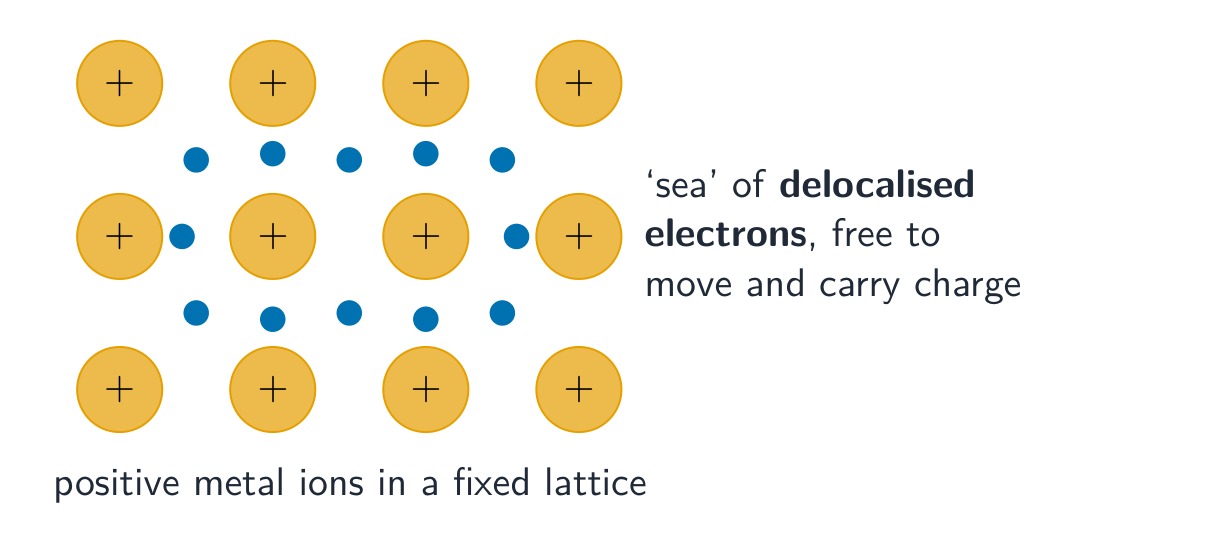
| 1 Describe metallic bonding as the electrostatic attraction between the positive ions in a giant metallic lattice and a ‘sea’ of delocalised electrons | |
| 2 Explain in terms of structure and bonding the properties of metals: (a) good electrical conductivity (b) malleability and ductility |
来源:剑桥国际大纲
一个金属是一个正离子的巨型结构,被一个自由地穿过整个金属移动的离域电子"海"围绕。金属键(metallic bonding)是这些正离子和电子海之间的强的静电引力。
这解释金属的两个关键性质:
- 好的导电性:离域电子自由移动并携带电荷穿过金属。
- 展性(malleability,能被锤成片)和延性(ductility,能被拉成线):正离子的层能互相滑过而不打破金属键,所以金属改变形状而不是破碎。
探索
Inside a metal — and why it behaves that way
Step through it. Positive ions sit in a shared sea of delocalised electrons — that one picture explains conduction and why metals bend instead of snapping.
词汇表
训练
| 英文 | 中文 | 拼音 |
|---|---|---|
| metallic bonding/məˈtælɪk ˈbɒndɪŋ/ | 金属键 | jīn shǔ jiàn |
| malleability/ˌmæləˈbɪlɪti/ | 展性 | zhǎn xìng |
| ductility/dʌkˈtɪlɪti/ | 延性 | yán xìng |
2.7
考试技巧
- 中子的数目 = 质量数 − 质子数。质子数是决定一个原子是哪个元素的东西。
- 同位素有相同的化学性质,因为反应只涉及电子,而同位素共享相同的电子排布;只有质量不同。
- 把结构匹配到性质:离子 = 巨型晶格(高熔点;只在熔融或水溶液时导电);简单分子 = 分子之间的弱力(低熔点;不导电);巨型共价 = 非常硬、非常高的熔点。
- 石墨导电且滑(每个碳一个自由电子;层滑动);金刚石两者都不(全部四个电子被键合,所以硬且不导电)。金属由于离域电子海导电并弯曲。
- 对于相对原子质量,取加权平均:$A_r = \dfrac{\sum(\text{isotope mass} \times \text{abundance})}{100}$。
本主题的互动课程
逐步学习,并即时检测练习。