| Core | Supplement |
|---|---|
| 1 Identify physical and chemical changes, and describe the differences between them |
化学反应
IGCSE 化学 · 第 6 主题
 15:53
15:53
Rates & Equilibrium
Milk on the counter spoils in a day. In the fridge, it lasts a week. Same milk — but the reaction runs at a different speed. First, a quick check: a chemical…
英文讲解 · 内嵌中英文字幕
6.1
物理变化与化学变化

大纲
来源:剑桥国际大纲
一个物理变化(physical change)不制造一个新物质。物质只改变它的状态或形状,而这个变化通常能被逆转。冰融化和糖溶解是物理变化。
一个化学变化(chemical change,一个化学反应)制造一个或多个新物质,而且通常难以逆转。一个化学变化的迹象包括一个颜色变化、一个气体被放出、一个能量变化,或一个沉淀(precipitate,一个固体)形成。
| 物理变化 | 化学变化 |
|---|---|
| 不制造新物质 | 制造新物质 |
| 容易逆转 | 通常难以逆转 |
| 例如熔化、沸腾、溶解 | 例如燃烧、生锈 |
探索
Physical change vs chemical change
Step through the difference. A physical change makes no new substance and is usually easy to reverse; a chemical change makes a new substance and is hard to undo.
词汇表
训练
| 英文 | 中文 | 拼音 |
|---|---|---|
| physical change/ˈfɪzɪkl tʃeɪndʒ/ | 物理变化 | wù lǐ biàn huà |
| chemical change/ˈkemɪkl tʃeɪndʒ/ | 化学变化 | huà xué biàn huà |
| precipitate/prɪˈsɪpɪteɪt/ | 沉淀 | chén diàn |
6.2
反应速率

大纲
| Core | Supplement |
|---|---|
| 5 Describe collision theory in terms of: (a) number of particles per unit volume (b) frequency of collisions between particles (c) kinetic energy of particles (d) activation energy, $E_a$ | |
| 1 Describe the effect on the rate of reaction of: (a) changing the concentration of solutions (b) changing the pressure of gases (c) changing the surface area of solids (d) changing the temperature (e) adding or removing a catalyst, including enzymes | 6 Describe and explain the effect on the rate of reaction of: (a) changing the concentration of solutions (b) changing the pressure of gases (c) changing the surface area of solids (d) changing the temperature (e) adding or removing a catalyst, including enzymes using collision theory |
| 2 State that a catalyst increases the rate of a reaction and is unchanged at the end of a reaction | 7 State that a catalyst decreases the activation energy, $E_a$, of a reaction |
| 3 Describe practical methods for investigating the rate of a reaction including change in mass of a reactant or a product and the formation of a gas | 8 Evaluate practical methods for investigating the rate of a reaction including change in mass of a reactant or a product and the formation of a gas |
| 4 Interpret data, including graphs, from rate of reaction experiments |
来源:剑桥国际大纲
反应速率(rate of reaction)告诉你反应物(reactants)变成生成物(products)有多快。
Collision theory
碰撞理论(collision theory)解释什么控制速率。为了一个反应发生,粒子(particles)必须碰撞(collide),而且它们必须以足够的能量碰撞。它们需要的最小能量是活化能(activation energy,$E_a$)。当粒子更频繁地有成功的碰撞时,发生一个更快的速率。
What changes the rate
| 变化 | 效果 | 原因(碰撞理论) |
|---|---|---|
| 增加一个溶液的浓度(concentration) | 更快 | 同样的体积中更多的粒子,所以碰撞更频繁地发生 |
| 增加气体的压强(pressure) | 更快 | 粒子被推得更近,所以碰撞更频繁地发生 |
| 增加一个固体的表面积(surface area) | 更快 | 更多的粒子被暴露,所以碰撞更频繁地发生 |
| 增加温度 | 更快 | 粒子获得动能(kinetic energy)并移动更快,所以碰撞更频繁,而且它们中更多的有足够的能量 |
| 加一个催化剂(catalyst) | 更快 | 催化剂降低活化能,所以更多的碰撞成功 |

Catalysts
一个催化剂加速一个反应但不被消耗——它在最后不变。它通过降低活化能来工作。酶(enzymes)是生物催化剂(在生物中工作的催化剂)。

Measuring the rate
你可以用这些方式随时间跟踪一个反应:
- 质量的变化:把烧瓶立在一台天平上。若一个气体逸出,质量下降。在规律的时间记录质量。
- 气体的体积:在一个气体注射器(syringe)中收集气体并在规律的时间读它的体积。
- 一个沉淀的形成:在一个变浑浊的反应中,计时一个烧瓶下的标记消失需要多长时间。

在一个生成物对时间的图上,线在开始时最陡(最快的速率)、随着反应物被用尽变得不那么陡,而在反应完成时变平。

探索
Rate from a gas-volume graph
The gradient of the volume–time curve is the rate; it is steepest at the start and flattens as reactants run out.
探索
Rate of reaction
conc = c₀·bᵗ
Concentration falls over time — fast at first, then slower.
探索
Collision theory in action
Watch the particles collide. Heat speeds them up so they collide more often and harder; more particles or a catalyst give more successful collisions — the rate climbs.
词汇表
训练
| 英文 | 中文 | 拼音 |
|---|---|---|
| rate of reaction/reɪt ɒv rɪˈækʃn/ | 反应速率 | fǎn yìng sù lǜ |
| reactants/rɪˈæktənts/ | 反应物 | fǎn yìng wù |
| products/ˈprɒdʌkts/ | 生成物 | shēng chéng wù |
| collision theory/kəˈlɪʒn ˈθɪəri/ | 碰撞理论 | pèng zhuàng lǐ lùn |
| particles/ˈpɑːtɪklz/ | 粒子 | lì zi |
| collide/kəˈlaɪd/ | 碰撞 | pèng zhuàng |
| activation energy/ˌæktɪˈveɪʃn ˈenədʒi/ | 活化能 | huó huà néng |
| concentration/ˌkɒnsənˈtreɪʃn/ | 浓度 | nóng dù |
| pressure/ˈpreʃə/ | 压强 | yā qiáng |
| surface area/ˈsɜːfɪs ˈeərɪə/ | 表面积 | biǎo miàn jī |
| kinetic energy/kɪˈnetɪk ˈenədʒi/ | 动能 | dòng néng |
| catalyst/ˈkætəlɪst/ | 催化剂 | cuī huà jì |
| enzymes/ˈenzaɪmz/ | 酶 | méi |
| syringe/sɪˈrɪndʒ/ | 注射器 | zhù shè qì |
| reversible reaction/rɪˈvɜːsɪbl rɪˈækʃn/ | 可逆反应 | kě nì fǎn yìng |
6.3
可逆反应与平衡

大纲
| Core | Supplement |
|---|---|
| 1 State that some chemical reactions are reversible as shown by the symbol $\rightleftharpoons$ | 3 State that a reversible reaction in a closed system is at equilibrium when: (a) the rate of the forward reaction is equal to the rate of the reverse reaction (b) the concentrations of reactants and products are no longer changing |
| 2 Describe how changing the conditions can change the direction of a reversible reaction for: (a) the effect of heat on hydrated compounds (b) the addition of water to anhydrous compounds limited to copper(II) sulfate and cobalt(II) chloride | 4 Predict and explain, for a reversible reaction, how the position of equilibrium is affected by: (a) changing temperature (b) changing pressure (c) changing concentration (d) using a catalyst using information provided |
| 5 State the symbol equation for the production of ammonia in the Haber process, $\text{N}_2\text{(g)} + 3\text{H}_2\text{(g)} \rightleftharpoons 2\text{NH}_3\text{(g)}$ | |
| 6 State the sources of the hydrogen (methane) and nitrogen (air) in the Haber process | |
| 7 State the typical conditions in the Haber process as $450\text{ }^{\circ}\text{C}$, $20\,000\text{ kPa}/200\text{ atm}$ and an iron catalyst | |
| 8 State the symbol equation for the conversion of sulfur dioxide to sulfur trioxide in the Contact process, $2\text{SO}_2\text{(g)} + \text{O}_2\text{(g)} \rightleftharpoons 2\text{SO}_3\text{(g)}$ | |
| 9 State the sources of the sulfur dioxide (burning sulfur or roasting sulfide ores) and oxygen (air) in the Contact process | |
| 10 State the typical conditions for the conversion of sulfur dioxide to sulfur trioxide in the Contact process as $450\text{ }^{\circ}\text{C}$, $200\text{ kPa}/2\text{ atm}$ and a vanadium(V) oxide catalyst | |
| 11 Explain, in terms of rate of reaction and position of equilibrium, why the typical conditions stated are used in the Haber process and in the Contact process, including safety considerations and economics |
来源:剑桥国际大纲
一些反应是可逆反应(reversible):生成物能反应以再次构成反应物。我们用符号 $\rightleftharpoons$ 显示这个。
Changing the direction
一个清晰的例子用水合(hydrated)和无水(anhydrous)化合物:
- 蓝色的水合硫酸铜(II),加热时,失去它的水变成白色的无水硫酸铜(II)。加水使它再次变蓝。
- 粉色的水合氯化钴(II)加热时失去水变成蓝色的无水氯化钴(II)。加水使它再次变粉。
给无水固体加水(并看到颜色返回)被用作一个水的测试。
Equilibrium
在一个密闭系统(closed system,没有东西进入或离开)中,一个可逆反应在以下时达到平衡(equilibrium):
- 正反应(forward reaction)的速率等于逆反应(reverse reaction)的速率,以及
- 反应物和生成物的浓度不再改变。
Changing the position of equilibrium
平衡位置(position of equilibrium)告诉你有更多的反应物还是更多的生成物。你可以移动它:
- 温度:加热把平衡移向吸入热的方向(吸热反应(endothermic)方向);冷却把它移向放出热的方向(放热反应(exothermic)方向)。
- 压强(气体):更多的压强把平衡移向气体分子较少的一侧。
- 浓度:加更多的一个物质把平衡移向另一侧,以用掉它。
- 一个催化剂****不移动平衡位置。它只帮助反应更快地达到平衡。
The Haber process
哈伯法(Haber process)制造氨:
$$\text{N}_2(g) + 3\text{H}_2(g) \rightleftharpoons 2\text{NH}_3(g)$$
- 氢气(hydrogen)来自甲烷(methane,天然气);氮气(nitrogen)来自空气。
- 典型条件:一个 $450\,{}^{\circ}\text{C}$ 的温度、一个约 $200$ atm($20\,000$ kPa)的压强,和一个铁(iron)催化剂。
The Contact process
接触法(Contact process)把二氧化硫变成三氧化硫:
$$2\text{SO}_2(g) + \text{O}_2(g) \rightleftharpoons 2\text{SO}_3(g)$$
- 二氧化硫来自烧硫(sulfur,或焙烧硫化矿);氧气(oxygen)来自空气。
- 典型条件:一个 $450\,{}^{\circ}\text{C}$ 的温度、一个约 $2$ atm($200$ kPa)的压强,和一个五氧化二钒(vanadium(V) oxide)催化剂。
Why these conditions are chosen
这些条件是一个折中(compromise):
- 一个更高的压强会给更多的生成物,但非常高的压强危险而昂贵,所以用一个中等的压强。
- 一个更低的温度会给更多的生成物(两个正反应都是放热的),但反应会太慢,所以用一个相当高的温度以保持一个好的速率。
- 催化剂加速反应而不改变平衡位置,这降低成本。
探索
Shifting an equilibrium
Change temperature, pressure or concentration and watch a reversible reaction shift to a new balance.
词汇表
训练
| 英文 | 中文 | 拼音 |
|---|---|---|
| hydrated/haɪˈdreɪtɪd/ | 水合 | shuǐ hé |
| anhydrous/ænˈhaɪdrəs/ | 无水 | wú shuǐ |
| closed system/kləʊzd ˈsɪstəm/ | 密闭系统 | mì bì xì tǒng |
| equilibrium/ˌiːkwɪˈlɪbrɪəm/ | 平衡 | píng héng |
| forward reaction/ˈfɔːwəd rɪˈækʃn/ | 正反应 | zhèng fǎn yìng |
| reverse reaction/rɪˈvɜːs rɪˈækʃn/ | 逆反应 | nì fǎn yìng |
| position of equilibrium/pəˈzɪʃn ɒv ˌiːkwɪˈlɪbrɪəm/ | 平衡位置 | píng héng wèi zhì |
| endothermic/ˌendəʊˈθɜːmɪk/ | 吸热反应 | xī rè fǎn yìng |
| exothermic/eɡzəˈðɜːmɪk/ | 放热反应 | fàng rè fǎn yìng |
| Haber process/ˈheɪbə ˈprəʊses/ | 哈伯法 | hā bó fǎ |
| hydrogen/ˈhaɪdrədʒn/ | 氢气 | qīng qì |
| methane/ˈmiːθeɪn/ | 甲烷 | jiǎ wán |
| nitrogen/ˈnaɪtrədʒn/ | 氮气 | dàn qì |
| iron/ˈaɪən/ | 铁 | tiě |
| Contact process/ˈkɒntækt ˈprəʊses/ | 接触法 | jiē chù fǎ |
| sulfur/ˈsʌlfɜː/ | 硫 | liú |
| oxygen/ˈɒksɪdʒn/ | 氧气 | yǎng qì |
| vanadium(V) oxide/væˈneɪdɪəm ˈɒksaɪd/ | 五氧化二钒 | wǔ yǎng huà èr fán |
| compromise/ˈkɒmprəmaɪz/ | 折中 | zhé zhōng |
6.4
氧化还原

大纲
| Core | Supplement |
|---|---|
| 1 Use a Roman numeral to indicate the oxidation number of an element in a compound | |
| 2 Define redox reactions as involving simultaneous oxidation and reduction | |
| 3 Define oxidation as gain of oxygen and reduction as loss of oxygen | 6 Define oxidation in terms of: (a) loss of electrons (b) an increase in oxidation number |
| 7 Define reduction in terms of: (a) gain of electrons (b) a decrease in oxidation number | |
| 4 Identify redox reactions as reactions involving gain and loss of oxygen | 8 Identify redox reactions as reactions involving gain and loss of electrons |
| 5 Identify oxidation and reduction in redox reactions | 9 Identify redox reactions by changes in oxidation number using: (a) the oxidation number of elements in their uncombined state is zero (b) the oxidation number of a monatomic ion is the same as the charge on the ion (c) the sum of the oxidation numbers in a compound is zero (d) the sum of the oxidation numbers in an ion is equal to the charge on the ion |
| 10 Identify redox reactions by the colour changes involved when using acidified aqueous potassium manganate(VII) or aqueous potassium iodide | |
| 11 Define an oxidising agent as a substance that oxidises another substance and is itself reduced | |
| 12 Define a reducing agent as a substance that reduces another substance and is itself oxidised | |
| 13 Identify oxidising agents and reducing agents in redox reactions |
来源:剑桥国际大纲
氧化(oxidation)和还原(reduction)总是同时发生,在叫一个氧化还原反应(redox reaction)的东西里。("Redox"是 reduction–oxidation 的简写。)
有三种描述氧化和还原的方式:
- 氧:氧化是氧的获得;还原是氧的失去。
- 电子(electrons):氧化是电子的失去;还原是电子的获得。
- 氧化数(oxidation number):在氧化中氧化数上升;在还原中它下降。
一个有用的记忆辅助是 OIL RIG:Oxidation Is Loss, Reduction Is Gain——电子的。
Oxidation number rules
氧化数由一个罗马数字显示,如铁(II)和铁(III)。规则是:
- 一个未化合的元素有一个 $0$ 的氧化数。
- 一个单原子离子有一个等于它电荷的氧化数(所以 $\text{Na}^{+}$ 是 $+1$)。
- 一个化合物中的氧化数加起来为 $0$。
- 一个离子中的氧化数加起来为离子上的电荷。
例题。 求高锰酸根离子 $\text{MnO}_4^{-}$ 中锰的氧化数。每个氧是 $-2$,共有四个,所以是 $4 \times (-2) = -8$。离子中各氧化数之和必须等于该离子所带的电荷,这里是 $-1$。所以设锰为 $x$,则 $x + (-8) = -1$,解得 $x = +7$ - 这正是名称中 (VII) 告诉你的。要把总和设为离子的电荷,而不是零:零只适用于中性化合物。
Oxidising and reducing agents
- 一个氧化剂(oxidising agent)氧化另一个物质,而它自己被还原。
- 一个还原剂(reducing agent)还原另一个物质,而它自己被氧化。
一些氧化还原反应显示清晰的颜色变化:
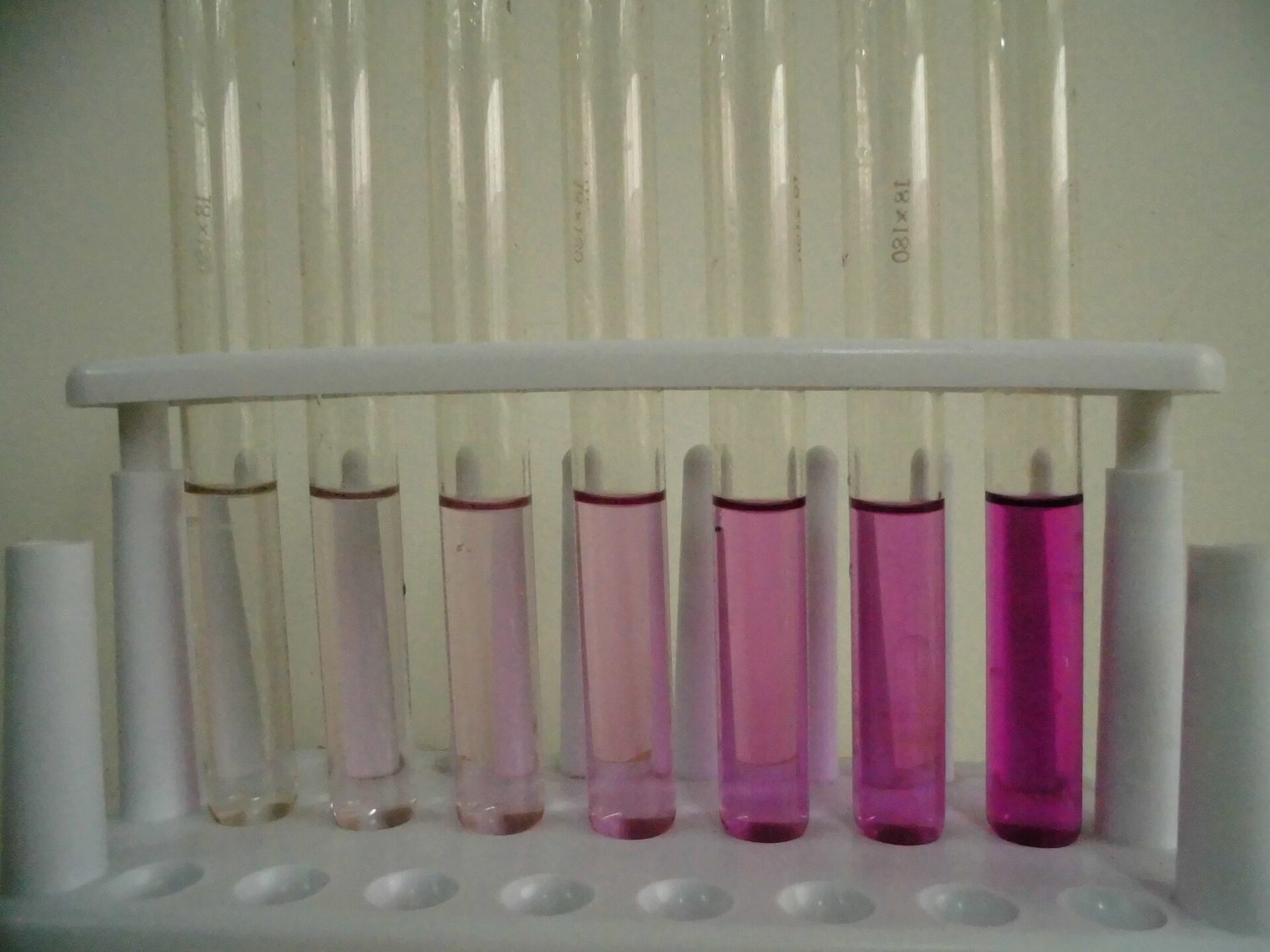
- 酸化的高锰酸钾(potassium manganate(VII))是紫色的。当它充当一个氧化剂时它被还原,而紫色褪成无色。
- 碘化钾(potassium iodide)是无色的。当它被氧化时,红棕色的碘(iodine)被构成。
探索
Oxidation and reduction happen together
Step through a redox reaction. One substance loses electrons while another gains them — you can never have one without the other.
词汇表
训练
| 英文 | 中文 | 拼音 |
|---|---|---|
| oxidation/ˌɒksɪˈdeɪʃn/ | 氧化 | yǎng huà |
| reduction/rɪˈdʌkʃn/ | 还原 | huán yuán |
| redox reaction/rɪˈdɒks rɪˈækʃn/ | 氧化还原反应 | yǎng huà huán yuán fǎn yìng |
| electrons/ɪˈlektrɒnz/ | 电子 | diàn zi |
| oxidation number/ˌɒksɪˈdeɪʃn ˈnʌmbə/ | 氧化数 | yǎng huà shù |
| oxidising agent/ˈɒksɪdaɪzɪŋ ˈeɪdʒənt/ | 氧化剂 | yǎng huà jì |
| reducing agent/rɪˈdjuːsɪŋ ˈeɪdʒənt/ | 还原剂 | huán yuán jì |
| potassium manganate(VII)/pəˈtæsɪəm ˈmæŋɡəneɪt/ | 高锰酸钾 | gāo měng suān jiǎ |
| potassium iodide/pəˈtæsɪəm ˈaɪədaɪd/ | 碘化钾 | diǎn huà jiǎ |
| iodine/ˈaɪədiːn/ | 碘 | diǎn |
6.4
考试技巧
- 用碰撞理论解释一个更快的速率:成功的碰撞更频繁地发生。浓度、压强和表面积都提高粒子碰撞的频率;一个更高的温度做那个而且给更多的粒子足够的能量。
- 一个催化剂降低活化能并加速反应,但不被消耗而且不改变 $\Delta H$ 或平衡位置。
- 在平衡时正反应和逆反应速率相等,而浓度停止改变——它不意味着反应物和生成物的量相等。
- 用勒夏特列原理:提高温度有利于吸热方向;提高压强有利于气体分子较少的一侧;加一个物质把平衡从它移开。
- 氧化还原——OIL RIG:Oxidation Is Loss, Reduction Is Gain 电子。它们总是一起发生,而一个氧化剂自己被还原。
本主题的互动课程
逐步学习,并即时检测练习。