| Core | Supplement |
|---|---|
| 1 Describe the Periodic Table as an arrangement of elements in periods and groups and in order of increasing proton number/atomic number | |
| 2 Describe the change from metallic to non‑metallic character across a period | |
| 3 Describe the relationship between group number and the charge of the ions formed from elements in that group | |
| 4 Explain similarities in the chemical properties of elements in the same group of the Periodic Table in terms of their electronic configuration | |
| 5 Explain how the position of an element in the Periodic Table can be used to predict its properties | 6 Identify trends in groups, given information about the elements |
元素周期表
IGCSE 化学 · 第 8 主题
 11:15
11:15
The Periodic Table
This is the most powerful chart in all of chemistry: the Periodic Table. It looks like a jumble of boxes, but it hides a beautiful secret. The elements are…
英文讲解 · 内嵌中英文字幕
8.1
元素的排列

大纲
来源:剑桥国际大纲
周期表(Periodic Table)按递增的质子数(proton number,原子序数(atomic number))排列所有元素(elements)。水平的行叫周期(periods),而竖直的列叫族(groups)。
几个关键的模式:
- 沿一个周期,元素从左边的金属(metals)变到右边的非金属(non-metals)。
- 族号告诉你元素构成的离子(ions)的电荷。族 I 构成 $+1$ 离子,族 II 构成 $+2$ 离子,而族 VII 构成 $-1$ 离子。
- 同一个族中的元素有相似的化学性质。这是因为它们有相同数目的外层电子(electrons,相同的外层电子排布(electronic configuration))。
因为这些模式,你可以用一个元素的位置来预测它的性质。

探索
Spot a trend across a period
Reading across a period, properties change in a regular, repeating pattern. Switch the trend to watch atomic radius, ionisation energy or melting point change element by element.
词汇表
训练
| 英文 | 中文 | 拼音 |
|---|---|---|
| Periodic Table/ˌpɪərɪˈɒdɪk ˈteɪbl/ | 周期表 | zhōu qī biǎo |
| elements/ˈelɪmənts/ | 元素 | yuán sù |
| proton number/ˈprəʊtɒn ˈnʌmbə/ | 质子数 | zhì zǐ shù |
| atomic number/əˈtɒmɪk ˈnʌmbə/ | 原子序数 | yuán zi xù shù |
| periods/ˈpɪərɪədz/ | 周期 | zhōu qī |
| groups/ɡruːps/ | 族 | zú |
| metals/ˈmetlz/ | 金属 | jīn shǔ |
| non-metals/nɒn ˈmetlz/ | 非金属 | fēi jīn shǔ |
| ions/ˈaɪɒnz/ | 离子 | lí zi |
| electrons/ɪˈlektrɒnz/ | 电子 | diàn zi |
| electronic configuration/ɪlekˈtrɒnɪk kənˌfɪɡjəˈreɪʃn/ | 电子排布 | diàn zi pái bù |
8.2
第I族的性质
大纲
| Core | Supplement |
|---|---|
| 1 Describe the Group I alkali metals, lithium, sodium and potassium, as relatively soft metals with general trends down the group, limited to: (a) decreasing melting point (b) increasing density (c) increasing reactivity | |
| 2 Predict the properties of other elements in Group I, given information about the elements |
来源:剑桥国际大纲
族 I 元素是碱金属(alkali metals):锂(lithium)、钠(sodium)和钾(potassium)。它们是柔软(soft)的金属(你可以用一把刀切它们)。

沿族向下,有清晰的趋势(trends):
| 性质 | 沿族向下的趋势 |
|---|---|
| 熔点(melting point) | 减小 |
| 密度(density) | 增大 |
| 活泼性(reactivity) | 增大 |
你可以用这些趋势来预测其他族 I 元素的性质。例如,铷(在钾下面)会甚至更活泼并有一个甚至更低的熔点。
Reaction with water, and what you see
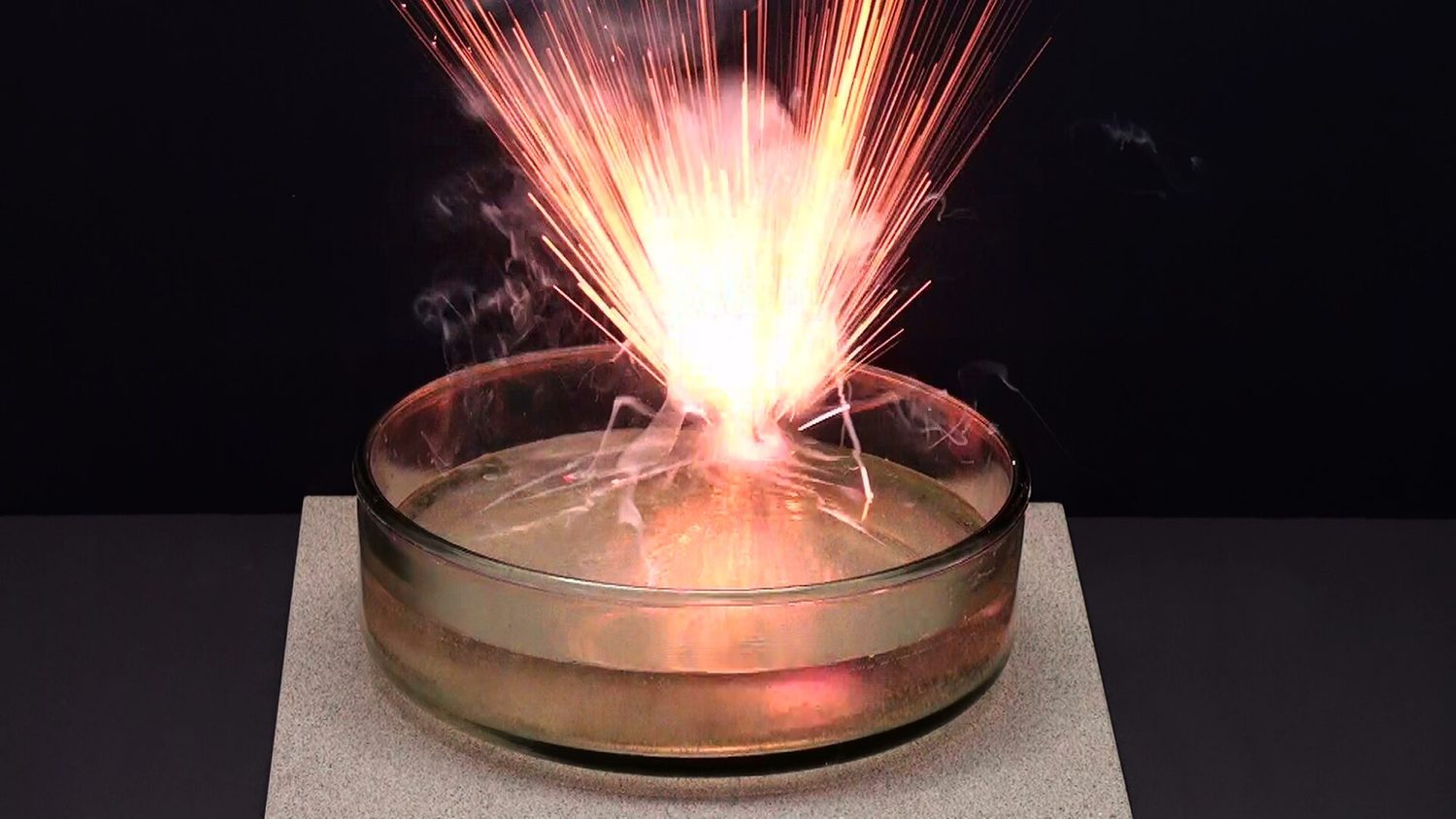
这是考试问得最多的反应。每一种族 I 金属都与水反应,生成一种碱(金属氢氧化物)加上氢气 —— 这正是它们被称为碱金属的原因:
$$2\text{Na} + 2\text{H}_2\text{O} \rightarrow 2\text{NaOH} + \text{H}_2$$
"描述你看到的现象"本身就有分,所以要记住钠在水面上的这份清单:
- 它浮在水面 —— 这种金属的密度比水小。
- 它熔化成一个小球 —— 反应放热,而且这种金属的熔点很低。
- 它在水面上四处移动 —— 喷出的氢气推着它跑。
- 有泡腾(effervescence,冒泡)—— 那是逸出的氢气。
- 它越来越小并消失,因为被消耗掉了。
- 溶液变成碱性,所以万用指示剂变紫色(现在它是 $\text{NaOH}$)。
这个趋势体现在反应有多剧烈上:锂平稳地冒泡但不熔化;钠熔化成小球并四处窜动;钾快到足以点燃它自己产生的氢气,燃烧时带淡紫色火焰。有两个答案要避免:"放出氢气"不是观察现象(你看不见它 —— 要写泡腾),而且金属熔化是因为反应放热,不是因为"水很热"。
探索
Group I trend lab
Follow Group I metals down the group and watch reactivity increase.
词汇表
训练
| 英文 | 中文 | 拼音 |
|---|---|---|
| alkali metals/ˈælkəlaɪ ˈmetlz/ | 碱金属 | jiǎn jīn shǔ |
| lithium/ˈlɪθɪəm/ | 锂 | lǐ |
| sodium/ˈsəʊdɪəm/ | 钠 | nà |
| potassium/pəˈtæsɪəm/ | 钾 | jiǎ |
| soft/sɒft/ | 柔软 | róu ruǎn |
| trends/trendz/ | 趋势 | qū shì |
| melting point/ˈmeltɪŋ pɔɪnt/ | 熔点 | róng diǎn |
| density/ˈdensɪti/ | 密度 | mì dù |
| reactivity/rɪəkˈtɪvɪti/ | 活泼性 | huó pō xìng |
| effervescence/ˌefəˈvesəns/ | 泡腾 | pào téng |
8.3
第VII族的性质

大纲
| Core | Supplement |
|---|---|
| 1 Describe the Group VII halogens, chlorine, bromine and iodine, as diatomic non-metals with general trends down the group, limited to: (a) increasing density (b) decreasing reactivity | |
| 2 State the appearance of the halogens at r.t.p. as: (a) chlorine, a pale yellow-green gas (b) bromine, a red-brown liquid (c) iodine, a grey-black solid | |
| 3 Describe and explain the displacement reactions of halogens with other halide ions | |
| 4 Predict the properties of other elements in Group VII, given information about the elements |
来源:剑桥国际大纲
族 VII 元素是卤素(halogens):氯气(chlorine)、溴(bromine)和碘(iodine)。它们是双原子(diatomic)非金属(每个分子由两个原子构成,如 $\text{Cl}_2$)。
它们在室温和压强下的外观:
| 卤素 | 外观 |
|---|---|
| 氯气 | 一种淡黄绿色气体 |
| 溴 | 一种红棕色液体 |
| 碘 | 一种灰黑色固体 |
沿族向下,密度增大但活泼性减小(与族 I 相反的趋势)。
Displacement reactions
一个更活泼的卤素把一个较不活泼的卤化物(halide)离子从它的溶液中推出(置换)。这是一个置换反应(displacement reaction)。
例如,氯比溴更活泼,所以氯从溴化钾中置换溴:
$$\text{Cl}_2 + 2\text{KBr} \rightarrow 2\text{KCl} + \text{Br}_2$$

例题。 把氯水加入碘化钾溶液;再把碘水加入溴化钾溶液。各自会发生什么?第 VII 族中活泼性向下递减:氯,然后是溴,然后是碘。(a) 氯在碘之上,所以更活泼,能把碘置换出来:$\text{Cl}_2 + 2\text{KI} \rightarrow 2\text{KCl} + \text{I}_2$,随着碘被释放,溶液变成红棕色。(b) 碘在溴之下,所以活泼性更低,无法置换溴 - 没有反应,也没有颜色变化。"没有反应"是一个完整且能得分的答案:写任何方程式之前,先看看它们在族中的顺序。
探索
Group VII trend lab
Follow halogens down the group and watch reactivity decrease.
词汇表
训练
| 英文 | 中文 | 拼音 |
|---|---|---|
| halogens/ˈhælədʒnz/ | 卤素 | lǔ sù |
| chlorine/ˈklɔːriːn/ | 氯气 | lǜ qì |
| bromine/ˈbrəʊmaɪn/ | 溴 | xiù |
| iodine/ˈaɪədiːn/ | 碘 | diǎn |
| diatomic/ˌdaɪəˈtɒmɪk/ | 双原子 | shuāng yuán zi |
| halide/ˈhælaɪd/ | 卤化物 | lǔ huà wù |
| displacement reaction/dɪˈspleɪsmənt rɪˈækʃn/ | 置换反应 | zhì huàn fǎn yìng |
8.4
过渡元素
大纲
| Core | Supplement |
|---|---|
| 1 Describe the transition elements as metals that: (a) have high densities (b) have high melting points (c) form coloured compounds (d) often act as catalysts as elements and in compounds | 2 Describe transition elements as having ions with variable oxidation numbers, including iron(II) and iron(III) |
来源:剑桥国际大纲
过渡元素(transition elements)是周期表中间的金属块。与族 I 金属相比,它们:
- 有高的密度;
- 有高的熔点;
- 构成有色(coloured)化合物(compounds);
- 常常充当催化剂,既作为元素又在化合物中。
它们也能有可变(variable)的氧化数(oxidation numbers)。例如,铁(iron)构成铁(II)和铁(III)化合物两者。
探索
Transition element lab
Match transition-metal properties to real examples.
词汇表
训练
| 英文 | 中文 | 拼音 |
|---|---|---|
| transition elements/trænˈsɪʃn ˈelɪmənts/ | 过渡元素 | guò dù yuán sù |
| coloured/ˈkʌləd/ | 有色 | yǒu sè |
| compounds/ˈkɒmpaʊndz/ | 化合物 | huà hé wù |
| variable/ˈveərɪəbl/ | 可变 | kě biàn |
| oxidation numbers/ˌɒksɪˈdeɪʃn ˈnʌmbəz/ | 氧化数 | yǎng huà shù |
| iron/ˈaɪən/ | 铁 | tiě |
8.5
稀有气体
大纲
| Core | Supplement |
|---|---|
| 1 Describe the Group VIII noble gases as unreactive, monatomic gases and explain this in terms of electronic configuration |
来源:剑桥国际大纲
族 VIII 稀有气体(noble gases)是不活泼(unreactive)、单原子(monatomic)的气体(它们作为单个原子存在,不作为分子)。
它们不活泼,因为它们已经有一个满的外层电子。这使它们稳定,所以它们不需要获得、失去或共享电子。
探索
Noble gas lab
Classify noble gas uses by the property that makes them useful.
词汇表
训练
| 英文 | 中文 | 拼音 |
|---|---|---|
| noble gases/ˈnəʊbl ˈɡæsɪz/ | 稀有气体 | xī yǒu qì tǐ |
| unreactive/ʌnrɪˈæktɪv/ | 不活泼 | bù huó pō |
| monatomic/ˌmɒnəˈtɒmɪk/ | 单原子 | dān yuán zi |
8.5
考试技巧
- 周期表按质子数排序。同一个族(列)中的元素有相同数目的外层电子,所以它们以相似的方式反应;周期是行。
- 族 I(碱金属)沿族向下变得更活泼;族 VII(卤素)沿族向下变得不那么活泼——相反的趋势。
- 一个更活泼的卤素置换一个较不活泼的从它盐的溶液中——例如氯置换溴。
- 稀有气体不活泼,因为它们有一个满的外层。过渡元素硬而致密、构成有色化合物、充当催化剂并有可变的氧化数。
本主题的互动课程
逐步学习,并即时检测练习。