| Core | Supplement |
|---|---|
| 1 State the distinguishing properties of solids, liquids and gases | |
| 2 Describe the structures of solids, liquids and gases in terms of particle separation, arrangement and motion | |
| 3 Describe changes of state in terms of melting, boiling, evaporating, freezing and condensing | 5 Explain changes of state in terms of kinetic particle theory, including the interpretation of heating and cooling curves |
| 4 Describe the effects of temperature and pressure on the volume of a gas | 6 Explain, in terms of kinetic particle theory, the effects of temperature and pressure on the volume of a gas |
IGCSE 化学
学习建议
IGCSE 化学(0620)从物质状态与原子结构出发,经化学计量、电化学、能量学、反应速率、酸碱、元素周期表、金属、环境化学与有机化学,最后是实验技术与分析。
化学计量决定等级。它既独立成题,又嵌在电化学、能量学与反应速率里,所以在“摩尔”上花的时间会成倍回报。
另一个稳定的失分是方程式:没配平、漏写状态符号,或把离子方程式写成完整方程式。试卷共六个卷种,分 Core 与 Extended——复习前先确认你考哪一类。
-
1
物质的状态
1.1
固体、液体与气体

大纲
来源:剑桥国际大纲
固体、液体、气体:粒子运动 你周围的一切都由微小的粒子(particles)构成——这些可以是原子(atoms)、分子(molecules)或离子(ions)。粒子动理论(kinetic particle theory)说这些粒子一直在运动。粒子有多近、它们如何排列,以及它们如何运动决定物质是一个固体(solid)、一个液体(liquid)还是一个气体(gas)。
Properties you can observe
你不需要一台显微镜就能区分三个状态。它们以不同的方式表现:
- 一个固体有一个固定的形状和一个固定的体积(volume)。它不流动,而且你不能压缩(compress,把它挤得更小)它。
- 一个液体有一个固定的体积但没有固定的形状。它流动并取它容器的形状。它几乎不可能被压缩。
- 一个气体没有固定的形状也没有固定的体积。它流动并铺开以填满整个容器。一个气体容易被压缩。
下面的表格总结这些性质。密度(density)意味着多少质量(mass)被塞进一个给定的体积。
性质 固体 液体 气体 形状 固定 取容器的形状 填满整个容器 体积 固定 固定 填满整个容器 它能被压缩吗? 不能 几乎不能 能,容易 它流动吗? 不 是 是 密度 高 高 低 The particle picture
粒子动理论通过看三样东西解释这些性质:粒子的间距(separation,它们相隔多远)、它们的排列(arrangement,图案),以及它们的运动(motion,它们如何运动)。
固体 液体 气体 间距 接触,非常近 靠近 相隔远 排列 规则(regular)图案 随机,没有图案 随机,没有图案 运动 在固定位置周围振动(vibrate) 移动并互相滑过 快速地向所有方向移动 强的引力(forces of attraction)把粒子保持在一起。在一个固体中这些力足够强以把每个粒子保持在原位,所以一个固体保持它的形状。在一个液体中力更弱,所以粒子能四处移动。在一个气体中粒子移动得如此快,以至于力几乎完全不起作用,所以气体铺开。
粒子在一个固体中堆积而规则、在一个液体中靠近而随机,在一个气体中相隔远 探索States of matter
Heat the box and watch the particles break free: a vibrating solid melts to a flowing liquid, then spreads out as a gas. Same particles — just more energy.
词汇表 训练英文 中文 拼音 particles/ˈpɑːtɪklz/ 粒子 lì zi atoms/ˈætəmz/ 原子 yuán zi molecules/ˈmɒlɪkjuːlz/ 分子 fèn zǐ ions/ˈaɪɒnz/ 离子 lí zi kinetic particle theory/kɪˈnetɪk ˈpɑːtɪkl ˈθɪəri/ 粒子动理论 lì zi dòng lǐ lùn solid/ˈsɒlɪd/ 固体 gù tǐ liquid/ˈlɪkwɪd/ 液体 yè tǐ gas/ɡæs/ 气体 qì tǐ volume/ˈvɒljuːm/ 体积 tǐ jī compress/kəmˈpres/ 压缩 yā suō density/ˈdensɪti/ 密度 mì dù separation/ˌsepəˈreɪʃn/ 间距 jiān jù arrangement/əˈreɪndʒmənt/ 排列 pái liè motion/ˈməʊʃn/ 运动 yùn dòng regular/ˈreɡjʊlə/ 规则 guī zé vibrate/vaɪˈbreɪt/ 振动 zhèn dòng forces of attraction/ˈfɔːsɪz ɒv əˈtrækʃn/ 引力 yǐn lì rate/reɪt/ 速率 sù lǜ 1.1
状态变化

冰融化成水:随着固体变暖的一个状态变化。 当你加热或冷却一个物质时,它能从一个状态变成另一个。你必须知道每个变化的名称。
变化 发生什么 名称 固体 → 液体 熔化(melting) 熔化 液体 → 固体 凝固(freezing) 凝固 液体 → 气体(在表面,低于沸点) 蒸发(evaporating) 蒸发 液体 → 气体(贯穿整个液体) 沸腾(boiling) 沸腾 气体 → 液体 凝结(condensing) 凝结 一个纯固体在一个固定的温度熔化,熔点(melting point)。一个纯液体在一个固定的温度沸腾,沸点(boiling point)。同一个物质在它的熔点凝固、在它的沸点凝结。

加热:固体 → 液体 → 气体;冷却逆转每个变化 少数物质直接从固体变成气体而不先熔化。这叫升华(sublimation)。在下面的照片中,一个烧杯里被加热的固体碘直接变成一个紫色气体;气体随即在上面的圆形冰瓶上冷却并变回一个固体。
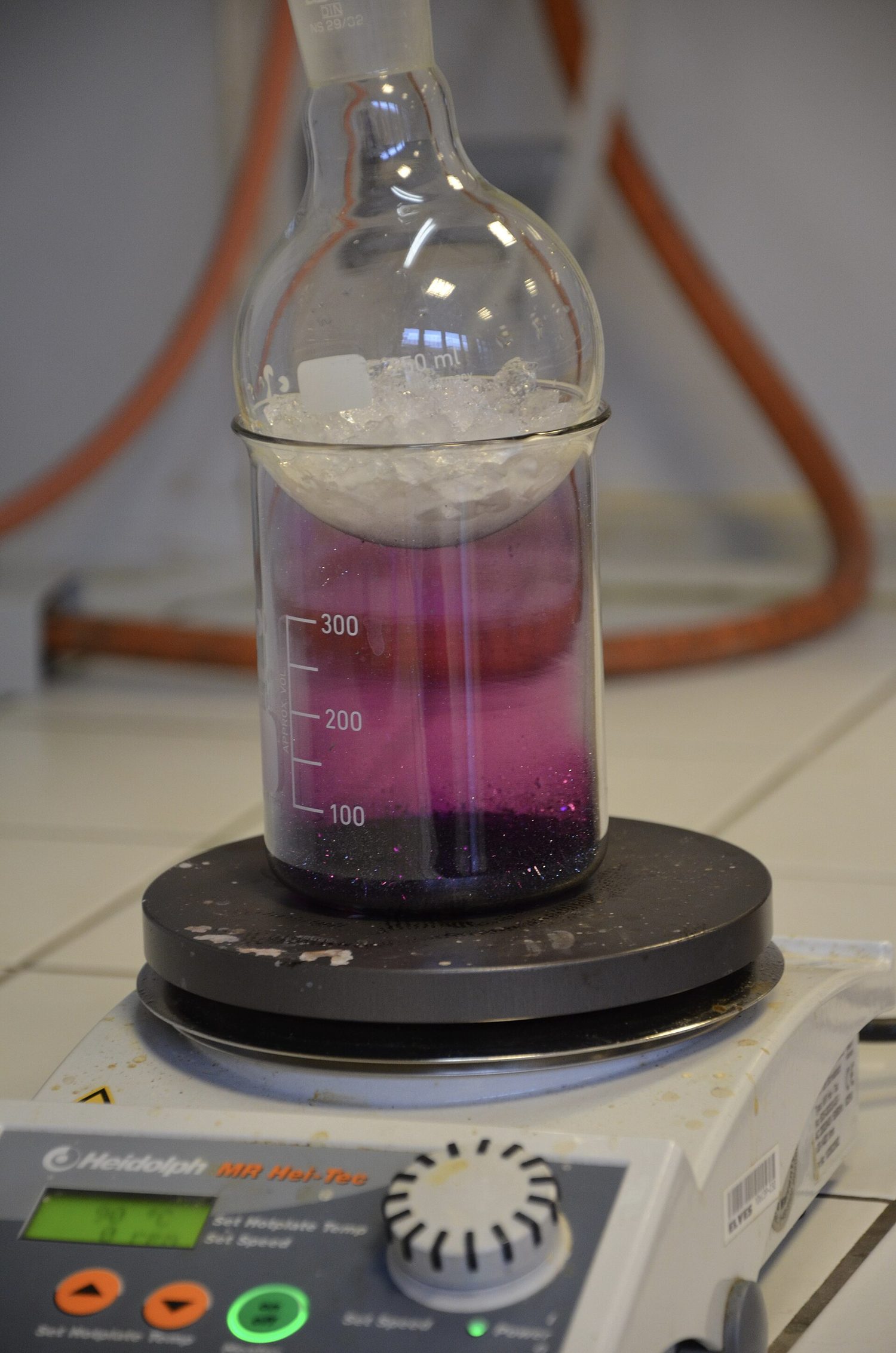
被加热的固体碘直接变成一个紫色气体(升华) 
日常的例子:干冰就是固态二氧化碳,它同样会升华——从不留下一滩水 Explaining changes of state with the particle theory
每个状态变化实际上是粒子能量(energy)的一个变化。
- 当你加热一个固体时,粒子获得能量并振动得更快。在熔点粒子有足够的能量从它们固定的位置挣脱并四处滑动——固体熔化。
- 当你加热一个液体时,粒子移动得更快。在沸点它们有足够的能量完全逃脱引力并变成一个气体。
- 冷却做相反的。粒子失去能量、移动得更慢,而引力把它们拉回在一起。
在一个状态变化期间,能量用于打破引力,而不是用于使粒子移动得更快。这就是为什么当一个物质在熔化或沸腾时温度保持不变。
Heating and cooling curves
一条加热曲线(heating curve)是你稳定地加热一个物质时温度对时间的一个图。一条冷却曲线(cooling curve)是物质冷却时同样的图。
在一条加热曲线上有两个平(水平)的部分:
- 第一个平的部分在熔点。这里固体和液体都存在。热能打破把固体保持在一起的力,所以温度不上升。
- 第二个平的部分在沸点。这里液体和气体都存在,而温度再次保持恒定。
一条冷却曲线是相反的。它在沸点有一个平的部分(气体凝结)和在熔点有一个平的部分(液体凝固)。随着粒子减速,热能(thermal energy)被释放到周围环境。
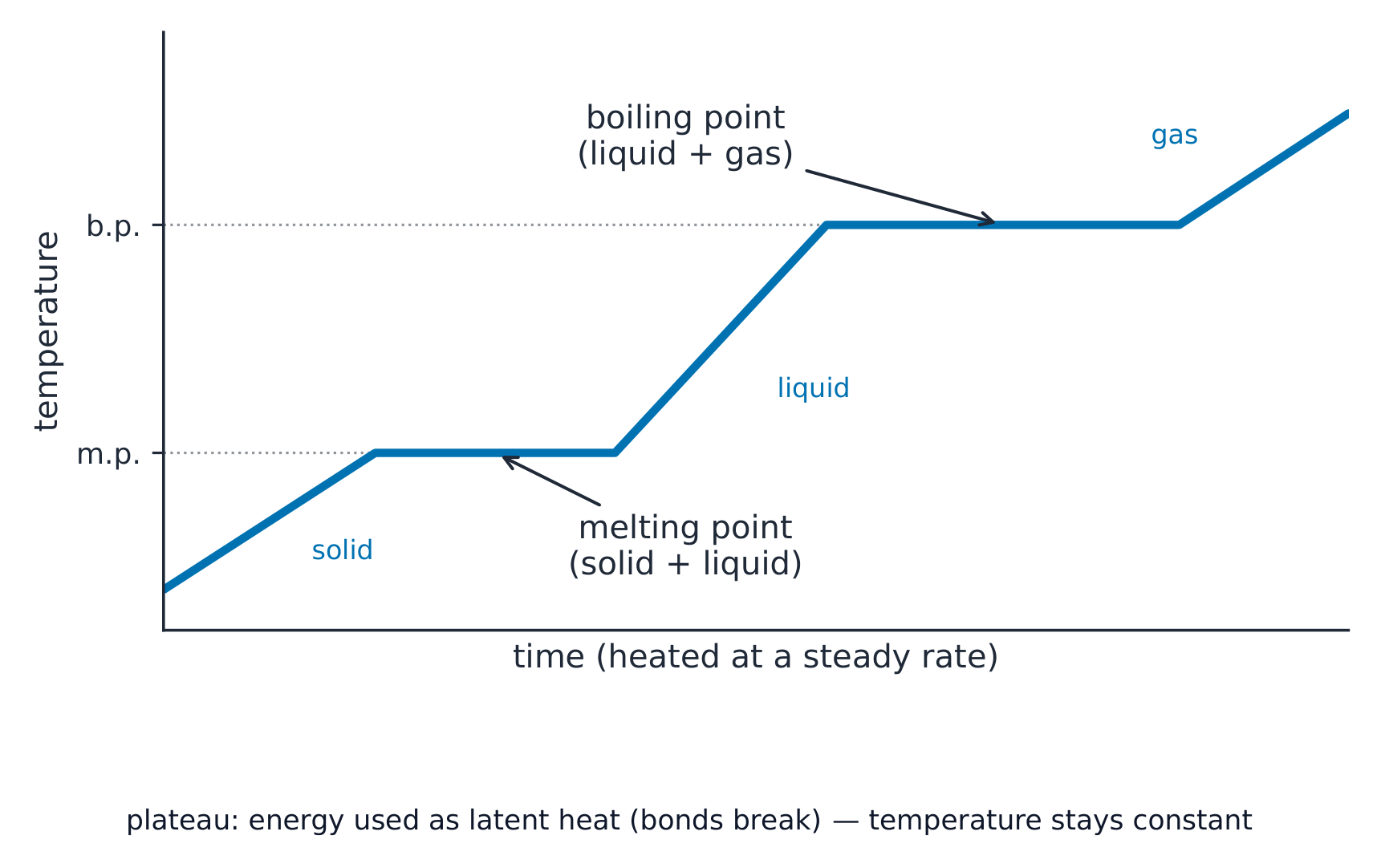
当引力被打破时,温度在熔点和沸点保持恒定 探索Heating a substance through its states
Step up the temperature. Adding heat gives the particles more energy until they break free — and the temperature pauses at each change of state while the energy does that work.
词汇表 训练英文 中文 拼音 melting/ˈmeltɪŋ/ 熔化 róng huà freezing/ˈfriːzɪŋ/ 凝固 níng gù evaporating/ɪˈvæpəreɪtɪŋ/ 蒸发 zhēng fā boiling/ˈbɔɪlɪŋ/ 沸腾 fèi téng condensing/kənˈdensɪŋ/ 凝结 níng jié melting point/ˈmeltɪŋ pɔɪnt/ 熔点 róng diǎn boiling point/ˈbɔɪlɪŋ pɔɪnt/ 沸点 fèi diǎn sublimation/ˌsʌblɪˈmeɪʃn/ 升华 shēng huá energy/ˈenədʒi/ 能量 néng liàng heating curve/ˈhiːtɪŋ kɜːv/ 加热曲线 jiā rè qū xiàn cooling curve/ˈkuːlɪŋ kɜːv/ 冷却曲线 lěng què qū xiàn thermal energy/ˈθɜːml ˈenədʒi/ 热能 rè néng 1.1
气体:温度、压强与体积

一个气体推它容器的壁。这个推,铺开在壁的面积上,是气体的压强(pressure)。压强来自气体粒子撞击壁。
Effect of temperature
若你加热一个固定质量的气体、同时保持压强相同,它的体积增加。
一个被加热的气体:更快的粒子铺开并占据更多的空间 用粒子理论:加热给粒子更多的动能(kinetic energy),所以它们移动得更快。它们更用力、更频繁地撞击壁。为了保持压强相同,气体必须占据更多的空间,所以体积变大。
若相反体积是固定的(一个密封、刚性的容器),加热气体使压强上升,因为更快的粒子更用力、更频繁地与壁碰撞(collide)。
Effect of pressure
若你增加一个固定质量气体上的压强、同时保持温度相同,它的体积减少。把气体挤进一个更小的空间意味着粒子更频繁地撞击壁,这就是一个更高的压强的意思。

把一个气体挤进一个更小的体积使粒子更频繁地撞击壁,所以压强上升 探索Gases, pressure & volume
p = k / V
Squeeze the volume and the pressure rises (Boyle's law).
词汇表 训练英文 中文 拼音 pressure/ˈpreʃə/ 压强 yā qiáng kinetic energy/kɪˈnetɪk ˈenədʒi/ 动能 dòng néng collide/kəˈlaɪd/ 碰撞 pèng zhuàng 1.2
扩散

大纲
Core Supplement 1 Describe and explain diffusion in terms of kinetic particle theory 2 Describe and explain the effect of relative molecular mass on the rate of diffusion of gases 来源:剑桥国际大纲
扩散:随机运动,单向流动 扩散(diffusion)是粒子从一个它们拥挤的区域到一个它们铺开的区域的铺开——也就是,从高浓度(concentration)到低浓度。它发生是因为粒子一直在随机方向上运动。
粒子从高到低浓度扩散,直到它们均匀地铺开 扩散解释为什么你能从一个房间的另一头闻到食物:气味粒子移动并与空气混合,直到它们到达你的鼻子。扩散在气体和液体中发生,但不在固体中,因为固体粒子不能从一个地方移动到另一个。
Rate of diffusion and molecular mass
在同样的温度下,较轻的气体粒子比较重的移动得更快。所以一个有较小相对分子质量(relative molecular mass,每个分子较小的质量)的气体有一个更快的扩散速率(rate)。
一个经典的实验显示这个。浸在氨气(ammonia,$\text{NH}_3$)中的棉絮被放在一根长玻璃管的一端。浸在氯化氢(hydrogen chloride,$\text{HCl}$)中的棉絮被放在另一端。两种气体沿管扩散并相遇,构成一个氯化铵(ammonium chloride,$\text{NH}_4\text{Cl}$)的白环。
$$\text{NH}_3 + \text{HCl} \rightarrow \text{NH}_4\text{Cl}$$氨气有 $M_r = 17$ 而氯化氢有 $M_r = 36.5$。氨气更轻,所以它扩散更快并沿管行进更远。白环在更靠近氯化氢端处形成。

氨气($M_r=17$)更轻,所以它扩散更快、更远;白环在更靠近 HCl 端处形成 例题。 溴($M_r = 160$)和氨($M_r = 17$)在同一时刻从一根长管的两端释放。它们相遇之前,哪一个走得更远?比较相对分子质量。氨的 $M_r$ 小得多,所以在相同温度下它的分子运动更快,扩散也更快。因此氨走的距离更远,两种气体在靠近溴的那一端相遇。规律始终是"越轻越快" - 要从 $M_r$ 来论证,而不是看化学式在纸上写得有多长。
探索Diffusion
Release the cloud and the particles spread on their own from the crowded corner until they fill the box evenly — diffusion, sped up by heat.
探索Diffusion
Set the concentration on each side. Particles spread from high to low concentration until evenly mixed.
词汇表 训练英文 中文 拼音 mass/mæs/ 质量 zhì liàng diffusion/dɪˈfjuːʒn/ 扩散 kuò sàn concentration/ˌkɒnsənˈtreɪʃn/ 浓度 nóng dù relative molecular mass/ˈrelətɪv məˈlekjʊlə mæs/ 相对分子质量 xiāng duì fèn zǐ zhì liàng ammonia/æˈməʊnɪə/ 氨气 ān qì hydrogen chloride/ˈhaɪdrədʒn ˈklɔːraɪd/ 氯化氢 lǜ huà qīng ammonium chloride/æˈməʊnɪəm ˈklɔːraɪd/ 氯化铵 lǜ huà ǎn 1.2
考试技巧
- 在熔化和沸腾期间温度保持恒定(一条加热曲线的平的部分),因为能量打破粒子之间的力而不是使它们移动得更快。
- 蒸发只在表面、在任何温度发生;沸腾在一个固定的温度贯穿整个液体发生。
- 用粒子理论解释气体行为:在固定体积加热一个气体提高压强,因为粒子更用力、更频繁地撞击壁——粒子本身不变大。
- 扩散对较轻的粒子(较小的 $M_r$)更快,而且不能在固体中发生。在氨气/氯化氢管中较轻的氨气行进更远,所以白环在更靠近 HCl 端处形成。
-
2
原子、元素与化合物
2.1
元素、化合物与混合物

大纲
Core Supplement 1 Describe the differences between elements, compounds and mixtures 来源:剑桥国际大纲
一个纯元素(钒):元素是最简单的物质。 所有物质都由约 100 个简单的构件构成。知道它们如何连接让你把每个物质分入三个组之一。
- 一个元素(element)是只由一种原子(atom)构成的物质。你不能用一个化学反应把它分解成任何更简单的东西。例子:铜、氧、碳。
- 一个化合物(compound)是两个或更多元素化学地连接(键合)在一起。原子以一个固定的比例连接。例子:水、二氧化碳。一个化合物有与它里面的元素不同的性质。
- 一个混合物(mixture)是两个或更多只是混在一起、没有化学连接的物质。各部分保持它们自己的性质,并能通过物理方法分离。例子:空气。
关键的区别:在一个化合物中元素被键合并只能通过化学反应分离;在一个混合物中它们不被键合并容易分离。

一个元素有一种原子;一个化合物有以一个固定比例键合的不同原子;一个混合物不被键合 探索Elements, compounds and mixtures lab
Classify everyday particle examples by composition.
词汇表 训练英文 中文 拼音 element/ˈelɪmənt/ 元素 yuán sù mixture/ˈmɪkstʃə/ 混合物 hùn hé wù 2.2
原子结构与元素周期表

大纲
Core Supplement 1 Describe the structure of the atom as a central nucleus containing neutrons and protons surrounded by electrons in shells 2 State the relative charges and relative masses of a proton, a neutron and an electron 3 Define proton number/atomic number as the number of protons in the nucleus of an atom 4 Define mass number/nucleon number as the total number of protons and neutrons in the nucleus of an atom 5 Determine the electronic configuration of elements and their ions with proton number 1 to 20, e.g. 2,8,3 6 State that: (a) Group VIII noble gases have a full outer electron shell (b) the number of outer shell electrons is equal to the group number in Groups I to VII (c) the number of occupied electron shells is equal to the period number 来源:剑桥国际大纲
Inside the atom
每个原子有一个小的、致密的中心,叫原子核(nucleus)。围绕它,电子(electrons)在电子层(shells,能级)中运动。原子核含有两种粒子:质子(protons)和中子(neutrons)。
一个原子有一个质子和中子的微小原子核,电子在它周围的电子层中 每个粒子有一个相对质量和一个相对电荷(charge)。你必须学习这些值:
粒子 相对质量 相对电荷 质子 1 $+1$ 中子 1 $0$ 电子 $\frac{1}{1840}$(几乎 0) $-1$ 一个原子没有整体电荷,因为它有相等数目的质子(各 $+1$)和电子(各 $-1$)。
Proton number and mass number
两个数描述一个原子:
- 质子数(proton number,也叫原子序数(atomic number))是原子核中质子的数目。它告诉你原子是哪个元素。
- 质量数(mass number,也叫核子数(nucleon number))是原子核中质子和中子的总数。
所以中子的数目 $=$ 质量数 $-$ 质子数。
Electronic configuration
电子从里到外填充电子层。第一个电子层容纳多达 2 个电子;接下来的电子层各容纳多达 8 个(对前 20 个元素)。电子排布(electronic configuration)列出每个电子层中有多少电子,从里面开始。
例如,一个有 13 个电子的原子有排布 $2,8,3$。钠(质子数 11)是 $2,8,1$。钙(质子数 20)是 $2,8,8,2$。
排布与周期表(Periodic Table)联系:
- 一个族(Group)号(族 I 到 VII)等于外层电子的数目。所以 $2,8,1$ 在族 I。
- 一个周期(Period)号等于容纳电子的电子层的数目。所以 $2,8,1$ 有三个电子层,所以它在周期 3。
- 族 VIII(或 0)中的稀有气体(noble gases)有一个满的外层,这使它们非常不活泼。

钠的排布 2,8,1 与周期表联系:一个外层电子意味着族 I,三个电子层意味着周期 3 探索Electron shells
Change the atomic number and watch the shells fill (2, 8, 8) — the electron arrangement of the first 20 elements.
词汇表 训练英文 中文 拼音 atom/ˈætəm/ 原子 yuán zi nucleus/ˈnjuːklɪəs/ 原子核 yuán zǐ hé electrons/ɪˈlektrɒnz/ 电子 diàn zi shells/ʃelz/ 电子层 diàn zi céng protons/ˈprəʊtɒnz/ 质子 zhì zi neutrons/ˈnjuːtrɒnz/ 中子 zhōng zǐ charge/tʃɑːdʒ/ 电荷 diàn hè proton number/ˈprəʊtɒn ˈnʌmbə/ 质子数 zhì zǐ shù atomic number/əˈtɒmɪk ˈnʌmbə/ 原子序数 yuán zi xù shù mass number/mæs ˈnʌmbə/ 质量数 zhì liàng shù nucleon number/ˈnjuːklɪən ˈnʌmbə/ 核子数 hé zǐ shù electronic configuration/ɪlekˈtrɒnɪk kənˌfɪɡjəˈreɪʃn/ 电子排布 diàn zi pái bù Periodic Table/ˌpɪərɪˈɒdɪk ˈteɪbl/ 周期表 zhōu qī biǎo Group/ɡruːp/ 族 zú Period/ˈpɪərɪəd/ 周期 zhōu qī noble gases/ˈnəʊbl ˈɡæsɪz/ 稀有气体 xī yǒu qì tǐ ion/ˈaɪɒn/ 离子 lí zi 2.3
同位素

大纲
Core Supplement 1 Define isotopes as different atoms of the same element that have the same number of protons but different numbers of neutrons 3 State that isotopes of the same element have the same chemical properties because they have the same number of electrons and therefore the same electronic configuration 2 Interpret and use symbols for atoms, e.g. $^{12}_{6}\text{C}$, and ions, e.g. $^{35}_{17}\text{Cl}^-$ 4 Calculate the relative atomic mass of an element from the relative masses and abundances of its isotopes 来源:剑桥国际大纲
同位素(isotopes)是同一个元素的原子,它们有相同数目的质子但不同数目的中子。因为质子数相同,它们是同一个元素。因为中子数不同,它们有不同的质量数。
你把一个原子写成它的质量数在上、质子数在下,像 $^{12}_{6}\text{C}$。对一个离子你加上电荷,像 $^{35}_{17}\text{Cl}^{-}$。
一个元素的同位素有相同的化学性质。这是因为化学反应只涉及电子,而同位素有相同数目的电子和相同的电子排布。(额外的中子只改变质量。)
Calculating relative atomic mass
一个元素的相对原子质量(relative atomic mass,$A_r$)是它原子的平均质量,考虑到每个同位素有多常见。丰度(abundance)是每个同位素的百分比。
$$A_r = \frac{\sum (\text{isotope mass} \times \text{abundance})}{100}$$例如,氯是 75% $^{35}\text{Cl}$ 和 25% $^{37}\text{Cl}$:
$$A_r = \frac{(35 \times 75) + (37 \times 25)}{100} = 35.5$$相对原子质量是一个加权平均:氯是 75% Cl-35 和 25% Cl-37,所以 A_r 是 35.5 例题。 硼有两种同位素,$^{10}\text{B}$ 和 $^{11}\text{B}$,其 $A_r$ 为 10.8。求各自的百分比。设 $^{11}\text{B}$ 的丰度为 $x$,则 $^{10}\text{B}$ 的丰度为 $(100 - x)$。于是
$$\frac{11x + 10(100 - x)}{100} = 10.8$$所以 $11x + 1000 - 10x = 1080$,解得 $x = 80$。硼是 80% 的 $^{11}\text{B}$ 和 20% 的 $^{10}\text{B}$。用常识检验一下:10.8 更接近 11,所以较重的同位素一定是更常见的那一个。如果你的答案把多数给了离 $A_r$ 更远的同位素,那就是弄反了。
探索Protons, neutrons & isotopes
Change the neutrons to make isotopes (same element, different mass number); change the electrons to make ions.
探索Isotope lab
Classify isotope facts by proton, neutron and mass number.
词汇表 训练英文 中文 拼音 isotopes/ˈaɪsətəʊps/ 同位素 tóng wèi sù relative atomic mass/ˈrelətɪv əˈtɒmɪk mæs/ 相对原子质量 xiāng duì yuán zi zhì liàng abundance/əˈbʌndəns/ 丰度 fēng dù 2.4
离子与离子键

大纲
Core Supplement 1 Describe the formation of positive ions, known as cations, and negative ions, known as anions 5 Describe the giant lattice structure of ionic compounds as a regular arrangement of alternating positive and negative ions 2 State that an ionic bond is a strong electrostatic attraction between oppositely charged ions 6 Describe the formation of ionic bonds between ions of metallic and non-metallic elements, including the use of dot-and-cross diagrams 3 Describe the formation of ionic bonds between elements from Group I and Group VII, including the use of dot-and-cross diagrams 7 Explain in terms of structure and bonding the properties of ionic compounds: (a) high melting points and boiling points (b) good electrical conductivity when aqueous or molten and poor when solid 4 Describe the properties of ionic compounds: (a) high melting points and boiling points (b) good electrical conductivity when aqueous or molten and poor when solid 来源:剑桥国际大纲
离子键:电子转移 一个离子(ion)是一个失去或获得电子的原子(或原子团),所以它有一个电荷。
- 一个金属原子失去电子以构成一个正离子,叫阳离子(cation)。
- 一个非金属原子获得电子以构成一个负离子,叫阴离子(anion)。
原子这样做以得到一个满的外层,像一个稀有气体。
How an ionic bond forms
一个离子键(ionic bond)是异号电荷离子之间的一个强的静电引力(electrostatic attraction,一个 $+$ 离子和一个 $-$ 离子互相拉近)。
离子键在一个金属(metal)和一个非金属(non-metal)之间形成。以氯化钠 $\text{NaCl}$ 为例。钠($2,8,1$)把它的一个外层电子给氯($2,8,7$)。现在钠是 $\text{Na}^{+}$($2,8$)而氯是 $\text{Cl}^{-}$($2,8,8$)。两者都有满的外层,而异号电荷吸引。
你可以用一个点叉图显示这个:把每个原子的外层电子画成一个元素用点、另一个用叉,然后显示电子从金属移到非金属。
钠把它的外层电子给氯;两者都达到满的外层,而异号电荷吸引(蓝色电子来自钠) The structure and properties of ionic compounds
一个离子化合物(ionic compound)不是由分开的分子(molecules)构成的。离子堆积成一个巨型晶格(lattice)——一个巨大数目的交替(alternating)正负离子的规则图案。

离子堆积成一个巨型晶格:一个交替正负离子的规则、重复的图案 
一块石盐晶体:氯化钠的立方外形就是它内部的离子晶格,放大到肉眼可见 这个结构解释这些性质:
性质 原因 高熔点(melting point)和沸点(boiling point) 离子之间强的静电引力需要很多能量来打破 固态时糟糕的导电性(electrical conductivity) 离子被固定在原位,不能移动 熔融(molten)或水溶液(aqueous)时好的导体 离子现在自由移动并携带电荷 探索Forming an ionic bond (NaCl)
Step through it. A metal hands its outer electron to a non-metal; the oppositely charged ions then attract and pack into a giant lattice.
探索Ionic bonding (electron transfer)
Step through it: the metal hands its outer electron(s) to the non-metal, both reach full shells, and the resulting + and − ions attract — an ionic bond.
词汇表 训练英文 中文 拼音 cation/ˈkætaɪən/ 阳离子 yáng lí zi anion/ˈænaɪən/ 阴离子 yīn lí zi ionic bond/aɪˈɒnɪk bɒnd/ 离子键 lí zi jiàn electrostatic attraction/ɪˌlektrəʊˈstætɪk əˈtrækʃn/ 静电引力 jìng diàn yǐn lì metal/ˈmetl/ 金属 jīn shǔ non-metal/nɒn ˈmetl/ 非金属 fēi jīn shǔ ionic compound/aɪˈɒnɪk ˈkɒmpaʊnd/ 离子化合物 lí zi huà hé wù molecules/ˈmɒlɪkjuːlz/ 分子 fèn zǐ lattice/ˈlætɪs/ 晶格 jīng gé alternating/ˈɔːltəneɪtɪŋ/ 交替 jiāo tì melting point/ˈmeltɪŋ pɔɪnt/ 熔点 róng diǎn boiling point/ˈbɔɪlɪŋ pɔɪnt/ 沸点 fèi diǎn electrical conductivity/ɪˈlektrɪkl kɒndəkˈtɪvɪti/ 导电性 dǎo diàn xìng molten/ˈməʊltn/ 熔融 róng róng aqueous/ˈeɪkwɪəs/ 水溶液 shuǐ róng yè 2.5
简单分子与共价键

大纲
Core Supplement 1 State that a covalent bond is formed when a pair of electrons is shared between two atoms leading to noble gas electronic configurations 2 Describe the formation of covalent bonds in simple molecules, including $\text{H}_2$, $\text{Cl}_2$, $\text{H}_2\text{O}$, $\text{CH}_4$, $\text{NH}_3$ and $\text{HCl}$. Use dot-and-cross diagrams to show the electronic configurations in these and similar molecules 4 Describe the formation of covalent bonds in simple molecules, including $\text{CH}_3\text{OH}$, $\text{C}_2\text{H}_4$, $\text{O}_2$, $\text{CO}_2$ and $\text{N}_2$. Use dot-and-cross diagrams to show the electronic configurations in these and similar molecules 3 Describe in terms of structure and bonding the properties of simple molecular compounds: (a) low melting points and boiling points (b) poor electrical conductivity 5 Explain in terms of structure and bonding the properties of simple molecular compounds: (a) low melting points and boiling points in terms of weak intermolecular forces (specific types of intermolecular forces are not required) (b) poor electrical conductivity 来源:剑桥国际大纲
共价键:一个共享对 一个水分子的模型:原子在共价键中共享电子。 一个共价键(covalent bond)在两个原子共享一对电子时形成。通过共享,每个原子得到一个满的外层(一个稀有气体排布)。共价键在非金属原子之间形成。
一些要知道的分子:
- $\text{H}_2$——两个氢原子共享一对电子(一个单键)。
- $\text{Cl}_2$、$\text{HCl}$——各一个共享对。
- $\text{H}_2\text{O}$——氧与两个氢原子的每一个共享一对。
- $\text{NH}_3$——氮与三个氢原子的每一个共享一对。
- $\text{CH}_4$——碳与四个氢原子的每一个共享一对。
- $\text{O}_2$ 和 $\text{CO}_2$ 有双键(两个共享对);$\text{N}_2$ 有一个三键(三个共享对);$\text{C}_2\text{H}_4$ 和 $\text{CH}_3\text{OH}$ 也用共享对。
在一个分子的点叉图中,你画每个原子的外层电子并显示哪些对在原子之间的重叠中被共享。

在一个共价键中,原子共享电子对,所以每个达到一个满的外层 Properties of simple molecular compounds
这些物质由小的、分开的分子构成。
- 它们有低的熔点和沸点。每个分子内部的共价键强,但分子间作用力(intermolecular forces,一个分子和下一个之间的力)弱,所以只需要很少的能量来分离分子。
- 它们是电的糟糕导体,因为分子没有整体电荷、没有自由电子或离子来携带电荷。
探索Why a molecule has its shape
Shared electron pairs repel one another and spread out as far apart as they can. Four bonding pairs and no lone pairs gives a tetrahedral shape, like methane (CH4).
探索Covalent bonding (sharing)
Step through it: two non-metal atoms overlap and share a pair of electrons — counting for both — so each reaches a full outer shell. That shared pair is the covalent bond; O₂ shares two pairs (a double bond).
词汇表 训练英文 中文 拼音 compound/ˈkɒmpaʊnd/ 化合物 huà hé wù covalent bond/ˈkəʊvələnt bɒnd/ 共价键 gòng jià jiàn intermolecular forces/ˌɪntəməˈlekjʊlə ˈfɔːsɪz/ 分子间作用力 fèn zǐ jiàn zuò yòng lì 2.6
巨型共价结构

大纲
Core Supplement 1 Describe the giant covalent structures of graphite and diamond 3 Describe the giant covalent structure of silicon(IV) oxide, $\text{SiO}_2$ 2 Relate the structures and bonding of graphite and diamond to their uses, limited to: (a) graphite as a lubricant and as an electrode (b) diamond in cutting tools 4 Describe the similarity in properties between diamond and silicon(IV) oxide, related to their structures 来源:剑桥国际大纲
一些共价物质不是小分子。而是数百万个原子由共价键连接成一个巨型共价结构(giant covalent structure)。你必须知道的两个都是碳的形式。
金刚石(diamond):每个碳原子键合到四个其他碳原子。这构成一个非常强、刚性的 3-D 网络。金刚石极硬,所以它被用于切割工具(cutting tools)。
石墨(graphite):每个碳原子只键合到三个其他的,构成扁平的层(layers)。层之间有弱的力,所以层能互相滑过——这使石墨成为一个好的润滑剂(lubricant)。每个碳的第四个外层电子是自由的;这些离域电子(delocalised electrons)能移动,所以石墨导电并被用作一个电极(electrode)。
金刚石把每个碳键合到四个其他的(硬);石墨构成扁平的层,它们之间有弱的力(滑) 
天然石墨:层与层之间那些弱的力,正是标本会剥片、也会在纸上留痕的原因 二氧化硅(silicon(IV) oxide,$\text{SiO}_2$)有一个像金刚石的巨型共价结构,所以它也非常硬并有一个非常高的熔点。
探索Giant covalent lab
Compare giant covalent structures by bonding and properties.
词汇表 训练英文 中文 拼音 giant covalent structure/ˈdʒaɪənt ˈkəʊvələnt ˈstrʌktʃə/ 巨型共价结构 jù xíng gòng jià jié gòu diamond/ˈdaɪəmənd/ 金刚石 jīn gāng shí cutting tools/ˈkʌtɪŋ tuːlz/ 切割工具 qiē gē gōng jù graphite/ˈɡræfaɪt/ 石墨 shí mò layers/ˈleɪəz/ 层 céng lubricant/ˈluːbrɪkənt/ 润滑剂 rùn huá jì delocalised electrons/dɪˈlɒkəlaɪzd ɪˈlektrɒnz/ 离域电子 lí yù diàn zi electrode/ɪˈlektrəʊd/ 电极 diàn jí silicon(IV) oxide/ˈsɪlɪkən ˈɒksaɪd/ 二氧化硅 èr yǎng huà guī 2.7
金属键
大纲
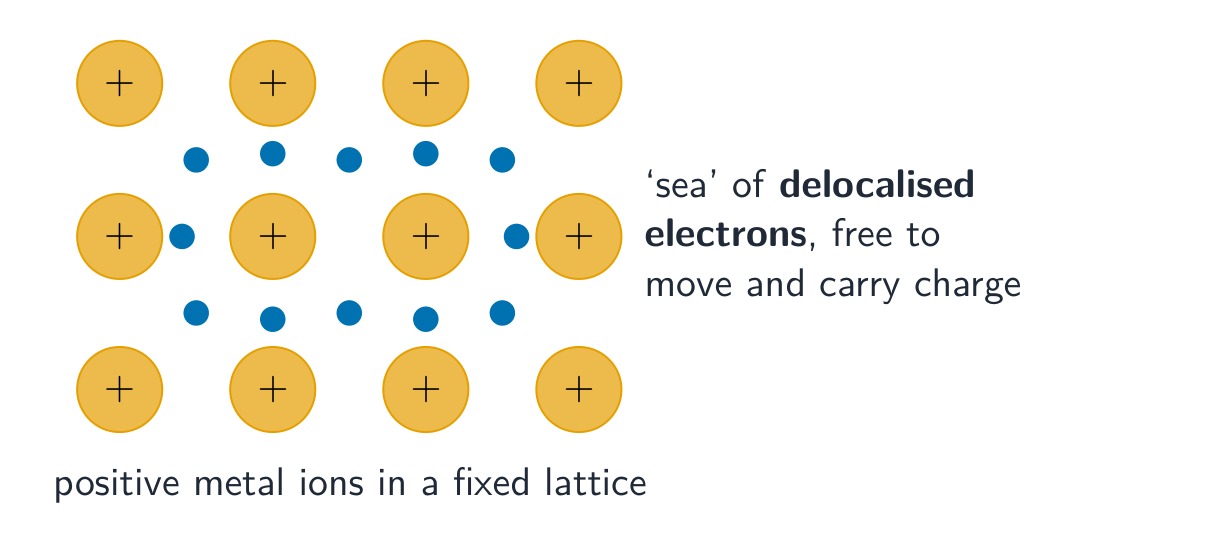
Core Supplement 1 Describe metallic bonding as the electrostatic attraction between the positive ions in a giant metallic lattice and a ‘sea’ of delocalised electrons 2 Explain in terms of structure and bonding the properties of metals: (a) good electrical conductivity (b) malleability and ductility 来源:剑桥国际大纲
一个金属是一个正离子的巨型结构,被一个自由地穿过整个金属移动的离域电子"海"围绕。金属键(metallic bonding)是这些正离子和电子海之间的强的静电引力。
一个金属是在一个自由移动并携带电荷的离域电子"海"中的正离子 这解释金属的两个关键性质:
- 好的导电性:离域电子自由移动并携带电荷穿过金属。
- 展性(malleability,能被锤成片)和延性(ductility,能被拉成线):正离子的层能互相滑过而不打破金属键,所以金属改变形状而不是破碎。
探索Inside a metal — and why it behaves that way
Step through it. Positive ions sit in a shared sea of delocalised electrons — that one picture explains conduction and why metals bend instead of snapping.
词汇表 训练英文 中文 拼音 metallic bonding/məˈtælɪk ˈbɒndɪŋ/ 金属键 jīn shǔ jiàn malleability/ˌmæləˈbɪlɪti/ 展性 zhǎn xìng ductility/dʌkˈtɪlɪti/ 延性 yán xìng 2.7
考试技巧
- 中子的数目 = 质量数 − 质子数。质子数是决定一个原子是哪个元素的东西。
- 同位素有相同的化学性质,因为反应只涉及电子,而同位素共享相同的电子排布;只有质量不同。
- 把结构匹配到性质:离子 = 巨型晶格(高熔点;只在熔融或水溶液时导电);简单分子 = 分子之间的弱力(低熔点;不导电);巨型共价 = 非常硬、非常高的熔点。
- 石墨导电且滑(每个碳一个自由电子;层滑动);金刚石两者都不(全部四个电子被键合,所以硬且不导电)。金属由于离域电子海导电并弯曲。
- 对于相对原子质量,取加权平均:$A_r = \dfrac{\sum(\text{isotope mass} \times \text{abundance})}{100}$。
-
3
化学计量
化学计量(stoichiometry)是研究一个反应中物质的量——多少发生反应、多少被制造。这个主题主要是关于数原子和做计算。
3.1
化学式

大纲
Core Supplement 1 State the formulae of the elements and compounds named in the subject content 2 Define the molecular formula of a compound as the number and type of different atoms in one molecule 5 Define the empirical formula of a compound as the simplest whole number ratio of the different atoms or ions in a compound 3 Deduce the formula of a simple compound from the relative numbers of atoms present in a model or a diagrammatic representation 6 Deduce the formula of an ionic compound from the relative numbers of the ions present in a model or a diagrammatic representation or from the charges on the ions 4 Construct word equations and symbol equations to show how reactants form products, including state symbols 7 Construct symbol equations with state symbols, including ionic equations 8 Deduce the symbol equation with state symbols for a chemical reaction, given relevant information 来源:剑桥国际大纲
一个化学式(formula)显示一个物质中有哪些原子(atoms),以及每种有多少。有两种你必须知道的化学式。
- 分子式(molecular formula)是一个分子(molecule)中每种原子的实际数目。对葡萄糖它是 $\text{C}_6\text{H}_{12}\text{O}_6$。
- 实验式(empirical formula)是一个化合物(compound)中原子或离子(ions)的最简整数比例(ratio)。对葡萄糖它是 $\text{CH}_2\text{O}$。
Working out a formula
若给你一个模型或图,只需数每个元素的原子并把它们写成一个化学式。
对于一个离子化合物(ionic compound)你可以从离子上的电荷算出化学式。总正电荷必须平衡总负电荷,因为化合物没有整体电荷。一些常见的离子:
正离子 负离子 $\text{Na}^{+}$、$\text{K}^{+}$、$\text{H}^{+}$ $\text{Cl}^{-}$、$\text{OH}^{-}$、$\text{NO}_3^{-}$ $\text{Mg}^{2+}$、$\text{Ca}^{2+}$、$\text{Cu}^{2+}$ $\text{O}^{2-}$、$\text{SO}_4^{2-}$、$\text{CO}_3^{2-}$ $\text{Al}^{3+}$ $\text{N}^{3-}$ 例如,$\text{Na}^{+}$ 和 $\text{O}^{2-}$:你需要两个 $\text{Na}^{+}$ 来平衡一个 $\text{O}^{2-}$,所以化学式是 $\text{Na}_2\text{O}$。
对一个离子化合物,离子电荷交叉过去给出化学式(这里 $\text{Al}_2\text{O}_3$) 探索Formula writing route
Follow charges or valencies to a neutral chemical formula.
词汇表 训练英文 中文 拼音 stoichiometry/ˌstəʊɪkɪˈɒmətri/ 化学计量 huà xué jì liàng formula/ˈfɔːmjʊlə/ 化学式 huà xué shì atoms/ˈætəmz/ 原子 yuán zi molecular formula/məˈlekjʊlə ˈfɔːmjʊlə/ 分子式 fēn zǐ shì molecule/ˈmɒlɪkjuːl/ 分子 fèn zǐ empirical formula/emˈpɪrɪkl ˈfɔːmjʊlə/ 实验式 shí yàn shì ratio/ˈreɪʃɪəʊ/ 比例 bǐ lì ions/ˈaɪɒnz/ 离子 lí zi compound/ˈkɒmpaʊnd/ 化合物 huà hé wù ionic compound/aɪˈɒnɪk ˈkɒmpaʊnd/ 离子化合物 lí zi huà hé wù mole/məʊl/ 摩尔 mó ěr 3.1
书写方程式

一个方程式显示反应物(reactants,起始物质)如何变成生成物(products,被制造的物质)。
- 一个文字方程式(word equation)用名称:镁 + 氧气 → 氧化镁。
- 一个化学方程式(symbol equation)用化学式,并且必须被配平(balanced)——两边每种原子的数目相同。
$$2\text{Mg} + \text{O}_2 \rightarrow 2\text{MgO}$$一个配平的化学方程式两边有每种原子相同的数目 你在括号中加状态符号(state symbols)以显示物理状态:$(s)$ 固体、$(l)$ 液体、$(g)$ 气体,以及 $(aq)$ 表示水溶液(aqueous,溶解在水中)。
$$\text{Zn}(s) + 2\text{HCl}(aq) \rightarrow \text{ZnCl}_2(aq) + \text{H}_2(g)$$Ionic equations
一个离子方程式(ionic equation)只显示实际改变的离子。两边相同的离子是旁观离子(spectator ions),被略去。例如,当一个酸与一个碱反应时:
$$\text{H}^{+}(aq) + \text{OH}^{-}(aq) \rightarrow \text{H}_2\text{O}(l)$$探索Balance the equation
Step the coefficients until every element has the same number of atoms on both sides.
词汇表 训练英文 中文 拼音 reactants/rɪˈæktənts/ 反应物 fǎn yìng wù products/ˈprɒdʌkts/ 生成物 shēng chéng wù word equation/wɜːd ɪˈkweɪʒn/ 文字方程式 wén zì fāng chéng shì symbol equation/ˈsɪmbl ɪˈkweɪʒn/ 化学方程式 huà xué fāng chéng shì balanced/ˈbælənst/ 配平 pèi píng state symbols/steɪt ˈsɪmblz/ 状态符号 zhuàng tài fú hào aqueous/ˈeɪkwɪəs/ 水溶液 shuǐ róng yè ionic equation/aɪˈɒnɪk ɪˈkweɪʒn/ 离子方程式 lí zi fāng chéng shì spectator ions/spekˈteɪtə ˈaɪɒnz/ 旁观离子 páng guān lí zi 3.2
原子与分子的相对质量

大纲
Core Supplement 1 Describe relative atomic mass, $A_r$, as the average mass of the isotopes of an element compared to 1/12th of the mass of an atom of $^{12}\text{C}$ 2 Define relative molecular mass, $M_r$, as the sum of the relative atomic masses. Relative formula mass, $M_r$, will be used for ionic compounds 3 Calculate reacting masses in simple proportions. Calculations will not involve the mole concept 来源:剑桥国际大纲
一台实验室天平测量质量——摩尔计算的基础。 一个元素(element)的相对原子质量(relative atomic mass,$A_r$)是它原子的平均质量(mass),与一个 $^{12}\text{C}$ 原子质量的 $\tfrac{1}{12}$ 相比。
相对分子质量(relative molecular mass,$M_r$)是分子中所有原子的相对原子质量之和。对于离子化合物我们用相对式量(relative formula mass),以同样的方式从化学式求得。
$$M_r(\text{H}_2\text{O}) = (2 \times 1) + 16 = 18$$Reacting masses by simple proportion
你有时能不用摩尔就求一个反应质量。若 24 g 的镁制造 40 g 的氧化镁,那么 12 g 的镁(一半那么多)制造 20 g 的氧化镁。
探索Formula mass lab
mass = moles x Mr
Change number of formula units and see total mass scale.
词汇表 训练英文 中文 拼音 relative atomic mass/ˈrelətɪv əˈtɒmɪk mæs/ 相对原子质量 xiāng duì yuán zi zhì liàng element/ˈelɪmənt/ 元素 yuán sù mass/mæs/ 质量 zhì liàng relative molecular mass/ˈrelətɪv məˈlekjʊlə mæs/ 相对分子质量 xiāng duì fèn zǐ zhì liàng relative formula mass/ˈrelətɪv ˈfɔːmjʊlə mæs/ 相对式量 xiāng duì shì liàng 3.3
摩尔与阿伏伽德罗常数

大纲
Core Supplement 2 State that the mole, mol, is the unit of amount of substance and that one mole contains $6.02 \times 10^{23}$ particles, e.g. atoms, ions, molecules; this number is the Avogadro constant 3 Use the relationship $\text{amount of substance (mol)} = \frac{\text{mass (g)}}{\text{molar mass (g/mol)}}$ to calculate: (a) amount of substance (b) mass (c) molar mass (d) relative atomic mass or relative molecular/formula mass (e) number of particles, using the value of the Avogadro constant 4 Use the molar gas volume, taken as $24\text{ dm}^3$ at room temperature and pressure, r.t.p., in calculations involving gases 1 State that concentration can be measured in $\text{g/dm}^3$ or $\text{mol/dm}^3$ 5 Calculate stoichiometric reacting masses, limiting reactants, volumes of gases at r.t.p., volumes of solutions and concentrations of solutions expressed in $\text{g/dm}^3$ and $\text{mol/dm}^3$, including conversion between $\text{cm}^3$ and $\text{dm}^3$ 6 Use experimental data from a titration to calculate the moles of solute, or the concentration or volume of a solution 7 Calculate empirical formulae and molecular formulae, given appropriate data 8 Calculate percentage yield, percentage composition by mass and percentage purity, given appropriate data 来源:剑桥国际大纲
摩尔(mole,符号 mol)是物质的量(amount of substance)的单位。任何物质的一摩尔含有 $6.02 \times 10^{23}$ 个粒子(particles,原子、离子或分子)。这个数是阿伏伽德罗常数(Avogadro constant)。
摩尔质量(molar mass)是一摩尔的质量,以克每摩尔(g/mol)计。它的数与 $A_r$ 或 $M_r$ 相同。关键关系是:
$$\text{amount (mol)} = \frac{\text{mass (g)}}{\text{molar mass (g/mol)}}$$例题。 36 g 的水中有多少摩尔?水的摩尔质量 $= 18$ g/mol。
$$n = \frac{36}{18} = 2 \text{ mol}$$要求粒子的数目,把摩尔乘以阿伏伽德罗常数。
Volumes of gases
在室温和压强(r.t.p.)下,任何气体的一摩尔占据相同的体积(volume)。这个摩尔气体体积(molar gas volume)是 $24 \text{ dm}^3$。
任何气体的一摩尔在室温和压强下填满 24 立方分米 $$\text{volume of gas (dm}^3) = \text{amount (mol)} \times 24$$例题。 $0.25$ mol 的二氧化碳在 r.t.p. 占据什么体积?
$$\text{volume} = 0.25 \times 24 = 6 \text{ dm}^3$$Concentration of solutions
一个溶液(solution)的浓度(concentration)能以 $\text{g/dm}^3$ 或 $\text{mol/dm}^3$ 给出。
$$\text{concentration (mol/dm}^3) = \frac{\text{amount of solute (mol)}}{\text{volume (dm}^3)}$$记住转换体积:$1 \text{ dm}^3 = 1000 \text{ cm}^3$,所以把一个以 $\text{cm}^3$ 计的体积除以 1000。

摩尔坐在中心:往外走乘、往回来除(浓度是摩尔 ÷ 体积) 探索Mole particle lab
particles = n x Avogadro constant
Change moles and see particle number scale with Avogadro constant.
词汇表 训练英文 中文 拼音 amount of substance/əˈmaʊnt ɒv ˈsʌbstəns/ 物质的量 wù zhì dì liàng particles/ˈpɑːtɪklz/ 粒子 lì zi Avogadro constant/ˌævəˈɡædrəʊ ˈkɒnstənt/ 阿伏伽德罗常数 ā fú gā dé luó cháng shù molar mass/ˈməʊlə mæs/ 摩尔质量 mó ěr zhì liàng volume/ˈvɒljuːm/ 体积 tǐ jī molar gas volume/ˈməʊlə ɡæs ˈvɒljuːm/ 摩尔气体体积 mó ěr qì tǐ tǐ jī concentration/ˌkɒnsənˈtreɪʃn/ 浓度 nóng dù solution/səˈluːʃn/ 溶液 róng yè solute/ˈsɒljuːt/ 溶质 róng zhì 3.3
进行反应计算

一次滴定精确测量多少酸与一个碱反应。 大多数计算遵循同样的步骤:把已知的量变成摩尔、用配平的方程式求出你想要的东西的摩尔,然后变回质量、体积或浓度。
例题。 当 12 g 的镁完全燃烧时构成什么质量的氧化镁?$2\text{Mg} + \text{O}_2 \rightarrow 2\text{MgO}$。($A_r$:Mg $= 24$,O $= 16$。)
Mg 的摩尔 $= 12 / 24 = 0.5$ mol。比例 Mg : MgO 是 $1 : 1$,所以构成 $0.5$ mol 的 MgO。它的摩尔质量是 $24 + 16 = 40$ g/mol,所以质量是 $0.5 \times 40 = 20$ g——与上面简单比例方法相同的答案。
Limiting reactant
当两个反应物被混合时,往往一个先用完。这是限量反应物(limiting reactant)。它决定多少生成物能构成;任何其他反应物是过量的(剩下)。

B 先用完,所以它是限量反应物并设定多少生成物构成;多余的 A 过量地剩下 例题。 8 g 的氢与 8 g 的氧反应:$2\text{H}_2 + \text{O}_2 \rightarrow 2\text{H}_2\text{O}$。哪个是限量反应物,而构成什么质量的水?($A_r$:H $= 1$,O $= 16$。)
$\text{H}_2$ 的摩尔 $= 8 / 2 = 4$ mol;$\text{O}_2$ 的摩尔 $= 8 / 32 = 0.25$ mol。方程式每一个 $\text{O}_2$ 需要 $2\text{H}_2$,所以 $0.25$ mol 的 $\text{O}_2$ 只与 $0.5$ mol 的 $\text{H}_2$ 反应。氢比那多得多,所以氧是限量反应物而氢是过量的。氧制造 $2 \times 0.25 = 0.5$ mol 的水,所以质量是 $0.5 \times 18 = 9$ g。总是用摩尔工作,而不是质量——质量较小的反应物不总是用完的那个。
Titration calculation
在一次滴定(titration)中,你测量与另一个反应的一个溶液的体积。从体积和浓度你求出一个溶质(solute)的摩尔,然后用方程式比例求出另一个的摩尔、浓度或体积。
例题。 $25.0 \text{ cm}^3$ 的氢氧化钠溶液被 $20.0 \text{ cm}^3$ 的 $0.10 \text{ mol/dm}^3$ 盐酸恰好中和。$\text{NaOH} + \text{HCl} \rightarrow \text{NaCl} + \text{H}_2\text{O}$。求氢氧化钠的浓度。
HCl 的摩尔 $= 0.10 \times \dfrac{20.0}{1000} = 0.0020$ mol。比例是 $1 : 1$,所以 $25.0 \text{ cm}^3$ 中有 $0.0020$ mol 的 NaOH:
$$\text{concentration} = \frac{0.0020}{25.0 / 1000} = 0.08 \text{ mol/dm}^3$$
滴定计算:已知溶液到摩尔、比例,然后未知浓度 Empirical and molecular formulae from data
要从质量或百分比求一个实验式:
- 把每个元素的质量(或 %)除以它的 $A_r$。
- 把所有答案除以最小的一个以得到最简比例。
要求分子式,把实验式质量与真实的 $M_r$ 比较并乘上去。
例题。 一个化合物按质量含有 $40\%$ 钙、$12\%$ 碳和 $48\%$ 氧。求它的实验式。($A_r$:Ca $= 40$,C $= 12$,O $= 16$。)
把每个百分比除以它的 $A_r$:Ca $= 40/40 = 1$,C $= 12/12 = 1$,O $= 48/16 = 3$。比例是 $1 : 1 : 3$,所以实验式是 $\text{CaCO}_3$。
Percentages
- 产率(percentage yield)把你实际得到的生成物与你能得到的最多比较:$\dfrac{\text{actual}}{\text{theoretical}} \times 100$。
- 一个元素的质量分数(percentage composition by mass)$= \dfrac{\text{mass of the element}}{M_r} \times 100$。
- 纯度(percentage purity)$= \dfrac{\text{mass of pure substance}}{\text{mass of impure sample}} \times 100$。
例题。 求硝酸铵 $\text{NH}_4\text{NO}_3$ 中氮的质量分数。($A_r$:N $= 14$,H $= 1$,O $= 16$。)
$M_r = (2 \times 14) + (4 \times 1) + (3 \times 16) = 80$。氮的质量是 $2 \times 14 = 28$,所以
$$\% \text{ nitrogen} = \frac{28}{80} \times 100 = 35\%$$例题。 一个反应最多能制造 5.0 g 的生成物,但只有 4.0 g 实际被收集。求产率。
$$\% \text{ yield} = \frac{4.0}{5.0} \times 100 = 80\%$$总是有一些生成物被损失——留在仪器中,或在副反应中被用掉——所以产率几乎从不是 $100\%$。
例题。 一个 50 g 的不纯碳酸钙样品含有 45 g 的纯碳酸钙。求它的纯度。
$$\% \text{ purity} = \frac{45}{50} \times 100 = 90\%$$探索Reaction calculation route
Follow a known mass through a balanced equation to the answer.
词汇表 训练英文 中文 拼音 limiting reactant/ˈlɪmɪtɪŋ rɪˈæktənt/ 限量反应物 xiàn liàng fǎn yìng wù titration/taɪˈtreɪʃn/ 滴定 dī dìng percentage yield/pəˈsentɪdʒ jiːld/ 产率 chǎn lǜ percentage composition by mass/pəˈsentɪdʒ ˌkɒmpəˈzɪʃn baɪ mæs/ 质量分数 zhì liàng fēn shù percentage purity/pəˈsentɪdʒ ˈpjʊərɪti/ 纯度 chún dù 3.3
考试技巧
- 总是先把质量、气体体积和浓度变成摩尔、用配平的方程式的比例,然后转换回来。绝不跨一个方程式直接比较质量。
- 关键公式:$n = \dfrac{\text{mass}}{M_r}$、在 r.t.p. 气体体积 $= n \times 24\ \text{dm}^3$,以及浓度 $= \dfrac{n}{\text{volume in dm}^3}$。通过除以 1000 把 cm³ 变成 dm³。
- 要配平一个化学方程式,你只能改变一个化学式前面的大数,绝不改变它里面的小下标。
- 限量反应物是用完的那个(一旦你考虑到比例后摩尔最少);它设定多少生成物构成。另一个反应物是过量的。
- 产率 = 实际 ÷ 理论 × 100;纯度 = 纯物质的质量 ÷ 样品的质量 × 100。两者总是 100% 或更少。
-
4
电化学
4.1
电解

大纲
Core Supplement 1 Define electrolysis as the decomposition of an ionic compound, when molten or in aqueous solution, by the passage of an electric current 8 Describe the transfer of charge during electrolysis to include: (a) the movement of electrons in the external circuit (b) the loss or gain of electrons at the electrodes (c) the movement of ions in the electrolyte 2 Identify in simple electrolytic cells: (a) the anode as the positive electrode (b) the cathode as the negative electrode (c) the electrolyte as the molten or aqueous substance that undergoes electrolysis 3 Identify the products formed at the electrodes and describe the observations made during the electrolysis of: (a) molten lead(II) bromide (b) concentrated aqueous sodium chloride (c) dilute sulfuric acid using inert electrodes made of platinum or carbon/graphite 9 Identify the products formed at the electrodes and describe the observations made during the electrolysis of aqueous copper(II) sulfate using inert carbon/graphite electrodes and when using copper electrodes 4 State that metals or hydrogen are formed at the cathode and that non-metals (other than hydrogen) are formed at the anode 5 Predict the identity of the products at each electrode for the electrolysis of a binary compound in the molten state 10 Predict the identity of the products at each electrode for the electrolysis of a halide compound in dilute or concentrated aqueous solution 11 Construct ionic half-equations for reactions at the anode (to show oxidation) and at the cathode (to show reduction) 6 State that metal objects are electroplated to improve their appearance and resistance to corrosion 7 Describe how metals are electroplated 来源:剑桥国际大纲
电解:离子在电极放电 电解(electrolysis)是通过让一个电流(electric current)穿过一个离子化合物(ionic compound)——当它是熔融(molten)或在水溶液(aqueous)溶液中时——来分解(分解(decomposition))它。
一个电解池用一个电流分裂一个化合物。 它只在物质是熔融或溶解时有效,因为那时离子(ions)自由移动并携带电荷。一个固体离子化合物不能被电解,因为它的离子被锁在原位。

水的电解:气体在每个电极冒泡出来并收集在上面的管中,氢约是氧的两倍 The electrolytic cell
这个装置叫一个电解池(electrolytic cell)。两个电极(electrodes,固体导体)浸入电解质(electrolyte)——被分解的熔融或水溶液物质。
- 阳极(anode)是正($+$)电极。
- 阴极(cathode)是负($-$)电极。
电极常常是惰性(inert,它们不反应)的,如铂(platinum)或碳/石墨(graphite)。
What is formed at each electrode
有一个简单的规则:
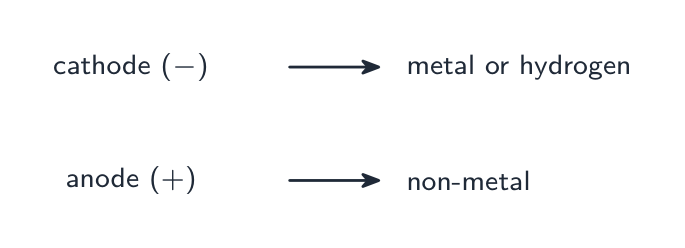
金属和氢气在阴极形成;非金属在阳极 - 金属(metals)或氢气(hydrogen)在阴极形成。
- 非金属(non-metals,氢气以外的)在阳极形成。
对于水溶液,产物可能取决于溶液是稀(dilute)还是浓(concentrated)。这里是三个核心例子:
电解质 在阴极($-$) 在阳极($+$) 熔融溴化铅(II),$\text{PbBr}_2$ 铅(lead,银色液体) 溴(bromine,红棕色蒸气) 浓氯化钠水溶液 氢气(气泡) 氯气(chlorine,淡绿色气体) 稀硫酸(sulfuric acid) 氢气(气泡) 氧气(oxygen,气泡) 例题。 预测电解熔融氯化锌 $\text{ZnCl}_2$ 的产物。因为是熔融态,所以只有锌离子和氯离子存在 - 没有水来添乱。锌是金属,所以在阴极生成:$\text{Zn}^{2+}$ 离子得到电子,出现银白色的锌。氯是非金属,所以在阳极生成:冒出淡绿色的氯气。一定要先看状态。熔融化合物直接给出它自己的两种元素,而水溶液会把水也拉进竞争 - 这正是为什么浓氯化钠溶液在阴极得到的是氢气而不是钠。
How the charge moves
电解期间:
- 电子(electrons)从电源穿过导线(外电路(external circuit))移动。
- 在阴极,正离子获得电子。获得电子是还原(reduction)。
- 在阳极,负离子失去电子。失去电子是氧化(oxidation)。
- 在电解质内部,离子移动:正离子去阴极,负离子去阳极。
你可以为每个电极写一个半反应式(half-equation)。对于熔融溴化铅(II):
$$\text{Pb}^{2+} + 2e^{-} \rightarrow \text{Pb} \quad (\text{cathode, reduction})$$$$2\text{Br}^{-} \rightarrow \text{Br}_2 + 2e^{-} \quad (\text{anode, oxidation})$$
在熔融溴化铅(II)中,$\text{Pb}^{2+}$ 移向阴极、$\text{Br}^-$ 移向阳极,它们在那里各被放电 Electrolysis of copper(II) sulfate
阳极的产物取决于电极:
- 用惰性碳电极:铜(copper)在阴极形成而氧气在阳极形成。随着铜被移除,溶液的蓝色慢慢褪去。
- 用铜电极:铜在阴极形成,而阳极本身溶入溶液。蓝色保持不变。这被用来提纯铜。
Electroplating
电镀(electroplating)意味着用另一种金属的一个薄层覆盖一个金属物体。这改善它的外观和它对腐蚀(corrosion,生锈和磨损)的抵抗。
要电镀一个物体:
- 要被涂层的物体被做成阴极;
- 镀层金属被做成阳极;
- 电解质是一个含有镀层金属离子的溶液。

要电镀,把物体做成阴极、把镀层金属做成阳极,在一个镀层金属离子的溶液中 探索Inside an electrolysis cell
Pick an electrolyte and watch ions move: positive ions to the cathode, negative ions to the anode.
词汇表 训练英文 中文 拼音 electrolysis/ɪlekˈtrɒləsɪs/ 电解 diàn jiě decomposition/ˌdiːkɒmpəˈzɪʃn/ 分解 fēn jiě ionic compound/aɪˈɒnɪk ˈkɒmpaʊnd/ 离子化合物 lí zi huà hé wù molten/ˈməʊltn/ 熔融 róng róng aqueous/ˈeɪkwɪəs/ 水溶液 shuǐ róng yè electric current/ɪˈlektrɪk ˈkʌrənt/ 电流 diàn liú ions/ˈaɪɒnz/ 离子 lí zi electrolytic cell/ɪˌlektrəˈlɪtɪk sel/ 电解池 diàn jiě chí electrodes/ɪˈlektrəʊdz/ 电极 diàn jí electrolyte/ɪˈlektrəlaɪt/ 电解质 diàn jiě zhì anode/ˈænəʊd/ 阳极 yáng jí cathode/ˈkæθəʊd/ 阴极 yīn jí inert/ɪˈnɜːt/ 惰性 duò xìng platinum/ˈplætɪnəm/ 铂 bó graphite/ˈɡræfaɪt/ 石墨 shí mò metals/ˈmetlz/ 金属 jīn shǔ hydrogen/ˈhaɪdrədʒn/ 氢气 qīng qì non-metals/nɒn ˈmetlz/ 非金属 fēi jīn shǔ dilute/daɪˈluːt/ 稀 xī concentrated/ˈkɒnsəntreɪtɪd/ 浓 nóng lead/liːd/ 铅 qiān bromine/ˈbrəʊmaɪn/ 溴 xiù chlorine/ˈklɔːriːn/ 氯气 lǜ qì sulfuric acid/sʌlˈfjʊərɪk ˈæsɪd/ 硫酸 liú suān oxygen/ˈɒksɪdʒn/ 氧气 yǎng qì electrons/ɪˈlektrɒnz/ 电子 diàn zi external circuit/ekˈstɜːnl ˈsɜːkɪt/ 外电路 wài diàn lù reduction/rɪˈdʌkʃn/ 还原 huán yuán oxidation/ˌɒksɪˈdeɪʃn/ 氧化 yǎng huà half-equation/hɑːf ɪˈkweɪʒn/ 半反应式 bàn fǎn yìng shì copper/ˈkɒpə/ 铜 tóng electroplating/ɪˌlektrəʊˈpleɪtɪŋ/ 电镀 diàn dù corrosion/kəˈrəʊʒn/ 腐蚀 fǔ shí 4.2
氢氧燃料电池

大纲
Core Supplement 1 State that a hydrogen–oxygen fuel cell uses hydrogen and oxygen to produce electricity with water as the only chemical product 2 Describe the advantages and disadvantages of using hydrogen–oxygen fuel cells in comparison with gasoline/petrol engines in vehicles 来源:剑桥国际大纲
一个燃料电池(fuel cell)用氢气和氧气直接制造电。唯一的化学产物是水。
$$2\text{H}_2 + \text{O}_2 \rightarrow 2\text{H}_2\text{O}$$一个氢氧燃料电池把化学能直接变成电,水作为唯一的产物 把一个燃料电池与一辆车里一个普通汽油发动机比较很有用。
氢氧燃料电池 汽油发动机 主要产物 只有水 二氧化碳和污染物(pollutants) 对空气的影响 干净 增加空气污染 燃料储存 氢难以且危险地储存(易燃,需要高压) 汽油容易储存 来源 氢可能用化石燃料制造 由原油制造 燃料电池的优点:唯一的产物是水,所以它不污染空气,而且它高效地把化学能变成电。缺点:氢难以安全地储存和运输,而生产氢仍能使用来自化石燃料的能量。
探索Inside a hydrogen–oxygen fuel cell
Step through a fuel cell. Hydrogen and oxygen combine to make water, and the energy of that reaction is released as electricity — with no carbon dioxide.
词汇表 训练英文 中文 拼音 fuel cell/ˈfjuːəl sel/ 燃料电池 rán liào diàn chí pollutants/pəˈluːtənts/ 污染物 wū rǎn wù 4.2
考试技巧
- 在阴极(负)你得到一个金属或氢气;在阳极(正)你得到一个非金属。正离子移向阴极,负离子移向阳极。
- 一个熔融化合物只给出它的两个元素。一个水溶液溶液能给出不同的东西(浓氯化钠给出氢气和氯气,而不是钠)。
- 还原是电子的获得(在阴极);氧化是电子的失去(在阳极)。记住 OIL RIG。
- 在一个半反应式中原子和电荷必须平衡,电子在正确的一侧:$\text{Pb}^{2+} + 2e^- \rightarrow \text{Pb}$(阴极)。
- 要电镀一个物体,把它做成阴极、把镀层金属做成阳极,并用一个含有镀层金属离子的溶液。
-
5
化学能量学
5.1
放热反应与吸热反应

大纲
Core Supplement 1 State that an exothermic reaction transfers thermal energy to the surroundings leading to an increase in the temperature of the surroundings 4 State that the transfer of thermal energy during a reaction is called the enthalpy change, $\Delta H$, of the reaction. $\Delta H$ is negative for exothermic reactions and positive for endothermic reactions 2 State that an endothermic reaction takes in thermal energy from the surroundings leading to a decrease in the temperature of the surroundings 5 Define activation energy, $E_a$, as the minimum energy that colliding particles must have to react 3 Interpret reaction pathway diagrams showing exothermic and endothermic reactions 6 Draw and label reaction pathway diagrams for exothermic and endothermic reactions using information provided, to include: (a) reactants (b) products (c) enthalpy change of the reaction, $\Delta H$ (d) activation energy, $E_a$ 7 State that bond breaking is an endothermic process and bond making is an exothermic process and explain the enthalpy change of a reaction in terms of bond breaking and bond making 8 Calculate the enthalpy change of a reaction using bond energies 来源:剑桥国际大纲
反应图:放热能量变化 烧木头是放热的,向周围环境释放热。 在每个化学反应中,能量被转移。反应要么是放热的,要么是吸热的,取决于能量往哪个方向移动。
- 一个放热反应(exothermic reaction)向环境(surroundings)放出热能(thermal energy)。所以周围环境的温度上升。
- 一个吸热反应(endothermic reaction)从周围环境吸入热能。所以周围环境的温度下降。
放热反应的例子是燃烧(combustion,烧一种燃料)和中和(neutralisation,一个酸与一个碱反应)。一个吸热反应的例子是一个化合物的热分解(decomposition,用热把它分解)。

一个放热反应温暖周围环境;一个吸热反应使它们降温 探索Exothermic & endothermic
ΔH = products − reactants
Exothermic drops to lower-energy products (releases heat); endothermic climbs to higher.
词汇表 训练英文 中文 拼音 exothermic reaction/eɡzəˈðɜːmɪk rɪˈækʃn/ 放热反应 fàng rè fǎn yìng thermal energy/ˈθɜːml ˈenədʒi/ 热能 rè néng surroundings/səˈraʊndɪŋz/ 环境 huán jìng endothermic reaction/ˌendəʊˈθɜːmɪk rɪˈækʃn/ 吸热反应 xī rè fǎn yìng combustion/kəmˈbʌstʃn/ 燃烧 rán shāo neutralisation/ˌnjuːtrəlaɪˈzeɪʃn/ 中和 zhōng hé decomposition/ˌdiːkɒmpəˈzɪʃn/ 分解 fēn jiě 5.1
焓变 ΔH

一个反应中转移的热能的量叫焓变(enthalpy change)。它被写成 $\Delta H$ 并有这些符号:
- 对一个放热反应 $\Delta H$ 是负的,因为能量离开化学物。
- 对一个吸热反应 $\Delta H$ 是正的,因为能量被吸入。
A Bunsen flame supplies energy: enthalpy change ΔH is the heat transferred at constant pressure 词汇表 训练英文 中文 拼音 enthalpy change/enˈθælpi tʃeɪndʒ/ 焓变 hán biàn 5.1
活化能
粒子不是每次相遇都反应。活化能(activation energy,$E_a$)是碰撞(colliding)的粒子(particles)在能反应之前必须有的最小能量。它像一座粒子在反应能发生之前必须越过的山。
探索Activation energy
Ea = the energy barrier
Every reaction must climb the activation-energy barrier before products can form.
词汇表 训练英文 中文 拼音 activation energy/ˌæktɪˈveɪʃn ˈenədʒi/ 活化能 huó huà néng colliding/kəˈlaɪdɪŋ/ 碰撞 pèng zhuàng particles/ˈpɑːtɪklz/ 粒子 lì zi 5.1
反应过程图

一个反应进程图(reaction pathway diagram)显示随着一个反应发生能量如何变化。能量在竖轴上,而反应的进程在横轴上。
- 线从反应物(reactants)的能级开始。
- 它越过一座"山"上升——这座山的高度是活化能 $E_a$。
- 它随即下降或上升到生成物(products)的能级。
- 反应物能级和生成物能级之间的间隙是焓变 $\Delta H$。
对一个放热反应,生成物比反应物低,所以能量被放出而 $\Delta H$ 是负的。
对一个吸热反应,生成物比反应物高,所以能量被吸入而 $\Delta H$ 是正的。
放热反应结束时比开始时低($\Delta H<0$);吸热反应结束时更高($\Delta H>0$) 探索Reaction pathway diagrams
Drag ΔH and the activation energy. Exothermic releases energy; endothermic takes it in; the hump is the energy barrier.
词汇表 训练英文 中文 拼音 reaction pathway diagram/rɪˈækʃn ˈpæθweɪ ˈdaɪəɡræm/ 反应进程图 fǎn yìng jìn chéng tú reactants/rɪˈæktənts/ 反应物 fǎn yìng wù products/ˈprɒdʌkts/ 生成物 shēng chéng wù 5.1
化学键与能量

断键和成键转移能量——火焰在这里提供它。 一个反应涉及打破反应物中的键并在生成物中构成新键。
- 断键(bond breaking)吸入能量,所以它是一个吸热步骤。
- 成键(bond making)放出能量,所以它是一个放热步骤。
键能(bond energy)是打破一摩尔一个特定的键所需的能量。你可以用键能来求焓变:
$$\Delta H = (\text{energy to break all bonds}) - (\text{energy released making all bonds})$$若成键放出的能量比断键吸入的多,反应是放热的($\Delta H$ 负)。若放出的能量较少,它是吸热的($\Delta H$ 正)。
Worked example
对反应 $\text{H}_2 + \text{Cl}_2 \rightarrow 2\text{HCl}$,用这些键能(以 kJ/mol 计):H–H $= 436$、Cl–Cl $= 242$、H–Cl $= 431$。
断的键:一个 H–H 和一个 Cl–Cl $= 436 + 242 = 678$。
成的键:两个 H–Cl $= 2 \times 431 = 862$。
$$\Delta H = 678 - 862 = -184 \text{ kJ/mol}$$答案是负的,所以这个反应是放热的。

断键吸入能量($+678$);成键放出更多($-862$);所以 $\Delta H = -184$ kJ/mol 词汇表 训练英文 中文 拼音 bond breaking/bɒnd ˈbreɪkɪŋ/ 断键 duàn jiàn bond making/bɒnd ˈmeɪkɪŋ/ 成键 chéng jiàn bond energy/bɒnd ˈenədʒi/ 键能 jiàn néng 5.1
考试技巧
- 放热放出热,所以周围环境温暖起来而 $\Delta H$ 是负的;吸热吸入热,所以周围环境降温而 $\Delta H$ 是正的。
- 断键吸入能量(吸热);成键放出能量(放热)。用 $\Delta H = (\text{energy to break bonds}) - (\text{energy released making bonds})$。
- 若成键放出的能量比断键用掉的多,反应是放热的。总是检查你最终答案的符号。
- 在一个反应进程图上,一个放热反应结束时比开始时低;一个吸热的结束时更高。山的高度是活化能。
-
6
化学反应
6.1
物理变化与化学变化

大纲
Core Supplement 1 Identify physical and chemical changes, and describe the differences between them 来源:剑桥国际大纲
铁生锈是一个化学变化——它构成一个新物质。 一个物理变化(physical change)不制造一个新物质。物质只改变它的状态或形状,而这个变化通常能被逆转。冰融化和糖溶解是物理变化。
一个化学变化(chemical change,一个化学反应)制造一个或多个新物质,而且通常难以逆转。一个化学变化的迹象包括一个颜色变化、一个气体被放出、一个能量变化,或一个沉淀(precipitate,一个固体)形成。
物理变化 化学变化 不制造新物质 制造新物质 容易逆转 通常难以逆转 例如熔化、沸腾、溶解 例如燃烧、生锈 探索Physical change vs chemical change
Step through the difference. A physical change makes no new substance and is usually easy to reverse; a chemical change makes a new substance and is hard to undo.
词汇表 训练英文 中文 拼音 physical change/ˈfɪzɪkl tʃeɪndʒ/ 物理变化 wù lǐ biàn huà chemical change/ˈkemɪkl tʃeɪndʒ/ 化学变化 huà xué biàn huà precipitate/prɪˈsɪpɪteɪt/ 沉淀 chén diàn 6.2
反应速率

大纲
Core Supplement 5 Describe collision theory in terms of: (a) number of particles per unit volume (b) frequency of collisions between particles (c) kinetic energy of particles (d) activation energy, $E_a$ 1 Describe the effect on the rate of reaction of: (a) changing the concentration of solutions (b) changing the pressure of gases (c) changing the surface area of solids (d) changing the temperature (e) adding or removing a catalyst, including enzymes 6 Describe and explain the effect on the rate of reaction of: (a) changing the concentration of solutions (b) changing the pressure of gases (c) changing the surface area of solids (d) changing the temperature (e) adding or removing a catalyst, including enzymes using collision theory 2 State that a catalyst increases the rate of a reaction and is unchanged at the end of a reaction 7 State that a catalyst decreases the activation energy, $E_a$, of a reaction 3 Describe practical methods for investigating the rate of a reaction including change in mass of a reactant or a product and the formation of a gas 8 Evaluate practical methods for investigating the rate of a reaction including change in mass of a reactant or a product and the formation of a gas 4 Interpret data, including graphs, from rate of reaction experiments 来源:剑桥国际大纲
碰撞理论:能量和取向 反应速率(rate of reaction)告诉你反应物(reactants)变成生成物(products)有多快。
Collision theory
碰撞理论(collision theory)解释什么控制速率。为了一个反应发生,粒子(particles)必须碰撞(collide),而且它们必须以足够的能量碰撞。它们需要的最小能量是活化能(activation energy,$E_a$)。当粒子更频繁地有成功的碰撞时,发生一个更快的速率。
What changes the rate
变化 效果 原因(碰撞理论) 增加一个溶液的浓度(concentration) 更快 同样的体积中更多的粒子,所以碰撞更频繁地发生 增加气体的压强(pressure) 更快 粒子被推得更近,所以碰撞更频繁地发生 增加一个固体的表面积(surface area) 更快 更多的粒子被暴露,所以碰撞更频繁地发生 增加温度 更快 粒子获得动能(kinetic energy)并移动更快,所以碰撞更频繁,而且它们中更多的有足够的能量 加一个催化剂(catalyst) 更快 催化剂降低活化能,所以更多的碰撞成功 同样体积中更多的粒子更频繁地碰撞,所以速率更快 
把一个固体分成一个粉末暴露多得多的表面,所以速率更快 Catalysts
一个催化剂加速一个反应但不被消耗——它在最后不变。它通过降低活化能来工作。酶(enzymes)是生物催化剂(在生物中工作的催化剂)。

一个催化剂给一个较低的活化能,所以更多的碰撞成功;$\Delta H$ 不变 Measuring the rate
你可以用这些方式随时间跟踪一个反应:
- 质量的变化:把烧瓶立在一台天平上。若一个气体逸出,质量下降。在规律的时间记录质量。
- 气体的体积:在一个气体注射器(syringe)中收集气体并在规律的时间读它的体积。
- 一个沉淀的形成:在一个变浑浊的反应中,计时一个烧瓶下的标记消失需要多长时间。

一个气体注射器收集放出的气体;在规律的时间读它的体积以跟踪速率 在一个生成物对时间的图上,线在开始时最陡(最快的速率)、随着反应物被用尽变得不那么陡,而在反应完成时变平。

速率在开始时最快(最陡),而线在反应完成时趋平 探索Rate from a gas-volume graph
The gradient of the volume–time curve is the rate; it is steepest at the start and flattens as reactants run out.
探索Rate of reaction
conc = c₀·bᵗ
Concentration falls over time — fast at first, then slower.
探索Collision theory in action
Watch the particles collide. Heat speeds them up so they collide more often and harder; more particles or a catalyst give more successful collisions — the rate climbs.
词汇表 训练英文 中文 拼音 rate of reaction/reɪt ɒv rɪˈækʃn/ 反应速率 fǎn yìng sù lǜ reactants/rɪˈæktənts/ 反应物 fǎn yìng wù products/ˈprɒdʌkts/ 生成物 shēng chéng wù collision theory/kəˈlɪʒn ˈθɪəri/ 碰撞理论 pèng zhuàng lǐ lùn particles/ˈpɑːtɪklz/ 粒子 lì zi collide/kəˈlaɪd/ 碰撞 pèng zhuàng activation energy/ˌæktɪˈveɪʃn ˈenədʒi/ 活化能 huó huà néng concentration/ˌkɒnsənˈtreɪʃn/ 浓度 nóng dù pressure/ˈpreʃə/ 压强 yā qiáng surface area/ˈsɜːfɪs ˈeərɪə/ 表面积 biǎo miàn jī kinetic energy/kɪˈnetɪk ˈenədʒi/ 动能 dòng néng catalyst/ˈkætəlɪst/ 催化剂 cuī huà jì enzymes/ˈenzaɪmz/ 酶 méi syringe/sɪˈrɪndʒ/ 注射器 zhù shè qì reversible reaction/rɪˈvɜːsɪbl rɪˈækʃn/ 可逆反应 kě nì fǎn yìng 6.3
可逆反应与平衡

大纲
Core Supplement 1 State that some chemical reactions are reversible as shown by the symbol $\rightleftharpoons$ 3 State that a reversible reaction in a closed system is at equilibrium when: (a) the rate of the forward reaction is equal to the rate of the reverse reaction (b) the concentrations of reactants and products are no longer changing 2 Describe how changing the conditions can change the direction of a reversible reaction for: (a) the effect of heat on hydrated compounds (b) the addition of water to anhydrous compounds limited to copper(II) sulfate and cobalt(II) chloride 4 Predict and explain, for a reversible reaction, how the position of equilibrium is affected by: (a) changing temperature (b) changing pressure (c) changing concentration (d) using a catalyst using information provided 5 State the symbol equation for the production of ammonia in the Haber process, $\text{N}_2\text{(g)} + 3\text{H}_2\text{(g)} \rightleftharpoons 2\text{NH}_3\text{(g)}$ 6 State the sources of the hydrogen (methane) and nitrogen (air) in the Haber process 7 State the typical conditions in the Haber process as $450\text{ }^{\circ}\text{C}$, $20\,000\text{ kPa}/200\text{ atm}$ and an iron catalyst 8 State the symbol equation for the conversion of sulfur dioxide to sulfur trioxide in the Contact process, $2\text{SO}_2\text{(g)} + \text{O}_2\text{(g)} \rightleftharpoons 2\text{SO}_3\text{(g)}$ 9 State the sources of the sulfur dioxide (burning sulfur or roasting sulfide ores) and oxygen (air) in the Contact process 10 State the typical conditions for the conversion of sulfur dioxide to sulfur trioxide in the Contact process as $450\text{ }^{\circ}\text{C}$, $200\text{ kPa}/2\text{ atm}$ and a vanadium(V) oxide catalyst 11 Explain, in terms of rate of reaction and position of equilibrium, why the typical conditions stated are used in the Haber process and in the Contact process, including safety considerations and economics 来源:剑桥国际大纲
勒夏特列原理 动态平衡:速率收敛 一些反应是可逆反应(reversible):生成物能反应以再次构成反应物。我们用符号 $\rightleftharpoons$ 显示这个。
加热蓝色硫酸铜赶走水;加水使它再次变蓝 Changing the direction
一个清晰的例子用水合(hydrated)和无水(anhydrous)化合物:
- 蓝色的水合硫酸铜(II),加热时,失去它的水变成白色的无水硫酸铜(II)。加水使它再次变蓝。
- 粉色的水合氯化钴(II)加热时失去水变成蓝色的无水氯化钴(II)。加水使它再次变粉。
给无水固体加水(并看到颜色返回)被用作一个水的测试。
Equilibrium
在一个密闭系统(closed system,没有东西进入或离开)中,一个可逆反应在以下时达到平衡(equilibrium):
- 正反应(forward reaction)的速率等于逆反应(reverse reaction)的速率,以及
- 反应物和生成物的浓度不再改变。
Changing the position of equilibrium
平衡位置(position of equilibrium)告诉你有更多的反应物还是更多的生成物。你可以移动它:
- 温度:加热把平衡移向吸入热的方向(吸热反应(endothermic)方向);冷却把它移向放出热的方向(放热反应(exothermic)方向)。
- 压强(气体):更多的压强把平衡移向气体分子较少的一侧。
- 浓度:加更多的一个物质把平衡移向另一侧,以用掉它。
- 一个催化剂****不移动平衡位置。它只帮助反应更快地达到平衡。
The Haber process
哈伯法(Haber process)制造氨:
$$\text{N}_2(g) + 3\text{H}_2(g) \rightleftharpoons 2\text{NH}_3(g)$$- 氢气(hydrogen)来自甲烷(methane,天然气);氮气(nitrogen)来自空气。
- 典型条件:一个 $450\,{}^{\circ}\text{C}$ 的温度、一个约 $200$ atm($20\,000$ kPa)的压强,和一个铁(iron)催化剂。
The Contact process
接触法(Contact process)把二氧化硫变成三氧化硫:
$$2\text{SO}_2(g) + \text{O}_2(g) \rightleftharpoons 2\text{SO}_3(g)$$- 二氧化硫来自烧硫(sulfur,或焙烧硫化矿);氧气(oxygen)来自空气。
- 典型条件:一个 $450\,{}^{\circ}\text{C}$ 的温度、一个约 $2$ atm($200$ kPa)的压强,和一个五氧化二钒(vanadium(V) oxide)催化剂。
Why these conditions are chosen
这些条件是一个折中(compromise):
- 一个更高的压强会给更多的生成物,但非常高的压强危险而昂贵,所以用一个中等的压强。
- 一个更低的温度会给更多的生成物(两个正反应都是放热的),但反应会太慢,所以用一个相当高的温度以保持一个好的速率。
- 催化剂加速反应而不改变平衡位置,这降低成本。
探索Shifting an equilibrium
Change temperature, pressure or concentration and watch a reversible reaction shift to a new balance.
词汇表 训练英文 中文 拼音 hydrated/haɪˈdreɪtɪd/ 水合 shuǐ hé anhydrous/ænˈhaɪdrəs/ 无水 wú shuǐ closed system/kləʊzd ˈsɪstəm/ 密闭系统 mì bì xì tǒng equilibrium/ˌiːkwɪˈlɪbrɪəm/ 平衡 píng héng forward reaction/ˈfɔːwəd rɪˈækʃn/ 正反应 zhèng fǎn yìng reverse reaction/rɪˈvɜːs rɪˈækʃn/ 逆反应 nì fǎn yìng position of equilibrium/pəˈzɪʃn ɒv ˌiːkwɪˈlɪbrɪəm/ 平衡位置 píng héng wèi zhì endothermic/ˌendəʊˈθɜːmɪk/ 吸热反应 xī rè fǎn yìng exothermic/eɡzəˈðɜːmɪk/ 放热反应 fàng rè fǎn yìng Haber process/ˈheɪbə ˈprəʊses/ 哈伯法 hā bó fǎ hydrogen/ˈhaɪdrədʒn/ 氢气 qīng qì methane/ˈmiːθeɪn/ 甲烷 jiǎ wán nitrogen/ˈnaɪtrədʒn/ 氮气 dàn qì iron/ˈaɪən/ 铁 tiě Contact process/ˈkɒntækt ˈprəʊses/ 接触法 jiē chù fǎ sulfur/ˈsʌlfɜː/ 硫 liú oxygen/ˈɒksɪdʒn/ 氧气 yǎng qì vanadium(V) oxide/væˈneɪdɪəm ˈɒksaɪd/ 五氧化二钒 wǔ yǎng huà èr fán compromise/ˈkɒmprəmaɪz/ 折中 zhé zhōng 6.4
氧化还原

大纲
Core Supplement 1 Use a Roman numeral to indicate the oxidation number of an element in a compound 2 Define redox reactions as involving simultaneous oxidation and reduction 3 Define oxidation as gain of oxygen and reduction as loss of oxygen 6 Define oxidation in terms of: (a) loss of electrons (b) an increase in oxidation number 7 Define reduction in terms of: (a) gain of electrons (b) a decrease in oxidation number 4 Identify redox reactions as reactions involving gain and loss of oxygen 8 Identify redox reactions as reactions involving gain and loss of electrons 5 Identify oxidation and reduction in redox reactions 9 Identify redox reactions by changes in oxidation number using: (a) the oxidation number of elements in their uncombined state is zero (b) the oxidation number of a monatomic ion is the same as the charge on the ion (c) the sum of the oxidation numbers in a compound is zero (d) the sum of the oxidation numbers in an ion is equal to the charge on the ion 10 Identify redox reactions by the colour changes involved when using acidified aqueous potassium manganate(VII) or aqueous potassium iodide 11 Define an oxidising agent as a substance that oxidises another substance and is itself reduced 12 Define a reducing agent as a substance that reduces another substance and is itself oxidised 13 Identify oxidising agents and reducing agents in redox reactions 来源:剑桥国际大纲
氧化(oxidation)和还原(reduction)总是同时发生,在叫一个氧化还原反应(redox reaction)的东西里。("Redox"是 reduction–oxidation 的简写。)
有三种描述氧化和还原的方式:
- 氧:氧化是氧的获得;还原是氧的失去。
- 电子(electrons):氧化是电子的失去;还原是电子的获得。
- 氧化数(oxidation number):在氧化中氧化数上升;在还原中它下降。
一个有用的记忆辅助是 OIL RIG:Oxidation Is Loss, Reduction Is Gain——电子的。
电子从被氧化的物质(失去它们)传到被还原的物质(获得它们)——两者总是一起发生 Oxidation number rules
氧化数由一个罗马数字显示,如铁(II)和铁(III)。规则是:
- 一个未化合的元素有一个 $0$ 的氧化数。
- 一个单原子离子有一个等于它电荷的氧化数(所以 $\text{Na}^{+}$ 是 $+1$)。
- 一个化合物中的氧化数加起来为 $0$。
- 一个离子中的氧化数加起来为离子上的电荷。
例题。 求高锰酸根离子 $\text{MnO}_4^{-}$ 中锰的氧化数。每个氧是 $-2$,共有四个,所以是 $4 \times (-2) = -8$。离子中各氧化数之和必须等于该离子所带的电荷,这里是 $-1$。所以设锰为 $x$,则 $x + (-8) = -1$,解得 $x = +7$ - 这正是名称中 (VII) 告诉你的。要把总和设为离子的电荷,而不是零:零只适用于中性化合物。
Oxidising and reducing agents
- 一个氧化剂(oxidising agent)氧化另一个物质,而它自己被还原。
- 一个还原剂(reducing agent)还原另一个物质,而它自己被氧化。
一些氧化还原反应显示清晰的颜色变化:
- 酸化的高锰酸钾(potassium manganate(VII))是紫色的。当它充当一个氧化剂时它被还原,而紫色褪成无色。
- 碘化钾(potassium iodide)是无色的。当它被氧化时,红棕色的碘(iodine)被构成。
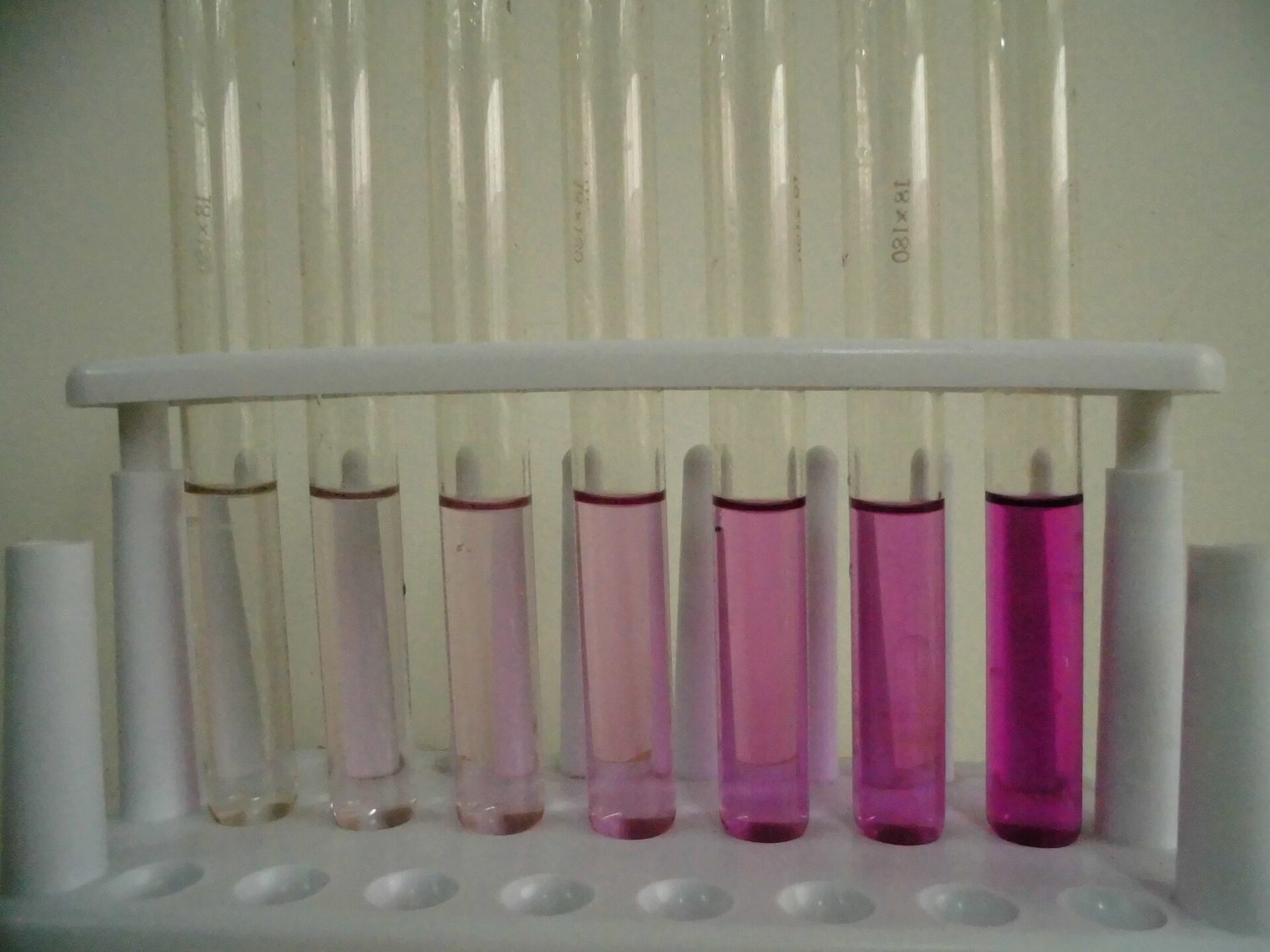
高锰酸钾是深紫色的;随着它被还原(或稀释)紫色褪成无色 探索Oxidation and reduction happen together
Step through a redox reaction. One substance loses electrons while another gains them — you can never have one without the other.
词汇表 训练英文 中文 拼音 oxidation/ˌɒksɪˈdeɪʃn/ 氧化 yǎng huà reduction/rɪˈdʌkʃn/ 还原 huán yuán redox reaction/rɪˈdɒks rɪˈækʃn/ 氧化还原反应 yǎng huà huán yuán fǎn yìng electrons/ɪˈlektrɒnz/ 电子 diàn zi oxidation number/ˌɒksɪˈdeɪʃn ˈnʌmbə/ 氧化数 yǎng huà shù oxidising agent/ˈɒksɪdaɪzɪŋ ˈeɪdʒənt/ 氧化剂 yǎng huà jì reducing agent/rɪˈdjuːsɪŋ ˈeɪdʒənt/ 还原剂 huán yuán jì potassium manganate(VII)/pəˈtæsɪəm ˈmæŋɡəneɪt/ 高锰酸钾 gāo měng suān jiǎ potassium iodide/pəˈtæsɪəm ˈaɪədaɪd/ 碘化钾 diǎn huà jiǎ iodine/ˈaɪədiːn/ 碘 diǎn 6.4
考试技巧
- 用碰撞理论解释一个更快的速率:成功的碰撞更频繁地发生。浓度、压强和表面积都提高粒子碰撞的频率;一个更高的温度做那个而且给更多的粒子足够的能量。
- 一个催化剂降低活化能并加速反应,但不被消耗而且不改变 $\Delta H$ 或平衡位置。
- 在平衡时正反应和逆反应速率相等,而浓度停止改变——它不意味着反应物和生成物的量相等。
- 用勒夏特列原理:提高温度有利于吸热方向;提高压强有利于气体分子较少的一侧;加一个物质把平衡从它移开。
- 氧化还原——OIL RIG:Oxidation Is Loss, Reduction Is Gain 电子。它们总是一起发生,而一个氧化剂自己被还原。
-
7
酸、碱与盐
7.1
酸与碱的特征性质

大纲
Core Supplement 1 Describe the characteristic properties of acids in terms of their reactions with: (a) metals (b) bases (c) carbonates 2 Describe acids in terms of their effect on: (a) litmus (b) thymolphthalein (c) methyl orange 3 State that bases are oxides or hydroxides of metals and that alkalis are soluble bases 4 Describe the characteristic properties of bases in terms of their reactions with: (a) acids (b) ammonium salts 5 Describe alkalis in terms of their effect on: (a) litmus (b) thymolphthalein (c) methyl orange 6 State that aqueous solutions of acids contain $\text{H}^+$ ions and aqueous solutions of alkalis contain $\text{OH}^-$ ions 9 Define acids as proton donors and bases as proton acceptors 10 Define a strong acid as an acid that is completely dissociated in aqueous solution and a weak acid as an acid that is partially dissociated in aqueous solution 11 State that hydrochloric acid is a strong acid, as shown by the symbol equation, $\text{HCl}(\text{aq}) \rightarrow \text{H}^+(\text{aq}) + \text{Cl}^-(\text{aq})$ 12 State that ethanoic acid is a weak acid, as shown by the symbol equation, $\text{CH}_3\text{COOH}(\text{aq}) \rightleftharpoons \text{H}^+(\text{aq}) + \text{CH}_3\text{COO}^-(\text{aq})$ 7 Describe how to compare hydrogen ion concentration, neutrality, relative acidity and relative alkalinity in terms of colour and pH using universal indicator paper 8 Describe the neutralisation reaction between an acid and an alkali to produce water, $\text{H}^+(\text{aq}) + \text{OH}^-(\text{aq}) \rightarrow \text{H}_2\text{O}(l)$ 来源:剑桥国际大纲
一个酸(acid)是一种当溶解在水中时构成氢离子($\text{H}^{+}$)的物质。酸有三个典型的反应:
酸与金属、碱和碳酸盐反应以给出不同的生成物 - 与金属(metals):酸 + 金属 → 一个盐(salt)+ 氢气(hydrogen)
- 与碱:酸 + 碱(base)→ 一个盐 + 水(这是中和(neutralisation))
- 与碳酸盐(carbonates):酸 + 碳酸盐 → 一个盐 + 水 + 二氧化碳(carbon dioxide)
Describing what you see
说出生成物只完成了考试要求的一半。"写出观察到的现象"问的是你用眼睛能看到什么,它本身就有分数 —— 所以要记住这些词:
你看到的 要写 有气泡冒出 泡腾(effervescence,也接受:冒泡、起泡) 固体变小并消失 固体溶解(dissolves)/ 消失(disappears) 溶液颜色变化 说出颜色,例如变蓝(铜盐) 冒泡停止 不再有泡腾 —— 酸已被消耗完 所以对于把镁加入盐酸,完整的答案是:泡腾,并且固体溶解(试管还会变热)。对于把氧化铜(II)加入温热的硫酸:黑色固体溶解,溶液变蓝。
有两条规则能挽回大部分丢掉的分。绝不要把"放出氢气"当作观察现象 —— 你看不见氢气,你只能看见气泡,所以要写泡腾。以及不要写你看不见的名称:"生成了一种盐"是结论,不是观察现象。
Indicators
一个指示剂(indicator)是一种变色以显示一个溶液是酸性还是碱性的染料。
指示剂 在酸中 在碱中 石蕊(litmus) 红 蓝 百里酚酞(thymolphthalein) 无色 蓝 甲基橙(methyl orange) 红 黄 酸的水溶液含有氢离子(ions,$\text{H}^{+}$)。碱的水溶液含有氢氧根离子($\text{OH}^{-}$)。

石蕊纸:蓝色石蕊在一个酸中变红,而红色石蕊在一个碱中变蓝 词汇表 训练英文 中文 拼音 acid/ˈæsɪd/ 酸 suān metals/ˈmetlz/ 金属 jīn shǔ hydrogen/ˈhaɪdrədʒn/ 氢气 qīng qì base/beɪs/ 碱 jiǎn neutralisation/ˌnjuːtrəlaɪˈzeɪʃn/ 中和 zhōng hé carbonates/ˈkɑːbəneɪts/ 碳酸盐 tàn suān yán carbon dioxide/ˈkɑːbən daɪˈɒksaɪd/ 二氧化碳 èr yǎng huà tàn indicator/ˈɪndɪkeɪtə/ 指示剂 zhǐ shì jì litmus/ˈlɪtməs/ 石蕊 shí ruǐ thymolphthalein/ˈθaɪməlfθæliːn/ 百里酚酞 bǎi lǐ fēn tài methyl orange/ˈmiːθaɪl ˈɒrɪndʒ/ 甲基橙 jiǎ jī chéng ions/ˈaɪɒnz/ 离子 lí zi neutral/ˈnjuːtrəl/ 中性 zhōng xìng effervescence/ˌefəˈvesəns/ 泡腾 pào téng 7.1
碱与可溶性碱

碱是金属的氧化物(oxides)或氢氧化物(hydroxides)。一个可溶性碱(alkali)是一个溶解在水中的碱(一个可溶碱)。
碱有两个典型的反应:
- 与酸:碱 + 酸 → 一个盐 + 水(又是中和)
- 与铵盐(ammonium salts):这释放氨气。
pH strips: alkalis turn universal indicator purple or blue (pH > 7) 探索Watch the pH during neutralisation
Adding alkali to acid raises the pH. Near the end point the pH leaps up sharply — that steep jump is where the acid has just been neutralised.
词汇表 训练英文 中文 拼音 oxides/ˈɒksaɪdz/ 氧化物 yǎng huà wù hydroxides/haɪˈdrɒksaɪdz/ 氢氧化物 qīng yǎng huà wù alkali/ˈælkəlaɪ/ 可溶性碱 kě róng xìng jiǎn ammonium salts/æˈməʊnɪəm sɒlts/ 铵盐 ǎn yán universal indicator/ˌjuːnɪˈvɜːsl ˈɪndɪkeɪtə/ 通用指示剂 tōng yòng zhǐ shì jì 7.1
强酸与弱酸

一个酸是一个质子(proton)供体——它给出 $\text{H}^{+}$ 离子(一个氢离子只是一个质子)。一个碱是一个质子受体。
一个酸有多强取决于它有多少在水中分裂成离子:
- 一个强酸(strong acid)在水中完全电离(dissociated,完全分裂成离子)。盐酸(hydrochloric acid)是强的:
$$\text{HCl}(aq) \rightarrow \text{H}^{+}(aq) + \text{Cl}^{-}(aq)$$- 一个弱酸(weak acid)只部分电离。乙酸(ethanoic acid)是弱的,所以方程式用可逆箭头:
$$\text{CH}_3\text{COOH}(aq) \rightleftharpoons \text{H}^{+}(aq) + \text{CH}_3\text{COO}^{-}(aq)$$注意:"强"和"弱"是关于电离的,不是关于稀或浓的。
一个强酸完全分裂成离子;一个弱酸大多保持为分子(只部分电离) 词汇表 训练英文 中文 拼音 proton/ˈprəʊtɒn/ 质子 zhì zi strong acid/strɒŋ ˈæsɪd/ 强酸 qiáng suān dissociated/dɪˈsəʊsɪeɪtɪd/ 电离 diàn lí hydrochloric acid/ˌhaɪdrəˈklɔːrɪk ˈæsɪd/ 盐酸 yán suān weak acid/wiːk ˈæsɪd/ 弱酸 ruò suān ethanoic acid/ˌeθəˈnəʊɪk ˈæsɪd/ 乙酸 yǐ suān 7.1
pH 标度

pH 标度从 0 到 14,告诉你一个溶液有多酸性或碱性。一个更高的氢离子浓度意味着一个更低的 pH。
你可以用通用指示剂(universal indicator)求 pH,它变不同的颜色:
pH 类型 通用指示剂的颜色 低于 7 酸性(acidic) 红 / 橙 / 黄 恰好 7 中性(neutral) 绿 高于 7 碱性(alkaline) 蓝 / 紫 通用指示剂在一个强酸中变红、在中性(pH 7)变绿,而在一个强碱中变紫 当一个酸和一个碱反应时,$\text{H}^{+}$ 和 $\text{OH}^{-}$ 离子结合以制造水:
$$\text{H}^{+}(aq) + \text{OH}^{-}(aq) \rightarrow \text{H}_2\text{O}(l)$$探索The pH scale
Slide the pH or tap a substance — lemon, water, soap, bleach. The indicator goes red→green→purple, and each step down in pH is ten times more H⁺ ions.
探索A titration curve
Add alkali to acid and watch the pH rise. The steep jump is where the acid is just neutralised.
词汇表 训练英文 中文 拼音 acidic/əˈsɪdɪk/ 酸性 suān xìng alkaline/ˈælkəlaɪn/ 碱性 jiǎn xìng 7.2
氧化物

大纲
Core Supplement 1 Classify oxides as acidic, including $\text{SO}_2$ and $\text{CO}_2$, or basic, including $\text{CuO}$ and $\text{CaO}$, related to metallic and non-metallic character 2 Describe amphoteric oxides as oxides that react with acids and with bases to produce a salt and water 3 Classify $\text{Al}_2\text{O}_3$ and $\text{ZnO}$ as amphoteric oxides 来源:剑桥国际大纲
氧化物能按它们如何表现分类:
- 酸性氧化物是非金属的氧化物,如 $\text{SO}_2$ 和 $\text{CO}_2$。
- 碱性氧化物是金属的氧化物,如 $\text{CuO}$ 和 $\text{CaO}$。
- 两性(amphoteric)氧化物与酸和碱两者反应以制造一个盐和水。$\text{Al}_2\text{O}_3$ 和 $\text{ZnO}$ 是两性的。
所以金属氧化物倾向于是碱性的,而非金属氧化物倾向于是酸性的。
Limestone is mostly calcium carbonate — a metal carbonate that acts as a base and neutralises acids 探索Oxide type lab
Classify oxides by how they behave with acids and bases.
词汇表 训练英文 中文 拼音 amphoteric/ˌæmfəʊˈterɪk/ 两性 liǎng xìng 7.3
盐的制备

大纲
Core Supplement 1 Describe the preparation, separation and purification of soluble salts by reaction of an acid with: (a) an alkali by titration (b) excess metal (c) excess insoluble base (d) excess insoluble carbonate 4 Describe the preparation of insoluble salts by precipitation 2 Describe the general solubility rules for salts: (a) sodium, potassium and ammonium salts are soluble (b) nitrates are soluble (c) chlorides are soluble, except lead and silver (d) sulfates are soluble, except barium, calcium and lead (e) carbonates are insoluble, except sodium, potassium and ammonium (f) hydroxides are insoluble, except sodium, potassium, ammonium and calcium (partially) 3 Define a hydrated substance as a substance that is chemically combined with water and an anhydrous substance as a substance containing no water 5 Define the term water of crystallisation as the water molecules present in hydrated crystals, including $\text{CuSO}_4\bullet5\text{H}_2\text{O}$ and $\text{CoCl}_2\bullet6\text{H}_2\text{O}$ 来源:剑桥国际大纲
一个盐是否能用某种方法制造取决于它是可溶(soluble,溶解)还是不溶(insoluble,不溶解)。
Solubility rules
盐类型 规则 钠、钾、铵盐 全部可溶 硝酸盐(nitrates) 全部可溶 氯化物(chlorides) 可溶,除了铅和银 硫酸盐(sulfates) 可溶,除了钡、钙和铅 碳酸盐 不溶,除了钠、钾和铵 氢氧化物 不溶,除了钠、钾、铵和(部分)钙 Making a soluble salt
你把一个酸与这些之一反应:
- 一个碱,用滴定(titration)(因为两者都是溶液,你必须测量确切的体积);
- 过量(excess)的一个金属、一个不溶碱,或一个不溶碳酸盐。
当你用过量的一个固体时,你随即过滤(filter)以移除剩下的固体。最后你蒸发(evaporate)一些水并让溶液结晶(crystallise)以得到盐。
从一个不溶固体制造一个可溶盐:与过量反应、把过量的滤掉、蒸发,然后结晶 例题。 制备 (a) 硫酸铜 和 (b) 硫酸钡,分别该用哪种方法?先查溶解性规则。(a) 硫酸铜是可溶的(只有钡、钙和铅的硫酸盐不溶),所以用不溶固体加酸来制:向温热的稀硫酸中加入过量氧化铜,过滤掉剩余的固体,然后蒸发掉一些水并结晶。(b) 硫酸钡是不溶的,所以用沉淀法制:把各自含有一种所需离子的两种溶液混合,然后过滤、洗涤并干燥固体。决定方法的是你想要的那种盐的溶解性 - 选择之前先查规则。
Making an insoluble salt
一个不溶盐通过沉淀(precipitation)制造:混合各含有所需离子之一的两个溶液,而不溶盐作为一个固体形成。你随即过滤、洗涤并干燥它。
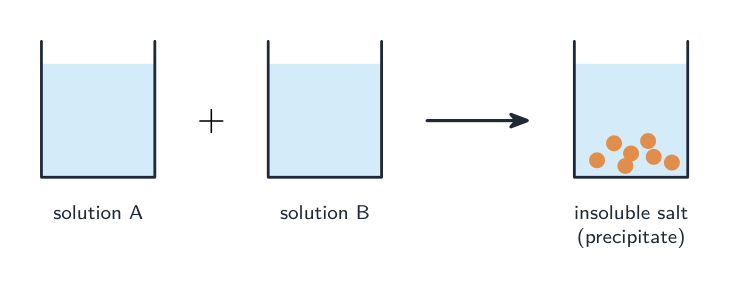
混合各携带所需离子之一的两个溶液使不溶盐作为一个固体沉淀出现,你随即把它滤掉 Water in salts
- 一个水合(hydrated)物质与水化学地连接。
- 一个无水(anhydrous)物质不含水。
水合晶体里面的水分子叫结晶水(water of crystallisation)。例如,$\text{CuSO}_4 \bullet 5\text{H}_2\text{O}$ 每个式量单位有五个水分子。
探索Preparing a soluble salt
Step through the method. React an acid with excess insoluble base, filter off what's left over, then evaporate and crystallise to get pure salt crystals.
词汇表 训练英文 中文 拼音 salt/sɒlt/ 盐 yán soluble/ˈsɒljuːbl/ 可溶 kě róng insoluble/ɪnˈsɒljuːbl/ 不溶 bù róng nitrates/ˈnaɪtreɪts/ 硝酸盐 xiāo suān yán chlorides/ˈklɔːraɪdz/ 氯化物 lǜ huà wù sulfates/ˈsʌlfeɪts/ 硫酸盐 liú suān yán titration/taɪˈtreɪʃn/ 滴定 dī dìng excess/ekˈses/ 过量 guò liàng filter/ˈfɪltə/ 过滤 guò lǜ evaporate/ɪˈvæpəreɪt/ 蒸发 zhēng fā crystallise/ˈkrɪstəlaɪz/ 结晶 jié jīng precipitation/prɪˌsɪpɪˈteɪʃn/ 沉淀 chén diàn hydrated/haɪˈdreɪtɪd/ 水合 shuǐ hé anhydrous/ænˈhaɪdrəs/ 无水 wú shuǐ water of crystallisation/ˈwɔːtə ɒv ˌkrɪstəlaɪˈzeɪʃn/ 结晶水 jié jīng shuǐ 7.3
考试技巧
- 学习三个酸反应:酸 + 金属 → 盐 + 氢气;酸 + 碱 → 盐 + 水(中和);酸 + 碳酸盐 → 盐 + 水 + 二氧化碳。
- 强和弱描述酸有多少分裂成离子(电离),不是它有多浓。一个强酸完全电离;一个弱酸只部分。
- 一个更低的 pH 意味着一个更高的氢离子浓度。pH 7 是中性,低于 7 是酸性,高于 7 是碱性。
- 按溶解度选择盐的方法:一个可溶盐从一个酸 + 过量固体制造(然后过滤、蒸发、结晶),或通过与一个碱滴定;一个不溶盐通过沉淀制造(混合两个溶液,然后过滤)。
- 学习溶解度规则——所有钠、钾、铵和硝酸盐都可溶。
-
8
元素周期表
8.1
元素的排列

大纲
Core Supplement 1 Describe the Periodic Table as an arrangement of elements in periods and groups and in order of increasing proton number/atomic number 2 Describe the change from metallic to non‑metallic character across a period 3 Describe the relationship between group number and the charge of the ions formed from elements in that group 4 Explain similarities in the chemical properties of elements in the same group of the Periodic Table in terms of their electronic configuration 5 Explain how the position of an element in the Periodic Table can be used to predict its properties 6 Identify trends in groups, given information about the elements 来源:剑桥国际大纲
周期表按原子序数排列元素。 周期表(Periodic Table)按递增的质子数(proton number,原子序数(atomic number))排列所有元素(elements)。水平的行叫周期(periods),而竖直的列叫族(groups)。
几个关键的模式:
- 沿一个周期,元素从左边的金属(metals)变到右边的非金属(non-metals)。
- 族号告诉你元素构成的离子(ions)的电荷。族 I 构成 $+1$ 离子,族 II 构成 $+2$ 离子,而族 VII 构成 $-1$ 离子。
- 同一个族中的元素有相似的化学性质。这是因为它们有相同数目的外层电子(electrons,相同的外层电子排布(electronic configuration))。
因为这些模式,你可以用一个元素的位置来预测它的性质。

族是列而周期是行;金属位于楼梯的左边,非金属在右边 探索Spot a trend across a period
Reading across a period, properties change in a regular, repeating pattern. Switch the trend to watch atomic radius, ionisation energy or melting point change element by element.
词汇表 训练英文 中文 拼音 Periodic Table/ˌpɪərɪˈɒdɪk ˈteɪbl/ 周期表 zhōu qī biǎo elements/ˈelɪmənts/ 元素 yuán sù proton number/ˈprəʊtɒn ˈnʌmbə/ 质子数 zhì zǐ shù atomic number/əˈtɒmɪk ˈnʌmbə/ 原子序数 yuán zi xù shù periods/ˈpɪərɪədz/ 周期 zhōu qī groups/ɡruːps/ 族 zú metals/ˈmetlz/ 金属 jīn shǔ non-metals/nɒn ˈmetlz/ 非金属 fēi jīn shǔ ions/ˈaɪɒnz/ 离子 lí zi electrons/ɪˈlektrɒnz/ 电子 diàn zi electronic configuration/ɪlekˈtrɒnɪk kənˌfɪɡjəˈreɪʃn/ 电子排布 diàn zi pái bù 8.2
第I族的性质
大纲
Core Supplement 1 Describe the Group I alkali metals, lithium, sodium and potassium, as relatively soft metals with general trends down the group, limited to: (a) decreasing melting point (b) increasing density (c) increasing reactivity 2 Predict the properties of other elements in Group I, given information about the elements 来源:剑桥国际大纲
族 I 元素是碱金属(alkali metals):锂(lithium)、钠(sodium)和钾(potassium)。它们是柔软(soft)的金属(你可以用一把刀切它们)。
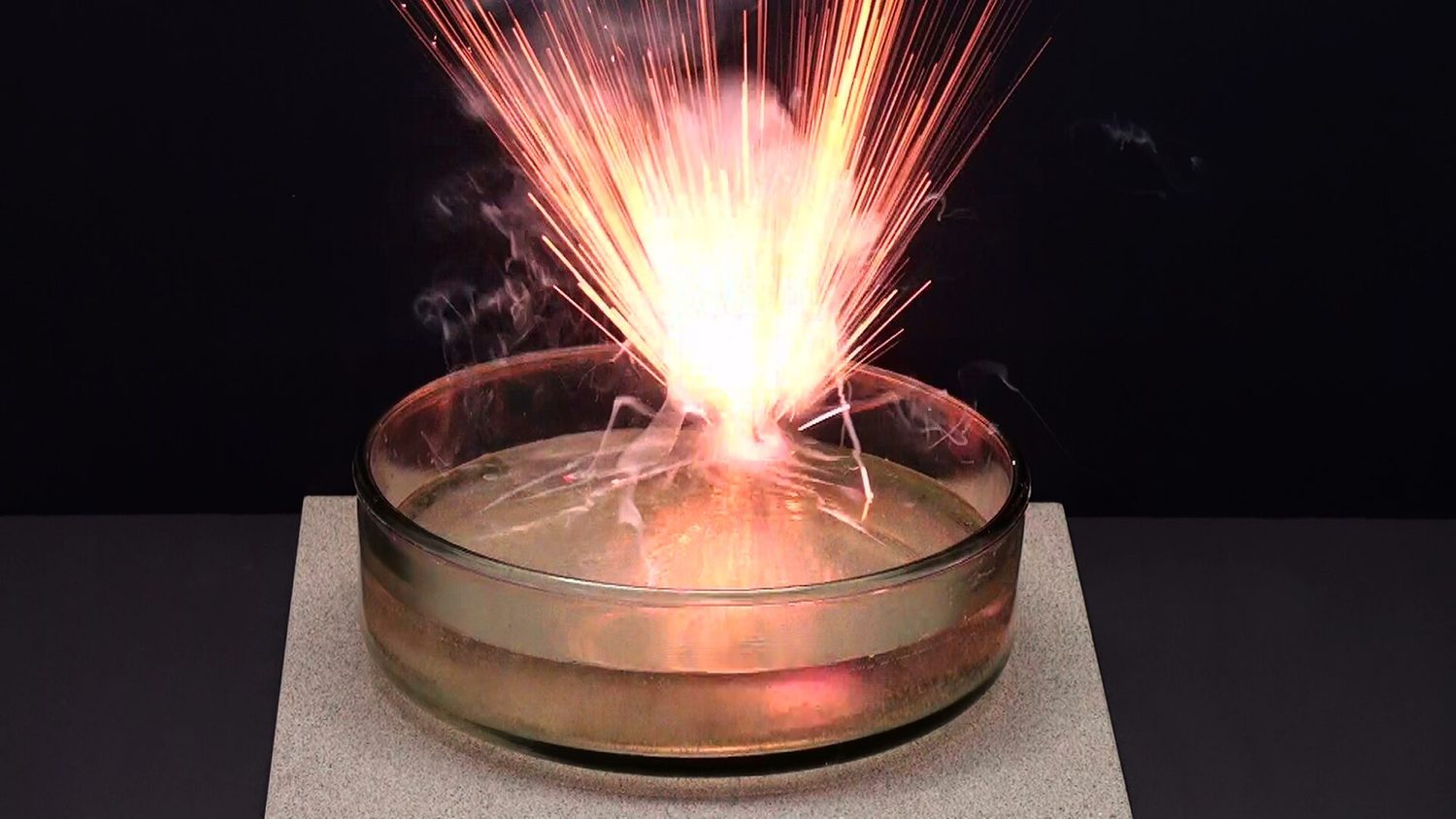
钾与水剧烈反应,放出以一个淡紫色火焰燃烧的氢——活泼性沿族 I 向下增加 
每个族 I 原子在它的外层有一个电子,这就是为什么它们以相似的方式反应 沿族向下,有清晰的趋势(trends):
性质 沿族向下的趋势 熔点(melting point) 减小 密度(density) 增大 活泼性(reactivity) 增大 你可以用这些趋势来预测其他族 I 元素的性质。例如,铷(在钾下面)会甚至更活泼并有一个甚至更低的熔点。
Reaction with water, and what you see
这是考试问得最多的反应。每一种族 I 金属都与水反应,生成一种碱(金属氢氧化物)加上氢气 —— 这正是它们被称为碱金属的原因:
$$2\text{Na} + 2\text{H}_2\text{O} \rightarrow 2\text{NaOH} + \text{H}_2$$"描述你看到的现象"本身就有分,所以要记住钠在水面上的这份清单:
- 它浮在水面 —— 这种金属的密度比水小。
- 它熔化成一个小球 —— 反应放热,而且这种金属的熔点很低。
- 它在水面上四处移动 —— 喷出的氢气推着它跑。
- 有泡腾(effervescence,冒泡)—— 那是逸出的氢气。
- 它越来越小并消失,因为被消耗掉了。
- 溶液变成碱性,所以万用指示剂变紫色(现在它是 $\text{NaOH}$)。
这个趋势体现在反应有多剧烈上:锂平稳地冒泡但不熔化;钠熔化成小球并四处窜动;钾快到足以点燃它自己产生的氢气,燃烧时带淡紫色火焰。有两个答案要避免:"放出氢气"不是观察现象(你看不见它 —— 要写泡腾),而且金属熔化是因为反应放热,不是因为"水很热"。
探索Group I trend lab
Follow Group I metals down the group and watch reactivity increase.
词汇表 训练英文 中文 拼音 alkali metals/ˈælkəlaɪ ˈmetlz/ 碱金属 jiǎn jīn shǔ lithium/ˈlɪθɪəm/ 锂 lǐ sodium/ˈsəʊdɪəm/ 钠 nà potassium/pəˈtæsɪəm/ 钾 jiǎ soft/sɒft/ 柔软 róu ruǎn trends/trendz/ 趋势 qū shì melting point/ˈmeltɪŋ pɔɪnt/ 熔点 róng diǎn density/ˈdensɪti/ 密度 mì dù reactivity/rɪəkˈtɪvɪti/ 活泼性 huó pō xìng effervescence/ˌefəˈvesəns/ 泡腾 pào téng 8.3
第VII族的性质

大纲
Core Supplement 1 Describe the Group VII halogens, chlorine, bromine and iodine, as diatomic non-metals with general trends down the group, limited to: (a) increasing density (b) decreasing reactivity 2 State the appearance of the halogens at r.t.p. as: (a) chlorine, a pale yellow-green gas (b) bromine, a red-brown liquid (c) iodine, a grey-black solid 3 Describe and explain the displacement reactions of halogens with other halide ions 4 Predict the properties of other elements in Group VII, given information about the elements 来源:剑桥国际大纲
族 VII 元素是卤素(halogens):氯气(chlorine)、溴(bromine)和碘(iodine)。它们是双原子(diatomic)非金属(每个分子由两个原子构成,如 $\text{Cl}_2$)。
它们在室温和压强下的外观:
卤素 外观 氯气 一种淡黄绿色气体 溴 一种红棕色液体 碘 一种灰黑色固体 沿族向下,密度增大但活泼性减小(与族 I 相反的趋势)。
族 I 沿族向下变得更活泼,而族 VII 沿族向下变得不那么活泼——相反的趋势 Displacement reactions
一个更活泼的卤素把一个较不活泼的卤化物(halide)离子从它的溶液中推出(置换)。这是一个置换反应(displacement reaction)。
例如,氯比溴更活泼,所以氯从溴化钾中置换溴:
$$\text{Cl}_2 + 2\text{KBr} \rightarrow 2\text{KCl} + \text{Br}_2$$
氯更活泼,所以它从溶液中置换溴;释放的溴使无色溶液变橙 例题。 把氯水加入碘化钾溶液;再把碘水加入溴化钾溶液。各自会发生什么?第 VII 族中活泼性向下递减:氯,然后是溴,然后是碘。(a) 氯在碘之上,所以更活泼,能把碘置换出来:$\text{Cl}_2 + 2\text{KI} \rightarrow 2\text{KCl} + \text{I}_2$,随着碘被释放,溶液变成红棕色。(b) 碘在溴之下,所以活泼性更低,无法置换溴 - 没有反应,也没有颜色变化。"没有反应"是一个完整且能得分的答案:写任何方程式之前,先看看它们在族中的顺序。
探索Group VII trend lab
Follow halogens down the group and watch reactivity decrease.
词汇表 训练英文 中文 拼音 halogens/ˈhælədʒnz/ 卤素 lǔ sù chlorine/ˈklɔːriːn/ 氯气 lǜ qì bromine/ˈbrəʊmaɪn/ 溴 xiù iodine/ˈaɪədiːn/ 碘 diǎn diatomic/ˌdaɪəˈtɒmɪk/ 双原子 shuāng yuán zi halide/ˈhælaɪd/ 卤化物 lǔ huà wù displacement reaction/dɪˈspleɪsmənt rɪˈækʃn/ 置换反应 zhì huàn fǎn yìng 8.4
过渡元素
大纲
Core Supplement 1 Describe the transition elements as metals that: (a) have high densities (b) have high melting points (c) form coloured compounds (d) often act as catalysts as elements and in compounds 2 Describe transition elements as having ions with variable oxidation numbers, including iron(II) and iron(III) 来源:剑桥国际大纲
过渡元素(transition elements)是周期表中间的金属块。与族 I 金属相比,它们:
- 有高的密度;
- 有高的熔点;
- 构成有色(coloured)化合物(compounds);
- 常常充当催化剂,既作为元素又在化合物中。
它们也能有可变(variable)的氧化数(oxidation numbers)。例如,铁(iron)构成铁(II)和铁(III)化合物两者。
探索Transition element lab
Match transition-metal properties to real examples.
词汇表 训练英文 中文 拼音 transition elements/trænˈsɪʃn ˈelɪmənts/ 过渡元素 guò dù yuán sù coloured/ˈkʌləd/ 有色 yǒu sè compounds/ˈkɒmpaʊndz/ 化合物 huà hé wù variable/ˈveərɪəbl/ 可变 kě biàn oxidation numbers/ˌɒksɪˈdeɪʃn ˈnʌmbəz/ 氧化数 yǎng huà shù iron/ˈaɪən/ 铁 tiě 8.5
稀有气体
大纲
Core Supplement 1 Describe the Group VIII noble gases as unreactive, monatomic gases and explain this in terms of electronic configuration 来源:剑桥国际大纲
族 VIII 稀有气体(noble gases)是不活泼(unreactive)、单原子(monatomic)的气体(它们作为单个原子存在,不作为分子)。
它们不活泼,因为它们已经有一个满的外层电子。这使它们稳定,所以它们不需要获得、失去或共享电子。
探索Noble gas lab
Classify noble gas uses by the property that makes them useful.
词汇表 训练英文 中文 拼音 noble gases/ˈnəʊbl ˈɡæsɪz/ 稀有气体 xī yǒu qì tǐ unreactive/ʌnrɪˈæktɪv/ 不活泼 bù huó pō monatomic/ˌmɒnəˈtɒmɪk/ 单原子 dān yuán zi 8.5
考试技巧
- 周期表按质子数排序。同一个族(列)中的元素有相同数目的外层电子,所以它们以相似的方式反应;周期是行。
- 族 I(碱金属)沿族向下变得更活泼;族 VII(卤素)沿族向下变得不那么活泼——相反的趋势。
- 一个更活泼的卤素置换一个较不活泼的从它盐的溶液中——例如氯置换溴。
- 稀有气体不活泼,因为它们有一个满的外层。过渡元素硬而致密、构成有色化合物、充当催化剂并有可变的氧化数。
-
9
金属
9.1
金属的性质

大纲
Core Supplement 1 Compare the general physical properties of metals and non-metals, including: (a) thermal conductivity (b) electrical conductivity (c) malleability and ductility (d) melting points and boiling points 2 Describe the general chemical properties of metals, limited to their reactions with: (a) dilute acids (b) cold water and steam (c) oxygen 来源:剑桥国际大纲
Physical properties
金属(metals)和非金属(non-metals)表现得非常不同:
性质 金属 非金属 导热性(thermal conductivity,导热) 好 差 导电性(electrical conductivity) 好 差(石墨除外) 展性(malleability)和延性(ductility) 有展性和延性 易碎(brittle,它们折断) 熔点(melting point)和沸点(boiling point) 通常高 通常低 Chemical properties
金属以三种主要方式反应:
- 与稀酸(acids)→ 一个盐(salt)+ 氢气(hydrogen)
- 与冷水或蒸汽(steam)→ 一个金属氢氧化物(或氧化物)+ 氢气
- 与氧气(oxygen)→ 一个金属氧化物(oxide)
Native copper: metals are shiny, dense, malleable conductors of heat and electricity 探索Metallic bonding
Positive ions sit in a sea of delocalised electrons — that is why metals conduct and bend. Push the layers and the bond holds.
探索Metal property lab
Link metal properties to the particle model.
词汇表 训练英文 中文 拼音 metals/ˈmetlz/ 金属 jīn shǔ non-metals/nɒn ˈmetlz/ 非金属 fēi jīn shǔ thermal conductivity/ˈθɜːml kɒndəkˈtɪvɪti/ 导热性 dǎo rè xìng electrical conductivity/ɪˈlektrɪkl kɒndəkˈtɪvɪti/ 导电性 dǎo diàn xìng malleability/ˌmæləˈbɪlɪti/ 展性 zhǎn xìng ductility/dʌkˈtɪlɪti/ 延性 yán xìng brittle/ˈbrɪtl/ 易碎 yì suì melting point/ˈmeltɪŋ pɔɪnt/ 熔点 róng diǎn boiling point/ˈbɔɪlɪŋ pɔɪnt/ 沸点 fèi diǎn acids/ˈæsɪdz/ 酸 suān salt/sɒlt/ 盐 yán hydrogen/ˈhaɪdrədʒn/ 氢气 qīng qì steam/stiːm/ 蒸汽 zhēng qì oxygen/ˈɒksɪdʒn/ 氧气 yǎng qì oxide/ˈɒksaɪd/ 氧化物 yǎng huà wù copper/ˈkɒpə/ 铜 tóng 9.2
金属的用途
大纲
Core Supplement 1 Describe the uses of metals in terms of their physical properties, including: (a) aluminium in the manufacture of aircraft because of its low density (b) aluminium in the manufacture of overhead electrical cables because of its low density and good electrical conductivity (c) aluminium in food containers because of its resistance to corrosion (d) copper in electrical wiring because of its good electrical conductivity and ductility 来源:剑桥国际大纲
一种金属因为它的物理性质被选来做一件工作。
- 铝(aluminium)因为它低的密度(density,它轻)被用来制造飞机。
- 铝因为它低的密度和好的导电性被用于架空电缆。
- 铝因为它抵抗腐蚀(corrosion)被用于食物容器。
- 铜(copper)因为它好的导电性和它的延性(它能被拉成线)被用于电线。
探索Metal use lab
Choose the property that explains each metal use.
词汇表 训练英文 中文 拼音 density/ˈdensɪti/ 密度 mì dù corrosion/kəˈrəʊʒn/ 腐蚀 fǔ shí 9.3
合金及其性质

大纲
Core Supplement 1 Describe an alloy as a mixture of a metal with other elements, including: (a) brass as a mixture of copper and zinc (b) stainless steel as a mixture of iron and other elements such as chromium, nickel and carbon 2 State that alloys can be harder and stronger than the pure metals and are more useful 5 Explain in terms of structure how alloys can be harder and stronger than the pure metals because the different sized atoms in alloys mean the layers can no longer slide over each other 3 Describe the uses of alloys in terms of their physical properties, including stainless steel in cutlery because of its hardness and resistance to rusting 4 Identify representations of alloys from diagrams of structure 来源:剑桥国际大纲
一个合金(alloy)是一种金属与一种或多种其他元素的一个混合物(mixture)。
- 黄铜(brass)是铜和锌(zinc)的一个混合物。
- 不锈钢(stainless steel)是铁(iron)与其他元素如铬(chromium)、镍(nickel)和碳(carbon)的一个混合物。
合金通常比纯金属更硬、更强,这使它们更有用。例如,不锈钢因为它硬且不生锈被用于餐具。
为什么合金更硬。 在一个纯金属中,原子(atoms)都是同样的大小,所以层(layers)能容易地互相滑过。在一个合金中,不同大小的原子阻止层滑动,所以合金更硬、更强。
在一个合金中,不同大小的原子阻止层互相滑过,所以合金比纯金属更硬 探索Alloy property lab
See why mixing atoms changes metal properties.
词汇表 训练英文 中文 拼音 alloy/ˈælɔɪ/ 合金 hé jīn mixture/ˈmɪkstʃə/ 混合物 hùn hé wù brass/bræs/ 黄铜 huáng tóng zinc/zɪŋk/ 锌 xīn stainless steel/ˈsteɪnləs stiːl/ 不锈钢 bù xiù gāng iron/ˈaɪən/ 铁 tiě chromium/ˈkrəʊmɪəm/ 铬 gè nickel/ˈnɪkl/ 镍 niè carbon/ˈkɑːbən/ 碳 tàn atoms/ˈætəmz/ 原子 yuán zi layers/ˈleɪəz/ 层 céng 9.4
金属活动性顺序

大纲
Core Supplement 1 State the order of the reactivity series as: potassium, sodium, calcium, magnesium, aluminium, carbon, zinc, iron, hydrogen, copper, silver, gold 4 Describe the relative reactivities of metals in terms of their tendency to form positive ions, by displacement reactions, if any, with the aqueous ions of magnesium, zinc, iron, copper and silver 2 Describe the reactions, if any, of: (a) potassium, sodium and calcium with cold water (b) magnesium with steam (c) magnesium, zinc, iron, copper, silver and gold with dilute hydrochloric acid and explain these reactions in terms of the position of the metals in the reactivity series 5 Explain the apparent unreactivity of aluminium in terms of its oxide layer 3 Deduce an order of reactivity from a given set of experimental results 来源:剑桥国际大纲
金属活动性顺序(reactivity series)按金属有多活泼的顺序列出它们。碳和氢被包括以供比较:
钾(potassium)、钠(sodium)、钙(calcium)、镁(magnesium)、铝、碳、锌、铁、氢、铜、银、金
(最活泼在顶部,最不活泼在底部)
碳之上的金属通过电解提取;碳之下的能通过与碳加热提取 一种金属越高,它越容易构成正离子(ions)。这解释它的反应:
- 钾、钠和钙与冷水反应。
- 镁与蒸汽反应(但只非常缓慢地与冷水)。
- 镁、锌和铁与稀盐酸反应;铜、银和金不反应。
Displacement reactions
一种更活泼的金属会从一种较不活泼金属离子的溶液中置换它(一个置换反应(displacement reaction))。例如,锌从硫酸铜(II)溶液中置换铜,因为锌比铜更活泼:
$$\text{Zn} + \text{CuSO}_4 \rightarrow \text{ZnSO}_4 + \text{Cu}$$要能说出你会看到什么,因为那是单独的分点:
- 溶液的蓝色变淡 —— 蓝色的 $\text{Cu}^{2+}$ 离子正在被消耗(硫酸锌是无色的)。
- 锌上覆盖了一层粉棕色固体 —— 那就是被置换出来的铜。
- 灰色的锌溶解并变小。
- 混合物变热 —— 置换反应放热。
金属与酸的反应有它自己的清单:泡腾(effervescence,逸出的氢气)以及固体溶解。如果是氧化铜(II)或碳酸铜与酸反应,还要加上溶液变蓝。绝不要把"放出氢气"当作观察现象 —— 你看不见这种气体,只能看见气泡,所以要写泡腾。
例题。 锌和铝都以氧化物的形式存在。哪一个能用碳加热提取?为什么?找出每种金属相对于碳在金属活动性顺序中的位置。锌在碳之下,所以碳是两者中更活泼的,能把氧从它那里夺走:氧化锌可以用碳加热还原。铝在碳之上,所以碳的活泼性不足以置换它,铝必须改用电解提取 - 这就是铝的提取成本高得多的原因。决定方法的那条线是碳所在的位置,而不是这个顺序表的顶端。
The special case of aluminium
铝看起来比它的位置所暗示的不那么活泼。这是因为它被一个薄的、强的氧化层(oxide layer)覆盖,它阻止其他物质到达下面的金属。
探索Displacement and the reactivity series
Step through a displacement. A more reactive metal pushes a less reactive one out of its compound — which is exactly what the reactivity series predicts.
词汇表 训练英文 中文 拼音 aluminium/ˌæljʊˈmɪnɪəm/ 铝 lǚ reactivity series/rɪəkˈtɪvɪti ˈsɪəriːz/ 金属活动性顺序 jīn shǔ huó dòng xìng shùn xù potassium/pəˈtæsɪəm/ 钾 jiǎ sodium/ˈsəʊdɪəm/ 钠 nà calcium/ˈkælsɪəm/ 钙 gài magnesium/mæɡˈniːzɪəm/ 镁 měi ions/ˈaɪɒnz/ 离子 lí zi displacement reaction/dɪˈspleɪsmənt rɪˈækʃn/ 置换反应 zhì huàn fǎn yìng oxide layer/ˈɒksaɪd ˈleɪə/ 氧化层 yǎng huà céng effervescence/ˌefəˈvesəns/ 泡腾 pào téng 9.5
金属的腐蚀

大纲
Core Supplement 1 State the conditions required for the rusting of iron and steel to form hydrated iron(III) oxide 2 State some common barrier methods, including painting, greasing and coating with plastic 4 Describe the use of zinc in galvanising as an example of a barrier method and sacrificial protection 3 Describe how barrier methods prevent rusting by excluding oxygen or water 5 Explain sacrificial protection in terms of the reactivity series and in terms of electron loss 来源:剑桥国际大纲
腐蚀慢慢侵蚀未受保护的金属。 生锈(rusting)是铁和钢的腐蚀。生锈需要两样东西:氧气(从空气)和水。构成的铁锈(rust)是水合氧化铁(III)。

海水和空气把这根铁链锈得很厉害——锈是水合氧化铁(III) 
生锈需要水和氧气两者——钉只在有两者的管中生锈 Stopping rust
隔离法(barrier methods)把氧气和水挡在离铁远处:
- 涂漆、涂油(用油覆盖),以及用塑料涂层。
镀锌(galvanising)意味着用一层锌涂层铁。这以两种方式起作用:
- 它是一个屏障(锌挡住空气和水);
- 它给牺牲保护(sacrificial protection)。因为锌比铁更活泼,锌失去电子(electrons)并代替铁腐蚀——即使表面被划伤。

更活泼的锌腐蚀并把它的电子给铁,所以铁即使在表面被划伤的地方也受保护 探索Why iron rusts — and how to stop it
Step through rusting. Iron needs BOTH water and oxygen, and once it starts the rust flakes off to expose fresh metal — which is why we protect iron.
词汇表 训练英文 中文 拼音 rusting/ˈrʌstɪŋ/ 生锈 shēng xiù rust/rʌst/ 铁锈 tiě xiù barrier methods/ˈbærɪə ˈmeθədz/ 隔离法 gé lí fǎ galvanising/ˈɡælvənaɪzɪŋ/ 镀锌 dù xīn sacrificial protection/ˌsækrɪˈfɪʃl prəˈtekʃn/ 牺牲保护 xī shēng bǎo hù electrons/ɪˈlektrɒnz/ 电子 diàn zi 9.6
金属的提取

大纲
Core Supplement 1 Describe the ease in obtaining metals from their ores, related to the position of the metal in the reactivity series 2 Describe the extraction of iron from hematite in the blast furnace, limited to: (a) the burning of carbon (coke) to provide heat and produce carbon dioxide (b) the reduction of carbon dioxide to carbon monoxide (c) the reduction of iron(III) oxide by carbon monoxide (d) the thermal decomposition of calcium carbonate/limestone to produce calcium oxide (e) the formation of slag Symbol equations are not required 4 State the symbol equations for the extraction of iron from hematite (a) $\text{C} + \text{O}_2 \rightarrow \text{CO}_2$ (b) $\text{C} + \text{CO}_2 \rightarrow 2\text{CO}$ (c) $\text{Fe}_2\text{O}_3 + 3\text{CO} \rightarrow 2\text{Fe} + 3\text{CO}_2$ (d) $\text{CaCO}_3 \rightarrow \text{CaO} + \text{CO}_2$ (e) $\text{CaO} + \text{SiO}_2 \rightarrow \text{CaSiO}_3$ 3 State that the main ore of aluminium is bauxite and that aluminium is extracted by electrolysis 5 Describe the extraction of aluminium from purified bauxite/aluminium oxide, including: (a) the role of cryolite (b) why the carbon anodes need to be regularly replaced (c) the reactions at the electrodes, including ionic half-equations Details of the purification of bauxite are not required 来源:剑桥国际大纲
一种金属如何从它的矿石(ore)中取出取决于它在金属活动性顺序中的位置。碳之下的金属能通过与碳加热(它移除氧)提取。碳之上的金属对这个太活泼,必须通过电解(electrolysis)提取。
碳之上的金属需要电解;碳之下的与碳加热 Iron from the blast furnace
铁在一个高炉(blast furnace)中从它的矿石赤铁矿(hematite,氧化铁(III))提取:
- 碳(焦炭)在热空气中燃烧以给出二氧化碳和大量的热。
- 这个二氧化碳(carbon dioxide)与更多的碳反应以构成一氧化碳(carbon monoxide)。
- 一氧化碳把氧化铁(III)还原成铁(这是还原(reduction))。
- 石灰石(limestone,碳酸钙)在热中分解以构成氧化钙(calcium oxide)。
- 氧化钙与沙质杂质反应以构成炉渣(slag),它被移除。

在高炉中,一氧化碳还原铁矿石,而石灰石以炉渣移除沙质杂质 Aluminium by electrolysis
铝通过电解从它的矿石铝土矿(bauxite,提纯成氧化铝)提取:
- 氧化铝被溶解在熔融的冰晶石(cryolite)中以降低它的熔点并节省能量。
- 在阴极(cathode),铝离子获得电子以构成铝金属。
- 在阳极(anode),氧气被构成。这个氧气与热的碳阳极反应并把它们烧掉,所以它们必须被定期替换。
探索Extracting iron in the blast furnace
Iron is below carbon in reactivity, so carbon can reduce its ore to the metal.
词汇表 训练英文 中文 拼音 ore/ɔː/ 矿石 kuàng shí electrolysis/ɪlekˈtrɒləsɪs/ 电解 diàn jiě hematite/ˈhemətaɪt/ 赤铁矿 chì tiě kuàng blast furnace/blæst ˈfɜːnɪs/ 高炉 gāo lú carbon dioxide/ˈkɑːbən daɪˈɒksaɪd/ 二氧化碳 èr yǎng huà tàn carbon monoxide/ˈkɑːbən mʌˈnɒksaɪd/ 一氧化碳 yī yǎng huà tàn reduction/rɪˈdʌkʃn/ 还原 huán yuán limestone/ˈlaɪmstəʊn/ 石灰石 shí huī shí calcium oxide/ˈkælsɪəm ˈɒksaɪd/ 氧化钙 yǎng huà gài slag/slæɡ/ 炉渣 lú zhā bauxite/ˈbɔːksaɪt/ 铝土矿 lǚ tǔ kuàng cryolite/ˈkraɪəlaɪt/ 冰晶石 bīng jīng shí cathode/ˈkæθəʊd/ 阴极 yīn jí anode/ˈænəʊd/ 阳极 yáng jí 9.6
考试技巧
- 学习金属活动性顺序(钾 → 金)。一种更活泼的金属从一种它离子的溶液中置换一种较不活泼的。
- 碳之上的金属通过电解提取;碳之下的(如铁)能通过与碳加热提取。
- 生锈需要水和氧气两者。隔离法(漆、油)把它们挡在外面;镀锌也给牺牲保护,因为更活泼的锌代替铁腐蚀。
- 合金比纯金属更硬,因为不同大小的原子阻止离子的层互相滑过。
-
10
环境化学
10.1
水

大纲
Core Supplement 1 Describe chemical tests for the presence of water using anhydrous cobalt(II) chloride and anhydrous copper(II) sulfate 2 Describe how to test for the purity of water using melting point and boiling point 3 Explain that distilled water is used in practical chemistry rather than tap water because it contains fewer chemical impurities 4 State that water from natural sources may contain substances, including: (a) dissolved oxygen (b) metal compounds (c) plastics (d) sewage (e) harmful microbes (f) nitrates from fertilisers (g) phosphates from fertilisers and detergents 5 State that some of these substances are beneficial, including: (a) dissolved oxygen for aquatic life (b) some metal compounds provide essential minerals for life 6 State that some of these substances are potentially harmful, including: (a) some metal compounds are toxic (b) some plastics harm aquatic life (c) sewage contains harmful microbes which cause disease (d) nitrates and phosphates lead to deoxygenation of water and damage to aquatic life Details of the eutrophication process are not required 7 Describe the treatment of the domestic water supply in terms of: (a) sedimentation and filtration to remove solids (b) use of carbon to remove tastes and odours (c) chlorination to kill microbes 来源:剑桥国际大纲
Testing for water
两个化学测试显示水存在:
- 无水(anhydrous)氯化钴(II)在加水时从蓝色变粉色。
- 无水硫酸铜(II)在加水时从白色变蓝色。
这些测试只显示水在那里。要显示水是纯的,你测试它的熔点(melting point)和沸点(boiling point):纯水恰好在 $0\,{}^{\circ}\text{C}$ 熔化、恰好在 $100\,{}^{\circ}\text{C}$ 沸腾。任何溶解的物质都改变这些值。
颜色变化测试显示水存在;固定的熔点和沸点显示它是纯的 这就是为什么化学中用蒸馏水(distilled water)而不是自来水——它有少得多的化学杂质(impurities)。
What is in natural water
来自河流、湖泊和海洋的水不是纯的。它可能含有溶解的氧气(oxygen)、金属化合物、塑料、污水(sewage)、有害的微生物(microbes),以及硝酸盐(nitrates)和磷酸盐(phosphates,来自化肥和洗涤剂)。
这些中的一些是有帮助的:
- 溶解的氧气让水生生物(aquatic life,鱼和植物)呼吸;
- 一些金属化合物给必需的矿物质(minerals)。
其他的是有害的:
- 一些金属化合物是有毒(toxic)的;
- 一些塑料伤害水生生物;
- 污水携带引起疾病的微生物;
- 硝酸盐和磷酸盐引起水中的缺氧(deoxygenation,氧的流失),它伤害水生生物。
Treating drinking water
要使水安全饮用,水供应分步骤被处理:
- 沉降(sedimentation)和过滤(filtration)移除固体碎片;
- 让它通过碳(carbon)移除坏的味道和气味;
- 氯消毒(chlorination,加氯)杀死有害的微生物。

水分步骤被做成安全饮用:沉出大碎片、过滤、用碳移除味道,然后氯消毒 探索Water treatment lab
Classify water processes by what they remove or change.
词汇表 训练英文 中文 拼音 anhydrous/ænˈhaɪdrəs/ 无水 wú shuǐ melting point/ˈmeltɪŋ pɔɪnt/ 熔点 róng diǎn boiling point/ˈbɔɪlɪŋ pɔɪnt/ 沸点 fèi diǎn distilled water/dɪˈstɪld ˈwɔːtə/ 蒸馏水 zhēng liú shuǐ impurities/ɪmˈpjʊərɪtiz/ 杂质 zá zhì oxygen/ˈɒksɪdʒn/ 氧气 yǎng qì sewage/ˈsuːɪdʒ/ 污水 wū shuǐ microbes/ˈmaɪkrəʊbz/ 微生物 wēi shēng wù nitrates/ˈnaɪtreɪts/ 硝酸盐 xiāo suān yán phosphates/ˈfɒsfeɪts/ 磷酸盐 lín suān yán aquatic life/əˈkwætɪk laɪf/ 水生生物 shuǐ shēng shēng wù minerals/ˈmɪnərəlz/ 矿物质 kuàng wù zhì toxic/ˈtɒksɪk/ 有毒 yǒu dú deoxygenation/diːˌɒksɪdʒəˈneɪʃn/ 缺氧 quē yǎng sedimentation/ˌsedɪmənˈteɪʃn/ 沉降 chén jiàng filtration/fɪlˈtreɪʃn/ 过滤 guò lǜ carbon/ˈkɑːbən/ 碳 tàn chlorination/ˌklɔːrɪˈneɪʃn/ 氯消毒 lǜ xiāo dú 10.2
化肥

大纲
Core Supplement 1 State that ammonium salts and nitrates are used as fertilisers 2 Describe the use of NPK fertilisers to provide the elements nitrogen, phosphorus and potassium for improved plant growth 来源:剑桥国际大纲
肥料(fertilisers)被加到土壤以帮助植物生长。铵盐和硝酸盐是常见的肥料。
NPK 肥料含有植物最需要的三种元素:氮气(nitrogen)、磷(phosphorus)和钾(potassium)。
NPK 肥料供应植物最需要的三种元素:氮、磷和钾 探索Fertiliser route lab
Follow nitrogen from raw materials to crop growth.
词汇表 训练英文 中文 拼音 fertilisers/ˈfɜːtəlaɪzəz/ 肥料 féi liào nitrogen/ˈnaɪtrədʒn/ 氮气 dàn qì phosphorus/ˈfɒsfɔːrəs/ 磷 lín potassium/pəˈtæsɪəm/ 钾 jiǎ 10.3
空气质量与气候

大纲
Core Supplement 1 State the composition of clean, dry air as approximately 78% nitrogen, $\text{N}_2$, 21% oxygen, $\text{O}_2$ and the remainder as a mixture of noble gases and carbon dioxide, $\text{CO}_2$ 2 State the source of each of these air pollutants, limited to: (a) carbon dioxide from the complete combustion of carbon-containing fuels (b) carbon monoxide and particulates from the incomplete combustion of carbon-containing fuels (c) methane from the decomposition of vegetation and waste gases from digestion in animals (d) oxides of nitrogen from car engines (e) sulfur dioxide from the combustion of fossil fuels which contain sulfur compounds 3 State the adverse effect of these air pollutants, limited to: (a) carbon dioxide: higher levels of carbon dioxide leading to increased global warming, which leads to climate change (b) carbon monoxide: toxic gas (c) particulates: increased risk of respiratory problems and cancer (d) methane: higher levels of methane leading to increased global warming, which leads to climate change (e) oxides of nitrogen: acid rain, photochemical smog and respiratory problems (f) sulfur dioxide: acid rain 7 Describe how the greenhouse gases carbon dioxide and methane cause global warming, limited to: (a) the absorption, reflection and emission of thermal energy (b) reducing thermal energy loss to space 4 State and explain strategies to reduce the effects of these environmental issues, limited to: (a) climate change: planting trees, reduction in livestock farming, decreasing use of fossil fuels, increasing use of hydrogen and renewable energy, e.g. wind, solar (b) acid rain: use of catalytic converters in vehicles, reducing emissions of sulfur dioxide by using low-sulfur fuels and flue gas desulfurisation with calcium oxide 8 Explain how oxides of nitrogen form in car engines and describe their removal by catalytic converters, e.g. $2\text{CO} + 2\text{NO} \rightarrow 2\text{CO}_2 + \text{N}_2$ 5 Describe photosynthesis as the reaction between carbon dioxide and water to produce glucose and oxygen in the presence of chlorophyll and using energy from light 6 State the word equation for photosynthesis, carbon dioxide + water $\rightarrow$ glucose + oxygen 9 State the symbol equation for photosynthesis, $6\text{CO}_2 + 6\text{H}_2\text{O} \rightarrow \text{C}_6\text{H}_{12}\text{O}_6 + 6\text{O}_2$ 来源:剑桥国际大纲
燃烧化石燃料污染空气并改变气候。 干净、干燥的空气大约是:
- 78% 氮气($\text{N}_2$)
- 21% 氧气($\text{O}_2$)
- 其余是稀有气体(noble gases)和二氧化碳($\text{CO}_2$)的一个混合物。

干净、干燥的空气约是 78% 氮、21% 氧,和 1% 其他气体(稀有气体和二氧化碳) Air pollutants and their sources
污染物 主要来源 二氧化碳($\text{CO}_2$) 含碳燃料的完全燃烧(complete combustion) 一氧化碳(carbon monoxide)和颗粒物(particulates) 含碳燃料的不完全燃烧(incomplete combustion) 甲烷(methane) 腐烂的植物和来自动物消化的废气 氮氧化物(oxides of nitrogen) 汽车发动机 二氧化硫 烧含硫(sulfur)的化石燃料(fossil fuels) Effects of these pollutants
- 二氧化碳(carbon dioxide)和甲烷是温室气体(greenhouse gases):它们更多引起全球变暖(global warming),它导致气候变化(climate change)。
- 一氧化碳是一种有毒气体。
- 颗粒物增加呼吸(respiratory)问题和癌症(cancer)的风险。
- 氮氧化物引起酸雨(acid rain)、光化学烟雾(photochemical smog)和呼吸问题。
- 二氧化硫引起酸雨。
例题。 一座电厂燃烧含硫的煤,下风处的一个湖慢慢变酸。说出污染物,解释其中的联系,并给出一种阻止的办法。燃烧含硫的化石燃料会释放二氧化硫,它导致酸雨,所以落在湖上的雨是酸性的。要从源头阻止,可以使用烟气脱硫,让氧化钙在废气离开烟囱之前把二氧化硫除掉,或者改用低硫燃料。要让措施对准污染物:催化转化器处理的是汽车的氮氧化物,对燃煤电厂的二氧化硫毫无作用。
Reducing these problems
要减慢气候变化:种树、养更少的动物、烧更少的化石燃料,并用更多的氢和可再生能源(renewable energy)如风能和太阳能。
要减少酸雨:在汽车上安装催化转化器(catalytic converters)、用低硫燃料,并用带氧化钙(calcium oxide)的烟气脱硫(flue gas desulfurisation)从废气中移除二氧化硫。
一个催化转化器里面是一个涂了催化剂金属的蜂窝;许多微小的通道给一个巨大的表面积 How greenhouse gases warm the Earth
二氧化碳和甲烷等温室气体让阳光通过,但它们吸收温暖的地球放出的热能(thermal energy),并把它的一些送回下来。这减少损失到太空的热能,所以地球变得更暖。

温室气体让阳光通过但困住地球放出的热的一些,所以地球变暖 在一个汽车发动机中,高温使来自空气的氮和氧反应以构成氮氧化物。一个催化转化器移除它们,例如:
$$2\text{CO} + 2\text{NO} \rightarrow 2\text{CO}_2 + \text{N}_2$$Photosynthesis
光合作用(photosynthesis)是燃烧的反面——它从空气中移除二氧化碳。植物用光能和叶绿素(chlorophyll)把二氧化碳和水变成葡萄糖(glucose)和氧气:
$$6\text{CO}_2 + 6\text{H}_2\text{O} \rightarrow \text{C}_6\text{H}_{12}\text{O}_6 + 6\text{O}_2$$探索Air pollutant lab
Classify air gases by source and environmental effect.
探索Climate and air quality route
Trace emissions from combustion to atmospheric effects.
词汇表 训练英文 中文 拼音 noble gases/ˈnəʊbl ˈɡæsɪz/ 稀有气体 xī yǒu qì tǐ complete combustion/kəmˈpliːt kəmˈbʌstʃn/ 完全燃烧 wán quán rán shāo carbon monoxide/ˈkɑːbən mʌˈnɒksaɪd/ 一氧化碳 yī yǎng huà tàn particulates/pəˈtɪkjʊleɪts/ 颗粒物 kē lì wù incomplete combustion/ɪŋkəmˈpliːt kəmˈbʌstʃn/ 不完全燃烧 bù wán quán rán shāo methane/ˈmiːθeɪn/ 甲烷 jiǎ wán oxides of nitrogen/ˈɒksaɪdz ɒv ˈnaɪtrədʒn/ 氮氧化物 dàn yǎng huà wù fossil fuels/ˈfɒsl ˈfjuːəlz/ 化石燃料 huà shí rán liào sulfur/ˈsʌlfɜː/ 硫 liú carbon dioxide/ˈkɑːbən daɪˈɒksaɪd/ 二氧化碳 èr yǎng huà tàn greenhouse gases/ˈɡriːnhaʊs ˈɡæsɪz/ 温室气体 wēn shì qì tǐ global warming/ˈɡləʊbl ˈwɔːmɪŋ/ 全球变暖 quán qiú biàn nuǎn climate change/ˈklaɪmət tʃeɪndʒ/ 气候变化 qì hòu biàn huà respiratory/rɪˈspɪrətəri/ 呼吸 hū xī cancer/ˈkænsə/ 癌症 ái zhèng acid rain/ˈæsɪd reɪn/ 酸雨 suān yǔ photochemical smog/ˌfəʊtəʊˈkemɪkl smɒɡ/ 光化学烟雾 guāng huà xué yān wù renewable energy/rɪˈnjuːəbl ˈenədʒi/ 可再生能源 kě zài shēng néng yuán catalytic converters/ˌkætəˈlɪtɪk kənˈvɜːtəz/ 催化转化器 cuī huà zhuǎn huà qì flue gas desulfurisation/fluː ɡæs diːˌsʌlfjʊəraɪˈzeɪʃn/ 烟气脱硫 yān qì tuō liú calcium oxide/ˈkælsɪəm ˈɒksaɪd/ 氧化钙 yǎng huà gài thermal energy/ˈθɜːml ˈenədʒi/ 热能 rè néng photosynthesis/ˌfəʊtəʊˈsɪnθəsɪs/ 光合作用 guāng hé zuò yòng chlorophyll/ˌklɔːrəʊˈfɪl/ 叶绿素 yè lǜ sù glucose/ˈɡluːkəʊs/ 葡萄糖 pú táo táng 10.3
考试技巧
- 两个测试显示水存在(氯化钴(II)蓝 → 粉;硫酸铜(II)白 → 蓝),但只有固定的熔点和沸点(0 °C 和 100 °C)显示它是纯的。
- 干净、干燥的空气约是 78% 氮、21% 氧和 1% 其他气体(大多是稀有气体和二氧化碳)。
- 把每个污染物匹配到它的来源和效果:一氧化碳(不完全燃烧;有毒);二氧化硫和氮氧化物(酸雨);二氧化碳和甲烷(温室气体 → 全球变暖)。
- 温室气体让阳光通过但吸收温暖的地球放出的热并把一些送回下来,所以地球变暖。
-
11
有机化学
有机化学是碳化合物的化学。碳特殊,因为它能与其他碳原子连接以构成长链和环。
11.1
化学式、官能团与术语

大纲
Core Supplement 1 Draw and interpret the displayed formula of a molecule to show all the atoms and all the bonds 2 Write and interpret general formulae of compounds in the same homologous series, limited to: (a) alkanes, $\text{C}_n\text{H}_{2n+2}$ (b) alkenes, $\text{C}_n\text{H}_{2n}$ (c) alcohols, $\text{C}_n\text{H}_{2n+1}\text{OH}$ (d) carboxylic acids, $\text{C}_n\text{H}_{2n+1}\text{COOH}$ 3 Identify a functional group as an atom or group of atoms that determine the chemical properties of a homologous series 7 State that a structural formula is an unambiguous description of the way the atoms in a molecule are arranged, including $\text{CH}_2=\text{CH}_2$, $\text{CH}_3\text{CH}_2\text{OH}$, $\text{CH}_3\text{COOCH}_3$ 8 Define structural isomers as compounds with the same molecular formula, but different structural formulae, including $\text{C}_4\text{H}_{10}$ as $\text{CH}_3\text{CH}_2\text{CH}_2\text{CH}_3$ and $\text{CH}_3\text{CH}(\text{CH}_3)\text{CH}_3$ and $\text{C}_4\text{H}_8$ as $\text{CH}_3\text{CH}_2\text{CH}=\text{CH}_2$ and $\text{CH}_3\text{CH}=\text{CHCH}_3$ 4 State that a homologous series is a family of similar compounds with similar chemical properties due to the presence of the same functional group 9 Describe the general characteristics of a homologous series as: (a) having the same functional group (b) having the same general formula (c) differing from one member to the next by a –CH2– unit (d) displaying a trend in physical properties (e) sharing similar chemical properties 5 State that a saturated compound has molecules in which all carbon–carbon bonds are single bonds 6 State that an unsaturated compound has molecules in which one or more carbon–carbon bonds are not single bonds 来源:剑桥国际大纲
有几种书写一个有机分子的方式:
- 分子式(molecular formula)显示每种原子有多少个,例如 $\text{C}_2\text{H}_6$。
- 结构式(displayed formula)完整地画出每个原子和每个键。
- 结构简式(structural formula)在不画每个键的情况下显示原子如何排列,例如 $\text{CH}_3\text{CH}_2\text{OH}$。
- 通式(general formula)对一整个家族有效,例如烷烃的 $\text{C}_n\text{H}_{2n+2}$。
一个同系物(homologous series)是有相同官能团(functional group)的一个化合物家族——给这个家族它化学性质的原子或原子团。一个系列的成员有相同的通式、每一步相差一个 $\text{CH}_2$ 单元,并有相似的化学性质、物理性质逐渐变化。
系列 官能团 通式 烷烃 只有 C–C 单键 $\text{C}_n\text{H}_{2n+2}$ 烯烃 C=C 双键 $\text{C}_n\text{H}_{2n}$ 醇 –OH $\text{C}_n\text{H}_{2n+1}\text{OH}$ 羧酸 –COOH $\text{C}_n\text{H}_{2n+1}\text{COOH}$ 烷烃是一个同系物:每个成员多一个 $\text{CH}_2$ 单元(通式 $\text{C}_n\text{H}_{2n+2}$) 一个饱和(saturated)化合物只有碳–碳单键。一个不饱和(unsaturated)化合物有一个或多个不是单键的碳–碳键(如一个 C=C 双键)。

一个饱和化合物只有单 C–C 键;一个不饱和的有一个 C=C 双键 同分异构体(structural isomers)是有相同分子式但不同结构简式的化合物。例如,$\text{C}_4\text{H}_{10}$ 能是一个直链或一个支链。

同分异构体:丁烷和 2-甲基丙烷共享化学式 $\text{C}_4\text{H}_{10}$ 但有不同的结构 探索Functional group lab
Classify organic molecules by the group that controls their reactions.
词汇表 训练英文 中文 拼音 molecular formula/məˈlekjʊlə ˈfɔːmjʊlə/ 分子式 fēn zǐ shì displayed formula/dɪˈspleɪd ˈfɔːmjʊlə/ 结构式 jié gòu shì structural formula/ˈstrʌktʃərəl ˈfɔːmjʊlə/ 结构简式 jié gòu jiǎn shì general formula/ˈdʒenərəl ˈfɔːmjʊlə/ 通式 tōng shì homologous series/həˈmɒləɡəs ˈsɪəriːz/ 同系物 tóng xì wù functional group/ˈfʌŋkʃənl ɡruːp/ 官能团 guān néng tuán saturated/ˈsætʃəreɪtɪd/ 饱和 bǎo hé unsaturated/ʌnˈsætʃəreɪtɪd/ 不饱和 bù bǎo hé Structural isomers/ˈstrʌktʃərəl ˈaɪsəməz/ 同分异构体 tóng fēn yì gòu tǐ 11.2
有机化合物的命名
大纲
Core Supplement 1 Name and draw the displayed formulae of: (a) methane and ethane (b) ethene (c) ethanol (d) ethanoic acid (e) the products of the reactions stated in sections 11.4–11.7 3 Name and draw the structural and displayed formulae of unbranched: (a) alkanes (b) alkenes, including but-1-ene and but-2-ene (c) alcohols, including propan-1-ol, propan-2-ol, butan-1-ol and butan-2-ol (d) carboxylic acids containing up to four carbon atoms per molecule 2 State the type of compound present, given a chemical name ending in -ane, -ene, -ol, or -oic acid or from a molecular formula or displayed formula 4 Name and draw the displayed formulae of the unbranched esters which can be made from unbranched alcohols and carboxylic acids, each containing up to four carbon atoms 来源:剑桥国际大纲
名称的结尾告诉你家族:
结尾 家族 例子 -ane 烷烃 甲烷、乙烷 -ene 烯烃 乙烯 -ol 醇 乙醇 -oic acid 羧酸 乙酸 名称的开头告诉你碳原子的数目:meth- = 1、eth- = 2、prop- = 3、but- = 4。对于更长的烯烃和醇,一个数字显示官能团在哪里,例如 but-1-ene 和 but-2-ene,或 propan-1-ol 和 propan-2-ol。
探索Organic naming route
Follow the route from structure to systematic name.
11.3
燃料

大纲
Core Supplement 1 Name the fossil fuels: coal, natural gas and petroleum 2 Name methane as the main constituent of natural gas 3 State that hydrocarbons are compounds that contain hydrogen and carbon only 4 State that petroleum is a mixture of hydrocarbons 5 Describe the separation of petroleum into useful fractions by fractional distillation 6 Describe how the properties of fractions obtained from petroleum change from the bottom to the top of the fractionating column, limited to: (a) decreasing chain length (b) higher volatility (c) lower boiling points (d) lower viscosity 7 Name the uses of the fractions as: (a) refinery gas fraction for gas used in heating and cooking (b) gasoline/petrol fraction for fuel used in cars (c) naphtha fraction as a chemical feedstock (d) kerosene/paraffin fraction for jet fuel (e) diesel oil/gas oil fraction for fuel used in diesel engines (f) fuel oil fraction for fuel used in ships and home heating systems (g) lubricating oil fraction for lubricants, waxes and polishes (h) bitumen fraction for making roads 来源:剑桥国际大纲
原油的分馏 一个炼油厂通过分馏把原油分离成有用的燃料。 三种化石燃料(fossil fuels)是煤(coal)、天然气(natural gas)和石油(petroleum,原油)。甲烷(methane)是天然气的主要部分。
一个碳氢化合物(hydrocarbon)是一个只由氢和碳构成的化合物。石油是许多不同碳氢化合物的一个混合物。
Fractional distillation
石油通过分馏(fractional distillation)被分离成有用的馏分(fractions)。混合物被加热,而不同的碳氢化合物变成气体并沿一个高的分馏塔(fractionating column)上升。塔在底部热而在顶部凉,所以每个馏分在一个不同的高度变回液体。

馏分按沸点分离:小分子离开凉的顶部,厚的沥青留在热的底部 从塔的底部到顶部,这些馏分有:
- 更短的链长(chain length,更小的分子);
- 更高的挥发性(volatility,它们更容易变成气体);
- 更低的沸点;
- 更低的黏度(viscosity,它们更容易流动)。
馏分 用途 炼厂气 供暖和烹饪的气体 汽油 汽车的燃料 石脑油 制造化学品的原料 煤油 喷气燃料 柴油 柴油发动机的燃料 燃料油 船只和家庭供暖的燃料 润滑油 润滑剂、蜡和抛光剂 沥青(bitumen) 修路 探索Fuel chain lab
Follow a fuel from source to combustion products.
词汇表 训练英文 中文 拼音 fossil fuels/ˈfɒsl ˈfjuːəlz/ 化石燃料 huà shí rán liào coal/kəʊl/ 煤 méi natural gas/ˈnætʃərəl ɡæs/ 天然气 tiān rán qì petroleum/pəˈtrəʊliːəm/ 石油 shí yóu Methane/ˈmiːθeɪn/ 甲烷 jiǎ wán hydrocarbon/ˈhaɪdrəkɑːbən/ 碳氢化合物 tàn qīng huà hé wù fractions/ˈfrækʃnz/ 馏分 liú fèn fractional distillation/ˈfrækʃənl dɪstɪˈleɪʃn/ 分馏 fēn liú fractionating column/ˈfrækʃənətɪŋ ˈkɒlʌm/ 分馏塔 fēn liú tǎ chain length/tʃeɪn leŋθ/ 链长 liàn zhǎng volatility/ˌvɒləˈtɪlɪti/ 挥发性 huī fā xìng viscosity/vɪˈskɒsɪti/ 黏度 nián dù bitumen/ˈbɪtʃuːmən/ 沥青 lì qīng 11.4
烷烃
大纲
Core Supplement 1 State that the bonding in alkanes is single covalent and that alkanes are saturated hydrocarbons 2 Describe the properties of alkanes as being generally unreactive, except in terms of combustion and substitution by chlorine 3 State that in a substitution reaction one atom or group of atoms is replaced by another atom or group of atoms 4 Describe the substitution reaction of alkanes with chlorine as a photochemical reaction, with ultraviolet light providing the activation energy, $E_a$, and draw the structural or displayed formulae of the products, limited to monosubstitution 来源:剑桥国际大纲
烷烃(alkanes)只有单共价键,所以它们是饱和碳氢化合物。它们通常不活泼。它们两个重要的反应是:
- 燃烧(combustion):它们在大量的氧气中燃烧以给出二氧化碳和水。
- 与氯的取代。
在一个取代反应(substitution reaction)中,一个原子(或原子团)被另一个替换。烷烃只在紫外线(ultraviolet light)中与氯反应——这是一个光化学反应(photochemical reaction),光提供活化能(activation energy)。例如:
$$\text{CH}_4 + \text{Cl}_2 \rightarrow \text{CH}_3\text{Cl} + \text{HCl}$$探索Burning an alkane
Step through combustion. With plenty of oxygen an alkane burns cleanly; starve it of oxygen and you get toxic carbon monoxide and soot instead.
词汇表 训练英文 中文 拼音 Alkanes/ˈælkeɪnz/ 烷烃 wán tīng Combustion/kəmˈbʌstʃn/ 燃烧 rán shāo substitution reaction/ˌsʌbstɪˈtjuːʃn rɪˈækʃn/ 取代反应 qǔ dài fǎn yìng ultraviolet light/ˌʊltrəˈvaɪəlɪt laɪt/ 紫外线 zǐ wài xiàn photochemical reaction/ˌfəʊtəʊˈkemɪkl rɪˈækʃn/ 光化学反应 guāng huà xué fǎn yìng activation energy/ˌæktɪˈveɪʃn ˈenədʒi/ 活化能 huó huà néng 11.5
烯烃

大纲
Core Supplement 1 State that the bonding in alkenes includes a double carbon–carbon covalent bond and that alkenes are unsaturated hydrocarbons 2 Describe the manufacture of alkenes and hydrogen by the cracking of larger alkane molecules using a high temperature and a catalyst 3 Describe the reasons for the cracking of larger alkane molecules 5 State that in an addition reaction only one product is formed 4 Describe the test to distinguish between saturated and unsaturated hydrocarbons by their reaction with aqueous bromine 6 Describe the properties of alkenes in terms of addition reactions with: (a) bromine or aqueous bromine (b) hydrogen in the presence of a nickel catalyst (c) steam in the presence of an acid catalyst and draw the structural or displayed formulae of the products 来源:剑桥国际大纲
烯烃(alkenes)有一个碳–碳双键(C=C),所以它们是不饱和碳氢化合物。
Cracking
大烷烃分子不太有用。裂化(cracking)用一个高温和一个催化剂(catalyst)把它们分解成更小、更有用的分子——更小的烷烃和烯烃。裂化也制造氢气(hydrogen)并提供制造塑料的烯烃。
裂化用热和一个催化剂把一个大烷烃分解成一个更小的烷烃加一个烯烃(带一个 C=C) 例题。 裂化一个癸烷分子 $\text{C}_{10}\text{H}_{22}$,得到辛烷 $\text{C}_8\text{H}_{18}$ 和另外一种产物。指出它是什么,并说明你如何区分这两种产物。原子是守恒的,所以做减法:碳 $10 - 8 = 2$,氢 $22 - 18 = 4$。另一种产物是 $\text{C}_2\text{H}_4$,即乙烯 - 一种烯烃,因为它符合 $\text{C}_n\text{H}_{2n}$。要区分它们,把每一种与橙色的溴水振荡:乙烯有 C=C,所以能使溴水褪色,而辛烷是饱和的,溴水仍是橙色。裂化方程式靠数两边的原子来配平;剩下的那部分就是烯烃。
Reactions of alkenes
C=C 双键使烯烃活泼。它们参与加成反应(addition reactions),两个分子连接以构成一个单一的生成物。
- 不饱和的测试:把化合物与溴(bromine)水(它是橙色的)摇动。一个烯烃使溴水变无色;一个烷烃不改变它。

溴水测试:一个烯烃使橙色溴水褪色(它的 C=C 反应),而一个烷烃使它保持橙色 - 与氢和一个镍(nickel)催化剂,一个烯烃变成一个烷烃。
- 与蒸汽(steam)和一个酸催化剂,一个烯烃变成一个醇。
探索Addition across the C=C double bond
Step through an addition reaction. The C=C double bond is an alkene's reactive spot — molecules add right across it, which also gives the bromine-water test.
词汇表 训练英文 中文 拼音 Alkenes/ˈælkiːnz/ 烯烃 xī tīng Cracking/ˈkrækɪŋ/ 裂化 liè huà catalyst/ˈkætəlɪst/ 催化剂 cuī huà jì hydrogen/ˈhaɪdrədʒn/ 氢气 qīng qì addition reactions/əˈdɪʃn rɪˈækʃnz/ 加成反应 jiā chéng fǎn yìng bromine/ˈbrəʊmaɪn/ 溴 xiù nickel/ˈnɪkl/ 镍 niè steam/stiːm/ 蒸汽 zhēng qì 11.6
醇

大纲
Core Supplement 1 Describe the manufacture of ethanol by: (a) fermentation of aqueous glucose at 25–35 °C in the presence of yeast and in the absence of oxygen (b) catalytic addition of steam to ethene at 300 °C and 6000 kPa / 60 atm in the presence of an acid catalyst 4 Describe the advantages and disadvantages of the manufacture of ethanol by: (a) fermentation (b) catalytic addition of steam to ethene 2 Describe the combustion of ethanol 3 State the uses of ethanol as: (a) a solvent (b) a fuel 来源:剑桥国际大纲
醇(alcohols)含有 –OH 官能团。最重要的一个是乙醇(ethanol)。有两种制造乙醇的方式。
到乙醇的两条路线:发酵,和乙烯的水合 方法 条件 注释 葡萄糖的发酵(fermentation) 酵母、25–35 °C、无氧气 用可再生的糖,但慢并给出不纯的乙醇 向乙烯(ethene)加蒸汽 300 °C、60 atm、酸催化剂 快而纯,但用石油(不可再生) 在发酵中,酵母(yeast)把葡萄糖(glucose)变成乙醇和二氧化碳。
乙醇燃烧得好(燃烧),所以它被用作一种燃料。它也溶解许多物质,所以它被用作一种溶剂(solvent)。
探索Making ethanol by fermentation
Step through fermentation. Yeast turns sugar into ethanol with no air — the same alcohol can then be oxidised to vinegar.
词汇表 训练英文 中文 拼音 Alcohols/ˈælkəhɒlz/ 醇 chún ethanol/ˈeθənɒl/ 乙醇 yǐ chún fermentation/fɜːmənˈteɪʃn/ 发酵 fā jiào ethene/ˈiːθiːn/ 乙烯 yǐ xī yeast/jiːst/ 酵母 jiào mǔ glucose/ˈɡluːkəʊs/ 葡萄糖 pú táo táng solvent/ˈsɒlvənt/ 溶剂 róng jì 11.7
羧酸

大纲
Core Supplement 1 Describe the reaction of ethanoic acid with: (a) metals (b) bases (c) carbonates including names and formulae of the salts produced 2 Describe the formation of ethanoic acid by the oxidation of ethanol: (a) with acidified aqueous potassium manganate(VII) (b) by bacterial oxidation during vinegar production 3 Describe the reaction of a carboxylic acid with an alcohol using an acid catalyst to form an ester 来源:剑桥国际大纲
羧酸(carboxylic acids)含有 –COOH 官能团。乙酸(ethanoic acid)是要知道的那个。像其他酸,它与以下反应:
一个羧酸和一个醇反应以制造一个酯和水 - 金属(metals)→ 一个盐 + 氢气;
- 碱(bases)→ 一个盐(salt)+ 水;
- 碳酸盐(carbonates)→ 一个盐 + 水 + 二氧化碳。
构成的盐叫乙酸盐。
乙酸能通过乙醇的氧化(oxidation)制造,要么用酸化的高锰酸钾(potassium manganate(VII)),要么由细菌在制造醋(vinegar)期间。
当一个羧酸与一个醇反应时(用一个酸催化剂),它构成一个酯(ester)。例如,乙醇 + 乙酸 → 乙酸乙酯 + 水。酯的官能团是 $-\text{COO}-$,你从它的两个母体命名它:醇给出第一部分,带 -yl(基)结尾(乙基 ethyl),酸给出第二部分,带 -oate(酸酯)结尾(乙酸酯 ethanoate)。它的示性式是 $\text{CH}_3\text{-COO-CH}_2\text{-CH}_3$。
探索A weak acid's pH
Carboxylic acids are weak acids — they only partly ionise, so they sit just below pH 7. Slide the scale to see where they fall.
词汇表 训练英文 中文 拼音 Carboxylic acids/ˌkɑːbəkˈsɪlɪk ˈæsɪdz/ 羧酸 suō suān Ethanoic acid/ˌeθəˈnəʊɪk ˈæsɪd/ 乙酸 yǐ suān metals/ˈmetlz/ 金属 jīn shǔ bases/ˈbeɪsɪz/ 碱 jiǎn salt/sɒlt/ 盐 yán carbonates/ˈkɑːbəneɪts/ 碳酸盐 tàn suān yán oxidation/ˌɒksɪˈdeɪʃn/ 氧化 yǎng huà potassium manganate(VII)/pəˈtæsɪəm ˈmæŋɡəneɪt/ 高锰酸钾 gāo měng suān jiǎ vinegar/ˈvɪnɪɡə/ 醋 cù ester/ˈestə/ 酯 zhǐ 11.8
聚合物

大纲
Core Supplement 1 Define polymers as large molecules built up from many smaller molecules called monomers 6 Identify the repeat units and/or linkages in addition polymers and in condensation polymers 2 Describe the formation of poly(ethene) as an example of addition polymerisation using ethene monomers 7 Deduce the structure or repeat unit of an addition polymer from a given alkene and vice versa 8 Deduce the structure or repeat unit of a condensation polymer from given monomers and vice versa, limited to: (a) polyamides from a dicarboxylic acid and a diamine (b) polyesters from a dicarboxylic acid and a diol 9 Describe the differences between addition and condensation polymerisation 10 Describe and draw the structure of: (a) nylon, a polyamide [image] (b) PET, a polyester [image] The full name for PET, polyethylene terephthalate, is not required 3 State that plastics are made from polymers 4 Describe how the properties of plastics have implications for their disposal 11 State that PET can be converted back into monomers and re-polymerised 5 Describe the environmental challenges caused by plastics, limited to: (a) disposal in landfill sites (b) accumulation in oceans (c) formation of toxic gases from burning 12 Describe proteins as natural polyamides and that they are formed from amino acid monomers with the general structure: [image] where R represents different types of side-chain 13 Describe and draw the structure of proteins as: [image] 来源:剑桥国际大纲
一个聚合物(polymer)是一个从许多叫单体(monomers)的小分子构建的非常大的分子。
Addition polymerisation
在加聚(addition polymerisation)中,许多不饱和单体连接在一起而没有其他生成物。例如,许多乙烯单体连接以制造聚乙烯。沿链重复的小部分是重复单元(repeat unit)。
在加聚中,C=C 键打开,而许多乙烯单体连接成一条长的聚乙烯链 Condensation polymerisation
在缩聚(condensation polymerisation)中,单体连接,而每次一个键形成时失去一个小分子(通常是水)。这制造两种重要的类型:
- 聚酰胺(polyamides)由一个二羧酸和一个二胺制造。尼龙(nylon)是一种聚酰胺。
- 聚酯(polyesters)由一个二羧酸和一个二醇制造。PET 是一种聚酯,而且它能被分解回它的单体并重新制造。
连接单体的新键是连接键:在尼龙等聚酰胺里是一个酰胺键 $-\text{CO-NH}-$(amide linkage),在 PET 等聚酯里是一个酯键 $-\text{CO-O}-$(ester linkage)。一个重复单元画在括号里,例如尼龙是 $-[\text{CO-}(\text{CH}_2)_4\text{-CO-NH-}(\text{CH}_2)_6\text{-NH}]-$;考试里你可能被要求在一个画出的重复单元上圈出连接键。
Plastics and the environment
塑料(plastics)由聚合物制造。因为许多塑料不分解,处理它们是一个问题:
- 它们在填埋(landfill)场积累;
- 它们在海洋中聚集并伤害海洋生物;
- 烧它们能制造有毒气体。
Proteins
蛋白质(proteins)是天然的聚酰胺。它们由连接成长链的氨基酸(amino acid)单体制造。
探索Making a polymer
Small monomers join into a long chain — the basis of all plastics.
词汇表 训练英文 中文 拼音 polymer/ˈpɒlɪmə/ 聚合物 jù hé wù monomers/ˈmɒnəʊməz/ 单体 dān tǐ addition polymerisation/əˈdɪʃn ˌpɒlɪməraɪˈzeɪʃn/ 加聚 jiā jù repeat unit/rɪˈpiːt ˈjuːnɪt/ 重复单元 chóng fù dān yuán condensation polymerisation/kɒndenˈseɪʃn ˌpɒlɪməraɪˈzeɪʃn/ 缩聚 suō jù Polyamides/ˌpɒlɪˈeɪmaɪdz/ 聚酰胺 jù xiān àn Nylon/ˈnaɪlɒn/ 尼龙 ní lóng Polyesters/ˌpɒlɪˈestəz/ 聚酯 jù zhǐ amide linkage/əˈmaɪd ˈlɪŋkɪdʒ/ 酰胺键 xiān àn jiàn ester linkage/ˈestə ˈlɪŋkɪdʒ/ 酯键 zhǐ jiàn Plastics/ˈplæstɪks/ 塑料 sù liào landfill/ˈlændfɪl/ 填埋 tián mái Proteins/ˈprəʊtiːnz/ 蛋白质 dàn bái zhì amino acid/əˈmiːnəʊ ˈæsɪd/ 氨基酸 ān jī suān 11.8
考试技巧
- 按官能团和通式学习每个同系物:烷烃 $\text{C}_n\text{H}_{2n+2}$、烯烃 $\text{C}_n\text{H}_{2n}$、醇 $-\text{OH}$、羧酸 $-\text{COOH}$。
- 不饱和的溴水测试:一个烯烃(带它的 C=C)使橙色溴水变无色;一个烷烃使它保持橙色。
- 裂化用热和一个催化剂把大的、不太有用的烷烃分解成更小的烷烃和烯烃。
- 到乙醇的两条路线:葡萄糖的发酵(可再生但慢而不纯)和向乙烯加蒸汽(快而纯,但来自石油)。
- 加聚连接不饱和单体而没有其他生成物;缩聚连接单体并每次失去一个小分子(通常是水)。
-
12
实验技术与化学分析
12.1
实验设计
大纲
Core Supplement 1 Name appropriate apparatus for the measurement of time, temperature, mass and volume, including: (a) stop-watches (b) thermometers (c) balances (d) burettes (e) volumetric pipettes (f) measuring cylinders (g) gas syringes 2 Suggest advantages and disadvantages of experimental methods and apparatus 3 Describe a: (a) solvent as a substance that dissolves a solute (b) solute as a substance that is dissolved in a solvent (c) solution as a mixture of one or more solutes dissolved in a solvent (d) saturated solution as a solution containing the maximum concentration of a solute dissolved in the solvent at a specified temperature (e) residue as a substance that remains after evaporation, distillation, filtration or any similar process (f) filtrate as a liquid or solution that has passed through a filter 来源:剑桥国际大纲
Apparatus
你应当知道对每种测量用哪一件仪器:
测量 仪器 时间 秒表(stop-watch) 温度 温度计(thermometer) 质量 天平(balance) 体积(精确) 滴定管(burette)或移液管(volumetric pipette) 体积(粗略) 量筒(measuring cylinder) 气体的体积 注射器(gas syringe) Key words
这些词在整个实用化学中被使用:
- 一个溶剂(solvent)是一种溶解一个溶质的物质。
- 一个溶质(solute)是溶解在溶剂中的物质。
- 一个溶液(solution)是一个或多个溶质溶解在一个溶剂中的一个混合物。
- 一个饱和溶液(saturated solution)容纳在一个给定温度会溶解的最大量的溶质。
- 一个残渣(residue)是蒸发、蒸馏或过滤后留下的物质。
- 一个滤液(filtrate)是已通过一个过滤器的液体。
探索Experiment design route
Follow a fair test from question to reliable conclusion.
词汇表 训练英文 中文 拼音 stop-watch/stɒp wɒtʃ/ 秒表 miǎo biǎo thermometer/θɜːˈmɒmɪtə/ 温度计 wēn dù jì balance/ˈbæləns/ 天平 tiān píng burette/bjʊəˈret/ 滴定管 dī dìng guǎn volumetric pipette/ˌvɒljuːˈmetrɪk pɪˈpet/ 移液管 yí yè guǎn measuring cylinder/ˈmeʒərɪŋ ˈsɪlɪndə/ 量筒 liáng tǒng gas syringe/ɡæs sɪˈrɪndʒ/ 注射器 zhù shè qì solvent/ˈsɒlvənt/ 溶剂 róng jì solute/ˈsɒljuːt/ 溶质 róng zhì solution/səˈluːʃn/ 溶液 róng yè saturated solution/ˈsætʃəreɪtɪd səˈluːʃn/ 饱和溶液 bǎo hé róng yè residue/ˈresɪdjuː/ 残渣 cán zhā filtrate/ˈfɪltreɪt/ 滤液 lǜ yè 12.2
酸碱滴定

大纲
Core Supplement 1 Describe an acid–base titration to include the use of a: (a) burette (b) volumetric pipette (c) suitable indicator 2 Describe how to identify the end-point of a titration using an indicator 来源:剑桥国际大纲
滴定曲线和等当点 一次滴定(titration)找到与另一个反应的一个溶液的确切体积。
- 用一个移液管(volumetric pipette)把一个固定体积的一个溶液量入一个烧瓶。
- 加几滴一个合适的指示剂(indicator)。
- 从一个滴定管(burette)慢慢地加另一个溶液,直到颜色刚好改变。
终点(end-point)是指示剂变色的时刻,它显示反应恰好完成。你读滴定管以求加入的体积。
溶液从滴定管流入烧瓶,直到指示剂刚好变色(终点) 
一次真实的滴定:来自滴定管的溶液被加到烧瓶,指示剂在那里已变橙 探索Acid–base titrations
pH jumps at the equivalence point
Track the pH as base is added — it leaps through neutral at the equivalence point.
词汇表 训练英文 中文 拼音 titration/taɪˈtreɪʃn/ 滴定 dī dìng indicator/ˈɪndɪkeɪtə/ 指示剂 zhǐ shì jì end-point/end pɔɪnt/ 终点 zhōng diǎn 12.3
色谱法

大纲
Core Supplement 1 Describe how paper chromatography is used to separate mixtures of soluble coloured substances, using a suitable solvent 3 Describe how paper chromatography is used to separate mixtures of soluble colourless substances, using a suitable solvent and a locating agent Knowledge of specific locating agents is not required 2 Interpret simple chromatograms to identify: (a) unknown substances by comparison with known substances (b) pure and impure substances 4 State and use the equation for $R_{\text{f}}$: $$R_{\text{f}} = \frac{\text{distance travelled by substance}}{\text{distance travelled by solvent}}$$来源:剑桥国际大纲
纸色谱法(paper chromatography)分离一个可溶物质的混合物。你把一个混合物的斑点放在纸底部附近,然后把纸立在一个溶剂中。随着溶剂沿纸上升,物质移动不同的距离,所以它们分离。
随着溶剂上升,物质行进不同的距离并分离;$R_f$ 是斑点距离($a$)除以溶剂距离($b$) 
在真实的色谱图上,混合物中的每种物质上升一个不同的距离,留下一个分开的彩色斑点 - 对有色物质你能直接看到斑点。
- 对无色物质你必须喷一个显色剂(locating agent)以使斑点显现。
完成的纸是一个色谱图(chromatogram)。你可以用它来:
- 通过与已知物质比较来识别一个未知物质;
- 判断一个物质是否纯(一个纯物质只给一个斑点)。
你也可以计算一个斑点的 $R_{\text{f}}$ 值:
$$R_{\text{f}} = \frac{\text{distance moved by the substance}}{\text{distance moved by the solvent}}$$例题。 在一张色谱图上,溶剂前沿从基线上升了 8.0 cm,一个斑点移动了 6.0 cm。求它的 $R_{\text{f}}$ 值。
$$R_{\text{f}} = \frac{6.0}{8.0} = 0.75$$两个距离都从基线(那条铅笔线)开始量,斑点的距离要量到斑点的中心。$R_{\text{f}}$ 没有单位,而且它总是小于 1,因为斑点不可能比带着它走的溶剂走得更远 - 答案大于 1 说明两个距离除反了。
探索Chromatography route
Watch a mixture separate as the solvent front moves.
词汇表 训练英文 中文 拼音 paper chromatography/ˈpeɪpə krəʊməˈtɒɡrəfi/ 纸色谱法 zhǐ sè pǔ fǎ locating agent/ləʊˈkeɪtɪŋ ˈeɪdʒənt/ 显色剂 xiǎn sè jì chromatogram/krəʊˈmætəɡræm/ 色谱图 sè pǔ tú 12.4
分离与提纯

大纲
Core Supplement 1 Describe and explain methods of separation and purification using: (a) a suitable solvent (b) filtration (c) crystallisation (d) simple distillation (e) fractional distillation 2 Suggest suitable separation and purification techniques, given information about the substances involved 3 Identify substances and assess their purity using melting point and boiling point information 来源:剑桥国际大纲
你基于混合物选择一个方法:
方法 用来分离 溶解在一个合适的溶剂中,然后过滤(filtration) 一个不溶固体从一个液体 结晶(crystallisation) 一个可溶固体从它的溶液 蒸馏(simple distillation) 一个溶剂(液体)从一个溶液 分馏(fractional distillation) 两个或更多沸点不同的液体 过滤:不溶固体留在滤纸上(残渣),而液体通过(滤液) 
蒸馏:溶剂沸腾掉,冷凝器把它冷回一个液体,而纯馏出物被收集 
分馏增加一个分馏塔,所以沸点不同的液体干净地分离 你可以用一个物质的熔点(melting point)和沸点(boiling point)检查它的纯度:一个纯物质在尖锐、固定的温度熔化和沸腾,而杂质降低熔点并提高沸点。
探索Separation method lab
Choose the method that matches the mixture.
词汇表 训练英文 中文 拼音 filtration/fɪlˈtreɪʃn/ 过滤 guò lǜ crystallisation/ˌkrɪstəlaɪˈzeɪʃn/ 结晶 jié jīng simple distillation/ˈsɪmpl dɪstɪˈleɪʃn/ 蒸馏 zhēng liú fractional distillation/ˈfrækʃənl dɪstɪˈleɪʃn/ 分馏 fēn liú melting point/ˈmeltɪŋ pɔɪnt/ 熔点 róng diǎn boiling point/ˈbɔɪlɪŋ pɔɪnt/ 沸点 fèi diǎn 12.5
离子与气体的鉴定

大纲
Core Supplement 1 Describe tests to identify the anions: (a) carbonate, $\text{CO}_3^{2-}$, by reaction with dilute acid and then testing for carbon dioxide gas (b) chloride, $\text{Cl}^-$, bromide, $\text{Br}^-$, and iodide, $\text{I}^-$, by acidifying with dilute nitric acid then adding aqueous silver nitrate (c) nitrate, $\text{NO}_3^-$, reduction with aluminium foil and aqueous sodium hydroxide and then testing for ammonia gas (d) sulfate, $\text{SO}_4^{2-}$, by acidifying with dilute nitric acid and then adding aqueous barium nitrate (e) sulfite, $\text{SO}_3^{2-}$, by reaction with acidified aqueous potassium manganate(VII) 2 Describe tests using aqueous sodium hydroxide and aqueous ammonia to identify the aqueous cations: (a) aluminium, $Al^{3+}$ (b) ammonium, $NH_4^+$ (c) calcium, $Ca^{2+}$ (d) chromium(III), $Cr^{3+}$ (e) copper(II), $Cu^{2+}$ (f) iron(II), $Fe^{2+}$ (g) iron(III), $Fe^{3+}$ (h) zinc, $Zn^{2+}$ 3 Describe tests to identify the gases: (a) ammonia, $NH_3$, using damp red litmus paper (b) carbon dioxide, $CO_2$, using limewater (c) chlorine, $Cl_2$, using damp litmus paper (d) hydrogen, $H_2$, using a lighted splint (e) oxygen, $O_2$, using a glowing splint (f) sulfur dioxide, $SO_2$, using acidified aqueous potassium manganate(VII) 4 Describe the use of a flame test to identify the cations: (a) lithium, $Li^+$ (b) sodium, $Na^+$ (c) potassium, $K^+$ (d) calcium, $Ca^{2+}$ (e) barium, $Ba^{2+}$ (f) copper(II), $Cu^{2+}$ 来源:剑桥国际大纲
Tests for anions
一个阴离子(anion)是一个负离子。
阴离子 测试 结果 碳酸盐(carbonate,$\text{CO}_3^{2-}$) 加稀酸 起泡;气体使石灰水变乳白(二氧化碳(carbon dioxide)) 氯化物(chloride,$\text{Cl}^-$) 加稀硝酸(nitric acid),然后硝酸银(silver nitrate) 白色沉淀 溴化物(bromide,$\text{Br}^-$) 加稀硝酸,然后硝酸银 奶油色沉淀 碘化物(iodide,$\text{I}^-$) 加稀硝酸,然后硝酸银 黄色沉淀 硝酸盐(nitrate,$\text{NO}_3^-$) 加铝(aluminium)箔和氢氧化钠(sodium hydroxide),加热 放出氨气(ammonia) 硫酸盐(sulfate,$\text{SO}_4^{2-}$) 加稀硝酸,然后硝酸钡(barium nitrate) 白色沉淀 亚硫酸盐(sulfite,$\text{SO}_3^{2-}$) 加酸化的高锰酸钾(potassium manganate(VII)) 紫色褪去 Tests for cations
一个阳离子(cation)是一个正离子。加氢氧化钠水溶液,或氨水溶液,并看构成的沉淀(precipitate)。
加氢氧化钠为一些金属离子构成一个彩色沉淀 阳离子 与氢氧化钠 与氨水溶液 铝($\text{Al}^{3+}$) 白色,在过量中溶解 白色,保持 铵(ammonium,$\text{NH}_4^+$) 加热时氨气 — 钙(calcium,$\text{Ca}^{2+}$) 白色,保持 没有沉淀 铬(III)(chromium,$\text{Cr}^{3+}$) 绿色,在过量中溶解 绿色,保持 铜(II)(copper,$\text{Cu}^{2+}$) 浅蓝色,保持 浅蓝色,溶解成深蓝 铁(II)(iron,$\text{Fe}^{2+}$) 绿色,保持 绿色,保持 铁(III)($\text{Fe}^{3+}$) 红棕色,保持 红棕色,保持 锌(zinc,$\text{Zn}^{2+}$) 白色,在过量中溶解 白色,在过量中溶解 Tests for gases
气体 测试 结果 氨气($\text{NH}_3$) 潮湿的红色石蕊(litmus)纸 变蓝 二氧化碳($\text{CO}_2$) 通入石灰水(limewater) 变乳白 氯气(chlorine,$\text{Cl}_2$) 潮湿的石蕊纸 被漂白成白色 氢气(hydrogen,$\text{H}_2$) 一根点燃的木条 以一声尖叫的爆鸣燃烧 氧气(oxygen,$\text{O}_2$) 一根发光的木条 重新点燃 二氧化硫($\text{SO}_2$) 酸化的高锰酸钾 紫色褪去 
测试气体:氢气爆鸣,氧气重新点燃一根发光的木条 Flame tests
一个焰色试验(flame test)通过一些金属阳离子给一个火焰的颜色来识别它们:

一个焰色试验:金属离子给火焰一个颜色 阳离子 火焰颜色 锂(lithium,$\text{Li}^+$) 红 钠(sodium,$\text{Na}^+$) 黄 钾(potassium,$\text{K}^+$) 淡紫(紫) 钙($\text{Ca}^{2+}$) 橙红 钡(barium,$\text{Ba}^{2+}$) 浅绿 铜(II)($\text{Cu}^{2+}$) 蓝绿 探索Ion and gas test lab
Match test observations to the ion or gas present.
词汇表 训练英文 中文 拼音 anion/ˈænaɪən/ 阴离子 yīn lí zi carbonate/ˈkɑːbəneɪt/ 碳酸盐 tàn suān yán carbon dioxide/ˈkɑːbən daɪˈɒksaɪd/ 二氧化碳 èr yǎng huà tàn chloride/ˈklɔːraɪd/ 氯化物 lǜ huà wù nitric acid/ˈnaɪtrɪk ˈæsɪd/ 硝酸 xiāo suān silver nitrate/ˈsɪlvə ˈnaɪtreɪt/ 硝酸银 xiāo suān yín bromide/ˈbrəʊmaɪd/ 溴化物 xiù huà wù iodide/ˈaɪədaɪd/ 碘化物 diǎn huà wù nitrate/ˈnaɪtreɪt/ 硝酸盐 xiāo suān yán aluminium/ˌæljʊˈmɪnɪəm/ 铝 lǚ sodium hydroxide/ˈsəʊdɪəm haɪˈdrɒksaɪd/ 氢氧化钠 qīng yǎng huà nà ammonia/æˈməʊnɪə/ 氨气 ān qì sulfate/ˈsʌlfeɪt/ 硫酸盐 liú suān yán barium nitrate/ˈbeərɪəm ˈnaɪtreɪt/ 硝酸钡 xiāo suān bèi sulfite/ˈsʌlfaɪt/ 亚硫酸盐 yà liú suān yán potassium manganate(VII)/pəˈtæsɪəm ˈmæŋɡəneɪt/ 高锰酸钾 gāo měng suān jiǎ cation/ˈkætaɪən/ 阳离子 yáng lí zi precipitate/prɪˈsɪpɪteɪt/ 沉淀 chén diàn ammonium/æˈməʊnɪəm/ 铵 ǎn calcium/ˈkælsɪəm/ 钙 gài chromium/ˈkrəʊmɪəm/ 铬 gè copper/ˈkɒpə/ 铜 tóng iron/ˈaɪən/ 铁 tiě zinc/zɪŋk/ 锌 xīn litmus/ˈlɪtməs/ 石蕊 shí ruǐ limewater/ˈlaɪmwɔːtə/ 石灰水 shí huī shuǐ chlorine/ˈklɔːriːn/ 氯气 lǜ qì hydrogen/ˈhaɪdrədʒn/ 氢气 qīng qì oxygen/ˈɒksɪdʒn/ 氧气 yǎng qì flame test/fleɪm test/ 焰色试验 yàn sè shì yàn lithium/ˈlɪθɪəm/ 锂 lǐ sodium/ˈsəʊdɪəm/ 钠 nà potassium/pəˈtæsɪəm/ 钾 jiǎ barium/ˈbeərɪəm/ 钡 bèi 12.5
考试技巧
- 按测量挑选仪器:一个滴定管或移液管用于精确体积、一个量筒用于粗略体积、一个注射器用于气体体积、一个天平用于质量。
- $R_f = \dfrac{\text{distance moved by the substance}}{\text{distance moved by the solvent}}$,所以它总是小于 1。一个纯物质给一个单一的斑点。
- 学习阴离子测试:一个碳酸盐起泡而气体使石灰水变乳白;卤化物与硝酸银给氯化物白色、溴化物奶油色、碘化物黄色沉淀;一个硫酸盐与硝酸钡给一个白色沉淀。
- 学习气体测试:氢气给一声尖叫的爆鸣、氧气重新点燃一根发光的木条、二氧化碳使石灰水变乳白、氯气漂白潮湿的石蕊、氨气使潮湿的红色石蕊变蓝。
- 对于阳离子,加氢氧化钠并读沉淀颜色:铜(II)浅蓝、铁(II)绿、铁(III)红棕。