| Core | Supplement |
|---|---|
| 1 Describe chemical tests for the presence of water using anhydrous cobalt(II) chloride and anhydrous copper(II) sulfate | |
| 2 Describe how to test for the purity of water using melting point and boiling point | |
| 3 Explain that distilled water is used in practical chemistry rather than tap water because it contains fewer chemical impurities | |
| 4 State that water from natural sources may contain substances, including: (a) dissolved oxygen (b) metal compounds (c) plastics (d) sewage (e) harmful microbes (f) nitrates from fertilisers (g) phosphates from fertilisers and detergents | |
| 5 State that some of these substances are beneficial, including: (a) dissolved oxygen for aquatic life (b) some metal compounds provide essential minerals for life | |
| 6 State that some of these substances are potentially harmful, including: (a) some metal compounds are toxic (b) some plastics harm aquatic life (c) sewage contains harmful microbes which cause disease (d) nitrates and phosphates lead to deoxygenation of water and damage to aquatic life Details of the eutrophication process are not required | |
| 7 Describe the treatment of the domestic water supply in terms of: (a) sedimentation and filtration to remove solids (b) use of carbon to remove tastes and odours (c) chlorination to kill microbes |
环境化学
IGCSE 化学 · 第 10 主题
 10:40
10:40
Chemistry of the Environment
Look at a glass of water, and the air in this room. Both look clean and simple. But natural water carries dissolved oxygen, minerals, and sometimes sewage and…
英文讲解 · 内嵌中英文字幕
10.1
水

大纲
来源:剑桥国际大纲
Testing for water
两个化学测试显示水存在:
- 无水(anhydrous)氯化钴(II)在加水时从蓝色变粉色。
- 无水硫酸铜(II)在加水时从白色变蓝色。
这些测试只显示水在那里。要显示水是纯的,你测试它的熔点(melting point)和沸点(boiling point):纯水恰好在 $0\,{}^{\circ}\text{C}$ 熔化、恰好在 $100\,{}^{\circ}\text{C}$ 沸腾。任何溶解的物质都改变这些值。
这就是为什么化学中用蒸馏水(distilled water)而不是自来水——它有少得多的化学杂质(impurities)。
What is in natural water
来自河流、湖泊和海洋的水不是纯的。它可能含有溶解的氧气(oxygen)、金属化合物、塑料、污水(sewage)、有害的微生物(microbes),以及硝酸盐(nitrates)和磷酸盐(phosphates,来自化肥和洗涤剂)。
这些中的一些是有帮助的:
- 溶解的氧气让水生生物(aquatic life,鱼和植物)呼吸;
- 一些金属化合物给必需的矿物质(minerals)。
其他的是有害的:
- 一些金属化合物是有毒(toxic)的;
- 一些塑料伤害水生生物;
- 污水携带引起疾病的微生物;
- 硝酸盐和磷酸盐引起水中的缺氧(deoxygenation,氧的流失),它伤害水生生物。
Treating drinking water
要使水安全饮用,水供应分步骤被处理:
- 沉降(sedimentation)和过滤(filtration)移除固体碎片;
- 让它通过碳(carbon)移除坏的味道和气味;
- 氯消毒(chlorination,加氯)杀死有害的微生物。

探索
Water treatment lab
Classify water processes by what they remove or change.
词汇表
训练
| 英文 | 中文 | 拼音 |
|---|---|---|
| anhydrous/ænˈhaɪdrəs/ | 无水 | wú shuǐ |
| melting point/ˈmeltɪŋ pɔɪnt/ | 熔点 | róng diǎn |
| boiling point/ˈbɔɪlɪŋ pɔɪnt/ | 沸点 | fèi diǎn |
| distilled water/dɪˈstɪld ˈwɔːtə/ | 蒸馏水 | zhēng liú shuǐ |
| impurities/ɪmˈpjʊərɪtiz/ | 杂质 | zá zhì |
| oxygen/ˈɒksɪdʒn/ | 氧气 | yǎng qì |
| sewage/ˈsuːɪdʒ/ | 污水 | wū shuǐ |
| microbes/ˈmaɪkrəʊbz/ | 微生物 | wēi shēng wù |
| nitrates/ˈnaɪtreɪts/ | 硝酸盐 | xiāo suān yán |
| phosphates/ˈfɒsfeɪts/ | 磷酸盐 | lín suān yán |
| aquatic life/əˈkwætɪk laɪf/ | 水生生物 | shuǐ shēng shēng wù |
| minerals/ˈmɪnərəlz/ | 矿物质 | kuàng wù zhì |
| toxic/ˈtɒksɪk/ | 有毒 | yǒu dú |
| deoxygenation/diːˌɒksɪdʒəˈneɪʃn/ | 缺氧 | quē yǎng |
| sedimentation/ˌsedɪmənˈteɪʃn/ | 沉降 | chén jiàng |
| filtration/fɪlˈtreɪʃn/ | 过滤 | guò lǜ |
| carbon/ˈkɑːbən/ | 碳 | tàn |
| chlorination/ˌklɔːrɪˈneɪʃn/ | 氯消毒 | lǜ xiāo dú |
10.2
化肥

大纲
| Core | Supplement |
|---|---|
| 1 State that ammonium salts and nitrates are used as fertilisers | |
| 2 Describe the use of NPK fertilisers to provide the elements nitrogen, phosphorus and potassium for improved plant growth |
来源:剑桥国际大纲
肥料(fertilisers)被加到土壤以帮助植物生长。铵盐和硝酸盐是常见的肥料。
NPK 肥料含有植物最需要的三种元素:氮气(nitrogen)、磷(phosphorus)和钾(potassium)。
探索
Fertiliser route lab
Follow nitrogen from raw materials to crop growth.
词汇表
训练
| 英文 | 中文 | 拼音 |
|---|---|---|
| fertilisers/ˈfɜːtəlaɪzəz/ | 肥料 | féi liào |
| nitrogen/ˈnaɪtrədʒn/ | 氮气 | dàn qì |
| phosphorus/ˈfɒsfɔːrəs/ | 磷 | lín |
| potassium/pəˈtæsɪəm/ | 钾 | jiǎ |
10.3
空气质量与气候

大纲
| Core | Supplement |
|---|---|
| 1 State the composition of clean, dry air as approximately 78% nitrogen, $\text{N}_2$, 21% oxygen, $\text{O}_2$ and the remainder as a mixture of noble gases and carbon dioxide, $\text{CO}_2$ | |
| 2 State the source of each of these air pollutants, limited to: (a) carbon dioxide from the complete combustion of carbon-containing fuels (b) carbon monoxide and particulates from the incomplete combustion of carbon-containing fuels (c) methane from the decomposition of vegetation and waste gases from digestion in animals (d) oxides of nitrogen from car engines (e) sulfur dioxide from the combustion of fossil fuels which contain sulfur compounds | |
| 3 State the adverse effect of these air pollutants, limited to: (a) carbon dioxide: higher levels of carbon dioxide leading to increased global warming, which leads to climate change (b) carbon monoxide: toxic gas (c) particulates: increased risk of respiratory problems and cancer (d) methane: higher levels of methane leading to increased global warming, which leads to climate change (e) oxides of nitrogen: acid rain, photochemical smog and respiratory problems (f) sulfur dioxide: acid rain | 7 Describe how the greenhouse gases carbon dioxide and methane cause global warming, limited to: (a) the absorption, reflection and emission of thermal energy (b) reducing thermal energy loss to space |
| 4 State and explain strategies to reduce the effects of these environmental issues, limited to: (a) climate change: planting trees, reduction in livestock farming, decreasing use of fossil fuels, increasing use of hydrogen and renewable energy, e.g. wind, solar (b) acid rain: use of catalytic converters in vehicles, reducing emissions of sulfur dioxide by using low-sulfur fuels and flue gas desulfurisation with calcium oxide | 8 Explain how oxides of nitrogen form in car engines and describe their removal by catalytic converters, e.g. $2\text{CO} + 2\text{NO} \rightarrow 2\text{CO}_2 + \text{N}_2$ |
| 5 Describe photosynthesis as the reaction between carbon dioxide and water to produce glucose and oxygen in the presence of chlorophyll and using energy from light | |
| 6 State the word equation for photosynthesis, carbon dioxide + water $\rightarrow$ glucose + oxygen | 9 State the symbol equation for photosynthesis, $6\text{CO}_2 + 6\text{H}_2\text{O} \rightarrow \text{C}_6\text{H}_{12}\text{O}_6 + 6\text{O}_2$ |
来源:剑桥国际大纲
干净、干燥的空气大约是:
- 78% 氮气($\text{N}_2$)
- 21% 氧气($\text{O}_2$)
- 其余是稀有气体(noble gases)和二氧化碳($\text{CO}_2$)的一个混合物。

Air pollutants and their sources
| 污染物 | 主要来源 |
|---|---|
| 二氧化碳($\text{CO}_2$) | 含碳燃料的完全燃烧(complete combustion) |
| 一氧化碳(carbon monoxide)和颗粒物(particulates) | 含碳燃料的不完全燃烧(incomplete combustion) |
| 甲烷(methane) | 腐烂的植物和来自动物消化的废气 |
| 氮氧化物(oxides of nitrogen) | 汽车发动机 |
| 二氧化硫 | 烧含硫(sulfur)的化石燃料(fossil fuels) |
Effects of these pollutants
- 二氧化碳(carbon dioxide)和甲烷是温室气体(greenhouse gases):它们更多引起全球变暖(global warming),它导致气候变化(climate change)。
- 一氧化碳是一种有毒气体。
- 颗粒物增加呼吸(respiratory)问题和癌症(cancer)的风险。
- 氮氧化物引起酸雨(acid rain)、光化学烟雾(photochemical smog)和呼吸问题。
- 二氧化硫引起酸雨。
例题。 一座电厂燃烧含硫的煤,下风处的一个湖慢慢变酸。说出污染物,解释其中的联系,并给出一种阻止的办法。燃烧含硫的化石燃料会释放二氧化硫,它导致酸雨,所以落在湖上的雨是酸性的。要从源头阻止,可以使用烟气脱硫,让氧化钙在废气离开烟囱之前把二氧化硫除掉,或者改用低硫燃料。要让措施对准污染物:催化转化器处理的是汽车的氮氧化物,对燃煤电厂的二氧化硫毫无作用。
Reducing these problems
要减慢气候变化:种树、养更少的动物、烧更少的化石燃料,并用更多的氢和可再生能源(renewable energy)如风能和太阳能。
要减少酸雨:在汽车上安装催化转化器(catalytic converters)、用低硫燃料,并用带氧化钙(calcium oxide)的烟气脱硫(flue gas desulfurisation)从废气中移除二氧化硫。
How greenhouse gases warm the Earth
二氧化碳和甲烷等温室气体让阳光通过,但它们吸收温暖的地球放出的热能(thermal energy),并把它的一些送回下来。这减少损失到太空的热能,所以地球变得更暖。

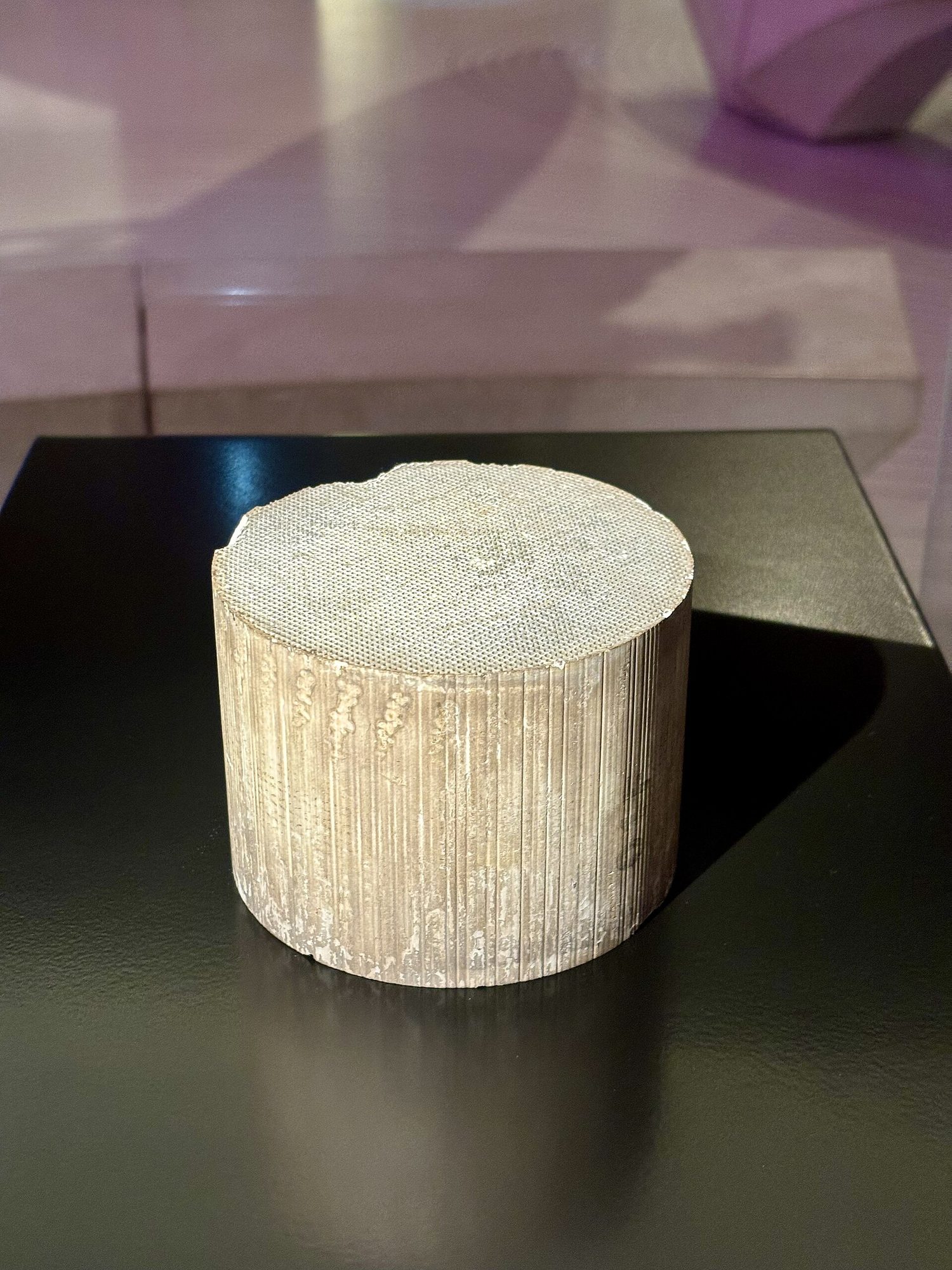
在一个汽车发动机中,高温使来自空气的氮和氧反应以构成氮氧化物。一个催化转化器移除它们,例如:
$$2\text{CO} + 2\text{NO} \rightarrow 2\text{CO}_2 + \text{N}_2$$
Photosynthesis
光合作用(photosynthesis)是燃烧的反面——它从空气中移除二氧化碳。植物用光能和叶绿素(chlorophyll)把二氧化碳和水变成葡萄糖(glucose)和氧气:
$$6\text{CO}_2 + 6\text{H}_2\text{O} \rightarrow \text{C}_6\text{H}_{12}\text{O}_6 + 6\text{O}_2$$
探索
Air pollutant lab
Classify air gases by source and environmental effect.
探索
Climate and air quality route
Trace emissions from combustion to atmospheric effects.
词汇表
训练
| 英文 | 中文 | 拼音 |
|---|---|---|
| noble gases/ˈnəʊbl ˈɡæsɪz/ | 稀有气体 | xī yǒu qì tǐ |
| complete combustion/kəmˈpliːt kəmˈbʌstʃn/ | 完全燃烧 | wán quán rán shāo |
| carbon monoxide/ˈkɑːbən mʌˈnɒksaɪd/ | 一氧化碳 | yī yǎng huà tàn |
| particulates/pəˈtɪkjʊleɪts/ | 颗粒物 | kē lì wù |
| incomplete combustion/ɪŋkəmˈpliːt kəmˈbʌstʃn/ | 不完全燃烧 | bù wán quán rán shāo |
| methane/ˈmiːθeɪn/ | 甲烷 | jiǎ wán |
| oxides of nitrogen/ˈɒksaɪdz ɒv ˈnaɪtrədʒn/ | 氮氧化物 | dàn yǎng huà wù |
| fossil fuels/ˈfɒsl ˈfjuːəlz/ | 化石燃料 | huà shí rán liào |
| sulfur/ˈsʌlfɜː/ | 硫 | liú |
| carbon dioxide/ˈkɑːbən daɪˈɒksaɪd/ | 二氧化碳 | èr yǎng huà tàn |
| greenhouse gases/ˈɡriːnhaʊs ˈɡæsɪz/ | 温室气体 | wēn shì qì tǐ |
| global warming/ˈɡləʊbl ˈwɔːmɪŋ/ | 全球变暖 | quán qiú biàn nuǎn |
| climate change/ˈklaɪmət tʃeɪndʒ/ | 气候变化 | qì hòu biàn huà |
| respiratory/rɪˈspɪrətəri/ | 呼吸 | hū xī |
| cancer/ˈkænsə/ | 癌症 | ái zhèng |
| acid rain/ˈæsɪd reɪn/ | 酸雨 | suān yǔ |
| photochemical smog/ˌfəʊtəʊˈkemɪkl smɒɡ/ | 光化学烟雾 | guāng huà xué yān wù |
| renewable energy/rɪˈnjuːəbl ˈenədʒi/ | 可再生能源 | kě zài shēng néng yuán |
| catalytic converters/ˌkætəˈlɪtɪk kənˈvɜːtəz/ | 催化转化器 | cuī huà zhuǎn huà qì |
| flue gas desulfurisation/fluː ɡæs diːˌsʌlfjʊəraɪˈzeɪʃn/ | 烟气脱硫 | yān qì tuō liú |
| calcium oxide/ˈkælsɪəm ˈɒksaɪd/ | 氧化钙 | yǎng huà gài |
| thermal energy/ˈθɜːml ˈenədʒi/ | 热能 | rè néng |
| photosynthesis/ˌfəʊtəʊˈsɪnθəsɪs/ | 光合作用 | guāng hé zuò yòng |
| chlorophyll/ˌklɔːrəʊˈfɪl/ | 叶绿素 | yè lǜ sù |
| glucose/ˈɡluːkəʊs/ | 葡萄糖 | pú táo táng |
10.3
考试技巧
- 两个测试显示水存在(氯化钴(II)蓝 → 粉;硫酸铜(II)白 → 蓝),但只有固定的熔点和沸点(0 °C 和 100 °C)显示它是纯的。
- 干净、干燥的空气约是 78% 氮、21% 氧和 1% 其他气体(大多是稀有气体和二氧化碳)。
- 把每个污染物匹配到它的来源和效果:一氧化碳(不完全燃烧;有毒);二氧化硫和氮氧化物(酸雨);二氧化碳和甲烷(温室气体 → 全球变暖)。
- 温室气体让阳光通过但吸收温暖的地球放出的热并把一些送回下来,所以地球变暖。
本主题的互动课程
逐步学习,并即时检测练习。