| Core | Supplement |
|---|---|
| 1 Define electrolysis as the decomposition of an ionic compound, when molten or in aqueous solution, by the passage of an electric current | 8 Describe the transfer of charge during electrolysis to include: (a) the movement of electrons in the external circuit (b) the loss or gain of electrons at the electrodes (c) the movement of ions in the electrolyte |
| 2 Identify in simple electrolytic cells: (a) the anode as the positive electrode (b) the cathode as the negative electrode (c) the electrolyte as the molten or aqueous substance that undergoes electrolysis | |
| 3 Identify the products formed at the electrodes and describe the observations made during the electrolysis of: (a) molten lead(II) bromide (b) concentrated aqueous sodium chloride (c) dilute sulfuric acid using inert electrodes made of platinum or carbon/graphite | 9 Identify the products formed at the electrodes and describe the observations made during the electrolysis of aqueous copper(II) sulfate using inert carbon/graphite electrodes and when using copper electrodes |
| 4 State that metals or hydrogen are formed at the cathode and that non-metals (other than hydrogen) are formed at the anode | |
| 5 Predict the identity of the products at each electrode for the electrolysis of a binary compound in the molten state | 10 Predict the identity of the products at each electrode for the electrolysis of a halide compound in dilute or concentrated aqueous solution |
| 11 Construct ionic half-equations for reactions at the anode (to show oxidation) and at the cathode (to show reduction) | |
| 6 State that metal objects are electroplated to improve their appearance and resistance to corrosion | |
| 7 Describe how metals are electroplated |
电化学
IGCSE 化学 · 第 4 主题
 10:25
10:25
Electrolysis
Electricity can do something amazing: it can tear a compound apart. Pass a current through a melted or dissolved compound, and it splits into its elements.…
英文讲解 · 内嵌中英文字幕
4.1
电解

大纲
来源:剑桥国际大纲
电解(electrolysis)是通过让一个电流(electric current)穿过一个离子化合物(ionic compound)——当它是熔融(molten)或在水溶液(aqueous)溶液中时——来分解(分解(decomposition))它。
它只在物质是熔融或溶解时有效,因为那时离子(ions)自由移动并携带电荷。一个固体离子化合物不能被电解,因为它的离子被锁在原位。

The electrolytic cell
这个装置叫一个电解池(electrolytic cell)。两个电极(electrodes,固体导体)浸入电解质(electrolyte)——被分解的熔融或水溶液物质。
- 阳极(anode)是正($+$)电极。
- 阴极(cathode)是负($-$)电极。
电极常常是惰性(inert,它们不反应)的,如铂(platinum)或碳/石墨(graphite)。
What is formed at each electrode
有一个简单的规则:
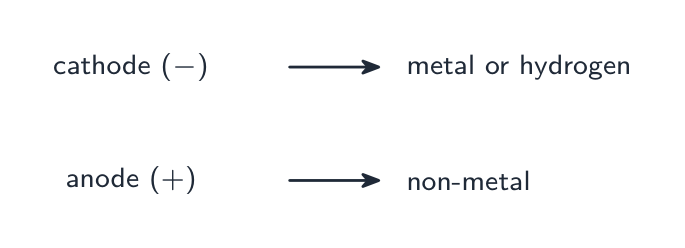
- 金属(metals)或氢气(hydrogen)在阴极形成。
- 非金属(non-metals,氢气以外的)在阳极形成。
对于水溶液,产物可能取决于溶液是稀(dilute)还是浓(concentrated)。这里是三个核心例子:
| 电解质 | 在阴极($-$) | 在阳极($+$) |
|---|---|---|
| 熔融溴化铅(II),$\text{PbBr}_2$ | 铅(lead,银色液体) | 溴(bromine,红棕色蒸气) |
| 浓氯化钠水溶液 | 氢气(气泡) | 氯气(chlorine,淡绿色气体) |
| 稀硫酸(sulfuric acid) | 氢气(气泡) | 氧气(oxygen,气泡) |
例题。 预测电解熔融氯化锌 $\text{ZnCl}_2$ 的产物。因为是熔融态,所以只有锌离子和氯离子存在 - 没有水来添乱。锌是金属,所以在阴极生成:$\text{Zn}^{2+}$ 离子得到电子,出现银白色的锌。氯是非金属,所以在阳极生成:冒出淡绿色的氯气。一定要先看状态。熔融化合物直接给出它自己的两种元素,而水溶液会把水也拉进竞争 - 这正是为什么浓氯化钠溶液在阴极得到的是氢气而不是钠。
How the charge moves
电解期间:
- 电子(electrons)从电源穿过导线(外电路(external circuit))移动。
- 在阴极,正离子获得电子。获得电子是还原(reduction)。
- 在阳极,负离子失去电子。失去电子是氧化(oxidation)。
- 在电解质内部,离子移动:正离子去阴极,负离子去阳极。
你可以为每个电极写一个半反应式(half-equation)。对于熔融溴化铅(II):
$$\text{Pb}^{2+} + 2e^{-} \rightarrow \text{Pb} \quad (\text{cathode, reduction})$$
$$2\text{Br}^{-} \rightarrow \text{Br}_2 + 2e^{-} \quad (\text{anode, oxidation})$$

Electrolysis of copper(II) sulfate
阳极的产物取决于电极:
- 用惰性碳电极:铜(copper)在阴极形成而氧气在阳极形成。随着铜被移除,溶液的蓝色慢慢褪去。
- 用铜电极:铜在阴极形成,而阳极本身溶入溶液。蓝色保持不变。这被用来提纯铜。
Electroplating
电镀(electroplating)意味着用另一种金属的一个薄层覆盖一个金属物体。这改善它的外观和它对腐蚀(corrosion,生锈和磨损)的抵抗。
要电镀一个物体:
- 要被涂层的物体被做成阴极;
- 镀层金属被做成阳极;
- 电解质是一个含有镀层金属离子的溶液。

探索
Inside an electrolysis cell
Pick an electrolyte and watch ions move: positive ions to the cathode, negative ions to the anode.
词汇表
训练
| 英文 | 中文 | 拼音 |
|---|---|---|
| electrolysis/ɪlekˈtrɒləsɪs/ | 电解 | diàn jiě |
| decomposition/ˌdiːkɒmpəˈzɪʃn/ | 分解 | fēn jiě |
| ionic compound/aɪˈɒnɪk ˈkɒmpaʊnd/ | 离子化合物 | lí zi huà hé wù |
| molten/ˈməʊltn/ | 熔融 | róng róng |
| aqueous/ˈeɪkwɪəs/ | 水溶液 | shuǐ róng yè |
| electric current/ɪˈlektrɪk ˈkʌrənt/ | 电流 | diàn liú |
| ions/ˈaɪɒnz/ | 离子 | lí zi |
| electrolytic cell/ɪˌlektrəˈlɪtɪk sel/ | 电解池 | diàn jiě chí |
| electrodes/ɪˈlektrəʊdz/ | 电极 | diàn jí |
| electrolyte/ɪˈlektrəlaɪt/ | 电解质 | diàn jiě zhì |
| anode/ˈænəʊd/ | 阳极 | yáng jí |
| cathode/ˈkæθəʊd/ | 阴极 | yīn jí |
| inert/ɪˈnɜːt/ | 惰性 | duò xìng |
| platinum/ˈplætɪnəm/ | 铂 | bó |
| graphite/ˈɡræfaɪt/ | 石墨 | shí mò |
| metals/ˈmetlz/ | 金属 | jīn shǔ |
| hydrogen/ˈhaɪdrədʒn/ | 氢气 | qīng qì |
| non-metals/nɒn ˈmetlz/ | 非金属 | fēi jīn shǔ |
| dilute/daɪˈluːt/ | 稀 | xī |
| concentrated/ˈkɒnsəntreɪtɪd/ | 浓 | nóng |
| lead/liːd/ | 铅 | qiān |
| bromine/ˈbrəʊmaɪn/ | 溴 | xiù |
| chlorine/ˈklɔːriːn/ | 氯气 | lǜ qì |
| sulfuric acid/sʌlˈfjʊərɪk ˈæsɪd/ | 硫酸 | liú suān |
| oxygen/ˈɒksɪdʒn/ | 氧气 | yǎng qì |
| electrons/ɪˈlektrɒnz/ | 电子 | diàn zi |
| external circuit/ekˈstɜːnl ˈsɜːkɪt/ | 外电路 | wài diàn lù |
| reduction/rɪˈdʌkʃn/ | 还原 | huán yuán |
| oxidation/ˌɒksɪˈdeɪʃn/ | 氧化 | yǎng huà |
| half-equation/hɑːf ɪˈkweɪʒn/ | 半反应式 | bàn fǎn yìng shì |
| copper/ˈkɒpə/ | 铜 | tóng |
| electroplating/ɪˌlektrəʊˈpleɪtɪŋ/ | 电镀 | diàn dù |
| corrosion/kəˈrəʊʒn/ | 腐蚀 | fǔ shí |
4.2
氢氧燃料电池

大纲
| Core | Supplement |
|---|---|
| 1 State that a hydrogen–oxygen fuel cell uses hydrogen and oxygen to produce electricity with water as the only chemical product | 2 Describe the advantages and disadvantages of using hydrogen–oxygen fuel cells in comparison with gasoline/petrol engines in vehicles |
来源:剑桥国际大纲
一个燃料电池(fuel cell)用氢气和氧气直接制造电。唯一的化学产物是水。
$$2\text{H}_2 + \text{O}_2 \rightarrow 2\text{H}_2\text{O}$$
把一个燃料电池与一辆车里一个普通汽油发动机比较很有用。
| 氢氧燃料电池 | 汽油发动机 | |
|---|---|---|
| 主要产物 | 只有水 | 二氧化碳和污染物(pollutants) |
| 对空气的影响 | 干净 | 增加空气污染 |
| 燃料储存 | 氢难以且危险地储存(易燃,需要高压) | 汽油容易储存 |
| 来源 | 氢可能用化石燃料制造 | 由原油制造 |
燃料电池的优点:唯一的产物是水,所以它不污染空气,而且它高效地把化学能变成电。缺点:氢难以安全地储存和运输,而生产氢仍能使用来自化石燃料的能量。
探索
Inside a hydrogen–oxygen fuel cell
Step through a fuel cell. Hydrogen and oxygen combine to make water, and the energy of that reaction is released as electricity — with no carbon dioxide.
词汇表
训练
| 英文 | 中文 | 拼音 |
|---|---|---|
| fuel cell/ˈfjuːəl sel/ | 燃料电池 | rán liào diàn chí |
| pollutants/pəˈluːtənts/ | 污染物 | wū rǎn wù |
4.2
考试技巧
- 在阴极(负)你得到一个金属或氢气;在阳极(正)你得到一个非金属。正离子移向阴极,负离子移向阳极。
- 一个熔融化合物只给出它的两个元素。一个水溶液溶液能给出不同的东西(浓氯化钠给出氢气和氯气,而不是钠)。
- 还原是电子的获得(在阴极);氧化是电子的失去(在阳极)。记住 OIL RIG。
- 在一个半反应式中原子和电荷必须平衡,电子在正确的一侧:$\text{Pb}^{2+} + 2e^- \rightarrow \text{Pb}$(阴极)。
- 要电镀一个物体,把它做成阴极、把镀层金属做成阳极,并用一个含有镀层金属离子的溶液。
本主题的互动课程
逐步学习,并即时检测练习。