| English | 释义 | 拼音 |
|---|---|---|
| electrolysis/ɪlekˈtrɒləsɪs/ | 电解 | diàn jiě |
| electrolyte/ɪˈlektrəlaɪt/ | 电解质 | diàn jiě zhì |
| electrodes/ɪˈlektrəʊdz/ | 电极 | diàn jí |
| cathode/ˈkæθəʊd/ | 阴极 | yīn jí |
| anode/ˈænəʊd/ | 阳极 | yáng jí |
| reduction/rɪˈdʌkʃn/ | 还原 | huán yuán |
| oxidation/ˌɒksɪˈdeɪʃn/ | 氧化 | yǎng huà |
Splitting compounds with electricity
- Some compounds are so stable that heat alone won't break them — but electricity can.
- Electrolysis 电解 uses an electric current to break down an ionic compound.
Electrolysis is the breaking down of a compound using:
难度 1/5 · 今日首次完成可获 100 金币及少量额外奖励
An electric current decomposes the electrolyte.
The molten or dissolved ionic compound being broken down is called the ______.
难度 1/5 · 今日首次完成可获 100 金币及少量额外奖励
The electrolyte supplies the free-moving ions.
The set-up
- The compound (molten or dissolved) is the electrolyte 电解质, holding free-moving ions.
- Two electrodes 电极 dip in: the cathode 阴极 (negative) and the anode 阳极 (positive), connected to a power supply.
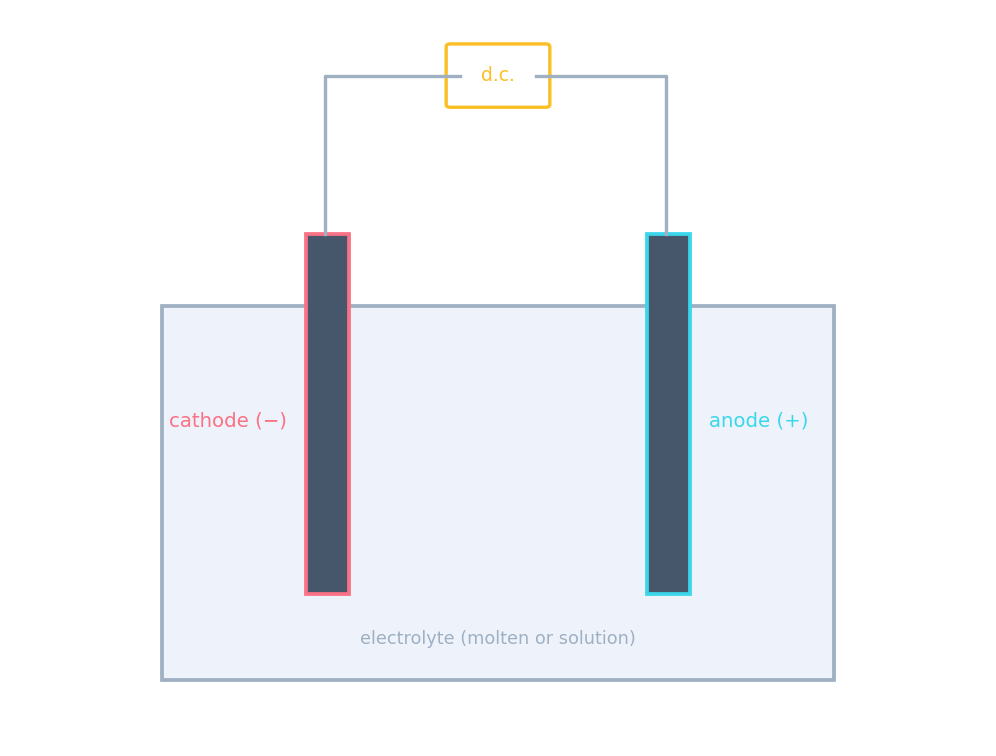
Positive ions move to the cathode; negative ions move to the anode.
Positive ions move towards the:
难度 1/5 · 今日首次完成可获 100 金币及少量额外奖励
Opposite charges attract: positive ions → negative cathode.
Negative ions move towards the negative cathode.
难度 1/5 · 今日首次完成可获 100 金币及少量额外奖励
False. Opposite charges attract, so negative ions (anions) move to the positive anode, and positive ions move to the cathode.
Where the ions go
- Positive ions (cations) move to the negative cathode.
- Negative ions (anions) move to the positive anode.
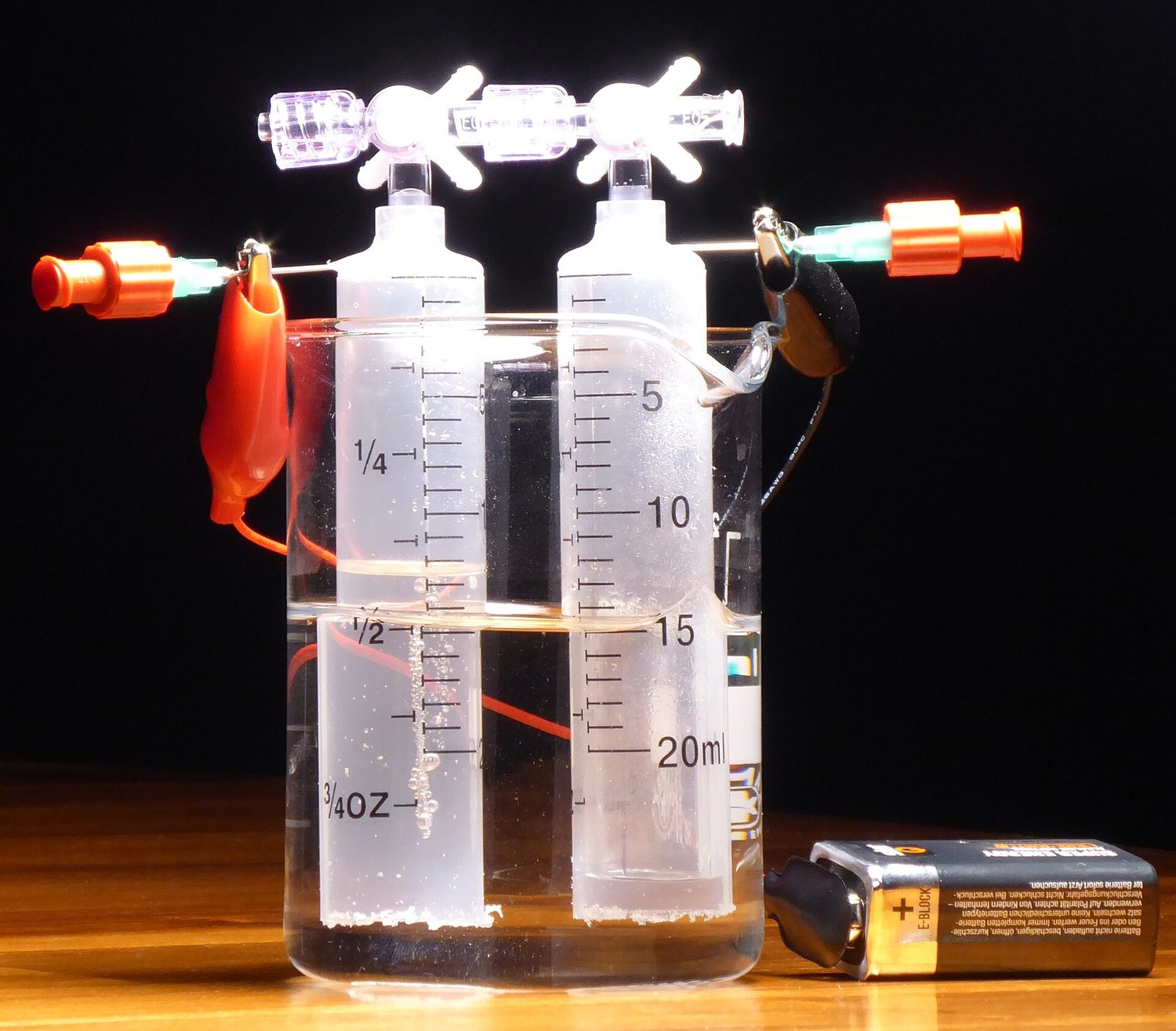
Electrolysis of water: gas bubbles off at each electrode and collects in the tubes above
Follow the ions through the cell
Step through it: the molten compound's free ions drift to the oppositely-charged electrode, then are discharged into the two elements — lead at the cathode, bromine at the anode.
For electrolysis to work, the electrolyte must be:
难度 1/5 · 今日首次完成可获 100 金币及少量额外奖励
Free-moving ions are essential.
What happens there
- At the cathode, positive ions gain electrons (reduction 还原).
- At the anode, negative ions lose electrons (oxidation 氧化), and elements are released.
Electrolysis needs free-moving ions. A solid ionic compound won't work — its ions are locked in place. It must be molten or dissolved so the ions can move to the electrodes.
Worked example: molten lead(II) bromide
Molten lead(II) bromide, $\text{PbBr}_2$, is electrolysed. Predict the product at each electrode and write the half-equations.
- Cathode (−): $\text{Pb}^{2+}$ ions are attracted and gain electrons: $\text{Pb}^{2+} + 2\text{e}^- \rightarrow \text{Pb}$. Silvery molten lead collects underneath.
- Anode (+): $\text{Br}^-$ ions are attracted and lose electrons: $2\text{Br}^- \rightarrow \text{Br}_2 + 2\text{e}^-$. Brown bromine vapour is given off (use a fume cupboard).
Molten sodium chloride is electrolysed. What forms at the cathode and at the anode?
难度 1/5 · 今日首次完成可获 100 金币及少量额外奖励
正 $\text{Na}^{+}$ goes to the negative cathode and becomes Na; negative $\text{Cl}^-$ goes to the anode and becomes $\text{Cl}_2$.
How many electrons does each $\text{Pb}^{2+}$ ion gain at the cathode?
难度 2/5 · 今日首次完成可获 140 金币及少量额外奖励
Its charge is 2+, so it needs 2 electrons to become a neutral Pb atom.
Products with inert electrodes
| Electrolyte | At the cathode (−) | At the anode (+) |
|---|---|---|
| molten lead(II) bromide | lead | bromine |
| concentrated aqueous sodium chloride | hydrogen | chlorine |
| dilute sulfuric acid | hydrogen | oxygen |
| aqueous copper(II) sulfate | copper | oxygen |
| dilute aqueous sodium chloride | hydrogen | oxygen |
- In aqueous solutions, water also supplies H⁺ and OH⁻ ions. At the cathode, hydrogen forms unless the metal is less reactive than hydrogen (e.g. copper).
- At the anode, a halogen forms if the halide ion is concentrated; otherwise oxygen forms.
Concentrated aqueous sodium chloride is electrolysed. What forms at the cathode?
难度 1/5 · 今日首次完成可获 100 金币及少量额外奖励
Sodium is more reactive than hydrogen, so H⁺ ions from water are reduced instead: hydrogen gas forms.
Why does copper, not hydrogen, form at the cathode in copper(II) sulfate solution?
难度 1/5 · 今日首次完成可获 100 金币及少量额外奖励
At the cathode, the less reactive of the metal and hydrogen is discharged.
You've got it
- electrolysis breaks down a compound using electricity; the compound is the electrolyte
- positive ions → cathode (−); negative ions → anode (+)
- it needs the electrolyte molten or dissolved so ions can move
Write from this case
- Molten lead bromide is electrolysed.
- Lead ions are positive and bromide ions are negative.
Which element forms at the anode?
Negative ions go to the anode and are discharged.
What forms at the anode?
难度 1/5 · 今日首次完成可获 100 金币及少量额外奖励
Bromide ions are discharged at the positive electrode.