| Core | Supplement |
|---|---|
| 1 Describe the characteristic properties of acids in terms of their reactions with: (a) metals (b) bases (c) carbonates | |
| 2 Describe acids in terms of their effect on: (a) litmus (b) thymolphthalein (c) methyl orange | |
| 3 State that bases are oxides or hydroxides of metals and that alkalis are soluble bases | |
| 4 Describe the characteristic properties of bases in terms of their reactions with: (a) acids (b) ammonium salts | |
| 5 Describe alkalis in terms of their effect on: (a) litmus (b) thymolphthalein (c) methyl orange | |
| 6 State that aqueous solutions of acids contain $\text{H}^+$ ions and aqueous solutions of alkalis contain $\text{OH}^-$ ions | 9 Define acids as proton donors and bases as proton acceptors |
| 10 Define a strong acid as an acid that is completely dissociated in aqueous solution and a weak acid as an acid that is partially dissociated in aqueous solution | |
| 11 State that hydrochloric acid is a strong acid, as shown by the symbol equation, $\text{HCl}(\text{aq}) \rightarrow \text{H}^+(\text{aq}) + \text{Cl}^-(\text{aq})$ | |
| 12 State that ethanoic acid is a weak acid, as shown by the symbol equation, $\text{CH}_3\text{COOH}(\text{aq}) \rightleftharpoons \text{H}^+(\text{aq}) + \text{CH}_3\text{COO}^-(\text{aq})$ | |
| 7 Describe how to compare hydrogen ion concentration, neutrality, relative acidity and relative alkalinity in terms of colour and pH using universal indicator paper | |
| 8 Describe the neutralisation reaction between an acid and an alkali to produce water, $\text{H}^+(\text{aq}) + \text{OH}^-(\text{aq}) \rightarrow \text{H}_2\text{O}(l)$ |
酸、碱与盐
IGCSE 化学 · 第 7 主题
 13:06
13:06
Acids, Bases & Salts
Lemon juice, vinegar, and the acid in your stomach — acids are everywhere. So are their opposites: alkalis, like soap and oven cleaner. Mix an acid and an…
英文讲解 · 内嵌中英文字幕
7.1
酸与碱的特征性质

大纲
来源:剑桥国际大纲
一个酸(acid)是一种当溶解在水中时构成氢离子($\text{H}^{+}$)的物质。酸有三个典型的反应:
- 与金属(metals):酸 + 金属 → 一个盐(salt)+ 氢气(hydrogen)
- 与碱:酸 + 碱(base)→ 一个盐 + 水(这是中和(neutralisation))
- 与碳酸盐(carbonates):酸 + 碳酸盐 → 一个盐 + 水 + 二氧化碳(carbon dioxide)
Describing what you see
说出生成物只完成了考试要求的一半。"写出观察到的现象"问的是你用眼睛能看到什么,它本身就有分数 —— 所以要记住这些词:
| 你看到的 | 要写 |
|---|---|
| 有气泡冒出 | 泡腾(effervescence,也接受:冒泡、起泡) |
| 固体变小并消失 | 固体溶解(dissolves)/ 消失(disappears) |
| 溶液颜色变化 | 说出颜色,例如变蓝(铜盐) |
| 冒泡停止 | 不再有泡腾 —— 酸已被消耗完 |
所以对于把镁加入盐酸,完整的答案是:泡腾,并且固体溶解(试管还会变热)。对于把氧化铜(II)加入温热的硫酸:黑色固体溶解,溶液变蓝。
有两条规则能挽回大部分丢掉的分。绝不要把"放出氢气"当作观察现象 —— 你看不见氢气,你只能看见气泡,所以要写泡腾。以及不要写你看不见的名称:"生成了一种盐"是结论,不是观察现象。
Indicators
一个指示剂(indicator)是一种变色以显示一个溶液是酸性还是碱性的染料。
| 指示剂 | 在酸中 | 在碱中 |
|---|---|---|
| 石蕊(litmus) | 红 | 蓝 |
| 百里酚酞(thymolphthalein) | 无色 | 蓝 |
| 甲基橙(methyl orange) | 红 | 黄 |
酸的水溶液含有氢离子(ions,$\text{H}^{+}$)。碱的水溶液含有氢氧根离子($\text{OH}^{-}$)。

词汇表
训练
| 英文 | 中文 | 拼音 |
|---|---|---|
| acid/ˈæsɪd/ | 酸 | suān |
| metals/ˈmetlz/ | 金属 | jīn shǔ |
| hydrogen/ˈhaɪdrədʒn/ | 氢气 | qīng qì |
| base/beɪs/ | 碱 | jiǎn |
| neutralisation/ˌnjuːtrəlaɪˈzeɪʃn/ | 中和 | zhōng hé |
| carbonates/ˈkɑːbəneɪts/ | 碳酸盐 | tàn suān yán |
| carbon dioxide/ˈkɑːbən daɪˈɒksaɪd/ | 二氧化碳 | èr yǎng huà tàn |
| indicator/ˈɪndɪkeɪtə/ | 指示剂 | zhǐ shì jì |
| litmus/ˈlɪtməs/ | 石蕊 | shí ruǐ |
| thymolphthalein/ˈθaɪməlfθæliːn/ | 百里酚酞 | bǎi lǐ fēn tài |
| methyl orange/ˈmiːθaɪl ˈɒrɪndʒ/ | 甲基橙 | jiǎ jī chéng |
| ions/ˈaɪɒnz/ | 离子 | lí zi |
| neutral/ˈnjuːtrəl/ | 中性 | zhōng xìng |
| effervescence/ˌefəˈvesəns/ | 泡腾 | pào téng |
7.1
碱与可溶性碱

碱是金属的氧化物(oxides)或氢氧化物(hydroxides)。一个可溶性碱(alkali)是一个溶解在水中的碱(一个可溶碱)。
碱有两个典型的反应:
- 与酸:碱 + 酸 → 一个盐 + 水(又是中和)
- 与铵盐(ammonium salts):这释放氨气。
探索
Watch the pH during neutralisation
Adding alkali to acid raises the pH. Near the end point the pH leaps up sharply — that steep jump is where the acid has just been neutralised.
词汇表
训练
| 英文 | 中文 | 拼音 |
|---|---|---|
| oxides/ˈɒksaɪdz/ | 氧化物 | yǎng huà wù |
| hydroxides/haɪˈdrɒksaɪdz/ | 氢氧化物 | qīng yǎng huà wù |
| alkali/ˈælkəlaɪ/ | 可溶性碱 | kě róng xìng jiǎn |
| ammonium salts/æˈməʊnɪəm sɒlts/ | 铵盐 | ǎn yán |
| universal indicator/ˌjuːnɪˈvɜːsl ˈɪndɪkeɪtə/ | 通用指示剂 | tōng yòng zhǐ shì jì |
7.1
强酸与弱酸

一个酸是一个质子(proton)供体——它给出 $\text{H}^{+}$ 离子(一个氢离子只是一个质子)。一个碱是一个质子受体。
一个酸有多强取决于它有多少在水中分裂成离子:
- 一个强酸(strong acid)在水中完全电离(dissociated,完全分裂成离子)。盐酸(hydrochloric acid)是强的:
$$\text{HCl}(aq) \rightarrow \text{H}^{+}(aq) + \text{Cl}^{-}(aq)$$
- 一个弱酸(weak acid)只部分电离。乙酸(ethanoic acid)是弱的,所以方程式用可逆箭头:
$$\text{CH}_3\text{COOH}(aq) \rightleftharpoons \text{H}^{+}(aq) + \text{CH}_3\text{COO}^{-}(aq)$$
注意:"强"和"弱"是关于电离的,不是关于稀或浓的。
词汇表
训练
| 英文 | 中文 | 拼音 |
|---|---|---|
| proton/ˈprəʊtɒn/ | 质子 | zhì zi |
| strong acid/strɒŋ ˈæsɪd/ | 强酸 | qiáng suān |
| dissociated/dɪˈsəʊsɪeɪtɪd/ | 电离 | diàn lí |
| hydrochloric acid/ˌhaɪdrəˈklɔːrɪk ˈæsɪd/ | 盐酸 | yán suān |
| weak acid/wiːk ˈæsɪd/ | 弱酸 | ruò suān |
| ethanoic acid/ˌeθəˈnəʊɪk ˈæsɪd/ | 乙酸 | yǐ suān |
7.1
pH 标度

pH 标度从 0 到 14,告诉你一个溶液有多酸性或碱性。一个更高的氢离子浓度意味着一个更低的 pH。
你可以用通用指示剂(universal indicator)求 pH,它变不同的颜色:
| pH | 类型 | 通用指示剂的颜色 |
|---|---|---|
| 低于 7 | 酸性(acidic) | 红 / 橙 / 黄 |
| 恰好 7 | 中性(neutral) | 绿 |
| 高于 7 | 碱性(alkaline) | 蓝 / 紫 |
当一个酸和一个碱反应时,$\text{H}^{+}$ 和 $\text{OH}^{-}$ 离子结合以制造水:
$$\text{H}^{+}(aq) + \text{OH}^{-}(aq) \rightarrow \text{H}_2\text{O}(l)$$
探索
The pH scale
Slide the pH or tap a substance — lemon, water, soap, bleach. The indicator goes red→green→purple, and each step down in pH is ten times more H⁺ ions.
探索
A titration curve
Add alkali to acid and watch the pH rise. The steep jump is where the acid is just neutralised.
词汇表
训练
| 英文 | 中文 | 拼音 |
|---|---|---|
| acidic/əˈsɪdɪk/ | 酸性 | suān xìng |
| alkaline/ˈælkəlaɪn/ | 碱性 | jiǎn xìng |
7.2
氧化物

大纲
| Core | Supplement |
|---|---|
| 1 Classify oxides as acidic, including $\text{SO}_2$ and $\text{CO}_2$, or basic, including $\text{CuO}$ and $\text{CaO}$, related to metallic and non-metallic character | 2 Describe amphoteric oxides as oxides that react with acids and with bases to produce a salt and water |
| 3 Classify $\text{Al}_2\text{O}_3$ and $\text{ZnO}$ as amphoteric oxides |
来源:剑桥国际大纲
氧化物能按它们如何表现分类:
- 酸性氧化物是非金属的氧化物,如 $\text{SO}_2$ 和 $\text{CO}_2$。
- 碱性氧化物是金属的氧化物,如 $\text{CuO}$ 和 $\text{CaO}$。
- 两性(amphoteric)氧化物与酸和碱两者反应以制造一个盐和水。$\text{Al}_2\text{O}_3$ 和 $\text{ZnO}$ 是两性的。
所以金属氧化物倾向于是碱性的,而非金属氧化物倾向于是酸性的。
探索
Oxide type lab
Classify oxides by how they behave with acids and bases.
词汇表
训练
| 英文 | 中文 | 拼音 |
|---|---|---|
| amphoteric/ˌæmfəʊˈterɪk/ | 两性 | liǎng xìng |
7.3
盐的制备

大纲
| Core | Supplement |
|---|---|
| 1 Describe the preparation, separation and purification of soluble salts by reaction of an acid with: (a) an alkali by titration (b) excess metal (c) excess insoluble base (d) excess insoluble carbonate | 4 Describe the preparation of insoluble salts by precipitation |
| 2 Describe the general solubility rules for salts: (a) sodium, potassium and ammonium salts are soluble (b) nitrates are soluble (c) chlorides are soluble, except lead and silver (d) sulfates are soluble, except barium, calcium and lead (e) carbonates are insoluble, except sodium, potassium and ammonium (f) hydroxides are insoluble, except sodium, potassium, ammonium and calcium (partially) | |
| 3 Define a hydrated substance as a substance that is chemically combined with water and an anhydrous substance as a substance containing no water | 5 Define the term water of crystallisation as the water molecules present in hydrated crystals, including $\text{CuSO}_4\bullet5\text{H}_2\text{O}$ and $\text{CoCl}_2\bullet6\text{H}_2\text{O}$ |
来源:剑桥国际大纲
一个盐是否能用某种方法制造取决于它是可溶(soluble,溶解)还是不溶(insoluble,不溶解)。
Solubility rules
| 盐类型 | 规则 |
|---|---|
| 钠、钾、铵盐 | 全部可溶 |
| 硝酸盐(nitrates) | 全部可溶 |
| 氯化物(chlorides) | 可溶,除了铅和银 |
| 硫酸盐(sulfates) | 可溶,除了钡、钙和铅 |
| 碳酸盐 | 不溶,除了钠、钾和铵 |
| 氢氧化物 | 不溶,除了钠、钾、铵和(部分)钙 |
Making a soluble salt
你把一个酸与这些之一反应:
- 一个碱,用滴定(titration)(因为两者都是溶液,你必须测量确切的体积);
- 过量(excess)的一个金属、一个不溶碱,或一个不溶碳酸盐。
当你用过量的一个固体时,你随即过滤(filter)以移除剩下的固体。最后你蒸发(evaporate)一些水并让溶液结晶(crystallise)以得到盐。
例题。 制备 (a) 硫酸铜 和 (b) 硫酸钡,分别该用哪种方法?先查溶解性规则。(a) 硫酸铜是可溶的(只有钡、钙和铅的硫酸盐不溶),所以用不溶固体加酸来制:向温热的稀硫酸中加入过量氧化铜,过滤掉剩余的固体,然后蒸发掉一些水并结晶。(b) 硫酸钡是不溶的,所以用沉淀法制:把各自含有一种所需离子的两种溶液混合,然后过滤、洗涤并干燥固体。决定方法的是你想要的那种盐的溶解性 - 选择之前先查规则。
Making an insoluble salt
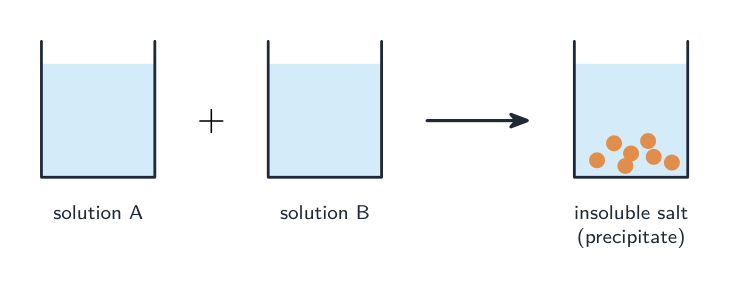
一个不溶盐通过沉淀(precipitation)制造:混合各含有所需离子之一的两个溶液,而不溶盐作为一个固体形成。你随即过滤、洗涤并干燥它。
Water in salts
- 一个水合(hydrated)物质与水化学地连接。
- 一个无水(anhydrous)物质不含水。
水合晶体里面的水分子叫结晶水(water of crystallisation)。例如,$\text{CuSO}_4 \bullet 5\text{H}_2\text{O}$ 每个式量单位有五个水分子。
探索
Preparing a soluble salt
Step through the method. React an acid with excess insoluble base, filter off what's left over, then evaporate and crystallise to get pure salt crystals.
词汇表
训练
| 英文 | 中文 | 拼音 |
|---|---|---|
| salt/sɒlt/ | 盐 | yán |
| soluble/ˈsɒljuːbl/ | 可溶 | kě róng |
| insoluble/ɪnˈsɒljuːbl/ | 不溶 | bù róng |
| nitrates/ˈnaɪtreɪts/ | 硝酸盐 | xiāo suān yán |
| chlorides/ˈklɔːraɪdz/ | 氯化物 | lǜ huà wù |
| sulfates/ˈsʌlfeɪts/ | 硫酸盐 | liú suān yán |
| titration/taɪˈtreɪʃn/ | 滴定 | dī dìng |
| excess/ekˈses/ | 过量 | guò liàng |
| filter/ˈfɪltə/ | 过滤 | guò lǜ |
| evaporate/ɪˈvæpəreɪt/ | 蒸发 | zhēng fā |
| crystallise/ˈkrɪstəlaɪz/ | 结晶 | jié jīng |
| precipitation/prɪˌsɪpɪˈteɪʃn/ | 沉淀 | chén diàn |
| hydrated/haɪˈdreɪtɪd/ | 水合 | shuǐ hé |
| anhydrous/ænˈhaɪdrəs/ | 无水 | wú shuǐ |
| water of crystallisation/ˈwɔːtə ɒv ˌkrɪstəlaɪˈzeɪʃn/ | 结晶水 | jié jīng shuǐ |
7.3
考试技巧
- 学习三个酸反应:酸 + 金属 → 盐 + 氢气;酸 + 碱 → 盐 + 水(中和);酸 + 碳酸盐 → 盐 + 水 + 二氧化碳。
- 强和弱描述酸有多少分裂成离子(电离),不是它有多浓。一个强酸完全电离;一个弱酸只部分。
- 一个更低的 pH 意味着一个更高的氢离子浓度。pH 7 是中性,低于 7 是酸性,高于 7 是碱性。
- 按溶解度选择盐的方法:一个可溶盐从一个酸 + 过量固体制造(然后过滤、蒸发、结晶),或通过与一个碱滴定;一个不溶盐通过沉淀制造(混合两个溶液,然后过滤)。
- 学习溶解度规则——所有钠、钾、铵和硝酸盐都可溶。
本主题的互动课程
逐步学习,并即时检测练习。