Insoluble salts and water of crystallisation · 不可溶盐与结晶水
| English | 中文 | Pinyin · 拼音 |
|---|---|---|
| precipitation/prɪˌsɪpɪˈteɪʃn/ | 沉淀 | chén diàn |
| precipitate/prɪˈsɪpɪteɪt/ | 沉淀 | chén diàn |
| water of crystallisation/ˈwɔːtə ɒv ˌkrɪstəlaɪˈzeɪʃn/ | 结晶水 | jié jīng shuǐ |
| hydrated/haɪˈdreɪtɪd/ | 水合 | shuǐ hé |
| anhydrous/ænˈhaɪdrəs/ | 无水 | wú shuǐ |
Salts that won't dissolve
- Some salts don't dissolve in water. They're made a different way — by precipitation 沉淀.
- And some crystals trap water inside them.
不会溶解的盐
- 一些盐不在水中溶解。它们以一种不同的方式制造——通过沉淀(precipitation)。
- 而一些晶体把水困在它们内部。
An insoluble salt is made by: · 一种不可溶盐通过以下制造:
Precipitation forms an insoluble solid. · 沉淀形成一个不可溶的固体。
The insoluble solid that forms when two solutions are mixed is called a: · 当两种溶液被混合时形成的不可溶固体被称为一个:
An insoluble solid formed this way is a precipitate. · 以这种方式形成的一个不可溶固体是一个沉淀。
Making insoluble salts
- Mix two soluble salt solutions that contain the right ions.
- The insoluble salt forms as a solid precipitate 沉淀, which is filtered off.
Worked example. To make insoluble silver chloride, mix silver nitrate solution with sodium chloride solution. Silver chloride forms as a white precipitate, which you filter, wash and dry.
Mixing two solutions that each carry one of the needed ions makes the insoluble salt appear as a solid precipitate
A strong acid is fully split into ions; a weak acid stays mostly as molecules
制造不可溶的盐
- 混合两种含有正确离子的可溶盐溶液。
- 不可溶的盐作为一个固体沉淀(precipitate)形成,它被过滤掉。
例题。 要制造不可溶的氯化银,把硝酸银溶液与氯化钠溶液混合。氯化银作为一个白色沉淀形成,你过滤、洗涤并干燥它。
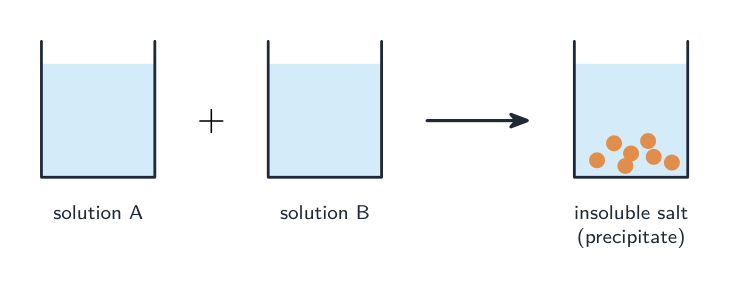
混合两种各自携带一种所需离子的溶液,使不可溶的盐作为固体沉淀出现

一种强酸完全分裂成离子;一种弱酸主要保持为分子
Making an insoluble salt by precipitation · 通过沉淀制造一种不可溶盐
Step through precipitation. Mix two solutions whose ions swap partners to make an insoluble salt, then filter, wash and dry the solid. · 逐步看沉淀。混合两种溶液,它们的离子交换伙伴以制造一种不可溶盐,然后过滤、洗涤并干燥固体。
A salt that contains water of crystallisation is described as: · 一种含有结晶水的盐被描述为:
Hydrated salts contain locked-in water. · 水合盐含有锁住的水。
Water locked into the structure of a crystal is called water of ______. · 锁在一个晶体结构中的水被称为______水。
Such salts are hydrated. · 这样的盐是水合的。
Water of crystallisation 结晶水
- Some salt crystals contain water locked into their structure — water of crystallisation.
- These are hydrated 水合 salts (e.g. blue copper sulfate, CuSO₄·5H₂O).
结晶水
- 一些盐晶体在它们的结构中锁着水——结晶水(water of crystallisation)。
- 这些是水合的(hydrated)盐(例如蓝色硫酸铜,CuSO₄·5H₂O)。
Heating hydrated copper sulfate (blue) drives off water, leaving white anhydrous salt. · 加热水合硫酸铜(蓝色)驱走水,留下白色的无水盐。
Removing the water of crystallisation turns it white. · 移除结晶水使它变白。
Hydrated and anhydrous 无水
- Heating a hydrated salt drives off the water, leaving the anhydrous salt.
- Blue hydrated copper sulfate turns white when the water is removed.
Precipitation is for insoluble salts; the excess-acid method is for soluble ones. Choose the method by the salt's solubility: insoluble → mix two solutions; soluble → react acid with excess base.
水合与无水
- 加热一种水合盐驱走水,留下无水的(anhydrous)盐。
- 蓝色水合硫酸铜在水被移除时变成白色。
沉淀用于不可溶盐;过量酸方法用于可溶的。 按盐的溶解度选择方法:不可溶 → 混合两种溶液;可溶 → 用酸与过量碱反应。
You've got it
- insoluble salts are made by precipitation (mix two solutions, filter the solid)
- water of crystallisation is water locked in crystals → a hydrated salt
- heating removes it, leaving the anhydrous salt (blue → white copper sulfate)
你掌握了
- 不可溶盐通过沉淀制造(混合两种溶液,过滤固体)
- 结晶水是锁在晶体中的水 → 一种水合盐
- 加热移除它,留下无水的盐(硫酸铜蓝 → 白)