| English | 释义 | 拼音 |
|---|---|---|
| water treatment/ˈwɔːtə ˈtriːtmənt/ | 水处理 | shuǐ chǔ lǐ |
| filtration/fɪlˈtreɪʃn/ | 过滤 | guò lǜ |
| chlorination/ˌklɔːrɪˈneɪʃn/ | 氯消毒 | lǜ xiāo dú |
Pure enough to drink
- Clean water is essential for life, but natural water is full of dissolved and suspended substances.
- Making it safe involves water treatment 水处理 and testing.
Water treatment lab
Classify water processes by what they remove or change.
Chlorine is added during water treatment to:
难度 1/5 · 今日首次完成可获 100 金币及少量额外奖励
Chlorination sterilises the water.
Filtration removes dissolved salts from water.
难度 1/5 · 今日首次完成可获 100 金币及少量额外奖励
False. Filtration removes insoluble solid particles only. Dissolved salts pass through the filter and need distillation or similar methods.
Water treatment
- Filtration 过滤 removes solid particles.
- Chlorination 氯消毒 (adding chlorine) kills harmful microbes (sterilisation).
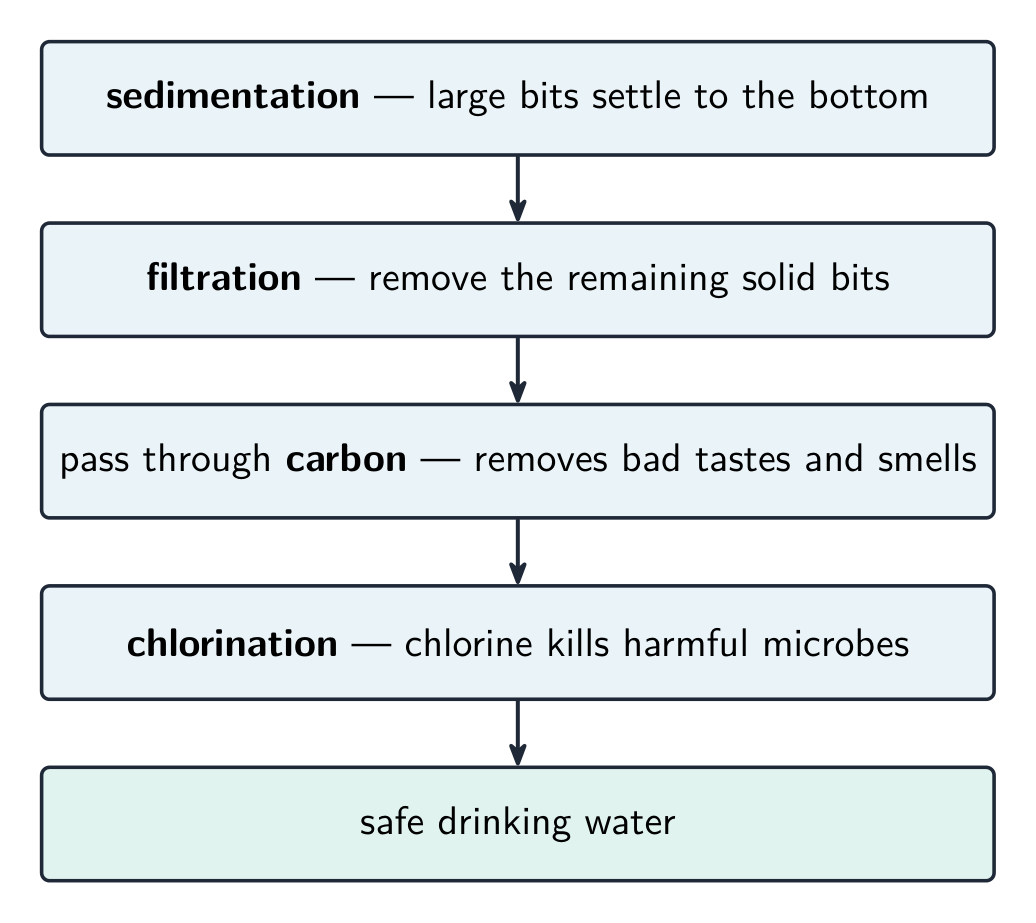
Treating water to make it safe to drink: sedimentation, filtration, carbon, then chlorination
Anhydrous copper sulfate turns which colour in the presence of water?
难度 1/5 · 今日首次完成可获 100 金币及少量额外奖励
White anhydrous copper sulfate turns blue with water.
Cobalt chloride paper turns from blue to ______ in the presence of water.
难度 1/5 · 今日首次完成可获 100 金币及少量额外奖励
A test for the presence of water.
Testing for water
- To test that a liquid is water: it turns anhydrous copper sulfate from white to blue, or cobalt chloride paper from blue to pink.
- To test it is pure water: it boils at exactly 100 °C and freezes at 0 °C.
At what temperature (°C) does pure water boil at normal pressure?
难度 2/5 · 今日首次完成可获 140 金币及少量额外奖励
Pure water boils at exactly 100 °C.
"Is water" vs "is pure"
- A chemical test shows a liquid contains water.
- Only the boiling/freezing point shows it is pure water (no dissolved substances).
"Contains water" is not the same as "pure water". Sea water turns cobalt chloride paper pink (it contains water) but is far from pure. Purity is shown by a sharp boiling point of 100 °C.
Worked example: is it water, and is it pure?
A colourless liquid turns white anhydrous copper(II) sulfate blue. It boils at 103 °C. What can you conclude?
- The colour change shows the liquid contains water. It does not prove the liquid is only water: salt water or tea would also turn the powder blue.
- Pure water boils at exactly 100 °C (and freezes at 0 °C). A boiling point of 103 °C means something is dissolved in it, so it is not pure water. Tap water, too, is safe to drink but not pure: it contains dissolved salts and chlorine.
Which result shows a liquid contains water?
难度 1/5 · 今日首次完成可获 100 金币及少量额外奖励
Water turns anhydrous cobalt(II) chloride from blue to pink. Boiling at exactly 100 °C shows it is pure water, a different question.
At what temperature, in °C, does pure water freeze?
难度 2/5 · 今日首次完成可获 140 金币及少量额外奖励
Pure water melts and freezes at exactly 0 °C; impurities lower the freezing point.
You've got it
- water treatment: filtration (removes solids) + chlorination (kills microbes)
- test for water: anhydrous copper sulfate white → blue, or cobalt chloride blue → pink
- only the boiling point (100 °C) shows water is pure
Write from this case
- Water has already been filtered.
- Chlorine is added. Pure water boils at 100 degrees, which is a different test.
What does the chlorine treatment do?
Chlorine disinfects the water supply.
What is the chlorine step for?
难度 1/5 · 今日首次完成可获 100 金币及少量额外奖励
Chlorination is disinfection, not desalination.