| English | 释义 | 拼音 |
|---|---|---|
| transition elements/trænˈsɪʃn ˈelɪmənts/ | 过渡元素 | guò dù yuán sù |
| catalysts/ˈkætəlɪsts/ | 催化剂 | cuī huà jì |
| variable charges/ˈveərɪəbl ˈtʃɑːdʒɪz/ | 可变电荷 | kě biàn diàn hè |
The metals in the middle
- The big block of metals in the centre of the table includes iron, copper and gold.
- These are the transition elements 过渡元素, with their own special properties.
Transition element lab
Match transition-metal properties to real examples.
Which are properties of transition metals? (Select all that apply.)
难度 2/5 · 今日首次完成可获 140 金币及少量额外奖励
They are dense, not low-density.
Transition metals are more reactive than Group I metals.
难度 1/5 · 今日首次完成可获 100 金币及少量额外奖励
False. Transition metals are much less reactive than the alkali metals, which is why iron and copper can be used for structures and pipes.
Properties of transition metals
- They are hard, strong, dense, with high melting points.
- They are far less reactive than the Group I metals.
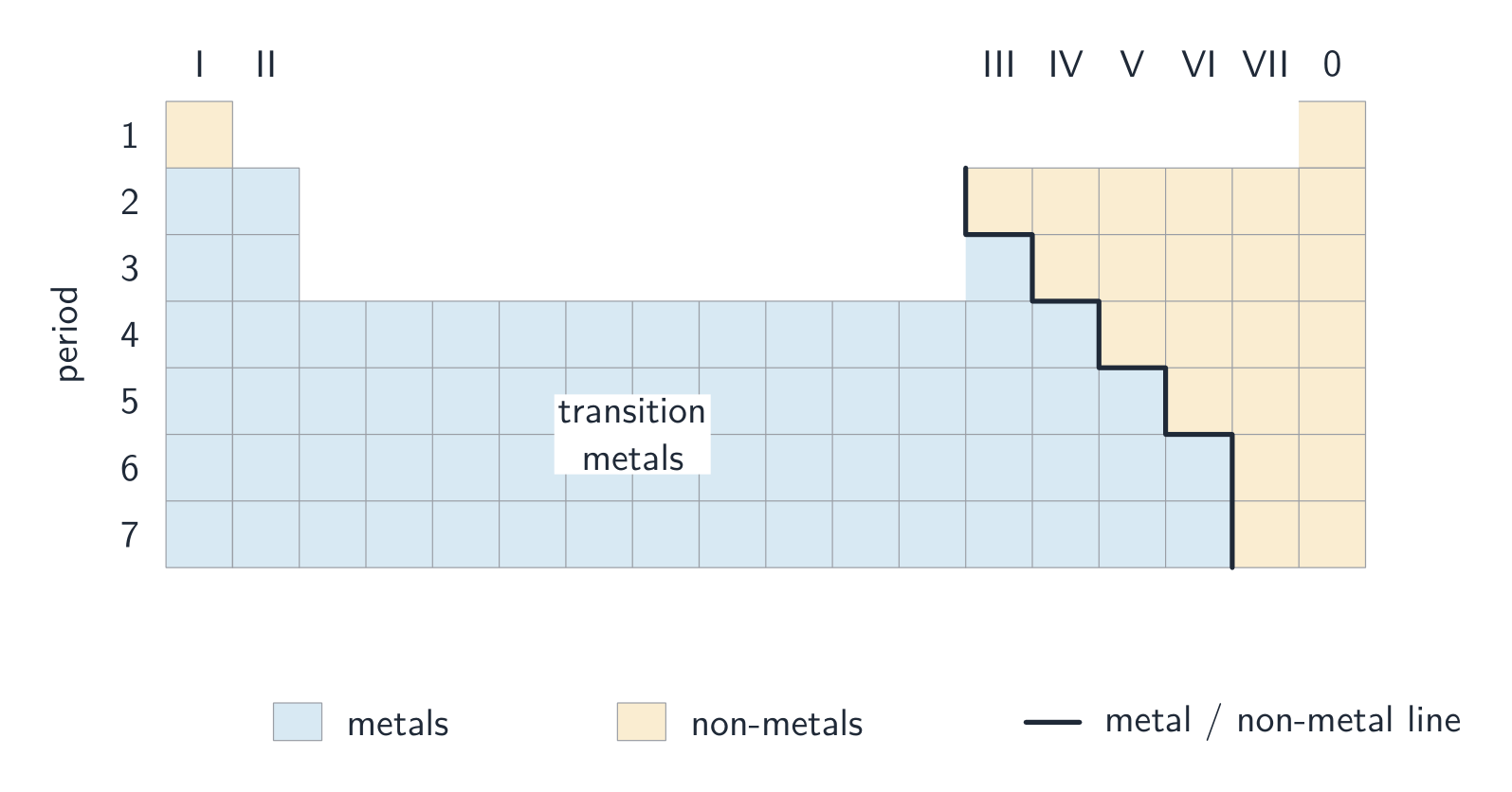
The transition metals form the central block of the periodic table
Many transition metals are useful as:
难度 1/5 · 今日首次完成可获 100 金币及少量额外奖励
E.g. iron catalyses the Haber process.
Unlike most other metals, transition-metal compounds are often ______.
难度 1/5 · 今日首次完成可获 100 金币及少量额外奖励
E.g. blue copper sulfate.
Coloured and catalytic
- Their compounds are often coloured (e.g. blue copper sulfate, green iron compounds).
- Many are useful catalysts 催化剂 (e.g. iron in the Haber process).
Transition metals can form ions with:
难度 1/5 · 今日首次完成可获 100 金币及少量额外奖励
E.g. iron forms Fe²⁺ and Fe³⁺.
Variable charges 可变电荷
- Transition metals can form ions with different charges (e.g. iron as Fe²⁺ or Fe³⁺).
- This is unlike Group I or II metals, which have a single fixed charge.
Transition metals differ from Group I in every way. They are harder, denser, much less reactive, form coloured compounds, and act as catalysts — the opposite of the soft, reactive Group I metals.
Worked example: two iron chlorides
Iron forms two chlorides. Use the ion charges to write their formulae, and say how sodium hydroxide tells them apart.
- Iron(II) is $\text{Fe}^{2+}$, so it needs 2 $\text{Cl}^-$: $\text{FeCl}_2$. Iron(III) is $\text{Fe}^{3+}$, so it needs 3: $\text{FeCl}_3$. The Roman numeral in the name gives the charge.
- With NaOH(aq), $\text{Fe}^{2+}$ gives a green precipitate and $\text{Fe}^{3+}$ a red-brown one. Sodium, in Group I, has only one ion, $\text{Na}^{+}$, so it needs no Roman numeral.
Copper forms the ions $\text{Cu}^{+}$ and $\text{Cu}^{2+}$. What is the formula of copper(II) oxide? (Oxide is $\text{O}^{2-}$.)
难度 1/5 · 今日首次完成可获 100 金币及少量额外奖励
一 $\text{Cu}^{2+}$ balances one $\text{O}^{2-}$. $\text{Cu}_2\text{O}$ is copper(I) oxide.
How many chloride ions combine with one iron(III) ion?
难度 2/5 · 今日首次完成可获 140 金币及少量额外奖励
Fe³⁺ has three positive charges, balanced by three Cl⁻ ions: FeCl₃.
You've got it
- transition elements are hard, strong, dense, with high melting points
- they form coloured compounds and act as catalysts
- they have variable charges (e.g. Fe²⁺ and Fe³⁺), unlike Group I/II
Write from this case
- Iron can form Fe2+ and Fe3+ compounds.
- Those compounds are coloured. Group I metals form only 1+ ions.
Which transition-metal property is the pair of iron ions?
More than one stable ion charge means variable oxidation states.
What property do Fe2+ and Fe3+ show?
难度 1/5 · 今日首次完成可获 100 金币及少量额外奖励
Two different positive charges are two oxidation states.