The Haber and Contact processes · 哈伯过程与接触过程
| English | 中文 | Pinyin · 拼音 |
|---|---|---|
| Contact process/ˈkɒntækt ˈprəʊses/ | 接触法 | jiē chù fǎ |
| ammonia/æˈməʊnɪə/ | 氨气 | ān qì |
| sulfuric acid/sʌlˈfjʊərɪk ˈæsɪd/ | 硫酸 | liú suān |
| Haber process/ˈheɪbə ˈprəʊses/ | 哈伯法 | hā bó fǎ |
| iron catalyst/ˈaɪən ˈkætəlɪst/ | 铁催化剂 | tiě cuī huà jì |
| yield/jiːld/ | 产率 | chǎn lǜ |
Equilibrium in industry
- Two of the world's most important industrial reactions are reversible.
- The Haber and Contact processes 接触法 make ammonia 氨气 and sulfuric acid 硫酸.
工业中的平衡
- 世界上两个最重要的工业反应是可逆的。
- 哈伯(Haber)和接触(Contact)过程制造氨和硫酸。
The Haber process makes: · 哈伯过程制造:
N₂ + H₂ ⇌ NH₃ in the Haber process. · 哈伯过程中 N₂ + H₂ ⇌ NH₃。
The catalyst used in the Haber process is: · 哈伯过程中使用的催化剂是:
Iron catalyses the Haber process. · 铁催化哈伯过程。
The Haber process combines nitrogen and hydrogen to make . · 哈伯过程结合氮气和氢气以制造。
Ammonia (NH₃) is used to make fertilisers. · 氨(NH₃)被用来制造肥料。
The Haber process 哈伯法
- The Haber process makes ammonia (NH₃) from nitrogen + hydrogen (a reversible reaction).
- Conditions: about 450 °C, 200 atmospheres pressure, and an iron catalyst 铁催化剂.
The Haber process makes ammonia: N₂ + 3H₂ ⇌ 2NH₃
哈伯过程
- 哈伯过程从氮气 + 氢气(一个可逆反应)制造氨(NH₃)。
- 条件:约 450 °C、200 个大气压的压强,和一个铁催化剂。
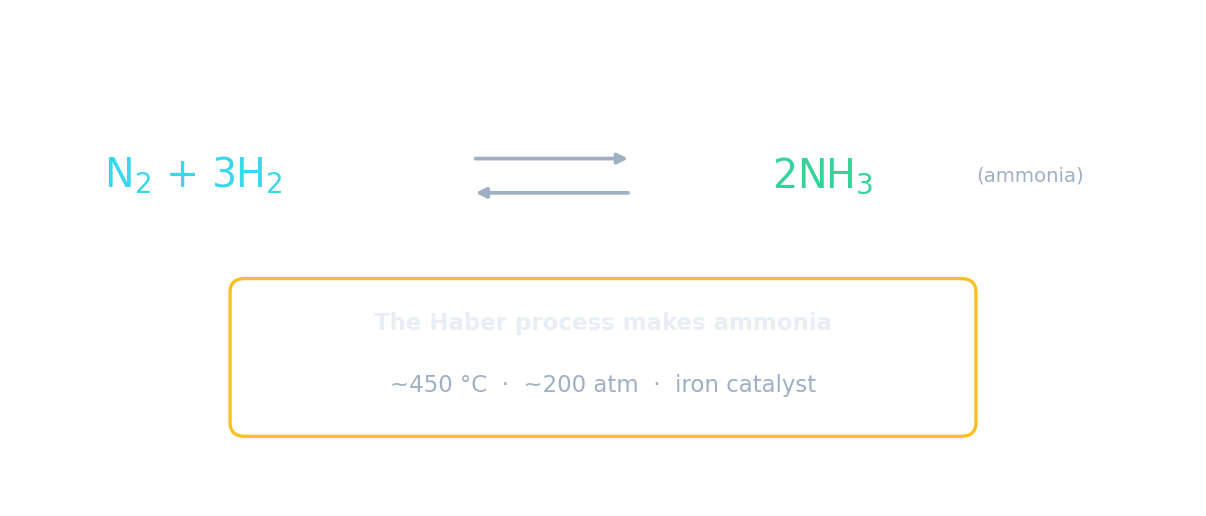
哈伯法制氨:N₂ + 3H₂ ⇌ 2NH₃
The Haber & Contact processes · 哈伯过程与接触过程
compromise: yield vs rate · 折衷:产率对速率
Pressure raises yield; temperature is a compromise between yield and rate. · 压强提高产率;温度是产率和速率之间的一个折衷。
The Contact process is used to make: · 接触过程被用来制造:
The Contact process makes sulfuric acid. · 接触过程制造硫酸。
The Contact process
- The Contact process makes sulfuric acid, via sulfur trioxide.
- A key reversible step uses a vanadium(V) oxide catalyst.
接触过程
- 接触过程通过三氧化硫制造硫酸。
- 一个关键的可逆步骤使用一个氧化钒(V)催化剂。
Industrial conditions are chosen as a compromise between yield, rate and cost. · 工业条件被选为产率、速率和成本之间的一个折衷。
No single condition is best for all three. · 没有单一的条件对所有三个都最好。
Choosing the conditions
- Conditions are a compromise: a good yield 产率 at a reasonable rate and cost.
- For example, higher pressure improves ammonia yield but is expensive and dangerous.
Worked example. In the Haber process, a lower temperature would give more ammonia (higher yield) but far too slowly. 450 °C is a compromise — a reasonable yield at a useful rate.
选择条件
- 条件是一个折衷:在一个合理的速率和成本下一个好的产率。
- 例如,更高的压强改善氨的产率但昂贵且危险。
例题。 在哈伯过程中,一个更低的温度会给出更多的氨(更高的产率)但太慢了。450 °C 是一个折衷——在一个有用的速率下一个合理的产率。
You've got it
- the Haber process makes ammonia from nitrogen + hydrogen (iron catalyst, ~450 °C, high pressure)
- the Contact process makes sulfuric acid (vanadium(V) oxide catalyst)
- conditions are a compromise between yield, rate and cost
你掌握了
- 哈伯过程从氮气 + 氢气制造氨(铁催化剂,~450 °C,高压)
- 接触过程制造硫酸(氧化钒(V)催化剂)
- 条件是产率、速率和成本之间的一个折衷