Atomic structure · 原子结构
| English | 中文 | Pinyin · 拼音 |
|---|---|---|
| nucleus/ˈnjuːklɪəs/ | 原子核 | yuán zǐ hé |
| electrons/ɪˈlektrɒnz/ | 电子 | diàn zi |
| protons/ˈprəʊtɒnz/ | 质子 | zhì zi |
| neutrons/ˈnjuːtrɒnz/ | 中子 | zhōng zi |
| shells/ʃelz/ | 电子层 | diàn zi céng |
| neutral/ˈnjuːtrəl/ | 中性 | zhōng xìng |
| mass number/mæs ˈnʌmbə/ | 质量数 | zhì liàng shù |
| atomic number/əˈtɒmɪk ˈnʌmbə/ | 原子序数 | yuán zi xù shù |
Inside the atom
- Atoms are the tiny building blocks of everything — but they have an even smaller inner structure.
- An atom has a central nucleus 原子核 surrounded by electrons 电子.
原子内部
- 原子是一切的微小构建块——但它们有一个甚至更小的内部结构。
- 一个原子有一个中央原子核被电子围绕。
Which subatomic particle has a positive charge? · 哪种亚原子粒子有一个正电荷?
Protons are positive; neutrons neutral; electrons negative. · 质子是正的;中子中性;电子负的。
The three subatomic particles
- Protons 质子: positive charge, in the nucleus.
- Neutrons 中子: no charge, in the nucleus.
- Electrons: negative charge, orbiting in shells 电子层.
Protons and neutrons sit in the nucleus; electrons orbit in shells.
三种亚原子粒子
- 质子(protons):正电荷,在原子核中。
- 中子(neutrons):无电荷,在原子核中。
- 电子(electrons):负电荷,在壳层(shells)中绕行。
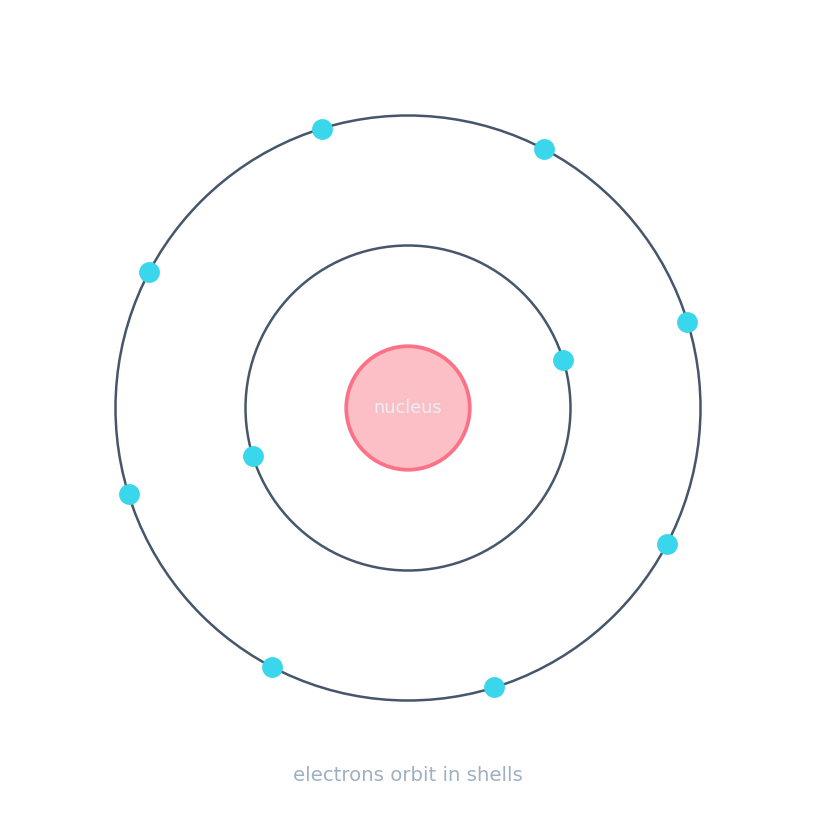
质子和中子坐在原子核中;电子在壳层中绕行。
An atom has no overall charge because it has equal numbers of: · 一个原子没有整体电荷,因为它有相等数量的:
Equal protons and electrons make an atom neutral. · 相等的质子和电子使一个原子中性。
Mass and charge
- Protons and neutrons each have a mass of 1; electrons have almost no mass.
- An atom is neutral 中性 because it has equal numbers of protons and electrons.
质量和电荷
- 质子和中子各有 1 的质量;电子几乎没有质量。
- 一个原子是中性的,因为它有相等数量的质子和电子。
Build the atom, shell by shell · 一层一层地建立原子
Protons and neutrons sit in the tiny nucleus; electrons fill shells around it — 2 in the first, then up to 8. Change the element to see how its particles are arranged. · 质子和中子坐在微小的原子核中;电子填满它周围的壳层——第一层 2 个,然后多达 8 个。改变元素以看它的粒子如何排列。
An atom has atomic number 6 and mass number 14. How many neutrons does it have? · 一个原子有原子序数 6 和质量数 14。它有多少个中子?
Neutrons = mass number − atomic number = 14 − 6 = 8. · 中子 = 质量数 − 原子序数 = 14 − 6 = 8。
The atomic number of an element is the number of: · 一个元素的原子序数是以下的数量:
Atomic number = number of protons. · 原子序数 = 质子的数量。
The mass number equals the number of protons plus . · 质量数等于质子的数量加上。
Mass number = protons + neutrons. · 质量数 = 质子 + 中子。
Atomic and mass number 质量数
- Atomic (proton) number = the number of protons (this defines the element).
- Mass number = protons + neutrons. So neutrons = mass number − atomic number 原子序数.
Worked example. A sodium atom has atomic number 11 and mass number 23. It has 11 protons, 11 electrons (neutral), and 23 − 11 = 12 neutrons.
原子序数和质量数
- 原子(质子)序数(atomic / proton number)= 质子的数量(这定义了元素)。
- 质量数(mass number)= 质子 + 中子。所以中子 = 质量数 − 原子序数。
例题。 一个钠原子有原子序数 11 和质量数 23。它有 11 个质子、11 个电子(中性),和 23 − 11 = 12 个中子。
You've got it
- protons (+, nucleus), neutrons (0, nucleus), electrons (−, shells)
- atoms are neutral: protons = electrons; proton and neutron mass = 1, electron ≈ 0
- atomic number = protons; mass number = protons + neutrons
你掌握了
- 质子(+,原子核)、中子(0,原子核)、电子(−,壳层)
- 原子是中性的:质子 = 电子;质子和中子质量 = 1,电子 ≈ 0
- 原子序数 = 质子;质量数 = 质子 + 中子