Metallic bonding · 金属键合
| English | 中文 | Pinyin · 拼音 |
|---|---|---|
| metallic bonding/məˈtælɪk ˈbɒndɪŋ/ | 金属键 | jīn shǔ jiàn |
| delocalised/dɪˈlɒkəlaɪzd/ | 离域的 | lí yù de |
| conductors/kənˈdʌktəz/ | 导体 | dǎo tǐ |
| malleable/ˈmæləbl/ | 可延展的 | kě yán zhǎn de |
A sea of electrons
- Metals conduct electricity, bend without breaking, and feel solid. Why?
- The answer is a special kind of bonding: metallic bonding 金属键.
一片电子海
- 金属导电、弯曲而不断裂,感觉坚实。为什么?
- 答案是一种特殊的键合:金属键合(metallic bonding)。
Metallic bonding consists of: · 金属键合由以下构成:
Delocalised electrons surround positive metal ions. · 离域电子围绕正金属离子。
The outer electrons in a metal are delocalised, meaning free to move. · 一个金属中的外层电子是离域的,意思是自由移动。
Delocalised electrons explain conduction and malleability. · 离域电子解释导电和可锻性。
In a metal, positive ions sit in a ______ of delocalised electrons. · 在一个金属中,正离子坐在一片离域电子的______中。
The electron sea holds the metal together. · 电子海把金属凝聚在一起。
What metallic bonding is
- In a metal, atoms lose their outer electrons, which become delocalised 离域的 (free to move).
- This creates a lattice of positive metal ions in a sea of free electrons.
A metal is positive ions in a sea of delocalised electrons that are free to move
金属键合是什么
- 在一个金属中,原子失去它们的外层电子,它们变成离域的(delocalised,自由移动)。
- 这创造一个在自由电子海中的正金属离子晶格。
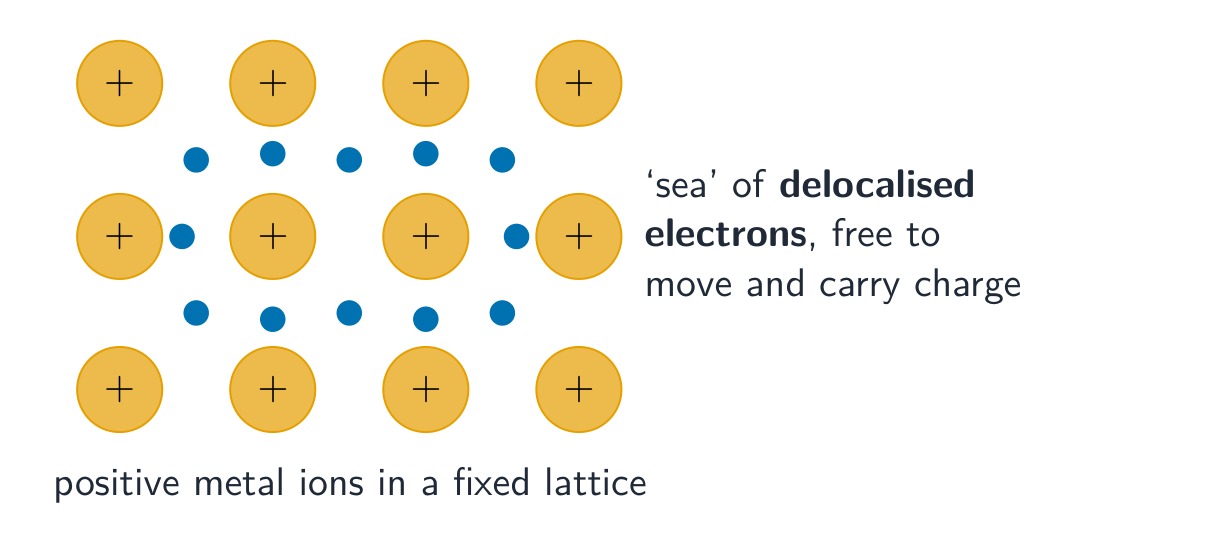
一个金属是在自由移动的离域电子海中的正离子
Inside a metal — and why it behaves that way · 一个金属内部——以及为什么它那样表现
Step through it. Positive ions sit in a shared sea of delocalised electrons — that one picture explains conduction and why metals bend instead of snapping. · 逐步看。正离子坐在一片共享的离域电子海中——那一幅图解释导电以及为什么金属弯曲而不是折断。
Metals conduct electricity because they have: · 金属导电,因为它们有:
Mobile electrons carry the current. · 可移动的电子携带电流。
Conducting electricity and heat
- The free electrons can move through the metal, carrying electric current and heat.
- This is why metals are good conductors 导体.
导电和导热
- 自由电子能穿过金属移动,携带电流和热。
- 这就是为什么金属是好的导体。
Metals can be bent and shaped (are malleable) because: · 金属能被弯曲和塑形(是可锻的),因为:
Sliding layers keep the metallic bond intact. · 滑动的层保持金属键完整。
Strong and bendy
- The strong attraction between the ions and the electron sea makes metals strong with high melting points.
- Layers of ions can slide over each other without breaking the bond, so metals are malleable 可延展的 (can be bent and shaped).
Worked example. Copper is used for wires because its delocalised electrons carry current easily, and it can be drawn into thin wires because its ion layers slide — both explained by metallic bonding.
强且可弯
- 离子和电子海之间的强吸引使金属强,有高熔点。
- 离子的层能互相滑过而不打破键,所以金属是可锻的(malleable,能被弯曲和塑形)。
例题。 铜被用于导线,因为它的离域电子容易携带电流,而它能被拉成细线,因为它的离子层滑动——两者都由金属键合解释。
You've got it
- metallic bonding: positive metal ions in a sea of delocalised electrons
- free electrons make metals good conductors of electricity and heat
- sliding ion layers make metals malleable; strong attraction gives high melting points
你掌握了
- 金属键合:在一个离域电子海中的正金属离子
- 自由电子使金属成为好的电和热导体
- 滑动的离子层使金属可锻;强吸引给出高熔点