持久理解(MEA-1): 一个经济体的表现可以通过不同的指标来衡量,例如国内生产总值(GDP)、通货膨胀率和失业率。
学习目标 MEA-1.A: a. 定义(适当时使用循环流量图)如何衡量GDP及其组成部分。 b. 计算名义GDP。
- MEA-1.A.1 GDP是对经济体最终产出的衡量。
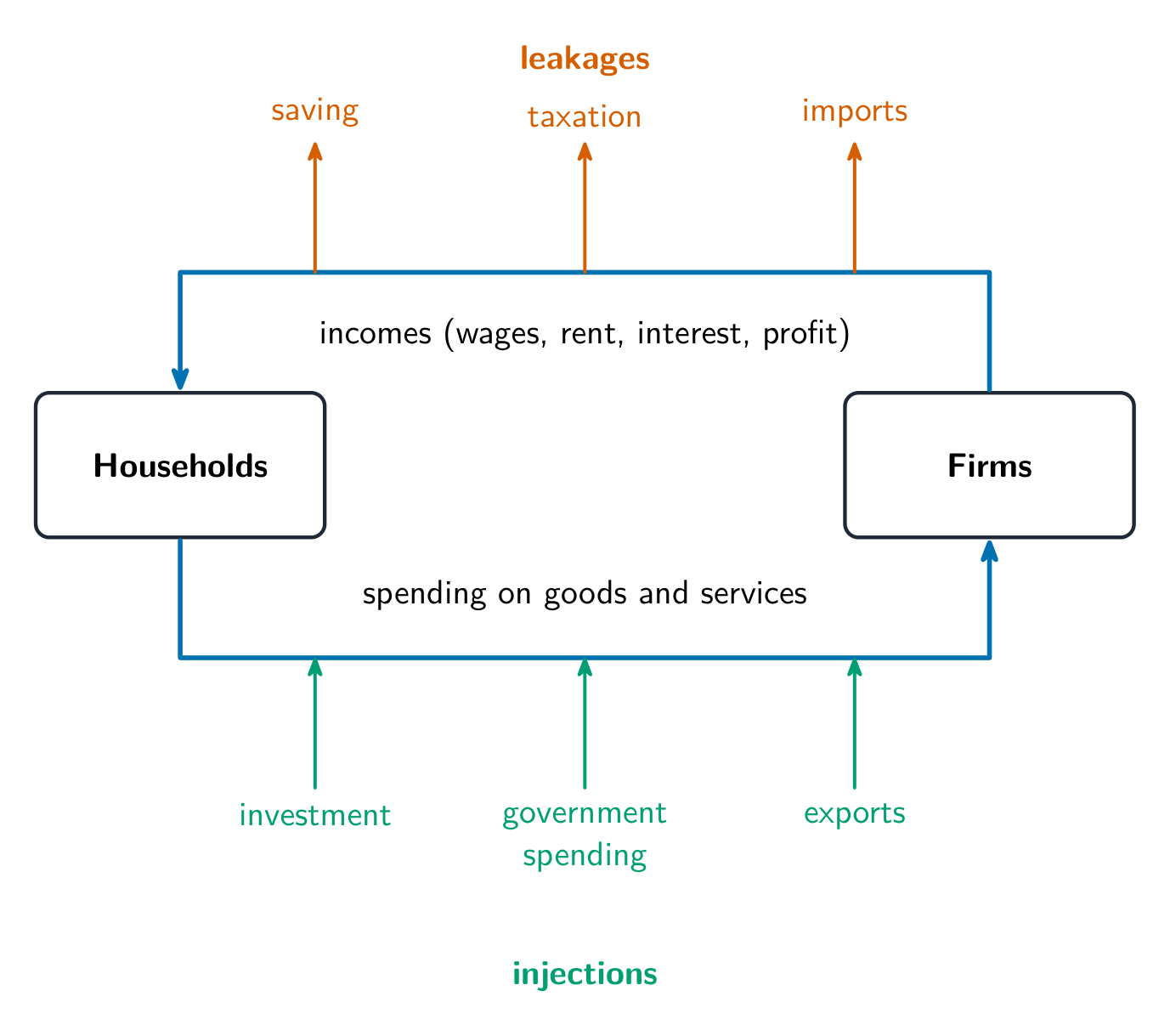
- MEA-1.A.2 作为总收入和总支出的一种总流量,GDP可以用循环流量图来表示。
- MEA-1.A.3 衡量GDP有三种方法:支出法、收入法和增值法。
AP 宏观经济学 · 知识点 2
 9:58
经济指标与经济周期
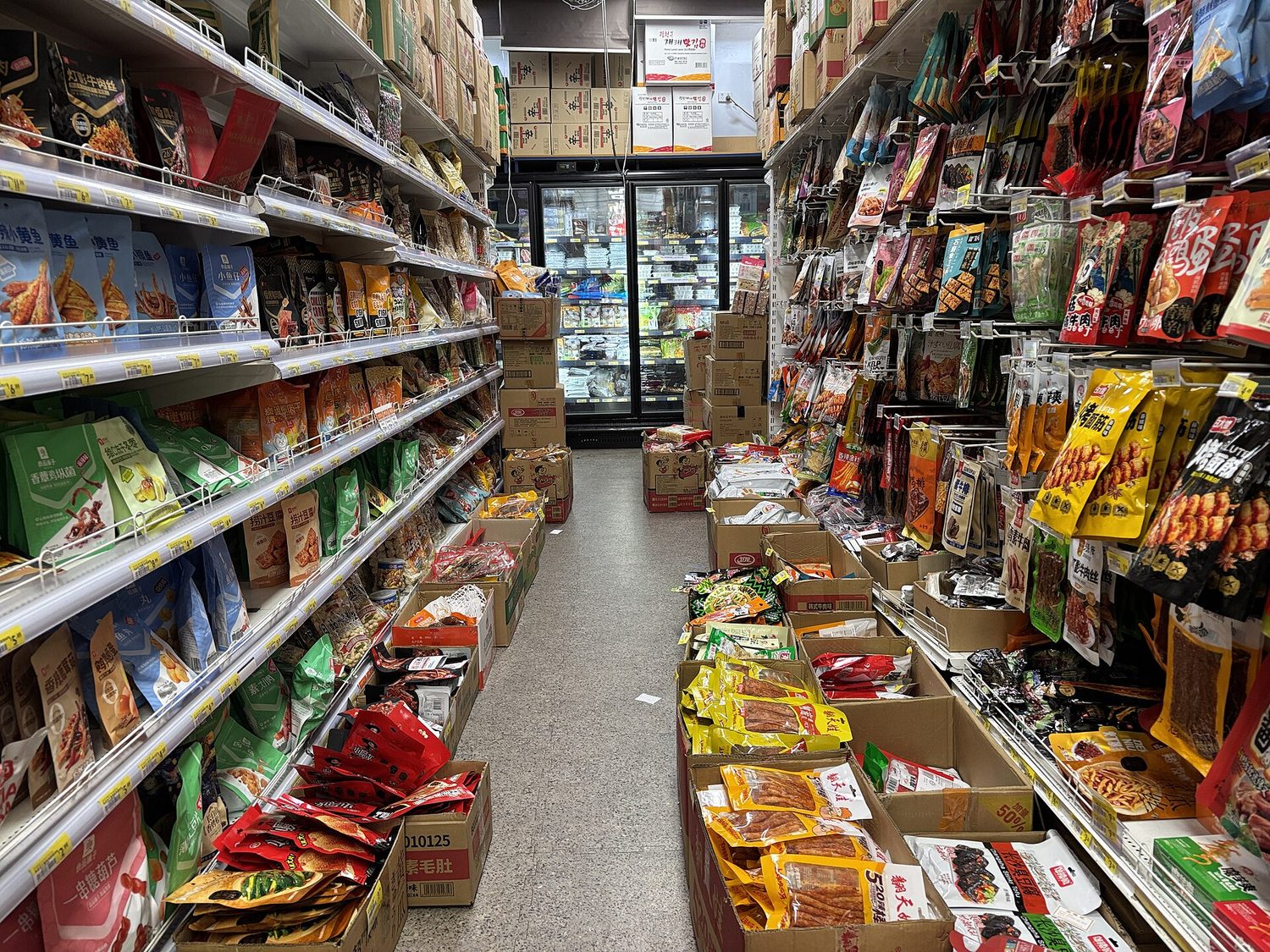
两个平凡的场景。一个是超市过道,同一篮食物的价格比去年更贵了;另一个是长长的人群在排队等候。这两者都不是……
英语旁白 · 英中内嵌字幕
持久理解(MEA-1): 一个经济体的表现可以通过不同的指标来衡量,例如国内生产总值(GDP)、通货膨胀率和失业率。
学习目标 MEA-1.A: a. 定义(适当时使用循环流量图)如何衡量GDP及其组成部分。 b. 计算名义GDP。
来源:College Board AP 课程与考试说明
The circular-flow model 循环流动模型 links households supplying factors and earning income with firms producing goods and services. Spending on current domestic production generates income; transfers and existing financial assets do not themselves add to GDP.
Gross domestic product (GDP) 国内生产总值 is the market value of all final goods and services produced within a country in a year. Three ways to measure it give the same number:
Worked example (billions of dollars). If $C=700$, $I=200$, $G=300$, exports are $150$ and imports $100$, GDP is $700+200+300+(150-100)=1250$. Buying shares is not investment in this GDP formula; a new factory machine is.
Exclude intermediate goods (avoid double counting), used goods, purely financial transactions, and transfer payments.
追踪国内当前生产的支出及其产生的收入。区分储蓄、税收和进口与投资、政府购买及出口;并非所有货币转移都计入GDP。
| English | 中文 | 拼音 |
|---|---|---|
| circular-flow model/ˈsɜːkjʊlə fləʊ ˈmɒdl/ | 循环流动模型 | xún huán liú dòng mó xíng |
| Gross domestic product (GDP)/ɡrəʊs dəˈmestɪk ˈprɒdʌkt/ | 国内生产总值 | guó nèi shēng chǎn zǒng zhí |
| consumption/kənˈsʌmpʃn/ | 消费 | xiāo fèi |
| investment/ɪnˈvestmənt/ | 投资 | tóu zī |
| government purchases/ˈɡʌvənmənt ˈpɜːtʃɪsɪz/ | 政府购买 | zhèng fǔ gòu mǎi |
| net exports/net ˈekspɔːts/ | 净出口 | jìng chū kǒu |
持久理解(MEA-1): 一个经济体的表现可以通过不同的指标来衡量,例如国内生产总值(GDP)、通货膨胀率和失业率。
学习目标 MEA-1.B: 定义GDP的局限性。
来源:College Board AP 课程与考试说明
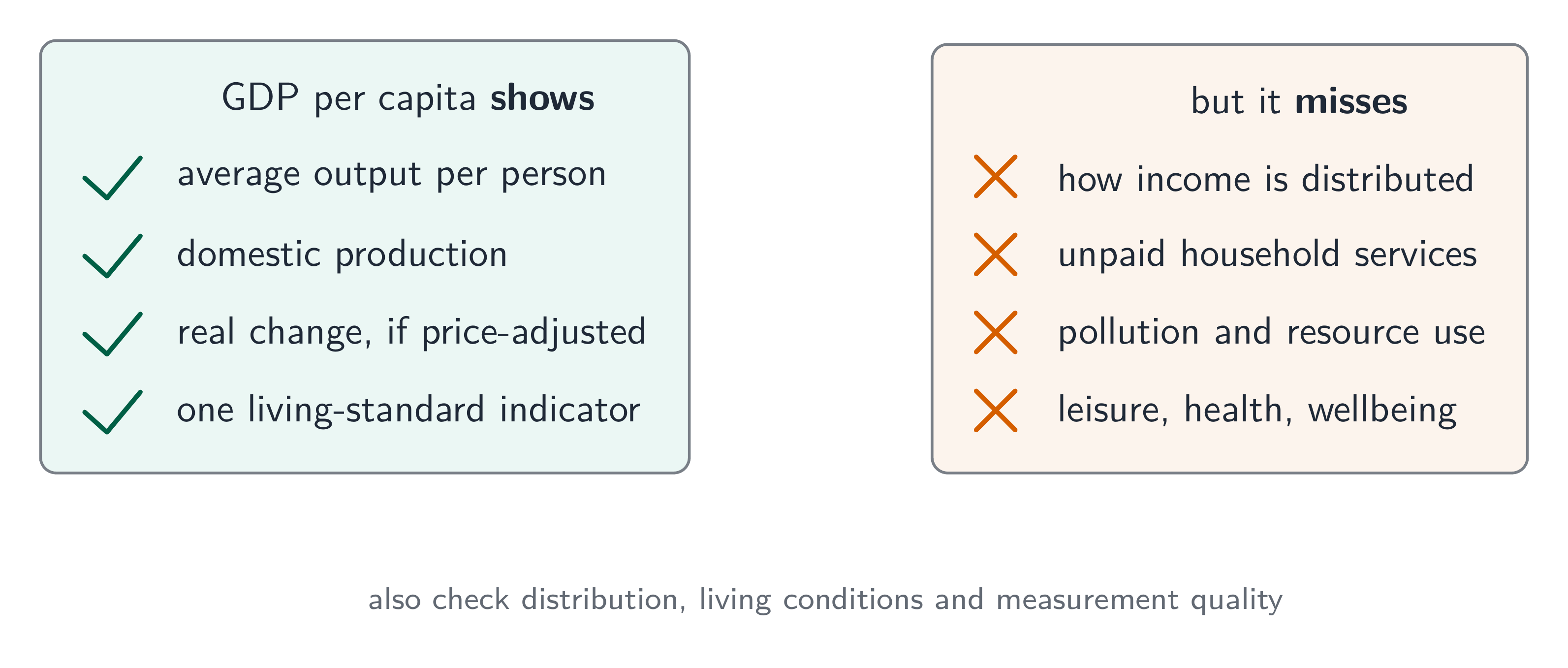
GDP measures market output, not well-being. It omits non-market production (unpaid housework, volunteering), unreported production in the underground economy 地下经济, leisure, and the distribution of income, and it ignores environmental damage and resource depletion. So a higher GDP does not automatically mean a better standard of living. Real GDP per capita (real GDP $\div$ population) is a better welfare proxy than total GDP.

Comparison example (AP 2024 Set 1, Q2). Year 1: real GDP $800,000, population 1,000, so output per person $800. Year 2: nominal GDP $1,035,000, deflator 115 (year 1 = 100), so real GDP $900,000. Population 1,200 gives $750 per person. Total real output rose 12.5%; output per person fell 6.25%. Neither average proves every household's welfare.
GDP 漏掉无偿和隐藏的劳动,忽略污染、资源损失、闲暇和不平等——所以它不是福祉的完整衡量。
| English | 中文 | 拼音 |
|---|---|---|
| underground economy/ˌʌndəˈɡraʊnd ɪˈkɒnəmi/ | 地下经济 | dì xià jīng jì |
持久理解 (MEA-1): 经济的表现可以通过不同的指标来衡量,例如国内生产总值(GDP)、通货膨胀率和失业率。
学习目标 MEA-1.C: a. 定义劳动力、失业率和劳动力参与率。 b. 解释就业和劳动力市场的变化如何影响失业率和劳动力参与率。 c. 计算失业率和劳动力参与率。
学习目标 MEA-1.D: 定义失业率的局限性。
学习目标 MEA-1.E: a. 定义失业的类型和自然失业率。 b. 解释失业类型的变化。
来源:College Board AP 课程与考试说明
The labor force 劳动力 is the employed plus the unemployed (those without work who are available and actively looking). People not looking are not in the labor force.
Worked example. A country has $150$ million employed and $10$ million unemployed (actively looking), with $40$ million working-age adults not looking. The labor force is $150+10=160$ million, so the unemployment rate is $\dfrac{10}{160}\times100\%=6.25\%$ and the participation rate is $\dfrac{160}{200}\times100\%=80\%$.
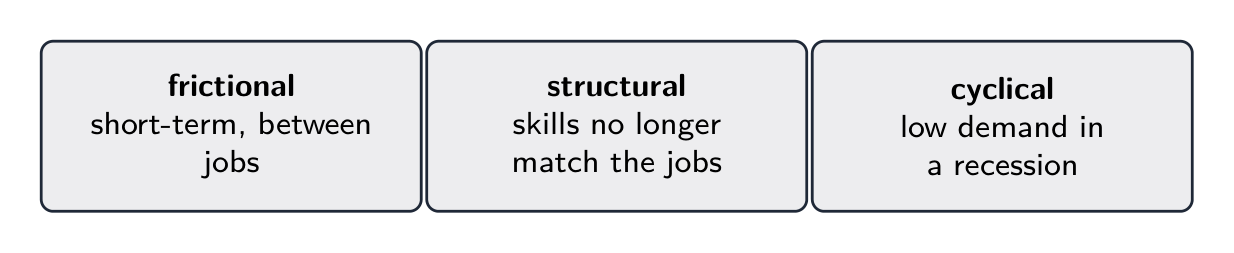
Three types of unemployment:
Frictional + structural make up the natural rate of unemployment 自然失业率. At the natural rate cyclical unemployment is zero and the economy is at full employment 充分就业. The rate does not describe all unused labor. Discouraged workers 灰心工人 have stopped looking, so are outside the labor force. Underemployed people working part time who want full-time work count as employed, not unemployed. If 5 million of the 10 million unemployed stop looking, with no new jobs, unemployment becomes $5/155\times100\%=3.23\%$ and participation $155/200\times100\%=77.5\%$. A falling unemployment rate need not mean more jobs.
Classify the cause. First-job search is frictional; skills mismatch is structural; recession layoffs are cyclical. Actual unemployment 8% minus cyclical 3% gives natural 5%; subtract frictional 4% to find structural 1% (AP 2024 Set 1, Q1a). The natural rate can change.
摩擦性失业是短期换工作;结构性是技能或地点不匹配;周期性来自经济周期的下行。
| English | 中文 | 拼音 |
|---|---|---|
| labor force/ˈleɪbə fɔːs/ | 劳动力 | láo dòng lì |
| Frictional/ˈfrɪkʃənl/ | 摩擦性失业 | mó cā xìng shī yè |
| Structural/ˈstrʌktʃərəl/ | 结构性失业 | jié gòu xìng shī yè |
| Cyclical/ˈsaɪklɪkl/ | 周期性失业 | zhōu qī xìng shī yè |
| natural rate of unemployment/ˈnætʃərəl reɪt ɒv ʌnemˈplɔɪmənt/ | 自然失业率 | zì rán shī yè lǜ |
| full employment/fʊl emˈplɔɪmənt/ | 充分就业 | chōng fèn jiù yè |
| discouraged workers/dɪˈskʌrɪdʒd ˈwɜːkəz/ | 灰心工人 | huī xīn gōng rén |
持久理解(MEA-1): 一个经济体的表现可以通过不同的指标来衡量,例如国内生产总值(GDP)、通货膨胀率和失业率。
学习目标 MEA-1.F: a. 定义消费者价格指数(CPI)、通货膨胀、通货紧缩、减速通胀、通货膨胀率以及实际变量。 b. 解释如何利用价格指数计算通货膨胀率,并比较不同时期的名义变量。 c. 计算消费者价格指数(CPI)、通货膨胀率以及实际变量的变化。
学习目标 MEA-1.G: 定义 CPI 作为真实通货膨胀衡量指标的局限性。
来源:College Board AP 课程与考试说明
Inflation 通货膨胀 is a sustained rise in the average price level. It is measured with a price index 价格指数, most often the consumer price index (CPI) 消费者价格指数, built from a fixed market basket of goods a typical household buys:
The inflation rate is the percent change in the index between two years. Deflation 通货紧缩 is a falling price level; disinflation is a slowing of inflation.
Read a series. In a fictional example, CPI values of 100, 110, 115 and 112 in four consecutive years imply inflation of 10%, 4.55% and -2.61%. Year 3 has disinflation: prices still rise, but more slowly. Year 4 has deflation: prices fall from year 3, yet remain 12% above the base year.
Substitution bias. If beef becomes dearer, households may buy more chicken. A fixed basket keeps the old quantities, so it can overstate the increase in the cost of maintaining living standards.
Worked example. If the CPI is $200$ this year and was $190$ last year, the inflation rate is $\dfrac{200-190}{190}\times100\%=5.3\%$. A basket that cost $\$190$ then costs $\$200$ – the same goods, more dollars.
通货膨胀是价格水平上升;通货紧缩是下降;反通货膨胀是通胀仍为正但在放缓。
| English | 中文 | 拼音 |
|---|---|---|
| Inflation/ɪnˈfleɪʃn/ | 通货膨胀 | tōng huò péng zhàng |
| price index/praɪs ˈɪndeks/ | 价格指数 | jià gé zhǐ shù |
| consumer price index (CPI)/kənˈsuːmə praɪs ˈɪndeks/ | 消费者价格指数 | xiāo fèi zhě jià gé zhǐ shù |
| Deflation/diːˈfleɪʃn/ | 通货紧缩 | tōng huò jǐn suō |

持久理解(MEA-1): 经济表现可以通过不同的指标来衡量,例如国内生产总值(GDP)、通货膨胀率和失业率。
学习目标 MEA-1.H: 解释意外通胀(通缩)对个人和经济造成的成本。
来源:College Board AP 课程与考试说明
Inflation redistributes and distorts:
The real interest rate. Real interest rate $\approx$ nominal interest rate $-$ inflation rate (Unit 4 uses it in the loanable-funds market). A bank lends at 6% expecting 2% inflation, so it expects a real return of 4%. If inflation turns out to be 8%, the real rate is $6 - 8 = -2\%$: the bank is repaid with dollars that buy less than the dollars it lent, and the borrower gains. A real case: US CPI inflation reached 9.1% in June 2022, the highest since 1981, while many savings accounts paid close to 0%. Savers earned a real return of about $-9\%$.
未预期的通胀帮助借款人,伤害放款人和持现金的储蓄者,并带来菜单成本、皮鞋成本等真实成本。
持久性理解(MEA-1): 一个经济体的表现可以通过不同的指标来衡量,例如国内生产总值(GDP)、通货膨胀率和失业率。
学习目标 MEA-1.I: 定义名义GDP和实际GDP。
学习目标 MEA-1.J: 计算实际GDP和GDP平减指数。
来源:College Board AP 课程与考试说明
Worked example. Nominal GDP is $\$22$ trillion and the GDP deflator is $110$. Real GDP is $\dfrac{22}{110}\times100=\$20$ trillion. The $2 trillion difference reflects different price bases, not growth. If last year's real GDP was $19 trillion, real growth is $(20-19)/19\times100\%=5.26\%$. Growth needs an earlier value.
Exam skill: be fluent converting nominal to real using a price index, and computing an inflation rate or a growth rate as a percent change.
名义 GDP 用当年价格,把产出和通胀混在一起;实际 GDP 把价格固定在基年,所以只显示产出的变化。
| English | 中文 | 拼音 |
|---|---|---|
| Nominal GDP/ˈnɒmɪnl ˌdʒiː diː ˈpiː/ | 名义 | míng yì |
| Real GDP/rɪəl ˌdʒiː diː ˈpiː/ | 实际 | shí jì |
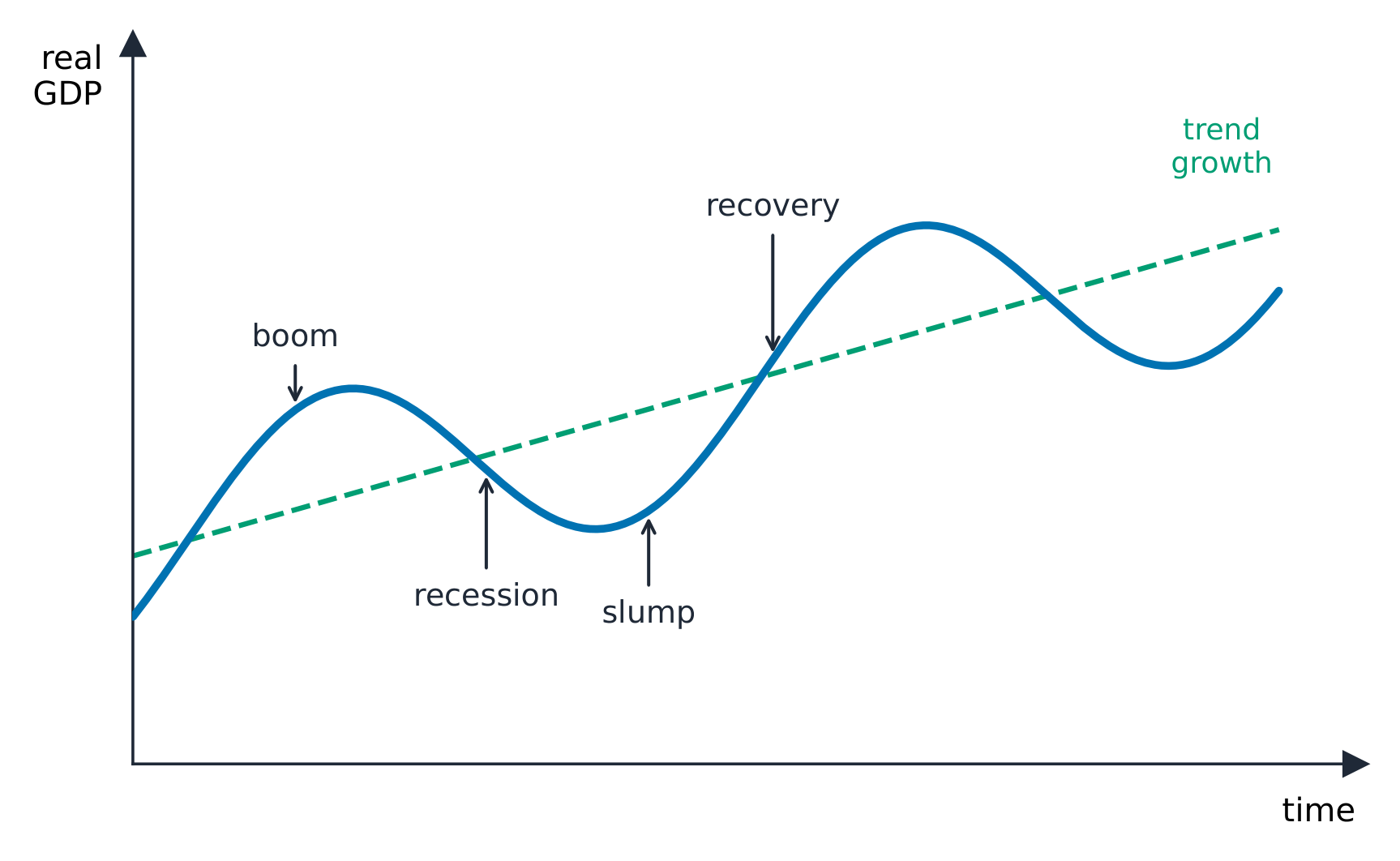
持久理解(MEA-2): 经济在短期内会在扩张和收缩之间波动,但在长期内可以实现经济增长。
学习目标 MEA-2.A: a. 定义(使用图表和数据说明)商业周期的转折点和阶段。 b. 解释(使用图表和数据说明)商业周期的转折点和阶段。
来源:College Board AP 课程与考试说明
The business cycle 经济周期 describes real GDP fluctuating around its long-run trend. Expansion 扩张 (rising output) ends at a peak 顶峰; contraction/recession 衰退 (falling output) ends at a trough 谷底. These are two phases and two turning points. Recessions raise cyclical unemployment, but inflation need not fall: an adverse supply shock can reduce output while raising prices.
Output-gap example. Potential output is real GDP at full employment. If actual real GDP is $1,140 billion and potential output $1,200 billion, the gap is minus $60 billion, or $-5\%$ of potential output: a recessionary gap. Positive gaps indicate actual output above potential, not automatically a higher long-run growth rate.
经济周期依次是扩张 → 顶峰 → 收缩 → 谷底。每个阶段的产出与失业都有各自的特征。
| English | 中文 | 拼音 |
|---|---|---|
| business cycle/ˈbɪznəs ˈsaɪkl/ | 经济周期 | jīng jì zhōu qī |
| expansion/ekˈspænʃn/ | 扩张 | kuò zhāng |
| peak/piːk/ | 顶峰 | dǐng fēng |
| contraction/recession/kənˈtrækʃn rɪˈseʃn/ | 衰退 | shuāi tuì |
| trough/trɒf/ | 谷底 | gǔ dǐ |
持久理解 (MEA-1): 经济的表现可以通过不同的指标来衡量,例如国内生产总值(GDP)、通货膨胀率和失业率。
学习目标 MEA-1.C: a. 定义劳动力、失业率和劳动力参与率。 b. 解释就业和劳动力市场的变化如何影响失业率和劳动力参与率。 c. 计算失业率和劳动力参与率。
学习目标 MEA-1.D: 定义失业率的局限性。
学习目标 MEA-1.E: a. 定义失业的类型和自然失业率。 b. 解释失业类型的变化。
持久理解(MEA-1): 一个经济体的表现可以通过不同的指标来衡量,例如国内生产总值(GDP)、通货膨胀率和失业率。
学习目标 MEA-1.F: a. 定义消费者价格指数(CPI)、通货膨胀、通货紧缩、减速通胀、通货膨胀率以及实际变量。 b. 解释如何利用价格指数计算通货膨胀率,并比较不同时期的名义变量。 c. 计算消费者价格指数(CPI)、通货膨胀率以及实际变量的变化。
学习目标 MEA-1.G: 定义 CPI 作为真实通货膨胀衡量指标的局限性。
持久理解(MEA-1): 经济表现可以通过不同的指标来衡量,例如国内生产总值(GDP)、通货膨胀率和失业率。
学习目标 MEA-1.H: 解释意外通胀(通缩)对个人和经济造成的成本。
持久性理解(MEA-1): 一个经济体的表现可以通过不同的指标来衡量,例如国内生产总值(GDP)、通货膨胀率和失业率。
学习目标 MEA-1.I: 定义名义GDP和实际GDP。
学习目标 MEA-1.J: 计算实际GDP和GDP平减指数。
持久理解(MEA-2): 经济在短期内会在扩张和收缩之间波动,但在长期内可以实现经济增长。
学习目标 MEA-2.A: a. 定义(使用图表和数据说明)商业周期的转折点和阶段。 b. 解释(使用图表和数据说明)商业周期的转折点和阶段。
来源:College Board AP 课程与考试说明
The data. Country Z (all figures in millions of people, and billions of dollars for GDP):
| Year 1 (base year) | Year 2 | |
|---|---|---|
| Employed | 95 | 95.5 |
| Unemployed | 5 | 4 |
| Working-age population | 152 | 152 |
| Cost of the market basket | $400 | $420 |
| Nominal GDP | $2,000 | $2,205 |
(a) Calculate the unemployment rate in each year. Labor force = employed + unemployed: 100 million in year 1 and 99.5 million in year 2. Unemployment rate: $\dfrac{5}{100}\times100\% = 5\%$ in year 1 and $\dfrac{4}{99.5}\times100\% \approx 4.02\%$ in year 2.
(b) Unemployment fell by 1 million, but employment rose by only 0.5 million. Explain. The labor force shrank by 0.5 million: some unemployed people stopped looking for work. These discouraged workers are no longer counted as unemployed, so the rate falls without new jobs. Labor-force participation fell from $\tfrac{100}{152} \approx 65.8\%$ to $\tfrac{99.5}{152} \approx 65.5\%$.
(c) Calculate the CPI in year 2 and the inflation rate. $CPI = \dfrac{420}{400}\times100 = 105$; year 1 is the base year, so its CPI is 100. Inflation $= \dfrac{105-100}{100}\times100\% = 5\%$.
(d) The GDP deflator in year 2 is 105. Calculate real GDP in year 2 and the real growth rate. Real GDP $= \dfrac{2205}{105}\times100 = \$2{,}100$ billion. In the base year real GDP equals nominal GDP ($2,000 billion), so real growth $= \dfrac{2100-2000}{2000}\times100\% = 5\%$. Nominal GDP rose 10.25%; about half of that rise is higher prices.
(e) In year 1 Ana borrowed at a fixed nominal interest rate of 6%, expecting 2% inflation. Inflation was 5%. Did she gain or lose? She expected a real rate of $6 - 2 = 4\%$ but paid only $6 - 5 = 1\%$. Unexpected inflation helped Ana, the borrower, and hurt her lender.
(f) Which phase of the business cycle is Country Z most likely in? Real GDP is rising (5% growth), so it is in an expansion. State the evidence (real, not nominal, GDP) and the phase.
Common errors: dividing the unemployed by the population instead of the labor force; quoting the CPI (105) as the inflation rate; measuring growth with nominal GDP; saying inflation always hurts borrowers.
Show the formula and denominator before substituting. Distinguish final output from intermediate sales, unemployment from non-participation, and index levels from inflation rates. For growth, compare real values across years; for living standards, divide by population and state the limitations.
逐步完成,配合即时检查练习。
正在加载学科…