跳到主要内容

金融部门

AP 宏观经济学 · 第 4 主题

训练
讲义 词汇表
4.1

金融资产

大纲
Enduring UnderstandingLearning ObjectiveEssential Knowledge

MEA-3
Money makes it possible to compare the value of goods and services, and interest rates provide a measure of the price of money that is borrowed or saved.

MEA-3.A
a. Define the principal attributes—liquidity, rate of return, and risk—associated with various classes of financial assets, including money.
b. Explain the relationship between the price of previously issued bonds and interest rates.

  • MEA-3.A.1 The most liquid forms of money are cash and demand deposits.
  • MEA-3.A.2 Other financial assets people can hold in place of the most liquid forms of money include bonds (interest-bearing assets) and stocks (equity).
  • MEA-3.A.3 The price of previously issued bonds and interest rates on bonds are inversely related.
  • MEA-3.A.4 The opportunity cost of holding money is the interest that could have been earned from holding other financial assets such as bonds.

来源:美国大学理事会 AP 课程与考试说明

一个金融资产(financial asset)是一个储存价值的债权:货币(money)、股票(stocks)(所有权份额)、债券(bonds)(付利息的贷款),和银行存款。资产在流动性(liquidity)(多容易转换成现金)、风险回报之间权衡。一个关键的反向关系:债券价格和利率朝相反方向移动——当市场利率上升时,付旧的、较低利率的现有债券价值更低,所以它们的价格下降。

词汇表 训练
英文 中文 拼音
financial asset 金融资产 jīn róng zī chǎn
stocks 股票 gǔ piào
bonds 债券 zhài quàn
liquidity 流动性 liú dòng xìng
Money 货币 huò bì
4.2

名义利率与实际利率

大纲
Enduring UnderstandingLearning ObjectiveEssential Knowledge

MEA-3
Money makes it possible to compare the value of goods and services, and interest rates provide a measure of the price of money that is borrowed or saved.

MEA-3.B
a. Define the nominal and real interest rate.
b. Explain the relationship between changes in nominal interest rates, expected inflation, and real interest rates.
c. Calculate the nominal and real interest rate.

  • MEA-3.B.1 A nominal interest rate is the rate of interest paid for a loan, unadjusted for inflation.
  • MEA-3.B.2 Lenders and borrowers establish nominal interest rates as the sum of their expected real interest rate and expected inflation.
  • MEA-3.B.3 A real interest rate can be calculated in hindsight by subtracting the actual inflation rate from the nominal interest rate.

来源:美国大学理事会 AP 课程与考试说明

  • 名义利率(nominal interest rate)是陈述的利率,未对通货膨胀调整。
  • 实际利率(real interest rate)是你实际以购买力赚取的:
$$\text{real rate}\approx\text{nominal rate}-\text{inflation rate}\quad(\text{Fisher equation}).$$

放贷者和借款者关心实际利率。若通货膨胀结果比预期更高,实际利率下降——帮助借款者而伤害放贷者。

Worked example. 一笔贷款有 $6\%$ 的名义利率而通货膨胀以 $2\%$ 运行。实际利率是 $6\%-2\%=4\%$,所以放贷者的购买力增长 $4\%$。若通货膨胀相反跳到 $7\%$,实际利率会是 $-1\%$ ——放贷者实际会损失购买力。

词汇表 训练
英文 中文 拼音
nominal interest rate 名义利率 míng yì lì lǜ
real interest rate 实际利率 shí jì lì lǜ
4.3

货币的定义、衡量与职能

大纲
Enduring UnderstandingLearning ObjectiveEssential Knowledge

MEA-3
Money makes it possible to compare the value of goods and services, and interest rates provide a measure of the price of money that is borrowed or saved.

MEA-3.C
a. Define money and its functions.
b. Calculate (using data as appropriate) measures of money.

  • MEA-3.C.1 Money is any asset that is accepted as a means of payment.
  • MEA-3.C.2 Money serves as a medium of exchange, unit of account, and store of value.
  • MEA-3.C.3 The money supply is measured using monetary aggregates designated as M1 and M2.
  • MEA-3.C.4 The monetary base (often labeled as M0 or MB) includes currency in circulation and bank reserves.

来源:美国大学理事会 AP 课程与考试说明

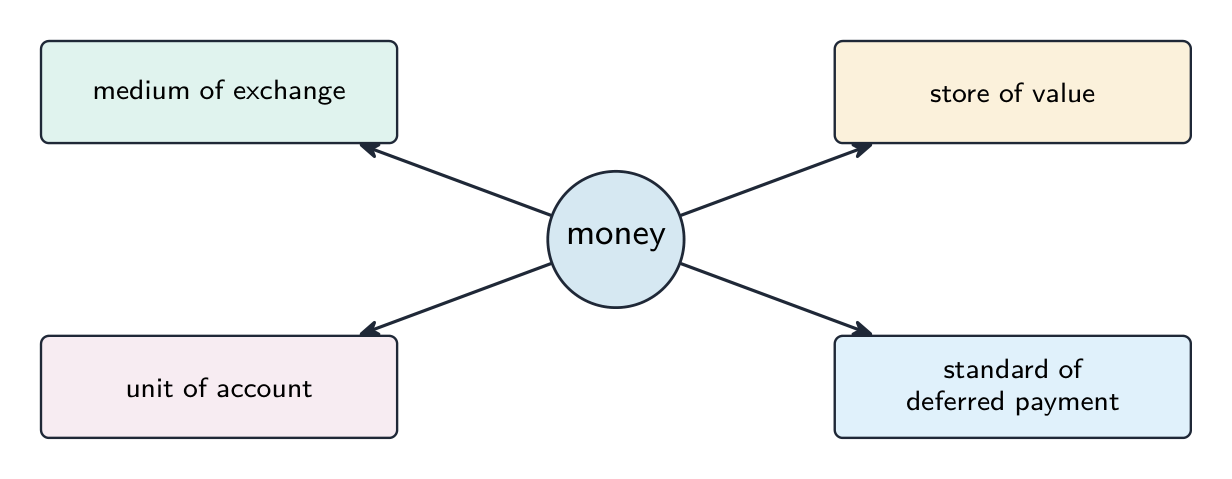
货币(money)是任何在交换中被广泛接受的东西。它的三个功能:一种交换媒介(medium of exchange)(避免物物交换)、一种记账单位(unit of account)(一个价值的共同衡量),和一种价值储藏(store of value)(随时间保持价值)。现代货币是法定货币(fiat money)——有价值是因为政府宣布它为法定货币而人们信任它,不是因为它由黄金支持。

货币的功能;AP 考试考查前三个
货币的功能——AP 考试考查前三个(交换媒介、记账单位、价值贮藏);延期支付标准超出 CED 范围

货币按流动性分层测量:M1(通货加可开支票的存款——最流动的)和更广的 M2(M1 加储蓄存款和其他准货币)。M1 之下是基础货币(monetary base)(M0 或 MB)——流通中的通货银行准备金。货币乘数等于货币供给 ÷ 基础货币,所以中央银行提高准备金的行动通过乘数把货币供给扩大更多。

词汇表 训练
英文 中文 拼音
medium of exchange 交换媒介 jiāo huàn méi jiè
unit of account 记账单位 jì zhàng dān wèi
store of value 价值储藏 jià zhí chǔ cáng
fiat money 法定货币 fǎ dìng huò bì
monetary base 基础货币 jī chǔ huò bì
4.4

银行体系与货币供给的扩张

大纲
Enduring UnderstandingLearning ObjectiveEssential Knowledge

POL-2
The banking system plays an important role in the expansion of the money supply.

POL-2.A
a. Define key terms related to the banking system and the expansion of the money supply.
b. Explain how the banking system creates and expands the money supply.
c. Calculate (using data and balance sheets as appropriate) the effects of changes in the banking system.

  • POL-2.A.1 Depository institutions (such as commercial banks) organize their assets and liabilities on balance sheets.
  • POL-2.A.2 Depository institutions operate using fractional reserve banking.
  • POL-2.A.3 Banks' reserves are divided into required reserves and excess reserves.
  • POL-2.A.4 Excess reserves are the basis of expansion of the money supply by the banking system.
  • POL-2.A.5 The money multiplier is the ratio of the money supply to the monetary base.
  • POL-2.A.6 The size of expansion of the money supply depends on the money multiplier.
  • POL-2.A.7 The maximum value of the money multiplier can be calculated as the reciprocal of the required reserve ratio.
  • POL-2.A.8 The amount predicted by the simple money multiplier may be overstated because it does not take into account a bank's desire to hold excess reserves or the public holding more currency.

来源:美国大学理事会 AP 课程与考试说明

银行在一个部分准备金(fractional reserve)系统上运作:它们保留存款的一个分数作为准备金(reserves)并借出其余。它们必须保留的分数是法定准备金率(required reserve ratio)(rr)。放贷创造新存款,它们被重新存入和重新借出,以货币乘数扩张货币供给:

$$\text{money multiplier}=\frac{1}{rr}.$$

一笔新的 $1000 存款,$rr=0.1$,留下$$900$的超额准备金,所以银行系统能使货币供给扩张多达$900\times\frac{1}{0.1}=9,000$。用一个银行的 T 型账户(资产 = 准备金 + 贷款;负债 = 存款)来追踪法定准备金和超额准备金(excess reserves)(可借出的数额)。

Worked example. 一个银行收到一笔 $\$1000$ 存款,$rr=0.20$。它必须持有 $0.20\times1000=\$200$ 作为法定准备金,留下 $\$800$超额准备金去借出。以一个 $\dfrac{1}{0.20}=5$ 的货币乘数,那 $\$800$ 的新放贷能使货币供给在整个银行系统扩张多达 $800\times5=\$4000$

考试技能: 给定一个法定准备金率和一笔存款,计算超额准备金、货币乘数,和货币供给的最大变化。

探索

See banks multiply deposits

Banks keep a fraction of deposits as reserves and lend the rest, which is redeposited and lent again — the money multiplier expands the money supply from the initial deposit.

词汇表 训练
英文 中文 拼音
fractional reserve 部分准备金 bù fèn zhǔn bèi jīn
reserves 准备金 zhǔn bèi jīn
required reserve ratio 法定准备金率 fǎ dìng zhǔn bèi jīn lǜ
excess reserves 超额准备金 chāo é zhǔn bèi jīn
4.5

货币市场

大纲
Enduring UnderstandingLearning ObjectiveEssential Knowledge

MKT-3
In the money market, demand for and supply of money determine the equilibrium nominal interest rate and influence the value of other financial assets.

MKT-3.A
a. Define (using graphs as appropriate) the money market, money demand, and money supply.
b. Explain (using graphs as appropriate) the relationship between the nominal interest rate and the quantity of money demanded (supplied).

  • MKT-3.A.1 The demand for money shows the inverse relationship between the nominal interest rate and the quantity of money people want to hold.
  • MKT-3.A.2 Given a monetary base determined by a country's central bank, money supply is independent of the nominal interest rate.

MKT-3.B
Define (using graphs as appropriate) equilibrium in the money market.

  • MKT-3.B.1 In the money market, equilibrium is achieved when the nominal interest rate is such that the quantities demanded and supplied of money are equal.

MKT-3.C
Explain (using graphs as appropriate) how nominal interest rates adjust to restore equilibrium in the money market.

  • MKT-3.C.1 Disequilibrium nominal interest rates create surpluses and shortages in the money market. Market forces drive nominal interest rates toward equilibrium.

MKT-3.D
a. Explain (using graphs as appropriate) the determinants of demand and supply in the money market.
b. Explain (using graphs as appropriate) how changes in demand and supply in the money market affect the equilibrium nominal interest rate.

  • MKT-3.D.1 Factors that shift the demand for money, such as changes in the price level, and supply of money, such as monetary policy, change the equilibrium nominal interest rate.

来源:美国大学理事会 AP 课程与考试说明

货币市场决定利率

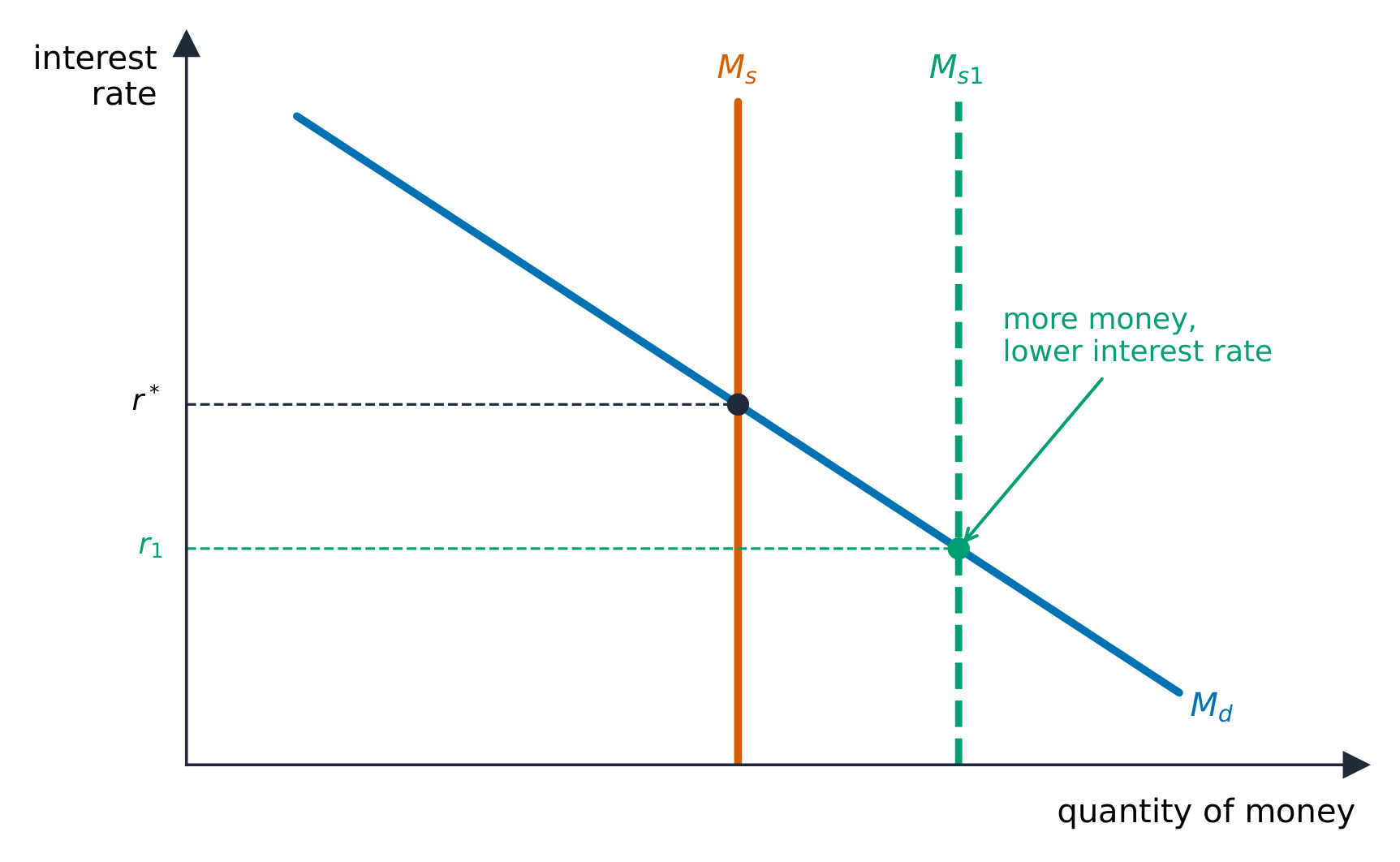
货币市场(money market)决定名义利率:

利率由对货币的需求和供给设定
利率由对货币的需求和供给设定
  • 货币需求(money demand)相对于利率向倾斜——利率是持有货币而不是有息资产的机会成本。它随一个更高的价格水平或更多实际 GDP 而右移。
  • 货币供给(money supply)是竖直的——由中央银行设定,与利率无关。

它们的交点设定均衡利率。若中央银行增加货币供给,供给线右移而利率下降

探索

Equilibrium in the money market

The money market sets the interest rate where money demand meets the central bank's money supply. A change in the money supply moves the interest rate.

词汇表 训练
英文 中文 拼音
money market 货币市场 huò bì shì chǎng
Money demand 货币需求 huò bì xū qiú
Money supply 货币供给 huò bì gōng jǐ
4.6

货币政策

大纲
Enduring UnderstandingLearning ObjectiveEssential Knowledge

POL-1
Fiscal and monetary policy have short-run effects on macroeconomic outcomes.

POL-1.D
a. Define monetary policy and related terms.
b. Explain (using graphs as appropriate) the short-run effects of a monetary policy action.
c. Calculate (using data and balance sheets as appropriate) the effects of a monetary policy action.

  • POL-1.D.1 Central banks implement monetary policies to achieve macroeconomic goals, such as price stability.
  • POL-1.D.2 The tools of monetary policy may include the central bank's discount rate and other administered interest rates (e.g., interest on reserves), open market operations, and the required reserve ratio. The tools used and the way in which they are implemented differ between economies that have limited reserves in their banking system and economies that have ample reserves in their banking system. (The banking system in the United States has ample reserves, and the Federal Reserve's key policy tool is interest on reserves.)
  • POL-1.D.3 When the central bank conducts an open-market purchase (sale), reserves increase (decrease), thereby increasing (decreasing) the monetary base.
  • POL-1.D.4 When the central bank conducts an open-market purchase (sale) in an economy with limited reserves, the effect on the money supply is greater than the effect on the monetary base because of the money multiplier.
  • POL-1.D.5 Many central banks carry out policy to hit a target range for an overnight interbank lending rate, sometimes referred to as the central bank's policy rate. (In the United States, this is the federal funds rate.)
  • POL-1.D.6 Central banks can influence the nominal interest rate in the short run, which in turn will affect investment and consumption. [See also EK MKT-5.G.2 for the influence on net capital inflows.] In an economy with limited reserves, the central bank can influence the nominal interest rate by changing the money supply. In an economy with ample reserves, changes in the money supply do not effectively change the nominal interest rate; instead, the central bank can influence the nominal interest rate by changing its administered interest rates.
  • POL-1.D.7 Expansionary or contractionary monetary policies are used to restore full employment when the economy is in a negative (i.e., recessionary) or positive (i.e., inflationary) output gap.
  • POL-1.D.8 Monetary policy can influence interest rates, aggregate demand, real output, and the price level. [See also EK MKT-5.E.3 for the effect on exchange rates.]
  • POL-1.D.9 A money market model, a reserve market model, and/or the AD–AS model may be used to demonstrate the short-run effects of monetary policy.

POL-1.E
Define why there are lags to monetary policy.

  • POL-1.E.1 In reality, there are lags to monetary policy caused by the time it takes to recognize a problem in the economy and the time it takes the economy to adjust to the policy action.

来源:美国大学理事会 AP 课程与考试说明

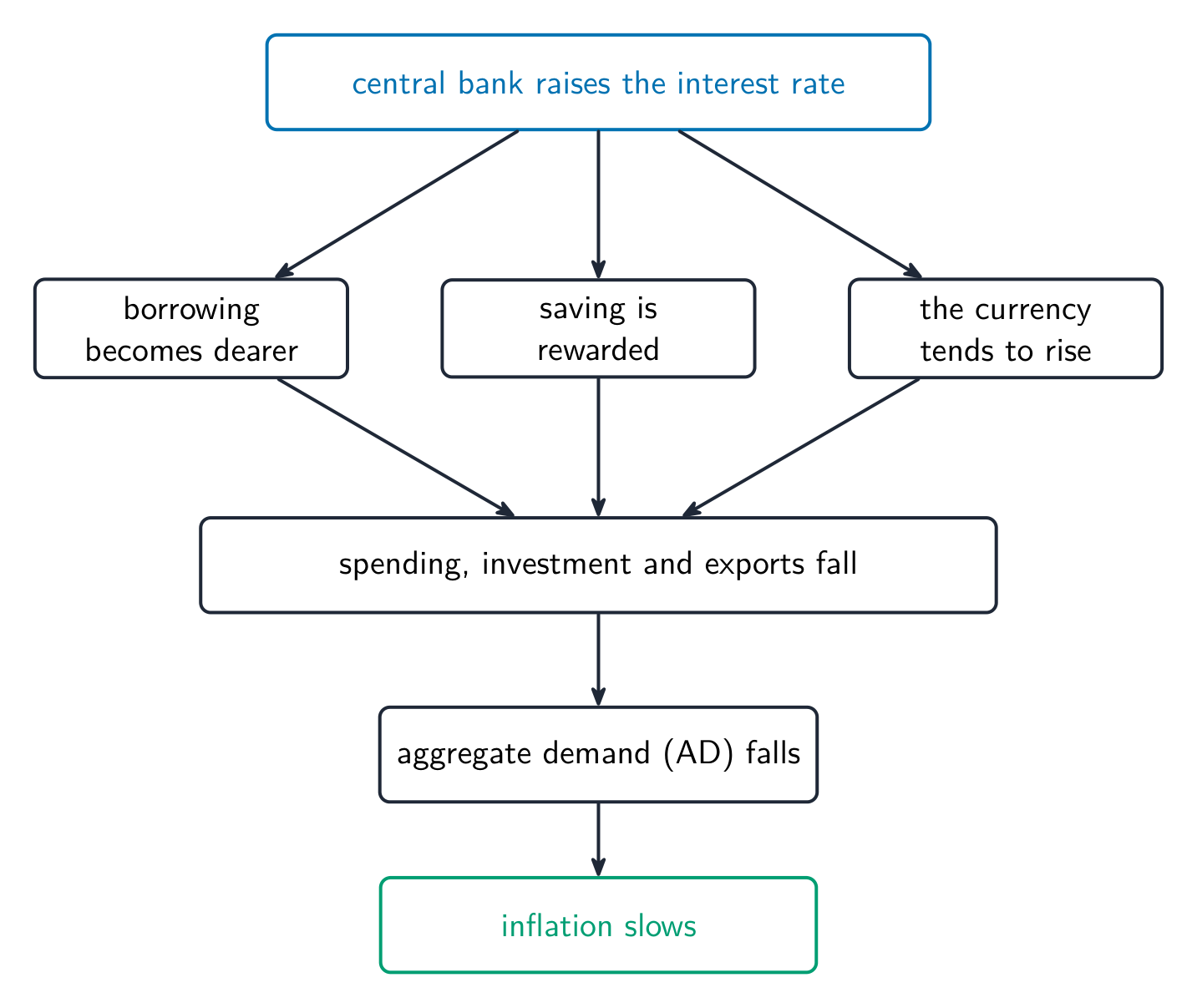
货币政策(monetary policy)是中央银行(联邦储备)对货币供给的使用以引导经济,通过利率起作用:

一个更高的利率如何通过经济起作用以减缓通货膨胀
  • 扩张性(宽松)(expansionary (easy)):增加货币供给 $\to$ 利率下降 $\to$ 投资和消费上升 $\to$ AD 移(对抗衰退)。
  • 紧缩性(紧)(contractionary (tight)):减少货币供给 $\to$ 利率上升 $\to$ AD 移(对抗通货膨胀)。

工具:公开市场操作(open-market operations)(买债券注入货币,卖债券撤回它——主要的工具)、改变准备金要求,和改变贴现率(discount rate)(银行向中央银行借款所付的利率)。在考试上跟随完整的链条:货币供给 $\to$ 利率 $\to$ 投资 $\to$ AD $\to$ 产出、价格水平、失业。

现代中央银行运行一个充足准备金(ample-reserves)系统。美联储不是推动货币供给,而是设定管理利率——主要是它付给银行的准备金利息(interest on reserves, IOR)——这引导政策利率(policy rate)(联邦基金利率,银行之间隔夜相互收取的利率)。在准备金市场里,准备金需求向下倾斜,而中央银行以它选择的利率供给准备金;提高 IOR 抬升整个政策利率以对抗通胀,降低它则放松以对抗衰退。(在较旧的有限准备金(limited-reserves)系统里,美联储改为通过公开市场操作移动准备金供给。)

A central bank building: monetary policy sets interest rates and the money supply
词汇表 训练
英文 中文 拼音
Monetary policy 货币政策 huò bì zhèng cè
Expansionary (easy) 扩张性 kuò zhāng xìng
Contractionary (tight) 紧缩性 jǐn suō xìng
open-market operations 公开市场操作 gōng kāi shì chǎng cāo zuò
discount rate 贴现率 tiē xiàn lǜ
interest on reserves (IOR) 准备金利息 zhǔn bèi jīn lì xī
policy rate 政策利率 zhèng cè lì lǜ
4.7

可贷资金市场

大纲
Enduring UnderstandingLearning ObjectiveEssential Knowledge

MKT-4
The interaction of borrowers, who demand loanable funds, and savers, who supply loanable funds, determines the equilibrium real interest rate.

MKT-4.A
a. Define (using graphs as appropriate) the loanable funds market, demand for loanable funds, and supply of loanable funds.
b. Explain (using graphs as appropriate) the relationship between the real interest rate and the quantity of loanable funds demanded (supplied).

  • MKT-4.A.1 The loanable funds market describes the behavior of savers and borrowers.
  • MKT-4.A.2 The demand for loanable funds shows the inverse relationship between real interest rates and the quantity demanded of loanable funds.
  • MKT-4.A.3 The supply of loanable funds shows the positive relationship between real interest rates and the quantity supplied of loanable funds.

MKT-4.B
Define national savings in both a closed and an open economy.

  • MKT-4.B.1 In the absence of international borrowing and lending, national savings is the sum of public savings and private savings.
  • MKT-4.B.2 For an open economy, investment equals national savings plus net capital inflow.

MKT-4.C
Define (using graphs as appropriate) equilibrium in the loanable funds market.

  • MKT-4.C.1 In the loanable funds market, equilibrium is achieved when the real interest rate is such that the quantities demanded and supplied of loanable funds are equal.

MKT-4.D
Explain (using graphs as appropriate) how real interest rates adjust to restore equilibrium in the loanable funds market.

  • MKT-4.D.1 Disequilibrium real interest rates create surpluses and shortages in the loanable funds market. Market forces drive real interest rates toward equilibrium.

MKT-4.E
a. Explain (using graphs as appropriate) the determinants of demand and supply in the loanable funds market.
b. Explain (using graphs as appropriate) how changes in demand and supply in the loanable funds market affect the equilibrium real interest rate and equilibrium quantity of loanable funds.

  • MKT-4.E.1 The loanable funds market can be used to show the effects of government spending, taxes, and borrowing on interest rates.
  • MKT-4.E.2 Factors that shift the demand (such as an investment tax credit) and supply (such as changes in saving behavior) of loanable funds change the equilibrium interest rate and the equilibrium quantity of funds.

来源:美国大学理事会 AP 课程与考试说明

可贷资金市场

可贷资金市场(loanable funds market)决定实际利率并把储蓄连接到投资:

  • 可贷资金的供给来自储蓄并向上倾斜。
  • 可贷资金的需求来自借款者(投资的企业、借款的政府)并向下倾斜。

那份储蓄是经济的国民储蓄(national savings)= 私人储蓄(家庭和企业)+ 公共储蓄(政府的预算余额——盈余增加储蓄,赤字减少它)。对一个开放经济,投资 = 国民储蓄 + 来自国外的净资本流入。所以更大的预算赤字是负的公共储蓄,它缩小可贷资金的供给并挤出投资。

更多储蓄使供给右移并降低实际利率;更多政府借款使需求右移并提高实际利率——挤出背后的机制。区分这两个图:货币市场设定名义利率(竖直的货币供给),而可贷资金设定实际利率(向上倾斜的储蓄供给)。

考试技能: 知道画哪个图——货币市场用于货币政策,可贷资金用于储蓄、赤字和挤出——并追踪一个的移动如何馈入 AD-AS。

词汇表 训练
英文 中文 拼音
loanable funds market 可贷资金市场 kě dài zī jīn shì chǎng
national savings 国民储蓄 guó mín chǔ xù
4.7

考试技巧

  • 知道货币的三个功能和 M1/M2 衡量。
  • 货币市场设定名义利率(竖直的货币供给);更多货币供给降低利率。
  • 计算货币乘数 $\tfrac{1}{rr}$ 和一笔新存款造成的货币供给的最大变化。
  • 追踪货币政策:货币供给 → 利率 → 投资 → AD → 产出。
  • 把货币市场(名义利率)与可贷资金市场(实际利率)区分开;用实际利率 $=$ 名义 $-$ 通货膨胀。

本主题的互动课程

逐步学习,并即时检测练习。

AP 宏观经济学历年真题

AP 宏观经济学的更多主题

登录或创建账号

IGCSE, A-Level & AP