| Enduring Understanding | Learning Objective | Essential Knowledge |
|---|---|---|
MEA-4 | MEA-4.A |
|
Open Economy—International Trade and Finance
AP Macroeconomics · Topic 6
 8:01
8:01
Open Economy—International Trade and Finance
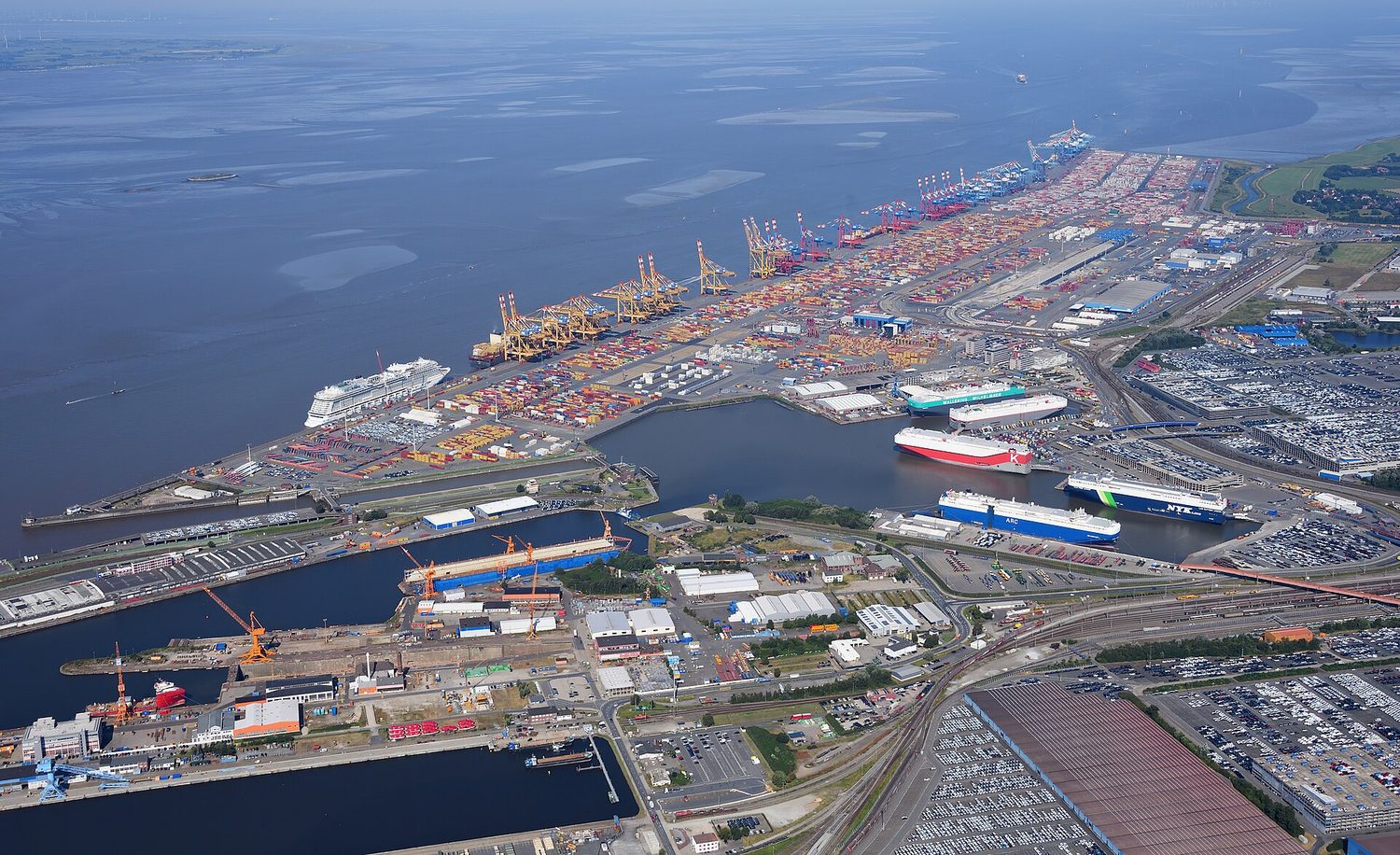
Check the label on almost anything you own. Made somewhere else. It crossed an ocean in a steel box like these, and somebody paid for it in a different money.…
English narration · English + 中文 subtitles burned in
6.1
Balance of Payments Accounts
Syllabus
Source: College Board AP Course and Exam Description
The balance of payments 国际收支 records all transactions between a country and the rest of the world, in two main accounts:
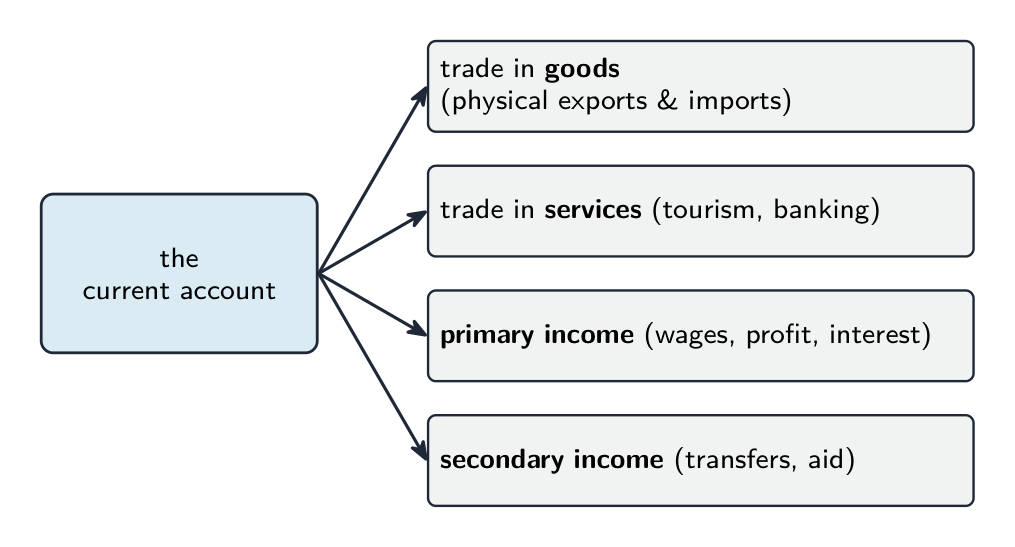
- The current account 经常账户 tracks trade in goods and services (exports minus imports), plus income and transfers. A trade deficit makes it negative.
- The capital (financial) account 资本账户 tracks flows of financial assets – foreigners buying domestic assets, and residents buying foreign assets.
The two are mirror images: a current-account deficit is matched by a capital-account surplus (a country that imports more than it exports pays with assets, so foreign investment flows in). They sum to zero.
Vocabulary
Train
| English |
|---|
| balance of payments/ˈbæləns ɒv ˈpeɪmənts/ |
| current account/ˈkʌrənt əˈkaʊnt/ |
| capital (financial) account/ˈkæpɪtl əˈkaʊnt/ |
6.2
Exchange Rates

Syllabus
| Enduring Understanding | Learning Objective | Essential Knowledge |
|---|---|---|
MKT-5 | MKT-5.A |
|
Source: College Board AP Course and Exam Description
An exchange rate 汇率 is the price of one currency in terms of another. A currency appreciates 升值 when it gains value (buys more foreign currency) and depreciates 贬值 when it loses value. Always track which currency: if the US dollar appreciates against the euro, the euro depreciates against the dollar – the same event from two sides.
Worked example. Suppose $\$1=\text{€}0.90$, so $\text{€}1=\dfrac{1}{0.90}\approx\$1.11$. If the dollar then appreciates to $\$1=\text{€}1.00$, each dollar now buys more euros, while the euro has depreciated – it now buys only $\$1.00$ instead of $\$1.11$. The single event is an appreciation of the dollar and a depreciation of the euro.
Most currencies today are floating 浮动, set by supply and demand in the foreign-exchange market.
Vocabulary
Train
| English |
|---|
| exchange rate/eksˈtʃeɪndʒ reɪt/ |
| appreciates/əˈpriːʃɪeɪts/ |
| depreciates/dɪˈpriːʃɪeɪts/ |
| floating/ˈfləʊtɪŋ/ |
6.3
The Foreign Exchange Market
Syllabus
| Enduring Understanding | Learning Objective | Essential Knowledge |
|---|---|---|
MKT-5 | MKT-5.B |
|
MKT-5.C |
| |
MKT-5.D |
|
Source: College Board AP Course and Exam Description
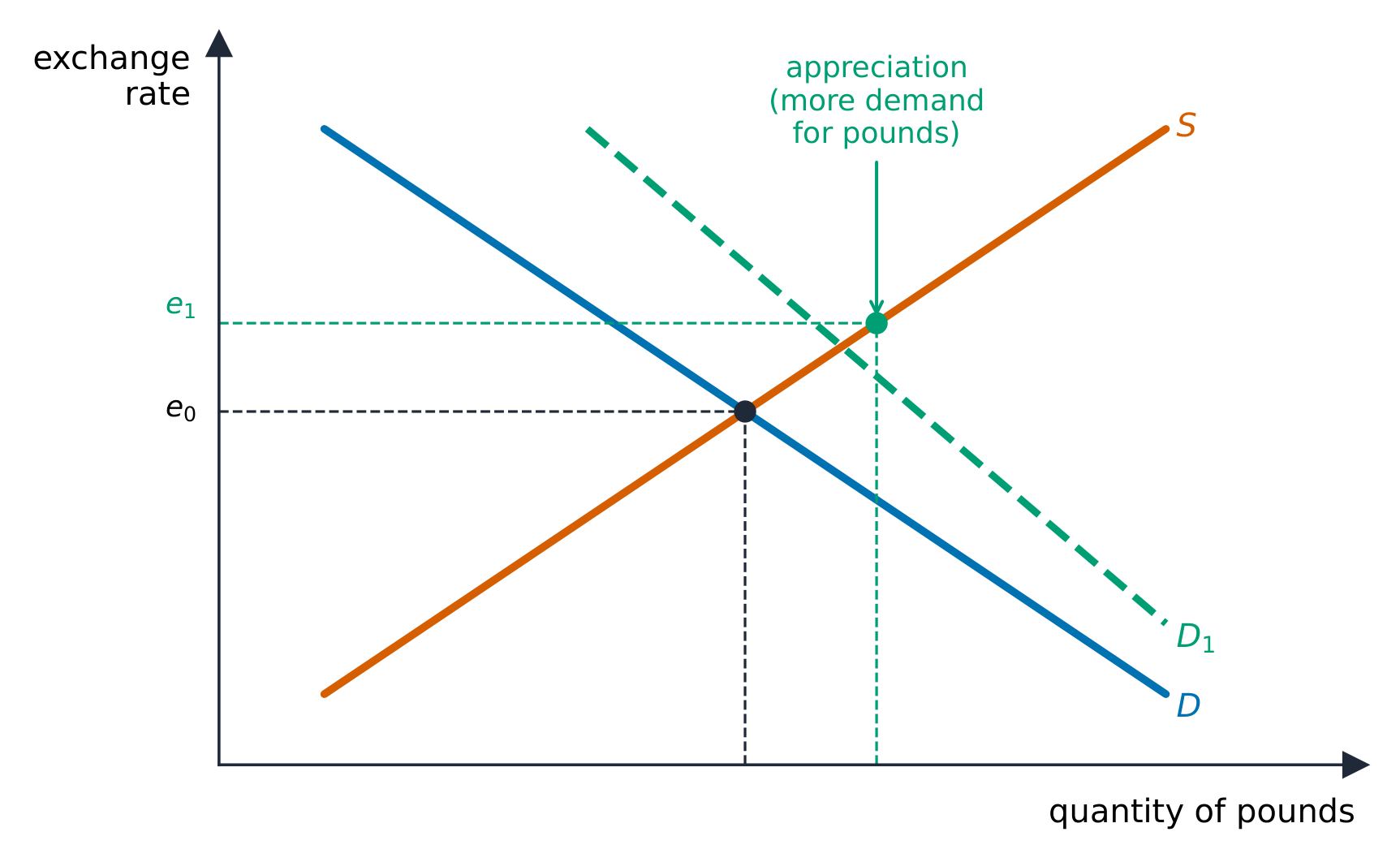
Each currency has its own supply-and-demand graph (price $=$ the exchange rate, quantity $=$ amount of that currency).
- Demand for a currency comes from foreigners wanting its goods, services, or assets.
- Supply of a currency comes from its own residents wanting foreign goods, services, or assets.
The equilibrium exchange rate is where they cross. A rightward shift in demand for a currency causes it to appreciate; a rightward shift in supply causes it to depreciate.
Exam skill: always draw the graph for the currency named in the question, label the axis with that currency's price, and shift the correct curve – mixing up the two currencies' graphs is the most common error.
Explore
The foreign-exchange market
A currency's exchange rate is set where demand for it meets supply. Higher demand for exports or higher interest rates appreciate the currency.
6.4
Changes in Policies and Economic Conditions
Syllabus
| Enduring Understanding | Learning Objective | Essential Knowledge |
|---|---|---|
MKT-5 | MKT-5.E |
|
Source: College Board AP Course and Exam Description
Exchange rates respond to:
- Relative interest rates: a higher domestic real interest rate attracts foreign financial investment, raising demand for the currency and causing appreciation.
- Relative price levels/inflation: higher domestic inflation makes goods less competitive, lowering demand for the currency (depreciation).
- Relative incomes: higher domestic income raises imports, increasing the supply of domestic currency (depreciation).
- Tastes and expectations about future value.
Monetary policy has a strong link: expansionary monetary policy lowers interest rates, reduces demand for the currency, and causes depreciation (which then boosts net exports).
6.5
Exchange Rates and Net Exports
Syllabus
| Enduring Understanding | Learning Objective | Essential Knowledge |
|---|---|---|
MKT-5 | MKT-5.F |
|
Source: College Board AP Course and Exam Description
Exchange rates feed back into AD through net exports:
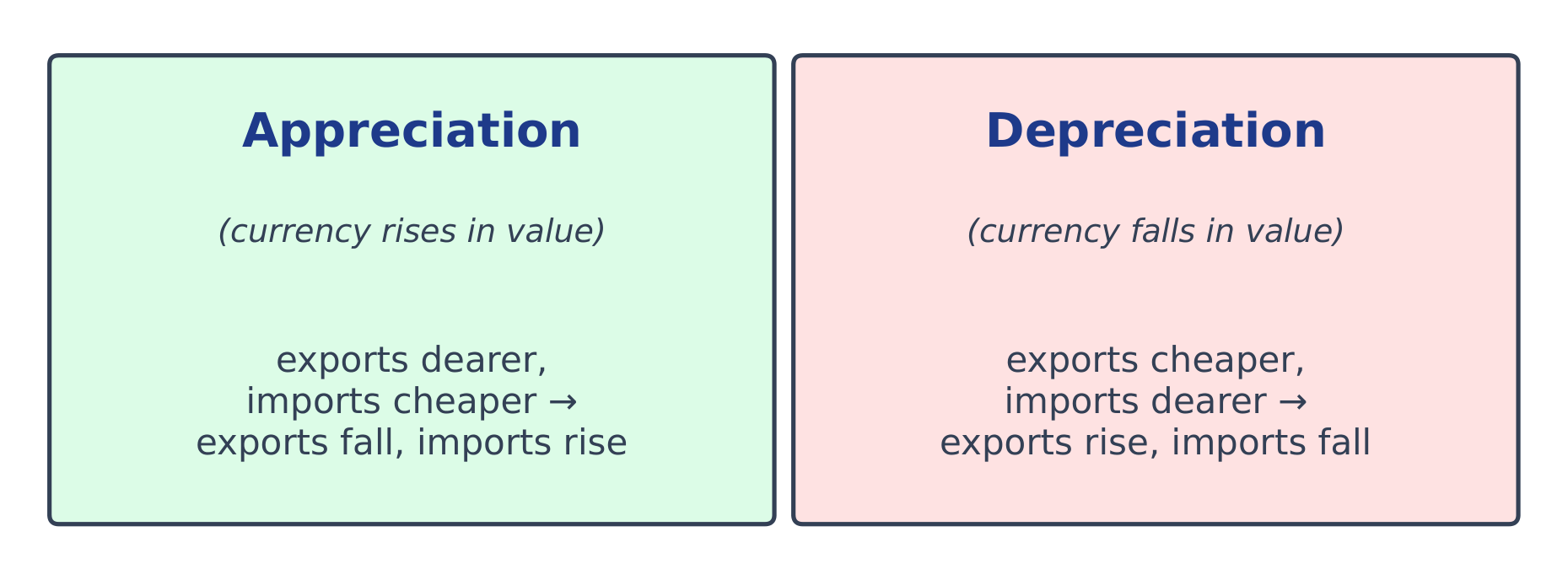
- A depreciation makes exports cheaper for foreigners and imports dearer, so net exports rise and AD shifts right.
- An appreciation makes exports dearer and imports cheaper, so net exports fall and AD shifts left.
Worked example. A US car priced at $\$30{,}000$ costs a European buyer $\text{€}27{,}000$ when $\$1=\text{€}0.90$. If the dollar depreciates to $\$1=\text{€}0.80$, the same car now costs only $\text{€}24{,}000$ – cheaper for foreigners, so US exports rise while imports (now dearer in dollars) fall, lifting net exports and shifting AD right.
This is how the foreign-exchange market and the AD-AS model connect – a currency change is a channel through which policy reaches output.
6.6
Real Interest Rates and International Capital Flows
Syllabus
| Enduring Understanding | Learning Objective | Essential Knowledge |
|---|---|---|
MKT-5 | MKT-5.G |
|
Source: College Board AP Course and Exam Description
Money chases the highest real return, so capital flows 资本流动 respond to real interest rates:
- A higher domestic real interest rate attracts inflows of foreign financial capital – foreigners buy domestic bonds, raising currency demand and causing appreciation.
- A lower real rate causes outflows and depreciation.
This ties the whole course together: government borrowing raises the real interest rate (loanable funds), which attracts foreign capital, appreciates the currency, and reduces net exports – so a budget deficit can widen a trade deficit (the "twin deficits"). Tracing these linked effects across the loanable-funds, forex, and AD-AS graphs is the capstone skill of AP Macroeconomics.
Vocabulary
Train
| English |
|---|
| capital flows/ˈkæpɪtl fləʊz/ |
6.6
Exam tips
- The current account and financial account are mirror images and sum to zero.
- Always draw the forex graph for the currency named, and label its price with that currency; one currency appreciating is the other depreciating.
- A depreciation raises net exports (exports cheaper); an appreciation lowers them.
- Higher domestic real interest rates attract capital inflows → currency appreciates → net exports fall.
- Link it all: a budget deficit raises the real rate, appreciates the currency, and can widen the trade deficit (twin deficits).
Interactive lessons on this topic
Work through it step by step, with instant-check exercises.