跳到主要内容

国民收入与价格决定

AP 宏观经济学 · 第 3 主题

训练
讲义 词汇表
3.1

总需求(AD)

大纲
Enduring UnderstandingLearning ObjectiveEssential Knowledge

MOD-2
Economists use the aggregate demand–aggregate supply model to represent the relationship between the price level and aggregate output in an economy and to illustrate how output, employment, and the price level respond to macroeconomic shocks.

MOD-2.A
a. Define (using graphs as appropriate) the aggregate demand (AD) curve.
b. Explain (using graphs as appropriate) the slope of the AD curve and its determinants.

  • MOD-2.A.1 The aggregate demand (AD) curve describes the relationship between the price level and the quantity of goods and services demanded by households (consumption), firms (investment), government (government spending), and the rest of the world (net exports).
  • MOD-2.A.2 The negative slope of the AD curve is explained by the real wealth effect, the interest rate effect, and the exchange rate effect. [See EK MKT-3.A.1]
  • MOD-2.A.3 Any change in the components of aggregate demand (consumption, investment, government spending, or net exports) that is not due to changes in the price level leads to a shift of the AD curve.

来源:美国大学理事会 AP 课程与考试说明

AD-AS 模型:需求冲击

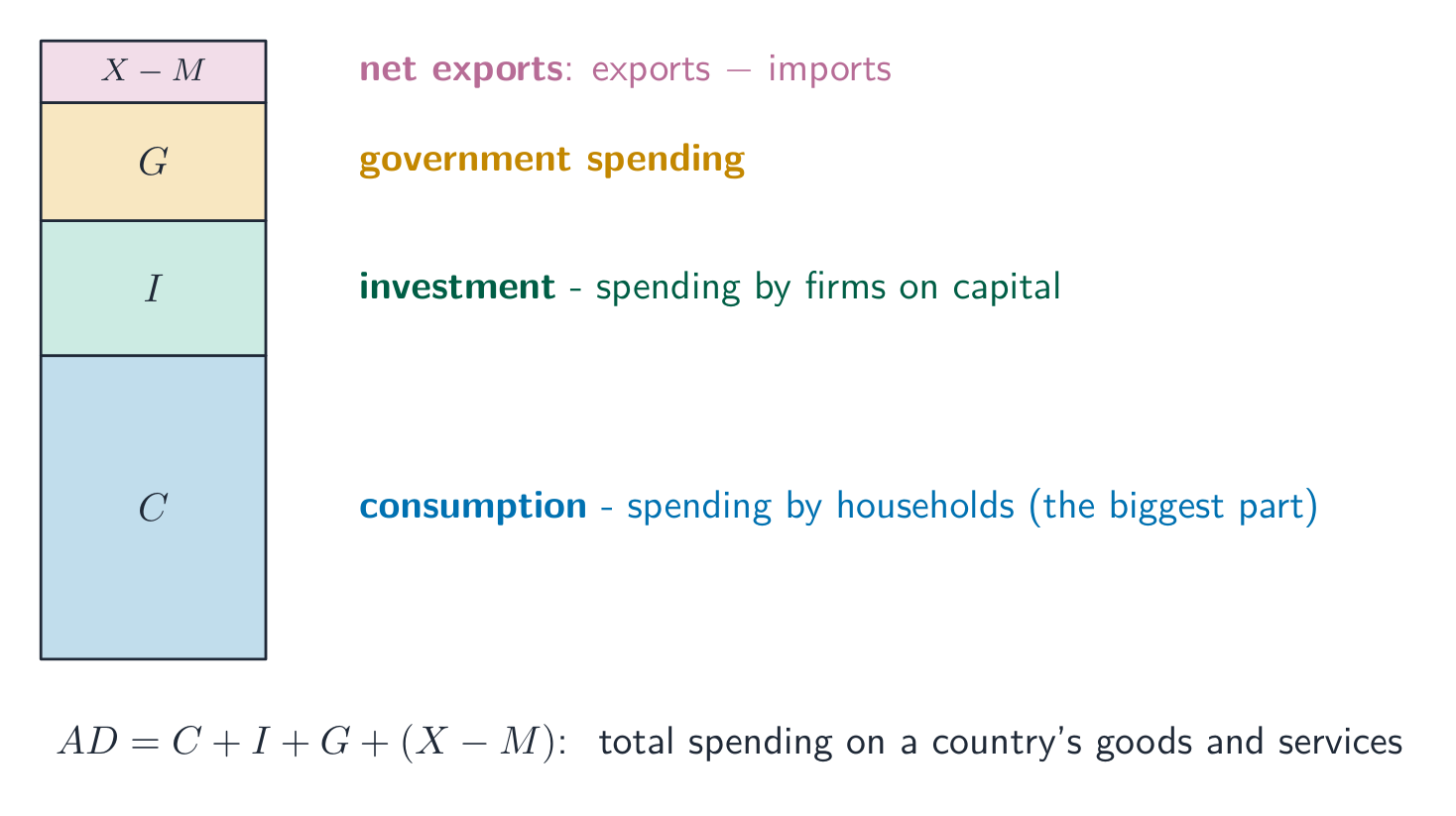
总需求(AD)(aggregate demand)显示买者在每个价格水平(price level)想要的实际产出($C+I+G+X_n$)的总数量。它向倾斜有三个整个经济特有的原因:

总需求是总花费:消费、投资、政府和净出口
  • 财富效应(wealth effect)(一个更高的价格水平缩小货币的实际价值,所以人们买更少),
  • 利率效应(interest-rate effect)(一个更高的价格水平提高货币需求和利率,削减投资),
  • 净出口效应(net-export effect)(一个更高的国内价格水平使出口更贵而进口更便宜)。

价格水平的一个变化是沿 AD 的一个移动(movement along)。当 $C+I+G+X_n$ 的任何组成部分因另一个原因变化时——消费者信心、企业预期、政府支出、税收,或外国收入——AD 移动(shifts)。

词汇表 训练
英文 中文 拼音
Aggregate demand (AD) 总需求 zǒng xū qiú
price level 价格水平 jià gé shuǐ píng
wealth effect 财富效应 cái fù xiào yìng
interest-rate effect 利率效应 lì lǜ xiào yìng
3.2

乘数

大纲
Enduring UnderstandingLearning ObjectiveEssential Knowledge

MOD-2
Economists use the aggregate demand–aggregate supply model to represent the relationship between the price level and aggregate output in an economy and to illustrate how output, employment, and the price level respond to macroeconomic shocks.

MOD-2.B
a. Define the expenditure multiplier, the tax multiplier, the marginal propensity to consume, and the marginal propensity to save.
b. Explain how changes in spending and taxes lead to changes in real GDP.
c. Calculate how changes in spending and taxes lead to changes in real GDP.

  • MOD-2.B.1 A $\$1$ change to autonomous expenditures leads to further changes in total expenditures and total output.
  • MOD-2.B.2 The expenditure multiplier quantifies the size of the change in aggregate demand as a result of a change in any of the components of aggregate demand.
  • MOD-2.B.3 The tax multiplier quantifies the size of the change in aggregate demand as a result of a change in taxes.
  • MOD-2.B.4 The expenditure multiplier and tax multiplier depend on the marginal propensity to consume.
  • MOD-2.B.5 The marginal propensity to consume is the change in consumer spending divided by the change in disposable income. The sum of the marginal propensity to consume and marginal propensity to save is equal to one.

来源:美国大学理事会 AP 课程与考试说明

支出乘数

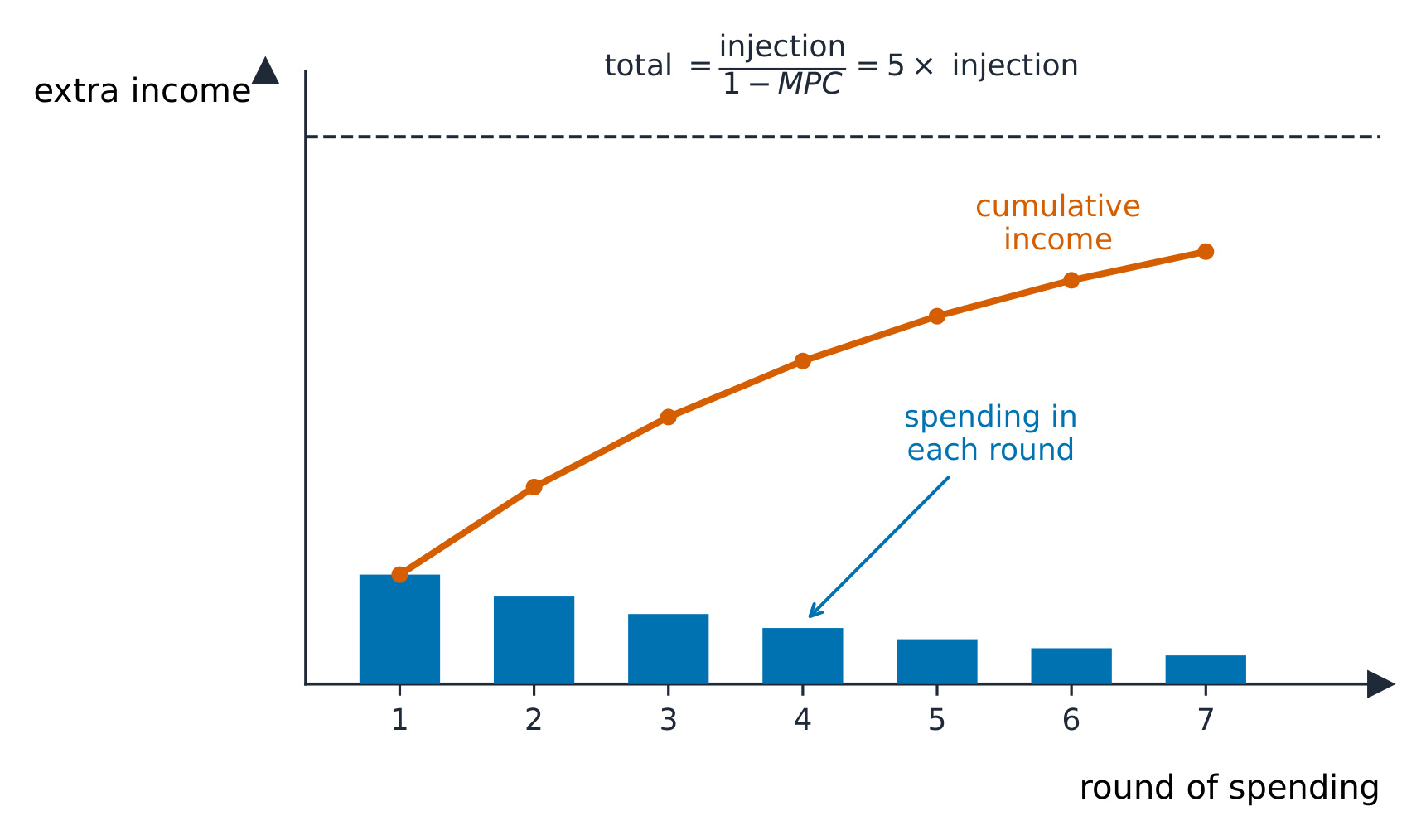
花费的一个变化引发进一步几轮的花费,所以 GDP 的最终变化比初始变化更大——乘数效应(multiplier effect)。它取决于边际消费倾向(marginal propensity to consume)(MPC),被花费的额外收入的分数(其余是边际储蓄倾向(marginal propensity to save),MPS,$MPC+MPS=1$):

一次注入放大成一个更大的整体收入上升
一次注入放大成一个更大的整体收入上升
$$\text{spending multiplier}=\frac{1}{1-MPC}=\frac{1}{MPS}.$$

一次减税也通过乘数起作用,但更弱,因为减税的一部分被储蓄:

$$\text{tax multiplier}=-\frac{MPC}{1-MPC}=-\frac{MPC}{MPS}.$$

税收乘数在大小上更小(减税提高 GDP;加税降低它)。GDP 的总变化 $=$ (乘数) $\times$ (初始变化)。

Worked example.$MPC=0.8$,花费乘数是 $\dfrac{1}{1-0.8}=5$,所以政府支出的一次 $\$10$ 十亿上升把实际 GDP 提升 $5\times\$10=\$50$ 十亿。税收乘数是 $-\dfrac{0.8}{0.2}=-4$,所以一次 $\$10$ 十亿的减税只提高 GDP $\$40$ 十亿——更弱,因为减税的一部分被储蓄。

考试技能: 从 MPC 计算两个乘数并求实际 GDP 的结果变化——一个几乎保证的计算。

探索

See the spending multiplier ripple out

A dollar of new spending becomes someone's income, part of which they spend again — so the total effect is a multiple of the first injection, set by the marginal propensity to consume (MPC).

词汇表 训练
英文 中文 拼音
multiplier effect 乘数效应 chéng shù xiào yìng
marginal propensity to consume 边际消费倾向 biān jì xiāo fèi qīng xiàng
marginal propensity to save 边际储蓄倾向 biān jì chǔ xù qīng xiàng
3.3

短期总供给(SRAS)

大纲
Enduring UnderstandingLearning ObjectiveEssential Knowledge

MOD-2
Economists use the aggregate demand–aggregate supply model to represent the relationship between the price level and aggregate output in an economy and to illustrate how output, employment, and the price level respond to macroeconomic shocks.

MOD-2.C
a. Define (using graphs as appropriate) the short-run aggregate supply (SRAS) curve.
b. Explain (using graphs as appropriate) the slope of the SRAS curve and its determinants.

  • MOD-2.C.1 The short-run aggregate supply (SRAS) curve describes the relationship between the price level and the quantity of goods and services supplied in an economy.
  • MOD-2.C.2 The SRAS curve is upward-sloping because of sticky wages and prices. [See EK MOD-2.E.1]
  • MOD-2.C.3 Any factor that causes production costs to change, such as a change in inflationary expectations, will cause the SRAS curve to shift.

MOD-2.D
Explain (using graphs as appropriate) how movement along the SRAS curve implies a relationship between the price level (and inflation) and unemployment.

  • MOD-2.D.1 Moving along the SRAS curve, an increase in the price level is associated with an increase in output, which means employment must correspondingly rise. With the labor force held constant, unemployment will fall. So, there is a short-run trade-off between inflation and unemployment. [See EK MOD-3.A.1]

来源:美国大学理事会 AP 课程与考试说明

短期总供给(SRAS)(short-run aggregate supply)向倾斜:在短期一些投入价格(尤其是名义工资(nominal wages))是粘性(sticky)的,所以一个更高的产出价格水平扩大利润率而企业生产更多。SRAS 随投入价格生产率对生产者的税/补贴,和供给冲击(例如一次油价变化)而移动。投入成本的一次上升使 SRAS 左移。

词汇表 训练
英文 中文 拼音
Short-run aggregate supply (SRAS) 短期总供给 duǎn qī zǒng gōng jǐ
nominal wages 名义工资 míng yì gōng zī
sticky 粘性 zhān xìng
3.4

长期总供给(LRAS)

大纲
Enduring UnderstandingLearning ObjectiveEssential Knowledge

MOD-2
Economists use the aggregate demand–aggregate supply model to represent the relationship between the price level and aggregate output in an economy and to illustrate how output, employment, and the price level respond to macroeconomic shocks.

MOD-2.E
Define (using graphs as appropriate) the short run and the long run.

  • MOD-2.E.1 In the long run all prices and wages are fully flexible, while in the short run some input prices are fixed. A consequence of flexible long-run prices and wages is the lack of a long-run trade-off between inflation and unemployment.

MOD-2.F
Define (using graphs as appropriate) the long-run aggregate supply (LRAS) curve.

  • MOD-2.F.1 The LRAS curve corresponds to the production possibilities curve (PPC) because they both represent maximum sustainable capacity. Maximum sustainable capacity is the total output an economic system will produce over a set period of time if all resources are fully employed. [See LO MOD-2.I]
  • MOD-2.F.2 The LRAS curve is vertical at the full-employment level of output because in the long run wages and prices fully adjust.

来源:美国大学理事会 AP 课程与考试说明

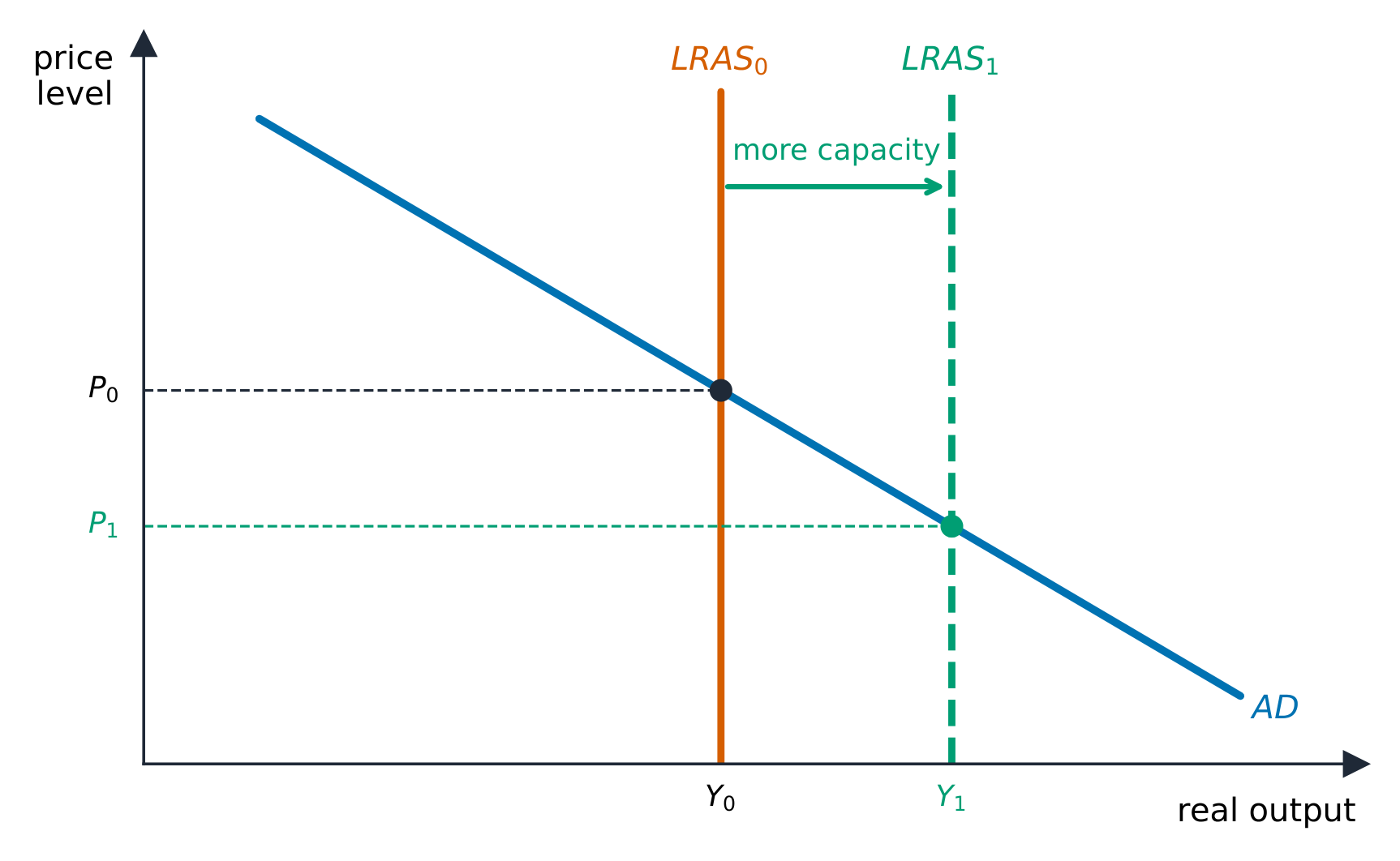
长期总供给(LRAS)(long-run aggregate supply)在经济的充分就业(潜在)产出(full-employment (potential) output)$Y_f$ 处是竖直的。在长期,所有价格和工资都是完全灵活的(只有在短期才有一些投入价格是固定的),所以产出只取决于实际因素——资源、技术、制度——不是价格水平。LRAS 只随经济增长(更多或更好的资源)而移动。LRAS 对应于生产可能性曲线(PPC)(production possibilities curve):两者都标示经济的最大可持续能力,所以 LRAS 向外移动和 PPC 向外移动是同一件事的两种画法。竖直的 LRAS 是为什么在长期需求政策改变价格,不是产出。

供给侧政策使长期总供给右移:更多产出、更低价格
词汇表 训练
英文 中文 拼音
Long-run aggregate supply (LRAS) 长期总供给 cháng qī zǒng gōng jǐ
full-employment (potential) output 潜在产出 qián zài chǎn chū
production possibilities curve (PPC) 生产可能性曲线 shēng chǎn kě néng xìng qū xiàn
3.5

总需求—总供给(AD–AS)模型中的均衡

大纲
Enduring UnderstandingLearning ObjectiveEssential Knowledge

MOD-2
Economists use the aggregate demand–aggregate supply model to represent the relationship between the price level and aggregate output in an economy and to illustrate how output, employment, and the price level respond to macroeconomic shocks.

MOD-2.G
Explain (using graphs as appropriate) the short-run and long-run equilibrium price level and output level.

  • MOD-2.G.1 Short-run equilibrium occurs when the aggregate quantity of output demanded and the aggregate quantity of output supplied are equal—i.e., at the intersection of the AD and SRAS curves.
  • MOD-2.G.2 Long-run equilibrium occurs when the AD and SRAS curves intersect on the LRAS—i.e., at the full-employment level of real output.
  • MOD-2.G.3 The short-run equilibrium output can be at the full-employment level of output, above it, or below it, creating positive (i.e., inflationary) or negative (i.e., recessionary) output gaps.

来源:美国大学理事会 AP 课程与考试说明

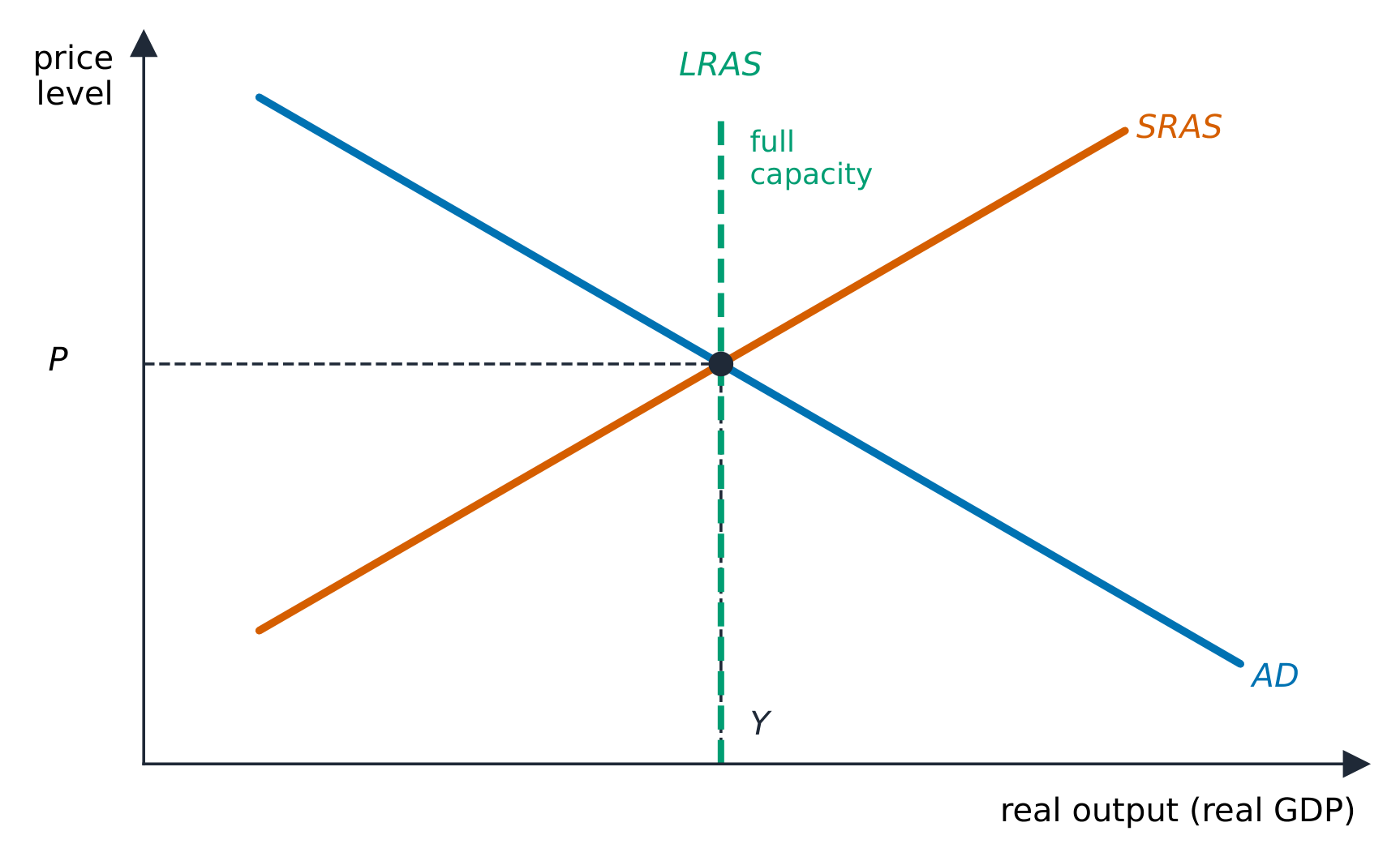
经济稳定在 AD 遇到 SRAS 的地方,固定均衡价格水平实际 GDP。把那个产出与 $Y_f$(LRAS 线)比较给出经济的状态:

总需求遇到总供给处的宏观经济均衡
总需求遇到总供给处的宏观经济均衡
  • 产出 $:一个衰退缺口(recessionary gap)(周期性失业),
  • 产出 $>Y_f$:一个通胀缺口(inflationary gap)(过热),
  • 产出 $=Y_f$:长期均衡。
探索

Find equilibrium in the AD-AS model

Aggregate demand and aggregate supply cross at the economy's price level and real GDP. A demand or supply shock shifts a curve and moves the whole economy's output and prices.

词汇表 训练
英文 中文 拼音
recessionary gap 衰退缺口 shuāi tuì quē kǒu
inflationary gap 通胀缺口 tōng zhàng quē kǒu
3.6

短期内 AD–AS 模型的变动

大纲
Enduring UnderstandingLearning ObjectiveEssential Knowledge

MOD-2
Economists use the aggregate demand–aggregate supply model to represent the relationship between the price level and aggregate output in an economy and to illustrate how output, employment, and the price level respond to macroeconomic shocks.

MOD-2.H
Explain (using graphs as appropriate) the response of output, employment, and the price level to an aggregate demand or aggregate supply shock in the short run.

  • MOD-2.H.1 A positive (negative) shock in AD causes output, employment, and the price level to rise (fall) in the short run.
  • MOD-2.H.2 A positive (negative) shock in SRAS causes output and employment to rise (fall) and the price level to fall (rise) in the short run.
  • MOD-2.H.3 Inflation can be caused by changes in aggregate demand (demand-pull) or aggregate supply (cost-push).

来源:美国大学理事会 AP 课程与考试说明

  • 一个需求冲击(demand shock)使 AD 移动:一个正的(更多花费)提高价格水平和产出两者(并降低失业);一个负的降低两者。
  • 一个供给冲击(supply shock)使 SRAS 移动:一个负的(更高的投入成本)同时提高价格水平降低产出——滞胀(stagflation)——对决策者最难的情况,因为修复一个使另一个恶化。
词汇表 训练
英文 中文 拼音
stagflation 滞胀 zhì zhàng
3.7

长期自我调整

大纲
Enduring UnderstandingLearning ObjectiveEssential Knowledge

MOD-2
Economists use the aggregate demand–aggregate supply model to represent the relationship between the price level and aggregate output in an economy and to illustrate how output, employment, and the price level respond to macroeconomic shocks.

MOD-2.I
Explain (using graphs as appropriate) the response of output, employment, and the price level to an aggregate demand or aggregate supply shock in the long run.

  • MOD-2.I.1 In the long run, in the absence of government policy actions, flexible wages and prices will adjust to restore full employment and unemployment will revert to its natural rate after a shock to aggregate demand or short-run aggregate supply. [See EK MEA-1.E.2]
  • MOD-2.I.2 Shifts in the long-run aggregate supply curve indicate changes in the full-employment level of output and economic growth.

来源:美国大学理事会 AP 课程与考试说明

如果不管,经济通过灵活的工资自我纠正:

  • 在一个衰退缺口里,高失业最终把名义工资推低,使 SRAS 移,直到产出以一个更低的价格水平回到 $Y_f$
  • 在一个通胀缺口里,劳动短缺把工资推高,使 SRAS 移回到 $Y_f$,以一个更高的价格水平。

关于这多快发生的辩论是支持(或反对)主动政策的理由:自我调整缓慢而痛苦,这是干预的论据。

3.8

财政政策
大纲
Enduring UnderstandingLearning ObjectiveEssential Knowledge

POL-1
Fiscal and monetary policy have short-run effects on macroeconomic outcomes.

POL-1.A
a. Define fiscal policy and related terms.
b. Explain (using graphs as appropriate) the short-run effects of a fiscal policy action.
c. Calculate the short-run effects of a fiscal policy action.

  • POL-1.A.1 Governments implement fiscal policies to achieve macroeconomic goals, such as full employment.
  • POL-1.A.2 The tools of fiscal policy are government spending and taxes/transfers.
  • POL-1.A.3 Changes in government spending affect aggregate demand directly, and changes in taxes/transfers affect aggregate demand indirectly.
  • POL-1.A.4 The government spending multiplier is greater than the tax multiplier.
  • POL-1.A.5 Expansionary or contractionary fiscal policies are used to restore full employment when the economy is in a negative (i.e., recessionary) or positive (i.e., inflationary) output gap.
  • POL-1.A.6 Fiscal policy can influence aggregate demand, real output, and the price level. [See also EK MKT-5.E.2 for the effect on exchange rates.]
  • POL-1.A.7 The AD–AS model is used to demonstrate the short-run effects of fiscal policy.

POL-1.B
Define why there are lags to discretionary fiscal policy.

  • POL-1.B.1 In reality, there are lags to discretionary fiscal policy because of factors such as the time it takes to decide on and implement a policy action.

来源:美国大学理事会 AP 课程与考试说明

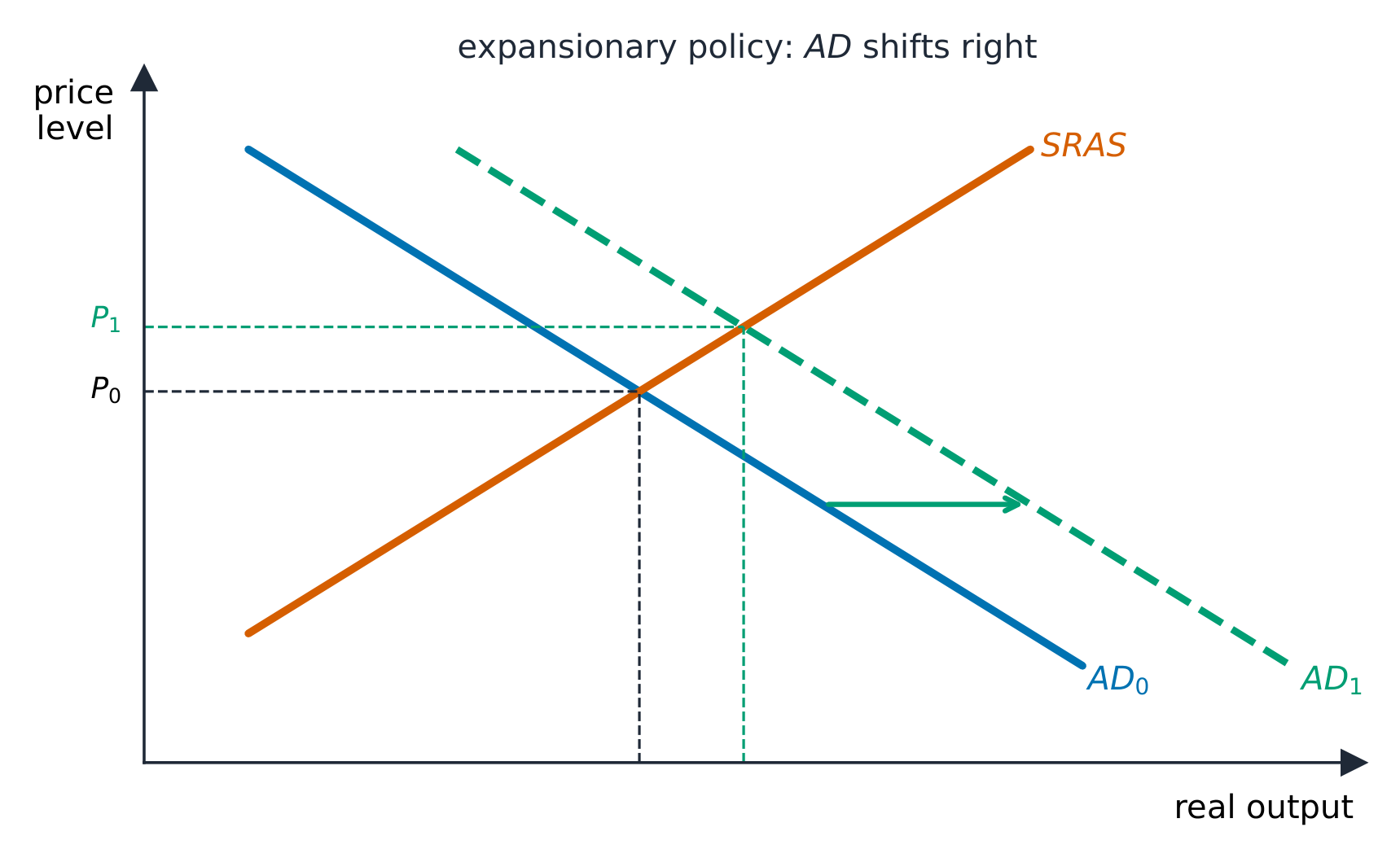
财政政策(fiscal policy)是政府对支出税收的使用以移动 AD:

扩张性财政政策使 AD 右移,提高产出和价格
  • 扩张性(expansionary)(更多支出或更低税)使 AD 移以关闭一个衰退缺口。
  • 紧缩性(contractionary)(更少支出或更高税)使 AD 移以关闭一个通胀缺口。

用乘数确定政策规模:要关闭一个给定大小的缺口,所需的支出变化是(缺口)$\div$(花费乘数)。限制包括时间滞后挤出(crowding out)(下面),和政治困难。

Worked example. 一个经济有一个 $\$100$ 十亿的衰退缺口和 $MPC=0.75$(花费乘数 $=\dfrac{1}{0.25}=4$)。要关闭它,政府必须提高支出 $\dfrac{\$100\text{ billion}}{4}=\$25$ 十亿。改用一次减税(税收乘数 $-3$)会需要一次更大的 $\dfrac{100}{3}\approx\$33$ 十亿的减税。

考试技能: 你必须画正确标注的 AD-AS 图、辨别缺口、开出正确的财政行动及其方向,并常常计算所需的确切支出或税收变化。

词汇表 训练
英文 中文 拼音
Fiscal policy 财政政策 cái zhèng zhèng cè
Expansionary 扩张性 kuò zhāng xìng
Contractionary 紧缩性 jǐn suō xìng
3.9

自动稳定器

大纲
Enduring UnderstandingLearning ObjectiveEssential Knowledge

POL-1
Fiscal and monetary policy have short-run effects on macroeconomic outcomes.

POL-1.C
a. Define automatic stabilizers.
b. Explain how automatic stabilizers moderate business cycles.

  • POL-1.C.1 Automatic stabilizers support the economy during recessions and help prevent the economy from being overheated during expansionary periods.
  • POL-1.C.2 Tax revenues decrease automatically as GDP falls, preventing consumption and the economy from falling further.
  • POL-1.C.3 Tax revenues increase automatically as GDP rises, slowing consumption and preventing the economy from overheating.
  • POL-1.C.4 Government policies, institutions, or agencies may also have social service programs whose transfer payments act as automatic stabilizers.

来源:美国大学理事会 AP 课程与考试说明

自动稳定器(automatic stabilizers)是不需要新立法就抑制周期的特征。在一次下行里,累进税收得更少而转移支付(失业救济、福利)自动上升——缓冲收入和花费;在一次繁荣里它们做相反的。它们软化周期并即刻起作用,避免相机抉择(discretionary)政策的滞后。

词汇表 训练
英文 中文 拼音
Automatic stabilizers 自动稳定器 zì dòng wěn dìng qì
discretionary 相机抉择 xiàng jī jué zé
3.9

考试技巧

  • 总需求因财富、利率和净出口效应向下倾斜;当 $C$$I$$G$$X_n$ 变化时它移动
  • 计算花费乘数 $\tfrac{1}{1-MPC}$ 和更小的、负的税收乘数 $-\tfrac{MPC}{1-MPC}$
  • 画一个正确标注的 AD–AS 图、辨别一个衰退或通胀缺口,并开出正确的财政行动。
  • 短期 AS 向上倾斜(粘性工资);长期 AS 在充分就业产出处是竖直的。
  • 用乘数确定政策规模:所需支出 = 缺口 ÷ 花费乘数。

本主题的互动课程

逐步学习,并即时检测练习。

AP 宏观经济学历年真题

AP 宏观经济学的更多主题

登录或创建账号

IGCSE, A-Level & AP