| English | 释义 | 拼音 |
|---|---|---|
| long-run aggregate supply/lɒŋ rʌn ˈæɡrɪɡeɪt səˈplaɪ/ | 长期总供给 | cháng qī zǒng gōng jǐ |
| full-employment output/fʊl emˈplɔɪmənt ˈaʊtpʊt/ | 充分就业产出 | chōng fèn jiù yè chǎn chū |
| frictional/ˈfrɪkʃənl/ | 摩擦性失业 | mó cā xìng shī yè |
| structural/ˈstrʌktʃərəl/ | 结构性失业 | jié gòu xìng shī yè |
| natural rate of unemployment/ˈnætʃərəl reɪt ɒv ʌnemˈplɔɪmənt/ | 自然失业率 | zì rán shī yè lǜ |
| potential GDP/pəˈtenʃl ˌdʒiː diː ˈpiː/ | 潜在GDP | qián zài GDP |
| fully flexible/ˈfʊli ˈfleksɪbl/ | 完全灵活 | wán quán líng huó |
| capacity/kəˈpæsɪti/ | 生产能力 | shēng chǎn néng lì |
| capital stock/ˈkæpɪtl stɒk/ | 资本存量 | zī běn cún liàng |
| technology/tekˈnɒlədʒi/ | 技术 | jì shù |
| economic growth/ˌiːkəˈnɒmɪk ɡrəʊθ/ | 经济增长 | jīng jì zēng zhǎng |
The economy's real ceiling
- Contracts don't stay fixed forever — given time, every wage and price adjusts.
- In that long run, the sticky-wage story disappears.
- Aggregate supply then looks completely different.
- It becomes the long-run aggregate supply 长期总供给 (LRAS) curve — and it is vertical.
Vertical at full-employment output
- LRAS is a vertical line at the economy's full-employment output 充分就业产出.
- This is not zero unemployment — only frictional 摩擦性失业 and structural 结构性失业 remain, at the natural rate of unemployment 自然失业率.
- Its position marks the economy's potential GDP 潜在GDP — the maximum sustainable output.
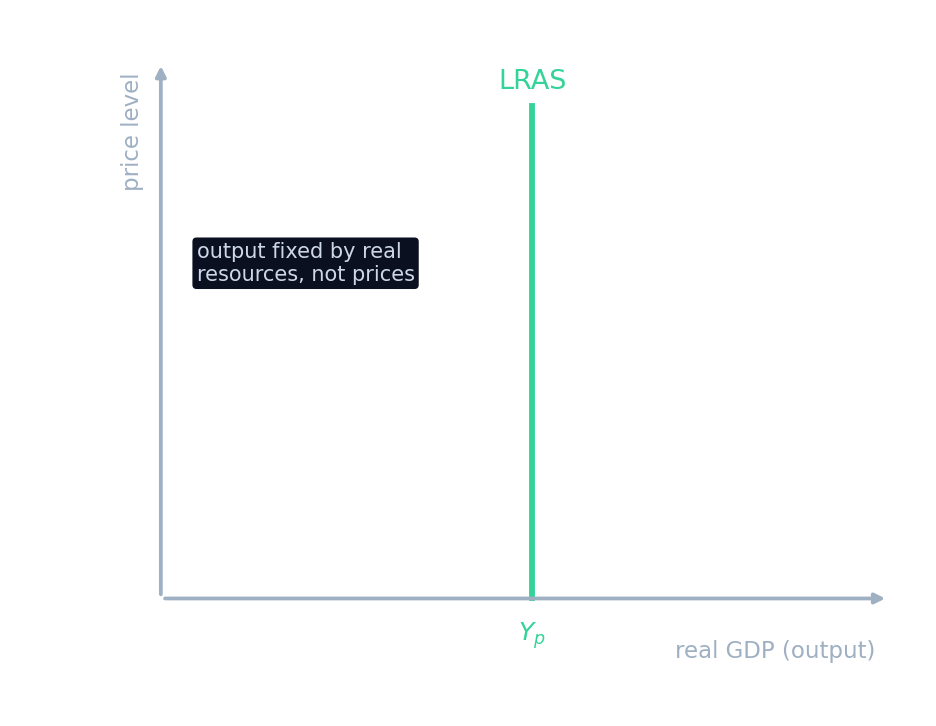
The AD-AS model
LRAS is vertical at potential output, because in the long run wages and prices are flexible. Economic growth shifts it right.
The long-run aggregate supply curve is:
难度 1/5 · 今日首次完成可获 100 金币及少量额外奖励
In the long run output depends on real resources, not the price level, so LRAS is vertical.
LRAS sits at the economy's maximum sustainable output, called potential ______.
难度 1/5 · 今日首次完成可获 100 金币及少量额外奖励
Potential GDP is the output at full employment, at the natural rate of unemployment.
Full-employment output means zero unemployment.
难度 1/5 · 今日首次完成可获 100 金币及少量额外奖励
Some frictional and structural unemployment always remain — the natural rate.
Why it's independent of the price level
- In the long run, wages and prices are fully flexible 完全灵活.
- If the price level doubles, wages eventually double too, so firms have no lasting reason to change output.
- Real output settles back to what the economy's real resources can make.
- That does not depend on how high the price tags are — so LRAS is vertical.
LRAS is independent of the price level because, in the long run:
难度 1/5 · 今日首次完成可获 100 金币及少量额外奖励
If the price level doubles, wages eventually double too, leaving real output unchanged.
Growth shifts LRAS right
- LRAS moves only when real productive capacity 生产能力 changes.
- More or better resources, a bigger capital stock 资本存量, or new technology 技术 all shift LRAS right.
- That rightward shift is long-run economic growth 经济增长.
- Worked idea. A decade of investment in schools and factories raises potential output — LRAS shifts right.
A country invests heavily in education and new factories for a decade. LRAS:
难度 1/5 · 今日首次完成可获 100 金币及少量额外奖励
More capital and a more skilled workforce raise potential output, shifting LRAS right.
Select 所有 that shift LRAS to the 精准的.
难度 2/5 · 今日首次完成可获 140 金币及少量额外奖励
Real resources and technology grow potential output; a price-level change does not move LRAS.
Worked example: what moves LRAS?
Which of these shift LRAS, and which way? (a) Oil prices rise for six months. (b) A large wave of skilled immigrants joins the workforce. (c) A war destroys many factories.
- (a) A temporary input-price change shifts SRAS, not LRAS: the economy's long-run capacity is unchanged.
- (b) More labor raises potential output: LRAS shifts right. (c) Less capital stock cuts potential output: LRAS shifts left. On a PPC, (b) moves the curve outward and (c) inward.
A breakthrough in battery technology raises productivity in every industry for good. LRAS:
难度 1/5 · 今日首次完成可获 100 金币及少量额外奖励
A lasting rise in productive capacity is long-run growth.
A higher price level shifts LRAS to the right.
难度 1/5 · 今日首次完成可获 100 金币及少量额外奖励
LRAS is vertical: potential output does not depend on the price level.
LRAS is vertical at full-employment output (potential GDP), because wages and prices are fully flexible in the long run — real output depends on real resources, not the price level. Economic growth shifts LRAS right.
Write from a new potential output of 1100
- A decade of schooling and new factories raises potential output from 1000 to 1100.
- Say what happens to long-run aggregate supply.
Schooling and new factories raise potential output from 1000 to 1100. What happens to the long-run aggregate supply curve, and why does the price level not set that output?
More capital and skills raise what the economy can produce.
What happens to long-run aggregate supply?
难度 1/5 · 今日首次完成可获 100 金币及少量额外奖励
Potential output rose from 1000 to 1100, a rightward shift.