| Enduring Understanding | Learning Objective | Essential Knowledge |
|---|---|---|
MOD-1 | MOD-1.A |
|
AP 宏观经济学
学习建议
AP 宏观经济学涵盖经济指标与经济周期、国民收入与价格水平的决定、金融部门、稳定政策、经济增长,以及开放经济。它研究的是整个国家,而不是单一市场。
三张模型图撑起整门课:AD–AS、货币市场、可贷资金市场。几乎每道自由作答题都在它们之间穿梭,所以核心能力是清楚什么导致什么移动、按什么顺序。
推理链条是给分点。“利率下降 → 投资上升 → AD 右移 → 实际 GDP 与价格水平上升”就是满分答案的形状。任何一环都不能跳过。
笔记逐单元展开,并把图画出来——AD-AS、货币市场、可贷资金市场——因为多数分数都挂在图上。公开FRQ在资料库中,笔记会标出哪些地方只要图标注正确就能得分。
-
1
基本经济概念
1.1
稀缺性
大纲
来源:美国大学理事会 AP 课程与考试说明
经济学(economics)以稀缺性(scarcity)开始:人们的欲望是无限的,但满足它们的资源(resources)是有限的。这些资源——生产要素(factors of production)——是土地(land)、劳动(labor)、资本(capital)和企业家才能(entrepreneurship)。稀缺性迫使每个社会选择生产什么、如何生产和为谁生产,而它使权衡(trade-offs)不可避免。
词汇表 训练英文 中文 拼音 Economics/ˌiːkəˈnɒmɪks/ 经济学 jīng jì xué scarcity/ˈskeəsɪti/ 稀缺性 xī quē xìng resources/rɪˈzɔːsɪz/ 资源 zī yuán factors of production/ˈfæktəz ɒv prəˈdʌkʃn/ 生产要素 shēng chǎn yào sù labor/ˈleɪbə/ 劳动 láo dòng capital/ˈkæpɪtl/ 资本 zī běn entrepreneurship/ˌɒntrɪprəˈnjʊəʃɪp/ 企业家才能 qǐ yè jiā cái néng trade-offs/treɪd ɒfs/ 权衡 quán héng 1.2
机会成本与生产可能性曲线(PPC)
大纲
Enduring Understanding Learning Objective Essential Knowledge MOD-1
The production possibilities curve (PPC) model is used to demonstrate the full employment level of output and to illustrate changes in full employment.MOD-1.B
a. Define (using graphs as appropriate) the PPC and related terms.
b. Explain (using graphs as appropriate) how the PPC illustrates opportunity costs, tradeoffs, inefficiency, efficiency, and economic growth or contraction under various conditions.
c. Calculate (using data from PPCs or tables as appropriate) opportunity cost.- MOD-1.B.1 The PPC is a model used to show the tradeoffs associated with allocating resources.
- MOD-1.B.2 The PPC can be used to illustrate the concepts of scarcity, opportunity cost, efficiency, underutilized resources, and economic growth or contraction.
- MOD-1.B.3 The shape of the PPC depends on whether opportunity costs are constant, increasing, or decreasing.
- MOD-1.B.4 The PPC can shift because of changes in factors of production as well as changes in productivity/technology.
- MOD-1.B.5 Economic growth results in an outward shift of the PPC.
来源:美国大学理事会 AP 课程与考试说明
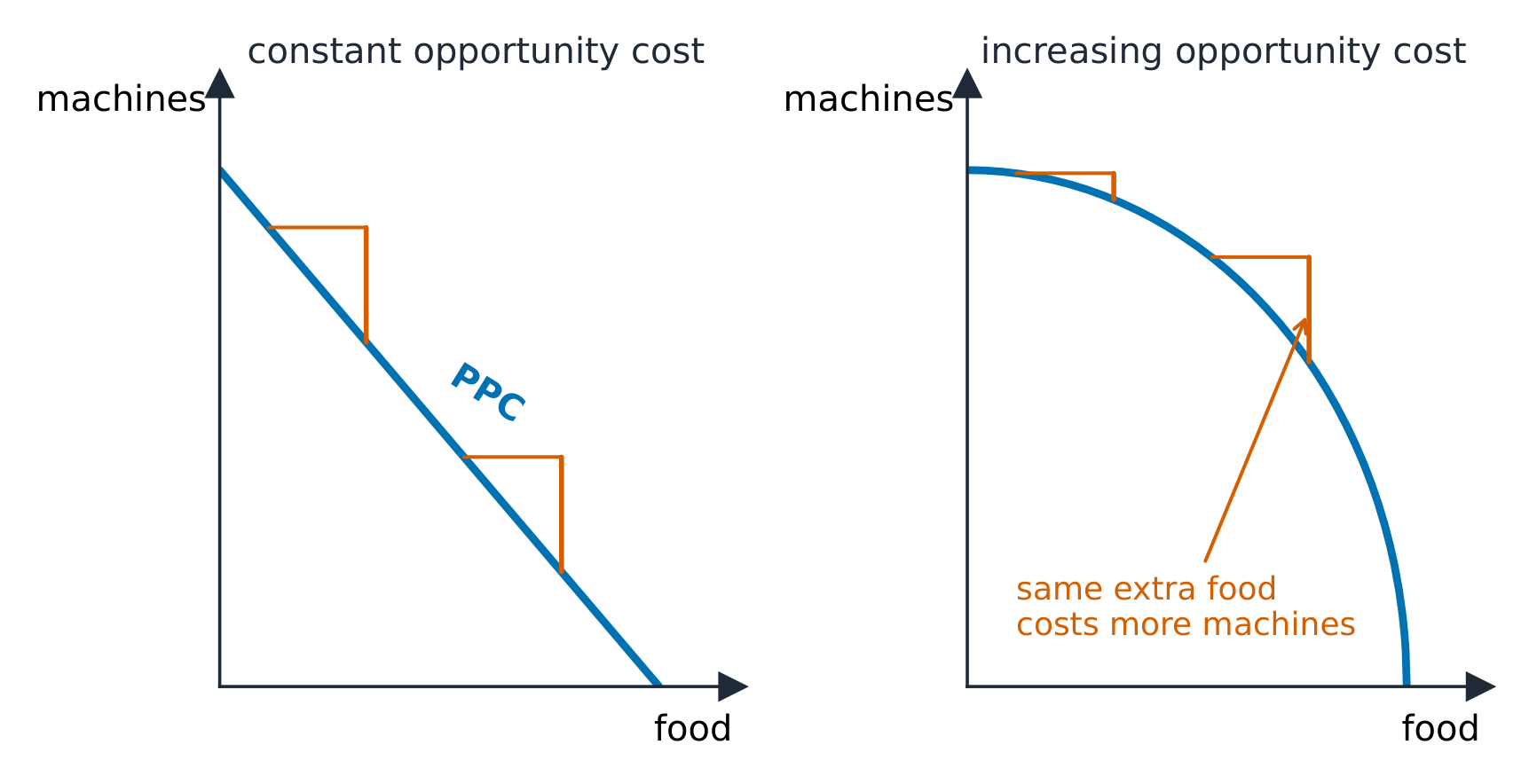
生产可能性边界 每个选择都有一个机会成本(opportunity cost)——放弃的下一个最好的替代的价值。生产可能性曲线(PPC)(production possibilities curve)显示当资源被充分而高效地使用时一个经济能制造的两种物品的最大组合。
一条直的 PPC 意味着恒定的机会成本;一条弯的意味着增加的成本 - 曲线上的点是高效的;里面,低效的(失业的资源);外面,不可达的。
- 向下的斜率显示机会成本;一条向外凸的曲线显示增加的机会成本。
- 更多资源或更好的技术造成经济增长(economic growth),使 PPC 向外移动。
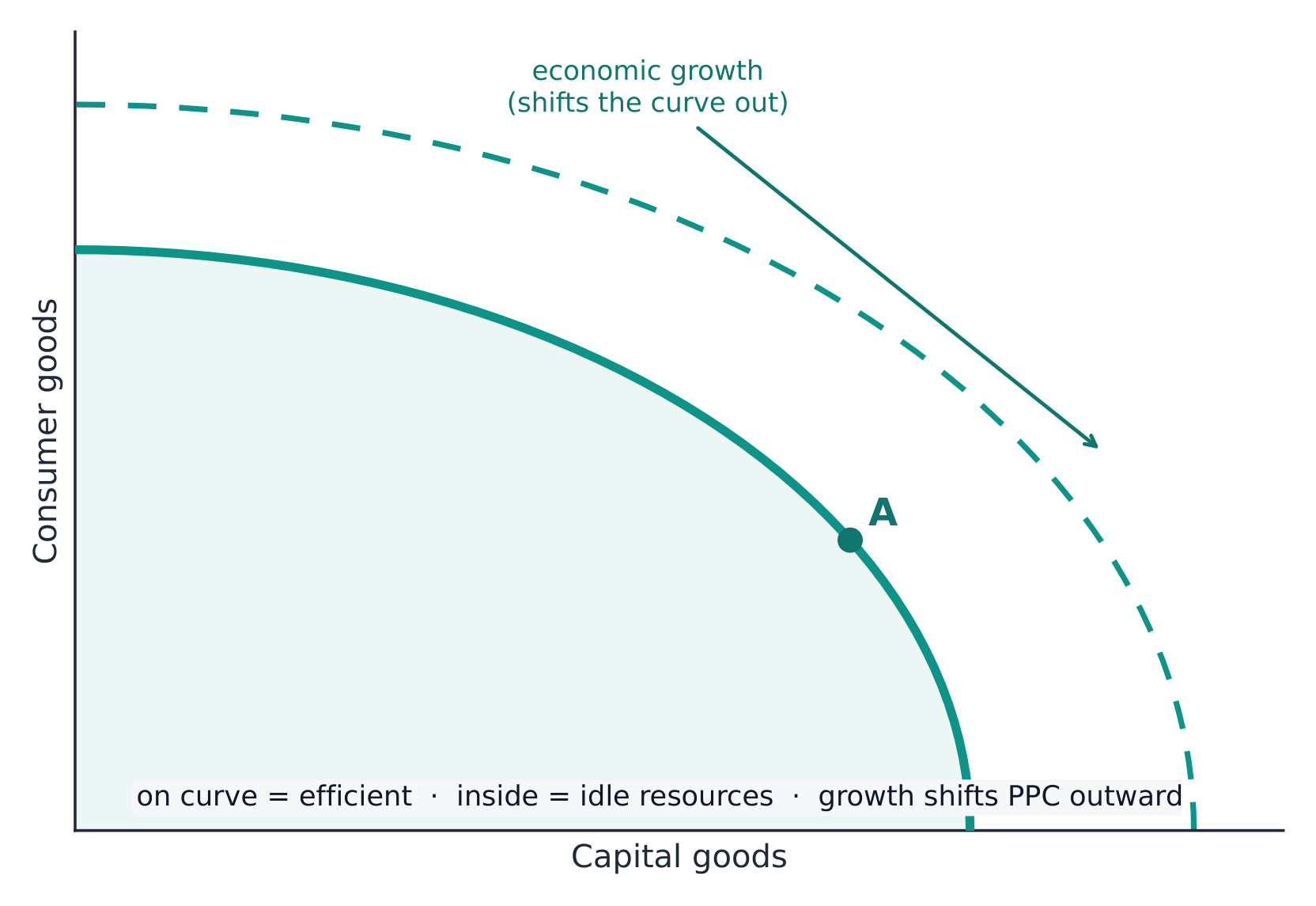
一条生产可能性曲线;投资于资本物品使它向外移动 探索Explore the production possibilities curve
Move along the curve — making more capital goods means giving up consumer goods. That lost output is the opportunity cost, and the bowed shape shows it rising with each extra unit.
词汇表 训练英文 中文 拼音 opportunity cost/ɒpəˈtjuːnɪti kɒst/ 机会成本 jī huì chéng běn production possibilities curve (PPC)/prəˈdʌkʃn ˌpɒsəˈbɪlɪtiz kɜːv/ 生产可能性曲线 shēng chǎn kě néng xìng qū xiàn economic growth/ˌiːkəˈnɒmɪk ɡrəʊθ/ 经济增长 jīng jì zēng zhǎng 1.3
比较优势与贸易收益
大纲
Enduring Understanding Learning Objective Essential Knowledge MKT-1
Production and consumption increase by engaging in trade.MKT-1.A
a. Define absolute advantage and comparative advantage.
b. Determine (using data from PPCs or tables as appropriate) absolute and comparative advantage.- MKT-1.A.1 Absolute advantage describes a situation in which an individual, business, or country can produce more of a good or service than any other producer with the same quantity of resources.
- MKT-1.A.2 Comparative advantage describes a situation in which an individual, business, or country can produce a good or service at a lower opportunity cost than another producer.
MKT-1.B
a. Explain (using data from PPCs or tables as appropriate) how specialization according to comparative advantage with appropriate terms of trade can lead to gains from trade.
b. Calculate (using data from PPCs or tables as appropriate) mutually beneficial terms of trade.- MKT-1.B.1 Production specialization according to comparative advantage results in exchange opportunities that lead to consumption opportunities beyond the PPC.
- MKT-1.B.2 Comparative advantage and opportunity costs determine the terms of trade for exchange under which mutually beneficial trade can occur.
来源:美国大学理事会 AP 课程与考试说明
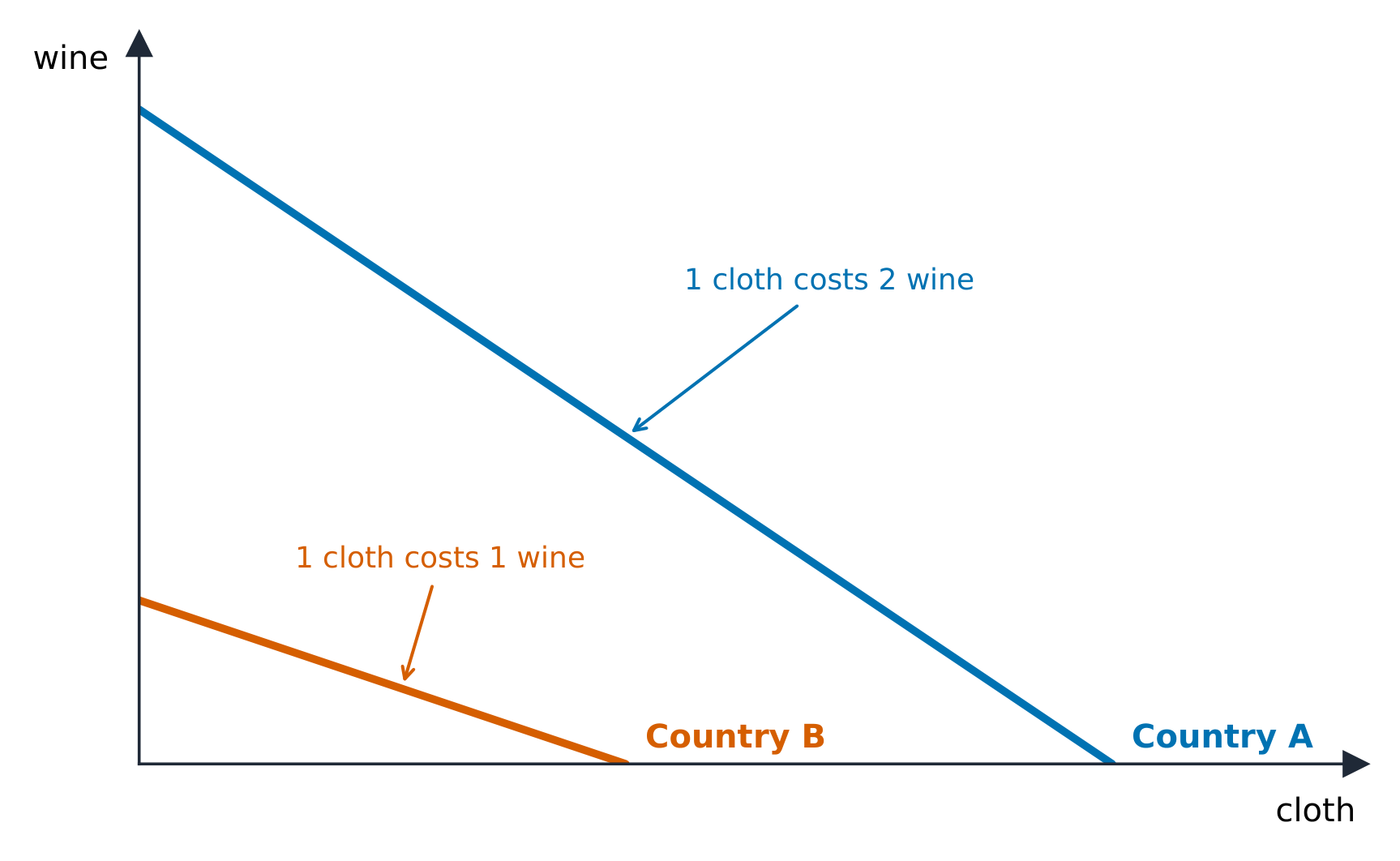
一个生产者在一种物品上有一个绝对优势(absolute advantage),若它能制造更多它。它有一个比较优势(comparative advantage),若它有更低的机会成本。国家应当专门于它们的比较优势物品并交易——若贸易条件(terms of trade)位于两个机会成本之间,两者都获益。贸易让一个国家消费超过它自己的 PPC。
Worked example. 国家 A 每天能制造 $10$ 小麦或 $5$ 布;国家 B 能制造 $8$ 小麦或 $8$ 布。对 A,一布值 $\tfrac{10}{5}=2$ 小麦;对 B 它值 $\tfrac{8}{8}=1$ 小麦。B 的布的机会成本更低,所以 B 专门于布。检查小麦:A 每小麦放弃 $0.5$ 布而 B 放弃 $1$,所以 A 专门于小麦。以两个成本之间的任何比率交易,两者都消费超过它们自己的 PPC。
比较优势来自斜率不同的生产可能性曲线 
Container shipping: comparative advantage and trade let countries specialise and gain 探索See the gains from specialization and trade
A country should specialize where its opportunity cost is lowest, then trade for the rest. Because the terms of trade sit between the two countries' costs, each can consume beyond its own production frontier.
词汇表 训练英文 中文 拼音 absolute advantage/ˈæbsəluːt ədˈvæntɪdʒ/ 绝对优势 jué duì yōu shì comparative advantage/kəmˈpærətɪv ədˈvæntɪdʒ/ 比较优势 bǐ jiào yōu shì terms of trade/tɜːmz ɒv treɪd/ 贸易条件 mào yì tiáo jiàn 1.4
需求
大纲
Enduring Understanding Learning Objective Essential Knowledge MKT-2
In a competitive market, demand for and supply of a good or service determine the equilibrium price.MKT-2.A
a. Define (using graphs as appropriate) the law of demand.
b. Explain (using graphs as appropriate) the relationship between the price of a good or service and the quantity demanded.- MKT-2.A.1 The law of demand states there is an inverse relationship between price and quantity demanded, leading to a downward-sloping demand curve.
MKT-2.B
Explain (using graphs as appropriate) the determinants of demand.- MKT-2.B.1 Factors that influence consumer demand, such as changes in consumer income, cause the market demand curve to shift.
来源:美国大学理事会 AP 课程与考试说明
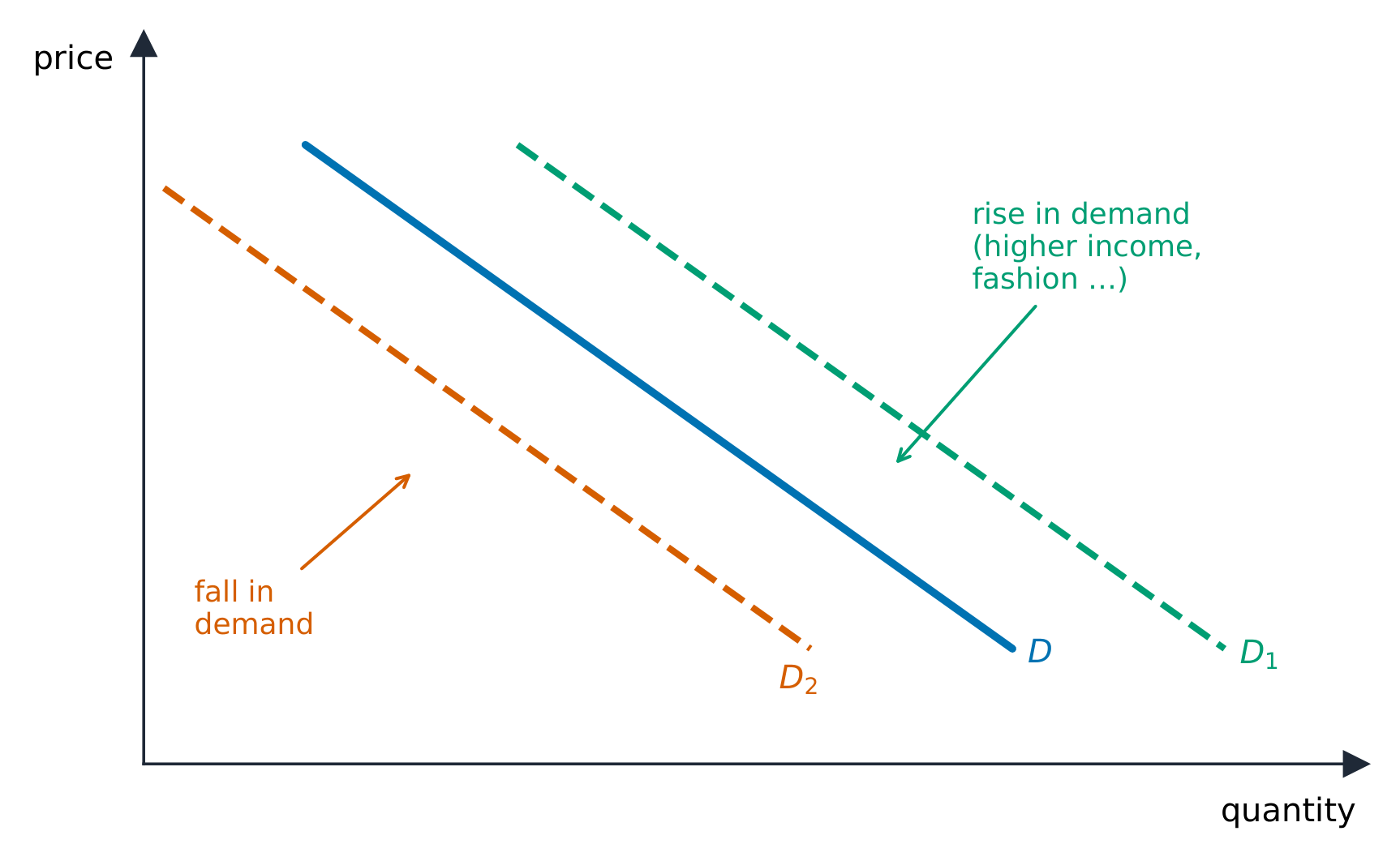
需求(demand)把价格与买者会买的数量关联。需求定律(law of demand)使曲线向下倾斜。物品自身价格的一个变化是沿曲线的一个移动;决定因素(收入、偏好、替代品(substitutes)和互补品(complements)的价格、买者数量、预期)移动整条曲线。
需求曲线向下倾斜;收入、偏好和相关价格移动它 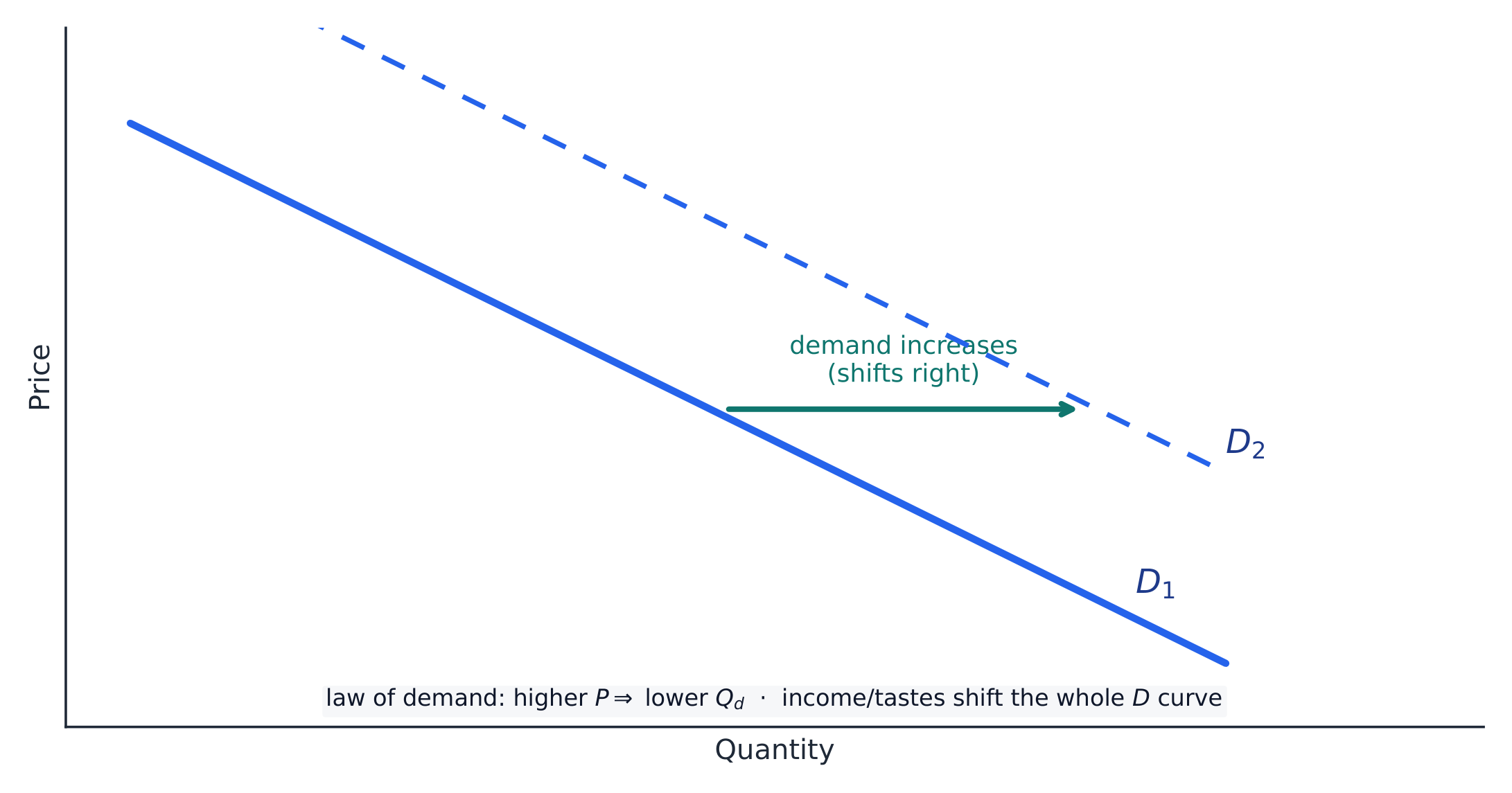
需求定律使曲线向下倾斜;一个决定因素移动整条曲线 探索Explore demand — move along vs shift the curve
A change in the own price moves you along a fixed curve (a change in quantity demanded); a determinant like income or tastes shifts the whole curve ($D_1 \to D_2$) — a change in demand.
词汇表 训练英文 中文 拼音 Demand/dɪˈmænd/ 需求 xū qiú law of demand/lɔː ɒv dɪˈmænd/ 需求定律 xū qiú dìng lǜ substitutes/ˈsʌbstɪtjuːts/ 替代品 tì dài pǐn complements/ˈkɒmplɪmənts/ 互补品 hù bǔ pǐn 1.5
供给
大纲
Enduring Understanding Learning Objective Essential Knowledge MKT-2
In a competitive market, demand for and supply of a good or service determine the equilibrium price.MKT-2.C
a. Define (using graphs as appropriate) the law of supply.
b. Explain (using graphs as appropriate) the relationship between the price of a good or service and the quantity supplied.- MKT-2.C.1 The law of supply states there is a positive relationship between price and quantity supplied, leading to an upward-sloping supply curve.
MKT-2.D
Explain (using graphs as appropriate) the determinants of supply.- MKT-2.D.1 Factors that influence producer supply, such as changes in input prices, cause the market supply curve to shift.
来源:美国大学理事会 AP 课程与考试说明
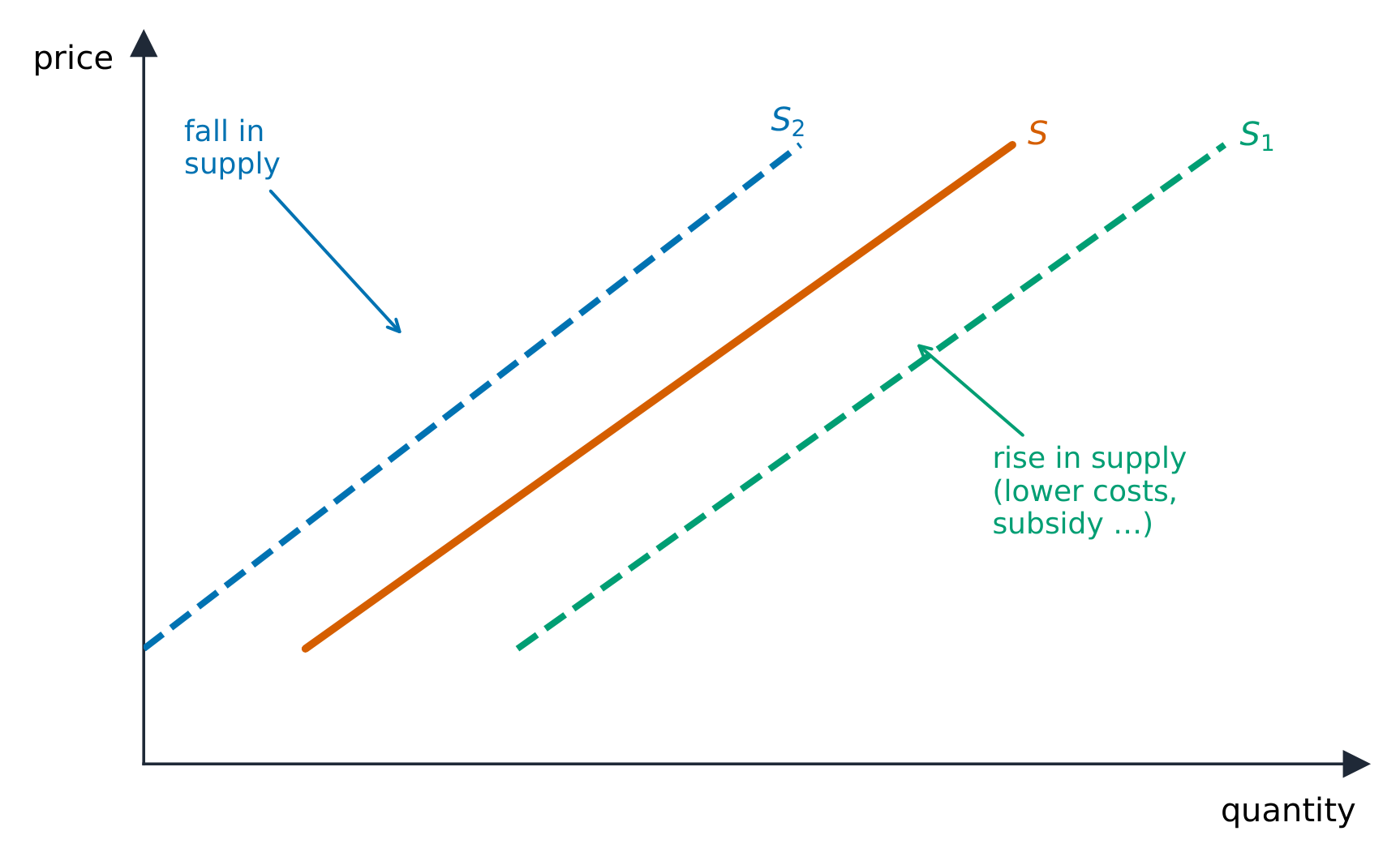
供给(supply)把价格与卖者会提供的数量关联;供给定律(law of supply)使它向上倾斜。它的决定因素——投入价格、技术、税收和补贴(subsidies)、卖者数量、预期——移动曲线,而物品自身价格沿它移动。
供给曲线向上倾斜;成本、技术、税和补贴移动它 探索Explore what moves the supply curve
Supply slopes up: a higher price makes selling more worthwhile. A change in costs, technology or the number of sellers shifts the whole curve — not a move along it. Drag the supply line and watch price and quantity respond.
词汇表 训练英文 中文 拼音 Supply/səˈplaɪ/ 供给 gōng jǐ law of supply/lɔː ɒv səˈplaɪ/ 供给定律 gōng jǐ dìng lǜ subsidies/ˈsʌbsɪdiz/ 补贴 bǔ tiē 1.6
市场均衡、失衡与均衡的变动
大纲
Enduring Understanding Learning Objective Essential Knowledge MKT-2
In a competitive market, demand for and supply of a good or service determine the equilibrium price.MKT-2.E
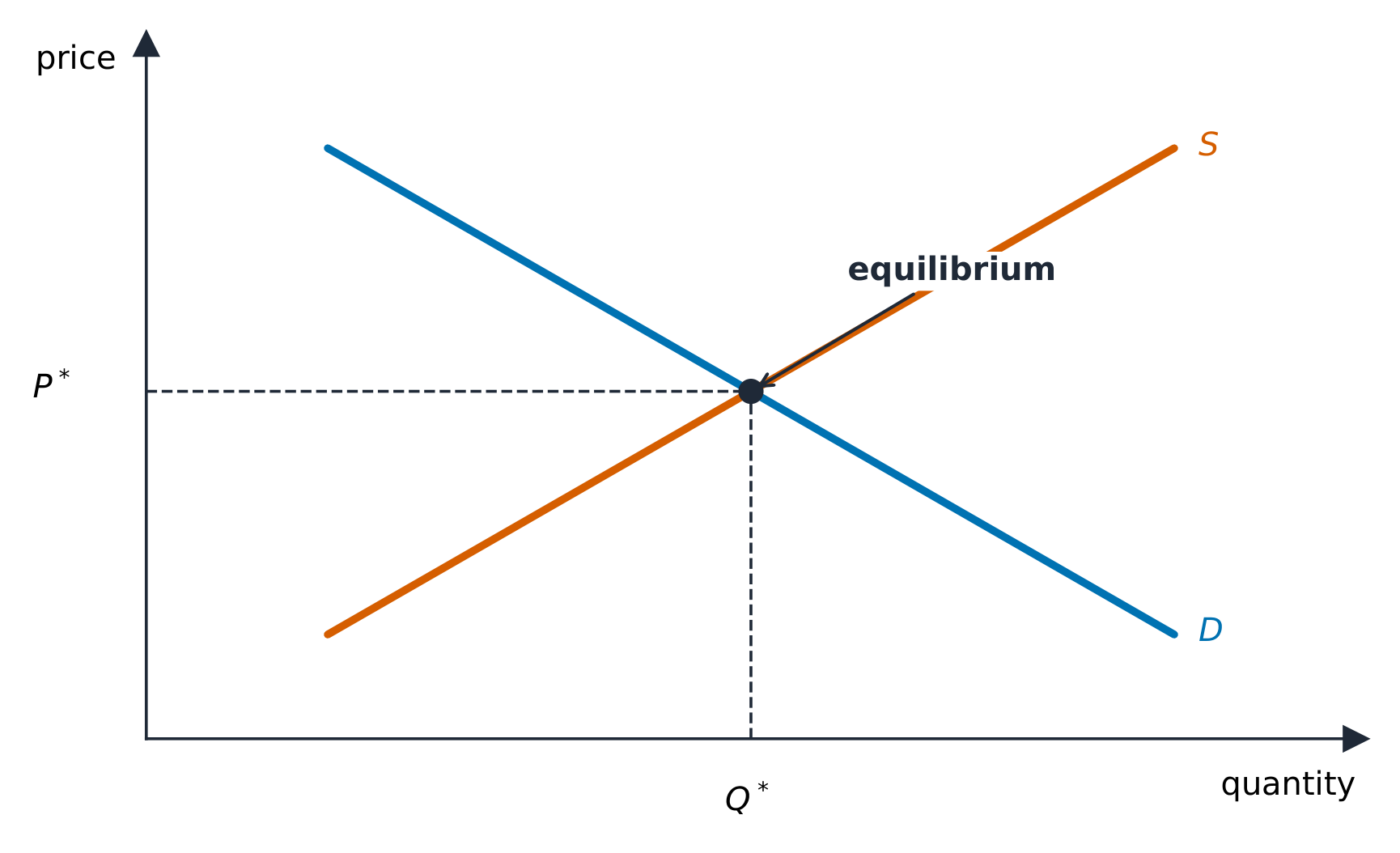
Define (using graphs as appropriate) market equilibrium.- MKT-2.E.1 Equilibrium is achieved at the price at which quantities demanded and supplied are equal.
MKT-2.F
a. Define a surplus and shortage.
b. Explain (using graphs as appropriate) how prices adjust to restore equilibrium in markets that are experiencing imbalances.
c. Calculate (using graphs as appropriate) the surplus or shortage in the market experience an imbalance.- MKT-2.F.1 Whenever markets experience imbalances—creating disequilibrium prices, surpluses, and shortages—market forces drive prices toward equilibrium.
MKT-2.G
Explain (using graphs as appropriate) how changes in demand and supply affect equilibrium price and equilibrium quantity.- MKT-2.G.1 Changes in the determinants of supply and/or demand result in a new equilibrium price and quantity.
来源:美国大学理事会 AP 课程与考试说明
供求:需求右移使价与量上升 均衡(equilibrium)是供给遇到需求的地方,使市场出清。均衡价格之上一个过剩(surplus)把价格推低;它之下一个短缺(shortage)把价格推高。当一个决定因素移动一条曲线时,价格和数量可预测地移动;当两者都移动时,它们之一是不确定的(indeterminate)。
Worked example. 一项新技术降低生产者的成本,使供给右移。沿不变的需求曲线,均衡价格下降而均衡数量上升。若相反收入的一次上升同时使需求右移,数量明显上升但对价格的效应取决于哪个移动更大——"两者都移动"的不确定情况。
需求遇到供给处的均衡价格和数量 考试技能: 宏观建立在这些微观工具上——你必须正确地画和移动供求和 PPC 图,因为同样的移动逻辑驱动课程后面的总量(整个经济)模型。
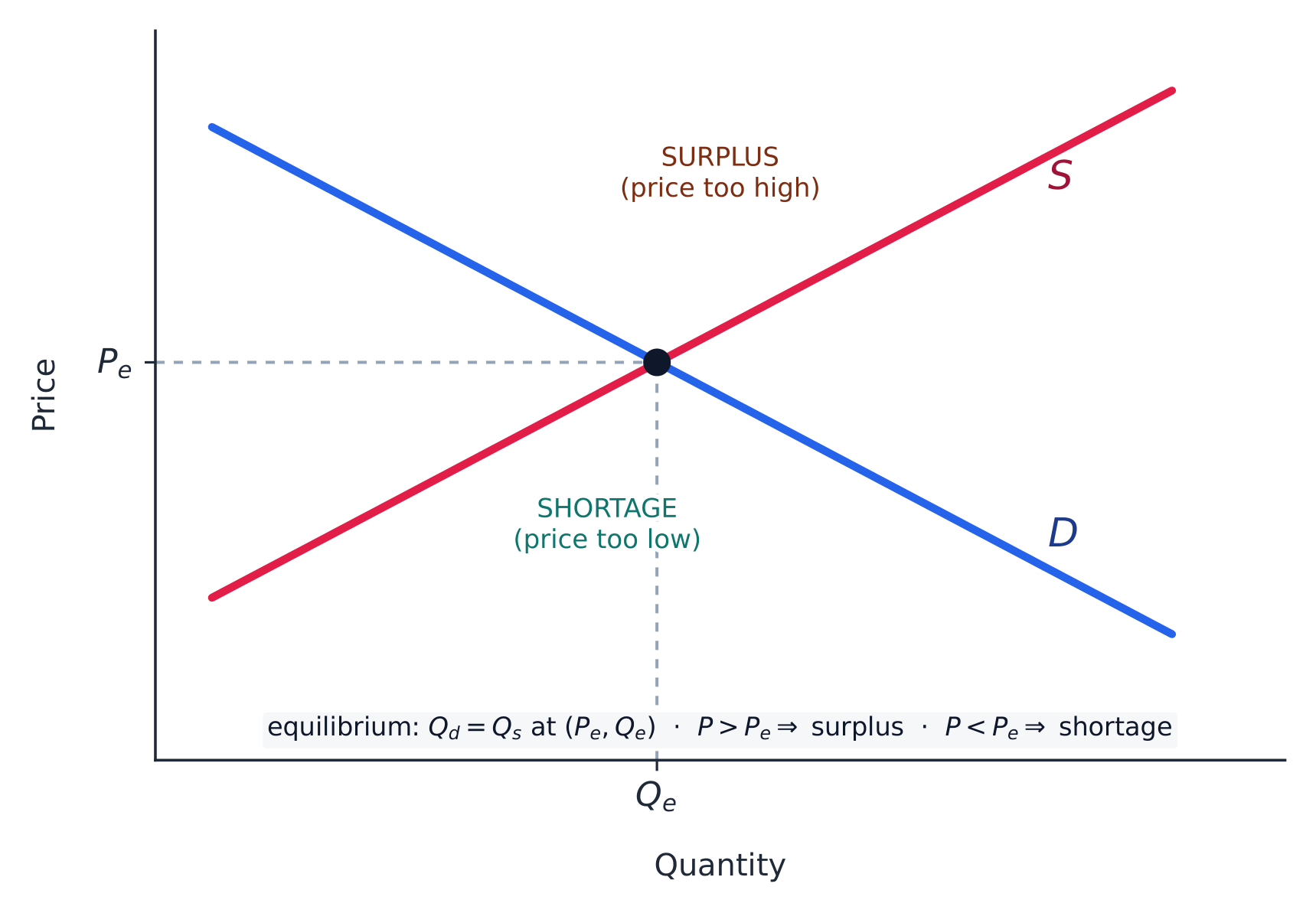
市场均衡坐在供给遇到需求的地方;离开它是过剩和短缺 探索Explore market equilibrium, surplus and shortage
The market clears where supply meets demand. Shift a curve and watch the crossing move — a rightward demand shift raises both price and quantity; away from equilibrium a surplus or shortage pushes the price back.
词汇表 训练英文 中文 拼音 Equilibrium/ˌiːkwɪˈlɪbrɪəm/ 均衡 jūn héng surplus/ˈsɜːpləs/ 过剩 guò shèng shortage/ˈʃɔːtɪdʒ/ 短缺 duǎn quē 1.6
考试技巧
- 机会成本是你放弃的——从一条 PPC 读它作为斜率;一条向外凸的 PPC 显示增加的机会成本。
- 比较优势(更低的机会成本),不是绝对优势,决定谁应当专门化并交易。
- PPC 里面的点是低效的、外面不可达;更多资源/技术使它向外移动(增长)。
- 把沿一条需求/供给曲线的一个移动(movement along)(自身价格)与一个移动(shift)(一个决定因素)区分开。
- 这些微观工具驱动后面的总量模型——在正确的方向画和移动正确的曲线。
-
2
经济指标与经济周期
2.1
循环流动模型与国内生产总值
大纲
Enduring Understanding Learning Objective Essential Knowledge MEA-1
An economy's performance can be measured by different indicators such as gross domestic product (GDP), the inflation rate, and the unemployment rate.MEA-1.A
a. Define (using the circular flow diagram as appropriate) how GDP is measured and its components.
b. Calculate nominal GDP.- MEA-1.A.1 GDP is a measure of final output of the economy.
- MEA-1.A.2 GDP as a total flow of income and expenditure can be represented by the circular flow diagram.
- MEA-1.A.3 There are three ways of measuring GDP: the expenditures approach, the income approach, and the value-added approach.
来源:美国大学理事会 AP 课程与考试说明
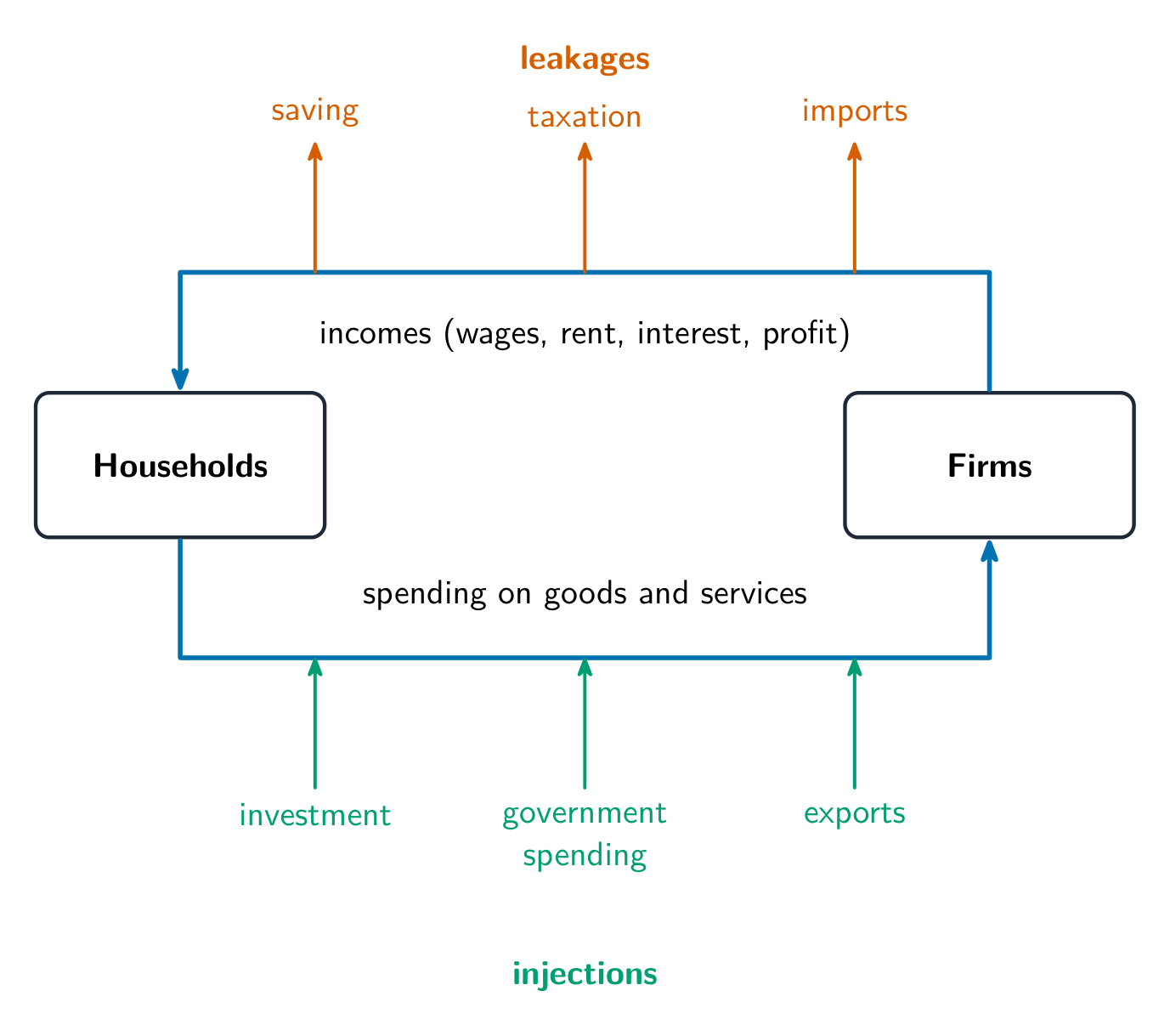
循环流动模型(circular-flow model)显示钱在家庭和企业之间移动:家庭供应要素并赚取收入;企业出售物品并赚取收入。每一美元的花费都是某人的收入,这就是为什么产出和收入是同一个总量的两面。
收入的循环流动,带它的漏出和注入 国内生产总值(GDP)(gross domestic product)是一年在一个国家之内生产的所有最终物品和服务的市场价值。测量它的三种方式给出相同的数字:
- 支出法: $GDP = C + I + G + X_n$ ——消费(consumption)、投资(investment)(企业对资本的花费,加新住房和存货)、政府购买(government purchases),和净出口(net exports)(出口减进口)。
- 收入法: 加起所有的工资、租金、利息和利润。
排除中间物品(避免重复计算)、二手物品、纯金融交易,和转移支付。
探索Follow money around the circular flow
Money flows from households to firms (spending) and back (wages), while injections (investment, government, exports) and leakages (saving, taxes, imports) can grow or shrink the flow — the size of that flow is GDP.
词汇表 训练英文 中文 拼音 circular-flow model/ˈsɜːkjʊlə fləʊ ˈmɒdl/ 循环流动模型 xún huán liú dòng mó xíng Gross domestic product (GDP)/ɡrəʊs dəˈmestɪk ˈprɒdʌkt/ 国内生产总值 guó nèi shēng chǎn zǒng zhí consumption/kənˈsʌmpʃn/ 消费 xiāo fèi investment/ɪnˈvestmənt/ 投资 tóu zī government purchases/ˈɡʌvənmənt ˈpɜːtʃɪsɪz/ 政府购买 zhèng fǔ gòu mǎi net exports/net ˈekspɔːts/ 净出口 jìng chū kǒu 2.2
国内生产总值的局限性
大纲
Enduring Understanding Learning Objective Essential Knowledge MEA-1
An economy's performance can be measured by different indicators such as gross domestic product (GDP), the inflation rate, and the unemployment rate.MEA-1.B
Define the limitations of GDP.- MEA-1.B.1 GDP is a useful indicator of a nation's economic performance, but it has some limitations, such as failing to account for nonmarket transactions.
来源:美国大学理事会 AP 课程与考试说明
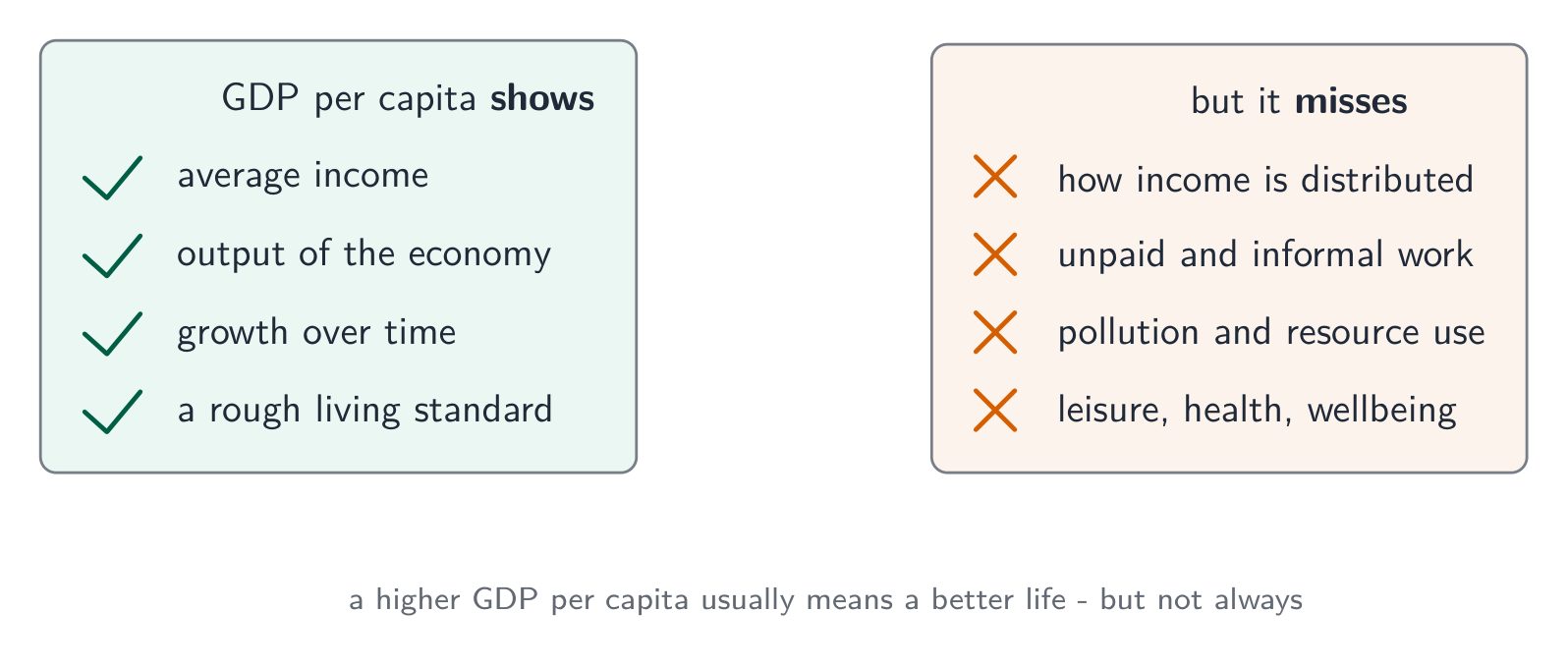
GDP 测量市场产出,不是福祉。它遗漏非市场生产(无偿家务、志愿服务)、地下经济(underground economy)、闲暇,和收入的分配,而且它忽略环境损害和资源耗竭。所以一个更高的 GDP 不自动意味着一个更好的生活水平。人均 GDP(GDP $\div$ 人口)是一个比总 GDP 更好的福利替代。
人均 GDP 显示平均产出但遗漏分配、无偿工作等 词汇表 训练英文 中文 拼音 underground economy/ˌʌndəˈɡraʊnd ɪˈkɒnəmi/ 地下经济 dì xià jīng jì 2.3
失业
大纲
Enduring Understanding Learning Objective Essential Knowledge MEA-1
An economy's performance can be measured by different indicators such as gross domestic product (GDP), the inflation rate, and the unemployment rate.MEA-1.C
a. Define the labor force, the unemployment rate, and the labor force participation rate.
b. Explain how changes in employment and the labor market affect the unemployment rate and the labor force participation rate.
c. Calculate the unemployment rate and the labor force participation rate.- MEA-1.C.1 The unemployment rate is the percentage of the labor force that is out of work.
- MEA-1.C.2 The labor force participation rate is another measure of the labor market activity in an economy. The labor force participation rate is the percentage of the adult population that is in the labor force.
MEA-1.D
Define the limitations of the unemployment rate.- MEA-1.D.1 The measured unemployment rate is often criticized for understating the level of joblessness because it excludes groups such as discouraged workers and part-time workers.
MEA-1.E
a. Define the types of unemployment and the natural rate of unemployment.
b. Explain changes in the types of unemployment.- MEA-1.E.1 Economists primarily focus on three types of unemployment: cyclical, frictional, and structural.
- MEA-1.E.2 The natural rate of unemployment is the unemployment rate that would exist when the economy produces full-employment real output. It is equal to the sum of frictional and structural unemployment.
- MEA-1.E.3 The deviation of the actual unemployment rate from the natural rate is cyclical unemployment.
- MEA-1.E.4 The natural rate of unemployment can gradually change over time because of such things as changes in labor force characteristics.
来源:美国大学理事会 AP 课程与考试说明
劳动力(labor force)是就业者加失业者(unemployed)(没有工作但正在积极寻找的人)。不寻找的人不在劳动力里。
三种失业类型:摩擦性、结构性和周期性 $$\text{Unemployment rate}=\frac{\text{unemployed}}{\text{labor force}}\times 100\%,\qquad \text{Labor-force participation}=\frac{\text{labor force}}{\text{working-age population}}\times100\%.$$Worked example. 一个国家有 $150$ 百万就业和 $10$ 百万失业(积极寻找),带 $40$ 百万不寻找的工作年龄成人。劳动力是 $150+10=160$ 百万,所以失业率是 $\dfrac{10}{160}=6.25\%$ 而参与率是 $\dfrac{160}{200}=80\%$。
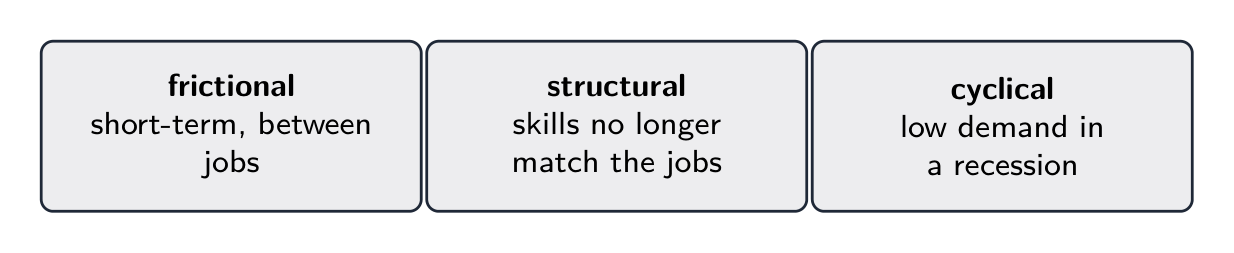
三种失业类型:
- 摩擦性失业(frictional):工作之间或寻找第一份工作(正常、短)。
- 结构性失业(structural):技能或位置不匹配可用的工作(技术、贸易)。
- 周期性失业(cyclical):由一次衰退造成(经济周期的一次下行)。
摩擦性 + 结构性构成自然失业率(natural rate of unemployment)。在自然率处周期性失业是零而经济处于充分就业(full employment)。这个率低估失业,因为它遗漏灰心工人(discouraged workers)和未充分就业者(underemployed)。
词汇表 训练英文 中文 拼音 labor force/ˈleɪbə fɔːs/ 劳动力 láo dòng lì Frictional/ˈfrɪkʃənl/ 摩擦性失业 mó cā xìng shī yè Structural/ˈstrʌktʃərəl/ 结构性失业 jié gòu xìng shī yè Cyclical/ˈsaɪklɪkl/ 周期性失业 zhōu qī xìng shī yè natural rate of unemployment/ˈnætʃərəl reɪt ɒv ʌnemˈplɔɪmənt/ 自然失业率 zì rán shī yè lǜ full employment/fʊl emˈplɔɪmənt/ 充分就业 chōng fèn jiù yè discouraged workers/dɪˈskʌrɪdʒd ˈwɜːkəz/ 灰心工人 huī xīn gōng rén 2.4
价格指数与通货膨胀
大纲
Enduring Understanding Learning Objective Essential Knowledge MEA-1
An economy's performance can be measured by different indicators such as gross domestic product (GDP), the inflation rate, and the unemployment rate.MEA-1.F
a. Define the consumer price index (CPI), inflation, deflation, disinflation, the inflation rate, and real variables.
b. Explain how price indices can be used to calculate the inflation rate and to compare nominal variables over time periods.
c. Calculate the CPI, the inflation rate, and changes in real variables.- MEA-1.F.1 The consumer price index (CPI) measures the change in income a consumer would need in order to maintain the same standard of living over time under a new set of prices as under the original set of prices.
- MEA-1.F.2 The CPI measures the cost of a fixed basket of goods and services in a given year relative to the base year.
- Exclusion statement: Calculating the producer price index (PPI) is beyond the scope of the course and AP Exam.
- MEA-1.F.3 The inflation rate is determined by calculating the percentage change in a price index, such as CPI or the GDP deflator.
- MEA-1.F.4 Real variables, such as real wages, are the nominal variables deflated by the price level.
MEA-1.G
Define the shortcomings of the CPI as a true measure of inflation.- MEA-1.G.1 The CPI as a measure of inflation has some shortcomings, such as substitution bias, causing it to overstate the true inflation rate.
来源:美国大学理事会 AP 课程与考试说明
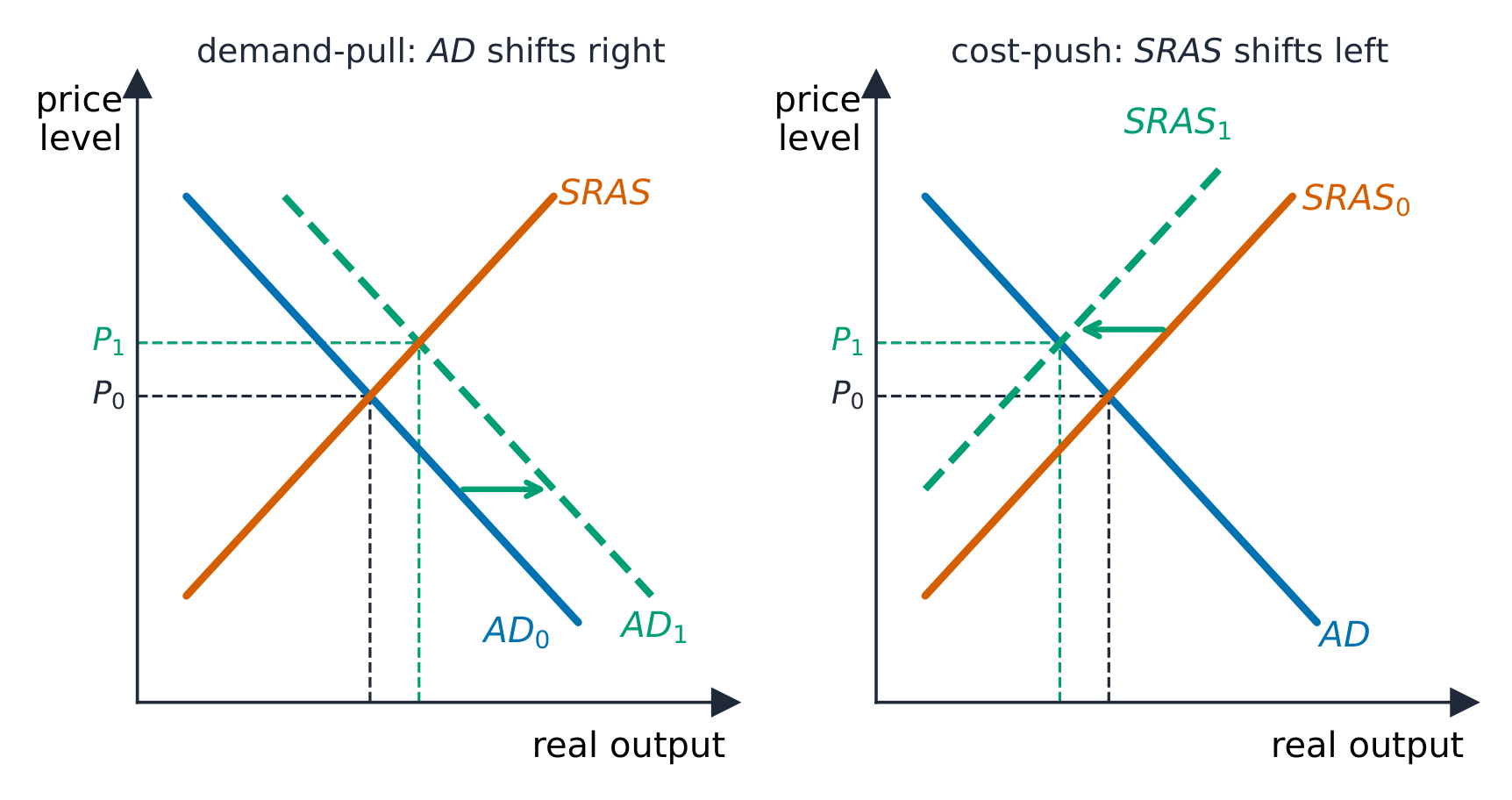
通货膨胀(inflation)是平均价格水平的一次持续上升。它用一个价格指数(price index)测量,最常是消费者价格指数(CPI)(consumer price index),从一个典型家庭购买的一个固定的市场篮子物品构建:
AD-AS 图上的需求拉动和成本推动通货膨胀 $$CPI=\frac{\text{cost of basket this year}}{\text{cost of basket in base year}}\times100.$$通货膨胀率(inflation rate)是指数在两年之间的百分比变化。通货紧缩(deflation)是一个下降的价格水平;反通货膨胀(disinflation)是通货膨胀的一次减慢。
Worked example. 若 CPI 今年是 $200$ 而去年是 $190$,通货膨胀率是 $\dfrac{200-190}{190}\times100\%=5.3\%$。那时值 $\$190$ 的一个篮子现在值 $\$200$ ——相同的物品、更多的美元。
词汇表 训练英文 中文 拼音 Inflation/ɪnˈfleɪʃn/ 通货膨胀 tōng huò péng zhàng price index/praɪs ˈɪndeks/ 价格指数 jià gé zhǐ shù consumer price index (CPI)/kənˈsuːmə praɪs ˈɪndeks/ 消费者价格指数 xiāo fèi zhě jià gé zhǐ shù Deflation/diːˈfleɪʃn/ 通货紧缩 tōng huò jǐn suō 2.5
通货膨胀的成本
大纲
Enduring Understanding Learning Objective Essential Knowledge MEA-1
An economy's performance can be measured by different indicators such as gross domestic product (GDP), the inflation rate, and the unemployment rate.MEA-1.H
Explain the costs that unexpected inflation (deflation) imposes on individuals and the economy.- MEA-1.H.1 Unexpected inflation arbitrarily redistributes wealth from one group of individuals to another group, such as lenders to borrowers.
来源:美国大学理事会 AP 课程与考试说明
通货膨胀再分配并扭曲:
- 当它意外时它伤害放贷者和储蓄者并帮助借款者,因为贷款以更便宜的美元偿还。它侵蚀货币和固定收入的价值。
- 菜单成本(menu costs)和不确定性阻碍投资。
- 预期的通货膨胀较不有害,因为合同和利率为它调整。这就是为什么我们把名义和实际值分开。
2.6
实际国内生产总值与名义国内生产总值
大纲
Enduring Understanding Learning Objective Essential Knowledge MEA-1
An economy's performance can be measured by different indicators such as gross domestic product (GDP), the inflation rate, and the unemployment rate.MEA-1.I
Define nominal GDP and real GDP.- MEA-1.I.1 Nominal GDP is a measure of how much is spent on output. Real GDP is a measure of how much is produced.
- MEA-1.I.2 Nominal GDP measures aggregate output using current prices. Real GDP measures aggregate output using constant prices, thus removing the effect of changes in the overall price level.
MEA-1.J
Calculate real GDP and the GDP deflator.- MEA-1.J.1 One way of measuring real GDP is to weigh final goods and services by their prices in a base year. Because this can lead to overstatement of real GDP growth, statistical agencies actually use different methods.
- MEA-1.J.2 Nominal GDP can be converted to real GDP by using the GDP deflator.
来源:美国大学理事会 AP 课程与考试说明
- 名义GDP(nominal GDP)以当前价格计价,所以它随产出和价格上升。
- 实际GDP(real GDP)以恒定(基年)价格计价,剥离通货膨胀,所以它反映真正的产出。实际 GDP 是增长的诚实衡量。
$$\text{Real GDP}=\frac{\text{Nominal GDP}}{\text{price index}}\times100,\qquad \text{GDP deflator}=\frac{\text{Nominal GDP}}{\text{Real GDP}}\times100.$$Worked example. 名义 GDP 是 $\$22$ 万亿而 GDP 平减指数是 $110$。实际 GDP 是 $\dfrac{22}{110}\times100=\$20$ 万亿。额外的 $\$2$ 万亿的名义 GDP 是纯的价格上升,不是实际产出——这就是为什么增长总是用实际 GDP 测量。
考试技能: 熟练地用一个价格指数把名义转换成实际,并作为一个百分比变化计算一个通货膨胀率或一个增长率。
词汇表 训练英文 中文 拼音 Nominal GDP/ˈnɒmɪnl ˌdʒiː diː ˈpiː/ 名义 míng yì Real GDP/rɪəl ˌdʒiː diː ˈpiː/ 实际 shí jì 2.7
经济周期
大纲
Enduring Understanding Learning Objective Essential Knowledge MEA-2
The economy fluctuates between periods of expansion and contraction in the short run, but economic growth can occur in the long run.MEA-2.A
a. Define (using graphs and data as appropriate) turning points and phases of the business cycle.
b. Explain (using graphs and data as appropriate) turning points and phases of the business cycle.- MEA-2.A.1 Business cycles are fluctuations in aggregate output and employment because of changes in aggregate supply and/or aggregate demand.
- MEA-2.A.2 The phases of a business cycle are recession and expansion.
- MEA-2.A.3 The turning points of a business cycle are peak and trough.
- MEA-2.A.4 The difference between actual output and potential output is the output gap.
- MEA-2.A.5 Potential output is also called full-employment output. It is the level of GDP where unemployment is equal to the natural rate of unemployment. [See EK MEA-1.E.2]
来源:美国大学理事会 AP 课程与考试说明
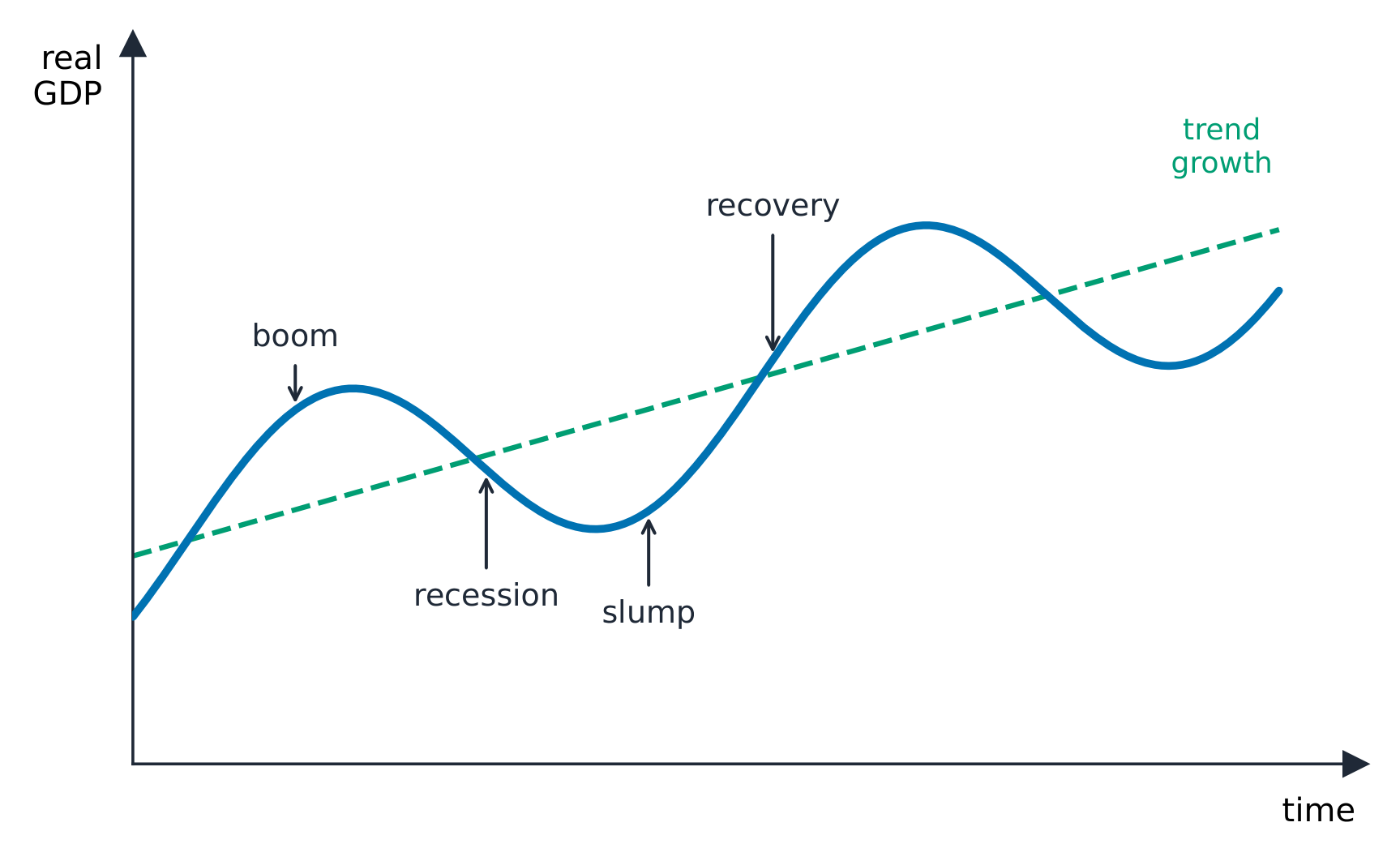
经济周期 经济周期(business cycle)是经济在它长期增长趋势周围实际 GDP 的短期起伏:扩张(expansion)(上升的产出、下降的失业)直到一个顶峰(peak),然后收缩/衰退(contraction/recession)(下降的产出、上升的周期性失业)向下到一个谷底(trough),然后复苏(recovery)。一次衰退常常是实际 GDP 下降的两个连续季度。失业和通货膨胀在周期上大致相反地移动——课程其余部分试图管理的那个张力。
实际 GDP 围绕它的长期趋势摆动 词汇表 训练英文 中文 拼音 business cycle/ˈbɪznəs ˈsaɪkl/ 经济周期 jīng jì zhōu qī expansion/ekˈspænʃn/ 扩张 kuò zhāng peak/piːk/ 顶峰 dǐng fēng contraction/recession/kənˈtrækʃn rɪˈseʃn/ 衰退 shuāi tuì trough/trɒf/ 谷底 gǔ dǐ 2.7
考试技巧
- 用支出法 $C+I+G+X_n$ 计算 GDP 并只数最终物品(避免重复计算)。
- 失业率 = 失业 ÷ 劳动力;灰心工人离开劳动力(所以这个率能低估失业)。
- 知道三种失业类型(摩擦性、结构性、周期性)以及自然率排除周期性。
- 通货膨胀是 CPI 的 % 变化;用一个价格指数把名义转换成实际并总是用实际 GDP 求增长。
- 把事件放在经济周期上(扩张 → 顶峰 → 收缩 → 谷底)。
-
3
国民收入与价格决定
3.1
总需求(AD)
大纲
Enduring Understanding Learning Objective Essential Knowledge MOD-2
Economists use the aggregate demand–aggregate supply model to represent the relationship between the price level and aggregate output in an economy and to illustrate how output, employment, and the price level respond to macroeconomic shocks.MOD-2.A
a. Define (using graphs as appropriate) the aggregate demand (AD) curve.
b. Explain (using graphs as appropriate) the slope of the AD curve and its determinants.- MOD-2.A.1 The aggregate demand (AD) curve describes the relationship between the price level and the quantity of goods and services demanded by households (consumption), firms (investment), government (government spending), and the rest of the world (net exports).
- MOD-2.A.2 The negative slope of the AD curve is explained by the real wealth effect, the interest rate effect, and the exchange rate effect. [See EK MKT-3.A.1]
- MOD-2.A.3 Any change in the components of aggregate demand (consumption, investment, government spending, or net exports) that is not due to changes in the price level leads to a shift of the AD curve.
来源:美国大学理事会 AP 课程与考试说明
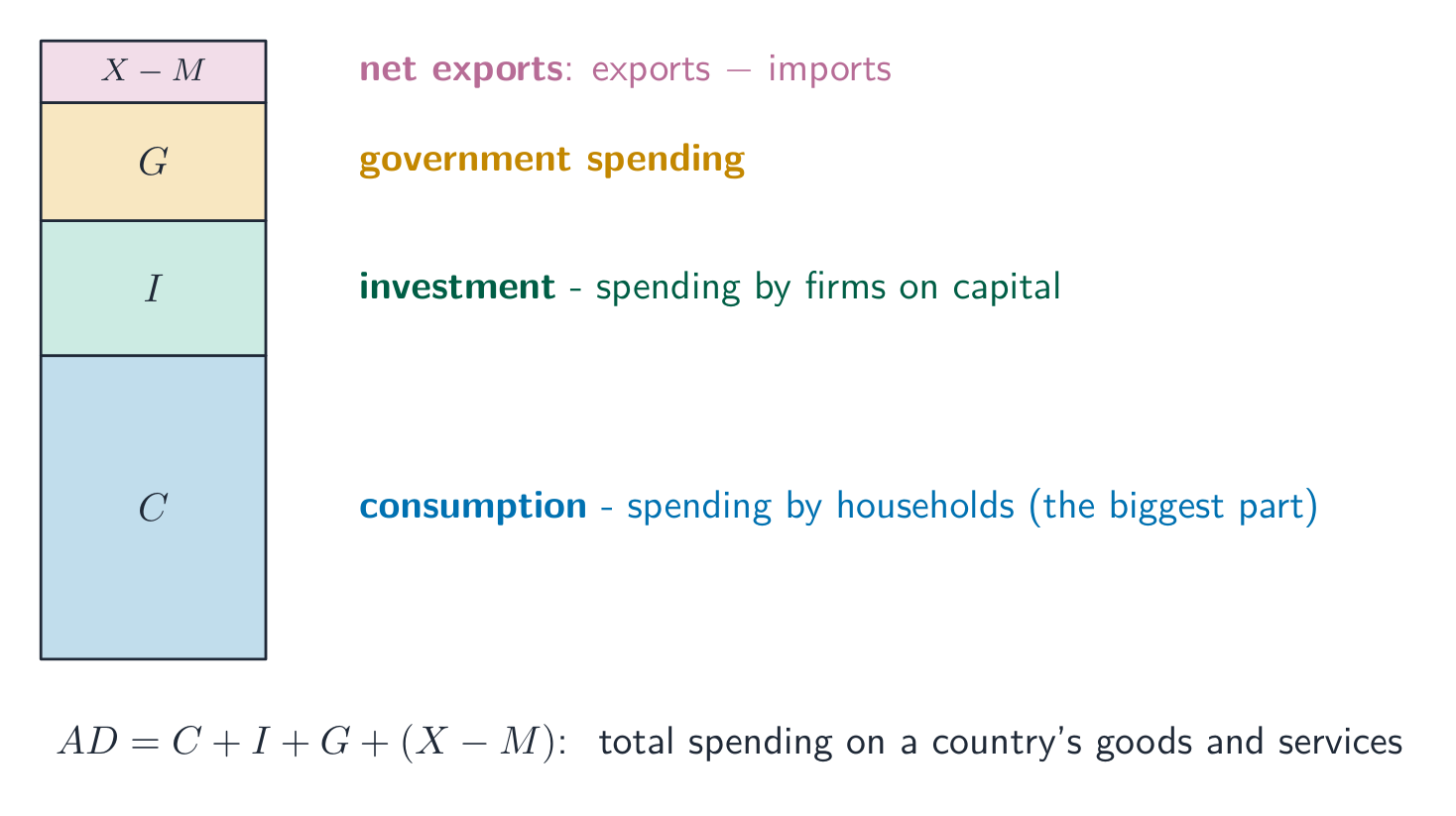
AD-AS 模型:需求冲击 总需求(AD)(aggregate demand)显示买者在每个价格水平(price level)想要的实际产出($C+I+G+X_n$)的总数量。它向下倾斜有三个整个经济特有的原因:
总需求是总花费:消费、投资、政府和净出口 - 财富效应(wealth effect)(一个更高的价格水平缩小货币的实际价值,所以人们买更少),
- 利率效应(interest-rate effect)(一个更高的价格水平提高货币需求和利率,削减投资),
- 净出口效应(net-export effect)(一个更高的国内价格水平使出口更贵而进口更便宜)。
价格水平的一个变化是沿 AD 的一个移动(movement along)。当 $C+I+G+X_n$ 的任何组成部分因另一个原因变化时——消费者信心、企业预期、政府支出、税收,或外国收入——AD 移动(shifts)。
词汇表 训练英文 中文 拼音 Aggregate demand (AD)/ˈæɡrɪɡeɪt dɪˈmænd/ 总需求 zǒng xū qiú price level/praɪs ˈlevl/ 价格水平 jià gé shuǐ píng wealth effect/welθ ɪˈfekt/ 财富效应 cái fù xiào yìng interest-rate effect/ˈɪntrest reɪt ɪˈfekt/ 利率效应 lì lǜ xiào yìng 3.2
乘数
大纲
Enduring Understanding Learning Objective Essential Knowledge MOD-2
Economists use the aggregate demand–aggregate supply model to represent the relationship between the price level and aggregate output in an economy and to illustrate how output, employment, and the price level respond to macroeconomic shocks.MOD-2.B
a. Define the expenditure multiplier, the tax multiplier, the marginal propensity to consume, and the marginal propensity to save.
b. Explain how changes in spending and taxes lead to changes in real GDP.
c. Calculate how changes in spending and taxes lead to changes in real GDP.- MOD-2.B.1 A $\$1$ change to autonomous expenditures leads to further changes in total expenditures and total output.
- MOD-2.B.2 The expenditure multiplier quantifies the size of the change in aggregate demand as a result of a change in any of the components of aggregate demand.
- MOD-2.B.3 The tax multiplier quantifies the size of the change in aggregate demand as a result of a change in taxes.
- MOD-2.B.4 The expenditure multiplier and tax multiplier depend on the marginal propensity to consume.
- MOD-2.B.5 The marginal propensity to consume is the change in consumer spending divided by the change in disposable income. The sum of the marginal propensity to consume and marginal propensity to save is equal to one.
来源:美国大学理事会 AP 课程与考试说明
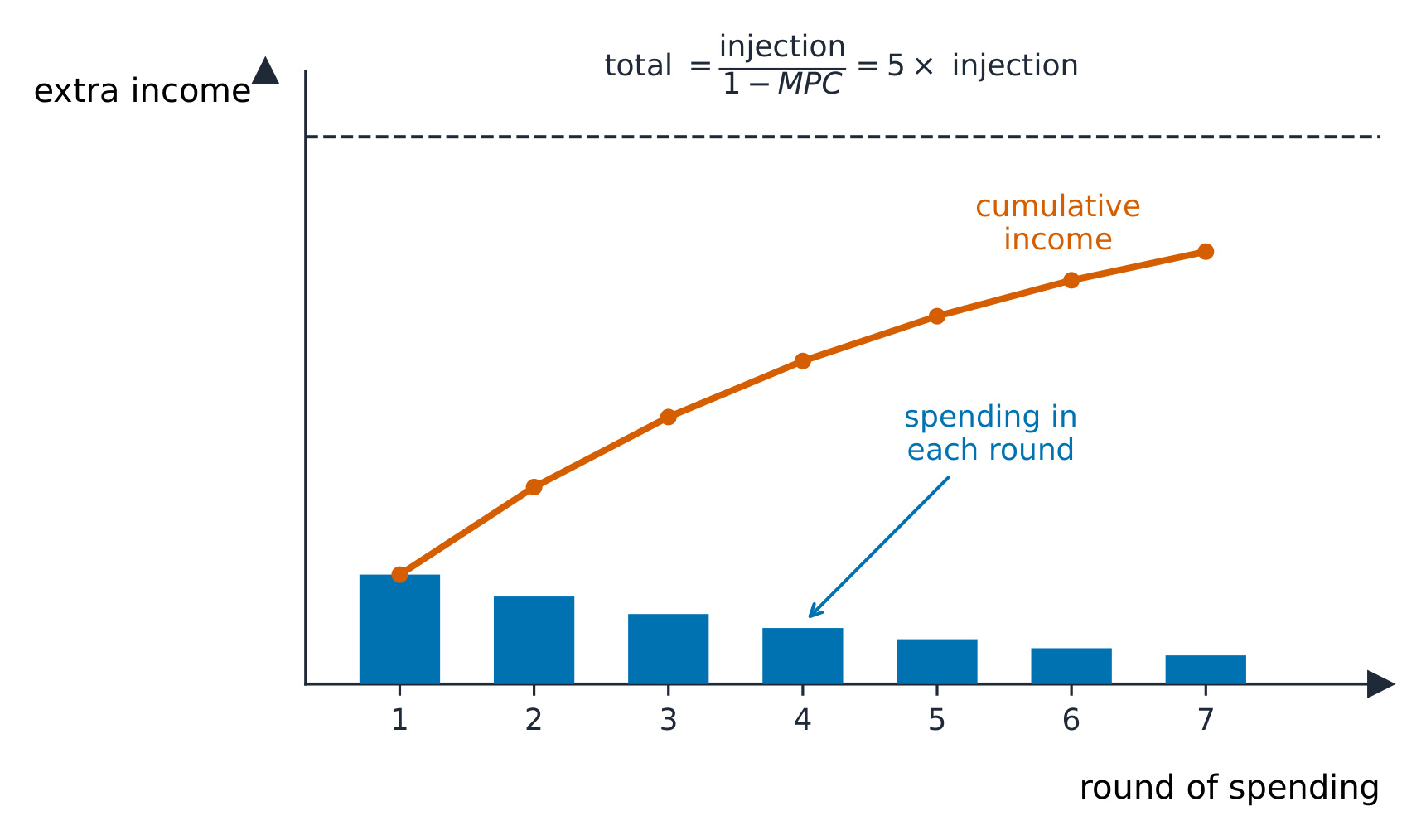
支出乘数 花费的一个变化引发进一步几轮的花费,所以 GDP 的最终变化比初始变化更大——乘数效应(multiplier effect)。它取决于边际消费倾向(marginal propensity to consume)(MPC),被花费的额外收入的分数(其余是边际储蓄倾向(marginal propensity to save),MPS,$MPC+MPS=1$):
一次注入放大成一个更大的整体收入上升 $$\text{spending multiplier}=\frac{1}{1-MPC}=\frac{1}{MPS}.$$一次减税也通过乘数起作用,但更弱,因为减税的一部分被储蓄:
$$\text{tax multiplier}=-\frac{MPC}{1-MPC}=-\frac{MPC}{MPS}.$$税收乘数在大小上更小且负(减税提高 GDP;加税降低它)。GDP 的总变化 $=$ (乘数) $\times$ (初始变化)。
Worked example. 若 $MPC=0.8$,花费乘数是 $\dfrac{1}{1-0.8}=5$,所以政府支出的一次 $\$10$ 十亿上升把实际 GDP 提升 $5\times\$10=\$50$ 十亿。税收乘数是 $-\dfrac{0.8}{0.2}=-4$,所以一次 $\$10$ 十亿的减税只提高 GDP $\$40$ 十亿——更弱,因为减税的一部分被储蓄。
考试技能: 从 MPC 计算两个乘数并求实际 GDP 的结果变化——一个几乎保证的计算。
探索See the spending multiplier ripple out
A dollar of new spending becomes someone's income, part of which they spend again — so the total effect is a multiple of the first injection, set by the marginal propensity to consume (MPC).
词汇表 训练英文 中文 拼音 multiplier effect/ˌmʌltɪˈplaɪə ɪˈfekt/ 乘数效应 chéng shù xiào yìng marginal propensity to consume/ˈmɑːdʒɪnl prəˈpensɪti tə kənˈsjuːm/ 边际消费倾向 biān jì xiāo fèi qīng xiàng marginal propensity to save/ˈmɑːdʒɪnl prəˈpensɪti tə seɪv/ 边际储蓄倾向 biān jì chǔ xù qīng xiàng 3.3
短期总供给(SRAS)
大纲
Enduring Understanding Learning Objective Essential Knowledge MOD-2
Economists use the aggregate demand–aggregate supply model to represent the relationship between the price level and aggregate output in an economy and to illustrate how output, employment, and the price level respond to macroeconomic shocks.MOD-2.C
a. Define (using graphs as appropriate) the short-run aggregate supply (SRAS) curve.
b. Explain (using graphs as appropriate) the slope of the SRAS curve and its determinants.- MOD-2.C.1 The short-run aggregate supply (SRAS) curve describes the relationship between the price level and the quantity of goods and services supplied in an economy.
- MOD-2.C.2 The SRAS curve is upward-sloping because of sticky wages and prices. [See EK MOD-2.E.1]
- MOD-2.C.3 Any factor that causes production costs to change, such as a change in inflationary expectations, will cause the SRAS curve to shift.
MOD-2.D
Explain (using graphs as appropriate) how movement along the SRAS curve implies a relationship between the price level (and inflation) and unemployment.- MOD-2.D.1 Moving along the SRAS curve, an increase in the price level is associated with an increase in output, which means employment must correspondingly rise. With the labor force held constant, unemployment will fall. So, there is a short-run trade-off between inflation and unemployment. [See EK MOD-3.A.1]
来源:美国大学理事会 AP 课程与考试说明
短期总供给(SRAS)(short-run aggregate supply)向上倾斜:在短期一些投入价格(尤其是名义工资(nominal wages))是粘性(sticky)的,所以一个更高的产出价格水平扩大利润率而企业生产更多。SRAS 随投入价格、生产率、对生产者的税/补贴,和供给冲击(例如一次油价变化)而移动。投入成本的一次上升使 SRAS 左移。
词汇表 训练英文 中文 拼音 Short-run aggregate supply (SRAS)/ʃɔːt rʌn ˈæɡrɪɡeɪt səˈplaɪ/ 短期总供给 duǎn qī zǒng gōng jǐ nominal wages/ˈnɒmɪnl ˈweɪdʒɪz/ 名义工资 míng yì gōng zī sticky/ˈstɪki/ 粘性 zhān xìng 3.4
长期总供给(LRAS)
大纲
Enduring Understanding Learning Objective Essential Knowledge MOD-2
Economists use the aggregate demand–aggregate supply model to represent the relationship between the price level and aggregate output in an economy and to illustrate how output, employment, and the price level respond to macroeconomic shocks.MOD-2.E
Define (using graphs as appropriate) the short run and the long run.- MOD-2.E.1 In the long run all prices and wages are fully flexible, while in the short run some input prices are fixed. A consequence of flexible long-run prices and wages is the lack of a long-run trade-off between inflation and unemployment.
MOD-2.F
Define (using graphs as appropriate) the long-run aggregate supply (LRAS) curve.- MOD-2.F.1 The LRAS curve corresponds to the production possibilities curve (PPC) because they both represent maximum sustainable capacity. Maximum sustainable capacity is the total output an economic system will produce over a set period of time if all resources are fully employed. [See LO MOD-2.I]
- MOD-2.F.2 The LRAS curve is vertical at the full-employment level of output because in the long run wages and prices fully adjust.
来源:美国大学理事会 AP 课程与考试说明
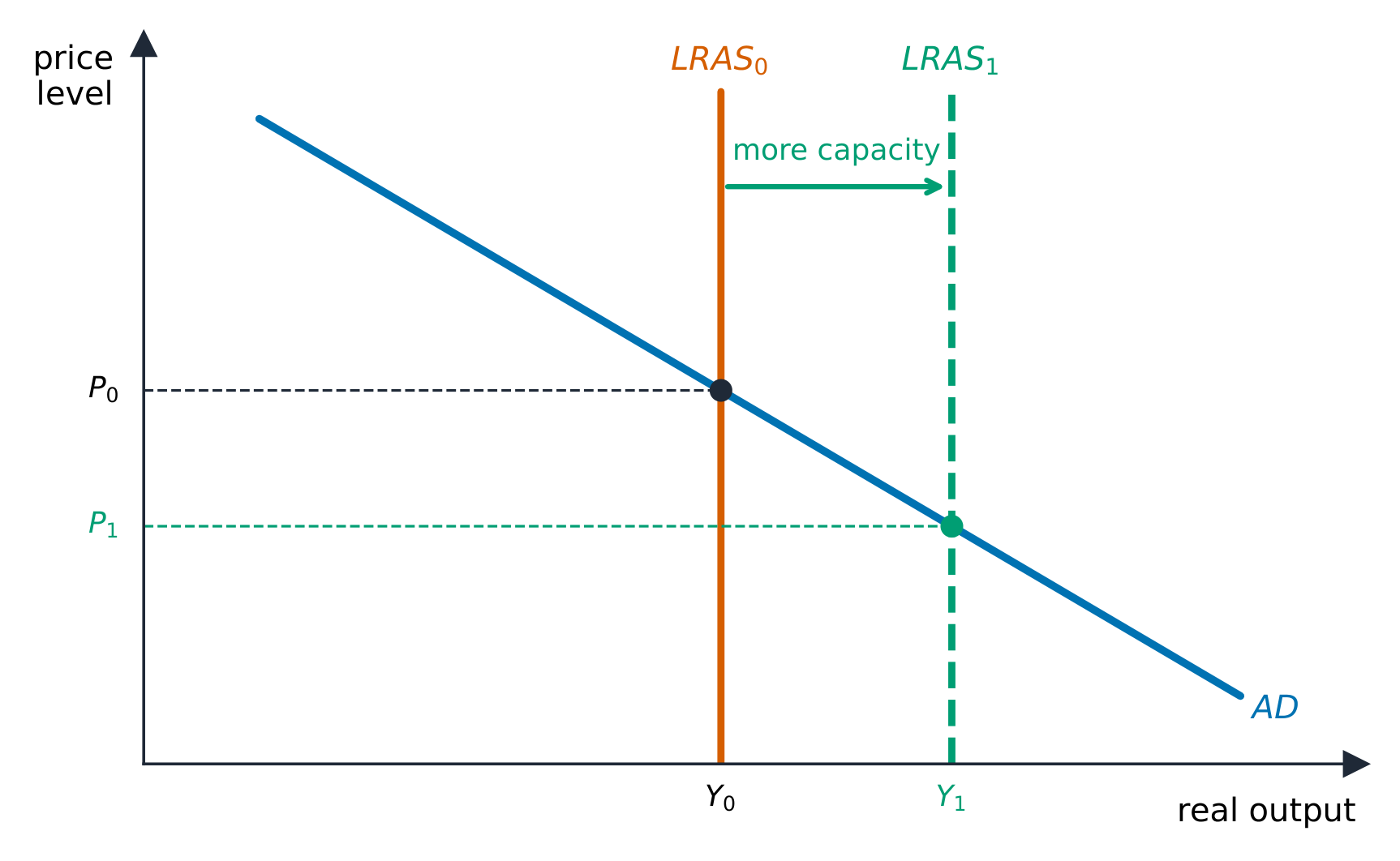
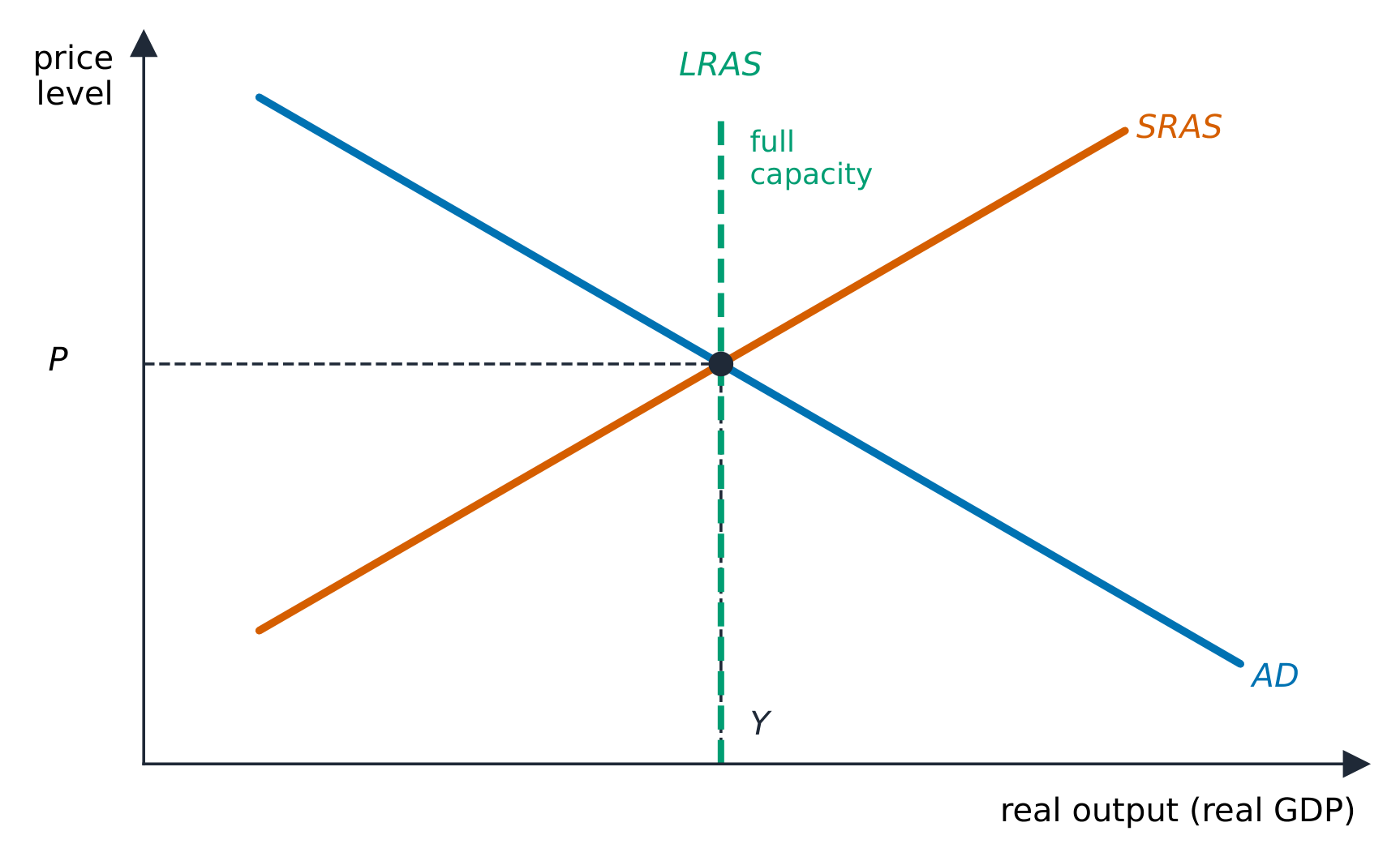
长期总供给(LRAS)(long-run aggregate supply)在经济的充分就业(潜在)产出(full-employment (potential) output)$Y_f$ 处是竖直的。在长期,所有价格和工资都是完全灵活的(只有在短期才有一些投入价格是固定的),所以产出只取决于实际因素——资源、技术、制度——不是价格水平。LRAS 只随经济增长(更多或更好的资源)而移动。LRAS 对应于生产可能性曲线(PPC)(production possibilities curve):两者都标示经济的最大可持续能力,所以 LRAS 向外移动和 PPC 向外移动是同一件事的两种画法。竖直的 LRAS 是为什么在长期需求政策改变价格,不是产出。
供给侧政策使长期总供给右移:更多产出、更低价格 词汇表 训练英文 中文 拼音 Long-run aggregate supply (LRAS)/lɒŋ rʌn ˈæɡrɪɡeɪt səˈplaɪ/ 长期总供给 cháng qī zǒng gōng jǐ full-employment (potential) output/fʊl emˈplɔɪmənt ˈaʊtpʊt/ 潜在产出 qián zài chǎn chū production possibilities curve (PPC)/prəˈdʌkʃn ˌpɒsəˈbɪlɪtiz kɜːv/ 生产可能性曲线 shēng chǎn kě néng xìng qū xiàn 3.5
总需求—总供给(AD–AS)模型中的均衡
大纲
Enduring Understanding Learning Objective Essential Knowledge MOD-2
Economists use the aggregate demand–aggregate supply model to represent the relationship between the price level and aggregate output in an economy and to illustrate how output, employment, and the price level respond to macroeconomic shocks.MOD-2.G
Explain (using graphs as appropriate) the short-run and long-run equilibrium price level and output level.- MOD-2.G.1 Short-run equilibrium occurs when the aggregate quantity of output demanded and the aggregate quantity of output supplied are equal—i.e., at the intersection of the AD and SRAS curves.
- MOD-2.G.2 Long-run equilibrium occurs when the AD and SRAS curves intersect on the LRAS—i.e., at the full-employment level of real output.
- MOD-2.G.3 The short-run equilibrium output can be at the full-employment level of output, above it, or below it, creating positive (i.e., inflationary) or negative (i.e., recessionary) output gaps.
来源:美国大学理事会 AP 课程与考试说明
经济稳定在 AD 遇到 SRAS 的地方,固定均衡价格水平和实际 GDP。把那个产出与 $Y_f$(LRAS 线)比较给出经济的状态:
总需求遇到总供给处的宏观经济均衡 - 产出 $
- 产出 $>Y_f$:一个通胀缺口(inflationary gap)(过热),
- 产出 $=Y_f$:长期均衡。
探索Find equilibrium in the AD-AS model
Aggregate demand and aggregate supply cross at the economy's price level and real GDP. A demand or supply shock shifts a curve and moves the whole economy's output and prices.
词汇表 训练英文 中文 拼音 recessionary gap/rɪˈseʃənəri ɡæp/ 衰退缺口 shuāi tuì quē kǒu inflationary gap/ɪnˈfleɪʃənəri ɡæp/ 通胀缺口 tōng zhàng quē kǒu 3.6
短期内 AD–AS 模型的变动
大纲
Enduring Understanding Learning Objective Essential Knowledge MOD-2
Economists use the aggregate demand–aggregate supply model to represent the relationship between the price level and aggregate output in an economy and to illustrate how output, employment, and the price level respond to macroeconomic shocks.MOD-2.H
Explain (using graphs as appropriate) the response of output, employment, and the price level to an aggregate demand or aggregate supply shock in the short run.- MOD-2.H.1 A positive (negative) shock in AD causes output, employment, and the price level to rise (fall) in the short run.
- MOD-2.H.2 A positive (negative) shock in SRAS causes output and employment to rise (fall) and the price level to fall (rise) in the short run.
- MOD-2.H.3 Inflation can be caused by changes in aggregate demand (demand-pull) or aggregate supply (cost-push).
来源:美国大学理事会 AP 课程与考试说明
- 一个需求冲击(demand shock)使 AD 移动:一个正的(更多花费)提高价格水平和产出两者(并降低失业);一个负的降低两者。
- 一个供给冲击(supply shock)使 SRAS 移动:一个负的(更高的投入成本)同时提高价格水平并降低产出——滞胀(stagflation)——对决策者最难的情况,因为修复一个使另一个恶化。
词汇表 训练英文 中文 拼音 stagflation/stæɡˈfleɪʃn/ 滞胀 zhì zhàng 3.7
长期自我调整
大纲
Enduring Understanding Learning Objective Essential Knowledge MOD-2
Economists use the aggregate demand–aggregate supply model to represent the relationship between the price level and aggregate output in an economy and to illustrate how output, employment, and the price level respond to macroeconomic shocks.MOD-2.I
Explain (using graphs as appropriate) the response of output, employment, and the price level to an aggregate demand or aggregate supply shock in the long run.- MOD-2.I.1 In the long run, in the absence of government policy actions, flexible wages and prices will adjust to restore full employment and unemployment will revert to its natural rate after a shock to aggregate demand or short-run aggregate supply. [See EK MEA-1.E.2]
- MOD-2.I.2 Shifts in the long-run aggregate supply curve indicate changes in the full-employment level of output and economic growth.
来源:美国大学理事会 AP 课程与考试说明
如果不管,经济通过灵活的工资自我纠正:
- 在一个衰退缺口里,高失业最终把名义工资推低,使 SRAS 右移,直到产出以一个更低的价格水平回到 $Y_f$。
- 在一个通胀缺口里,劳动短缺把工资推高,使 SRAS 左移回到 $Y_f$,以一个更高的价格水平。
关于这多快发生的辩论是支持(或反对)主动政策的理由:自我调整缓慢而痛苦,这是干预的论据。
3.8
财政政策
大纲
Enduring Understanding Learning Objective Essential Knowledge POL-1
Fiscal and monetary policy have short-run effects on macroeconomic outcomes.POL-1.A
a. Define fiscal policy and related terms.
b. Explain (using graphs as appropriate) the short-run effects of a fiscal policy action.
c. Calculate the short-run effects of a fiscal policy action.- POL-1.A.1 Governments implement fiscal policies to achieve macroeconomic goals, such as full employment.
- POL-1.A.2 The tools of fiscal policy are government spending and taxes/transfers.
- POL-1.A.3 Changes in government spending affect aggregate demand directly, and changes in taxes/transfers affect aggregate demand indirectly.
- POL-1.A.4 The government spending multiplier is greater than the tax multiplier.
- POL-1.A.5 Expansionary or contractionary fiscal policies are used to restore full employment when the economy is in a negative (i.e., recessionary) or positive (i.e., inflationary) output gap.
- POL-1.A.6 Fiscal policy can influence aggregate demand, real output, and the price level. [See also EK MKT-5.E.2 for the effect on exchange rates.]
- POL-1.A.7 The AD–AS model is used to demonstrate the short-run effects of fiscal policy.
POL-1.B
Define why there are lags to discretionary fiscal policy.- POL-1.B.1 In reality, there are lags to discretionary fiscal policy because of factors such as the time it takes to decide on and implement a policy action.
来源:美国大学理事会 AP 课程与考试说明
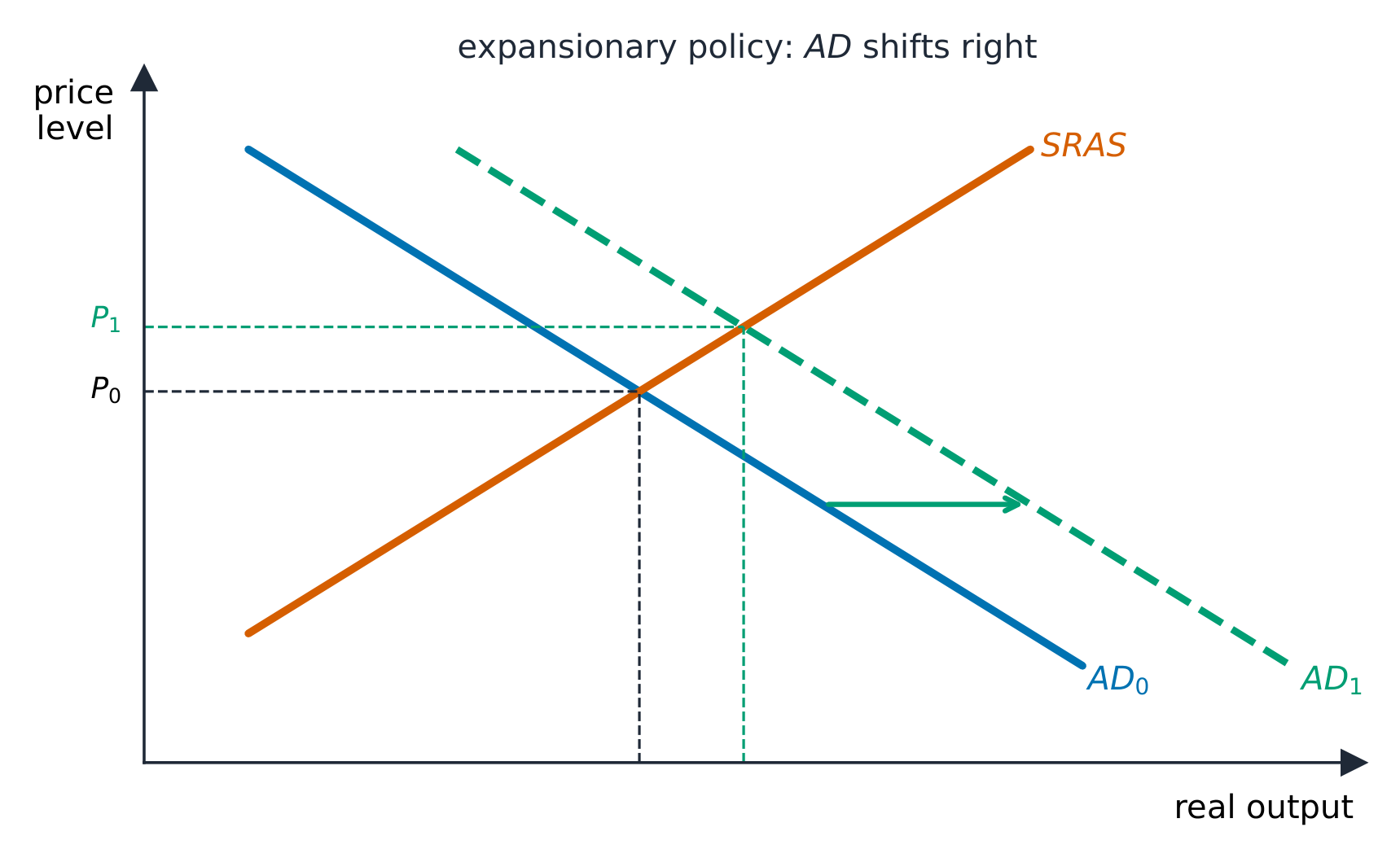
财政政策(fiscal policy)是政府对支出和税收的使用以移动 AD:
扩张性财政政策使 AD 右移,提高产出和价格 - 扩张性(expansionary)(更多支出或更低税)使 AD 右移以关闭一个衰退缺口。
- 紧缩性(contractionary)(更少支出或更高税)使 AD 左移以关闭一个通胀缺口。
用乘数确定政策规模:要关闭一个给定大小的缺口,所需的支出变化是(缺口)$\div$(花费乘数)。限制包括时间滞后、挤出(crowding out)(下面),和政治困难。
Worked example. 一个经济有一个 $\$100$ 十亿的衰退缺口和 $MPC=0.75$(花费乘数 $=\dfrac{1}{0.25}=4$)。要关闭它,政府必须提高支出 $\dfrac{\$100\text{ billion}}{4}=\$25$ 十亿。改用一次减税(税收乘数 $-3$)会需要一次更大的 $\dfrac{100}{3}\approx\$33$ 十亿的减税。
考试技能: 你必须画正确标注的 AD-AS 图、辨别缺口、开出正确的财政行动及其方向,并常常计算所需的确切支出或税收变化。
词汇表 训练英文 中文 拼音 Fiscal policy/ˈfɪskl ˈpɒlɪsi/ 财政政策 cái zhèng zhèng cè Expansionary/ekˈspænʃənəri/ 扩张性 kuò zhāng xìng Contractionary/kənˈtrækʃənəri/ 紧缩性 jǐn suō xìng 3.9
自动稳定器
大纲
Enduring Understanding Learning Objective Essential Knowledge POL-1
Fiscal and monetary policy have short-run effects on macroeconomic outcomes.POL-1.C
a. Define automatic stabilizers.
b. Explain how automatic stabilizers moderate business cycles.- POL-1.C.1 Automatic stabilizers support the economy during recessions and help prevent the economy from being overheated during expansionary periods.
- POL-1.C.2 Tax revenues decrease automatically as GDP falls, preventing consumption and the economy from falling further.
- POL-1.C.3 Tax revenues increase automatically as GDP rises, slowing consumption and preventing the economy from overheating.
- POL-1.C.4 Government policies, institutions, or agencies may also have social service programs whose transfer payments act as automatic stabilizers.
来源:美国大学理事会 AP 课程与考试说明
自动稳定器(automatic stabilizers)是不需要新立法就抑制周期的特征。在一次下行里,累进税收得更少而转移支付(失业救济、福利)自动上升——缓冲收入和花费;在一次繁荣里它们做相反的。它们软化周期并即刻起作用,避免相机抉择(discretionary)政策的滞后。
词汇表 训练英文 中文 拼音 Automatic stabilizers/ˌɔːtəˈmætɪk ˈsteɪbəlaɪzəz/ 自动稳定器 zì dòng wěn dìng qì discretionary/dɪˈskreʃənəri/ 相机抉择 xiàng jī jué zé 3.9
考试技巧
- 总需求因财富、利率和净出口效应向下倾斜;当 $C$、$I$、$G$ 或 $X_n$ 变化时它移动。
- 计算花费乘数 $\tfrac{1}{1-MPC}$ 和更小的、负的税收乘数 $-\tfrac{MPC}{1-MPC}$。
- 画一个正确标注的 AD–AS 图、辨别一个衰退或通胀缺口,并开出正确的财政行动。
- 短期 AS 向上倾斜(粘性工资);长期 AS 在充分就业产出处是竖直的。
- 用乘数确定政策规模:所需支出 = 缺口 ÷ 花费乘数。
-
4
金融部门
4.1
金融资产
大纲
Enduring Understanding Learning Objective Essential Knowledge MEA-3
Money makes it possible to compare the value of goods and services, and interest rates provide a measure of the price of money that is borrowed or saved.MEA-3.A
a. Define the principal attributes—liquidity, rate of return, and risk—associated with various classes of financial assets, including money.
b. Explain the relationship between the price of previously issued bonds and interest rates.- MEA-3.A.1 The most liquid forms of money are cash and demand deposits.
- MEA-3.A.2 Other financial assets people can hold in place of the most liquid forms of money include bonds (interest-bearing assets) and stocks (equity).
- MEA-3.A.3 The price of previously issued bonds and interest rates on bonds are inversely related.
- MEA-3.A.4 The opportunity cost of holding money is the interest that could have been earned from holding other financial assets such as bonds.
来源:美国大学理事会 AP 课程与考试说明
一个金融资产(financial asset)是一个储存价值的债权:货币(money)、股票(stocks)(所有权份额)、债券(bonds)(付利息的贷款),和银行存款。资产在流动性(liquidity)(多容易转换成现金)、风险和回报之间权衡。一个关键的反向关系:债券价格和利率朝相反方向移动——当市场利率上升时,付旧的、较低利率的现有债券价值更低,所以它们的价格下降。
词汇表 训练英文 中文 拼音 financial asset/faɪˈnænʃl ˈæset/ 金融资产 jīn róng zī chǎn stocks/stɒks/ 股票 gǔ piào bonds/bɒndz/ 债券 zhài quàn liquidity/lɪˈkwɪdɪti/ 流动性 liú dòng xìng Money/ˈmʌni/ 货币 huò bì 4.2
名义利率与实际利率
大纲
Enduring Understanding Learning Objective Essential Knowledge MEA-3
Money makes it possible to compare the value of goods and services, and interest rates provide a measure of the price of money that is borrowed or saved.MEA-3.B
a. Define the nominal and real interest rate.
b. Explain the relationship between changes in nominal interest rates, expected inflation, and real interest rates.
c. Calculate the nominal and real interest rate.- MEA-3.B.1 A nominal interest rate is the rate of interest paid for a loan, unadjusted for inflation.
- MEA-3.B.2 Lenders and borrowers establish nominal interest rates as the sum of their expected real interest rate and expected inflation.
- MEA-3.B.3 A real interest rate can be calculated in hindsight by subtracting the actual inflation rate from the nominal interest rate.
来源:美国大学理事会 AP 课程与考试说明
- 名义利率(nominal interest rate)是陈述的利率,未对通货膨胀调整。
- 实际利率(real interest rate)是你实际以购买力赚取的:
$$\text{real rate}\approx\text{nominal rate}-\text{inflation rate}\quad(\text{Fisher equation}).$$放贷者和借款者关心实际利率。若通货膨胀结果比预期更高,实际利率下降——帮助借款者而伤害放贷者。
Worked example. 一笔贷款有 $6\%$ 的名义利率而通货膨胀以 $2\%$ 运行。实际利率是 $6\%-2\%=4\%$,所以放贷者的购买力增长 $4\%$。若通货膨胀相反跳到 $7\%$,实际利率会是 $-1\%$ ——放贷者实际会损失购买力。
词汇表 训练英文 中文 拼音 nominal interest rate/ˈnɒmɪnl ˈɪntrest reɪt/ 名义利率 míng yì lì lǜ real interest rate/rɪəl ˈɪntrest reɪt/ 实际利率 shí jì lì lǜ 4.3
货币的定义、衡量与职能
大纲
Enduring Understanding Learning Objective Essential Knowledge MEA-3
Money makes it possible to compare the value of goods and services, and interest rates provide a measure of the price of money that is borrowed or saved.MEA-3.C
a. Define money and its functions.
b. Calculate (using data as appropriate) measures of money.- MEA-3.C.1 Money is any asset that is accepted as a means of payment.
- MEA-3.C.2 Money serves as a medium of exchange, unit of account, and store of value.
- MEA-3.C.3 The money supply is measured using monetary aggregates designated as M1 and M2.
- MEA-3.C.4 The monetary base (often labeled as M0 or MB) includes currency in circulation and bank reserves.
来源:美国大学理事会 AP 课程与考试说明
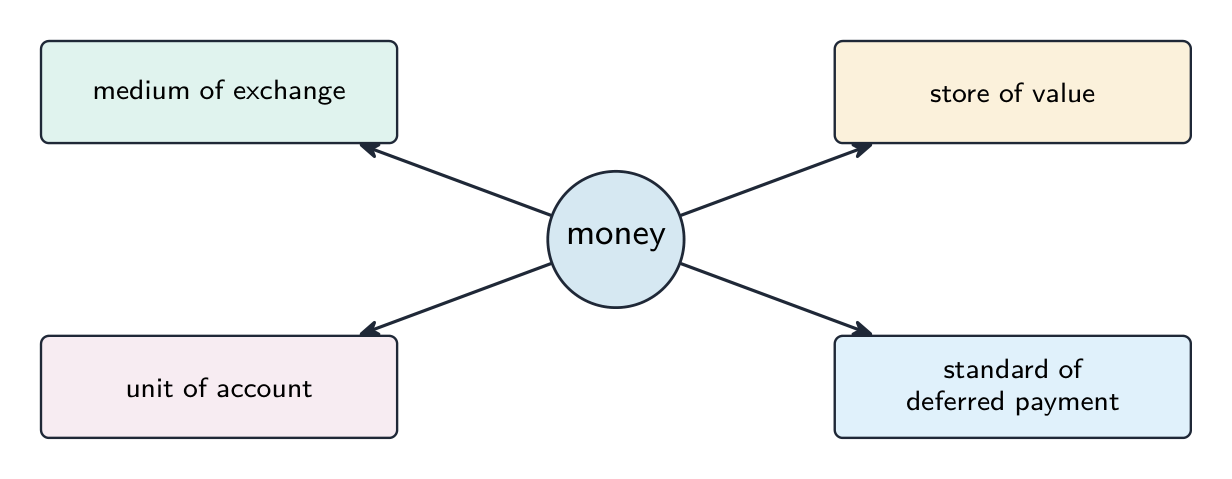
货币(money)是任何在交换中被广泛接受的东西。它的三个功能:一种交换媒介(medium of exchange)(避免物物交换)、一种记账单位(unit of account)(一个价值的共同衡量),和一种价值储藏(store of value)(随时间保持价值)。现代货币是法定货币(fiat money)——有价值是因为政府宣布它为法定货币而人们信任它,不是因为它由黄金支持。
货币的功能——AP 考试考查前三个(交换媒介、记账单位、价值贮藏);延期支付标准超出 CED 范围 货币按流动性分层测量:M1(通货加可开支票的存款——最流动的)和更广的 M2(M1 加储蓄存款和其他准货币)。M1 之下是基础货币(monetary base)(M0 或 MB)——流通中的通货加银行准备金。货币乘数等于货币供给 ÷ 基础货币,所以中央银行提高准备金的行动通过乘数把货币供给扩大更多。
词汇表 训练英文 中文 拼音 medium of exchange/ˈmiːdɪəm ɒv eksˈtʃeɪndʒ/ 交换媒介 jiāo huàn méi jiè unit of account/ˈjuːnɪt ɒv əˈkaʊnt/ 记账单位 jì zhàng dān wèi store of value/stɔː ɒv ˈvæljuː/ 价值储藏 jià zhí chǔ cáng fiat money/ˈfiːət ˈmʌni/ 法定货币 fǎ dìng huò bì monetary base/ˈmʌnɪtəri beɪs/ 基础货币 jī chǔ huò bì 4.4
银行体系与货币供给的扩张
大纲
Enduring Understanding Learning Objective Essential Knowledge POL-2
The banking system plays an important role in the expansion of the money supply.POL-2.A
a. Define key terms related to the banking system and the expansion of the money supply.
b. Explain how the banking system creates and expands the money supply.
c. Calculate (using data and balance sheets as appropriate) the effects of changes in the banking system.- POL-2.A.1 Depository institutions (such as commercial banks) organize their assets and liabilities on balance sheets.
- POL-2.A.2 Depository institutions operate using fractional reserve banking.
- POL-2.A.3 Banks' reserves are divided into required reserves and excess reserves.
- POL-2.A.4 Excess reserves are the basis of expansion of the money supply by the banking system.
- POL-2.A.5 The money multiplier is the ratio of the money supply to the monetary base.
- POL-2.A.6 The size of expansion of the money supply depends on the money multiplier.
- POL-2.A.7 The maximum value of the money multiplier can be calculated as the reciprocal of the required reserve ratio.
- POL-2.A.8 The amount predicted by the simple money multiplier may be overstated because it does not take into account a bank's desire to hold excess reserves or the public holding more currency.
来源:美国大学理事会 AP 课程与考试说明
银行在一个部分准备金(fractional reserve)系统上运作:它们保留存款的一个分数作为准备金(reserves)并借出其余。它们必须保留的分数是法定准备金率(required reserve ratio)(rr)。放贷创造新存款,它们被重新存入和重新借出,以货币乘数扩张货币供给:
$$\text{money multiplier}=\frac{1}{rr}.$$一笔新的 $1000 存款,$rr=0.1$,留下$$900$的超额准备金,所以银行系统能使货币供给扩张多达$900\times\frac{1}{0.1}=9,000$。用一个银行的 T 型账户(资产 = 准备金 + 贷款;负债 = 存款)来追踪法定准备金和超额准备金(excess reserves)(可借出的数额)。
Worked example. 一个银行收到一笔 $\$1000$ 存款,$rr=0.20$。它必须持有 $0.20\times1000=\$200$ 作为法定准备金,留下 $\$800$ 的超额准备金去借出。以一个 $\dfrac{1}{0.20}=5$ 的货币乘数,那 $\$800$ 的新放贷能使货币供给在整个银行系统扩张多达 $800\times5=\$4000$。
考试技能: 给定一个法定准备金率和一笔存款,计算超额准备金、货币乘数,和货币供给的最大变化。
探索See banks multiply deposits
Banks keep a fraction of deposits as reserves and lend the rest, which is redeposited and lent again — the money multiplier expands the money supply from the initial deposit.
词汇表 训练英文 中文 拼音 fractional reserve/ˈfrækʃənl rɪˈzɜːv/ 部分准备金 bù fèn zhǔn bèi jīn reserves/rɪˈzɜːvz/ 准备金 zhǔn bèi jīn required reserve ratio/rɪˈkwaɪəd rɪˈzɜːv ˈreɪʃɪəʊ/ 法定准备金率 fǎ dìng zhǔn bèi jīn lǜ excess reserves/ekˈses rɪˈzɜːvz/ 超额准备金 chāo é zhǔn bèi jīn 4.5
货币市场
大纲
Enduring Understanding Learning Objective Essential Knowledge MKT-3
In the money market, demand for and supply of money determine the equilibrium nominal interest rate and influence the value of other financial assets.MKT-3.A
a. Define (using graphs as appropriate) the money market, money demand, and money supply.
b. Explain (using graphs as appropriate) the relationship between the nominal interest rate and the quantity of money demanded (supplied).- MKT-3.A.1 The demand for money shows the inverse relationship between the nominal interest rate and the quantity of money people want to hold.
- MKT-3.A.2 Given a monetary base determined by a country's central bank, money supply is independent of the nominal interest rate.
MKT-3.B
Define (using graphs as appropriate) equilibrium in the money market.- MKT-3.B.1 In the money market, equilibrium is achieved when the nominal interest rate is such that the quantities demanded and supplied of money are equal.
MKT-3.C
Explain (using graphs as appropriate) how nominal interest rates adjust to restore equilibrium in the money market.- MKT-3.C.1 Disequilibrium nominal interest rates create surpluses and shortages in the money market. Market forces drive nominal interest rates toward equilibrium.
MKT-3.D
a. Explain (using graphs as appropriate) the determinants of demand and supply in the money market.
b. Explain (using graphs as appropriate) how changes in demand and supply in the money market affect the equilibrium nominal interest rate.- MKT-3.D.1 Factors that shift the demand for money, such as changes in the price level, and supply of money, such as monetary policy, change the equilibrium nominal interest rate.
来源:美国大学理事会 AP 课程与考试说明
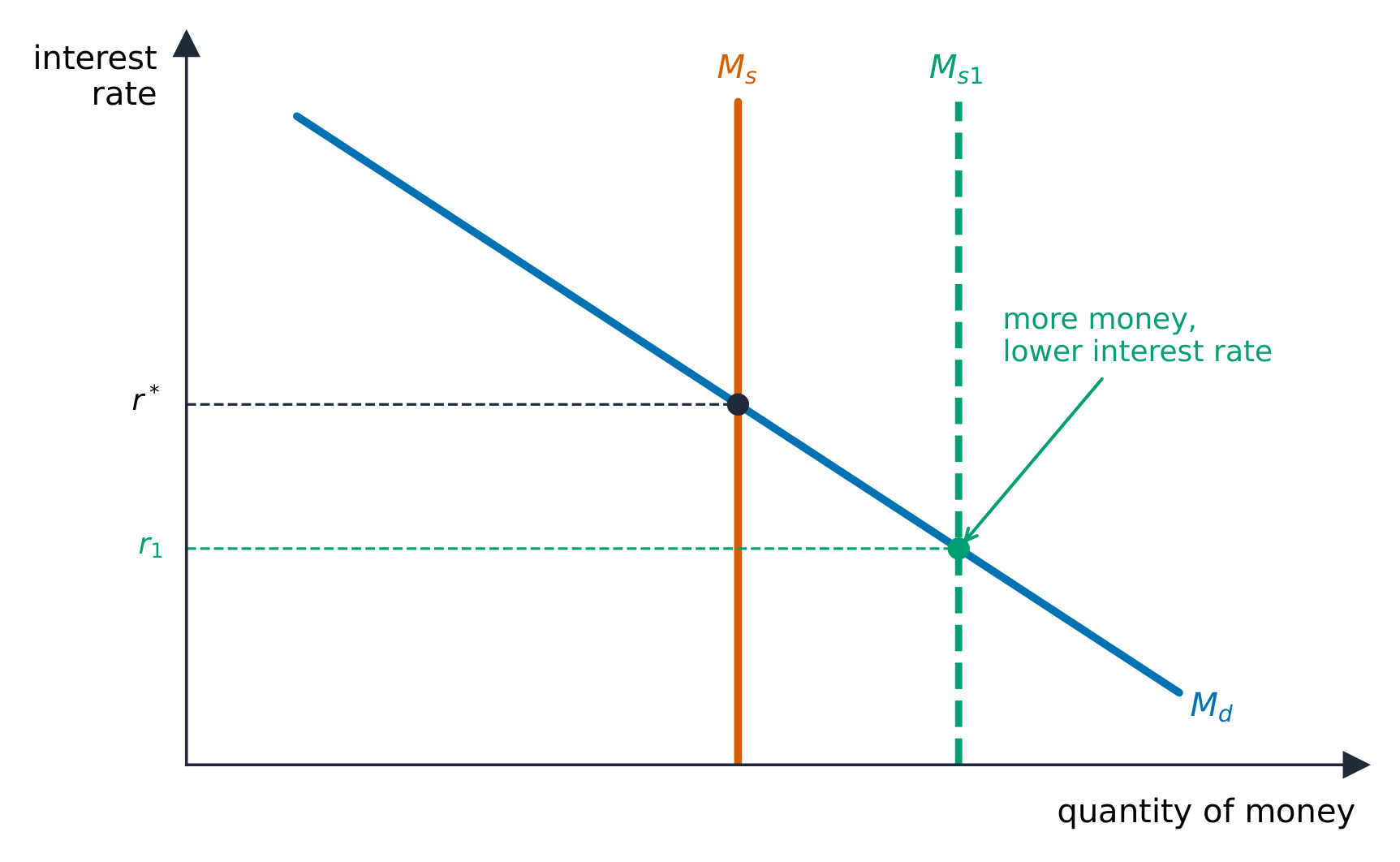
货币市场决定利率 货币市场(money market)决定名义利率:
利率由对货币的需求和供给设定 - 货币需求(money demand)相对于利率向下倾斜——利率是持有货币而不是有息资产的机会成本。它随一个更高的价格水平或更多实际 GDP 而右移。
- 货币供给(money supply)是竖直的——由中央银行设定,与利率无关。
它们的交点设定均衡利率。若中央银行增加货币供给,供给线右移而利率下降。
探索Equilibrium in the money market
The money market sets the interest rate where money demand meets the central bank's money supply. A change in the money supply moves the interest rate.
词汇表 训练英文 中文 拼音 money market/ˈmʌni ˈmɑːkɪt/ 货币市场 huò bì shì chǎng Money demand/ˈmʌni dɪˈmænd/ 货币需求 huò bì xū qiú Money supply/ˈmʌni səˈplaɪ/ 货币供给 huò bì gōng jǐ 4.6
货币政策
大纲
Enduring Understanding Learning Objective Essential Knowledge POL-1
Fiscal and monetary policy have short-run effects on macroeconomic outcomes.POL-1.D
a. Define monetary policy and related terms.
b. Explain (using graphs as appropriate) the short-run effects of a monetary policy action.
c. Calculate (using data and balance sheets as appropriate) the effects of a monetary policy action.- POL-1.D.1 Central banks implement monetary policies to achieve macroeconomic goals, such as price stability.
- POL-1.D.2 The tools of monetary policy may include the central bank's discount rate and other administered interest rates (e.g., interest on reserves), open market operations, and the required reserve ratio. The tools used and the way in which they are implemented differ between economies that have limited reserves in their banking system and economies that have ample reserves in their banking system. (The banking system in the United States has ample reserves, and the Federal Reserve's key policy tool is interest on reserves.)
- POL-1.D.3 When the central bank conducts an open-market purchase (sale), reserves increase (decrease), thereby increasing (decreasing) the monetary base.
- POL-1.D.4 When the central bank conducts an open-market purchase (sale) in an economy with limited reserves, the effect on the money supply is greater than the effect on the monetary base because of the money multiplier.
- POL-1.D.5 Many central banks carry out policy to hit a target range for an overnight interbank lending rate, sometimes referred to as the central bank's policy rate. (In the United States, this is the federal funds rate.)
- POL-1.D.6 Central banks can influence the nominal interest rate in the short run, which in turn will affect investment and consumption. [See also EK MKT-5.G.2 for the influence on net capital inflows.] In an economy with limited reserves, the central bank can influence the nominal interest rate by changing the money supply. In an economy with ample reserves, changes in the money supply do not effectively change the nominal interest rate; instead, the central bank can influence the nominal interest rate by changing its administered interest rates.
- POL-1.D.7 Expansionary or contractionary monetary policies are used to restore full employment when the economy is in a negative (i.e., recessionary) or positive (i.e., inflationary) output gap.
- POL-1.D.8 Monetary policy can influence interest rates, aggregate demand, real output, and the price level. [See also EK MKT-5.E.3 for the effect on exchange rates.]
- POL-1.D.9 A money market model, a reserve market model, and/or the AD–AS model may be used to demonstrate the short-run effects of monetary policy.
POL-1.E
Define why there are lags to monetary policy.- POL-1.E.1 In reality, there are lags to monetary policy caused by the time it takes to recognize a problem in the economy and the time it takes the economy to adjust to the policy action.
来源:美国大学理事会 AP 课程与考试说明
货币政策(monetary policy)是中央银行(联邦储备)对货币供给的使用以引导经济,通过利率起作用:
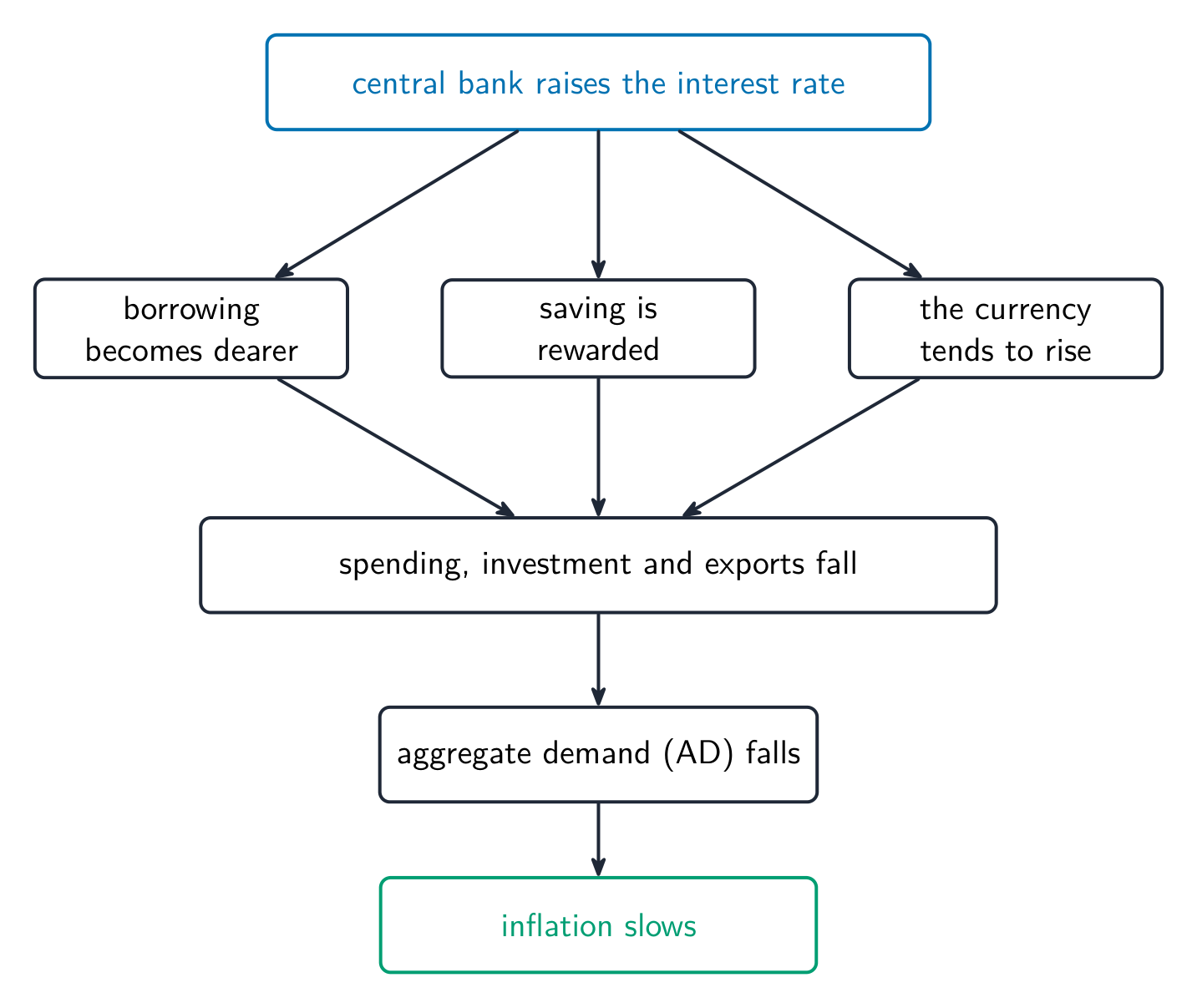
一个更高的利率如何通过经济起作用以减缓通货膨胀 - 扩张性(宽松)(expansionary (easy)):增加货币供给 $\to$ 利率下降 $\to$ 投资和消费上升 $\to$ AD 右移(对抗衰退)。
- 紧缩性(紧)(contractionary (tight)):减少货币供给 $\to$ 利率上升 $\to$ AD 左移(对抗通货膨胀)。
工具:公开市场操作(open-market operations)(买债券注入货币,卖债券撤回它——主要的工具)、改变准备金要求,和改变贴现率(discount rate)(银行向中央银行借款所付的利率)。在考试上跟随完整的链条:货币供给 $\to$ 利率 $\to$ 投资 $\to$ AD $\to$ 产出、价格水平、失业。
现代中央银行运行一个充足准备金(ample-reserves)系统。美联储不是推动货币供给,而是设定管理利率——主要是它付给银行的准备金利息(interest on reserves, IOR)——这引导政策利率(policy rate)(联邦基金利率,银行之间隔夜相互收取的利率)。在准备金市场里,准备金需求向下倾斜,而中央银行以它选择的利率供给准备金;提高 IOR 抬升整个政策利率以对抗通胀,降低它则放松以对抗衰退。(在较旧的有限准备金(limited-reserves)系统里,美联储改为通过公开市场操作移动准备金供给。)

A central bank building: monetary policy sets interest rates and the money supply 词汇表 训练英文 中文 拼音 Monetary policy/ˈmʌnɪtəri ˈpɒlɪsi/ 货币政策 huò bì zhèng cè Expansionary (easy)/ekˈspænʃənəri/ 扩张性 kuò zhāng xìng Contractionary (tight)/kənˈtrækʃənəri/ 紧缩性 jǐn suō xìng open-market operations/ˈəʊpən ˈmɑːkɪt ˌɒpəˈreɪʃnz/ 公开市场操作 gōng kāi shì chǎng cāo zuò discount rate/ˈdɪskaʊnt reɪt/ 贴现率 tiē xiàn lǜ interest on reserves (IOR)/ˈɪntrest ɒn rɪˈzɜːvz/ 准备金利息 zhǔn bèi jīn lì xī policy rate/ˈpɒlɪsi reɪt/ 政策利率 zhèng cè lì lǜ 4.7
可贷资金市场
大纲
Enduring Understanding Learning Objective Essential Knowledge MKT-4
The interaction of borrowers, who demand loanable funds, and savers, who supply loanable funds, determines the equilibrium real interest rate.MKT-4.A
a. Define (using graphs as appropriate) the loanable funds market, demand for loanable funds, and supply of loanable funds.
b. Explain (using graphs as appropriate) the relationship between the real interest rate and the quantity of loanable funds demanded (supplied).- MKT-4.A.1 The loanable funds market describes the behavior of savers and borrowers.
- MKT-4.A.2 The demand for loanable funds shows the inverse relationship between real interest rates and the quantity demanded of loanable funds.
- MKT-4.A.3 The supply of loanable funds shows the positive relationship between real interest rates and the quantity supplied of loanable funds.
MKT-4.B
Define national savings in both a closed and an open economy.- MKT-4.B.1 In the absence of international borrowing and lending, national savings is the sum of public savings and private savings.
- MKT-4.B.2 For an open economy, investment equals national savings plus net capital inflow.
MKT-4.C
Define (using graphs as appropriate) equilibrium in the loanable funds market.- MKT-4.C.1 In the loanable funds market, equilibrium is achieved when the real interest rate is such that the quantities demanded and supplied of loanable funds are equal.
MKT-4.D
Explain (using graphs as appropriate) how real interest rates adjust to restore equilibrium in the loanable funds market.- MKT-4.D.1 Disequilibrium real interest rates create surpluses and shortages in the loanable funds market. Market forces drive real interest rates toward equilibrium.
MKT-4.E
a. Explain (using graphs as appropriate) the determinants of demand and supply in the loanable funds market.
b. Explain (using graphs as appropriate) how changes in demand and supply in the loanable funds market affect the equilibrium real interest rate and equilibrium quantity of loanable funds.- MKT-4.E.1 The loanable funds market can be used to show the effects of government spending, taxes, and borrowing on interest rates.
- MKT-4.E.2 Factors that shift the demand (such as an investment tax credit) and supply (such as changes in saving behavior) of loanable funds change the equilibrium interest rate and the equilibrium quantity of funds.
来源:美国大学理事会 AP 课程与考试说明
可贷资金市场 可贷资金市场(loanable funds market)决定实际利率并把储蓄连接到投资:
- 可贷资金的供给来自储蓄并向上倾斜。
- 可贷资金的需求来自借款者(投资的企业、借款的政府)并向下倾斜。
那份储蓄是经济的国民储蓄(national savings)= 私人储蓄(家庭和企业)+ 公共储蓄(政府的预算余额——盈余增加储蓄,赤字减少它)。对一个开放经济,投资 = 国民储蓄 + 来自国外的净资本流入。所以更大的预算赤字是负的公共储蓄,它缩小可贷资金的供给并挤出投资。
更多储蓄使供给右移并降低实际利率;更多政府借款使需求右移并提高实际利率——挤出背后的机制。区分这两个图:货币市场设定名义利率(竖直的货币供给),而可贷资金设定实际利率(向上倾斜的储蓄供给)。
考试技能: 知道画哪个图——货币市场用于货币政策,可贷资金用于储蓄、赤字和挤出——并追踪一个的移动如何馈入 AD-AS。
词汇表 训练英文 中文 拼音 loanable funds market/ˈləʊnəbl fʌndz ˈmɑːkɪt/ 可贷资金市场 kě dài zī jīn shì chǎng national savings/ˈnæʃənl ˈseɪvɪŋz/ 国民储蓄 guó mín chǔ xù 4.7
考试技巧
- 知道货币的三个功能和 M1/M2 衡量。
- 货币市场设定名义利率(竖直的货币供给);更多货币供给降低利率。
- 计算货币乘数 $\tfrac{1}{rr}$ 和一笔新存款造成的货币供给的最大变化。
- 追踪货币政策:货币供给 → 利率 → 投资 → AD → 产出。
- 把货币市场(名义利率)与可贷资金市场(实际利率)区分开;用实际利率 $=$ 名义 $-$ 通货膨胀。
-
5
稳定政策的长期影响
5.1
短期内的财政与货币政策行动
大纲
Enduring Understanding Learning Objective Essential Knowledge POL-1
Fiscal and monetary policy have short-run effects on macroeconomic outcomes.POL-1.F
Explain (using graphs as appropriate) the effects of combined fiscal and monetary policy actions.- POL-1.F.1 A combination of expansionary or contractionary fiscal and monetary policies may be used to restore full employment when the economy is in a negative (i.e., recessionary) or positive (i.e., inflationary) output gap.
- POL-1.F.2 A combination of fiscal and monetary policies can influence aggregate demand, real output, the price level, and interest rates. [For additional details on fiscal and monetary policy actions and how to demonstrate their effects graphically, see LO POL-1.A and LO POL-1.D.]
来源:美国大学理事会 AP 课程与考试说明
两个政策在短期都通过移动 AD 起作用。财政政策(fiscal policy)改变政府支出或税收;货币政策(monetary policy)改变货币供给因而利率。它们能一起工作(两者都扩张性以对抗一次深的衰退)或被混合(例如宽松财政 + 紧货币)。在短期,扩张性政策提高产出和价格水平并降低失业;紧缩性政策做相反的。
探索Use policy to shift aggregate demand
In the short run, fiscal (spending/taxes) and monetary (interest-rate) policy shift aggregate demand, moving real GDP and the price level along short-run aggregate supply.
词汇表 训练英文 中文 拼音 Fiscal policy/ˈfɪskl ˈpɒlɪsi/ 财政政策 cái zhèng zhèng cè monetary policy/ˈmʌnɪtəri ˈpɒlɪsi/ 货币政策 huò bì zhèng cè 5.2
菲利普斯曲线
大纲
Enduring Understanding Learning Objective Essential Knowledge MOD-3
The Phillips curve model is used to represent the relationship between inflation and unemployment and to illustrate how macroeconomic shocks affect inflation and unemployment.MOD-3.A
a. Define (using graphs as appropriate) the short-run Phillips curve and the long-run Phillips curve.
b. Explain (using graphs as appropriate) short-run and long-run equilibrium in the Phillips curve model.- MOD-3.A.1 The short-run trade-off between inflation and unemployment can be illustrated by the downward-sloping short-run Phillips curve (SRPC).
- MOD-3.A.2 An economy is always operating somewhere along the SRPC.
- MOD-3.A.3 The long-run relationship between inflation and unemployment can be illustrated by the long-run Phillips curve (LRPC), which is vertical at the natural rate of unemployment.
- MOD-3.A.4 Long-run equilibrium corresponds to the intersection of the SRPC and the LRPC.
- MOD-3.A.5 Points to the left of long-run equilibrium represent inflationary gaps, while points to the right of long-run equilibrium represent recessionary gaps.
MOD-3.B
Explain (using graphs as appropriate) the response of unemployment and inflation in the short run and in the long run.- MOD-3.B.1 Demand shocks correspond to movement along the SRPC.
- MOD-3.B.2 Supply shocks correspond to shifts of the SRPC.
- MOD-3.B.3 Factors that cause the natural rate of unemployment to change will cause the LRPC to shift.
来源:美国大学理事会 AP 课程与考试说明
短期菲利普斯曲线 菲利普斯曲线(Phillips curve)显示通货膨胀和失业之间的短期权衡:
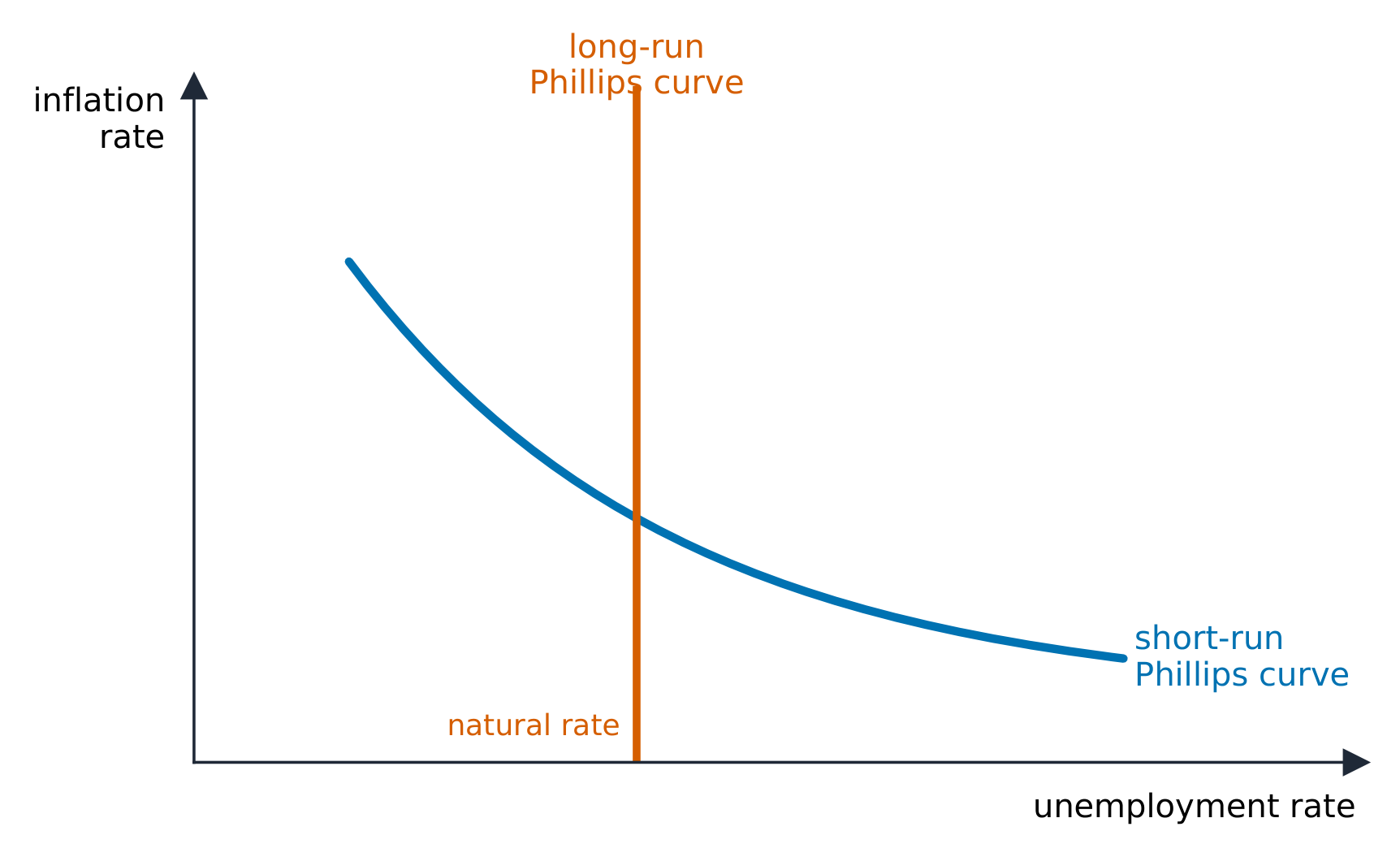
短期和长期菲利普斯曲线 - 短期菲利普斯曲线(SRPC)(short-run Phillips curve)向下倾斜——更低的失业伴随更高的通货膨胀。它是 AD-AS 的镜像:一次向右的 AD 移动使经济沿 SRPC 向上-左移动(更少失业、更多通货膨胀)。
- 长期菲利普斯曲线(LRPC)(long-run Phillips curve)在自然失业率(natural rate of unemployment)处是竖直的——竖直 LRAS 的对应物。在长期没有权衡:政策改变通货膨胀,不是失业。
- 一次供给冲击使 SRPC 移动(一次负的冲击使它右移——更糟的通货膨胀和失业,即滞胀)。预期通货膨胀的一个变化也使 SRPC 移动。
考试技能: 把 AD-AS 和菲利普斯图联系起来——AD-AS 里的一个衰退缺口对应 SRPC 上自然率右侧的一个点;知道什么使 SRPC 移动与沿它移动。
词汇表 训练英文 中文 拼音 Phillips curve/ˈfɪlɪps kɜːv/ 菲利普斯曲线 fēi lì pǔ sī qū xiàn short-run Phillips curve (SRPC)/ʃɔːt rʌn ˈfɪlɪps kɜːv/ 短期菲利普斯曲线 duǎn qī fēi lì pǔ sī qū xiàn long-run Phillips curve (LRPC)/lɒŋ rʌn ˈfɪlɪps kɜːv/ 长期菲利普斯曲线 cháng qī fēi lì pǔ sī qū xiàn natural rate of unemployment/ˈnætʃərəl reɪt ɒv ʌnemˈplɔɪmənt/ 自然失业率 zì rán shī yè lǜ 5.3
货币增长与通货膨胀
大纲
Enduring Understanding Learning Objective Essential Knowledge POL-3
There are long-run implications of monetary and fiscal policy.POL-3.A
a. Explain (using graphs as appropriate) how inflation is a monetary phenomenon.
b. Define the quantity theory of money.
c. Calculate the money supply, velocity, the price level, and real output using the quantity theory of money.- POL-3.A.1 Inflation (deflation) results from increasing (decreasing) the money supply at too rapid of a rate for a sustained period of time.
- POL-3.A.2 When the economy is at full employment, changes in the money supply have no effect on real output in the long run.
- POL-3.A.3 In the long run, the growth rate of the money supply determines the growth rate of the price level (inflation rate) according to the quantity theory of money.
来源:美国大学理事会 AP 课程与考试说明
在长期,通货膨胀是一个货币现象。货币数量论(quantity theory of money)陈述 $M\times V = P\times Y$(货币供给 $\times$ 流通速度 $=$ 价格水平 $\times$ 实际产出)。以流通速度 $V$ 和实际产出 $Y$ 在长期大致稳定,货币供给的增长几乎一对一地转换成通货膨胀。印钱比经济增长更快提高价格水平,不是实际产出——高通货膨胀的根源,而在极端情况下,恶性通货膨胀(hyperinflation)。
Worked example. 假设货币供给每年增长 $8\%$ 而实际产出 $Y$ 增长 $3\%$ 且流通速度 $V$ 稳定。把 $M\times V=P\times Y$ 重新排列成增长率,通货膨胀 $\approx 8\%-3\%=5\%$。不被额外产出匹配的那 $5\%$ 的货币增长简单地变成更高的价格。
More money chasing goods: sustained money growth tends to raise the price level over time 探索Link money growth to inflation
The quantity theory $MV=PY$: with output and velocity roughly fixed, the price level moves in proportion to the money supply — too much money chasing the same goods is inflation.
词汇表 训练英文 中文 拼音 quantity theory of money/ˈkwɒntɪti ˈθɪəri ɒv ˈmʌni/ 货币数量论 huò bì shù liàng lùn hyperinflation/ˌhaɪpərɪnˈfleɪʃn/ 恶性通货膨胀 è xìng tōng huò péng zhàng 5.4
政府赤字与国家债务

大纲
Enduring Understanding Learning Objective Essential Knowledge POL-3
There are long-run implications of monetary and fiscal policy.POL-3.B
a. Define the government budget surplus (deficit) and national debt.
b. Explain the issues involved with the burden of the national debt.- POL-3.B.1 The government budget surplus (deficit) is the difference between tax revenues and government purchases plus transfer payments in a given year.
- POL-3.B.2 A government adds to the national debt when it runs a budget deficit.
- POL-3.B.3 A government must pay interest on its accumulated debt, thus increasing the national debt and increasingly forgoing using those funds for alternative uses. [See also LO POL-3.C on crowding out.]
来源:美国大学理事会 AP 课程与考试说明
一个预算赤字(budget deficit)在一年里政府支出超过税收时发生(一个盈余(surplus)是相反的)。过去赤字的累积总和是国债(national debt)。赤字由借款——出售政府债券——融资,它增加债务和未来的利息支付。持续的赤字引起对挤出和偿还债务负担的顾虑。
Bond and equity markets: government borrowing competes for loanable funds and can crowd out private investment 词汇表 训练英文 中文 拼音 budget deficit/ˈbʌdʒɪt ˈdefɪsɪt/ 预算赤字 yù suàn chì zì surplus/ˈsɜːpləs/ 盈余 yíng yú national debt/ˈnæʃənl det/ 国债 guó zhài 5.5
挤出效应
大纲
Enduring Understanding Learning Objective Essential Knowledge POL-3
There are long-run implications of monetary and fiscal policy.POL-3.C
a. Define crowding out.
b. Explain (using graphs as appropriate) how fiscal policy may cause crowding out.- POL-3.C.1 When a government is in budget deficit, it typically borrows to finance its spending.
- POL-3.C.2 A loanable funds market model can be used to show the effect of government borrowing on the equilibrium real interest rate and the resulting crowding out of private investment. [See MKT-4]
- POL-3.C.3 Crowding out refers to the adverse effect of increased government borrowing, which leads to decreased levels of interest-sensitive private sector spending in the short run.
- POL-3.C.4 A potential long-run impact of crowding out is a lower rate of physical capital accumulation and less economic growth as a result.
来源:美国大学理事会 AP 课程与考试说明
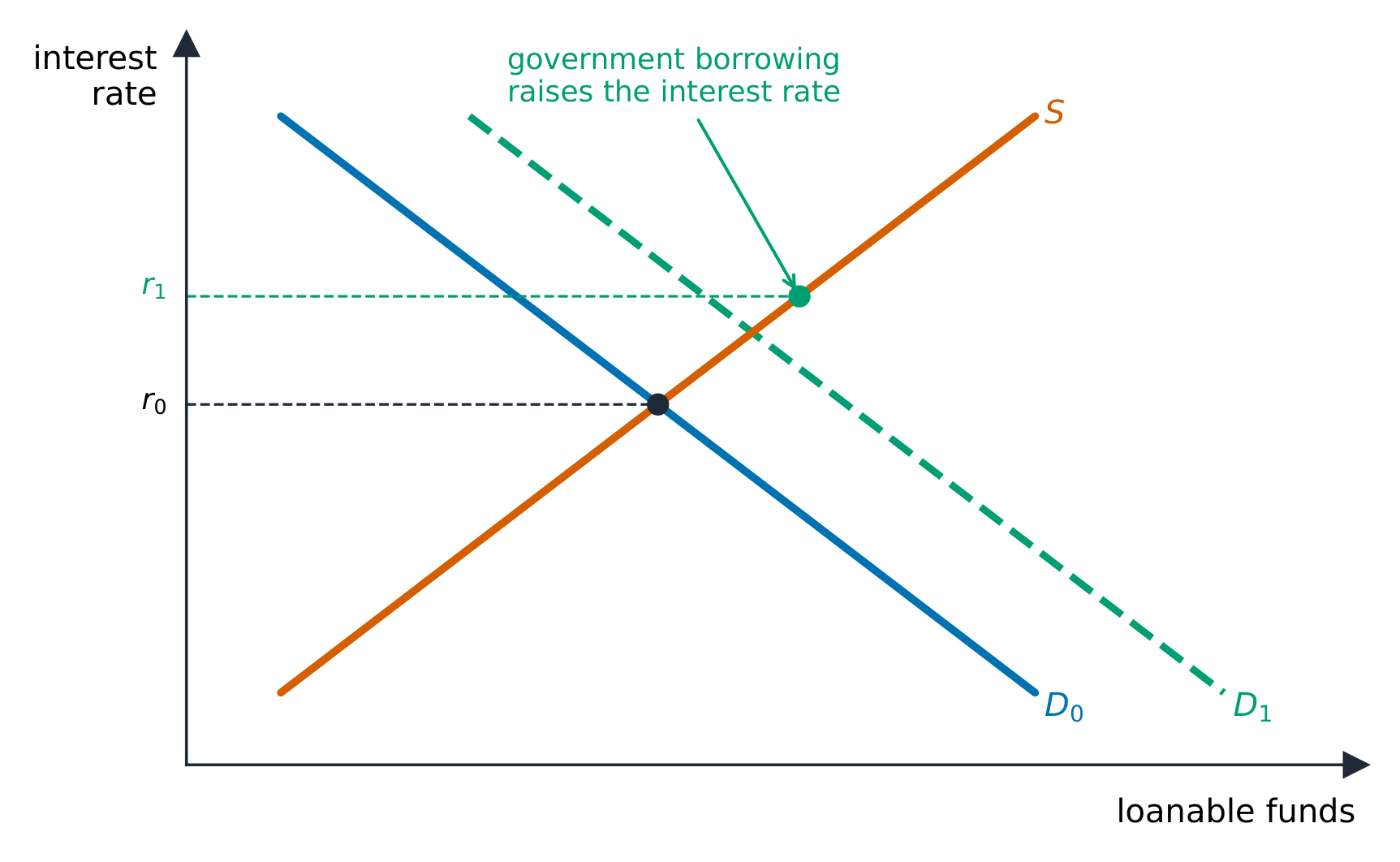
挤出效应(crowding out)是赤字融资财政政策的主要长期成本。当政府大量借款时,它增加对可贷资金的需求,提高实际利率。更高的利率减少私人投资(和利率敏感的消费)。所以扩张性财政政策部分地抵消它自己:AD 提振被更弱的投资抵消。更糟的是,今天更少的投资意味着一个更小的资本存量和更慢的长期增长。
政府借款提高利率并挤出私人投资 考试技能: 在可贷资金图上显示挤出——政府借款使需求右移,实际利率上升,而私人投资下降。
Worked example. 一个政府借 $\$500$ 十亿来为一个赤字融资。在可贷资金市场上这使对资金的需求右移,把实际利率推高(比如说从 $3\%$ 到 $4\%$)。在更高的利率企业缩减投资——也许 $\$150$ 十亿——所以对 AD 的净提振小于 $\$500$ 十亿,而失去的投资减慢长期增长。
词汇表 训练英文 中文 拼音 Crowding out/ˈkraʊdɪŋ aʊt/ 挤出效应 jǐ chū xiào yìng 5.6
经济增长
大纲
Enduring Understanding Learning Objective Essential Knowledge MEA-2
The economy fluctuates between periods of expansion and contraction in the short run, but economic growth can occur in the long run.MEA-2.B
a. Define measures and determinants of economic growth.
b. Explain (using graphs and data as appropriate) the determinants of economic growth.
c. Calculate (using graphs and data as appropriate) per capita GDP and economic growth.- MEA-2.B.1 Economic growth can be measured as the growth rate in real GDP per capita over time.
- MEA-2.B.2 Aggregate employment and aggregate output are directly related because firms need to employ more workers in order to produce more output, holding other factors constant. This is captured by the aggregate production function.
- MEA-2.B.3 Output per employed worker is a measure of average labor productivity.
- MEA-2.B.4 Productivity is determined by the level of technology and physical and human capital per worker.
- MEA-2.B.5 The aggregate production function shows that output per capita is positively related to both physical and human capital per capita.
来源:美国大学理事会 AP 课程与考试说明
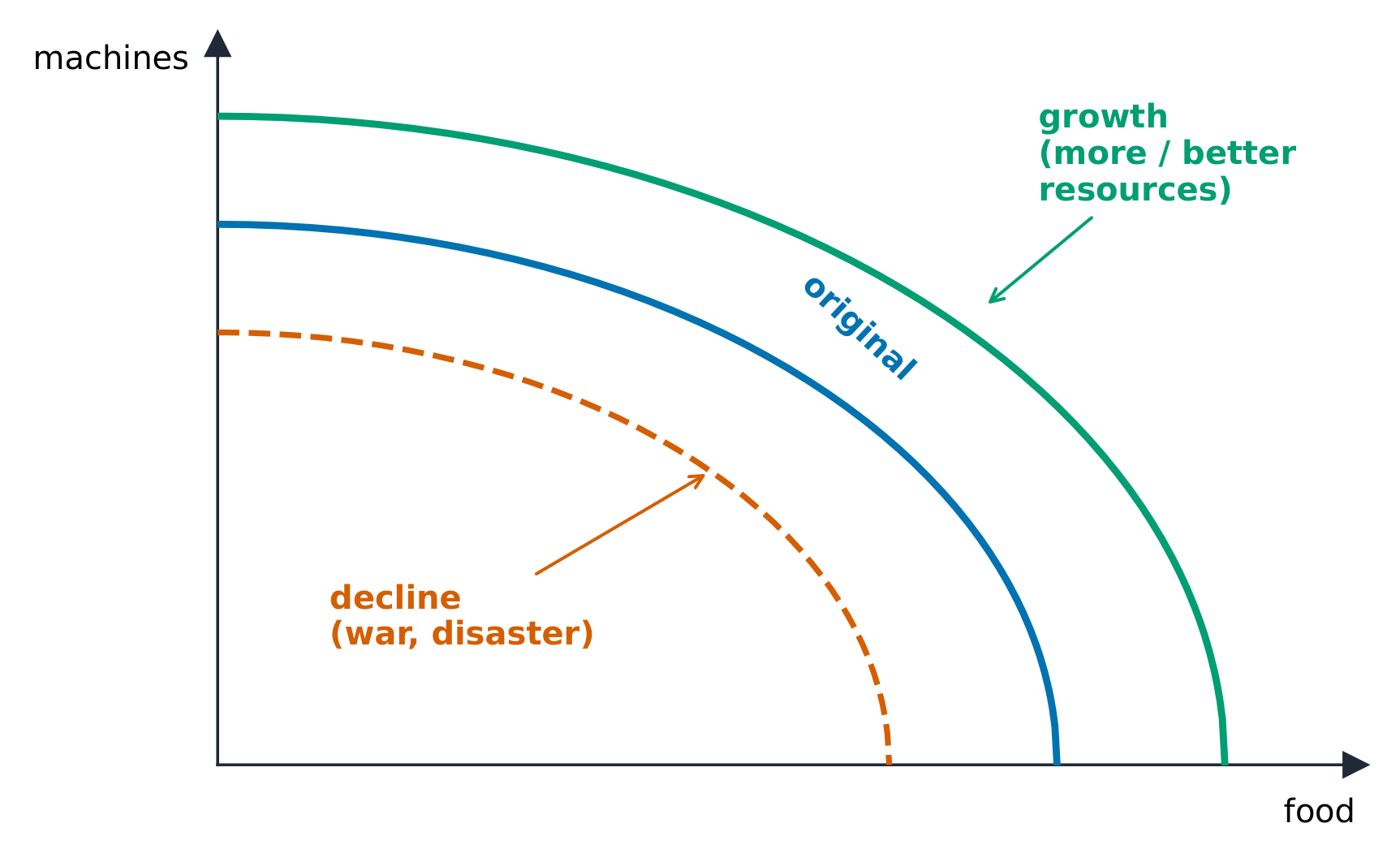
经济增长(economic growth)是人均实际 GDP 的一次持续上升——更高生活水平的真正来源。它来自更多或更好的资源,并显示为 LRAS 的一次右移(和 PPC 的一次向外移动)。它的主要驱动力:
经济增长使生产可能性曲线向外移动 - 实物资本(physical capital)(每个工人更多的工具和机器),
- 人力资本(human capital)(教育、技能、健康),
- 技术(technology)和创新,
- 生产率(productivity)(每个工人的产出)增长,最深的驱动力。
探索Economic growth pushes the frontier out
Economic growth — more resources, better technology — shifts the whole production possibilities frontier outward, letting the economy produce more of everything.
词汇表 训练英文 中文 拼音 Economic growth/ˌiːkəˈnɒmɪk ɡrəʊθ/ 经济增长 jīng jì zēng zhǎng physical capital/ˈfɪzɪkl ˈkæpɪtl/ 实物资本 shí wù zī běn human capital/ˈhjuːmən ˈkæpɪtl/ 人力资本 rén lì zī běn technology/tekˈnɒlədʒi/ 技术 jì shù productivity/ˌprɒdəkˈtɪvɪti/ 生产率 shēng chǎn lǜ 5.7
公共政策与经济增长
大纲
Enduring Understanding Learning Objective Essential Knowledge POL-4
Authorities and organizations institute policies that affect economic growth.POL-4.A
a. Explain (using graphs as appropriate) public policies aimed at influencing long-run economic growth.
b. Define supply-side fiscal policies.
[For a description of economic growth and information about how to show it graphically, see LO MEA-2.B, LO MOD-1.B, and LO MOD-2.I]- POL-4.A.1 Public policies that impact productivity and labor force participation affect real GDP per capita and economic growth.
- POL-4.A.2 Government policies that invest in infrastructure and technology affect growth.
- POL-4.A.3 Supply-side fiscal policies affect aggregate demand, aggregate supply, and potential output in the short run and long run by influencing incentives that affect household and business economic behavior.
来源:美国大学理事会 AP 课程与考试说明
政府能通过建立资本和生产率的政策提高长期增长:对基础设施和教育的投资、研究与开发激励、保护产权(property rights)和法治、鼓励储蓄和投资(它为资本融资),并保持通货膨胀低而稳定。反复出现的长期主题:挤出或阻碍投资的政策减慢增长,而那些鼓励资本形成的加速它。
词汇表 训练英文 中文 拼音 property rights/ˈprɒpəti raɪts/ 产权 chǎn quán 5.7
考试技巧
- 短期菲利普斯曲线显示通货膨胀-失业权衡;长期曲线在自然率处是竖直的。
- 在长期通货膨胀是一个货币现象(货币增长超过产出增长 → 通货膨胀)。
- 在可贷资金图上显示挤出:政府借款提高实际利率并削减私人投资。
- 增长来自更多/更好的资源——实物资本、人力资本、技术——使 LRAS 右移。
- 一次供给冲击使通货膨胀和失业朝相同方向移动(滞胀),不像一次需求冲击。
-
6
开放经济——国际贸易与金融
6.1
国际收支账户
大纲
Enduring Understanding Learning Objective Essential Knowledge MEA-4
Foreign trade accounting measures the flow of goods, services, and financial capital between countries.MEA-4.A
a. Define the current account (CA), the capital and financial account (CFA), and the balance of payments (BOP).
b. Explain how changes in the components of the CA and CFA affect a country's BOP.
c. Calculate the CA, the CFA, and the BOP.- MEA-4.A.1 The current account (CA) records net exports, net income from abroad, and net unilateral transfers.
- MEA-4.A.2 The CA is not always balanced; it may show a surplus or a deficit. A nation's balance of trade (i.e., net exports) is part of the current account and may also show a surplus or a deficit.
- MEA-4.A.3 The capital and financial account (CFA) records financial capital transfers and purchases and sales of assets between countries.
- MEA-4.A.4 The CFA is not always balanced; it may show a surplus (financial capital inflow) or a deficit (financial capital outflow).
- MEA-4.A.5 The balance of payments (BOP) is an accounting system that records a country's international transactions for a particular time period. It consists of the CA and the CFA.
- MEA-4.A.6 Any transaction that causes money to flow into a country is a credit to its BOP account, and any transaction that causes money to flow out is a debit. The sum of all credit entries should match the sum of all debit entries ($CA + CFA = 0$).
来源:美国大学理事会 AP 课程与考试说明
国际收支(balance of payments)记录一个国家与世界其余部分之间的所有交易,在两个主要账户里:
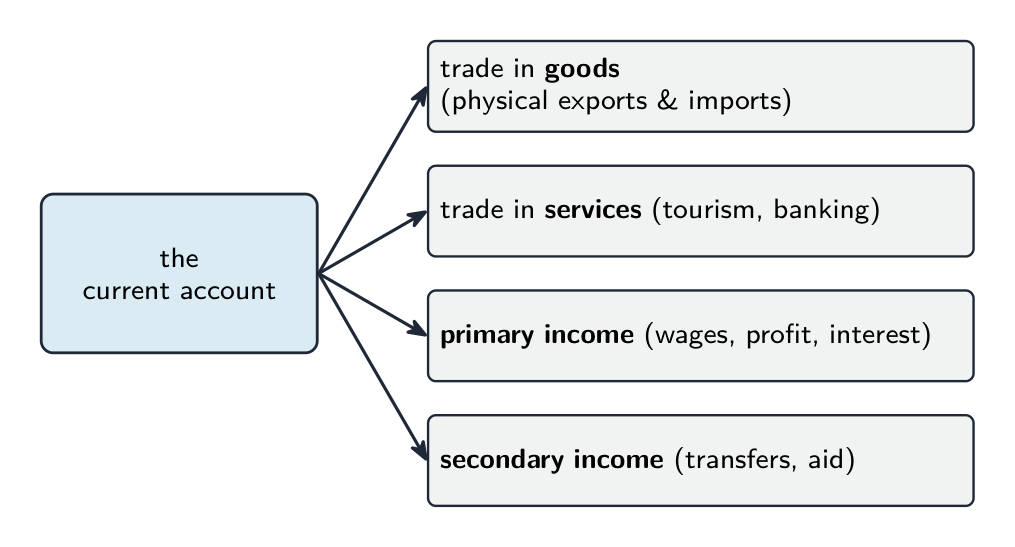
经常账户的四个部分 - 经常账户(current account)追踪物品和服务的贸易(出口减进口)、加收入和转移。一个贸易逆差使它为负。
- 资本(金融)账户(capital (financial) account)追踪金融资产的流动——外国人买国内资产,和居民买外国资产。
这两者是镜像:一个经常账户逆差被一个资本账户顺差匹配(一个进口多于它出口的国家用资产支付,所以外国投资流入)。它们加起来等于零。
词汇表 训练英文 中文 拼音 balance of payments/ˈbæləns ɒv ˈpeɪmənts/ 国际收支 guó jì shōu zhī current account/ˈkʌrənt əˈkaʊnt/ 经常账户 jīng cháng zhàng hù capital (financial) account/ˈkæpɪtl əˈkaʊnt/ 资本账户 zī běn zhàng hù 6.2
汇率
大纲
Enduring Understanding Learning Objective Essential Knowledge MKT-5
The interaction of buyers and sellers exchanging the currency of one country for the currency of another determines the equilibrium exchange rate in a flexible exchange market and influences the flow of goods, services, and financial capital between countries.MKT-5.A
a. Define the exchange rate, currency appreciation, and currency depreciation.
b. Explain how currencies are valued relative to one another.
c. Calculate the value of one currency relative to another.- MKT-5.A.1 In the foreign exchange market, one currency is exchanged for another; the price of one currency in terms of the other is the exchange rate.
- MKT-5.A.2 If one currency becomes more valuable in terms of the other, it is said to appreciate. If one currency becomes less valuable in terms of the other, it is said to depreciate.
来源:美国大学理事会 AP 课程与考试说明
一个汇率(exchange rate)是一种货币以另一种表示的价格。一种货币升值(appreciates),当它获得价值时(买更多外国货币),而贬值(depreciates),当它失去价值时。总是追踪哪种货币:若美元对欧元升值,欧元对美元贬值——同一事件的两面。
Worked example. 假设 $\$1=\text{€}0.90$,所以 $\text{€}1=\dfrac{1}{0.90}\approx\$1.11$。若美元然后升值到 $\$1=\text{€}1.00$,每美元现在买更多欧元,而欧元已贬值——它现在只买 $\$1.00$ 而不是 $\$1.11$。这单个事件是美元的一次升值和欧元的一次贬值。
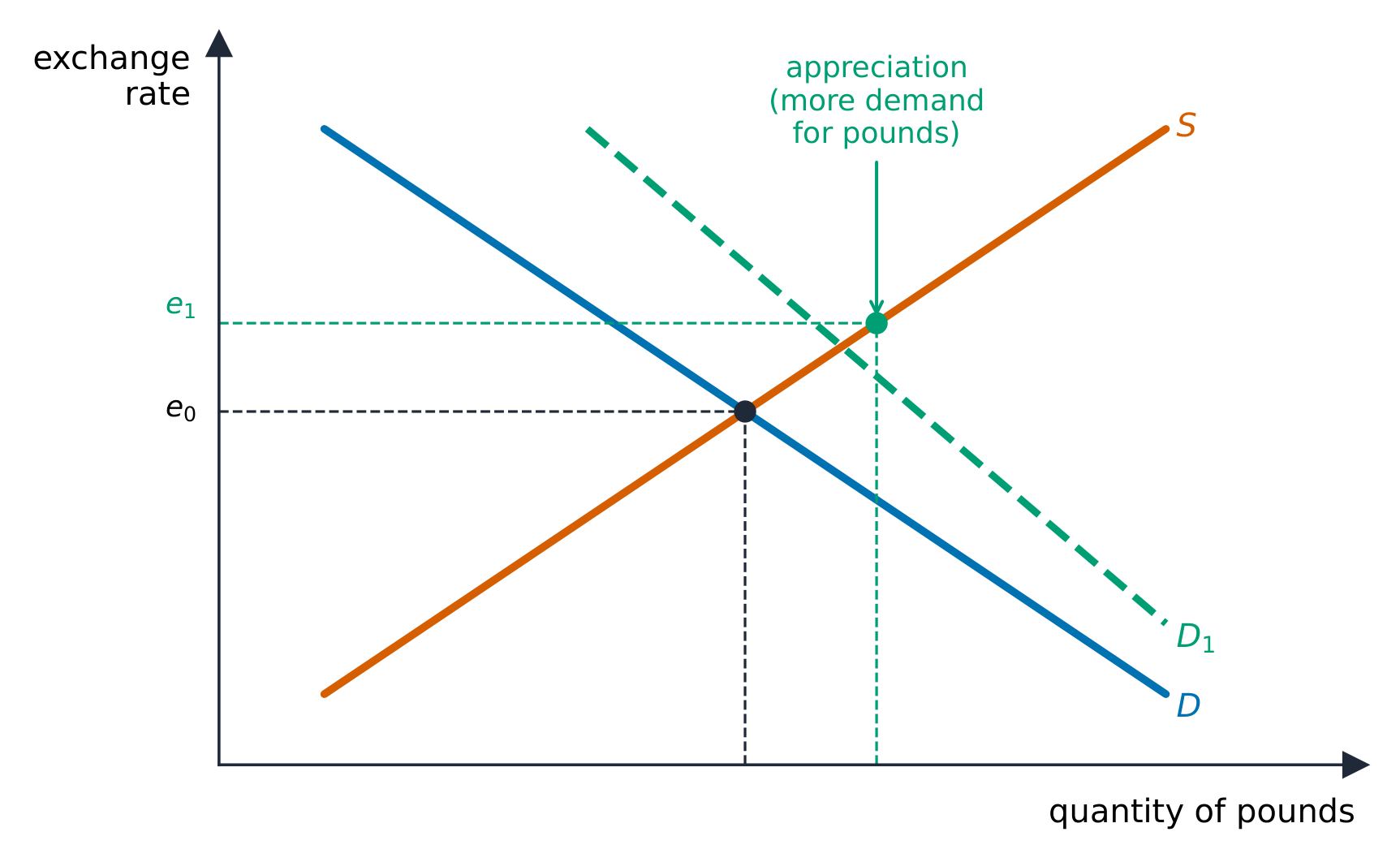
一个由对一种货币的需求和供给设定的浮动汇率 今天大多数货币是浮动(floating)的,由外汇市场的供给和需求设定。
词汇表 训练英文 中文 拼音 exchange rate/eksˈtʃeɪndʒ reɪt/ 汇率 huì lǜ appreciates/əˈpriːʃɪeɪts/ 升值 shēng zhí depreciates/dɪˈpriːʃɪeɪts/ 贬值 biǎn zhí floating/ˈfləʊtɪŋ/ 浮动 fú dòng 6.3
外汇市场
大纲
Enduring Understanding Learning Objective Essential Knowledge MKT-5
The interaction of buyers and sellers exchanging the currency of one country for the currency of another determines the equilibrium exchange rate in a flexible exchange market and influences the flow of goods, services, and financial capital between countries.MKT-5.B
a. Define the foreign exchange market, demand for currency, and supply of currency.
b. Explain (using graphs as appropriate) the relationship between the exchange rate and the quantity of currency demanded (supplied).- MKT-5.B.1 The demand for a currency in a foreign exchange market arises from the demand for the country's goods, services, and financial assets and shows the inverse relationship between the exchange rate and the quantity demanded of a currency.
- MKT-5.B.2 The supply of a currency in a foreign exchange market arises from making payments in other currencies and shows the positive relationship between the exchange rate and the quantity supplied of a currency.
MKT-5.C
Define (using graphs as appropriate) the equilibrium exchange rate.- MKT-5.C.1 In the foreign exchange market, equilibrium is achieved when the exchange rate is such that the quantities demanded and supplied of the currency are equal.
MKT-5.D
Explain (using graphs as appropriate) how exchange rates adjust to restore equilibrium in the foreign exchange market.- MKT-5.D.1 Disequilibrium exchange rates create surpluses and shortages in the foreign exchange market. Market forces drive exchange rates toward equilibrium.
来源:美国大学理事会 AP 课程与考试说明
外汇市场 每种货币有它自己的供求图(价格 $=$ 汇率,数量 $=$ 那种货币的量)。
- 对一种货币的需求来自想要它的物品、服务或资产的外国人。
- 一种货币的供给来自想要外国物品、服务或资产的它自己的居民。
均衡汇率是它们交叉的地方。对一种货币需求的一次向右移动使它升值;供给的一次向右移动使它贬值。
考试技能: 总是为问题里命名的货币画图、用那种货币的价格标注坐标轴,并移动正确的曲线——把两种货币的图搞混是最常见的错误。
探索The foreign-exchange market
A currency's exchange rate is set where demand for it meets supply. Higher demand for exports or higher interest rates appreciate the currency.
6.4
政策与经济状况变化对外汇市场的影响
大纲
Enduring Understanding Learning Objective Essential Knowledge MKT-5
The interaction of buyers and sellers exchanging the currency of one country for the currency of another determines the equilibrium exchange rate in a flexible exchange market and influences the flow of goods, services, and financial capital between countries.MKT-5.E
a. Explain (using graphs as appropriate) the determinants of currency demand and supply.
b. Explain (using graphs as appropriate) how changes in demand and supply in the foreign exchange market affect the equilibrium exchange rate.- MKT-5.E.1 Factors that shift the demand for a currency (such as the demand for that country's goods, services, or assets) and the supply of a currency (such as tariffs or quotas on the other country's goods and services) change the equilibrium exchange rate.
- MKT-5.E.2 Fiscal policy can influence aggregate demand, real output, the price level, and exchange rates.
- MKT-5.E.3 Monetary policy can influence aggregate demand, real output, the price level, and interest rates, and thereby affect exchange rates.
来源:美国大学理事会 AP 课程与考试说明
汇率对以下反应:
- 相对利率: 一个更高的国内实际利率吸引外国金融投资,提高对这种货币的需求并造成升值。
- 相对价格水平/通货膨胀: 更高的国内通货膨胀使物品竞争力更低,降低对这种货币的需求(贬值)。
- 相对收入: 更高的国内收入提高进口,增加国内货币的供给(贬值)。
- 偏好和关于未来价值的预期。
货币政策有一个强的联系:扩张性货币政策降低利率、减少对货币的需求,并造成贬值(它然后提振净出口)。
6.5
外汇市场的变动与净出口
大纲
Enduring Understanding Learning Objective Essential Knowledge MKT-5
The interaction of buyers and sellers exchanging the currency of one country for the currency of another determines the equilibrium exchange rate in a flexible exchange market and influences the flow of goods, services, and financial capital between countries.MKT-5.F
Explain (using graphs as appropriate) how changes in the value of a currency can lead to changes in a country's net exports and aggregate demand.- MKT-5.F.1 Factors that cause a currency to appreciate cause that country's exports to decrease and its imports to increase. As a result, net exports will decrease.
- MKT-5.F.2 Factors that cause a currency to depreciate cause that country's exports to increase and its imports to decrease. As a result, net exports will increase. [See EK MOD-2.A.3 and EK MOD-2.H.1 for explanations of the effect of changes in net exports on aggregate demand and the resulting effects on output, employment, and the price level.]
来源:美国大学理事会 AP 课程与考试说明
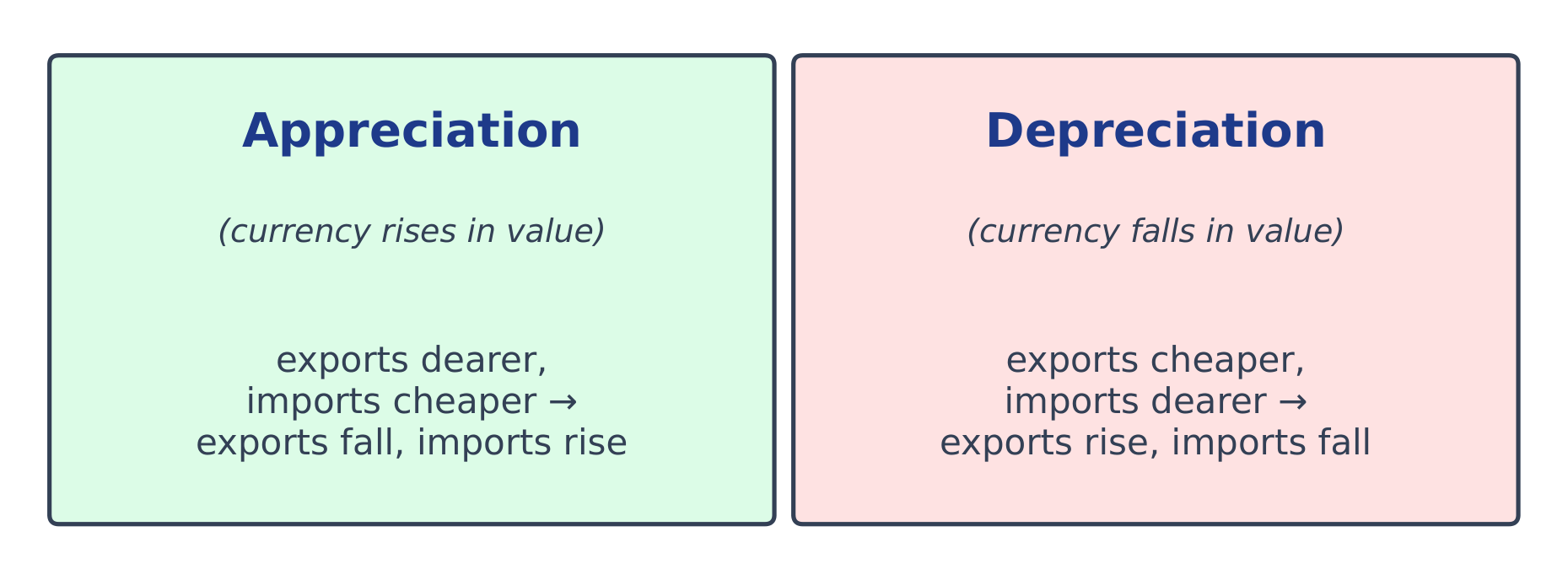
汇率通过净出口反馈进 AD:
升值使出口更贵而进口更便宜;贬值做相反的 - 一次贬值使出口对外国人更便宜而进口更贵,所以净出口上升而 AD 右移。
- 一次升值使出口更贵而进口更便宜,所以净出口下降而 AD 左移。
Worked example. 一辆定价 $\$30{,}000$ 的美国车在 $\$1=\text{€}0.90$ 时让一个欧洲买者花 $\text{€}27{,}000$。若美元贬值到 $\$1=\text{€}0.80$,同一辆车现在只花 $\text{€}24{,}000$ ——对外国人更便宜,所以美国出口上升而进口(现在以美元更贵)下降,提升净出口并使 AD 右移。
这就是外汇市场和 AD-AS 模型如何连接——一次货币变化是政策到达产出的一个渠道。
6.6
实际利率与国际资本流动
大纲
Enduring Understanding Learning Objective Essential Knowledge MKT-5
The interaction of buyers and sellers exchanging the currency of one country for the currency of another determines the equilibrium exchange rate in a flexible exchange market and influences the flow of goods, services, and financial capital between countries.MKT-5.G
Explain (using graphs as appropriate) how differences in real interest rates across countries affect financial capital flows, foreign exchange markets, and loanable funds markets.- MKT-5.G.1 In an open economy, differences in real interest rates across countries change the relative values of domestic and foreign assets. Financial capital will flow toward the country with the relatively higher interest rate. [See EK MKT-4.E.2 and EK MEA-4.A.6 for explanations of the impact on the loanable funds market and on net exports.]
- MKT-5.G.2 Central banks can influence the domestic interest rate in the short run, which in turn will affect net capital inflows.
来源:美国大学理事会 AP 课程与考试说明
钱追逐最高的实际回报,所以资本流动(capital flows)对实际利率反应:
- 一个更高的国内实际利率吸引外国金融资本的流入——外国人买国内债券,提高货币需求并造成升值。
- 一个更低的实际利率造成流出和贬值。
这把整个课程绑在一起:政府借款提高实际利率(可贷资金),它吸引外国资本、使货币升值,并减少净出口——所以一个预算赤字能扩大一个贸易逆差("双赤字")。跨可贷资金、外汇和 AD-AS 图追踪这些相连的效应是 AP 宏观经济学的顶点技能。
词汇表 训练英文 中文 拼音 capital flows/ˈkæpɪtl fləʊz/ 资本流动 zī běn liú dòng 6.6
考试技巧
- 经常账户和金融账户是镜像并加起来等于零。
- 总是为命名的货币画外汇图,并用那种货币标注它的价格;一种货币升值就是另一种贬值。
- 一次贬值提高净出口(出口更便宜);一次升值降低它们。
- 更高的国内实际利率吸引资本流入 → 货币升值 → 净出口下降。
- 把它全部联系起来:一个预算赤字提高实际利率、使货币升值,并能扩大贸易逆差(双赤字)。