跳到主要内容

稳定政策的长期影响

AP 宏观经济学 · 知识点 5

本主题的视频课程 打开视频页面
8:27

稳定政策的长期后果

政府希望快速结束衰退。它增加支出,削减税收,中央银行降低借贷成本。这奏效了——产出上升,就业机会回归……

英语旁白 · 英中内嵌字幕

5.1

短期内的财政与货币政策行动

教学大纲

持久理解 (POL-1): 财政政策和货币政策对宏观经济结果具有短期影响。

学习目标 POL-1.F: 解释(在适当时使用图表)综合财政和货币政策行动的影响。

  • POL-1.F.1 当经济处于负产出缺口(即衰退性缺口)或正产出缺口(即通货膨胀性缺口)时,可采用扩张性或紧缩性的财政与货币政策组合来恢复充分就业。
  • POL-1.F.2 财政与货币政策的组合可以影响总需求、实际产出、价格水平和利率。[关于财政政策与货币政策行动的更多细节及其如何在图表中演示其影响,请参阅学习目标 POL-1.A 和 POL-1.D。]

来源:College Board AP 课程与考试说明

English
A parliament building: governments use spending and taxes as fiscal policy tools

Both policies work by shifting AD in the short run. Fiscal policy 财政政策 changes government spending or taxes; monetary policy 货币政策 changes the money supply 货币供给 and thus the interest rate. They can work together (both expansionary to fight a deep recession) or be mixed (e.g. loose fiscal + tight monetary). In the short run, expansionary policy raises output and the price level and lowers unemployment; contractionary policy does the reverse.

The policy mix in one table. Use it to check the direction of each effect before you write an answer.

Policy Interest rate Investment AD Real GDP and price level
Expansionary fiscal (more $G$ or lower taxes) rises (government borrows) may fall (crowding out) right both rise
Contractionary fiscal falls may rise left both fall
Expansionary monetary (buy bonds or lower IOR) falls rises right both rise
Contractionary monetary rises falls left both fall
Loose fiscal and tight monetary rises clearly falls uncertain uncertain: depends on sizes

When two policies push AD in opposite directions, the effect on output is indeterminate. Say so in an FRQ, and explain that it depends on which shift is larger.

探索

使用政策来平移总需求

在短期内,财政(支出/税收)和货币(利率)政策会平移总需求,使实际GDP和价格水平沿短期总供给曲线移动。

词汇 训练
English 中文 拼音
fiscal policy/ˈfɪskl ˈpɒlɪsi/ 财政政策 cái zhèng zhèng cè
monetary policy/ˈmʌnɪtəri ˈpɒlɪsi/ 货币政策 huò bì zhèng cè
money supply/ˈmʌni səˈplaɪ/ 货币供给 huò bì gōng jǐ
5.2

菲利普斯曲线

教学大纲

持久理解 (MOD-3): 菲利普斯曲线模型用于表示通货膨胀与失业率之间的关系,并说明宏观经济冲击如何影响通货膨胀和失业率。

学习目标 MOD-3.A: a. 定义(在适当时使用图表)短期菲利普斯曲线和长期菲利普斯曲线。 b. 解释(在适当时使用图表)菲利普斯曲线模型中的短期均衡和长期均衡。

  • MOD-3.A.1 通货膨胀与失业之间的短期权衡关系可以通过向下倾斜的短期菲利普斯曲线 (SRPC) 来说明。
  • MOD-3.A.2 经济体始终处于 SRPC 上的某一点运行。
  • MOD-3.A.3 通货膨胀与失业之间的长期关系可以通过长期菲利普斯曲线 (LRPC) 来说明,该曲线在自然失业率处呈垂直状。
  • MOD-3.A.4 长期均衡对应于 SRPC 与 LRPC 的交点。
  • MOD-3.A.5 位于长期均衡左侧的点代表通胀缺口,而位于长期均衡右侧的点代表衰退缺口。

学习目标 MOD-3.B: 解释(在适当时使用图表)短期内和长期内失业率和通货膨胀的反应。

  • MOD-3.B.1 需求冲击对应于沿 SRPC 的移动。
  • MOD-3.B.2 供给冲击对应于 SRPC 的移动。
  • MOD-3.B.3 导致自然失业率变化的因素将引起 LRPC 的移动。

来源:College Board AP 课程与考试说明

English
The short-run Phillips curve

The Phillips curve 菲利普斯曲线 shows the short-run trade-off between inflation and unemployment:

Expansionary policy moves the economy from A to B along SRPC1; when expected inflation catches up, SRPC shifts up and unemployment returns to the natural rate at C
  • The short-run Phillips curve (SRPC) 短期菲利普斯曲线 slopes downward – lower unemployment comes with higher inflation. It is the mirror image of AD-AS: a rightward AD shift moves the economy up-left along the SRPC (less unemployment, more inflation).
  • The long-run Phillips curve (LRPC) 长期菲利普斯曲线 is vertical at the natural rate of unemployment 自然失业率 – the counterpart of vertical LRAS. In the long run there is no trade-off: policy changes inflation, not unemployment. One demand shock on two graphs: AD shifts right on the AD-AS graph (A to B), and the economy moves up-left along the short-run Phillips curve One demand shock on two graphs: AD shifts right on the AD-AS graph (A to B), and the economy moves up-left along the short-run Phillips curve

Translate between the two graphs. A shift of AD is a movement along the SRPC (right on AD means up-left on the SRPC). A shift of SRAS is a shift of the SRPC, in the opposite direction: SRAS left means SRPC right. Point A on LRAS matches point A on LRPC, because full-employment output goes with the natural rate of unemployment.

  • A supply shock 供给冲击 shifts the SRPC (a negative shock moves it right – worse inflation and unemployment, i.e. stagflation 滞胀). A change in expected inflation 预期通货膨胀 also shifts the SRPC.

Exam skill: link the AD-AS and Phillips graphs – a recessionary gap in AD-AS corresponds to a point on the SRPC to the right of the natural rate; know what shifts SRPC versus moves along it.

探索

沿 SRPC 移动,还是移动它?

AD 的变化让你沿短期菲利普斯曲线移动;通胀预期的变化或供给冲击移动整条曲线。

词汇 训练
English 中文 拼音
Phillips curve/ˈfɪlɪps kɜːv/ 菲利普斯曲线 fēi lì pǔ sī qū xiàn
short-run Phillips curve (SRPC)/ʃɔːt rʌn ˈfɪlɪps kɜːv/ 短期菲利普斯曲线 duǎn qī fēi lì pǔ sī qū xiàn
long-run Phillips curve (LRPC)/lɒŋ rʌn ˈfɪlɪps kɜːv/ 长期菲利普斯曲线 cháng qī fēi lì pǔ sī qū xiàn
natural rate of unemployment/ˈnætʃərəl reɪt ɒv ʌnemˈplɔɪmənt/ 自然失业率 zì rán shī yè lǜ
supply shock/səˈplaɪ ʃɒk/ 供给冲击 gōng jǐ chōng jī
stagflation/stæɡˈfleɪʃn/ 滞胀 zhì zhàng
expected inflation/ekˈspektɪd ɪnˈfleɪʃn/ 预期通货膨胀 yù qī tōng huò péng zhàng
5.3

货币增长与通货膨胀

教学大纲

持久理解 (POL-3): 货币政策和财政政策具有长期影响。

学习目标 POL-3.A: a. 解释(在适当时使用图表)通货膨胀为何是一种货币现象。 b. 定义货币数量论。 c. 利用货币数量论计算货币供应量、货币流通速度、价格水平和实际产出。

  • POL-3.A.1 当货币供应量以过快的速度持续增加(或减少)时,会导致通货膨胀(或通货紧缩)。
  • POL-3.A.2 当经济处于充分就业状态时,从长期来看,货币供应量的变化对实际产出没有影响。
  • POL-3.A.3 根据货币数量论,从长期来看,货币供应量的增长率决定了价格水平(通货膨胀率)的增长率。

来源:College Board AP 课程与考试说明

English

In the long run, inflation is a monetary phenomenon. The quantity theory of money 货币数量论 states $M\times V = P\times Y$ (money supply $\times$ velocity $=$ price level $\times$ real output). In the long run velocity $V$ is roughly stable and real output $Y$ grows at its own pace, set by real resources and technology, not by money. So growth in the money supply above output growth translates almost one-for-one into inflation: inflation $\approx$ money growth $-$ real output growth. Printing money faster than the economy grows raises the price level, not real output – the root of high inflation and, in the extreme, hyperinflation 恶性通货膨胀.

Worked example. An economy has a money supply of $2 trillion, velocity of 5 and real output of $5 trillion. Then $P=\dfrac{M\times V}{Y}=\dfrac{2\times5}{5}=2$. Next year the money supply grows by 8 %, real output grows by 3 % and velocity does not change. Inflation $\approx8\%-3\%=5\%$, so the price level rises to about $2\times1.05=2.10$. Check: $\dfrac{2.16\times5}{5.15}\approx2.10$.

A real example. Zimbabwe's government financed its spending by printing money in the 2000s. By late 2008 monthly inflation was in the billions of percent, and in 2009 the country stopped using its own currency and switched to the U.S. dollar and other foreign currencies.

Worked example. Suppose the money supply grows $8\%$ per year while real output $Y$ grows $3\%$ and velocity $V$ is stable. Rearranging $M\times V=P\times Y$ into growth rates, inflation $\approx 8\%-3\%=5\%$. The $5\%$ of money growth not matched by extra output simply becomes higher prices.

More money chasing goods: sustained money growth tends to raise the price level over time
探索

将货币增长与通货膨胀联系起来

数量理论 $MV=PY$:假设产出和流通速度大致固定,价格水平与货币供给成正比变动——过多的货币追逐相同的商品即为通货膨胀。

词汇 训练
English 中文 拼音
quantity theory of money/ˈkwɒntɪti ˈθɪəri ɒv ˈmʌni/ 货币数量论 huò bì shù liàng lùn
hyperinflation/ˌhaɪpərɪnˈfleɪʃn/ 恶性通货膨胀 è xìng tōng huò péng zhàng
5.4

政府赤字与国家债务

教学大纲

持久理解 (POL-3): 货币和财政政策具有长期影响。

学习目标 POL-3.B: a. 定义政府预算盈余(赤字)和国家债务。 b. 解释国家债务负担涉及的问题。

  • POL-3.B.1 政府预算盈余(赤字)是指某一年中税收收入与政府购买及转移支付之间的差额。
  • POL-3.B.2 当政府出现预算赤字时,会增加国家债务。
  • POL-3.B.3 政府必须为其累积的债务支付利息,这既增加了国家债务,也越来越多地导致放弃将这些资金用于其他用途的机会。[另见关于挤出效应的学习目标 POL-3.C]

来源:College Board AP 课程与考试说明

English

A budget deficit 预算赤字 occurs when government spending exceeds tax revenue in a year (a budget surplus 预算盈余 is the reverse). The accumulated total of past deficits is the national debt 国债. Deficits are financed by borrowing – selling government bonds 政府债券 – which adds to the debt and to future interest payments. Persistent deficits raise concerns about crowding out and the burden of servicing the debt.

Bond and equity markets: government borrowing competes for loanable funds and can crowd out private investment
A deficit is a yearly flow; the national debt is the stock it adds to
词汇 训练
English 中文 拼音
budget deficit/ˈbʌdʒɪt ˈdefɪsɪt/ 预算赤字 yù suàn chì zì
budget surplus/ˈbʌdʒɪt ˈsɜːpləs/ 预算盈余 yù suàn yíng yú
national debt/ˈnæʃənl det/ 国债 guó zhài
government bonds/ˈɡʌvənmənt bɒndz/ 政府债券 zhèng fǔ zhài quàn
5.5

挤出效应

教学大纲

持久理解 (POL-3): 货币和财政政策具有长期影响。

学习目标 POL-3.C: a. 定义挤出效应。 b. 解释(在适当时使用图表)财政政策如何导致挤出效应。

  • POL-3.C.1 当政府出现预算赤字时,通常通过借贷来为其支出融资。
  • POL-3.C.2 可贷资金市场模型可用于展示政府借贷对均衡实际利率的影响,以及由此导致的私人投资被挤出。[参见 MKT-4]
  • POL-3.C.3 挤出效应是指政府借贷增加所带来的负面影响,这会导致短期内对利率敏感的私人部门支出减少。
  • POL-3.C.4 挤出效应的一个潜在长期影响是实物资本积累率降低,从而导致经济增长放缓。

来源:College Board AP 课程与考试说明

English

Crowding out 挤出效应 is the main long-run cost of deficit-financed fiscal policy. When the government borrows heavily, it increases the demand for loanable funds 可贷资金需求, raising the real interest rate 实际利率. Higher rates reduce private investment (and interest-sensitive consumption). So expansionary fiscal policy partly cancels itself: the AD boost is offset by weaker investment. Worse, less investment today means a smaller capital stock and slower long-run growth.

Government borrowing raises interest rates and crowds out private investment

Exam skill: show crowding out on the loanable funds graph – government borrowing shifts demand right, the real interest rate rises, and private investment falls.

Worked example. A government borrows $\$500$ billion to finance a deficit. On the loanable funds market this shifts the demand for funds right, pushing the real interest rate up (say from $3\%$ to $4\%$). At the higher rate firms scale back investment – perhaps by $\$150$ billion – so the net boost to AD is smaller than the $\$500$ billion, and the lost investment slows long-run growth.

词汇 训练
English 中文 拼音
crowding out/ˈkraʊdɪŋ aʊt/ 挤出效应 jǐ chū xiào yìng
demand for loanable funds 可贷资金需求 kě dài zī jīn xū qiú
real interest rate/rɪəl ˈɪntrest reɪt/ 实际利率 shí jì lì lǜ
5.6

经济增长

教学大纲

持久理解(MEA-2): 经济在短期内于扩张和收缩之间波动,但在长期内可以实现经济增长。

学习目标 MEA-2.B: a. 定义衡量经济增长的指标及其决定因素。 b. 解释(在适当情况下使用图表和数据)经济增长的决定因素。 c. 计算(在适当情况下使用图表和数据)人均GDP及经济增长率。

  • MEA-2.B.1 经济增长可以通过实际人均GDP随时间的增长率来衡量。
  • MEA-2.B.2 总就业量与总产出直接相关,因为企业在其他条件不变的情况下需要雇佣更多工人以生产更多产出。这一关系由总生产函数所描述。
  • MEA-2.B.3 每位就业工人的产出是平均劳动生产率的衡量指标。
  • MEA-2.B.4 生产率由技术水平以及每位工人所拥有的物质资本和人力资本水平决定。
  • MEA-2.B.5 总生产函数表明,人均产出与人均物质资本和人均人力资本呈正相关关系。

来源:College Board AP 课程与考试说明

English

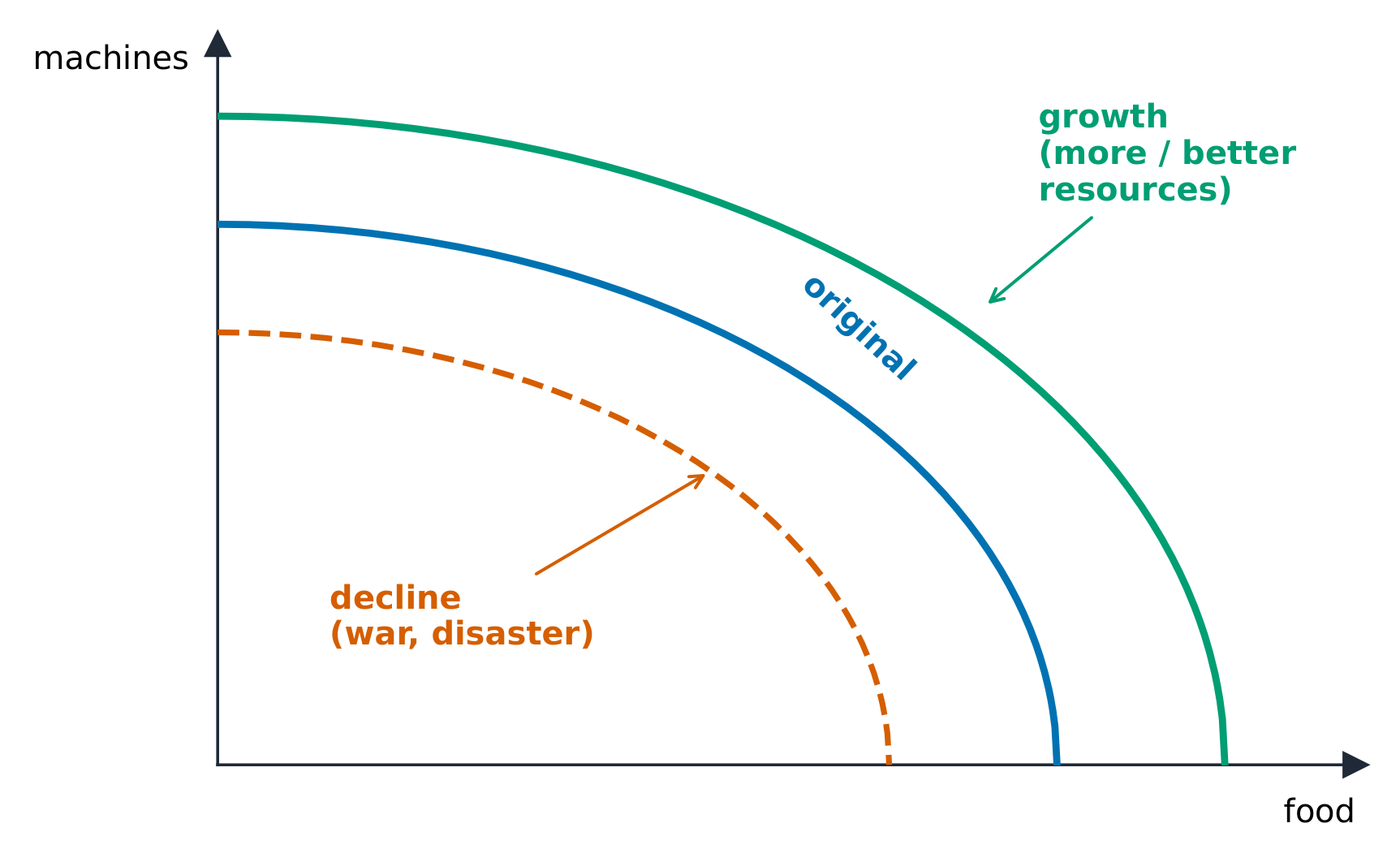
Economic growth 经济增长 is a sustained rise in real GDP per capita 人均实际国内生产总值 – the true source of higher living standards. It comes from more or better resources and is shown as a rightward shift of LRAS (and an outward shift of the PPC). Its main drivers:

Economic growth shifts the production possibilities curve outward
  • physical capital 实物资本 (more tools and machines per worker),
  • human capital 人力资本 (education, skills, health),
  • technology 技术 and innovation,
  • productivity 生产率 (output per worker) growth, the deepest driver.
探索

经济增长推动生产可能性边界外移

经济增长——更多的资源、更好的技术——使整条生产可能性边界向外移动,使经济体能够生产更多的所有产品。

词汇 训练
English 中文 拼音
economic growth/ˌiːkəˈnɒmɪk ɡrəʊθ/ 经济增长 jīng jì zēng zhǎng
real GDP per capita/rɪəl ˌdʒiː diː ˈpiː pɜː ˈkæpɪtə/ 人均实际国内生产总值 rén jūn shí jì guó nèi shēng chǎn zǒng zhí
physical capital/ˈfɪzɪkl ˈkæpɪtl/ 实物资本 shí wù zī běn
human capital/ˈhjuːmən ˈkæpɪtl/ 人力资本 rén lì zī běn
technology/tekˈnɒlədʒi/ 技术 jì shù
productivity/ˌprɒdəkˈtɪvɪti/ 生产率 shēng chǎn lǜ
5.7

公共政策与经济增长

教学大纲

持久理解 (POL-4): 当权机构和组织制定影响经济增长的政策。

学习目标 POL-4.A: a. 解释(在适当时使用图表)旨在影响长期经济增长的公共政策。 b. 定义供给侧财政政策。

[有关经济增长的描述以及如何用图表表示的信息,请参阅 LO MEA-2.B、LO MOD-1.B 和 LO MOD-2.I]

  • POL-4.A.1 影响生产力和劳动力参与率的公共政策会影响人均实际GDP和经济增长。
  • POL-4.A.2 投资于基础设施和技术的政府政策会影响经济增长。
  • POL-4.A.3 供给侧财政政策通过影响影响家庭和企业的经济行为的激励措施,在短期和长期内影响总需求、总供给和潜在产出。

来源:College Board AP 课程与考试说明

English
A wind farm: public investment in capital can raise long-run economic growth

Governments can raise long-run growth by policies that build capital and productivity: investment in infrastructure 基础设施 and education, research and development 研究与开发 incentives, protecting property rights 产权 and the rule of law 法治, encouraging saving and investment (which finances capital), and keeping inflation low and stable. The recurring long-run theme: policies that crowd out or discourage investment slow growth, while those that encourage capital formation speed it up.

探索

供给侧,还是需求侧?

供给侧政策扩大潜在产出(LRAS 右移);需求侧政策只在短期移动 AD。

词汇 训练
English 中文 拼音
infrastructure/ˈɪnfrəstrʌktʃə/ 基础设施 jī chǔ shè shī
research and development/rɪˈsɜːtʃ ænd dɪˈveləpmənt/ 研究与开发 yán jiū yǔ kāi fā
property rights/ˈprɒpəti raɪts/ 产权 chǎn quán
rule of law 法治 fǎ zhì
5.2

菲利普斯曲线

教学大纲

持久理解 (MOD-3): 菲利普斯曲线模型用于表示通货膨胀与失业率之间的关系,并说明宏观经济冲击如何影响通货膨胀和失业率。

学习目标 MOD-3.A: a. 定义(在适当时使用图表)短期菲利普斯曲线和长期菲利普斯曲线。 b. 解释(在适当时使用图表)菲利普斯曲线模型中的短期均衡和长期均衡。

  • MOD-3.A.1 通货膨胀与失业之间的短期权衡关系可以通过向下倾斜的短期菲利普斯曲线 (SRPC) 来说明。
  • MOD-3.A.2 经济体始终处于 SRPC 上的某一点运行。
  • MOD-3.A.3 通货膨胀与失业之间的长期关系可以通过长期菲利普斯曲线 (LRPC) 来说明,该曲线在自然失业率处呈垂直状。
  • MOD-3.A.4 长期均衡对应于 SRPC 与 LRPC 的交点。
  • MOD-3.A.5 位于长期均衡左侧的点代表通胀缺口,而位于长期均衡右侧的点代表衰退缺口。

学习目标 MOD-3.B: 解释(在适当时使用图表)短期内和长期内失业率和通货膨胀的反应。

  • MOD-3.B.1 需求冲击对应于沿 SRPC 的移动。
  • MOD-3.B.2 供给冲击对应于 SRPC 的移动。
  • MOD-3.B.3 导致自然失业率变化的因素将引起 LRPC 的移动。

来源:College Board AP 课程与考试说明

English

An economy is in long-run equilibrium with an unemployment rate of 5 % and an inflation rate of 2 %.

(a) Draw a correctly labeled graph of the short-run and long-run Phillips curves. Label the current point A. Label the axes inflation rate (vertical) and unemployment rate (horizontal). Draw a downward-sloping SRPC and a vertical LRPC at 5 %. A is where they cross, at (5 %, 2 %).

(b) The government increases spending. Show the short-run effect as point B. AD shifts right, so unemployment falls below 5 % and inflation rises. B is up-left of A on the same SRPC.

(c) Over time, people expect the higher inflation. What happens to the SRPC? Where does unemployment end up? Higher expected inflation shifts the SRPC up (right). Unemployment returns to the natural rate, 5 %, at a higher inflation rate (point C on the LRPC). This is the same story as SRAS shifting left back to LRAS.

(d) Instead, a sharp rise in oil prices hits the economy at A. What happens to the SRPC? It is a negative supply shock: SRAS shifts left, so the SRPC shifts right. Unemployment and inflation both rise (stagflation).

Common ways to lose the mark: swapping the axes; drawing the LRPC at an unemployment rate other than the natural rate; shifting the SRPC for a demand shock (a demand shock is a movement along it); putting the long-run point anywhere but on the LRPC.


5.2

考试技巧

English
  • The short-run Phillips curve shows the inflation–unemployment trade-off; the long-run curve is vertical at the natural rate.
  • In the long run inflation is a monetary phenomenon (money growth beyond output growth → inflation).
  • Show crowding out on the loanable-funds graph: government borrowing raises the real rate and cuts private investment.
  • Growth comes from more/better resources — physical capital, human capital, technology — shifting LRAS right.
  • A supply shock moves inflation and unemployment the same way (stagflation), unlike a demand shock.

该知识点的互动课程

逐步完成,配合即时检查练习。

历年真题

更多 AP 宏观经济学 知识点

登录或创建账户

IGCSE, A-Level & AP