跳到主要内容

开放经济——国际贸易与金融

AP 宏观经济学 · 第 6 主题

训练
讲义 词汇表
6.1

国际收支账户

大纲
Enduring UnderstandingLearning ObjectiveEssential Knowledge

MEA-4
Foreign trade accounting measures the flow of goods, services, and financial capital between countries.

MEA-4.A
a. Define the current account (CA), the capital and financial account (CFA), and the balance of payments (BOP).
b. Explain how changes in the components of the CA and CFA affect a country's BOP.
c. Calculate the CA, the CFA, and the BOP.

  • MEA-4.A.1 The current account (CA) records net exports, net income from abroad, and net unilateral transfers.
  • MEA-4.A.2 The CA is not always balanced; it may show a surplus or a deficit. A nation's balance of trade (i.e., net exports) is part of the current account and may also show a surplus or a deficit.
  • MEA-4.A.3 The capital and financial account (CFA) records financial capital transfers and purchases and sales of assets between countries.
  • MEA-4.A.4 The CFA is not always balanced; it may show a surplus (financial capital inflow) or a deficit (financial capital outflow).
  • MEA-4.A.5 The balance of payments (BOP) is an accounting system that records a country's international transactions for a particular time period. It consists of the CA and the CFA.
  • MEA-4.A.6 Any transaction that causes money to flow into a country is a credit to its BOP account, and any transaction that causes money to flow out is a debit. The sum of all credit entries should match the sum of all debit entries ($CA + CFA = 0$).

来源:美国大学理事会 AP 课程与考试说明

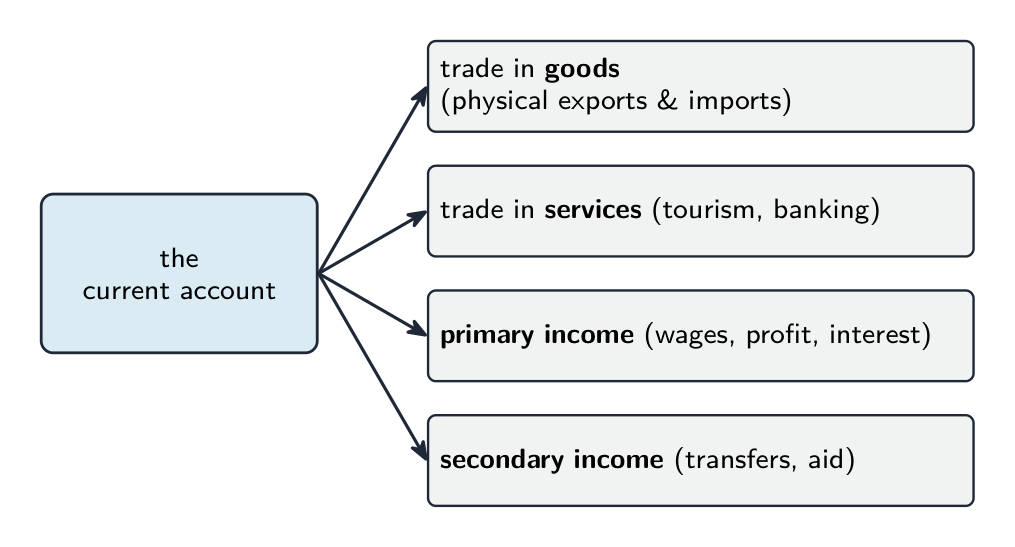
国际收支(balance of payments)记录一个国家与世界其余部分之间的所有交易,在两个主要账户里:

经常账户的四个部分
经常账户的四个部分
  • 经常账户(current account)追踪物品和服务的贸易(出口减进口)、加收入和转移。一个贸易逆差使它为负。
  • 资本(金融)账户(capital (financial) account)追踪金融资产的流动——外国人买国内资产,和居民买外国资产。

这两者是镜像:一个经常账户逆差被一个资本账户顺差匹配(一个进口多于它出口的国家用资产支付,所以外国投资流入)。它们加起来等于零。

词汇表 训练
英文 中文 拼音
balance of payments 国际收支 guó jì shōu zhī
current account 经常账户 jīng cháng zhàng hù
capital (financial) account 资本账户 zī běn zhàng hù
6.2

汇率

大纲
Enduring UnderstandingLearning ObjectiveEssential Knowledge

MKT-5
The interaction of buyers and sellers exchanging the currency of one country for the currency of another determines the equilibrium exchange rate in a flexible exchange market and influences the flow of goods, services, and financial capital between countries.

MKT-5.A
a. Define the exchange rate, currency appreciation, and currency depreciation.
b. Explain how currencies are valued relative to one another.
c. Calculate the value of one currency relative to another.

  • MKT-5.A.1 In the foreign exchange market, one currency is exchanged for another; the price of one currency in terms of the other is the exchange rate.
  • MKT-5.A.2 If one currency becomes more valuable in terms of the other, it is said to appreciate. If one currency becomes less valuable in terms of the other, it is said to depreciate.

来源:美国大学理事会 AP 课程与考试说明

一个汇率(exchange rate)是一种货币以另一种表示的价格。一种货币升值(appreciates),当它获得价值时(买更多外国货币),而贬值(depreciates),当它失去价值时。总是追踪哪种货币:若美元对欧元升值,欧元对美元贬值——同一事件的两面。

Worked example. 假设 $\$1=\text{€}0.90$,所以 $\text{€}1=\dfrac{1}{0.90}\approx\$1.11$。若美元然后升值到 $\$1=\text{€}1.00$,每美元现在买更多欧元,而欧元已贬值——它现在只买 $\$1.00$ 而不是 $\$1.11$。这单个事件是美元的一次升值欧元的一次贬值。

一个由对一种货币的需求和供给设定的浮动汇率

今天大多数货币是浮动(floating)的,由外汇市场的供给和需求设定。

词汇表 训练
英文 中文 拼音
exchange rate 汇率 huì lǜ
appreciates 升值 shēng zhí
depreciates 贬值 biǎn zhí
floating 浮动 fú dòng
6.3

外汇市场

大纲
Enduring UnderstandingLearning ObjectiveEssential Knowledge

MKT-5
The interaction of buyers and sellers exchanging the currency of one country for the currency of another determines the equilibrium exchange rate in a flexible exchange market and influences the flow of goods, services, and financial capital between countries.

MKT-5.B
a. Define the foreign exchange market, demand for currency, and supply of currency.
b. Explain (using graphs as appropriate) the relationship between the exchange rate and the quantity of currency demanded (supplied).

  • MKT-5.B.1 The demand for a currency in a foreign exchange market arises from the demand for the country's goods, services, and financial assets and shows the inverse relationship between the exchange rate and the quantity demanded of a currency.
  • MKT-5.B.2 The supply of a currency in a foreign exchange market arises from making payments in other currencies and shows the positive relationship between the exchange rate and the quantity supplied of a currency.

MKT-5.C
Define (using graphs as appropriate) the equilibrium exchange rate.

  • MKT-5.C.1 In the foreign exchange market, equilibrium is achieved when the exchange rate is such that the quantities demanded and supplied of the currency are equal.

MKT-5.D
Explain (using graphs as appropriate) how exchange rates adjust to restore equilibrium in the foreign exchange market.

  • MKT-5.D.1 Disequilibrium exchange rates create surpluses and shortages in the foreign exchange market. Market forces drive exchange rates toward equilibrium.

来源:美国大学理事会 AP 课程与考试说明

外汇市场

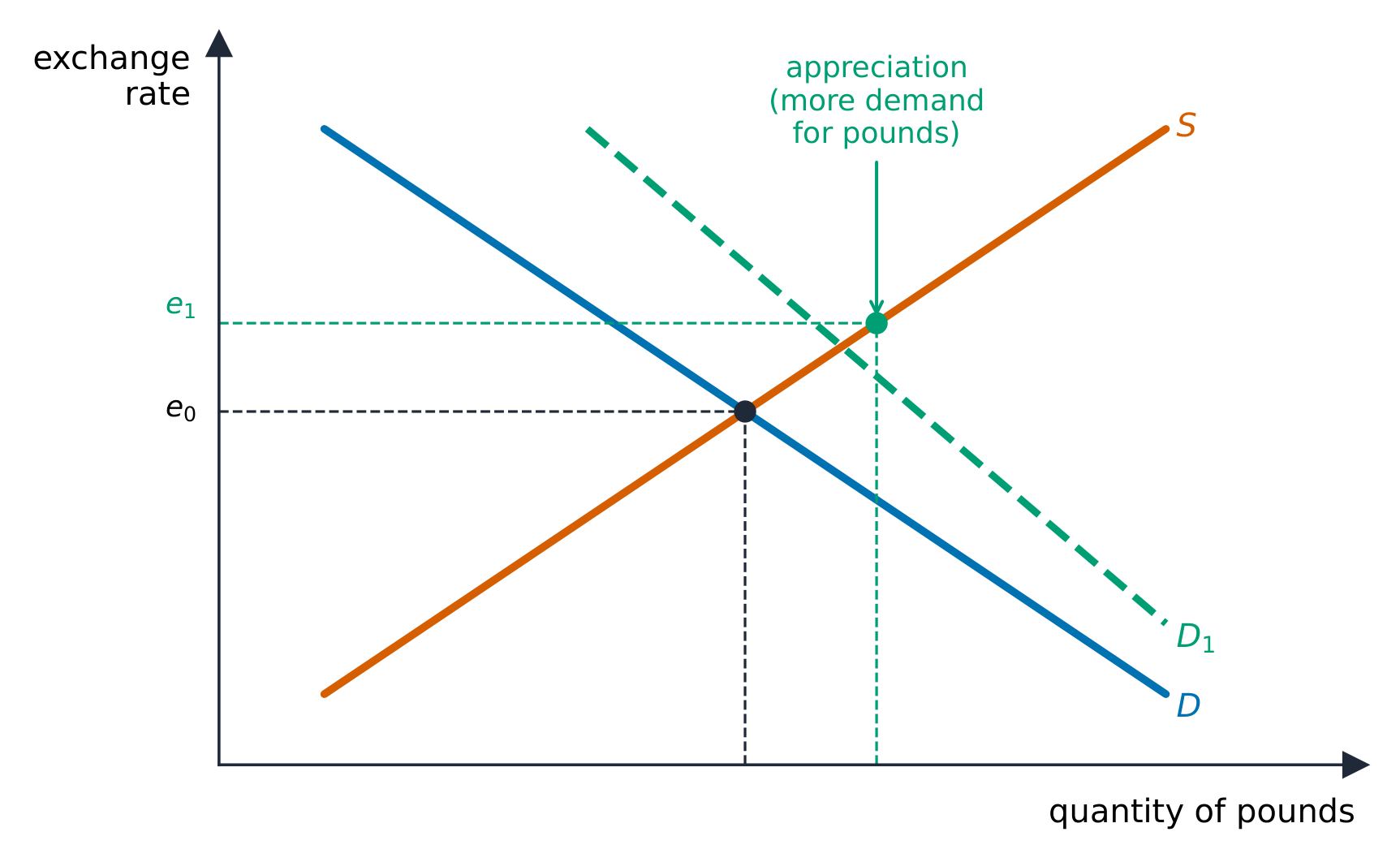
每种货币有它自己的供求图(价格 $=$ 汇率,数量 $=$ 那种货币的量)。

  • 对一种货币的需求来自想要它的物品、服务或资产的外国人。
  • 一种货币的供给来自想要外国物品、服务或资产的它自己的居民。

均衡汇率是它们交叉的地方。对一种货币需求的一次向右移动使它升值;供给的一次向右移动使它贬值

考试技能: 总是为问题里命名的货币画图、用那种货币的价格标注坐标轴,并移动正确的曲线——把两种货币的图搞混是最常见的错误。

探索

The foreign-exchange market

A currency's exchange rate is set where demand for it meets supply. Higher demand for exports or higher interest rates appreciate the currency.

6.4

政策与经济状况变化对外汇市场的影响

大纲
Enduring UnderstandingLearning ObjectiveEssential Knowledge

MKT-5
The interaction of buyers and sellers exchanging the currency of one country for the currency of another determines the equilibrium exchange rate in a flexible exchange market and influences the flow of goods, services, and financial capital between countries.

MKT-5.E
a. Explain (using graphs as appropriate) the determinants of currency demand and supply.
b. Explain (using graphs as appropriate) how changes in demand and supply in the foreign exchange market affect the equilibrium exchange rate.

  • MKT-5.E.1 Factors that shift the demand for a currency (such as the demand for that country's goods, services, or assets) and the supply of a currency (such as tariffs or quotas on the other country's goods and services) change the equilibrium exchange rate.
  • MKT-5.E.2 Fiscal policy can influence aggregate demand, real output, the price level, and exchange rates.
  • MKT-5.E.3 Monetary policy can influence aggregate demand, real output, the price level, and interest rates, and thereby affect exchange rates.

来源:美国大学理事会 AP 课程与考试说明

汇率对以下反应:

  • 相对利率: 一个更高的国内实际利率吸引外国金融投资,提高对这种货币的需求并造成升值
  • 相对价格水平/通货膨胀: 更高的国内通货膨胀使物品竞争力更低,降低对这种货币的需求(贬值)。
  • 相对收入: 更高的国内收入提高进口,增加国内货币的供给(贬值)。
  • 偏好和关于未来价值的预期。

货币政策有一个强的联系:扩张性货币政策降低利率、减少对货币的需求,并造成贬值(它然后提振净出口)。

6.5

外汇市场的变动与净出口
大纲
Enduring UnderstandingLearning ObjectiveEssential Knowledge

MKT-5
The interaction of buyers and sellers exchanging the currency of one country for the currency of another determines the equilibrium exchange rate in a flexible exchange market and influences the flow of goods, services, and financial capital between countries.

MKT-5.F
Explain (using graphs as appropriate) how changes in the value of a currency can lead to changes in a country's net exports and aggregate demand.

  • MKT-5.F.1 Factors that cause a currency to appreciate cause that country's exports to decrease and its imports to increase. As a result, net exports will decrease.
  • MKT-5.F.2 Factors that cause a currency to depreciate cause that country's exports to increase and its imports to decrease. As a result, net exports will increase. [See EK MOD-2.A.3 and EK MOD-2.H.1 for explanations of the effect of changes in net exports on aggregate demand and the resulting effects on output, employment, and the price level.]

来源:美国大学理事会 AP 课程与考试说明

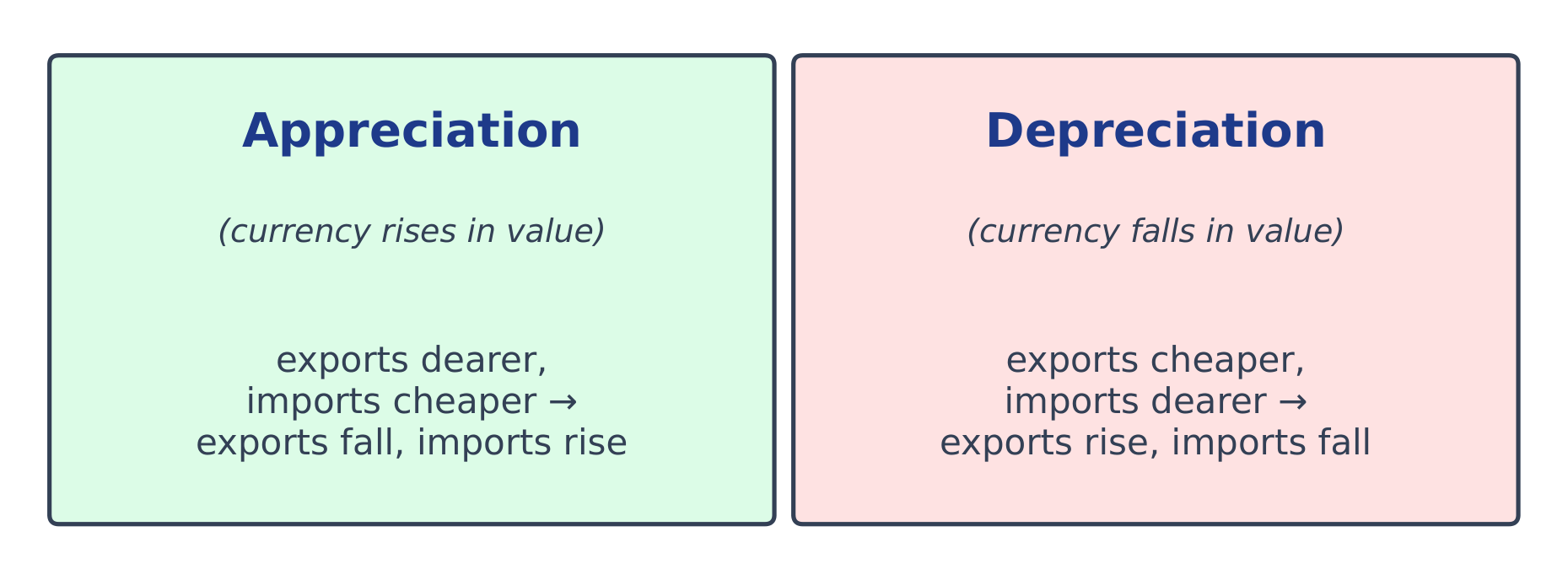
汇率通过净出口反馈进 AD:

升值使出口更贵而进口更便宜;贬值做相反的
  • 一次贬值使出口对外国人更便宜而进口更贵,所以净出口上升而 AD 右移。
  • 一次升值使出口更贵而进口更便宜,所以净出口下降而 AD 左移。

Worked example. 一辆定价 $\$30{,}000$ 的美国车在 $\$1=\text{€}0.90$ 时让一个欧洲买者花 $\text{€}27{,}000$。若美元贬值$\$1=\text{€}0.80$,同一辆车现在只花 $\text{€}24{,}000$ ——对外国人更便宜,所以美国出口上升而进口(现在以美元更贵)下降,提升净出口并使 AD 右移。

这就是外汇市场和 AD-AS 模型如何连接——一次货币变化是政策到达产出的一个渠道。

6.6

实际利率与国际资本流动

大纲
Enduring UnderstandingLearning ObjectiveEssential Knowledge

MKT-5
The interaction of buyers and sellers exchanging the currency of one country for the currency of another determines the equilibrium exchange rate in a flexible exchange market and influences the flow of goods, services, and financial capital between countries.

MKT-5.G
Explain (using graphs as appropriate) how differences in real interest rates across countries affect financial capital flows, foreign exchange markets, and loanable funds markets.

  • MKT-5.G.1 In an open economy, differences in real interest rates across countries change the relative values of domestic and foreign assets. Financial capital will flow toward the country with the relatively higher interest rate. [See EK MKT-4.E.2 and EK MEA-4.A.6 for explanations of the impact on the loanable funds market and on net exports.]
  • MKT-5.G.2 Central banks can influence the domestic interest rate in the short run, which in turn will affect net capital inflows.

来源:美国大学理事会 AP 课程与考试说明

钱追逐最高的实际回报,所以资本流动(capital flows)对实际利率反应:

  • 一个更高的国内实际利率吸引外国金融资本的流入——外国人买国内债券,提高货币需求并造成升值。
  • 一个更低的实际利率造成流出和贬值。

这把整个课程绑在一起:政府借款提高实际利率(可贷资金),它吸引外国资本、使货币升值,并减少净出口——所以一个预算赤字能扩大一个贸易逆差("双赤字")。跨可贷资金、外汇和 AD-AS 图追踪这些相连的效应是 AP 宏观经济学的顶点技能。

词汇表 训练
英文 中文 拼音
capital flows 资本流动 zī běn liú dòng
6.6

考试技巧

  • 经常账户和金融账户是镜像并加起来等于零。
  • 总是为命名的货币画外汇图,并用那种货币标注它的价格;一种货币升值就是另一种贬值。
  • 一次贬值提高净出口(出口更便宜);一次升值降低它们。
  • 更高的国内实际利率吸引资本流入 → 货币升值 → 净出口下降。
  • 把它全部联系起来:一个预算赤字提高实际利率、使货币升值,并能扩大贸易逆差(双赤字)。

本主题的互动课程

逐步学习,并即时检测练习。

AP 宏观经济学历年真题

AP 宏观经济学的更多主题

登录或创建账号

IGCSE, A-Level & AP