Changes in Policies and Economic Conditions
Introduced| English |
|---|
| interest rates/ˈɪntrest reɪts/ |
| inflation/ɪnˈfleɪʃn/ |
| income/ˈɪŋkʌm/ |
| monetary policy/ˈmʌnɪtəri ˈpɒlɪsi/ |
| Fiscal policy/ˈfɪskl ˈpɒlɪsi/ |
What moves the exchange rate
- Several forces shift currency demand and supply, moving the exchange rate.
- The big three: interest rates, inflation, and income.
- Government policy works through these same channels.
- Learn the three and you can predict almost any exchange-rate move.
If a country raises its interest rates (others steady), its currency tends to:
Higher bond returns attract foreign money, raising currency demand.
Higher domestic inflation than the rest of the world tends to make a currency:
Dearer goods lose foreign buyers, so demand for the currency falls.
Interest rates and inflation
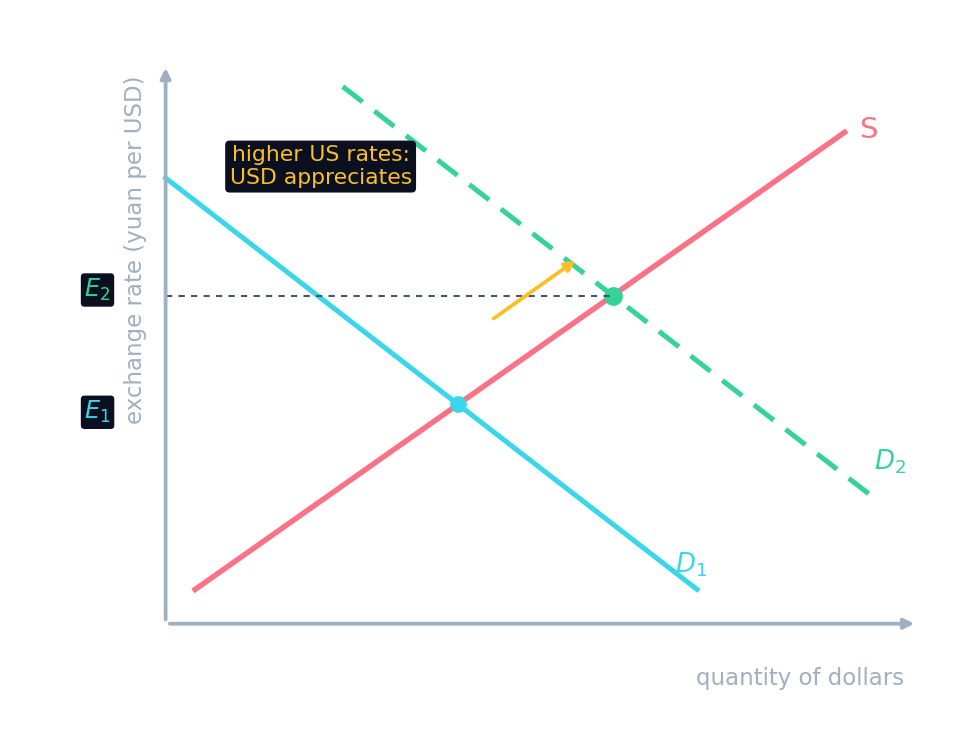
- A change in interest rates 利率: raise them, and foreign investors want your bonds — they demand your currency, so it appreciates.
- A difference in inflation 通货膨胀: higher inflation at home makes your goods dearer, so foreigners buy fewer — demand falls and the currency depreciates.
- So high rates strengthen a currency; high inflation weakens it.
Does it appreciate or depreciate the dollar?
Higher domestic interest rates appreciate a currency; higher inflation or higher income (more imports) depreciate it.
When a country's income booms and imports surge, its currency tends to depreciate because residents:
Buying imports means offering your currency — supply rises, the rate falls.
Income
- A change in income 收入: when a country's income grows, its residents buy more imports.
- To buy imports they supply more of their own currency, which tends to depreciate it.
- A booming economy can therefore weaken its own currency through extra imports.
- Notice this one works through the supply side, not demand.
Contractionary monetary policy, by raising interest rates, tends to strengthen a currency.
Higher rates pull in foreign money that must buy the currency.
Which changes would appreciate a currency? (Select all that apply)
Higher rates and bond demand raise currency demand; inflation and imports weaken it.
The US raises rates while others hold steady. The demand for dollars shifts:
Investors buy dollars to hold higher-paying US bonds — demand right, dollar up.
Policy works the same way
- Contractionary monetary policy 货币政策 raises interest rates and tends to strengthen the currency.
- Fiscal policy 财政政策 that raises interest rates (through government borrowing) can do the same.
- Worked idea. The US central bank raises rates while others hold steady. Global investors move money into higher-paying US bonds, buying dollars first. Demand for dollars shifts right and the dollar appreciates.
- Higher interest rates draw in foreign money and lift the currency.
The exchange rate shifts with interest rates (higher → appreciate), inflation (higher → depreciate), and income (higher → more imports → depreciate). Policy works through these: contractionary monetary policy raises rates and strengthens the currency, as foreign investors buy it to hold higher-paying bonds.