The Circular Flow and GDP · 循环流动模型与国内生产总值
| English | 中文 | Pinyin · 拼音 |
|---|---|---|
| gross domestic product/ɡrəʊs dəˈmestɪk ˈprɒdʌkt/ | 国内生产总值 | guó nèi shēng chǎn zǒng zhí |
| market value/ˈmɑːkɪt ˈvæljuː/ | 市场价值 | shì chǎng jià zhí |
| final goods/ˈfaɪnl ɡʊdz/ | 最终产品 | zuì zhōng chǎn pǐn |
| circular flow model/ˈsɜːkjʊlə fləʊ ˈmɒdl/ | 循环流动模型 | xún huán liú dòng mó xíng |
| households/ˈhaʊshəʊldz/ | 家庭 | jiā tíng |
| firms/fɜːmz/ | 企业 | qǐ yè |
| government/ˈɡʌvənmənt/ | 政府 | zhèng fǔ |
| intermediate goods/ˌɪntəˈmiːdɪət ɡʊdz/ | 中间产品 | zhōng jiān chǎn pǐn |
| double-count/ˈdʌbl kaʊnt/ | 重复计算 | chóng fù jì suàn |
| used goods/juːzd ɡʊdz/ | 二手商品 | èr shǒu shāng pǐn |
| purely financial transactions/ˈpjʊəli faɪˈnænʃl trænˈsækʃnz/ | 纯金融交易 | chún jīn róng jiāo yì |
One number for a whole economy
- How do you measure something as vast as a country's output?
- You add up the value of everything it produces in a year.
- That single figure is gross domestic product 国内生产总值 (GDP).
- A simple model shows why a nation's output and its income are the same thing.
用一个数字看整个经济
- 怎么衡量像一个国家的产出这样庞大的东西?
- 你把它一年里生产的所有东西的价值加起来。
- 这个单一数字就是国内生产总值(gross domestic product,GDP)。
- 一个简单的模型说明,为什么一国的产出和收入是同一回事。
The circular flow
- GDP is the market value 市场价值 of all final goods 最终产品 and services made in a country in a year.
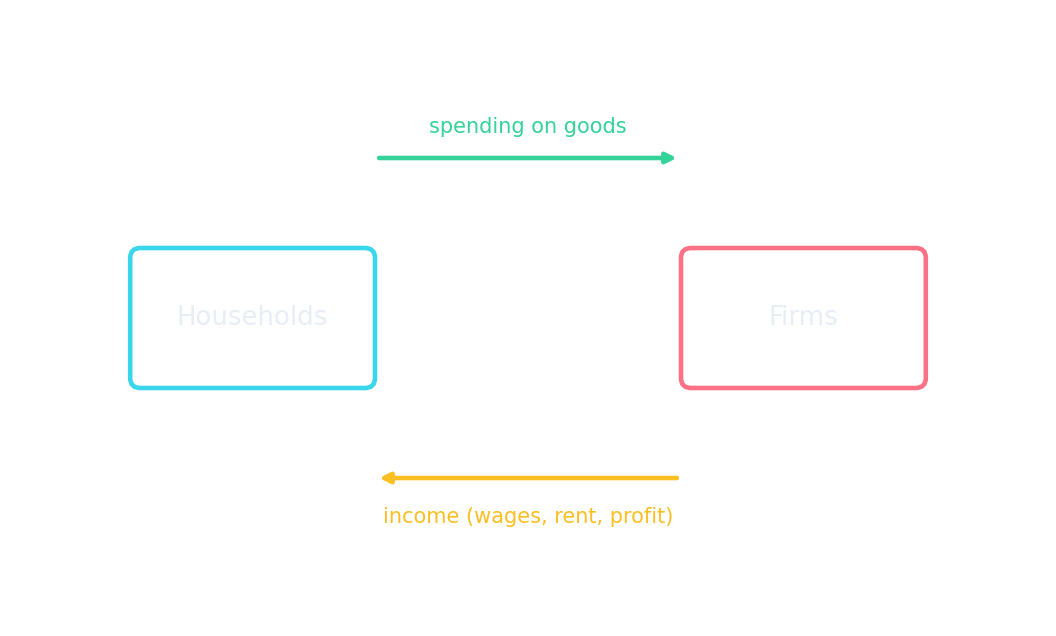
- The circular flow model 循环流动模型 tracks money among households 家庭, firms 企业, and government 政府.
- Households sell resources to firms and earn income; firms make goods and sell them back.
- Every dollar spent is a dollar earned — so total spending equals total income.
循环流动
- GDP 是一个国家一年里生产的所有最终产品(final goods)和服务的市场价值(market value)。
- 循环流动模型(circular flow model)追踪金钱在家庭(households)、企业(firms)和政府(government)之间的流动。
- 家庭把资源卖给企业赚取收入;企业生产商品再卖回给家庭。
- 花出去的每一元都是赚到的一元——所以总支出等于总收入。
GDP is the market value of all ______ goods and services produced in a country in a year. · GDP 是一个国家一年里生产的所有______产品和服务的市场价值。
Only final goods count, so we don't double-count the intermediate parts. · 只算最终产品,这样就不会重复计算中间部件。
In the circular flow, total spending equals total income. · 在循环流动中,总支出等于总收入。
Every dollar a household spends becomes a dollar of income for a firm's workers or owners. · 家庭花的每一元都变成企业工人或所有者的一元收入。
Match each way of measuring GDP to what it adds up. · 把每种衡量 GDP 的方法与它加总的东西配对。
All three give the same GDP, because spending = income = value created. · 三者给出相同的 GDP,因为支出 = 收入 = 创造的价值。
What GDP leaves out
- Intermediate goods 中间产品 — used up to make something else (flour for a bakery); only the final bread counts, or we double-count 重复计算.
- Used goods 二手商品 — a resale was already counted when the item was new.
- Purely financial transactions 纯金融交易 — buying a stock just moves money; it produces nothing new.
GDP 不计入什么
- 中间产品(intermediate goods)——被用掉去生产别的东西(做面包的面粉);只算最终的面包,否则就重复计算(double-count)。
- 二手商品(used goods)——转售在物品全新时就已经算过了。
- 纯金融交易(purely financial transactions)——买股票只是转移金钱,并没有生产新东西。
Does it count in GDP? · 它算进 GDP 吗?
GDP counts only final goods and services made this year. Intermediate goods, used goods, and financial trades are excluded. · GDP 只计算今年生产的最终产品和服务。中间产品、二手商品和金融交易都被排除。
Select all · 所有 that are excluded from GDP. · 选出所有被 GDP 排除的项目。
Intermediate, used, and financial transactions are excluded; a new final good counts. · 中间、二手和金融交易被排除;新的最终产品计入。
The expenditure approach
- Add up all spending on final goods: $GDP = C + I + G + (X - M)$.
- $C$ is consumption, $I$ investment, $G$ government spending, $X$ exports, $M$ imports.
- We subtract imports because they are made abroad, not here.
- Worked idea. With $C = 700$, $I = 200$, $G = 300$, $X = 150$, $M = 100$: $GDP = 700 + 200 + 300 + 50 = 1250$ billion.
支出法
- 把所有对最终产品的支出加起来:$GDP = C + I + G + (X - M)$。
- $C$ 是消费,$I$ 投资,$G$ 政府支出,$X$ 出口,$M$ 进口。
- 我们减去进口,因为它们是在国外生产的,不是本国。
- 例题。 当 $C = 700$、$I = 200$、$G = 300$、$X = 150$、$M = 100$:$GDP = 700 + 200 + 300 + 50 = 1250$ 十亿。
With C = 700, I = 200, G = 300, exports X = 150, and imports M = 100, what is GDP? · 当 C = 700、I = 200、G = 300、出口 X = 150、进口 M = 100 时,GDP 是多少?
GDP = C + I + G + (X − M) = 700 + 200 + 300 + (150 − 100) = 1250. · GDP = C + I + G + (X − M) = 700 + 200 + 300 + (150 − 100) = 1250。
In GDP = C + I + G + (X − M), why do we subtract imports (M)? · 在 GDP = C + I + G + (X − M) 中,为什么要减去进口(M)?
Spending on imports is included in C, I, or G, but the output was made abroad — so we subtract it. · 对进口的支出已包含在 C、I 或 G 中,但产出是在国外做的——所以要减去。
GDP is the market value of all final goods made in a country in a year. The circular flow shows why total spending equals total income. Measure it with the expenditure approach: $GDP = C + I + G + (X - M)$, excluding intermediate goods, used goods, and financial transactions.
GDP 是一个国家一年里生产的所有最终产品的市场价值。循环流动说明为什么总支出等于总收入。用支出法衡量它:$GDP = C + I + G + (X - M)$,不计中间产品、二手商品和金融交易。