持久理解(CHA-1): 微积分使我们能够将关于运动的普遍知识推广到各种涉及变化的问题中。
学习目标 CHA-1.A: 通过包含该瞬时的区间内的平均变化率来解释瞬时变化率。
- CHA-1.A.1 微积分利用极限来理解和建模动态变化。
- CHA-1.A.2 由于平均变化率是将一个变量的变化量除以另一个变量的变化量,因此当自变量的变化量为零时,该点的平均变化率是未定义的。
- CHA-1.A.3 极限概念使我们能够基于平均变化率来定义瞬时变化率。
AP 微积分 BC · 知识点 1
 17:53
极限与连续性
从一个谜题开始。汽车速度表显示每小时六十公里。但这在单一时刻意味着什么?速度是距离除以时间。然而在一……内
英语旁白 · 英中内嵌字幕
持久理解(CHA-1): 微积分使我们能够将关于运动的普遍知识推广到各种涉及变化的问题中。
学习目标 CHA-1.A: 通过包含该瞬时的区间内的平均变化率来解释瞬时变化率。
来源:College Board AP 课程与考试说明
Calculus is the mathematics of change 变化 and of accumulation 累积. It answers two big questions: how fast is something changing right now, and how much has piled up so far? Unit 1 builds the one tool both questions rest on – the limit 极限.
Start with a puzzle. A car's speedometer reads $60$ km/h. What does that mean at a single instant 瞬间? Speed is distance over time. But at one instant no time passes and no distance is covered, so the fraction looks like $\tfrac{0}{0}$ – undefined.
The clever move is not to plug in zero (undefined), but to watch what the average rate approaches as the interval gets smaller and smaller. That approaching value is a limit. So calculus lets us describe change at an instant – as a limit of average rates over ever-shorter intervals. This one idea powers the derivative 导数 (Unit 2) and, run in reverse, the integral 积分 (Unit 6). Everything else in this unit defines limits carefully and computes them reliably.
y = bx² + d
沿曲线滑动该点。切线显示了该处确切的瞬时变化率 $\frac{dy}{dx}$——即当区间缩小到单个瞬间时平均变化率趋近的值。斜率随位置变化,因此变化确实在每个瞬间都有一个值。
| English | 中文 | 拼音 |
|---|---|---|
| change/tʃeɪndʒ/ | 变化 | biàn huà |
| accumulation/əˌkjuːmjʊˈleɪʃn/ | 累积 | lěi jī |
| limit/ˈlɪmɪt/ | 极限 | jí xiàn |
| at a single instant/ætə ˈsɪŋɡl ˈɪnstənt/ | 瞬间 | shùn jiān |
| average rate of change/ˈævrɪdʒ reɪt ɒv tʃeɪndʒ/ | 平均变化率 | píng jūn biàn huà lǜ |
| interval/ˈɪntəvl/ | 区间 | qū jiān |
| instantaneous rate of change/ˌɪnstənˈteɪnɪəs reɪt ɒv tʃeɪndʒ/ | 瞬时变化率 | shùn shí biàn huà lǜ |
| approaches/əˈprəʊtʃɪz/ | 趋近 | qū jìn |
| derivative/dɪˈrɪvətɪv/ | 导数 | dǎo shù |
| integral/ˈɪntɪɡrəl/ | 积分 | jī fēn |
| hole/həʊl/ | 空洞 | kōng dòng |

持久理解 (LIM-1): 利用定义、定理和性质进行推理,可以为关于极限的断言提供依据。
学习目标 LIM-1.A: 使用正确的记号以解析方式表示极限。
学习目标 LIM-1.B: 解释用解析记号表达的极限。
来源:College Board AP 课程与考试说明
Given a function $f$, the limit of $f(x)$ as $x$ approaches $c$ is a real number $R$ if $f(x)$ can be made arbitrarily 任意地 close to $R$ by taking $x$ sufficiently 足够 close to $c$ – but not equal to $c$. We write
The last words are the heart of a limit: it describes the behavior 行为 of $f$ near $c$, not the value at $c$. The function may be undefined at $c$, or defined but equal to something else – the limit does not care.
A limit can be shown in three ways: graphically 用图象, numerically 用数值 (a table), and analytically 用解析式 (algebra). Learning to move between these representations is a core skill.
(Note: the epsilon-delta definition of a limit is not tested on the AP Exam, so this handout does not use it.)
y = ax² + bx + c
拖动系数并在心中选定一个输入 $c$ —— 极限是曲线在 $c$ 附近趋近的高度,而非该点本身。
| English | 中文 | 拼音 |
|---|---|---|
| arbitrarily/ˌɑːbɪˈtrerɪli/ | 任意地 | rèn yì dì |
| sufficiently/səˈfɪʃəntli/ | 足够 | zú gòu |
| behavior/bɪˈheɪvjə/ | 行为 | xíng wéi |
| graphically/ˈɡræfɪkli/ | 用图象 | yòng tú xiàng |
| numerically/njuːˈmerɪkli/ | 用数值 | yòng shù zhí |
| analytically/ˌænəˈlɪtɪkli/ | 用解析式 | yòng jiě xī shì |
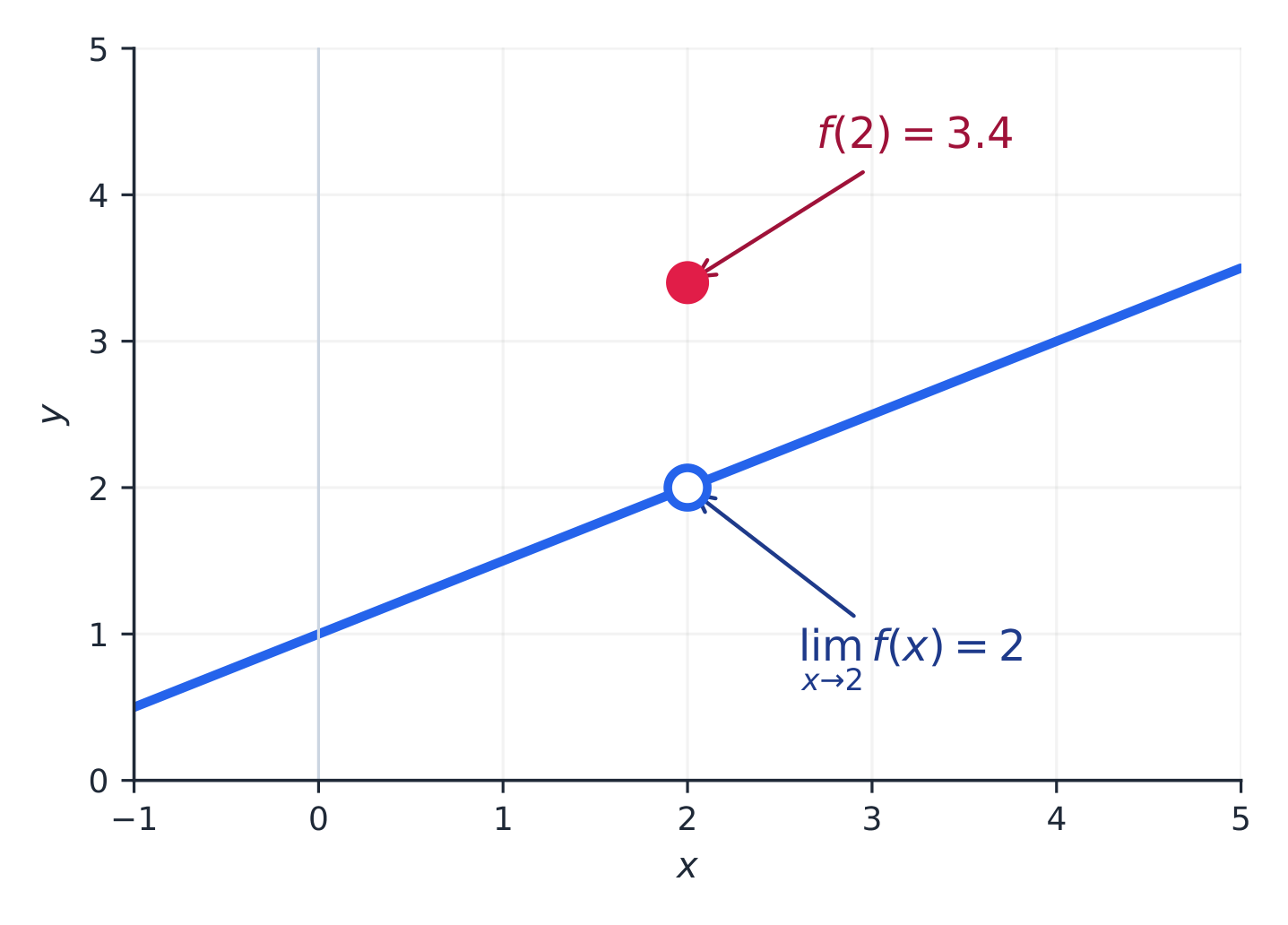
持久理解 (LIM-1): 运用定义、定理和性质进行推理,可以为关于极限的论断提供依据。
学习目标 LIM-1.C: 估计函数的极限。
来源:College Board AP 课程与考试说明
A graph is often the fastest way to read a limit. To find $\displaystyle \lim_{x \to c} f(x)$, run your finger along the curve toward $x = c$ from each side and ask: what height is the curve heading for?
Crucially, ignore the point itself. Graphs mark the difference between the limit and the value:
So a curve may approach $R = 3$ from both sides (limit is $3$) while a filled dot sits at height $5$ (value $f(c) = 5$). The limit is $3$; the two need not match.
A limit does not exist (often written DNE) when the two sides disagree (a jump 跳跃), when the function is unbounded 无界 (grows without limit), or when it oscillates 振荡 near $c$ with fluctuations that do not shrink toward one value. Oscillation alone does not prevent a limit: $x\sin(1/x)\to0$ as $x\to0$. For example:
Watch the scale 比例 of a graph: a zoomed-out picture can hide important behavior near a point, so confirm with algebra when you can.
y = ax² + bx + c
当 $x\to c$ 时的极限是曲线从两侧趋近的高度——它关注的是函数要去往哪里,而不是其在 $c$ 处的值。跟随曲线趋向一个 $x$ 并读取它趋近的 $y$。
| English | 中文 | 拼音 |
|---|---|---|
| left-hand limit/left hænd ˈlɪmɪt/ | 左极限 | zuǒ jí xiàn |
| right-hand limit/raɪt hænd ˈlɪmɪt/ | 右极限 | yòu jí xiàn |
| one-sided limits/wʌn ˈsaɪdɪd ˈlɪmɪts/ | 单侧极限 | dān cè jí xiàn |
| open circle/ˈəʊpən ˈsɜːkl/ | 空心圆 | kōng xīn yuán |
| closed circle/kləʊzd ˈsɜːkl/ | 实心圆 | shí xīn yuán |
| jump/dʒʌmp/ | 跳跃 | tiào yuè |
| unbounded/ʌnˈbaʊndɪd/ | 无界 | wú jiè |
| oscillates/ˈɒsɪleɪts/ | 振荡 | zhèn dàng |
| scale/skeɪl/ | 比例 | bǐ lì |
持久理解 (LIM-1): 利用定义、定理和性质进行推理,可以为关于极限的论断提供依据。
学习目标 LIM-1.C: 估算函数的极限。
来源:College Board AP 课程与考试说明
When you have data or a formula but no picture, a table 表格 of values estimates a limit numerically. Choose inputs that creep toward $c$ from both sides and watch the outputs.
For example, to estimate $\displaystyle \lim_{x \to 2} \frac{x^2 - 4}{x - 2}$ (which is $\tfrac{0}{0}$ at $x=2$):
| $x$ | $1.9$ | $1.99$ | $1.999$ | $\to 2 \leftarrow$ | $2.001$ | $2.01$ | $2.1$ |
|---|---|---|---|---|---|---|---|
| $f(x)$ | $3.9$ | $3.99$ | $3.999$ | ? | $4.001$ | $4.01$ | $4.1$ |
Both sides march toward $4$, so we estimate the limit is $4$. A table only suggests a value – it is a numerical estimate, not a proof.
y = ax² + bx + c
表格只是曲线上采样的点——拖动系数并想象输出收敛于单一高度。
| English | 中文 | 拼音 |
|---|---|---|
| table/ˈteɪbl/ | 表格 | biǎo gé |
持久理解 (LIM-1): 运用定义、定理和性质可以对关于极限的主张进行论证。
学习目标 LIM-1.D: 利用极限定理确定函数的极限。
来源:College Board AP 课程与考试说明
Most limits are found analytically using limit theorems 极限定理. If $\lim_{x\to c} f(x)$ and $\lim_{x\to c} g(x)$ both exist, the limit of a combination is the same combination of the limits:
The practical rule: for a function built from polynomials, roots, and the like, first try direct substitution 直接代入 – put $x = c$ in. If you get a real number, that is the limit. One-sided limits obey the same theorems, read from one direction only.
y = ax² + bx + c
多项式处处光滑——拖动系数并理解为何直接代入 $c$(直接代入法)只需读出高度即可。
| English | 中文 | 拼音 |
|---|---|---|
| limit theorems/ˈlɪmɪt ˈθɪərəmz/ | 极限定理 | jí xiàn dìng lǐ |
| Composite/ˈkɒmpəzɪt/ | 复合函数 | fù hé hán shù |
| direct substitution/daɪˈrekt ˌsʌbstɪˈtjuːʃn/ | 直接代入 | zhí jiē dài rù |
持久理解(LIM-1): 利用定义、定理和性质进行推理,可以为关于极限的论断提供依据。
学习目标 LIM-1.E: 利用函数的等价表达式或夹逼定理求函数的极限。
来源:College Board AP 课程与考试说明
Direct substitution sometimes gives the indeterminate form 未定式 $\tfrac{0}{0}$. This does not mean the limit fails – it means you must rewrite the function into an equivalent form 等价形式 that removes the trouble, then substitute. Three standard moves:
The cancelled factor is why the original graph had a hole: the two functions agree everywhere except at $x=c$, so they share the same limit there.
y = x + 3(来自约去 (x−3))
因式分解并约分后,图形变为普通曲线仅剩一个缺失点——极限可从该缺口读出。
| English | 中文 | 拼音 |
|---|---|---|
| indeterminate form/ˌɪndɪˈtɜːmɪnət fɔːm/ | 未定式 | wèi dìng shì |
| equivalent form/ɪˈkwɪvələnt fɔːm/ | 等价形式 | děng jià xíng shì |
| Factor and cancel/ˈfæktə ænd ˈkænsl/ | 因式分解并约分 | yīn shì fēn jiě bìng yuē fēn |
| rational function/ˈræʃənl ˈfʌŋkʃn/ | 有理函数 | yǒu lǐ hán shù |
| conjugate/ˈkɒndʒuːɡeɪt/ | 共轭 | gòng è |
| radical/ˈrædɪkl/ | 根式 | gēn shì |
本主题旨在聚焦于选择求极限适当方法的技能。应为学生提供练习机会,使其掌握何时以及如何应用所有与求极限相关的学习目标。
来源:College Board AP 课程与考试说明
This is a skill topic, not new content: choose the right tool for the limit in front of you.
y = ax² + bx + c
改变形状并询问代入是否给出数字、孔($\tfrac00$)或爆炸($\tfrac{n}{0}$)——这种分诊决定你的工具。
| English | 中文 | 拼音 |
|---|---|---|
| dominant/ˈdɒmɪnənt/ | 主导 | zhǔ dǎo |

持久理解 (LIM-1): 运用定义、定理和性质进行推理,可以为关于极限的论断提供依据。
学习目标 LIM-1.E: 利用函数的等价表达式或夹逼定理来确定函数的极限。
来源:College Board AP 课程与考试说明
The squeeze theorem 夹逼定理 (also called the sandwich theorem) finds a limit by trapping the function between two others. If $g(x) \le f(x) \le h(x)$ near $c$, and
The two famous results proved this way, both used throughout calculus, are:
y = ax²
抛物线 $y=x^2$ 及其镜像 $-x^2$ 在原点处共同挤压至 $0$ — 被夹在两者之间的任何函数都被迫趋向于 $0$。
| English | 中文 | 拼音 |
|---|---|---|
| squeeze theorem/skwiːz ˈθɪərəm/ | 夹逼定理 | jiā bī dìng lǐ |
本主题旨在重点训练学生建立不同表示形式之间的联系。应为学生提供练习机会,使其掌握何时以及如何应用所有与极限相关的学习目标,并能够在单一表示形式之间或跨多种表示形式之间转换数学信息。
来源:College Board AP 课程与考试说明
Another skill topic: the same limit lives in a graph, a table, and an algebraic form, and you should be able to translate between them. A graph shows the shape and any holes or jumps; a table gives numerical evidence; algebra gives an exact value and a reason. Strong answers use one representation to confirm another.
y = ax² + bx + c
同一条曲线也可以以表格或公式的形式提供 — 读取其在某点附近的行为并用文字描述。
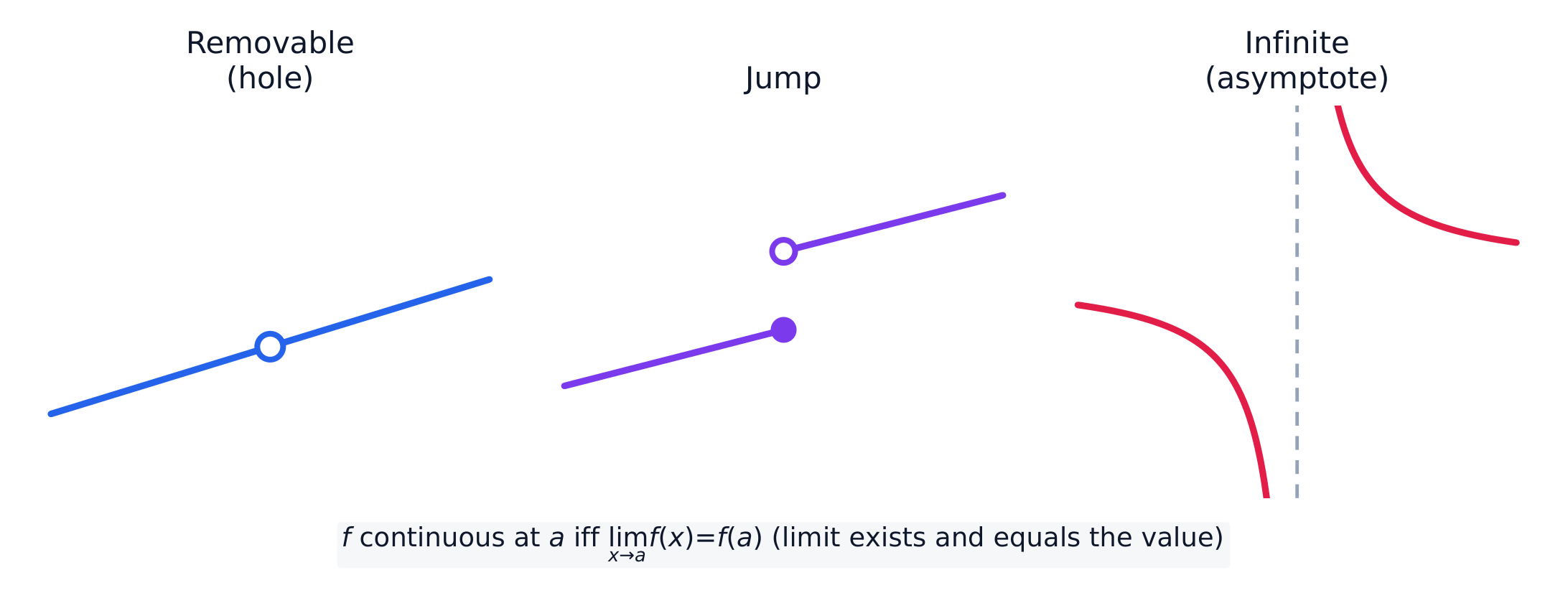
持久理解(LIM-2): 利用定义、定理和性质进行推理,可以为关于连续性的论断提供依据。
学习目标 LIM-2.A: 利用定义论证某点处的连续性结论。
来源:College Board AP 课程与考试说明
A function is discontinuous 间断 at $c$ when its graph “breaks” there. There are three types:
y = a / (x − b)
倒数函数在其分母为零的点附近趋向于 $\pm\infty$ — 这是无穷间断点和垂直渐近线。
| English | 中文 | 拼音 |
|---|---|---|
| discontinuous/dɪskənˈtɪnjuːəs/ | 间断 | jiàn duàn |
| Removable discontinuity/rɪˈmuːvəbl dɪskɒntɪˈnjuːɪti/ | 可去间断 | kě qù jiàn duàn |
| Jump discontinuity/dʒʌmp dɪskɒntɪˈnjuːɪti/ | 跳跃间断 | tiào yuè jiàn duàn |
| Infinite discontinuity/ˈɪnfɪnət dɪskɒntɪˈnjuːɪti/ | 无穷间断 | wú qióng jiàn duàn |
| vertical asymptote/ˈvɜːtɪkl ˈæsɪmptəʊt/ | 垂直渐近线 | chuí zhí jiàn jìn xiàn |
持久理解(LIM-2): 运用定义、定理和性质进行推理,可以为关于连续性的主张提供依据。
学习目标 LIM-2.A: 利用定义论证关于函数在某一点处连续性的结论。
来源:College Board AP 课程与考试说明
Continuity is defined by a three-part test. A function $f$ is continuous 连续 at $x=c$ exactly when all three hold:
In words: the point is there, the limit is there, and the two agree. If any one fails, $f$ is discontinuous at $c$. This test is the backbone of nearly every continuity question, so learn it as a checklist.
y = ax² + bx + c
该多项式在所有点都满足三个连续性条件 — 有定义、极限存在且两者相等。
| English | 中文 | 拼音 |
|---|---|---|
| continuous/kənˈtɪnjuːəs/ | 连续 | lián xù |
持久理解 (LIM-2): 利用定义、定理和性质进行推理,可以为关于连续性的主张提供依据。
学习目标 LIM-2.B: 确定函数连续的区间。
来源:College Board AP 课程与考试说明
A function is continuous on an interval 在区间上连续 if it is continuous at every point of that interval. You rarely check point by point, because whole families are continuous on their domains:
Polynomial, rational, power, exponential 指数, logarithmic 对数, and trigonometric 三角 functions are continuous at every point of their domains.
So a rational function is continuous everywhere except where its denominator is zero; $\ln x$ is continuous for $x>0$; and so on. Knowing this lets you declare continuity quickly and correctly.
y = ax³ + bx
多项式在任何区间上都连续 — 无论你在哪里看都没有空洞、跳跃或爆炸。
| English | 中文 | 拼音 |
|---|---|---|
| continuous on an interval/kənˈtɪnjuːəs ɒn ən ˈɪntəvl/ | 在区间上连续 | zài qū jiān shàng lián xù |
| exponential/ˌekspəˈnenʃl/ | 指数 | zhǐ shù |
| logarithmic/ˌlɒɡəˈrɪθmɪk/ | 对数 | duì shù |
| trigonometric/ˌtrɪɡənəʊˈmetrɪk/ | 三角 | sān jiǎo |
持久理解 (LIM-2): 利用定义、定理和性质进行推理,可以为关于连续性的主张提供依据。
学习目标 LIM-2.C: 确定使不连续函数变为连续的 $x$ 值或求解参数(若可能)。
来源:College Board AP 课程与考试说明
If the limit exists at a hole, the discontinuity is removable: redefine the function at that one point to equal the limit, and the graph is repaired. Formally, set the missing value to $\displaystyle \lim_{x\to c} f(x)$.
For a piecewise-defined function 分段函数, continuity at a boundary $x=c$ needs the two pieces to meet: the left piece's value, the right piece's value, and $f(c)$ must all be equal. This is a common exam setup – you solve for a parameter 参数 (an unknown constant) that makes the pieces match:
Worked example. Find the constant $k$ that makes this function continuous at $x=2$:
Check: with $k=1$ both pieces give $3$ at $x=2$, so all three conditions of the continuity test hold.
y = x + 3
约分后的函数 $y=x+3$ 是一条直线 — 填充空洞只是绘制了该直线已经经过的点。
| English | 中文 | 拼音 |
|---|---|---|
| piecewise-defined function/ˈpiːswaɪz dɪˈfaɪnd ˈfʌŋkʃn/ | 分段函数 | fēn duàn hán shù |
| parameter/pəˈræmɪtə/ | 参数 | cān shù |
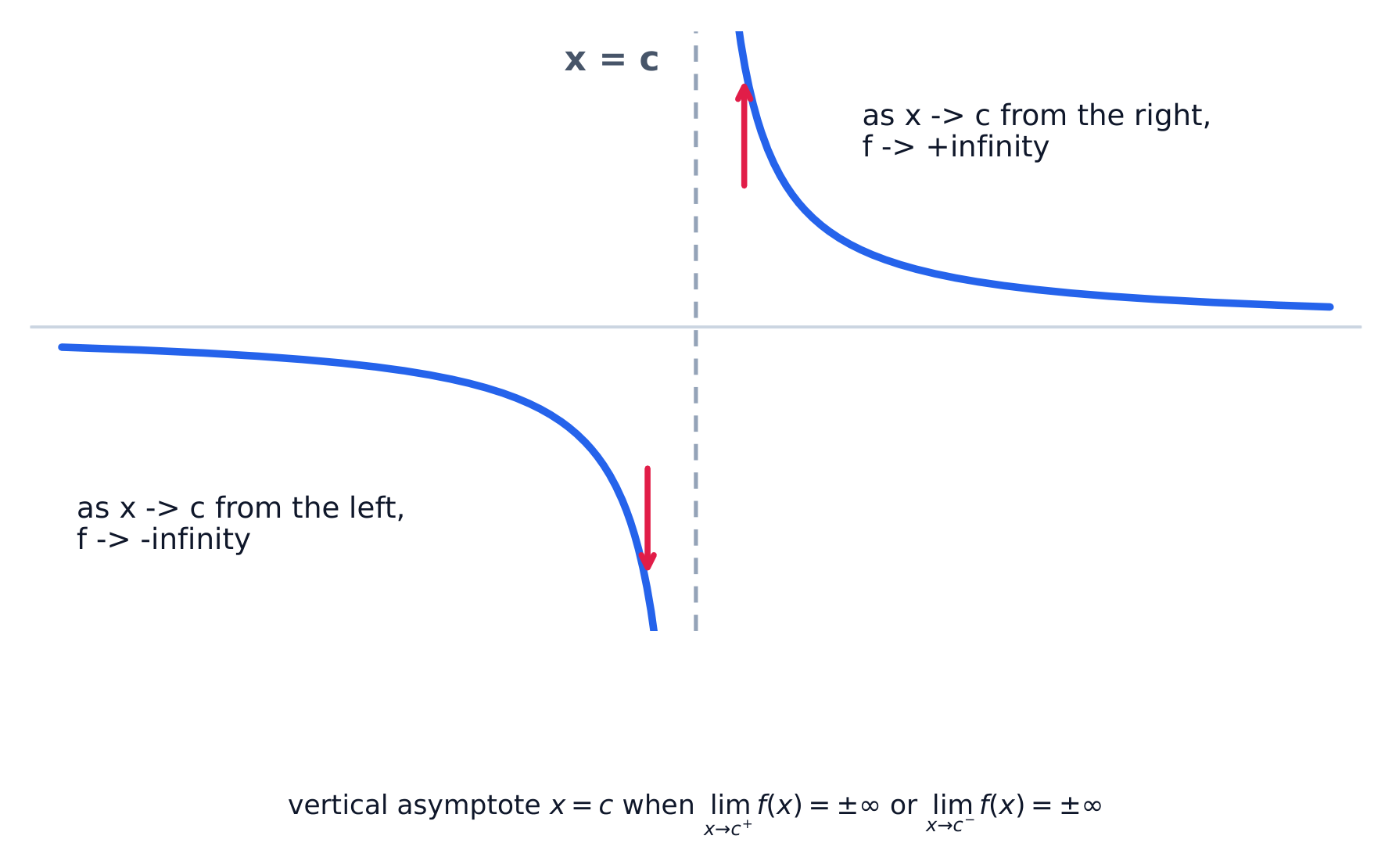
持久理解 (LIM-2): 利用定义、定理和性质进行推理,可以为关于连续性的主张提供依据。
学习目标 LIM-2.D: 使用涉及无穷大的极限来解释函数的行为。
来源:College Board AP 课程与考试说明
The idea of a limit extends to infinite limits 无穷极限. When a function grows without bound near $x=c$, we write $\lim_{x\to c} f(x) = \pm\infty$. This describes a vertical asymptote at $x=c$: the graph hugs the vertical line $x=c$ and shoots off toward $\pm\infty$.
This happens where a non-zero number is divided by something approaching $0$, such as at a zero of a denominator that does not cancel. Always check each side separately – the two sides can shoot opposite ways (one to $+\infty$, one to $-\infty$).
Worked example. Find $\displaystyle \lim_{x\to 1^-}\frac{x+2}{x-1}$ and $\displaystyle \lim_{x\to 1^+}\frac{x+2}{x-1}$.
Substitution gives $\tfrac{3}{0}$: a non-zero number over $0$, so each one-sided limit is infinite. Decide the sign from each side:
The line $x=1$ is a vertical asymptote, and the two-sided limit does not exist.
y = a/(x − b) + c
当 $x \to 0$ 时,曲线 $y=\frac{1}{x}$ 从右侧冲向 $+\infty$,从左侧冲向 $-\infty$——直线 $x=0$ 是图像紧贴但从不接触的垂直渐近线。
| English | 中文 | 拼音 |
|---|---|---|
| infinite limits/ˈɪnfɪnət ˈlɪmɪts/ | 无穷极限 | wú qióng jí xiàn |
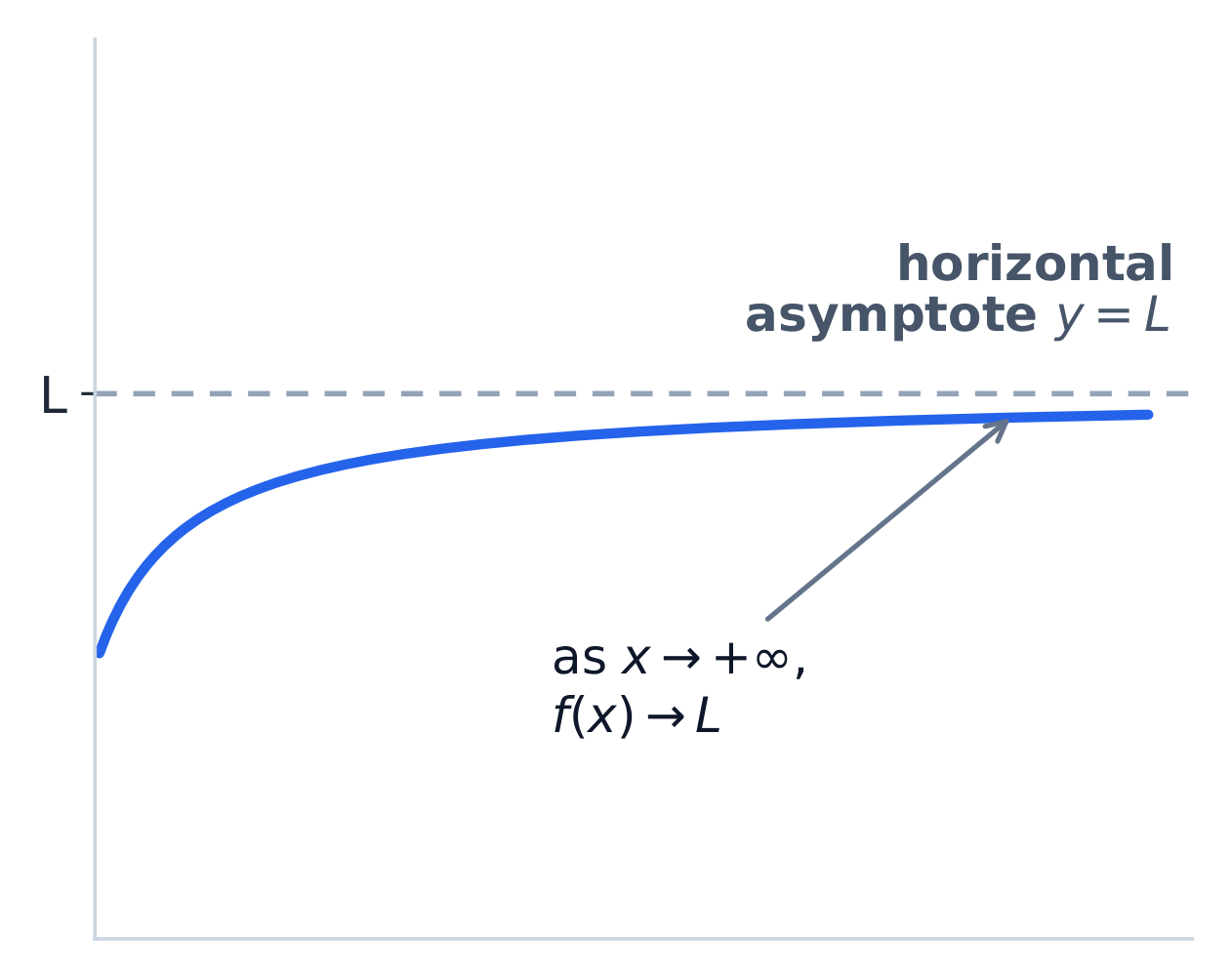
持久理解 (LIM-2): 运用定义、定理和性质进行推理,可以为关于连续性的主张提供依据。
学习目标 LIM-2.D: 利用涉及无穷大的极限来解释函数的行为。
来源:College Board AP 课程与考试说明
We can also let the input grow: limits at infinity 无穷远处的极限 describe the end behavior 末端行为 of a function as $x\to\pm\infty$. If the outputs settle toward a finite value $L$, then $y=L$ is a horizontal asymptote 水平渐近线.
For a rational function, compare the degrees 次数 of the top and bottom:
More generally, we compare the relative magnitudes 相对大小 (relative growth rates) of functions: far out, an exponential beats any polynomial, and a polynomial beats any logarithm. On the exam, “as $t\to\infty$, which quantity is larger/where does the rate settle?” is answered with a limit at infinity.
Worked example. Evaluate $\lim_{x\to\infty}\dfrac{3x^2-5}{2x^2+x}$. Divide top and bottom by the highest power, $x^2$: $\dfrac{3-5/x^2}{2+1/x}\to\dfrac{3-0}{2+0}=\dfrac{3}{2}$. Because the limit is a finite number, the line $y=\tfrac{3}{2}$ is a horizontal asymptote of the graph.
y = a/(x − b) + c
在极左和极右远处,曲线趋于平缓并向 $y=\mathbf{c}$ ——即 $\lim_{x\to\pm\infty}f(x)$,这是水平渐近线。更改 $\mathbf{c}$ 以移动其稳定所在的水平位置。
| English | 中文 | 拼音 |
|---|---|---|
| limits at infinity/ˈlɪmɪts æt ɪnˈfɪnɪti/ | 无穷远处的极限 | wú qióng yuǎn chù de jí xiàn |
| end behavior/end bɪˈheɪvjə/ | 末端行为 | mò duān xíng wéi |
| horizontal asymptote/ˌhɒrɪˈzɒntl ˈæsɪmptəʊt/ | 水平渐近线 | shuǐ píng jiàn jìn xiàn |
| degrees/dɪˈɡriːz/ | 次数 | cì shù |
| ratio of the leading coefficients/ˈreɪʃɪəʊ ɒvðə ˈliːdɪŋ ˌkəʊɪˈfɪʃənts/ | 首项系数之比 | shǒu xiàng xì shù zhī bǐ |
| relative magnitudes/ˈrelətɪv ˈmæɡnɪtjuːdz/ | 相对大小 | xiāng duì dà xiǎo |
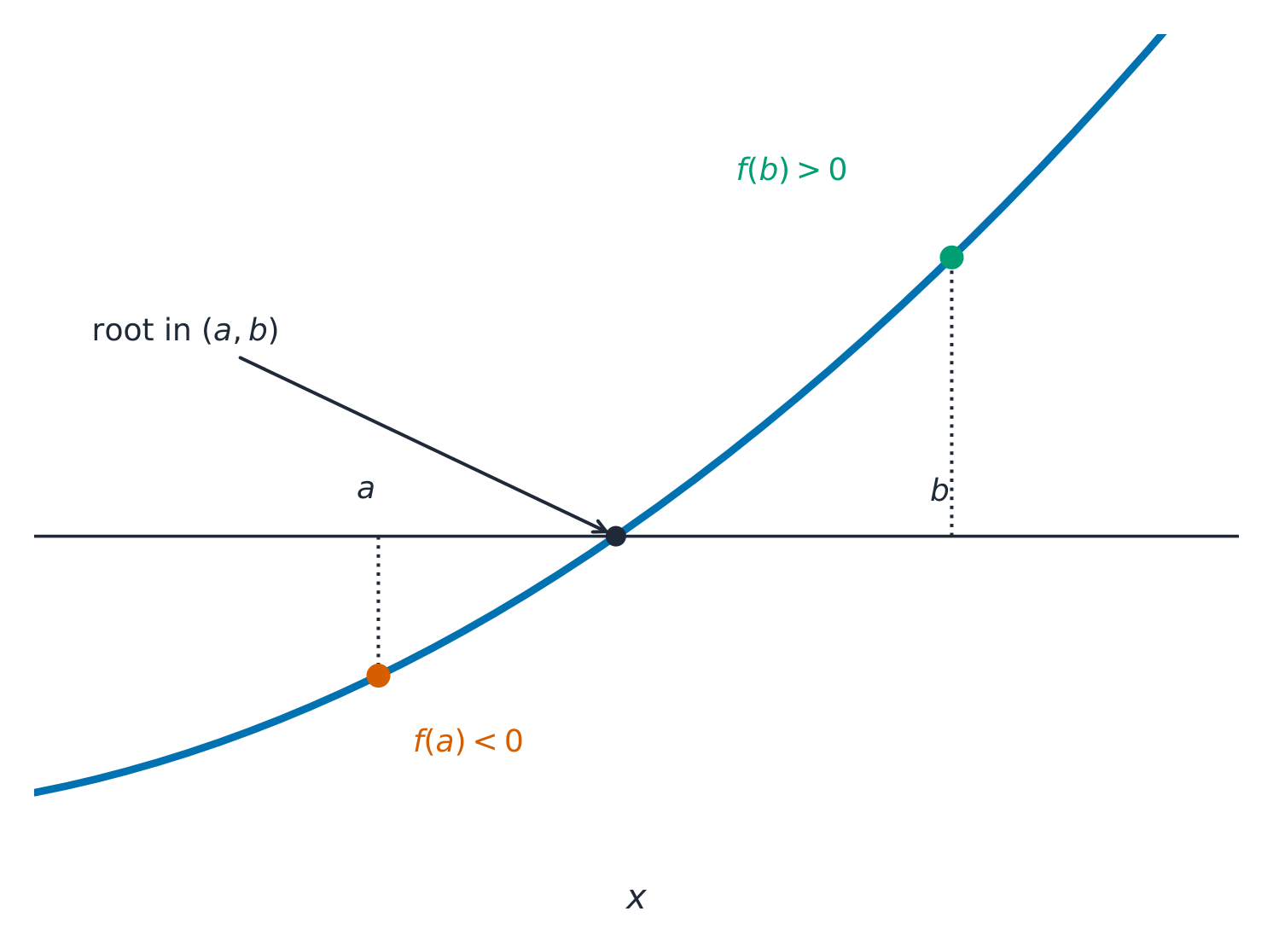
持久理解(FUN-1): 存在性定理允许我们在不精确定位具体位置的情况下,对函数在某个区间上的行为得出结论。
学习目标 FUN-1.A: 运用介值定理解释函数在某个区间上的行为。
来源:College Board AP 课程与考试说明
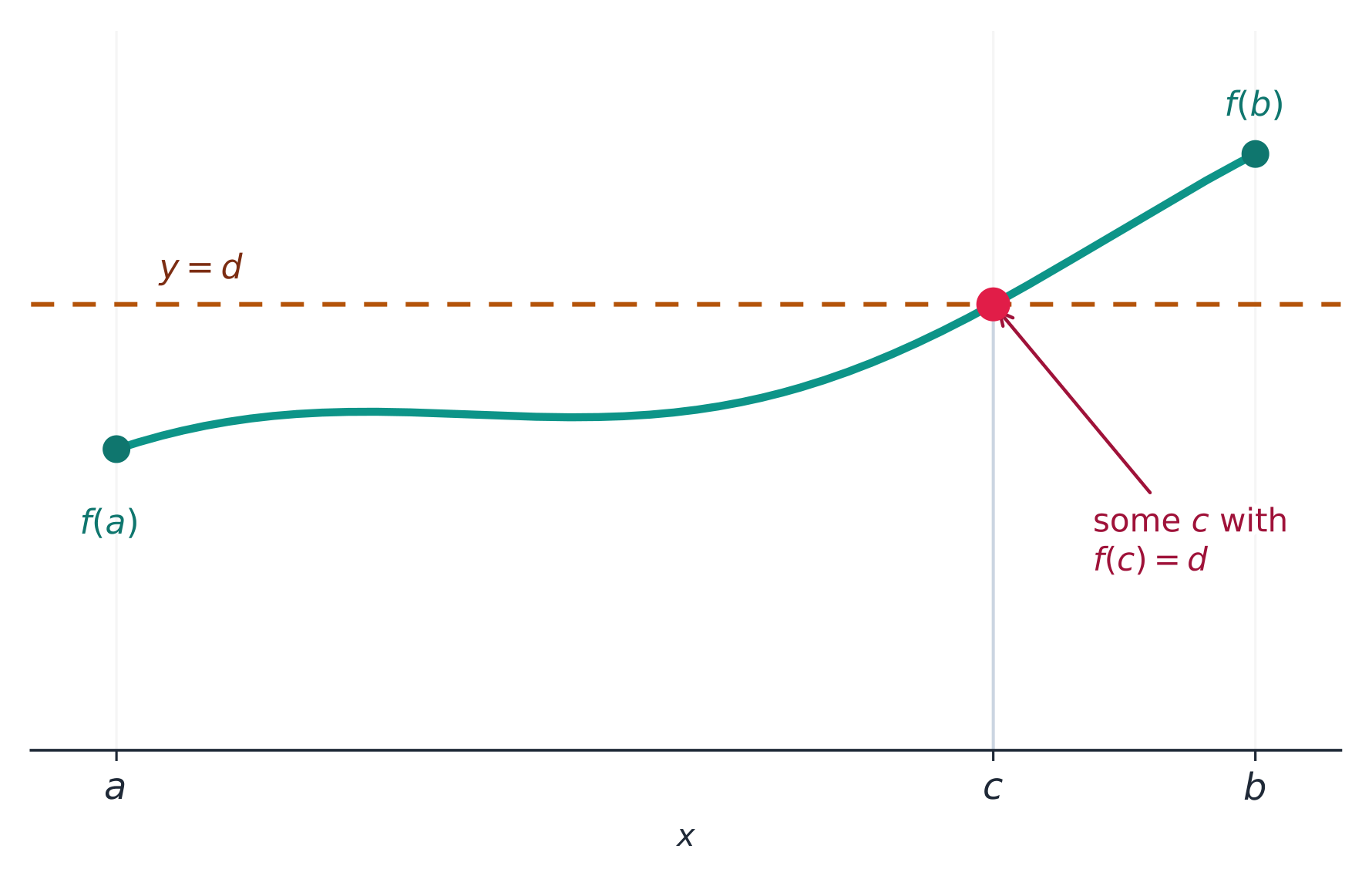
The Intermediate Value Theorem 介值定理 is an existence theorem 存在性定理 – it guarantees a value exists without telling you where:
If $f$ is continuous on the closed interval $[a,b]$, and $d$ is any number between $f(a)$ and $f(b)$, then there is at least one number $c$ in $(a,b)$ with $f(c)=d$.
An unbroken curve cannot skip a height between its endpoints – it must pass through every one.
Exam skill – how to justify with the IVT. These questions appear almost every year (for example, “Must there be a value $c$ with $R(c)=155$?” or “Is there a time when $r'(t)=-6$?”). A full-credit justification has three moves:
Skipping the continuity statement, or not showing $d$ is between the endpoints, loses the point – the theorem requires both conditions.
Worked example. Show that $f(x)=x^3-x-1$ has a zero between $x=1$ and $x=2$.
The theorem says nothing about where $c$ is or how many such values there are (here $c\approx 1.32$, found with a calculator).
Common mistakes with the IVT.
y = ax³ + bx² + cx + d
介值定理:在区间 上连续的函数会取到 与 之间的所有值,至少在区间内的某一点处成立。一条不间断的曲线无法跨越某个高度——它必须经过该高度。 $[a,b]$ 采取每一个 $y$ 之间 $f(a)$ 和 $f(b)$ 在某个时刻内部。一条不间断的曲线不能越过一个高度——它必须穿过它。
| English | 中文 | 拼音 |
|---|---|---|
| Intermediate Value Theorem/ˌɪntəˈmiːdɪət ˈvæljuː ˈθɪərəm/ | 介值定理 | jiè zhí dìng lǐ |
| existence theorem/eɡˈzɪstəns ˈθɪərəm/ | 存在性定理 | cún zài xìng dìng lǐ |
逐步完成,配合即时检查练习。
正在加载学科…