| English | 释义 | 拼音 |
|---|---|---|
| continuous/kənˈtɪnjuːəs/ | 连续 | lián xù |
"Draw it without lifting your pen"
- A function is continuous 连续 at $c$ if its graph has no break there: no hole, no jump, no blow-up.
- "No break" needs a test you can check. Calculus uses three conditions at the point $c$.
A curve with no break
y = ax² + bx + c
This polynomial passes all three continuity conditions at every point — defined, limit exists, and the two match.
The three conditions
- (1) $f(c)$ is defined. (2) $\displaystyle\lim_{x\to c}f(x)$ exists (both one-sided limits agree). (3) They are equal: $\displaystyle\lim_{x\to c}f(x)=f(c)$.
- All three must hold. On the AP exam, write all three, with numbers.
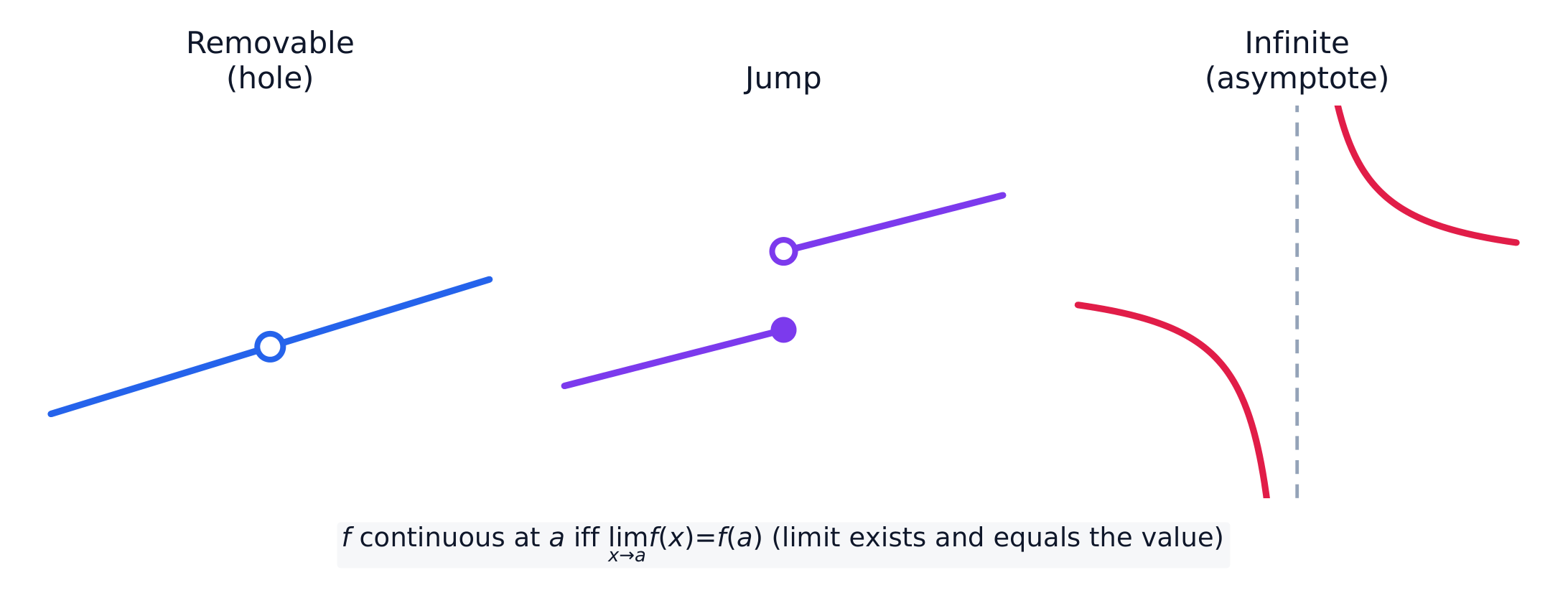
Three ways continuity fails: a removable hole and a jump and an infinite asymptote
Select 所有 conditions required for $f$ to be continuous at $c$.
难度 2/5 · 今日首次完成可获 140 金币及少量额外奖励
The three conditions are defined, limit-exists, and equal. Being a polynomial is not required.
The third continuity condition says the limit must ____ the function value $f(c)$.
难度 1/5 · 今日首次完成可获 100 金币及少量额外奖励
$\lim_{x\to c}f(x)=f(c)$.
Break any one → discontinuity
- Fail (1): the point is missing. Fail (2): a jump, a blow-up or oscillation. Fail (3): the dot sits off the curve.
- Each failure matches a discontinuity type from 1.10.
If $f(c)=1$ and $\lim_{x\to c}f(x)=4$, then at $c$ the function is...
难度 1/5 · 今日首次完成可获 100 金币及少量额外奖励
Both exist but disagree — condition 3 fails, so $f$ is discontinuous (a removable hole).
Is $f(x)=\begin{cases}\dfrac{x^2-1}{x-1},&x\neq1\\[4pt]3,&x=1\end{cases}$ continuous at $x=1$?
- (1) $f(1)=3$: defined. (2) $\displaystyle\lim_{x\to1}\dfrac{x^2-1}{x-1}=\lim_{x\to1}(x+1)=2$: exists.
- (3) $2\neq3$: not equal, so $f$ is not continuous at 1 (a hole with the point plotted at height 3).
支持 $f(x)=x^2+1$, is $f$ continuous at $x=2$?
难度 1/5 · 今日首次完成可获 100 金币及少量额外奖励
All three conditions hold, so $f$ is continuous at $2$ (polynomials are continuous everywhere).
For continuity of $f$ at $x=1$ we need $\lim_{x\to1}f(x)=f(1)$. If $\lim_{x\to1}f(x)=7$, what must $f(1)$ equal?
难度 2/5 · 今日首次完成可获 140 金币及少量额外奖励
Condition 3 forces $f(1)=7$.
Make a piecewise function continuous
- AP questions often ask for the constant $k$ that makes a piecewise function continuous at the join.
- Set the left-hand limit equal to the right-hand limit (which also equals $f(c)$), then solve for $k$.
Find $k$ so that $f(x)=\begin{cases}kx+1, & x<2\\ x^2-k, & x\ge2\end{cases}$ is continuous at $x=2$.
- Left: $2k+1$. Right, and $f(2)$: $4-k$.
- $2k+1=4-k\Rightarrow3k=3\Rightarrow k=1$. Check: both sides give 3.
查找 $k$ so that $f(x)=\begin{cases}kx^2, & x<3\\ 2x+k, & x\ge3\end{cases}$ is continuous at $x=3$.
难度 2/5 · 今日首次完成可获 140 金币及少量额外奖励
Left: $9k$. Right and $f(3)$: $6+k$. $9k=6+k$ gives $8k=6$, $k=\tfrac34$.
- Checking only that $f(c)$ exists, or only that the limit exists, is not enough. $f(c)=1$ with limit 4 is not continuous.
- In a piecewise function, $f(c)$ comes from the piece whose condition includes $c$ (here $x\ge2$).
- Polynomials, $\sin x$, $\cos x$ and $e^x$ are continuous everywhere. A fraction is continuous wherever its denominator is not 0.
Merely knowing $f(c)$ is defined is enough to conclude $f$ is continuous at $c$.
难度 1/5 · 今日首次完成可获 100 金币及少量额外奖励
You also need the limit to exist and to equal $f(c)$.
$f(x)=\dfrac{x+1}{x^2+4}$ is continuous for every real $x$.
难度 1/5 · 今日首次完成可获 100 金币及少量额外奖励
$x^2+4\ge4$ is never 0, so the fraction is defined everywhere and is continuous everywhere.
$f$ is continuous at $c$ exactly when $f(c)$ is defined, $\displaystyle\lim_{x\to c}f(x)$ exists, and the two are equal. To make a piecewise function continuous, set the one-sided limits equal and solve.