| English | 释义 | 拼音 |
|---|---|---|
| interval/ˈɪntəvl/ | 区间 | qū jiān |
| domains/dəˈmeɪnz/ | 定义域 | dìng yì yù |
From one point to a whole stretch
- A function is continuous on an interval 区间 if it is continuous at every point in it: you can draw that stretch without lifting your pen.
- Two questions: what happens at the endpoints, and which functions are continuous automatically?
Open vs. closed intervals
- On an open interval $(a,b)$, check every interior point. On a closed interval $[a,b]$, the endpoints can be approached from one side only.
- Left end: $\displaystyle\lim_{x\to a^+}f(x)=f(a)$. Right end: $\displaystyle\lim_{x\to b^-}f(x)=f(b)$.
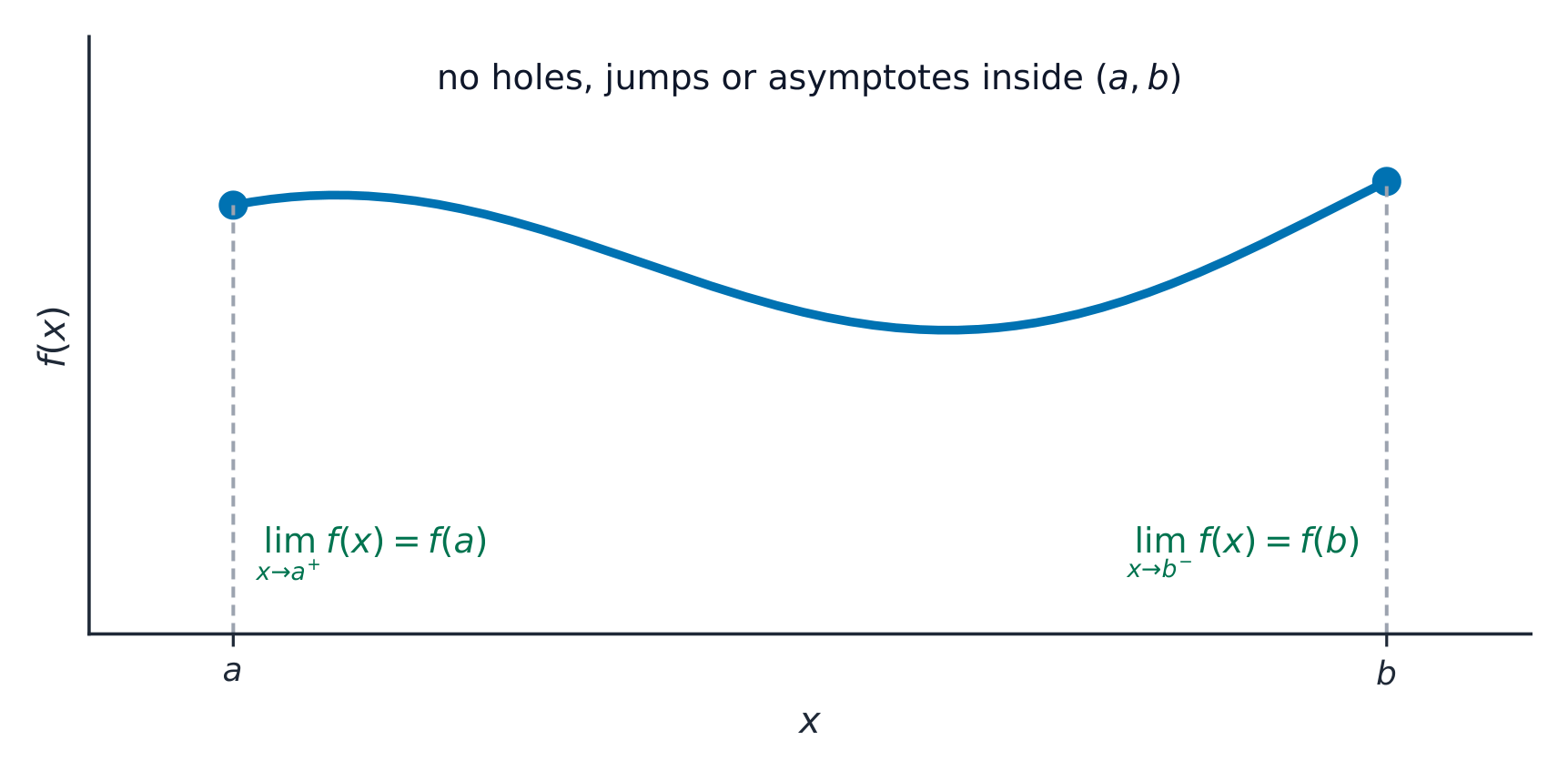
Continuous on (a, b): no breaks inside and the one-sided limits match at the ends
At the 左侧 endpoint $a$ of a closed interval $[a,b]$, continuity requires...
难度 1/5 · 今日首次完成可获 100 金币及少量额外奖励
You can only approach the left endpoint from the right, so right-continuity is required.
The functions that come "pre-continuous"
- Polynomials, $\sin x$, $\cos x$ and $e^x$ are continuous for all real $x$.
- Rational, $\ln x$, $\sqrt x$ and $\tan x$ are continuous on their domains 定义域: everywhere they are defined. So find where they are not defined.
Continuous across the whole view
y = ax³ + bx
A polynomial is continuous on every interval — no holes, jumps, or blow-ups anywhere you look.
Which function is continuous for 所有 实数 $x$?
难度 1/5 · 今日首次完成可获 100 金币及少量额外奖励
Polynomials are continuous everywhere; the others have domain gaps.
Select 所有 function families that are continuous on their entire natural domain.
难度 2/5 · 今日首次完成可获 140 金币及少量额外奖励
All four are continuous throughout their domains — the domain just excludes trouble points (e.g. rational at zeros of the denominator).
Intervals of continuity. Where is $f(x)=\dfrac{\ln(x-1)}{x-3}$ continuous?
- $\ln(x-1)$ needs $x>1$. The fraction needs $x\neq3$.
- $f$ is continuous on $(1,3)$ and on $(3,\infty)$.
Where is $f(x)=\dfrac{\sqrt{4-x}}{x+1}$ continuous?
难度 1/5 · 今日首次完成可获 100 金币及少量额外奖励
$\sqrt{4-x}$ needs $x\le4$; the fraction needs $x\ne-1$. At $x=4$ the function is left-continuous ($\to0=f(4)$), so 4 is included.
Is $f(x)=\sqrt{x}$ continuous on $[0,4]$?
- Inside $(0,4)$: yes, a standard function on its domain. Left end: $\displaystyle\lim_{x\to0^+}\sqrt x=0=f(0)$.
- Right end: $\displaystyle\lim_{x\to4^-}\sqrt x=2=f(4)$. So $f$ is continuous on $[0,4]$.
支持 $f(x)=\sqrt x$ on $[0,9]$, the left-continuity check at the right endpoint needs $\lim_{x\to9^-}\sqrt x$. What is that value?
难度 2/5 · 今日首次完成可获 140 金币及少量额外奖励
$\sqrt 9 = 3$, which equals $f(9)$, so $f$ is left-continuous there.
Why we care: it unlocks theorems
- The Intermediate Value Theorem (1.16) and the Extreme Value Theorem (5.2) both require continuity on $[a,b]$.
- Without it, they do not apply. Always state "$f$ is continuous on $[a,b]$" before using them.
Continuity on a closed interval is a required hypothesis of the ____ Value Theorem.
难度 1/5 · 今日首次完成可获 100 金币及少量额外奖励
The IVT (and the Extreme Value Theorem) require continuity on $[a,b]$.
- "Continuous on its domain" is not "continuous everywhere". $\dfrac1x$ is continuous on its domain, but not on $[-1,1]$, because 0 is inside.
- A piecewise function can be continuous on each piece and still break at the join. Check the join with 1.11.
$f(x)=\dfrac1x$ is continuous on the interval $[-1,1]$.
难度 1/5 · 今日首次完成可获 100 金币及少量额外奖励
$0\in[-1,1]$ and $f$ blows up there, so it is not continuous on that interval.
If each piece of a piecewise function is a polynomial, the function is continuous everywhere.
难度 1/5 · 今日首次完成可获 100 金币及少量额外奖励
Each piece is continuous, but the pieces may not meet at the join. $x$ for $x<1$ and $x+2$ for $x\ge1$ jump from 1 to 3.
Continuous on an interval = continuous at every point, with one-sided limits at the ends of a closed interval. Standard functions are continuous wherever they are defined. This is the hypothesis behind the IVT and EVT.