持久理解 (CHA-4): 定积分使我们能够解决涉及区间内变化累积的问题。
学习目标 CHA-4.B: 利用定积分确定函数的平均值。
- CHA-4.B.1 连续函数 $f$ 在区间 $[a, b]$ 上的平均值为 $\dfrac{1}{b-a}\int_a^b f(x)\,dx$。
AP 微积分 BC · 知识点 8
 9:59
积分的应用
这里有一个起伏的图形及其下方的面积。现在想象将该面积倒入同一区间上的矩形中,并使其平整。高度……
英语旁白 · 英中内嵌字幕
持久理解 (CHA-4): 定积分使我们能够解决涉及区间内变化累积的问题。
学习目标 CHA-4.B: 利用定积分确定函数的平均值。
来源:College Board AP 课程与考试说明
The average value 平均值 of $f$ over $[a,b]$ is the integral 积分 divided by the width:
Worked example. The average value of $f(x)=x^2$ on $[0,3]$ is $\dfrac{1}{3}\displaystyle\int_0^3 x^2\,dx=\dfrac13\left[\dfrac{x^3}{3}\right]_0^3=\dfrac13(9)=3$.
y = ax³ + bx² + cx + d
$f$ 在 $[a,b]$ 上的平均值是其积分除以宽度——即具有与曲线下相同面积的矩形的恒定高度。
| English | 中文 | 拼音 |
|---|---|---|
| average value/ˈævrɪdʒ ˈvæljuː/ | 平均值 | píng jūn zhí |
| integral/ˈɪntɪɡrəl/ | 积分 | jī fēn |
| rectangle/ˈrektæŋɡl/ | 矩形 | jǔ xíng |
| rate of change/reɪt ɒv tʃeɪndʒ/ | 变化率 | biàn huà lǜ |
| derivative/dɪˈrɪvətɪv/ | 导数 | dǎo shù |
持久理解 (CHA-4): 定积分使我们能够解决涉及区间内变化累积的问题。
学习目标 CHA-4.C: 在涉及直线运动的问题中,利用定积分确定位置和变化率的值。
来源:College Board AP 课程与考试说明
For straight-line motion, integration 积分法 reverses differentiation 求导:
| English | 中文 | 拼音 |
|---|---|---|
| integration/ˌɪntɪˈɡreɪʃn/ | 积分法 | jī fēn fǎ |
| differentiation/ˌdɪfəˌrenʃɪˈeɪʃn/ | 求导 | qiú dǎo |
| displacement/dɪˈspleɪsmənt/ | 位移 | wèi yí |
| net change/net tʃeɪndʒ/ | 净变化 | jìng biàn huà |
| total distance/ˈtəʊtl ˈdɪstəns/ | 总路程 | zǒng lù chéng |
| speed/spiːd/ | 速率 | sù lǜ |
持久理解 (CHA-4): 定积分使我们能够解决涉及区间内变化累积的问题。
学习目标 CHA-4.D: 解释定积分在累积问题中的含义。
学习目标 CHA-4.E: 在应用情境中利用定积分确定净变化量。
来源:College Board AP 课程与考试说明
When a rate is given (flow rate, sales per day), the definite integral 定积分 gives the accumulated total 累积总量, and $\int_a^b R(t)\,dt$ carries the units of $R$ times time. A common setup: initial amount 初始量 $+\int(\text{rate in}-\text{rate out})\,dt$ gives the amount at a later time. Always interpret the answer in context, with units.
y = 4t(流入速率)
流入速率 $R(t)$ 下方的面积是加入的水量;总量等于初始量加上该面积。
| English | 中文 | 拼音 |
|---|---|---|
| definite integral/ˈdefɪnət ˈɪntɪɡrəl/ | 定积分 | dìng jī fēn |
| accumulated total | 累积总量 | lěi jī zǒng liàng |
| initial amount | 初始量 | chū shǐ liàng |
持久理解 (CHA-5): 定积分使我们能够解决在某个区间内涉及面积或体积累积变化的问题。
学习目标 CHA-5.A: 使用定积分计算平面中的面积。
来源:College Board AP 课程与考试说明
The area between $y=f(x)$ (top) and $y=g(x)$ (bottom) from $a$ to $b$ is
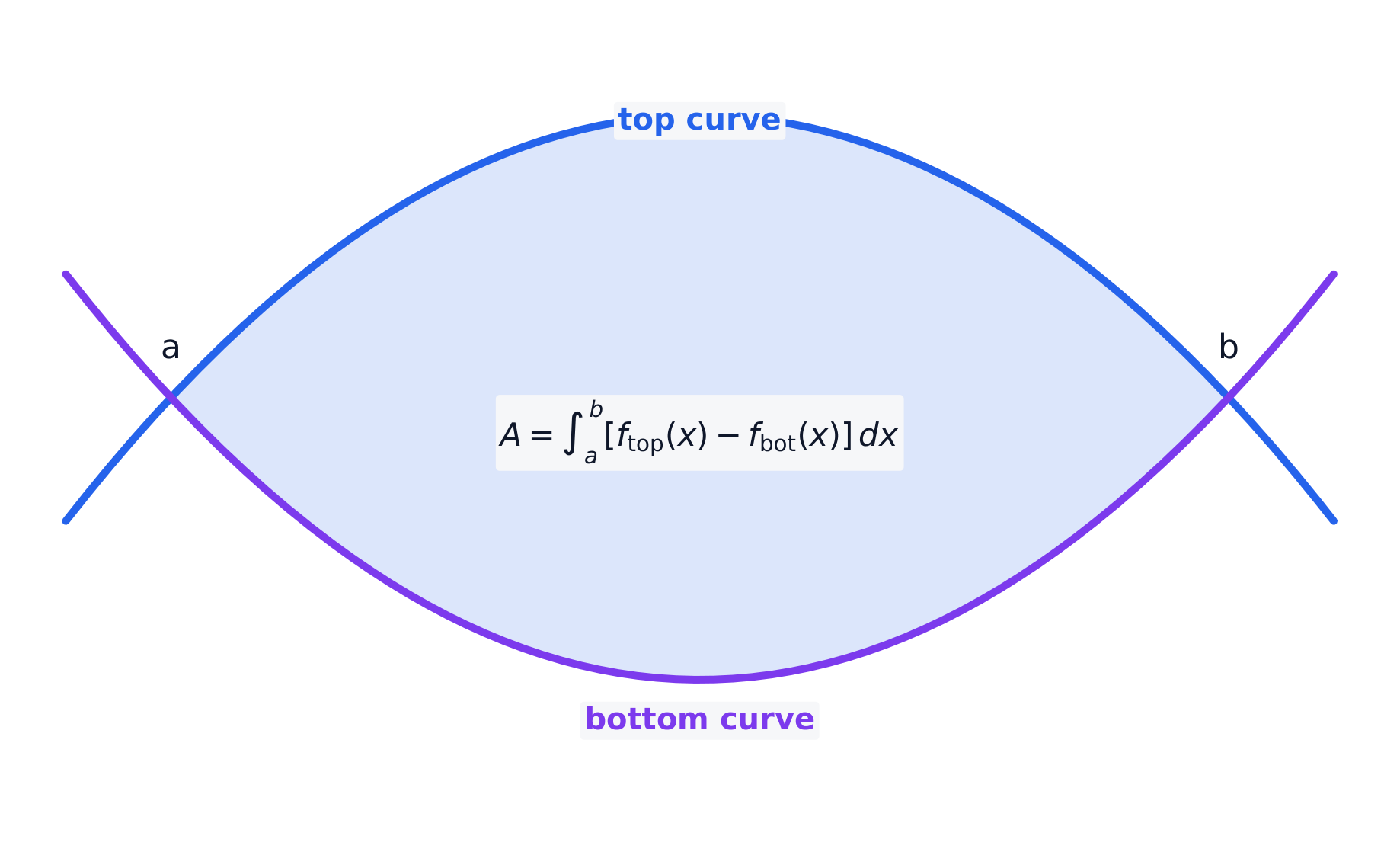
Worked example. Between $y=x$ and $y=x^2$ (crossing at $x=0,1$, with $y=x$ on top), the area is $\displaystyle\int_0^1 (x-x^2)\,dx=\left[\dfrac{x^2}{2}-\dfrac{x^3}{3}\right]_0^1=\dfrac16$.
y = ax² + bx + c
在两交点之间,直线位于抛物线上方 — 垂直间距经积分后即为所围面积。
| English | 中文 | 拼音 |
|---|---|---|
| intersection point/ˌɪntəˈsekʃn pɔɪnt/ | 交点 | jiāo diǎn |
| limits of integration/ˈlɪmɪts ɒv ˌɪntɪˈɡreɪʃn/ | 积分限 | jī fēn xiàn |
持久理解 (CHA-5): 定积分使我们能够求解在某一区间内面积或体积的变化累积问题。
学习目标 CHA-5.A: 使用定积分计算平面区域的面积。
来源:College Board AP 课程与考试说明
When curves are easier to describe as $x=f(y)$, integrate with respect to $y$ instead, using right minus left:
Worked example. Find the same area between $y=x$ and $y=x^2$ with horizontal slices. Solve each curve for $x$: the line is $x=y$ and the parabola 抛物线 is $x=\sqrt{y}$. For $0<y<1$, $\sqrt{y}>y$ (try $y=0.25$: $0.5>0.25$), so the parabola is on the right:
Both methods give $\tfrac16$, as they must.
y = ax² + bx + c
当曲线开口侧向时,水平切片(右减左,对 $y$ 积分)是更简洁的选择。
| English | 中文 | 拼音 |
|---|---|---|
| parabola/pəˈræbələ/ | 抛物线 | pāo wù xiàn |
持久理解 (CHA-5): 定积分使我们能够解决关于区间内面积或体积变化累积的问题。
学习目标 CHA-5.A: 使用定积分计算平面中的面积。
来源:College Board AP 课程与考试说明
If two curves cross several times, the top and bottom switch. Split the region at each intersection and integrate each piece with the correct top-minus-bottom (or use $\int|f-g|$), then add the pieces.
持久理解 (CHA-5): 定积分使我们能够解决涉及区间内面积或体积累积变化的问题。
学习目标 CHA-5.B: 使用定积分计算已知横截面的立体体积。
来源:College Board AP 课程与考试说明
If a solid's cross sections 横截面 perpendicular 垂直 to the $x$-axis are squares 正方形 or rectangles, integrate their area to find the volume 体积. With side length equal to the distance between two curves, a square cross section gives
Worked example. The base of a solid is the region under $y=\sqrt{x}$ from $x=0$ to $x=4$, and cross sections perpendicular to the $x$-axis are squares. Each square's side is $s(x)=\sqrt{x}$, so $A(x)=x$ and
With semicircles on the same base instead, $A(x)=\tfrac{\pi}{8}\big(\sqrt{x}\big)^2$, so $V=\tfrac{\pi}{8}\cdot 8=\pi$: only the area formula changes.
Worked example. The base of a solid is the region between $y=x$ and $y=x^2$. Cross sections perpendicular to the $x$-axis are squares. Find the volume.
The side of each square is the slice length $s(x)=x-x^2$, so $A(x)=(x-x^2)^2=x^2-2x^3+x^4$ and
Expand the square before integrating; $\int (x-x^2)^2\,dx$ is not $\left(\int (x-x^2)\,dx\right)^2$.
y = a·√x
每个正方形切片置于底面上;其边长为$\sqrt{x}$,因此面积为$(\sqrt{x})^2=x$。
| English | 中文 | 拼音 |
|---|---|---|
| cross section/krɒs ˈsekʃn/ | 横截面 | héng jié miàn |
| perpendicular/ˌpɜːpənˈdɪkjʊlə/ | 垂直 | chuí zhí |
| square/skweə/ | 正方形 | zhèng fāng xíng |
| volume/ˈvɒljuːm/ | 体积 | tǐ jī |
持久理解 (CHA-5): 定积分使我们能够解决涉及区间内面积或体积累积变化的问题。
学习目标 CHA-5.B: 利用定积分计算已知截面的立体体积。
来源:College Board AP 课程与考试说明
Same idea, different area formula: for equilateral triangle 等边三角形 cross sections use $A=\tfrac{\sqrt3}{4}s^2$, and for semicircular 半圆形的 ones $A=\tfrac{\pi}{8}s^2$ (with $s$ the distance between the curves). Substitute the area formula and integrate.
y = a·√x
相同的底面区域会因切片形状不同而产生不同的体积——仅当面积常数乘以$s(x)^2$时发生变化。
| English | 中文 | 拼音 |
|---|---|---|
| equilateral triangle/ˌiːkwɪˈlætərəl ˈtraɪæŋɡl/ | 等边三角形 | děng biān sān jiǎo xíng |
| semicircular | 半圆形的 | bàn yuán xíng de |
持久理解 (CHA-5): 定积分使我们能够解决在某个区间内面积或体积变化累积的问题。
学习目标 CHA-5.C: 使用定积分计算旋转体的体积。
来源:College Board AP 课程与考试说明
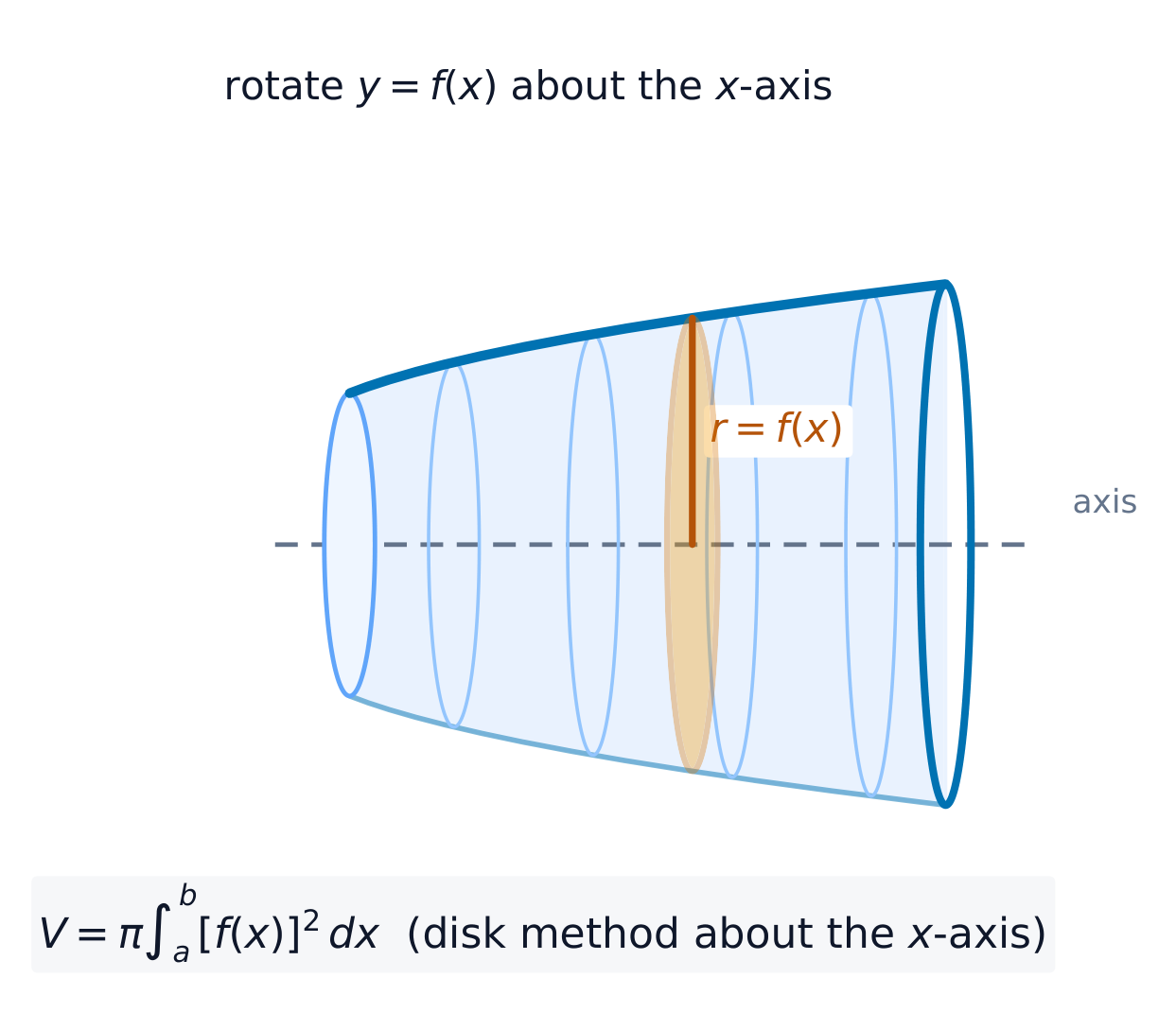
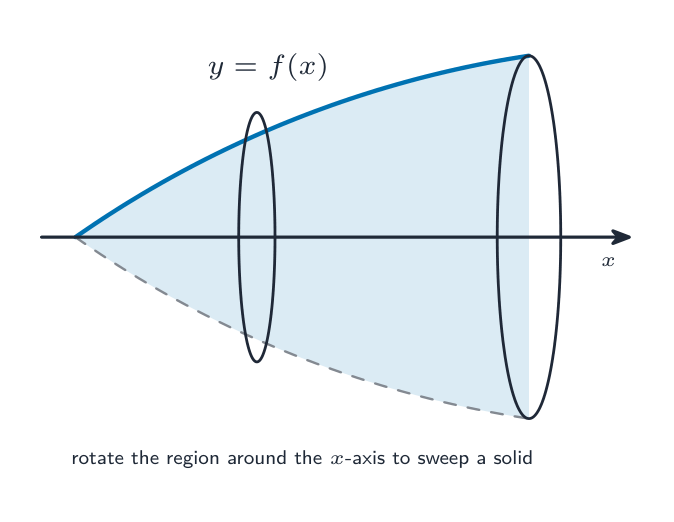
Revolving a region around an axis makes a solid of revolution 旋转体 whose cross sections are discs. The disc method 圆盘法 integrates $\pi(\text{radius})^2$:
Worked example. Revolving the region under $y=\sqrt{x}$ from $0$ to $4$ about the $x$-axis gives discs of radius $\sqrt{x}$: $V=\pi\displaystyle\int_0^4 (\sqrt{x})^2\,dx=\pi\int_0^4 x\,dx=8\pi$.
y = a·√x
绕 $y=\sqrt x$ 轴旋转的 $x$ 堆积出半径为 $\sqrt x$ 的圆盘——体积 $\pi\int R^2\,dx$。
| English | 中文 | 拼音 |
|---|---|---|
| solid of revolution/ˈsɒlɪd ɒv ˌrevəˈluːʃn/ | 旋转体 | xuán zhuǎn tǐ |
| disc method/dɪsk ˈmeθəd/ | 圆盘法 | yuán pán fǎ |
| radius/ˈreɪdɪəs/ | 半径 | bàn jìng |
持久理解 (CHA-5): 定积分使我们能够解决在区间内面积或体积变化累积的问题。
学习目标 CHA-5.C: 使用定积分计算旋转体的体积。
来源:College Board AP 课程与考试说明
When the axis of revolution 旋转轴 is a horizontal or vertical line like $y=k$ (not an axis), the radius adjusts: $R=|f(x)-k|$. Set up the radius as the distance from the curve to that line, then integrate $\pi R^2$ as before.
y = a·√x
绕$y=-1$旋转会使半径从曲线延伸到该直线——$R=f(x)+1$,大于$f(x)$。
| English | 中文 | 拼音 |
|---|---|---|
| axis of revolution | 旋转轴 | xuán zhuàn zhóu |
持久性理解 (CHA-5): 定积分使我们能够解决涉及在区间内面积或体积变化累积的问题。
学习目标 CHA-5.C: 使用定积分计算旋转体的体积。
来源:College Board AP 课程与考试说明
If the region does not touch the axis, revolving leaves a hole, so cross sections are washers (rings 圆环). The washer method 垫圈法 subtracts the inner disc:
y = ax² + bx
在$y=x$和$y=\sqrt x$之间有一个远离轴的间隙——旋转产生外径为$\sqrt x$、内径为$x$的垫圈。
| English | 中文 | 拼音 |
|---|---|---|
| ring | 圆环 | yuán huán |
| washer method/ˈwɒʃə ˈmeθəd/ | 垫圈法 | diàn juàn fǎ |
持久理解 (CHA-5): 定积分使我们能够求解区间内面积或体积变化累积的问题。
学习目标 CHA-5.C: 使用定积分计算旋转体的体积。
来源:College Board AP 课程与考试说明
As with discs, revolving around a line $y=k$ or $x=k$ shifts both radii – each becomes the distance from its curve to that line. Sketch the region and the axis, label $R_{\text{outer}}$ and $R_{\text{inner}}$, then integrate the difference of squares.
Worked example. Revolve the region between $y=\sqrt{x}$ and $y=x^2$ ($0\le x\le 1$) about (a) the $x$-axis and (b) the line $y=-1$.
(a) On $(0,1)$, $\sqrt{x}>x^2$, so $y=\sqrt{x}$ is farther from the $x$-axis: $R=\sqrt{x}$ and $r=x^2$.
(b) Each radius is now a distance to $y=-1$, so add $1$ to each height: $R=\sqrt{x}+1$ and $r=x^2+1$. Expand both squares:
Common mistakes. Writing $\pi\int (R-r)^2\,dx$ instead of $\pi\int (R^2-r^2)\,dx$; and, about $y=-1$, using $R=\sqrt{x}-1$ (subtracting) instead of $R=\sqrt{x}-(-1)=\sqrt{x}+1$.
y = ax² + bx
绕$y=-1$旋转,两个半径都增加$1$——外$\sqrt x+1$,内$x+1$;仍然是$R^2-r^2$。

持久理解 (CHA-6): 定积分使我们能够解决区间内长度累积变化的问题。
学习目标 CHA-6.A: 利用定积分求由函数定义的平面曲线的长度。仅限BC
来源:College Board AP 课程与考试说明
The arc length 弧长 of $y=f(x)$ from $a$ to $b$ is
Worked example. Find the arc length of $y=\tfrac{2}{3}x^{3/2}$ from $x=0$ to $x=3$. Here $f'(x)=x^{1/2}$, so $1+(f')^2=1+x$ and

| English | 中文 | 拼音 |
|---|---|---|
| arc length/ɑːk leŋθ/ | 弧长 | hú cháng |
| hypotenuse/haɪˈpɒtənjuːs/ | 斜边 | xié biān |
| particle/ˈpɑːtɪkl/ | 质点 | zhì diǎn |
逐步完成,配合即时检查练习。
正在加载学科…