| Enduring Understanding | Learning Objective | Essential Knowledge |
|---|---|---|
CHA-2 | CHA-2.A |
|
CHA-2.B |
|
Differentiation: Definition and Fundamental Properties
AP Calculus BC · Topic 2
 7:52
7:52
Defining the Derivative
Draw a journey as a curve. Pick two points, join them with a straight line, and its slope gives the average rate over an interval. But we want the rate at one…
English narration · English + 中文 subtitles burned in
2.1
Average and Instantaneous Rates of Change at a Point

Syllabus
Source: College Board AP Course and Exam Description
Unit 1 built the limit. Unit 2 uses it to define the derivative 导数 – the exact rate of change at a point.
Over an interval, the average rate of change is a difference quotient 差商. Two equivalent forms appear:
$$\frac{f(a+h)-f(a)}{h} \qquad\text{and}\qquad \frac{f(x)-f(a)}{x-a}.$$
The first uses a step of size $h$ from $a$; the second uses two points $x$ and $a$. Both compute $\dfrac{\text{change in output}}{\text{change in input}}$ over the interval.
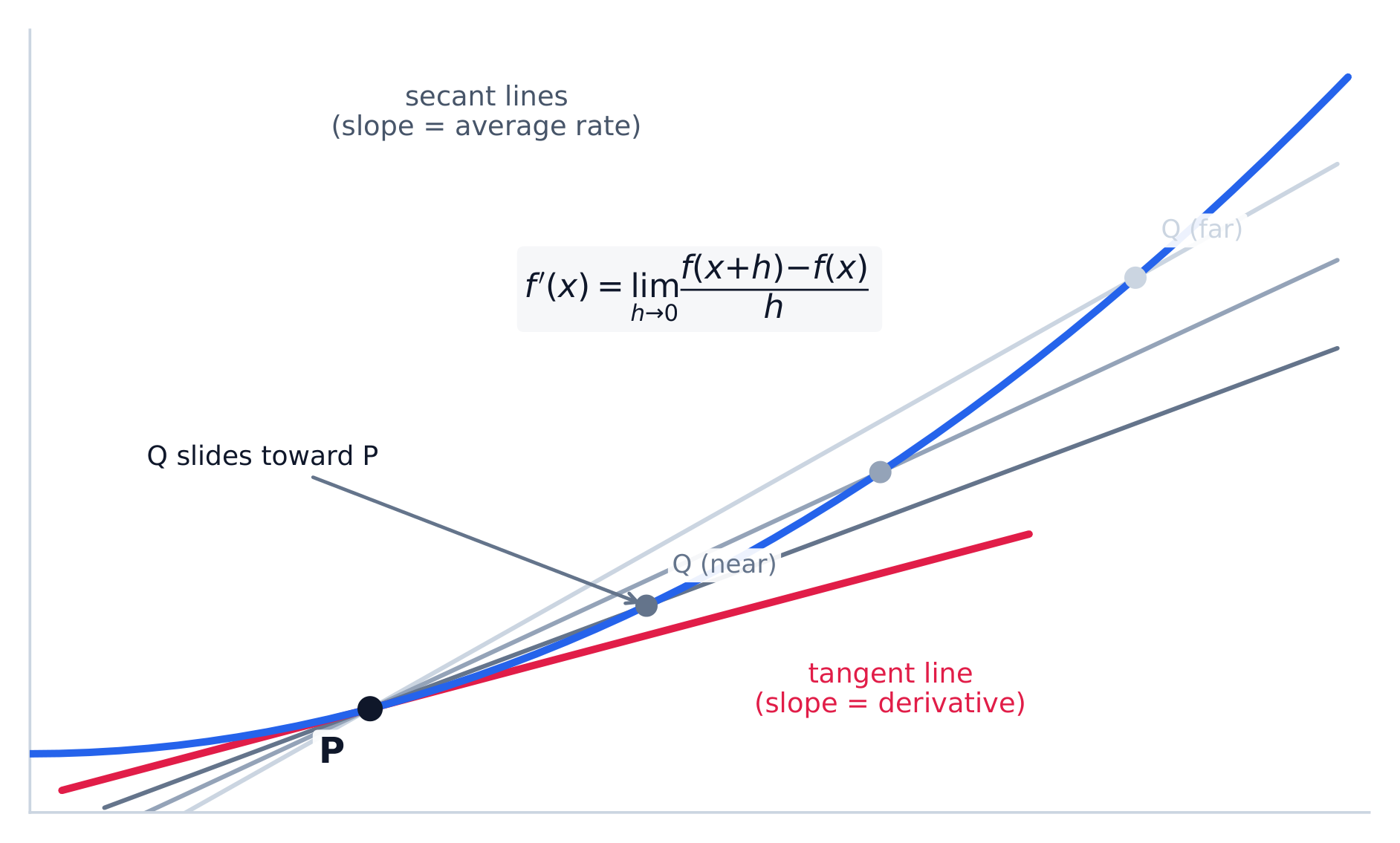
The instantaneous 瞬时 rate of change at $x=a$ is what the difference quotient approaches as the interval shrinks to zero. This limit is the derivative at $a$, written $f'(a)$:
$$f'(a) = \lim_{h\to 0}\frac{f(a+h)-f(a)}{h} = \lim_{x\to a}\frac{f(x)-f(a)}{x-a},$$
provided the limit exists.
Explore
From average rate to instantaneous rate
y = ax³ + bx² + cx + d
Slide the point: the secant through two nearby points tips toward the tangent as they merge. The tangent's slope is the derivative — the instantaneous rate of change.
Vocabulary
Train
| English |
|---|
| derivative/dɪˈrɪvətɪv/ |
| difference quotient/ˈdɪfrəns ˈkwəʊʃənt/ |
| instantaneous/ˌɪnstənˈteɪnɪəs/ |
| first principles/fɜːst ˈprɪnsɪplz/ |
2.2
Defining the Derivative and Reading Its Notation
Syllabus
| Enduring Understanding | Learning Objective | Essential Knowledge |
|---|---|---|
CHA-2 | CHA-2.B |
|
CHA-2.C |
|
Source: College Board AP Course and Exam Description
Let the point $a$ vary and the derivative becomes a new function:
$$f'(x) = \lim_{h\to 0}\frac{f(x+h)-f(x)}{h}.$$
This is the definition of the derivative (sometimes called differentiating "by first principles" 用定义求导). Its value at each $x$ is the instantaneous rate of change there.
Common notations 记号 for the derivative of $y=f(x)$ are:
$$\frac{dy}{dx}, \qquad f'(x), \qquad y'.$$
The derivative can be represented graphically, numerically, analytically, and verbally – be ready to move between them.
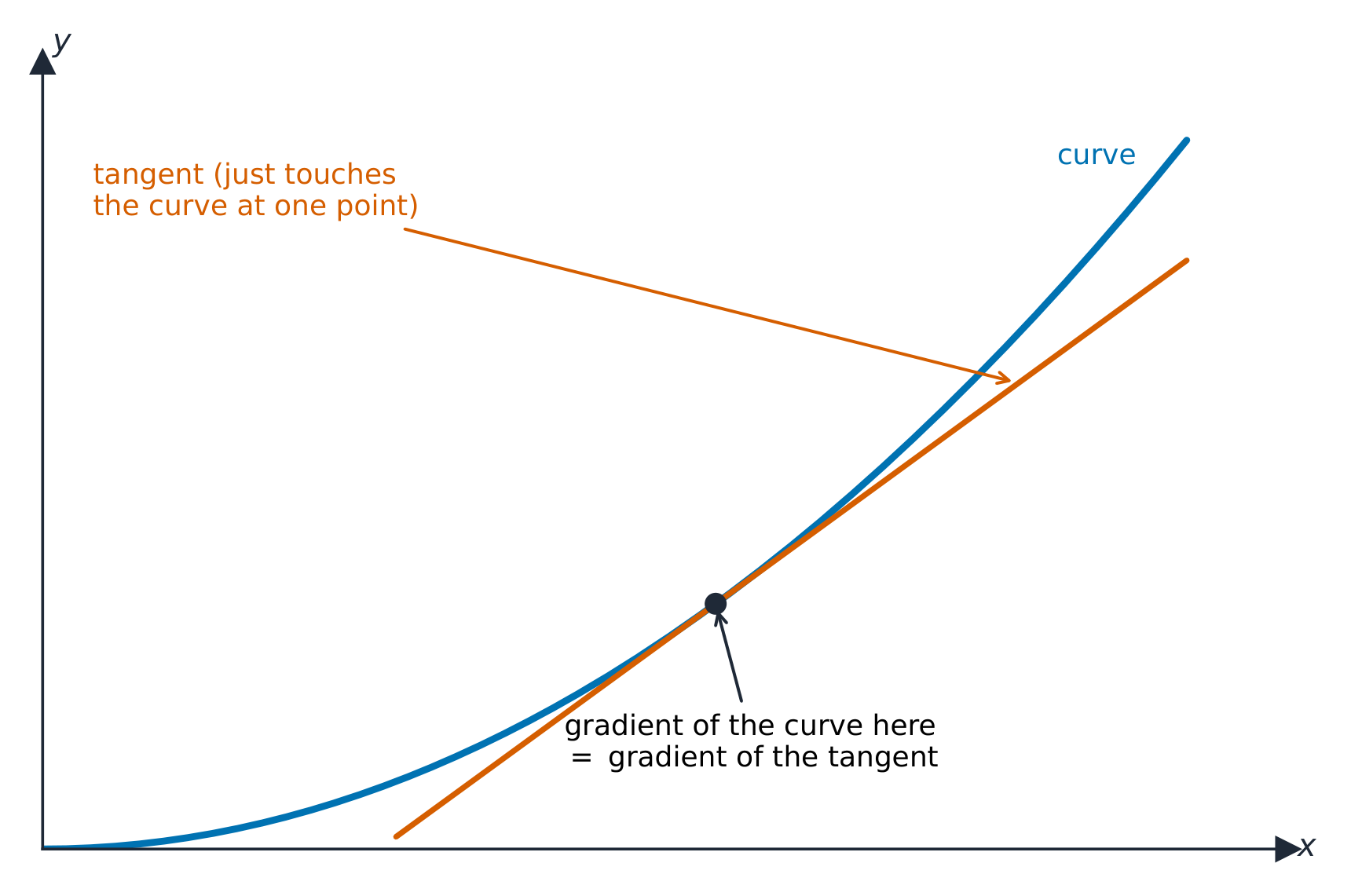
Geometric meaning. The derivative at a point is the slope 斜率 of the tangent line 切线 to the graph there. So the tangent line at $x=a$ passes through $\big(a, f(a)\big)$ with slope $f'(a)$:
$$y - f(a) = f'(a)\,(x-a).$$
Writing this line is a routine exam task, so keep the point-slope form ready.
Vocabulary
Train
| English |
|---|
| notations/nəʊˈteɪʃnz/ |
| slope/sləʊp/ |
| tangent line/ˈtændʒənt laɪn/ |
2.3
Estimating a Derivative at a Point
Syllabus
| Enduring Understanding | Learning Objective | Essential Knowledge |
|---|---|---|
CHA-2 | CHA-2.D |
|
Source: College Board AP Course and Exam Description
You do not always have a formula. When a function is given by a table 表格 or a graph, estimate the derivative $f'(a)$ with a difference quotient over a small interval around $a$. A table with values on both sides of $a$ gives the best estimate:
$$f'(a) \approx \frac{f(b)-f(c)}{b-c},\qquad \text{where } c < a < b \text{ are the closest table inputs}.$$
Technology (a calculator) can also estimate a derivative at a point.
Exam skill (appears almost every year). Questions such as "Approximate $M'(7.5)$ using the average rate of change of $M$ over the interval $5 \le t \le 10$" ask for exactly this difference quotient. Show the setup:
$$M'(7.5) \approx \frac{M(10)-M(5)}{10-5}.$$
Full credit needs the numbers plugged in and the correct units 单位 (output units per input unit), since these come from real-world models.
Vocabulary
Train
| English |
|---|
| table/ˈteɪbl/ |
| units/ˈjuːnɪts/ |
2.4
Differentiability and Continuity: When a Derivative Exists
Syllabus
| Enduring Understanding | Learning Objective | Essential Knowledge |
|---|---|---|
FUN-2 | FUN-2.A |
|
Source: College Board AP Course and Exam Description
Differentiability is stronger than continuity. The key relationship:
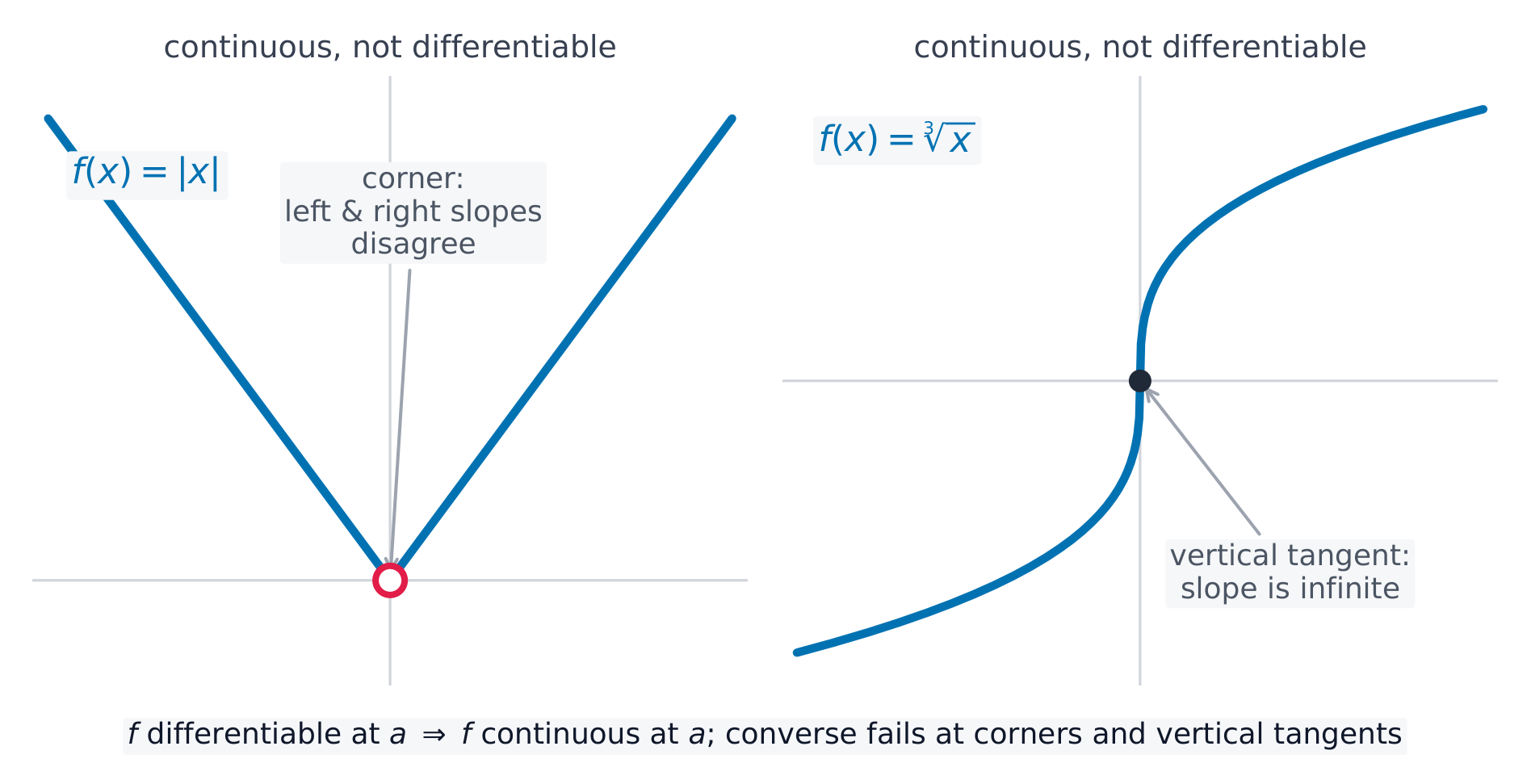
If $f$ is differentiable 可导 at a point, then $f$ is continuous 连续 there.
So differentiability implies continuity. The reverse is false: a continuous function can fail to be differentiable. Two ways this happens:
- A corner 尖点: the left and right difference-quotient limits disagree, as with $f(x)=|x|$ at $x=0$.
- A vertical tangent 垂直切线: the slope is infinite (no real number), as with $f(x)=\sqrt[3]{x}$ at $x=0$.
Also, a point outside the domain of $f$ cannot be in the domain of $f'$. Use the contrapositive on the exam: if $f$ is not continuous at $a$, then $f$ is not differentiable at $a$.
Vocabulary
Train
| English |
|---|
| differentiable/ˈdɪfərenʃɪəbl/ |
| continuous/kənˈtɪnjuːəs/ |
| corner/ˈkɔːnə/ |
| vertical tangent/ˈvɜːtɪkl ˈtændʒənt/ |
2.5
The Power Rule
Syllabus
| Enduring Understanding | Learning Objective | Essential Knowledge |
|---|---|---|
FUN-3 | FUN-3.A |
|
Source: College Board AP Course and Exam Description
From here we use rules instead of the limit definition each time. The power rule 幂法则 handles any power of $x$:
$$\frac{d}{dx}\,x^{r} = r\,x^{\,r-1}\qquad\text{for any real } r.$$
It works for whole-number powers, negative powers ($\tfrac{1}{x}=x^{-1}$), and roots ($\sqrt{x}=x^{1/2}$) – rewrite as a power first, then apply the rule.
Explore
A power function and its steepening slope
y = ax³ + bx² + cx + d
The power rule $\frac{d}{dx}x^n = nx^{n-1}$ drops the exponent as a factor. For $x^3$ the slope grows quickly as $x$ leaves 0 — the curve steepens.
Vocabulary
Train
| English |
|---|
| power rule/ˈpaʊə ruːl/ |
2.6
Constant, Sum, Difference, and Constant Multiple Rules
Syllabus
| Enduring Understanding | Learning Objective | Essential Knowledge |
|---|---|---|
FUN-3 | FUN-3.A |
|
Source: College Board AP Course and Exam Description
These rules let you differentiate term by term:
- Constant: $\dfrac{d}{dx}\,k = 0$ (a constant does not change).
- Constant multiple 常数倍: $\dfrac{d}{dx}\big[k\,f(x)\big] = k\,f'(x)$.
- Sum / difference: $\dfrac{d}{dx}\big[f(x)\pm g(x)\big] = f'(x)\pm g'(x)$.
Combined with the power rule, they differentiate any polynomial 多项式 term by term. Example:
$$\frac{d}{dx}\big(4x^3 - 5x + 7\big) = 12x^2 - 5.$$
Vocabulary
Train
| English |
|---|
| Constant multiple/ˈkɒnstənt ˈmʌltɪpl/ |
| polynomial/ˌpɒlɪˈnəʊmɪəl/ |
2.7
Derivatives of cos x, sin x, e^x, and ln x
Syllabus
| Enduring Understanding | Learning Objective | Essential Knowledge |
|---|---|---|
FUN-3 | FUN-3.A |
|
LIM-3 | LIM-3.A |
|
Source: College Board AP Course and Exam Description
Learn these four building-block derivatives by heart:
$$\frac{d}{dx}\sin x = \cos x, \qquad \frac{d}{dx}\cos x = -\sin x,$$
$$\frac{d}{dx}e^{x} = e^{x}, \qquad \frac{d}{dx}\ln x = \frac{1}{x}\ \ (x>0).$$
Note the minus sign on the derivative of cosine, and that $e^{x}$ is its own derivative.
A limit that is really a derivative (LIM-3.A.1). Sometimes a limit is secretly the definition of a known derivative. If you recognize
$$\lim_{h\to 0}\frac{f(a+h)-f(a)}{h}$$
for a function $f$ whose derivative you know, just evaluate $f'(a)$. For example, $\displaystyle \lim_{h\to 0}\frac{\sin\!\big(\tfrac{\pi}{2}+h\big)-1}{h} = \left.\frac{d}{dx}\sin x\right|_{x=\pi/2} = \cos\tfrac{\pi}{2} = 0$.
Explore
The shape of sin x (whose slope is cos x)
y = asin(bx + c) + d
The derivative of $\sin x$ is $\cos x$: the slope of the sine curve is largest where sine crosses zero and zero at its peaks. Watch the curve to feel where its slope is steep or flat.
2.8
The Product Rule
Syllabus
| Enduring Understanding | Learning Objective | Essential Knowledge |
|---|---|---|
FUN-3 | FUN-3.B |
|
Source: College Board AP Course and Exam Description
A product of two functions is not differentiated by multiplying the derivatives. Use the product rule 乘积法则:
$$\frac{d}{dx}\big[u\,v\big] = u'v + uv'.$$
"Derivative of the first times the second, plus the first times the derivative of the second." Example:
$$\frac{d}{dx}\big(x^2 e^{x}\big) = 2x\,e^{x} + x^2 e^{x}.$$
Exam questions often build a new function from given pieces, e.g. $k'(x) = \big(f(x)\big)^2 g(x)$, and ask you to combine rules while reading values from a table.
Vocabulary
Train
| English |
|---|
| product rule/ˈprɒdʌkt ruːl/ |
2.9
The Quotient Rule
Syllabus
| Enduring Understanding | Learning Objective | Essential Knowledge |
|---|---|---|
FUN-3 | FUN-3.B |
|
Source: College Board AP Course and Exam Description
For a quotient, use the quotient rule 商法则:
$$\frac{d}{dx}\!\left[\frac{u}{v}\right] = \frac{u'v - uv'}{v^{2}}.$$
"Bottom times derivative of top, minus top times derivative of bottom, all over bottom squared." The order matters because of the minus sign, so write the numerator carefully. Example:
$$\frac{d}{dx}\!\left(\frac{x}{\cos x}\right) = \frac{1\cdot\cos x - x\cdot(-\sin x)}{\cos^2 x} = \frac{\cos x + x\sin x}{\cos^2 x}.$$
Vocabulary
Train
| English |
|---|
| quotient rule/ˈkwəʊʃənt ruːl/ |
2.10
Derivatives of Tangent, Cotangent, Secant, and Cosecant
Syllabus
| Enduring Understanding | Learning Objective | Essential Knowledge |
|---|---|---|
FUN-3 | FUN-3.B |
|
Source: College Board AP Course and Exam Description
The remaining trigonometric derivatives are not memorized separately – you rewrite them with identities 恒等式 and apply the quotient (or product) rule. For instance, $\tan x = \dfrac{\sin x}{\cos x}$, so the quotient rule gives
$$\frac{d}{dx}\tan x = \frac{\cos x\cos x - \sin x(-\sin x)}{\cos^2 x} = \frac{1}{\cos^2 x} = \sec^2 x.$$
The same method (writing $\cot x=\tfrac{\cos x}{\sin x}$, $\sec x=\tfrac{1}{\cos x}$, $\csc x=\tfrac{1}{\sin x}$) gives $-\csc^2 x$, $\sec x\tan x$, and $-\csc x\cot x$.
Higher-order derivatives. Differentiating $f'$ again gives the second derivative 二阶导数 $f''(x)$ (or $\tfrac{d^2y}{dx^2}$) – the rate of change of the rate of change. An exam part like "Find $k''(3)$" just means differentiate twice, then substitute. You can also estimate a second derivative from a table by applying the average-rate-of-change method to the $f'$ values.
Worked example. Differentiate $g(x)=\dfrac{\sin x}{x}$ with the quotient rule $\left(\tfrac{u}{v}\right)'=\dfrac{u'v-uv'}{v^2}$: take $u=\sin x$, $v=x$, giving $g'(x)=\dfrac{x\cos x-\sin x}{x^2}$. Keep the order $u'v-uv'$ in the numerator — swapping the terms flips the sign and loses the mark.
Vocabulary
Train
| English |
|---|
| identities/aɪˈdentɪtiz/ |
| second derivative/ˈsekənd dɪˈrɪvətɪv/ |
2.10
Exam tips
- The derivative is the slope of the tangent — the limit of the secant slope $\tfrac{f(x+h)-f(x)}{h}$ as $h\to0$.
- Memorise the rules: power, product, quotient, and the derivatives of $\sin$, $\cos$, $e^x$, and $\ln x$.
- Differentiability implies continuity, but not the reverse (a corner or cusp is continuous yet not differentiable).
- Distinguish average rate of change (secant slope over an interval) from instantaneous rate (the derivative at a point).
- Give a tangent-line equation as $y-f(a)=f'(a)(x-a)$.
Interactive lessons on this topic
Work through it step by step, with instant-check exercises.
- Defining Average and Instantaneous Rates of Change at a Point
- Defining the Derivative of a Function and Using Derivative Notation
- Estimating Derivatives of a Function at a Point
- Connecting Differentiability and Continuity: When Derivatives Do and Do Not Exist
- Applying the Power Rule
- Derivative Rules: Constant, Sum, Difference, and Constant Multiple
- Derivatives of cos x, sin x, eˣ, and ln x
- The Product Rule
- The Quotient Rule
- Finding the Derivatives of Tangent, Cotangent, Secant, and Cosecant Functions