| Enduring Understanding | Learning Objective | Essential Knowledge |
|---|---|---|
CHA-4 | CHA-4.A |
|
Integration and Accumulation of Change
AP Calculus BC · Topic 6
 10:02
10:02
Exploring Accumulations of Change
Water flows into a tank. The meter shows litres per minute. That is a rate of change. Now, how much water arrived in the first ten minutes? Draw the rate…
English narration · English + 中文 subtitles burned in
6.1
Exploring Accumulations of Change

Syllabus
Source: College Board AP Course and Exam Description
Where a derivative measures a rate, an integral 积分 measures an accumulation 累积 – a total built up from a rate. If a rate of change acts over an interval, the area between its graph and the axis gives the net accumulated change. This "area = total change" idea is the foundation of integral calculus.
Vocabulary
Train
| English |
|---|
| integral/ˈɪntɪɡrəl/ |
| accumulation/əˌkjuːmjʊˈleɪʃn/ |
6.2
Approximating Areas with Riemann Sums

Syllabus
| Enduring Understanding | Learning Objective | Essential Knowledge |
|---|---|---|
LIM-5 | LIM-5.A |
|
Source: College Board AP Course and Exam Description
A Riemann sum 黎曼和 estimates the area under a curve by adding the areas of thin rectangles. Split $[a,b]$ into subintervals and use the function's height at the left endpoint, right endpoint, or midpoint of each. A trapezoidal sum 梯形法 uses trapezoids instead, averaging the two endpoint heights – usually more accurate. With more, thinner rectangles the estimate improves.
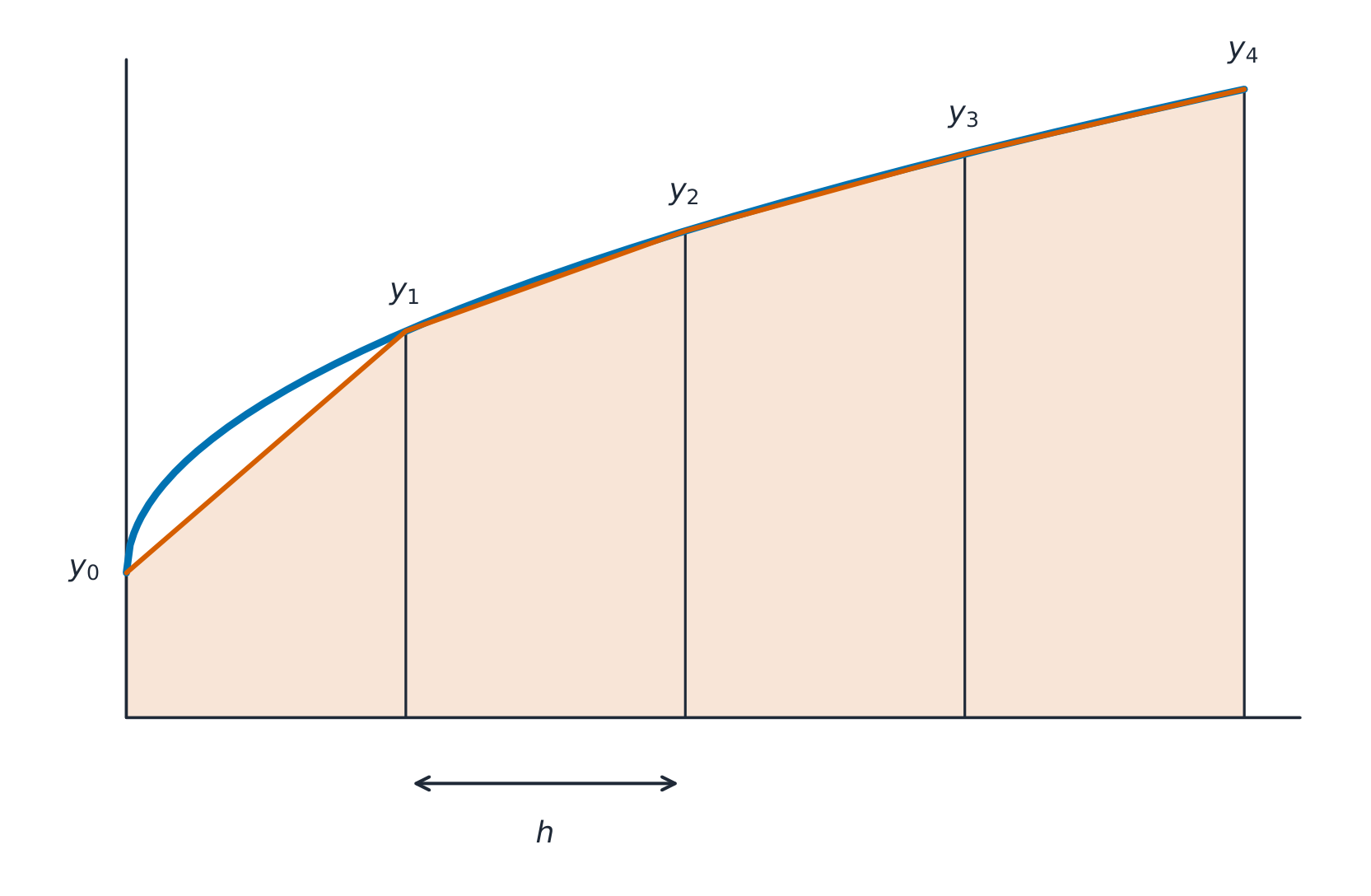
Exam skill: be able to compute left, right, midpoint, and trapezoidal estimates from a table or graph, and state whether each over- or under-estimates based on whether the function is increasing/decreasing or concave up/down.
Explore
Approximate area with rectangles
y = ax³ + bx² + cx + d
A Riemann sum approximates the area under a curve with rectangles. Add more, thinner rectangles and the estimate converges to the exact definite integral.
Vocabulary
Train
| English |
|---|
| Riemann sum/ˈriːmən sʌm/ |
| trapezoidal sum/ˈtræpɪzɔɪdl sʌm/ |
6.3
Riemann Sums, Summation Notation, and Definite Integral Notation
Syllabus
| Enduring Understanding | Learning Objective | Essential Knowledge |
|---|---|---|
LIM-5 | LIM-5.B |
|
LIM-5.C |
|
Source: College Board AP Course and Exam Description
Writing a Riemann sum with summation notation $\sum_{k=1}^{n} f(x_k)\,\Delta x$ and letting the number of rectangles grow without bound gives the exact area – the definite integral 定积分:
$$\int_a^b f(x)\,dx=\lim_{n\to\infty}\sum_{k=1}^{n} f(x_k)\,\Delta x.$$
The integral is the limit of Riemann sums; $a$ and $b$ are the limits of integration.
Vocabulary
Train
| English |
|---|
| definite integral/ˈdefɪnət ˈɪntɪɡrəl/ |
6.4
The Fundamental Theorem of Calculus and Accumulation Functions
Syllabus
| Enduring Understanding | Learning Objective | Essential Knowledge |
|---|---|---|
FUN-5 | FUN-5.A |
|
Source: College Board AP Course and Exam Description
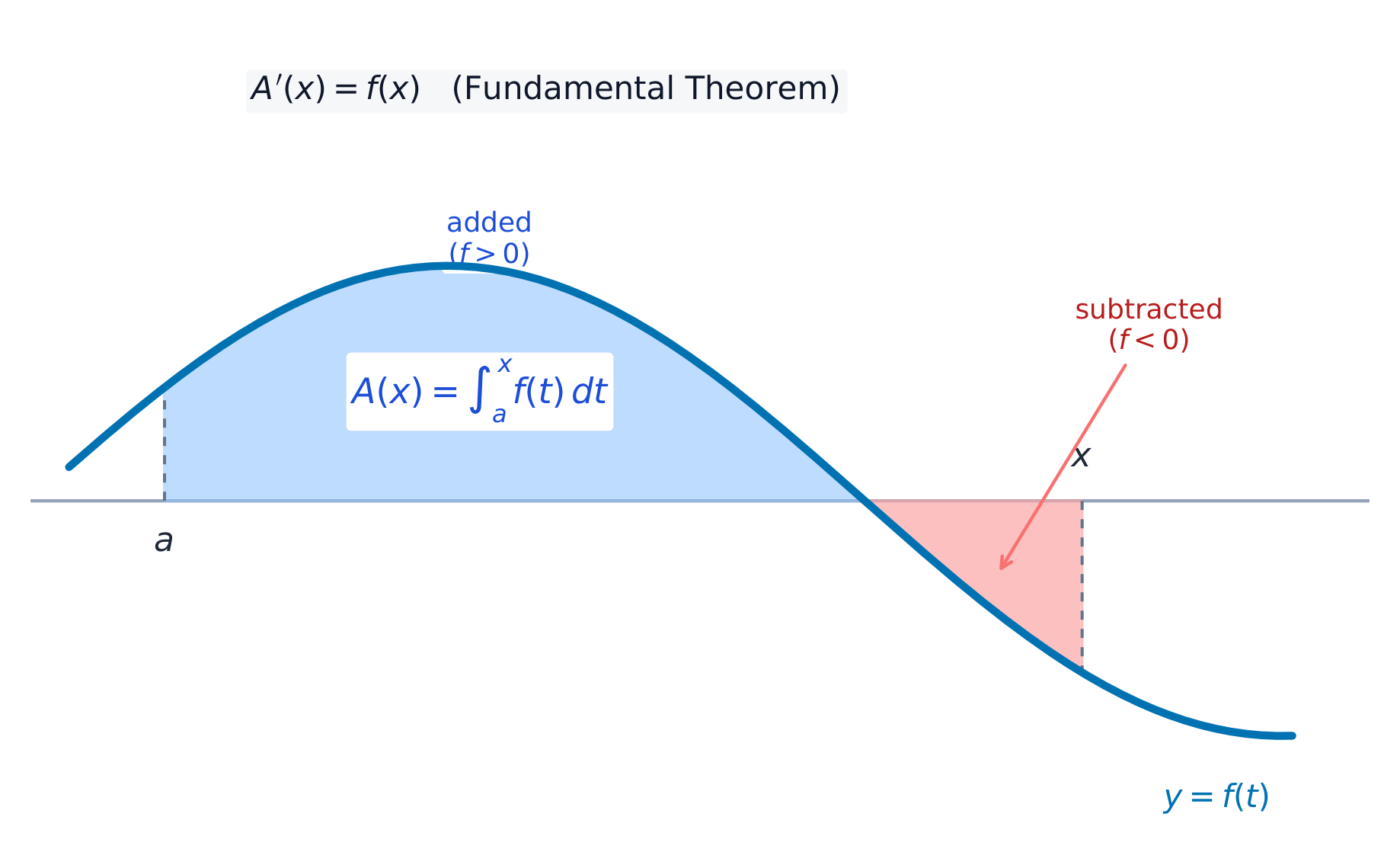
An accumulation function 累积函数 $g(x)=\int_a^x f(t)\,dt$ gives the accumulated area from $a$ up to $x$. The Fundamental Theorem of Calculus (FTC) 微积分基本定理 says its derivative is the integrand:
$$\frac{d}{dx}\int_a^x f(t)\,dt=f(x).$$
Differentiation and integration are inverse operations. With a variable upper limit and the chain rule, $\dfrac{d}{dx}\int_a^{u(x)} f(t)\,dt=f(u(x))\,u'(x)$.
Explore
Accumulate area as an integral
y = ax³ + bx² + cx + d
An accumulation function $\int_a^x f(t)\,dt$ builds up signed area as $x$ moves. The Fundamental Theorem says its derivative is just $f(x)$.
Vocabulary
Train
| English |
|---|
| accumulation function/əˌkjuːmjʊˈleɪʃn ˈfʌŋkʃn/ |
| Fundamental Theorem of Calculus (FTC)/ˌfʌndəˈmentl ˈθɪərəm ɒv ˈkælkjʊləs/ |
6.5
Interpreting the Behavior of Accumulation Functions
Syllabus
| Enduring Understanding | Learning Objective | Essential Knowledge |
|---|---|---|
FUN-5 | FUN-5.A |
|
Source: College Board AP Course and Exam Description
Because $g'(x)=f(x)$, the graph of $f$ tells you everything about $g$: $g$ increases where $f>0$, decreases where $f<0$, has extrema where $f$ crosses zero, and is concave up where $f$ is increasing. Reading these connections off a graph of $f$ is a classic free-response task.
6.6
Applying Properties of Definite Integrals
Syllabus
| Enduring Understanding | Learning Objective | Essential Knowledge |
|---|---|---|
FUN-6 | FUN-6.A |
|
Source: College Board AP Course and Exam Description
Definite integrals obey useful rules: reversing the limits negates the value ($\int_b^a=-\int_a^b$), an integral over a zero-width interval is $0$, they add over adjacent intervals ($\int_a^c=\int_a^b+\int_b^c$), and constants factor out. Use these to combine or split given integral values.
6.7
The Fundamental Theorem of Calculus and Definite Integrals
Syllabus
| Enduring Understanding | Learning Objective | Essential Knowledge |
|---|---|---|
FUN-6 | FUN-6.B |
|
Source: College Board AP Course and Exam Description
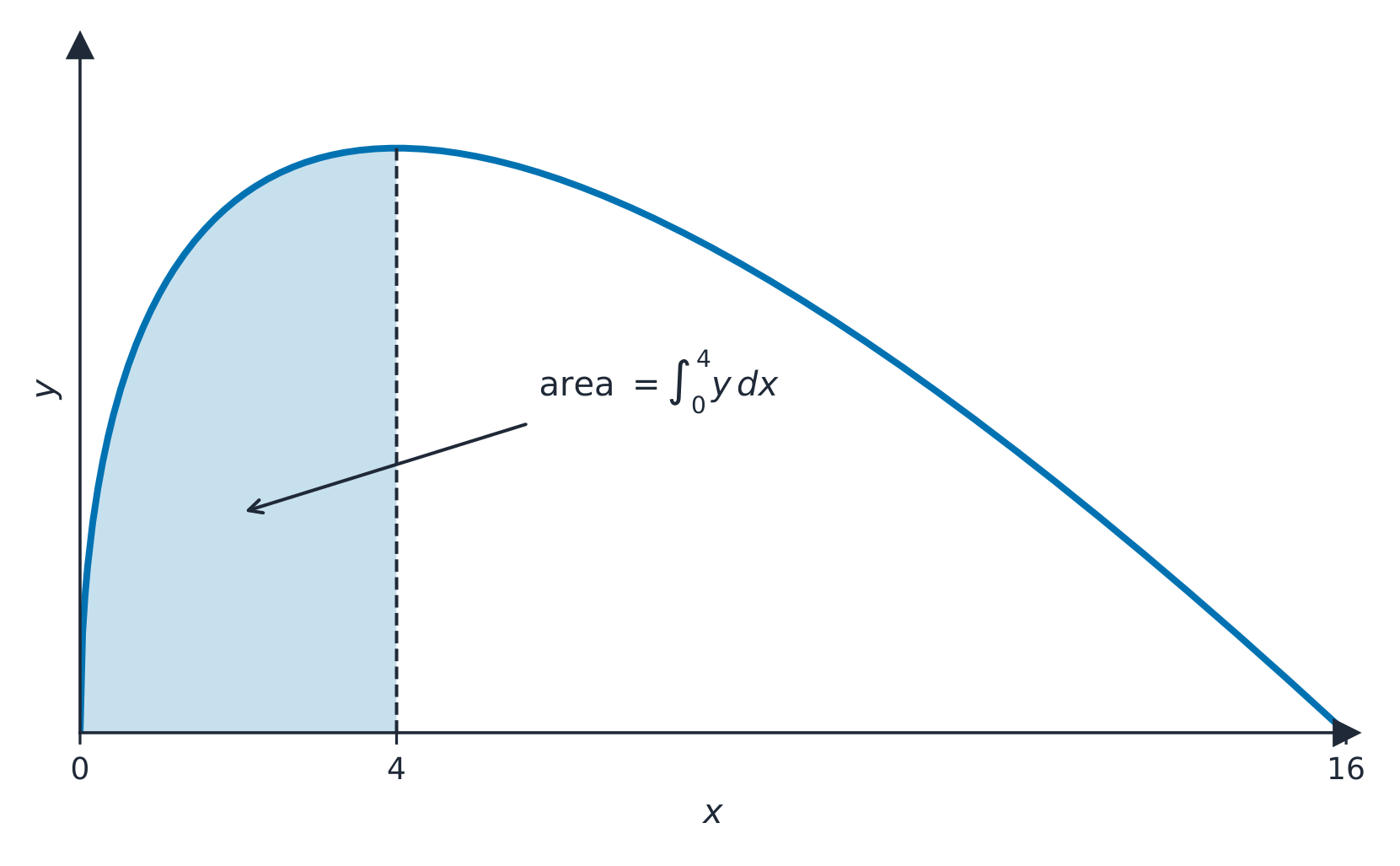
The evaluation form of the FTC computes a definite integral from an antiderivative 原函数 $F$ (where $F'=f$):
$$\int_a^b f(x)\,dx=F(b)-F(a).$$
So integrating a rate of change over $[a,b]$ gives the net change in the quantity – the single most-used result in the course.
Worked example. $\displaystyle\int_1^3 (2x+1)\,dx$: an antiderivative is $F(x)=x^2+x$, so the value is $F(3)-F(1)=12-2=10$.
Vocabulary
Train
| English |
|---|
| antiderivative/ˌæntɪdɪˈrɪvətɪv/ |
6.8
Finding Antiderivatives and Indefinite Integrals
Syllabus
| Enduring Understanding | Learning Objective | Essential Knowledge |
|---|---|---|
FUN-6 | FUN-6.C |
|
Source: College Board AP Course and Exam Description
An indefinite integral 不定积分 $\int f(x)\,dx=F(x)+C$ is the family of all antiderivatives (hence the constant of integration $C$). Reverse each derivative rule: the power rule becomes $\int x^n\,dx=\dfrac{x^{n+1}}{n+1}+C$ (for $n\neq-1$), with $\int \frac1x\,dx=\ln|x|+C$, and the antiderivatives of $e^x$, $\sin x$, $\cos x$, and $\sec^2 x$ come straight from their derivatives.
Vocabulary
Train
| English |
|---|
| indefinite integral/ɪnˈdefɪnət ˈɪntɪɡrəl/ |
6.9
Integrating Using Substitution
Syllabus
| Enduring Understanding | Learning Objective | Essential Knowledge |
|---|---|---|
FUN-6 | FUN-6.D |
|
Source: College Board AP Course and Exam Description
u-substitution 换元积分 reverses the chain rule: choose $u=g(x)$ so that $g'(x)$ also appears, turning $\int f(g(x))g'(x)\,dx$ into $\int f(u)\,du$. Remember to convert $dx$ to $du$ and, for a definite integral, either change the limits to $u$-values or convert back to $x$ at the end.
Vocabulary
Train
| English |
|---|
| u-substitution/juː ˌsʌbstɪˈtjuːʃn/ |
6.10
Integrating Using Long Division and Completing the Square
Syllabus
| Enduring Understanding | Learning Objective | Essential Knowledge |
|---|---|---|
FUN-6 | FUN-6.D |
|
Source: College Board AP Course and Exam Description
When a rational integrand is "top-heavy" (numerator degree $\ge$ denominator degree), long division rewrites it as a polynomial plus a proper fraction you can integrate. Completing the square in a denominator turns it into a form like $u^2+a^2$, leading to an arctangent antiderivative $\frac1a\arctan\frac{u}{a}+C$.
6.11
Integrating Using Integration by Parts
Syllabus
| Enduring Understanding | Learning Objective | Essential Knowledge |
|---|---|---|
FUN-6 | FUN-6.E |
|
Source: College Board AP Course and Exam Description
Integration by parts 分部积分 reverses the product rule:
$$\int u\,dv = uv-\int v\,du.$$
Choose $u$ to simplify when differentiated and $dv$ to be easy to integrate (the LIATE guide: logs, inverse-trig, algebraic, trig, exponential). It handles products like $\int x e^x\,dx$ and $\int x\ln x\,dx$, sometimes applied twice.
Worked example. For $\int x e^x\,dx$, choose $u=x$ ($du=dx$) and $dv=e^x\,dx$ ($v=e^x$):
$$\int x e^x\,dx = x e^x-\int e^x\,dx = x e^x - e^x + C = e^x(x-1)+C.$$
Vocabulary
Train
| English |
|---|
| Integration by parts/ˌɪntɪˈɡreɪʃn baɪ pɑːts/ |
6.12
Integrating Using Linear Partial Fractions
Syllabus
| Enduring Understanding | Learning Objective | Essential Knowledge |
|---|---|---|
FUN-6 | FUN-6.F |
|
Source: College Board AP Course and Exam Description
Partial fractions 部分分式 split a rational function with a factorable denominator into a sum of simpler fractions:
$$\frac{1}{(x-a)(x-b)}=\frac{A}{x-a}+\frac{B}{x-b},$$
each of which integrates to a logarithm. This technique is essential for the logistic differential equation in the next unit.
Vocabulary
Train
| English |
|---|
| Partial fractions/ˈpɑːʃl ˈfrækʃnz/ |
6.13
Evaluating Improper Integrals
Syllabus
| Enduring Understanding | Learning Objective | Essential Knowledge |
|---|---|---|
LIM-6 | LIM-6.A |
|
Source: College Board AP Course and Exam Description
An improper integral 反常积分 has an infinite limit of integration or an infinite discontinuity in the integrand. Evaluate it as a limit: $\int_a^\infty f\,dx=\lim_{b\to\infty}\int_a^b f\,dx$. If the limit is a finite number the integral converges 收敛; otherwise it diverges 发散.
Worked example. $\displaystyle\int_1^\infty \frac{1}{x^2}\,dx=\lim_{b\to\infty}\left[-\frac1x\right]_1^b=\lim_{b\to\infty}\left(1-\frac1b\right)=1$, so it converges to $1$. By contrast $\int_1^\infty \frac1x\,dx$ gives $\lim_{b\to\infty}\ln b=\infty$ and diverges – the same integrand-shape can go either way.
Vocabulary
Train
| English |
|---|
| improper integral/ɪmˈprɒpə ˈɪntɪɡrəl/ |
| converges/kənˈvɜːdʒɪz/ |
| diverges/daɪˈvɜːdʒɪz/ |
6.14
Selecting Techniques for Antidifferentiation
Syllabus
This topic is intended to focus on the skill of selecting an appropriate procedure for antidifferentiation. Students should be given opportunities to practice when and how to apply all learning objectives relating to antidifferentiation.
Source: College Board AP Course and Exam Description
The BC exam expects you to recognize which method fits: basic rules, substitution (a chain-rule pattern), by parts (a product), partial fractions (a factorable rational), or long division/completing the square. Being able to look at an integral and pick the right tool quickly is itself a tested skill.
6.14
Exam tips
- Integration is antidifferentiation; use the power rule $\int x^n\,dx=\tfrac{x^{n+1}}{n+1}+C$ and don't forget the $+C$.
- The Fundamental Theorem links the two: $\int_a^b f'(x)\,dx=f(b)-f(a)$, and $\tfrac{d}{dx}\int_a^x f(t)\,dt=f(x)$.
- Approximate a definite integral with Riemann sums or the trapezoidal rule from a table of values.
- A definite integral is a signed area (below the axis counts negative); split at sign changes for total area.
- Use u-substitution and remember to change the limits (or back-substitute) accordingly.
Interactive lessons on this topic
Work through it step by step, with instant-check exercises.
- Exploring Accumulations of Change
- Approximating Areas with Riemann Sums
- Riemann Sums, Summation Notation, and Definite Integral Notation
- The Fundamental Theorem of Calculus and Accumulation Functions
- Interpreting the Behavior of Accumulation Functions Involving Area
- Applying Properties of Definite Integrals
- The Fundamental Theorem of Calculus and Definite Integrals
- Finding Antiderivatives and Indefinite Integrals: Basic Rules and Notation
- Integrating Using Substitution
- Integrating Functions Using Long Division and Completing the Square
- Integrating Using Integration by Parts
- Integrating Using Linear Partial Fractions
- Evaluating Improper Integrals
- Selecting Techniques for Antidifferentiation